USD Potential Retracement to 99.5I am anticipating a potential retracement on DXY :
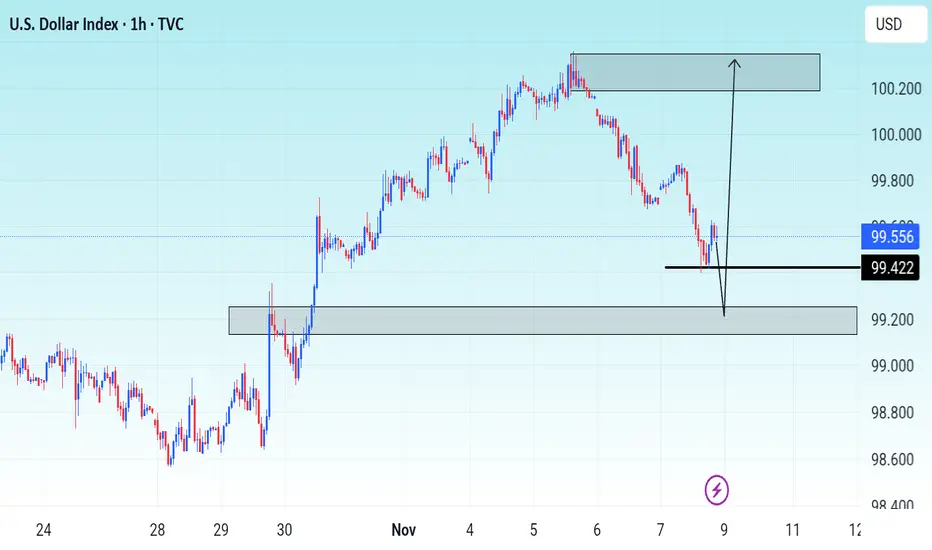
Price has run above the recent daily range high. I am now anticipating a potential retracement or pullback.
I will be monitoring H4 and H1 Timeframe price action to see if H1 and H4 lows can start getting taken to validate the idea.
I will also be monitoring the close of Wednesdays Daily Candle.
I am anticipating DXY to pullback to around 99.475 to look for more long positions.
Once dxy has traded back to the key level / support area i will then target 100.360
Trade ideas
Day market cautiously adjusts its bullish stance The DXY cautiously maintains its bullish stance, rising 1.52% since the last week of October. With momentum building, the index now sets its path toward mitigating the 101.000 level, signaling continued dollar resilience amid shifting market conditions. follow for more insights , comment and boost idea
DXY Selling view watch chart📉 DXY Update (4H Timeframe)
DXY currently reacting from the 100.300 supply zone, following selling pressure from the 100.000 level.
🔹 Technical Outlook:
Resistance / Supply Zone: 100.000 – 100.300
Support Levels: 99.800 🟡 | 99.500 🟢
Bias: Bearish below 100.000
💡 Price action shows signs of rejection at key resistance. Watch for confirmation before entering. Always trade with discipline and a clear plan.
⚠️ Risk Management Reminder:
Use proper position sizing and always protect your capital — no setup is 100% guaranteed.
👉 Like • Comment • Follow • Share
For more daily technical updates and insights 💹
#DXY #DollarIndex #ForexAnalysis #TechnicalAnalysis #PriceAction #TradingSetup #RiskManagement
US DOLLAR INDEX (DXY) shortsFor DXY, I am looking for a continuation of last week's sells. There are two supply area I am looking to short from. I will sit on my hands until price reaches these areas and give a confirmation for sells. One market reaches these levels, an update will be sent out. Please do not jump in blindly. Manage risk!
-TD
Bullish momentum to extend?The US Dollar Index (DXY) is declining toward the pivot level, which serves as an overlap support zone, and may rebound toward the 1st resistance.
Pivot: 98.29
1st Support: 97.14
1st Resistance: 101.91
Disclaimer:
The above opinions given constitute general market commentary, and do not constitute the opinion or advice of IC Markets or any form of personal or investment advice.
Any opinions, news, research, analyses, prices, other information, or links to third-party sites contained on this website are provided on an "as-is" basis, are intended only to be informative, is not an advice nor a recommendation, nor research, or a record of our trading prices, or an offer of, or solicitation for a transaction in any financial instrument and thus should not be treated as such. The information provided does not involve any specific investment objectives, financial situation and needs of any specific person who may receive it. Please be aware, that past performance is not a reliable indicator of future performance and/or results. Past Performance or Forward-looking scenarios based upon the reasonable beliefs of the third-party provider are not a guarantee of future performance. Actual results may differ materially from those anticipated in forward-looking or past performance statements. IC Markets makes no representation or warranty and assumes no liability as to the accuracy or completeness of the information provided, nor any loss arising from any investment based on a recommendation, forecast or any information supplied by any third-party.
US Dollar: Buy The Rally!Welcome back to the Weekly Forex Forecast for the week of Nov. 10-14th
In this video, we will analyze the following FX market: USD Dollar
The USD is in a pullback... that I believe is ending. Buying is the best bet! Once price gives the signature of a market shift from bearish to bullish, buys are valid!
Enjoy!
May profits be upon you.
Leave any questions or comments in the comment section.
I appreciate any feedback from my viewers!
Disclaimer:
I do not provide personal investment advice and I am not a qualified licensed investment advisor.
All information found here, including any ideas, opinions, views, predictions, forecasts, commentaries, suggestions, expressed or implied herein, are for informational, entertainment or educational purposes only and should not be construed as personal investment advice. While the information provided is believed to be accurate, it may include errors or inaccuracies.
I will not and cannot be held liable for any actions you take as a result of anything you read here.
Conduct your own due diligence, or consult a licensed financial advisor or broker before making any and all investment decisions. Any investments, trades, speculations, or decisions made on the basis of any information found on this channel, expressed or implied herein, are committed at your own risk, financial or otherwise.
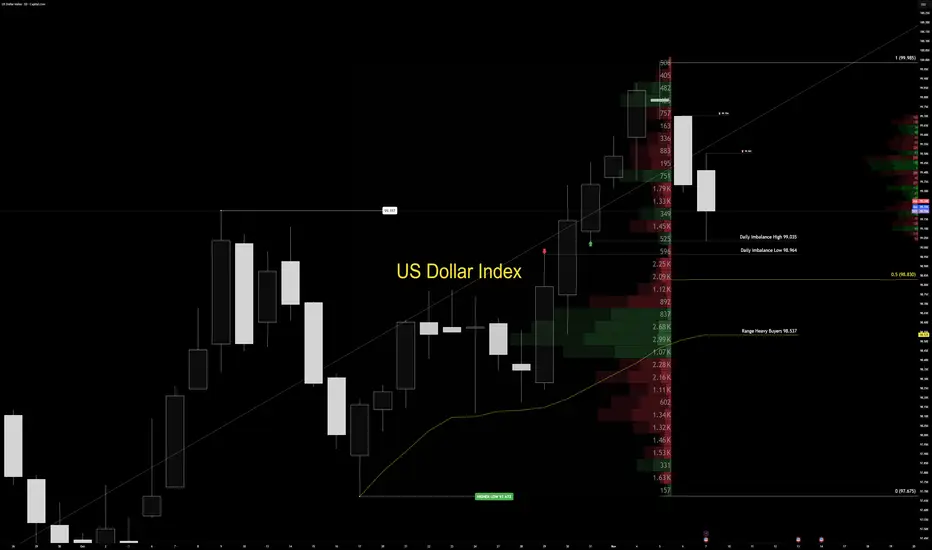
Sunday Dollar War Map | Week Ahead — DXY Structure OutlookThe US Dollar Index (DXY) continues to trade within a controlled bullish range, holding the upper half of its daily structure between 97.675 (range low) and 99.985 (range high). Price remains anchored inside premium territory, with a daily imbalance cap defined between 99.035 (high) and 98.964 (low).
Volume delta stays concentrated deep in the discount zone near 98.537, showing that institutional participation remains limited. Early in the week, price may probe deeper into that imbalance cap to trigger larger positioning before any directional expansion. Until confirmed volume steps in, the tactical stance remains clear: observe, don’t predict. Professionals wait for conviction — amateurs try to guess it.
The active order flow imbalance remains unfilled, and price typically reacts once single prints inside that imbalance get touched. However, the heavy volume concentration across the lower half of the range deserves attention — trading directly into the cap often causes reactive blowback. That’s not random; it’s how market maker logic plays out through volume flow behavior.
On the macro side, US yields continue to climb as investors demand higher compensation for duration risk. The 10-year Treasury yield hovers near 4.1%, while the 30-year sits close to 4.7%. Meanwhile, fiscal pressure continues to build — record government debt and renewed shutdown risks are keeping confidence fragile.
The outcome is a balancing act: rising yields support the dollar in the short term, while long-term credibility remains under pressure. For now, the dollar holds its ground — but each move is conditional.
Professionals trade participation, not prediction. The market doesn’t reward speed — it rewards confirmation. Let the tape show its hand before you show yours. Structure speaks first. Volume decides who listens.
— Institutional Logic. Modern Technology. Real Freedom.
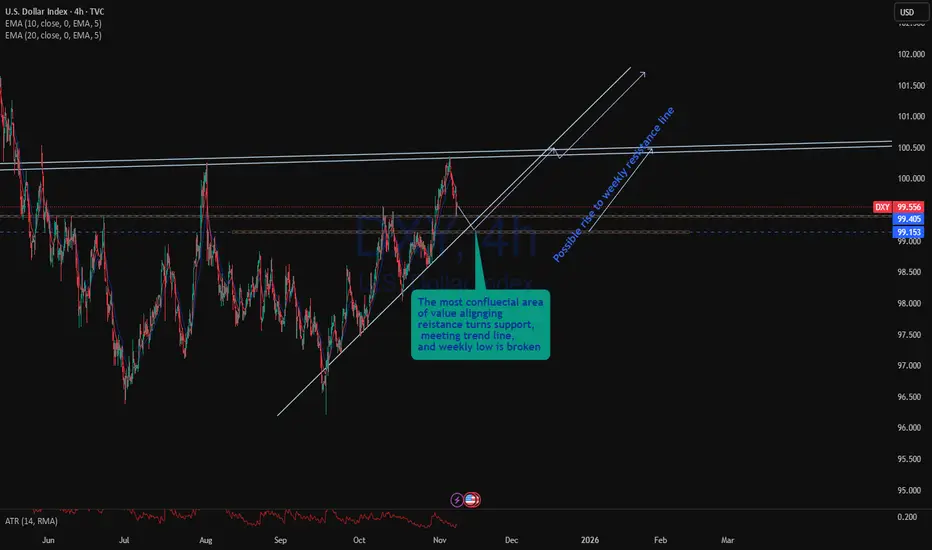
DXY is approaching a very area of value!As the US government shudtown started along with DXY's bullish trend is continuing except past weeks, needed pullback. with price formed a weekly pin par, which could bring early this week price to further down and, which may approach the most confluenced point of 99.15 which is the previous reistance turn support leading a possible buy zone for trend continuation.
Aligning 3 high confluence of
1. Trend line
2. Resistance turns support and
3. weekly low
upon price action rejection, and reversal confirmation to bullish it is a probability bullish market.
DXY : This Up Wave Won’t Last Long!The U.S. Dollar Index has made a corrective push up, but momentum looks weak. Structure suggests this “up wave” could soon fade, paving the way for another bearish move. Watch closely a potential reversal could be near!
Disclosure: We are part of Trade Nation's Influencer program and receive a monthly fee for using their TradingView charts in our analysis.*
DXY FRGNT Weekly Forecast -Q4 | W46 | Y25 |📅 Q4 | W46 | Y25 |
📊 DXY FRGNT Weekly Forecast
🔍 Analysis Approach:
I’m applying Smart Money Concepts, focusing on:
Identifying Points of Interest on the Higher Time Frames (HTFs) 🕰️
Using those POIs to define a clear trading range 📐
Refining those zones on Lower Time Frames (LTFs) 🔎
Waiting for a Break of Structure (BoS) for confirmation ✅
This method allows me to stay precise, disciplined, and aligned with the market narrative, rather than chasing price.
💡 My Motto:
"Capital management, discipline, and consistency in your trading edge."
A positive risk-to-reward ratio, paired with a high win rate, is the backbone of any solid trading plan 📈🔐
⚠️ Losses?
They’re part of the mathematical game of trading 🎲
They don’t define you — they’re necessary, they happen, and we move forward 📊➡️
🙏 I appreciate you taking the time to review my Daily Forecast.
Stay sharp, stay consistent, and protect your capital
— FRNGT 🚀
TVC:DXY
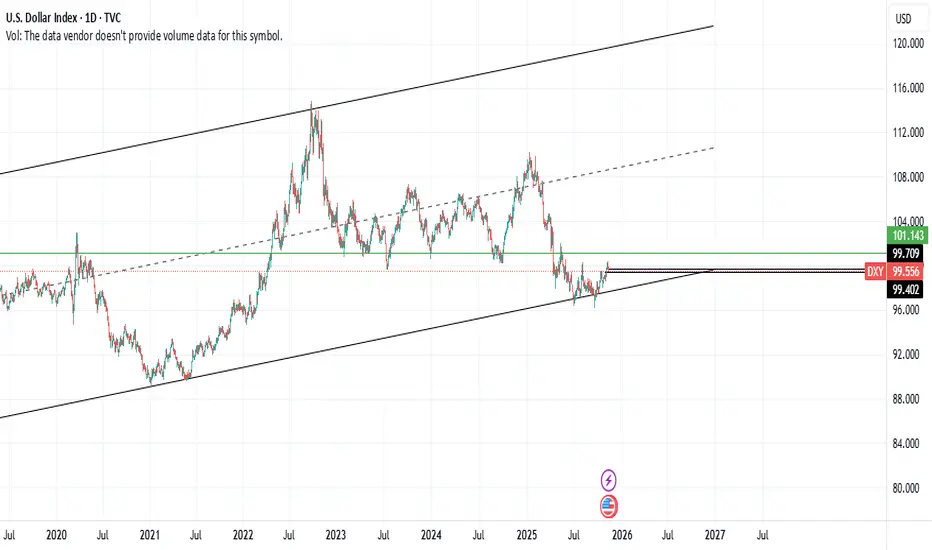
DXY is on an upward path, albeit with some hesitation.DXY is attempting to move away from the bottom of the channel and target higher levels. If the 101.14 level is broken, we can expect the median line of the advancing channel to be reached in higher timeframes. However, it is important to note that the release of economic data has been halted due to the government shutdown, which must be taken into consideration. Additionally, the FOMC’s decision to either lower or maintain Funds Rate is another key factor influencing this situation.
DXY Bear Cycleif Trump's drill baby drill works and inflation is controlled, then the fed can continue its rate cutting and lead us this scenario..
Yield differentials between USD and other currencies (EUR, JPY, EM FX) shrink.
Global investors rotate out of USD assets into higher-beta risk assets.
then, Stocks 10x to the moon!
DXY (DOLLAR INDEX) outlook for this weekDXY Weekly Outlook
Looking at the dollar this week, it’s aligning nicely with my setups on EU and GU. I’m watching to see if price will mitigate the 8hr supply zone, which fits perfectly with my plan to buy EU and GU from their demand zones — since a move down in the dollar typically means those pairs will push higher.
Alternatively, if the dollar bounces from demand and continues up, then I’ll be looking for sell opportunities on EU and GU instead.
Overall, DXY still looks bullish long term, and I believe this current downside move is just a temporary bearish correction before continuing higher.
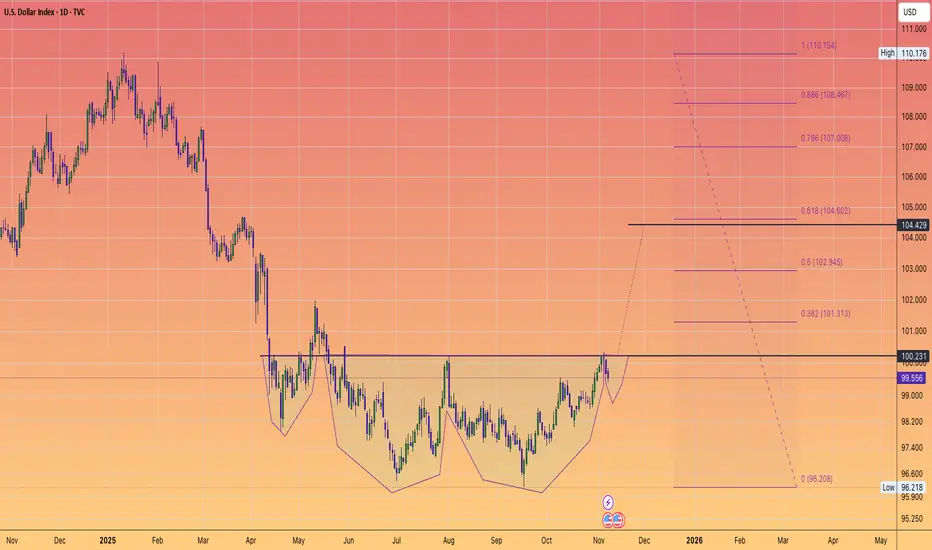
$DXY eye a 5 point move. RISK OFF.The dollar index is reversing course.
And I believe highly likely to trigger this complex inverse head and shoulder's.
A swift move to the 105 region
lines up with a expected downside move in #BTC
A corrective move in the #PreciousMetals
and further profit taking on the #AI trade.
I believe this all could play by Xmas.
So the odds of a #SantaRally are slim given current price action that we are seeing across the board.
DXY Weekly OutlookOn the weekly chart, the DXY has reached the global point B that we marked five weeks ago. This move defined the direction for all dollar-related pairs over the past month and a half. Now it’s time to reassess the chart and outline the key mid-term scenarios.
Plan A:
The key level provides enough volume to trigger a deeper correction. The price bounces from one of the support zones and then continues the main trend. For now, there are no strong arguments on the chart to confirm a trend reversal — the structure remains bullish.
Plan B:
The price reacts to the nearest support area and continues moving upward without a deep correction. This scenario becomes valid only if we see renewed momentum and strong buy-side pressure.
We’re at an important turning point. Watch how the price reacts around point B — this will determine the next phase for the dollar.
dxy 4h🔹 Overall Outlook and Potential Price Movements
In the charts above, we have outlined the overall outlook and possible price movement paths.
As shown, each analysis highlights a key support or resistance zone near the current market price. The market’s reaction to these zones — whether a breakout or rejection — will likely determine the next direction of the price toward the specified levels.
⚠️ Important Note:
The purpose of these trading perspectives is to identify key upcoming price levels and assess potential market reactions. The provided analyses are not trading signals in any way.
✅ Recommendation for Use:
To make effective use of these analyses, it is advised to manually draw the marked zones on your chart. Then, on the 15-minute time frame, monitor the candlestick behavior and look for valid entry triggers before making any trading decisions.
DXY LONG ENTRY IDEA I am waiting for the price to drop to the previous bullish 4-Hour Fair Value Gap (FVG) buy-side imbalance sell-side inefficiency (BISI) bullish order block and 99.200 level.
If the price rejects those levels, I will look at my entry model from the 15-minute chart.
My STOP LOSS will be 99.00, and my 1st take profit will be 100.500, and my second TP will be 102.00 level.
World Trade Impacts on Market1. Introduction: The Global Nature of Trade
In today’s interconnected world, no country operates in isolation. Nations depend on each other for raw materials, technology, energy, and consumer goods. This interconnectedness, facilitated by globalization, free trade agreements, and technological advancements, has turned world trade into the backbone of global economic growth. The effects of trade ripple through various markets — financial, commodity, labor, and even digital.
Trade flows determine the direction of capital, affect inflation rates, and shape investment opportunities. A disruption in one part of the world, such as a supply chain bottleneck in Asia or a political crisis in the Middle East, can influence prices and investor sentiment worldwide.
2. Trade and Economic Growth
One of the most significant impacts of world trade on markets is its role in driving economic growth. Open economies that engage actively in trade tend to grow faster than closed economies. When countries export goods and services, they earn foreign exchange, which strengthens their currency reserves and supports domestic investment. Importing advanced technologies and machinery enhances productivity and competitiveness.
For example, China’s rapid rise to become the world’s second-largest economy is largely due to its trade-oriented policies. Similarly, export-driven economies such as Germany, Japan, and South Korea have thrived by focusing on global markets. Growth in trade often translates to rising corporate profits, which boosts stock markets and attracts foreign investors.
3. Impact on Stock Markets
Stock markets are highly sensitive to international trade trends. When global trade expands, companies involved in exports, logistics, and manufacturing often see increased revenues. Investors respond positively, pushing stock prices higher. Conversely, trade slowdowns, tariffs, or geopolitical tensions can lead to stock market volatility.
For instance, during the U.S.-China trade war (2018–2019), uncertainty over tariffs led to significant declines in global equity markets. Export-heavy industries such as automobiles, semiconductors, and agriculture experienced sharp losses due to disrupted trade flows. Conversely, when trade relations improve, optimism returns to the markets, leading to rallies and renewed investor confidence.
Trade also impacts sectoral performance — for example, commodity-exporting companies benefit from high global demand, while domestic-focused sectors might remain unaffected. Therefore, investors closely monitor trade data, global supply chains, and export-import statistics to predict market trends.
4. Impact on Currency Markets
World trade has a direct connection to foreign exchange (Forex) markets. When a country exports more than it imports, it experiences higher demand for its currency, strengthening its exchange rate. Conversely, trade deficits (more imports than exports) can weaken a currency.
For example, if India exports software services worth billions of dollars, foreign clients need Indian rupees to pay for these services, leading to a stronger INR. However, if India imports large amounts of crude oil, it must pay in U.S. dollars, increasing demand for USD and weakening the rupee.
Global trade imbalances also influence monetary policies. Central banks may intervene to stabilize their currencies when trade-related pressures become too strong. Thus, traders and investors watch trade balances, export data, and global demand indicators closely to anticipate currency movements.
5. Impact on Commodity Markets
Commodities such as oil, gold, steel, and agricultural products are the foundation of world trade. International demand and supply determine their prices. A surge in global trade usually increases the demand for raw materials, leading to higher commodity prices. Conversely, trade disruptions or global recessions reduce demand, causing price declines.
For example:
Crude oil prices fluctuate based on global trade volumes, shipping activity, and industrial production.
Gold prices often rise during trade conflicts or economic uncertainty, as investors seek safe-haven assets.
Agricultural commodities depend heavily on trade agreements and weather patterns in major exporting nations.
Hence, world trade patterns influence inflation, production costs, and ultimately, consumer prices across markets.
6. Employment and Labor Market Impacts
World trade also affects job creation and wage levels. Export industries often generate large-scale employment, especially in developing countries. However, increased competition from imports can lead to job losses in domestic industries that cannot compete globally.
For instance, India’s textile and IT sectors have benefited significantly from global trade, creating millions of jobs. On the other hand, industries exposed to cheaper imports (like steel or electronics) have sometimes suffered layoffs. Labor markets must therefore adapt to trade-driven structural changes by focusing on innovation, skill development, and productivity improvement.
7. Foreign Direct Investment (FDI) and Capital Flows
Trade liberalization encourages foreign direct investment (FDI). Multinational corporations (MNCs) set up production facilities in countries with strategic trade advantages — such as low labor costs, favorable tax policies, or access to key markets. FDI inflows create employment, transfer technology, and boost local markets.
For example, automobile giants like Toyota and Hyundai invested in India to serve both domestic and export markets. Similarly, U.S. tech companies have established R&D centers in developing countries to leverage skilled human resources. As trade barriers fall, capital flows more freely, creating interconnected global markets that react swiftly to any trade-related news.
8. Trade Wars and Protectionism
While free trade promotes growth, trade conflicts can destabilize markets. Protectionism — through tariffs, quotas, and trade barriers — distorts market efficiency and raises costs for consumers and producers alike. Trade wars, such as the one between the U.S. and China, reduce global growth prospects and shake investor confidence.
Protectionist policies often lead to inflationary pressures (as imports become expensive), reduced exports, and declining business profits. Global supply chains become disrupted, affecting industries from semiconductors to agriculture. Consequently, financial markets become volatile, and currencies fluctuate unpredictably.
9. Supply Chain Globalization and Market Interdependence
Modern trade is not just about exporting finished goods — it’s about global supply chains. A single product like a smartphone involves components sourced from multiple countries. This interdependence means that disruptions in one country (due to natural disasters, political instability, or pandemics) can have global ripple effects.
The COVID-19 pandemic highlighted this vulnerability. Factory shutdowns in China led to worldwide shortages of electronics, automotive parts, and consumer goods. As supply chains recovered, inflationary pressures spread globally, affecting interest rates and stock valuations. Investors now track supply chain data as closely as trade statistics to assess market risks.
10. Environmental and Social Impacts
World trade also influences environmental and social policies. The demand for raw materials and energy-intensive goods contributes to carbon emissions and climate change. To counter this, many countries are adopting ESG (Environmental, Social, and Governance) frameworks and promoting green trade initiatives like carbon credits and renewable energy exports.
Markets are beginning to reward sustainable trade practices. Investors favor companies that align with eco-friendly standards and responsible sourcing. Thus, the intersection of trade and sustainability is shaping new market trends and investment opportunities.
11. Conclusion: The Future of World Trade and Markets
World trade remains a powerful engine driving global market dynamics. Its impacts are broad and deep — influencing economic growth, currency values, commodity prices, employment, and investment flows. However, as globalization evolves, new challenges such as digital trade, geopolitical tensions, and environmental concerns will redefine how markets respond to trade patterns.
In the future, digital trade, AI-driven logistics, and regional trade alliances (like RCEP and EU partnerships) will shape global commerce. Markets that adapt to these transformations with innovation, transparency, and resilience will thrive in the next era of global trade.
Final Thought
In essence, world trade acts as the heartbeat of the global economy. It integrates nations, drives competition, and promotes prosperity. But it also introduces complexity and vulnerability. Understanding its impacts helps market participants — from policymakers to investors — navigate an ever-changing financial landscape shaped by the flow of goods, services, and ideas across borders.