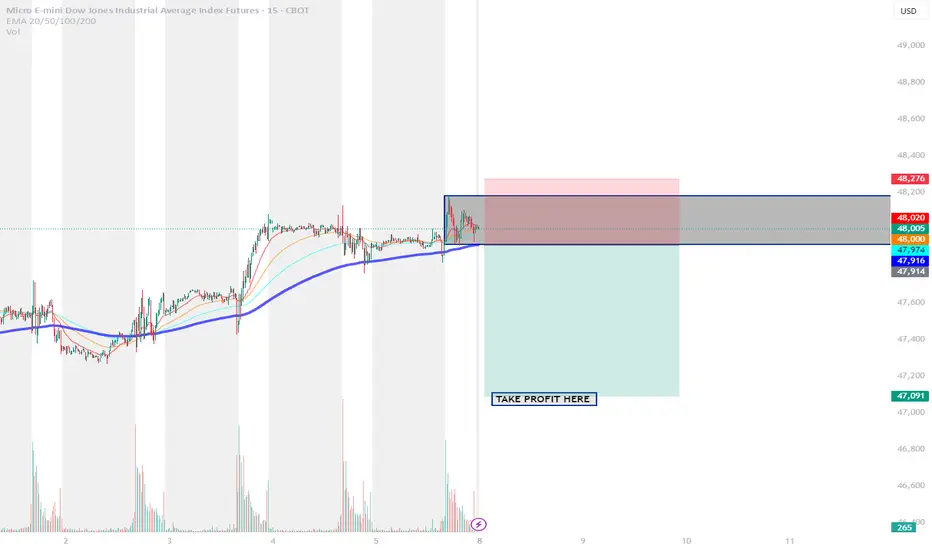
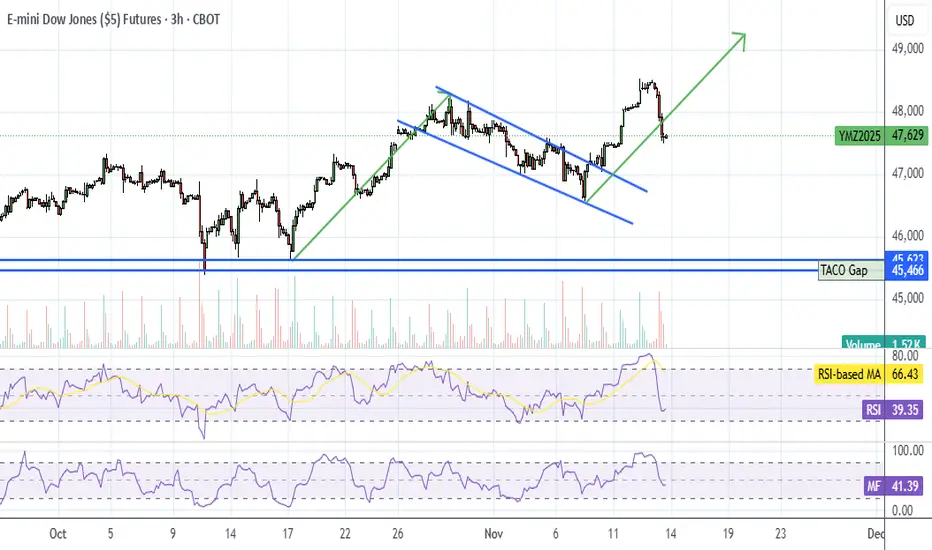
YM1! DOW JONES E-MINI FUTURES - THE POST-FED BLUEPRINTDecember 10, 2025 | by officialjackofalltrades
🟢 BULLISH | Fed's "Hawkish Cut" Creates Opportunity
EXECUTIVE SUMMARY - THE FED DECISION IS IN
Current Price: $47,913 | Date: December 10, 2025 - POST-FOMC
The Dow Jones E-mini futures just experienced a historic moment :
The Dow gained 497.46 points, or 1.1%, to close at 48,057.75 following the Federal Reserve's decision to lower rates by a quarter percentage point, putting it in a range between 3.5%-3.75%.
But here's what NOBODY is talking about: This was a "hawkish cut" with three "no" votes, which hasn't happened since September 2019. Yet the market RALLIED .
Why? Because the "hawkish" part was already priced in.
The Technical Setup:
Pattern: Ascending channel (intact since November)
Current Position: Testing mid-channel at 47,700-47,800
Resistance: 48,100-48,300 (upper channel boundary)
Support: 46,800-47,00 (mid-channel), 46,500-46,100 (lower channel)
Breakout Target: 48,000-48,500
The Fed Backdrop:
Powell said "We are well positioned to wait and see how the economy evolves"
Translation? The Fed is DONE cutting for now.
But here's the twist: Fed funds futures suggest around a 68% chance the central bank will cut rates two or more times in 2026. The market doesn't believe Powell!
The Trade: Long from 47,700-48,300, target 48,000+
🔎 MARKET CONTEXT - THE FED'S "HAWKISH CUT" PARADOX
What Just Happened (Last 6 Hours)
At 2:00 PM ET today, the Fed delivered exactly what was expected: 25-basis-point reduction from 3.75-4% to 3.50-3.75%.
But the details were hawkish:
Three dissenting votes (Cleveland Fed President Beth Hammack voted against, plus two others)
Dot plot indicated just one more cut in 2026 and another in 2027
Seven officials indicated they want NO cuts next year
Powell called it a "very challenging situation"
The Market's Response?
Dow jumped 497.46 points (+1.1%) to 48,057.75. Why rally on hawkish news?
Answer: Because the hawkish tone was already priced in from the pre-meeting leaks and October's dissenting votes. The market expected worse .
The Internal Fed War
Asked about the elevated level of dissenting members, Powell emphasized that everyone on the FOMC agrees that inflation is still too high, and that there are also risks to economic growth.
This Fed is more divided than any time in recent memory :
Hawks (7 members): Want ZERO cuts in 2026
Centrists (5 members): Want 1-2 cuts in 2026
Doves (7 members): Want 2-3 cuts in 2026
19 participants among the governors and regional presidents, 12 of whom vote.
This division means volatility , but also opportunity .
TECHNICAL ANALYSIS - THE ASCENDING CHANNEL AT DECISION POINT
The Pattern: Ascending Channel (Bullish Structure)
Your chart shows a textbook ascending channel that's been in play since early November 2025.
Channel Characteristics:
Lower Support: Started at 44,000 (early Nov) → 46,500 (mid-Nov) → 47,000
Current Position: Dow closed at 48,057.75, which is mid-channel perfect positioning for next leg up.
Technical Indicators:
Moving Averages:
50-day MA: ~46,800 (rising, bullish)
200-day MA: ~45,200 (rising, bullish)
Golden Cross: Active since mid-October = long-term bullish
Volume:
Dow jumped on Wednesday after Fed decision with significant volume, this confirms the breakout is real , not a fake pump.
RSI:
Current: ~58-62 (slightly bullish but not overbought)
Room to run to 70+ before overbought conditions
🎯 SCENARIO ANALYSIS - WHAT HAPPENS NEXT
BASE CASE: Grind Higher to 48,000+ - BULLISH
What Happens:
Dow consolidates 48,000-48,400 for 2-3 days
Then breaks above 48,600 with volume
Grinds higher toward 49,000-49,500
Powell's "wait and see" stance removes uncertainty
Holiday buying + year-end window dressing pushes higher
Timeline: 2-3 weeks (by end of December)
Expected Return: +3-4% from 48,000 to 49,500-50,000
Catalysts:
Continued corporate buybacks
Holiday retail strength
Year-end fund rebalancing (institutional buying)
No negative Fed surprises (Powell on "pause")
BULL CASE: Breakout to 50,500+ - VERY BULLISH
What Happens:
Market doesn't believe Powell - 68% chance of 2+ cuts in 2026
Strong economic data (retail sales, employment) supports growth
Dow breaks 49,500 with conviction
FOMO kicks in, target 50,500-51,000
Timeline: 3-4 weeks (by early January)
Expected Return: +5-6% from 48,000
Catalysts:
Q4 earnings beat expectations
Strong holiday retail numbers
Dovish Fed speakers in January
International capital flows into US equities
BEAR CASE : Channel Break to 46,500 - BEARISH
What Happens:
Economic data deteriorates (unemployment spikes)
Earnings disappoint in early Q4 reporting
Geopolitical shock (unlikely but possible)
Dow breaks below 47,400, tests 46,500-47,000
Timeline: 1-2 weeks
Expected Return: -3-4% from 48,000
This is LOW probability given Fed just cut and Powell said "well positioned to wait."
📊 FUNDAMENTAL ANALYSIS - WHY DOW OUTPERFORMS
CATALYST #1: The Fed's "Hawkish Cut" Was Actually Dovish
Let me explain the paradox:
Hawkish Elements:
Three dissenting votes
Dot plot shows only 1 cut in 2026
Powell says "wait and see"
But Dovish Reality:
They STILL cut rates (3rd in a row!)
GDP forecast raised to 2.5% for 2025 and 2.3% for 2026
Unemployment expectations unchanged at 4.5% for 2025
68% market probability of 2+ cuts in 2026 means market doesn't believe the hawkish talk
Net Effect: Lower rates NOW + no immediate threat of hikes = bullish for stocks .
CATALYST #2: Corporate Earnings Remain Strong
GE Vernova jumped 8% after saying 2025 revenue trending toward higher end of guidance and doubled quarterly dividend.
This is indicative of broader Dow strength:
Industrial companies benefiting from infrastructure spending
Dividend increases signal confidence
Guidance raises = earnings momentum
CATALYST #3: Small Caps Leading (Risk-On)
Russell 2000 jumped to new all-time highs as lower interest rates benefit smaller firms that need to refinance debt.
When small caps outperform, it's a risk-on signal . Dow industrials benefit from this environment.
CATALYST #4: Year-End Window Dressing
Fund managers underperformed in 2025. In December, they buy winners to make their portfolios look good for year-end reports.
Dow = full of winners like UnitedHealth, Goldman Sachs, Boeing (recovery story).
⚠️ RISK FACTORS - THE BEAR CASE
RISK #1: The Fed Is More Hawkish Than Market Believes
Seven officials indicated they want NO cuts next year
If the Fed actually holds rates at 3.5-3.75% all of 2026, stocks could stall or correct 5-8%.
RISK #2: Channel Break Below 47,000
If Dow closes below 47,000 on daily chart, the ascending channel is broken . Next support: 46,000-46,500 (-4-5%).
RISK #3: Economic Data Deteriorates
Unemployment at 4.5% is manageable, but rising. If it spikes to 5%+, recession fears return.
RISK #4: Geopolitical Shock
US Coast Guard seized sanctioned crude tanker off Venezuela. Tensions with Venezuela/Russia could spike oil prices, hurting economy.
Entry Confirmation Checklist:
Before entering, CHECK:
✅ Price holding above 47,800 (support intact)
✅ Volume on bounce (>50K contracts on daily)
✅ No negative Fed speakers this week
✅ S&P 500 also bouncing (correlation check)
✅ VIX declining below 15 (fear subsiding)
✅ Treasury yields stable or declining
WAIT FOR 4/6 CONFIRMATIONS
THE BOTTOM LINE
Here's what I KNOW on December 10, 2025 (POST-FED):
✅ Dow rallied +497 points (+1.1%) post-Fed to 48,057
✅ Fed cut 25bps as expected to 3.5-3.75%
✅ Powell says "well positioned to wait and see"
✅ Market pricing 68% chance of 2+ cuts in 2026
✅ Ascending channel intact since November
✅ Your technical analysis shows clear support/resistance
Here's what I DON'T know:
Will economic data support more cuts?
Will earnings season (Jan) beat or miss?
Will geopolitical risks escalate?
📍 Follow officialjackofalltrades for post-FOMC analysis, institutional setups, and professional risk management.
Drop a 📊 if you're trading the post-Fed bounce.
Drop a 🎯 if this helped your YM1! setup.
Drop a 💰 if you're ready for 50K Dow.
Market insights
Dow Futures (YM) Bullish Path Projects 49,900 LevelThe cycle from the April 2025 low in Dow Futures (YM) continues to unfold as a clear impulse. Within this structure, wave (4) concluded at 45,810, as illustrated by the one‑hour chart. Following that completion, wave (5) began to develop as another sequence of five waves of lesser degree. From the termination of wave (4), wave (i) advanced to 46,656, while the corrective pullback in wave (ii) reached 46,165. The Index then extended upward in wave (iii), achieving 47,796, before a modest retracement in wave (iv) ended at 47,270.
The final push in wave (v) carried prices to 48,184, thereby completing wave ((i)) of higher degree. Subsequent declines in wave ((ii)) unfolded in the form of a zigzag, consistent with Elliott Wave principles. From the peak of wave ((i)), wave (a) dropped to 47,663, followed by a rebound in wave (b) that reached 48,004. The final leg, wave (c), declined to 47,504, marking the completion of wave ((ii)) at the higher degree.
The Index has since resumed its upward trajectory in wave ((iii)). From the low of wave ((ii)), wave (i) advanced to 48,245, while the corrective wave (ii) ended at 47,859. In the near term, as long as the pivotal low at 45,810 remains intact, dips are expected to attract buyers. These corrective phases should unfold in the familiar 3, 7, or 11 swing sequences, supporting the continuation of the broader bullish cycle.
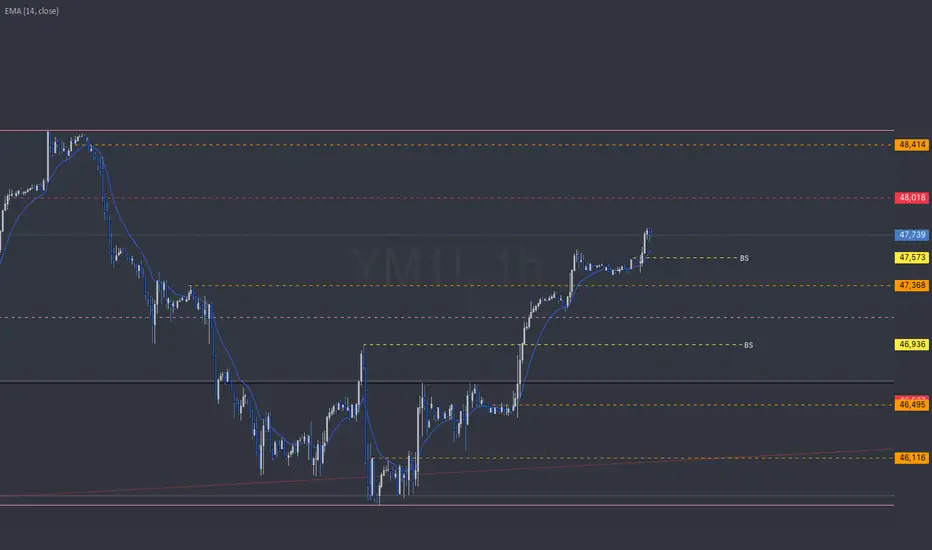
YM | Week 52 | 1hr chartT.A explained -
BackSide (BS)
FrontSide (FS)
Inverse BS (Inv.BS)
Inverse FS (Inv.FS)
BS & FS levels are expected support when dashed lines, tested when dotted and resistance when solid lines.
The inverse is true for the Inv. BS Inv. FS levels, they are resistance as dashed lines, tested as dotted and support as solid lines.
Monthly timeframe is color pink
weekly grey
daily is red
4hr is orange
1hr is yellow
15min is blue
5min is green if they are shown.
strength favors the higher timeframe.
2x dotted levels are origin levels where trends have or will originate. When trends break, price will target the origin of the trend. its math, when the trend breaks, the vertex breaks too so the higher timeframe level/trend that breaks, the more volatility there could be as strength in the orders flow in to fuel the move.
Systematic Risk in the Global Trading Market1. Introduction to Systematic Risk
Systematic risk, often referred to as market risk, represents the risk inherent to the entire market or a specific segment of the market. Unlike unsystematic risk, which is specific to a company or industry, systematic risk cannot be eliminated through diversification. It affects all securities and assets in a market simultaneously and is driven by broad economic, political, and social factors.
In the global trading context, systematic risk is particularly significant because financial markets are interconnected. Events in one country, such as economic slowdowns, political instability, or central bank policy shifts, can ripple across international markets, influencing stocks, bonds, currencies, and commodities worldwide.
2. Types of Systematic Risk
Systematic risk can be classified into several main categories:
2.1. Interest Rate Risk
Interest rate changes by central banks (like the Federal Reserve, European Central Bank, or Reserve Bank of India) can have a massive impact on financial markets.
Global Effect: Rising interest rates increase borrowing costs for corporations and governments, potentially slowing economic growth and affecting stock valuations worldwide.
Example: A US Federal Reserve rate hike often strengthens the US dollar and can cause capital outflows from emerging markets.
2.2. Inflation Risk
Inflation risk, or purchasing power risk, is the risk that rising prices erode the value of investments.
Global Effect: Inflation in major economies influences global trade and capital flows. For instance, higher inflation in the US can trigger interest rate hikes, impacting global equity and bond markets.
2.3. Economic/Business Cycle Risk
Economic slowdowns or recessions affect virtually all asset classes.
Global Effect: A slowdown in China can affect commodity-exporting countries; European debt crises may impact global banks and investors.
2.4. Political and Geopolitical Risk
Political instability, wars, trade sanctions, or elections in major economies can trigger global market volatility.
Global Effect: For example, trade wars between the US and China can disrupt global supply chains, affecting stock markets, commodities, and currencies worldwide.
2.5. Currency Risk (Exchange Rate Risk)
In global trading, currency fluctuations create systematic risk for multinational investors.
Example: A strong US dollar can negatively affect emerging market equities and commodities priced in dollars, while benefiting US-based exporters.
2.6. Market Sentiment Risk
Market sentiment or herd behavior can amplify systematic risk. Global investors’ fear or optimism can lead to synchronized buying or selling across markets.
Example: During the 2008 financial crisis, negative sentiment in the US mortgage market quickly spread to Europe and Asia, causing a global market collapse.
3. Measuring Systematic Risk
Systematic risk is often measured using Beta (β) in finance.
Beta Definition: Beta measures the sensitivity of a security or portfolio to overall market movements.
β = 1: The security moves in line with the market.
β > 1: The security is more volatile than the market.
β < 1: The security is less volatile than the market.
For global portfolios, beta helps investors understand how exposure to international markets affects risk. For example, a US-based investor with emerging market equities will have a higher beta due to the vulnerability of those markets to global economic shocks.
Other quantitative measures include Value at Risk (VaR), which estimates potential losses under normal market conditions, and stress testing, which evaluates the impact of extreme market scenarios.
4. Systematic Risk in Global Trading
4.1. Impact on Equity Markets
Global stock indices are highly sensitive to systematic risk. Factors such as economic data releases, central bank policies, and geopolitical events affect investor confidence globally.
Example: The US S&P 500 drop often triggers declines in Asian and European markets due to investor panic and cross-border capital flows.
4.2. Impact on Forex Markets
Foreign exchange markets react to global systematic risks, including interest rate differentials and geopolitical tensions.
Example: Political turmoil in Europe can lead investors to move funds into “safe-haven” currencies like the US dollar, Swiss franc, or Japanese yen.
4.3. Impact on Commodities
Commodity prices, such as oil, gold, and metals, are influenced by global demand-supply factors and geopolitical stability. Systematic risks like global recessions or oil-producing country conflicts can affect prices worldwide.
4.4. Impact on Bonds
Government bond markets reflect systematic risk through yields and spreads. Rising risk aversion increases demand for safe-haven bonds (like US Treasuries), lowering yields, while risky assets may face selling pressure.
5. Strategies to Manage Systematic Risk
Since systematic risk cannot be eliminated through diversification alone, investors adopt alternative risk management strategies:
5.1. Hedging
Using derivatives such as futures, options, and swaps to hedge against interest rate, currency, or commodity price fluctuations.
5.2. Asset Allocation
Global Diversification: Investing in a mix of countries, sectors, and asset classes to reduce exposure to region-specific events while acknowledging systematic risk exists.
Risk-adjusted allocation: Adjusting weights of assets based on beta or historical volatility.
5.3. Safe-Haven Assets
Allocating funds to assets like gold, US Treasuries, or the Swiss franc during periods of high market uncertainty.
5.4. Dynamic Portfolio Management
Regularly monitoring global economic indicators, central bank policies, and geopolitical developments to adjust positions proactively.
6. Real-World Examples of Systematic Risk
2008 Global Financial Crisis: Triggered by US subprime mortgage collapse, it spread worldwide, affecting equities, bonds, commodities, and currencies.
COVID-19 Pandemic (2020): Global lockdowns caused simultaneous declines across all asset classes, highlighting the interconnectedness of systematic risk.
Russia-Ukraine War (2022): Triggered spikes in oil, gas, and wheat prices globally, showing geopolitical events as major sources of systematic risk.
7. Conclusion
Systematic risk is an inevitable part of global trading, influencing all financial markets simultaneously. Unlike company-specific risks, it cannot be eliminated through diversification alone but can be managed through strategic hedging, global asset allocation, and risk-adjusted portfolio management. Understanding systematic risk helps investors anticipate market movements, protect capital, and make informed decisions in an increasingly interconnected global economy.
In summary, global traders and investors must remain vigilant to macroeconomic indicators, geopolitical developments, and market sentiment because systematic risk shapes the ups and downs of global markets, regardless of individual company performance.
YM | WK 51T.A explained -
BackSide (BS)
FrontSide (FS)
Inverse BS (Inv.BS)
Inverse FS (Inv.FS)
BS & FS levels are expected support when dashed lines, tested when dotted and resistance when solid lines.
The inverse is true for the Inv. BS Inv. FS levels, they are resistance as dashed lines, tested as dotted and support as solid lines.
Monthly timeframe is color pink
weekly grey
daily is red
4hr is orange
1hr is yellow
15min is blue
5min is green if they are shown.
strength favors the higher timeframe.
2x dotted levels are origin levels where trends have or will originate. When trends break, price will target the origin of the trend. its math, when the trend breaks, the vertex breaks too so the higher timeframe level/trend that breaks, the more volatility there could be as strength in the orders flow in to fuel the move.
YM | Week 50T.A explained -
BackSide (BS)
FrontSide (FS)
Inverse BS (Inv.BS)
Inverse FS (Inv.FS)
BS & FS levels are expected support when dashed lines, tested when dotted and resistance when solid lines.
The inverse is true for the Inv. BS Inv. FS levels, they are resistance as dashed lines, tested as dotted and support as solid lines.
Monthly timeframe is color pink
weekly grey
daily is red
4hr is orange
1hr is yellow
15min is blue
5min is green if they are shown.
strength favors the higher timeframe.
2x dotted levels are origin levels where trends have or will originate. When trends break, price will target the origin of the trend. its math, when the trend breaks, the vertex breaks too so the higher timeframe level/trend that breaks, the more volatility there could be as strength in the orders flow in to fuel the move.
YM | Week 49 | 1hr chartT.A explained -
BackSide (BS)
FrontSide (FS)
Inverse BS (Inv.BS)
Inverse FS (Inv.FS)
BS & FS levels are expected support when dashed lines, tested when dotted and resistance when solid lines.
The inverse is true for the Inv. BS Inv. FS levels, they are resistance as dashed lines, tested as dotted and support as solid lines.
Monthly timeframe is color pink
weekly grey
daily is red
4hr is orange
1hr is yellow
15min is blue
5min is green if they are shown.
strength favors the higher timeframe.
2x dotted levels are origin levels where trends have or will originate. When trends break, price will target the origin of the trend. its math, when the trend breaks, the vertex breaks too so the higher timeframe level/trend that breaks, the more volatility there could be as strength in the orders flow in to fuel the move.
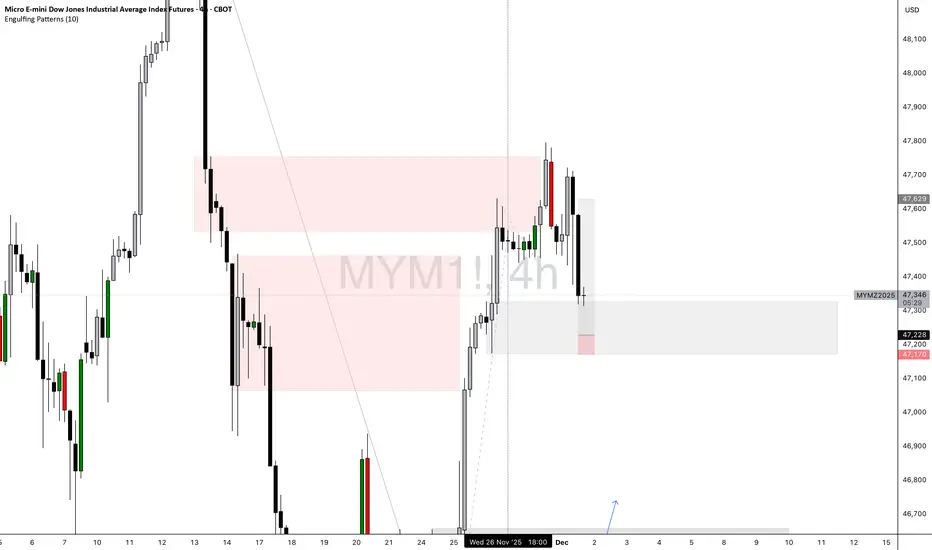
$YM Long the pullback.In the Dow today, we're coming off yestserday's fresh breakout to the upside, which makes us bullish for today.
We're simply waiting for a pullback on the 30 minute chart. We want a touch of the Weekly VWAP +1 standard deviation. Stop loss just above Weekly-VWAP.
Manage your risk and wait for the real pullback! Happy trading.
YM Week 48 (1hr chart)T.A explained -
BackSide (BS)
FrontSide (FS)
Inverse BS (Inv.BS)
Inverse FS (Inv.FS)
BS & FS levels are expected support when dashed lines, tested when dotted and resistance when solid lines.
The inverse is true for the Inv. BS Inv. FS levels, they are resistance as dashed lines, tested as dotted and support as solid lines.
Monthly timeframe is color pink
weekly grey
daily is red
4hr is orange
1hr is yellow
15min is blue
5min is green if they are shown.
strength favors the higher timeframe.
2x dotted levels are origin levels where trends have or will originate. When trends break, price will target the origin of the trend. its math, when the trend breaks, the vertex breaks too so the higher timeframe level/trend that breaks, the more volatility there could be as strength in the orders flow in to fuel the move.
Dow jones ( us30) - Has All the Good News Been Priced?
Dow Jones Is Loading for a Violent Break Into ATH
The corrective phase is nearly complete, and the chart structure is tightening exactly as expected.
Market Geometry confirms that momentum is building for a sharp upside continuation — with the next destination set firmly toward a new **All-Time High**.
I’ll share the detailed projection and key reaction zones in the next update. Stay tuned.
```
$YM | Get long the pullback!Today we go through plans in $YM. After a large bull day, it's not the best day to trade as the market often needs a 'day of rest'. However, we were able to dig into our tools and come up with a solid plan to potentially get long.
Hopefully you can learn something from this video about how to make plans admit the chaos of the market.
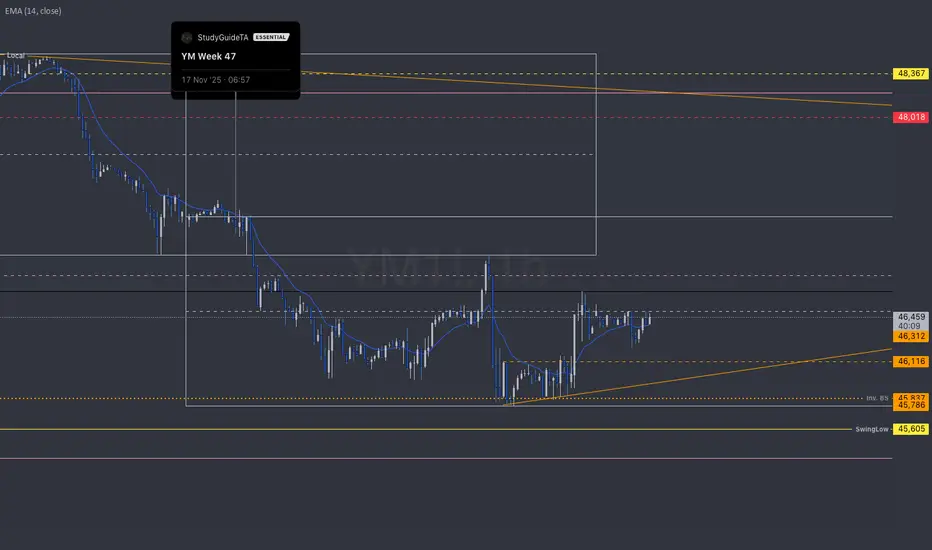
YM Week 47T.A explained -
BackSide (BS)
FrontSide (FS)
Inverse BS (Inv.BS)
Inverse FS (Inv.FS)
BS & FS levels are expected support when dashed lines, tested when dotted and resistance when solid lines.
The inverse is true for the Inv. BS Inv. FS levels, they are resistance as dashed lines, tested as dotted and support as solid lines.
Monthly timeframe is color pink
weekly grey
daily is red
4hr is orange
1hr is yellow
15min is blue
5min is green if they are shown.
strength favors the higher timeframe.
2x dotted levels are origin levels where trends have or will originate. When trends break, price will target the origin of the trend. its math, when the trend breaks, the vertex breaks too so the higher timeframe level/trend that breaks, the more volatility there could be as strength in the orders flow in to fuel the move.
DOW JONES INDEX GOES 'FIGHT' vs 50-DAY BATTLE LINE AVERAGEThe Dow Jones Industrial Average (DJIA), commonly known as the Dow Jones index, is a stock market index that tracks 30 of the largest and most established U.S. companies.
It serves as a barometer for overall market and economic health, reflecting investor sentiment and trends in blue-chip stocks. From a technical analysis perspective, the Dow Jones is studied to identify price trends, support and resistance levels, and potential reversal points to guide trading and investment decisions.
One key technical indicator used in analyzing the Dow Jones index is the 50-day Simple Moving Average (SMA). The 50-day SMA calculates the average closing price of the index over the past 50 trading days, smoothing out short-term price fluctuations to highlight the intermediate-term trend. Traders and investors widely monitor the 50-day SMA because it balances responsiveness to recent price changes with reduced noise compared to shorter-term averages.
When the Dow Jones index price is above the 50-day SMA, it generally indicates an upward or bullish trend with potential support around the SMA level. Conversely, if the price falls below the 50-day SMA, it may signal a weakening trend or bearish sentiment. The 50-day SMA can also act as a dynamic support or resistance level where price reactions may occur due to the collective attention of market participants at this average.
Currently, the Dow Jones trades slightly below its 50-day SMA, which stands at approximately 46,840 points for Dow Jones Futures CBOT_MINI:YM1! .
This technical setup suggests caution as the index might face resistance near this average before a possible trend confirmation or reversal. The 50-day SMA is often used in conjunction with other indicators like the 200-day SMA to generate signals, such as the "Golden Cross" or "Death Cross," which signal major trend shifts.
In summary, the Dow Jones index technical perspective focuses on using the 50-day SMA as an intermediate trend indicator and key level of market interest, helping traders gauge momentum and potential price direction over the medium term.
--
Best wishes,
@PandorraResearch Team
YM - 11/18 (15min chart)Added a Daily box in red, an Hourly SwingLow level in yellow and a 15min Inverse FS hold level in blue as resistance and a 15min accumulation trend in blue.
15min accumulation trend building off the 4hr trend in orange plus its backed by a yearly level in black.
Price broke the 4hr accumulation trend on a lower timeframe though so it's just a matter of time until it breaks so price can test lower levels. Unless, price can convince us long pants are trending again, sentiment is shorts all day.
T.A explained -
BackSide (BS)
FrontSide (FS)
Inverse BS (Inv.BS)
Inverse FS (Inv.FS)
BS & FS levels are expected support when dashed lines, tested when dotted and resistance when solid lines.
The inverse is true for the Inv. BS Inv. FS levels, they are resistance as dashed lines, tested as dotted and support as solid lines.
Monthly timeframe is color pink
weekly grey
daily is red
4hr is orange
1hr is yellow
15min is blue
5min is green if they are shown.
strength favors the higher timeframe.
2x dotted levels are origin levels where trends have or will originate. When trends break, price will target the origin of the trend. its math, when the trend breaks, the vertex breaks too so the higher timeframe level/trend that breaks, the more volatility there could be as strength in the orders flow in to fuel the move.
YM (DJI Futures) UpdateI haven't posted YM in a while, but it's been moving a lot lately.
I think MFI needs to get oversold then it goes for the bull flag target. With fewer stocks to pump, the algos have a much easier time pumping the Dow, like earlier this week.
Not sure if RSI will hit oversold. Quite frankly, I should have shorter DIA yesterday because it was so overbought. Oh well.