The BreakDown ClubThis is a minimalistic setup that we are seeing for today, an expansion expected. We analyse we wait and seeby TheDemoTrader_SA1
NASDAQ NASDAQ can start a bullish move from the price zones of 24,767 or 24,682 toward 25,200. However, the 24,530 level is highly critical. NASDAQ:NDX Longby keyvanjs13724
Analysis of Sp500 And Goldhello, using SK system and personal knowledge reviewing futures markets 20:00by iliasfloro0
NDQ Short catching the sweet double topChart says it all , attempt to catch a double top on NDQ. Tight stop loss is a must. Shortby oreladari334
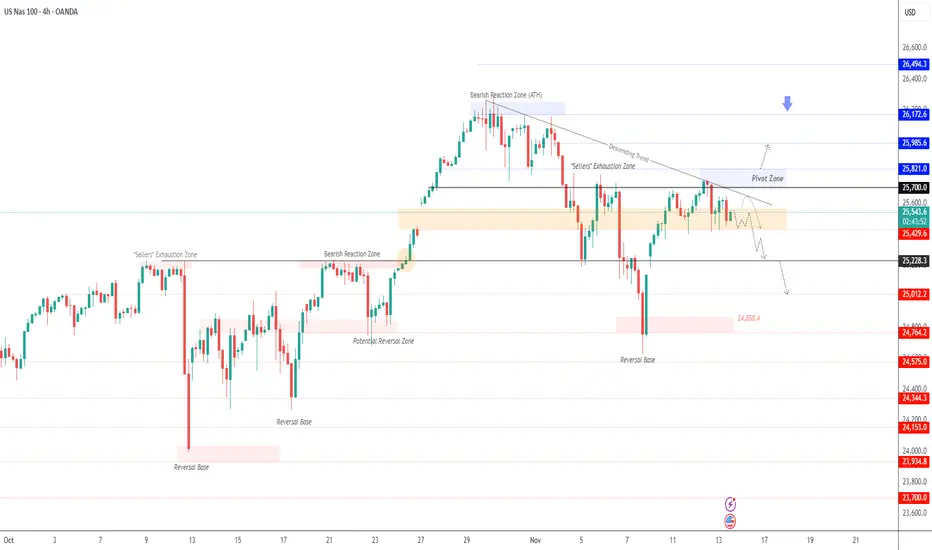
Tech Sector Pauses|USNAS100 Awaits Direction Between 25430–25700USNAS100 | Overview The price is currently consolidating between 25430 and 25570, showing a slight bearish bias as momentum weakens near resistance. As long as the index trades below 25570 and 25700, the outlook remains bearish, with downside potential toward 25430 and 25220. A confirmed break below 25220 would accelerate losses toward 25010. However, if the price closes a 4H candle above 25700, it would signal a bullish reversal, opening the path toward 25820 and 25985. Pivot Line: 25570 Resistance: 25700 · 25820 · 25985 Support: 25430 · 25230 · 25010Shortby SroshMayiUpdated 10
NAS100 Trade Set Up Nov 17 2025Price swept PDH and is pushing down towards 1h FVG which i will want to see tested before looking for a reversal back up. There is a daily FVG that will need to be filled this week at 25,800Longby Indicesforlife115
NASDAQ Can the 1D MA50 give one more rally??Nasdaq (NDX) has been trading within a 6-month Channel Up and Friday saw the price breaking below its 1D MA50 (blue trend-line) and the pattern, but managed to close back above it for the 2nd time in a week (blue circles). This resembles the September 02 break, which eventually also closed above it and initiated a +9.59% Bullish Leg. With the 1D RSI also testing a similar Support Zone with September's, we expect the index to initiate the new Bullish Leg, as long as it continues to close its daily candles above the 1D MA50. Our Target is 26900 (+9.59%). --- ** Please LIKE 👍, FOLLOW ✅, SHARE 🙌 and COMMENT ✍ if you enjoy this idea! Also share your ideas and charts in the comments section below! This is best way to keep it relevant, support us, keep the content here free and allow the idea to reach as many people as possible. ** --- 💸💸💸💸💸💸 👇 👇 👇 👇 👇 👇Longby TradingShot26
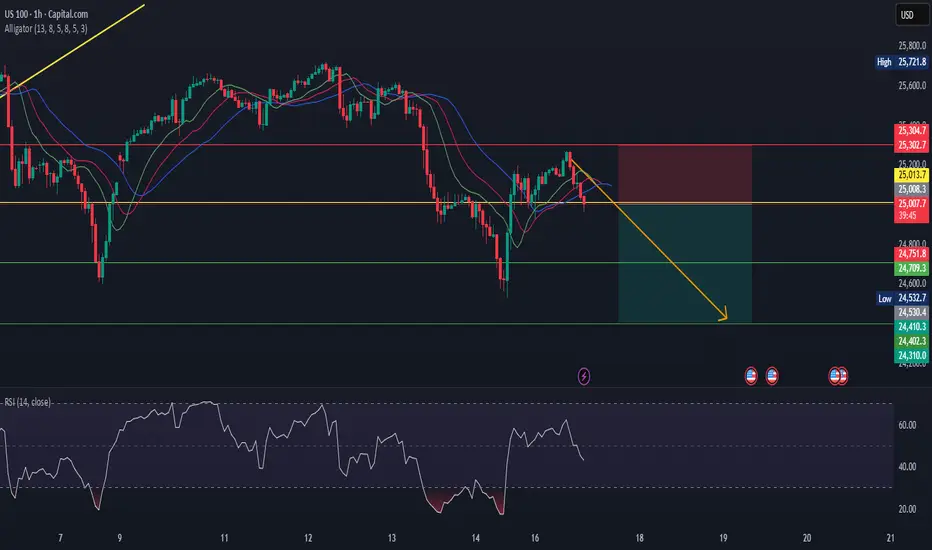
US100US100 is in bearish trend. No sign of divergence here. Alligator also indicates price will go down . We sell at CMPShortby Naqash91111
NASDAQ Pressure Still to The DownsideI know many a people are anticipating new ATHs here but I beg to differ. I think pressure to the downside will likely resume. I am just waiting patiently to see how far up the bullish correction goes so I can continue to short. Or alternatively, a break and retest of the current H1 support if price does not pull back up. My overall bias is still bearish here.Shortby LessYappingMoreTrading3
NAS100 LONG SETUP Price continues to follow the uptrend on D1. After rejecting 26... price retraced to the 24... region meeting a stable support there to form a double bottomLongby Justin-fx2212
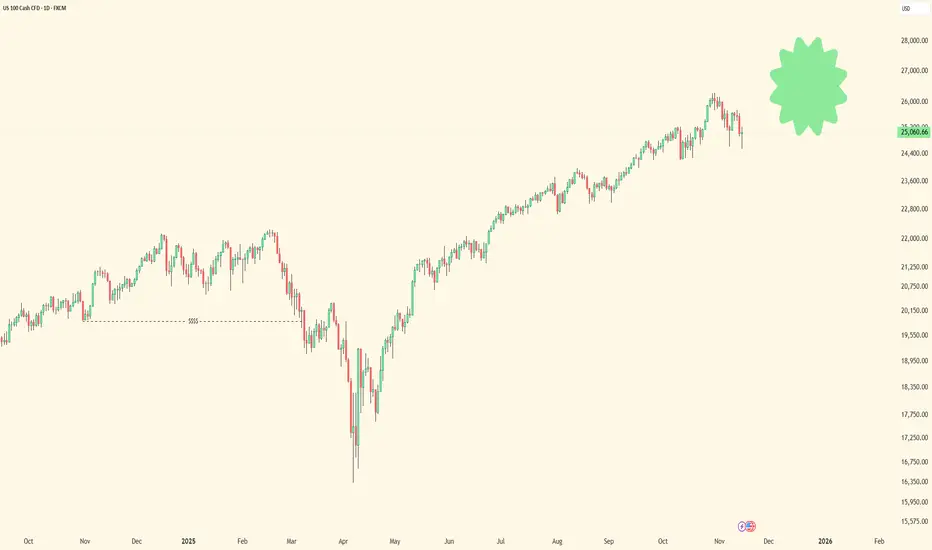
US 100 Index – NVIDIA Earnings and September Payrolls To Keep TrNovember has been a choppy and volatile period for the US 100 index. After opening the month with a push to a high of 26154 on November 1st concerns about lofty valuations of AI companies, more hawkish than expected Federal Reserve speakers and a US government shutdown have all combined to weaken prices which has seen the index twice dip and recover from support at 24608 (more on this in technical update below). Now looking forward, sentiment towards technology stocks is going to face potentially its toughest test so far with the release of AI bellwether NVIDIA’s earnings after the close on Wednesday, which is closely followed by the delayed September US Non-farm Payrolls report on Thursday. Expectations for NVIDIA’s results are high, with Reuters reporting analysts on average expecting the company to post a 54% year-on-year rise in Q3 earnings per share, with optimism for future revenue being driven higher by recent chip supply deals the company has announced with a string of companies such as Samsung. NVIDIA carries a huge 10% weighing in the US 100 index so these results could have a big impact on the direction of prices into the weekend, perhaps even further. The reopening of the US federal government last Thursday has restarted the release of key economic data updates on the labour market and inflation. The Bureau of Labor Statistics (BLS) has confirmed the September Non-farm payrolls report, originally due in early October, will now be released on Thursday November 20th at 1330 GMT. This update could be important for traders as they try and work out whether the US labour market has weakened enough for Federal Reserve policymakers to be swayed to cut interest rates by 25bps (0.25%) again at their final meeting of the year on December 10th. Recent commentary from Fed speakers has been more hawkish than expected by markets only a month ago, so there may be an extra level of US 100 price sensitivity to the outcome of this release on Thursday. US 100 Index Technical Update: 24608 Support Holds Again Last week’s US 100 activity began with price strength on Monday, but this quickly reversed, seeing a retreat of nearly 5% into Friday’s low at (24542, November 14th). Importantly, that decline tested support at 24608, which is the 50% Fibonacci retracement of the August to October advance. This level holding last week maintains potential for prices to stabilise to begin the new week. Interestingly, a similar rally emerged the previous Friday (November 7th) following tests of the same 24608 retracement support, reinforcing the possibility that buyers are currently still active around this area. While not a guarantee of future price strength, with this level now limiting selling pressure on 2 occasions, this may be viewed as the first important support level for traders to focus on this week. Potential Support Levels: With 24608 established as a potential support, closing breaks below this level might be needed to suggest renewed downside pressure, leading to a further phase of price weakness. A close below 24608 if seen, could then turn the focus toward 24221, which is the deeper 61.8% Fibonacci retracement, with the possibility for extension of price declines to 24004, which is the October 10th session low, increasing if this 24221 support level were to give way. Potential Resistance Levels: If 24608 continues to hold selling pressure, fresh attempts at price strength might result. However, it could prove to be the still rising Bollinger mid‑average at 25490 that marks an initial resistance level, with a close above this level needed to suggest risks for the possibility of fresh upside momentum. If the 25490 mid‑average does give way to the upside on a closing basis, renewed price strength could be the result. Such moves may then open scope for tests of 25742, the November 12th session high, and possibly toward 26277, the October 30th all‑time high. The material provided here has not been prepared accordance with legal requirements designed to promote the independence of investment research and as such is considered to be a marketing communication. Whilst it is not subject to any prohibition on dealing ahead of the dissemination of investment research, we will not seek to take any advantage before providing it to our clients. Pepperstone doesn’t represent that the material provided here is accurate, current or complete, and therefore shouldn’t be relied upon as such. The information, whether from a third party or not, isn’t to be considered as a recommendation; or an offer to buy or sell; or the solicitation of an offer to buy or sell any security, financial product or instrument; or to participate in any particular trading strategy. It does not take into account readers’ financial situation or investment objectives. We advise any readers of this content to seek their own advice. Without the approval of Pepperstone, reproduction or redistribution of this information isn’t permitted. by Pepperstone8
NAS100 -LONGMonthly-Respect candle Weekly-Bullish orderflow Daily-context area/SUPPORT H1-EntryLongby Forexbats8
NAS100 INTRADAY TECHNICAL ANALYSIS ═════════════════════════════════════════════════════════════════════ NAS100 INTRADAY TECHNICAL ANALYSIS & MARKET OUTLOOK November 17, 2025 | 10:30 AM UTC+4 | Current Level: 25,187.5 ═════════════════════════════════════════════════════════════════════ CRITICAL SUPPORT & RESISTANCE LEVELS RESISTANCE ZONES (Sell Targets): R1: 25,245.80 (First Profit Zone - 58.3 points) | RSI 65-70 zone R2: 25,335.40 (Intermediate Target - 147.9 points) | EMA 20 confluence + Rising Wedge apex R3: 25,445.20 (Strong Resistance - 257.7 points) | Weekly pivot + Gann 1x1 angle SUPPORT ZONES (Buy Opportunities): S1: 25,115.20 (Initial Support - 72.3 points) | 15m Bollinger Band lower band S2: 25,010.60 (Intermediate Support - 176.9 points) | SMA 50 daily + Gann angle S3: 24,885.40 (Strong Support - 302.1 points) | Harmonic AB=CD node CURRENT PRICE ACTION Index rallying after Wyckoff accumulation completion. Price above EMA 20/50 on 4h = bullish confirmation. Bollinger Bands expanding—breakout phase active. RSI at 62 (bullish) on 1h suggesting momentum continuation. Rising Wedge pattern on 30m approaching apex breakout. Volume surging into US session. Ichimoku cloud bullish alignment below price. ═════════════════════════════════════════════════════════════════════ ENTRY & EXIT SETUPS - INTRADAY EXECUTION ═════════════════════════════════════════════════════════════════════ BULLISH SETUP (Optimal on 5m/15m continuation): ENTRY: 25,210.40 (Break above 25,200 resistance + candle close confirmation) STOP LOSS: 25,140.00 (Beneath S1 by 0.20 risk buffer) TARGET 1: 25,245.80 (35.4 points) | Scale 50% profits TARGET 2: 25,335.40 (125 points) | Scale 30% profits TARGET 3: 25,445.20 (234.8 points) | Hold 20% to runner with trailing stop at 25,380 RISK/REWARD: 1:6.2 ratio | Risk 70.40 to win 437.25 BEARISH SETUP (Optimal on 1h wedge apex rejection): ENTRY: 25,160.50 (Break below support + rejection candle formation) STOP LOSS: 25,235.00 (Above R1 by 0.20 risk buffer) TARGET 1: 25,115.20 (45.3 points) | Scale 50% profits TARGET 2: 25,010.60 (149.9 points) | Scale 30% profits TARGET 3: 24,885.40 (275.1 points) | Hold 20% with trailing stop at 24,935 RISK/REWARD: 1:3.8 ratio | Risk 74.50 to win 283.25 ═════════════════════════════════════════════════════════════════════ TIMEFRAME-SPECIFIC TACTICS ═════════════════════════════════════════════════════════════════════ 5-MIN SCALPING: Monitor Rising Wedge squeeze. Target 15-22 points on wedge breakout. Tactical range 25,175-25,210. Volume surge = apex confirmation. 15-MIN SWING: Head & Shoulders potentially forming on rejection. RSI divergence at 25,245 = sell signal. Hold 45-65 points per trade. 30-MIN POSITION: Rising Wedge apex critical—breakout within 60 minutes. EMA 9/21 bullish cross validated. Harmonic ratios at R2 confluence. 1-HOUR MACRO: Gann 1x1 angle support at 25,010. Price must hold above 25,160 for continued upside. Ichimoku Tenkan-sen/Kijun-sen bullish alignment. Wyckoff markup phase accelerating. 4-HOUR BIAS: Daily pivot at 25,115 institutional support. Close above 25,245 = sustained rally to R3. Gann Square of 9 confluences: 24,885 (S3), 25,187.5 (current), 25,445 (R3). Below 25,160 = triangle breakout to downside. ═════════════════════════════════════════════════════════════════════ SESSION EXECUTION RULES ═════════════════════════════════════════════════════════════════════ ✓ ENTRY ONLY on candle close confirmation (not wick touch) ✓ STOP always 0.20-0.40 points BEYOND level (never AT exact level) ✓ SCALE profits: Take 50% at R1/S1, 30% at R2/S2, trail 20% to R3/S3 ✓ Rising Wedge apex breakout = directional confirmation signal ✓ IF price closes below 25,115 or above 25,245 = trend acceleration likely ✓ Maximum 3 trades per session. Exit after 2 consecutive losses ✓ Volume confirmation mandatory—low volume = false breakout likely ✓ Gann angle violation = position review trigger ═════════════════════════════════════════════════════════════════════ Risk Disclaimer: Analysis is educational. Past performance ≠ future results. ═════════════════════════════════════════════════════════════════════by sunya0
US Tech 100 Cash (NAS100 / NASDAQ) Recorded: 11/17 – 1:52Thesis: Price swept prior liquidity and printed aggressive delta absorption at the demand zone. Despite selling imbalance, buyers continued to lift the offer, signaling passive accumulation rather than continuation selling. This aligns with the current higher-timeframe trend structure. Footprint Evidence: Large negative delta absorbed at the lows (2.9K → 3.3K stacked). No follow-through selling despite footprint imbalance. Subsequent candle printed trapped sellers and initiated responsive buy programs. Cumulative delta failed to make a lower low → bullish divergence. Market Context: NASDAQ remains in a trending environment with controlled pullbacks. Current positioning shows willingness from larger participants to defend the zone rather than liquidate. As long as price remains above the absorption block, bullish continuation remains the higher-probability play. Trade Logic: Entered on absorption confirmation. If price reclaims the imbalance above, I expect continuation toward liquidity at the previous session high. Invalidation is below the absorption block, where passive buyers failed. Summary: Smart money absorbed sell pressure at demand, trapped shorts, and rotated the auction higher. Bias remains long until structural invalidation.Longby YUHUNGTsai1
US100 climbing.US100 moving up upon markets reopening. Looking strong near the Resistance.Longby SETLifeTrading1
NAS100 Trade Plan: Counter-Trend Opportunity Into Friday CloseI’m currently watching the NASDAQ NAS100 📊 and looking for a potential setup as we head into the Friday close. The market has pushed into the weekly low, and I’m anticipating the possibility of a retracement, which could offer a counter-trend opportunity during the New York session. 🚀📉📈 All details are broken down clearly in the video — this is not financial advice. ⚠️05:05by fxtraderanthonyUpdated 3
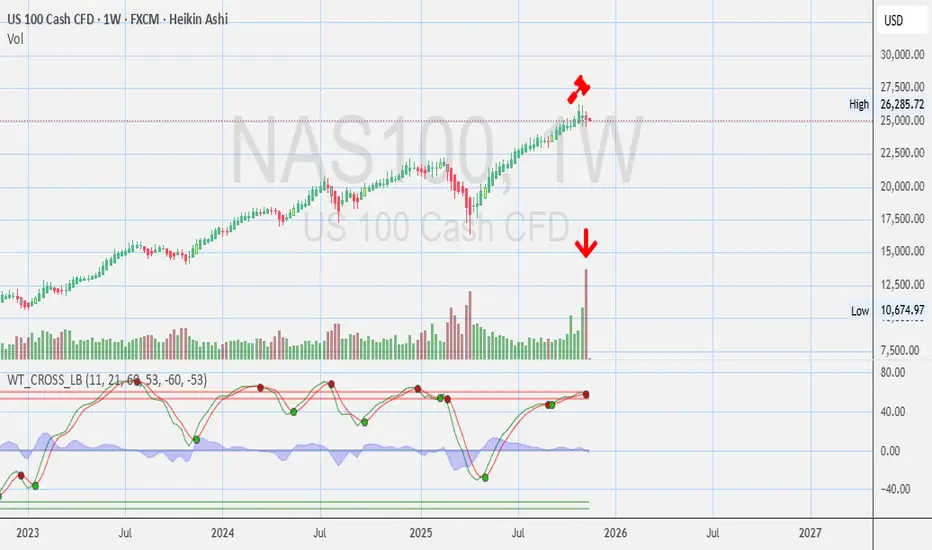
NASDAQ - Weekly Chart Opinions? Game Over ? or 🧠 Keep it on watch. Momentum shifting. Any Opinions on HUGE VEEKLY VOLUME? Game Over? or? ⚠️ Disclosures : This analysis is for informational purposes only and is not financial advice. It does not constitute a recommendation to buy, sell, or trade any securities, cryptocurrencies, or stocks. Trading involves significant risk, and you should consult with a qualified financial advisor before making any investment decisions. Past performance is not indicative of future results.Shortby CryptoChartDaily1
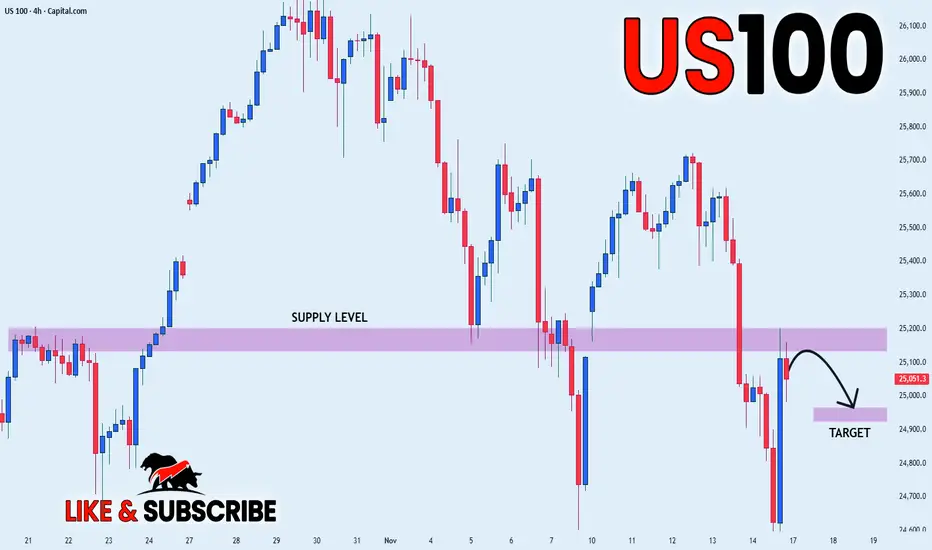
US100 LOCAL SHORT| ✅US100 price rejects the supply block and forms a clean displacement lower, hinting at a draw on liquidity toward the inefficiency below. A corrective retrace before targeting the marked zone is likely. Time Frame 4H. SHORT🔥 ✅Like and subscribe to never miss a new idea!✅Shortby ProSignalsFx116
US100 | Bullish Reversal From Demand Zone — Targeting 25,200 LiqUS100 has reacted strongly from the 24,400–24,900 major demand zone, showing a sharp rejection and reclaiming structure. Price is now building momentum toward the 25,200 buy-side liquidity level. A clean consolidation + breakout pattern is forming just below liquidity, indicating potential continuation to the upside. Market Breakdown: HTF Bias: Bullish Demand Zone: 24,400 – 24,900 Intraday Target: 25,201 liquidity zone Extended Target: 25,722 (major buy-side liquidity) Confirmation: Break & retest above 25,100 Invalidation: Clean break below 24,950Longby TheWallstreetCapital3
Daq buyWhat is up ma friends? Happy Government reopen! Price flushed straight into a demand pocket after a steady selloff. The long triggers right as the candle sweeps the previous lows and snaps back. classic liquidity grab followed by an immediate reclaim. Longby Spankky27Updated 9
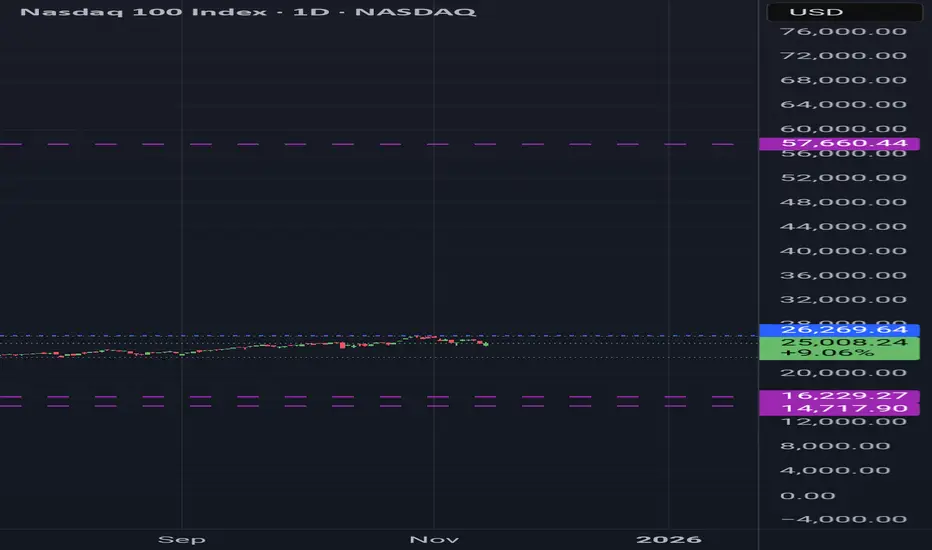
DECODED RESISTANCE ANALYSIS NDX (NASDAQ)DECODED RESISTANCE ANALYSIS NDX (NASDAQ) After testing the support at $14,717 in Q4 2026 (as mentioned yesterday in my post), the stock market will rise to reach a new high over the next four years, with the DECODED resistance at $57,660, marking the end of the first Grand cycle. Once the first Grand cycle ends, a huge correction will occur. The market will turn bearish and decline over the next 19 years, forming lower highs. During this period, the market will drop to the support level $16,229. The second Grand pattern will form around 2050/2051. I see what others call impossible, every support and resistance I draw is already written. I do not predict, I decode, even in uncharted areas. This message is for educational purposes only. Always DYOR.by FUTURISTIC_110
The Deeper Logic Behind Price Delivery (Nobody Talks About This)Most traders think some pairs are slow and others are fast. But that belief is the reason they stay confused, lose trades, and can’t read delivery. The truth is deeper, and once you see it, you can’t unsee it. This is the real explanation behind timing, alignment, and phase delivery — the part nobody teaches. Most traders think some markets “move fast” and other markets “move slow.” That’s a surface-level observation. It sounds true, but it completely misses the deeper mechanics behind why price behaves the way it does. The truth is this: Markets don’t move fast or slow — markets move according to timing. Every pair follows the same structural blueprint. The only difference is where each pair is within its delivery cycle. Price is always doing one of two things: 1. Delivering a continuation leg (impulsive, clean, fast movement) 2. Building the pullback leg (corrective, choppy, slower movement) When a pair is fully aligned on the higher timeframe — when the trend, liquidity objectives, and structural breaks are all synchronized — the continuation phase will always look fast. It’s clean, directional, and decisive because the cycle is ready to deliver. When a pair is still developing inducements, collecting liquidity, or forming the structure it needs for the next leg, it will naturally look slow or indecisive. Not because the pair is slow, but because the cycle is incomplete. This is why one pair may be exploding while another is barely moving: they’re simply in different phases of the same universal process. Price is never random. Price is never “lazy” or “weak.” Price is simply obeying its timing. Higher timeframes reveal that timing. They show you: • Whether continuation is ready • Whether the pullback is still developing • Whether liquidity has been engineered • Whether the dominant leg is prepared to deliver • Whether the cycle is aligned or still maturing Lower timeframes only express what the higher timeframe already decided. So the idea that “some pairs move fast and some move slow” is a misunderstanding. No pair is naturally fast or slow — every pair delivers exactly the same way, just not at the same time. Fast movement = HTF alignment + continuation phase Slow movement = HTF development + liquidity engineering phase Once you understand timing, you stop comparing pairs by their speed and start reading them by their position in the cycle. That’s when trading stops being guesswork and starts becoming recognition. Because the deeper truth is simple: Price isn’t unpredictable — traders are just unaware of what time it is. -Do you view the market by timing or by “speed”? Let me know — I read every comment. #NAS100 #Education #SMC #MarketTiming #PriceAction #SmartMoney #Forex #Indices Educationby Juicemannn111129