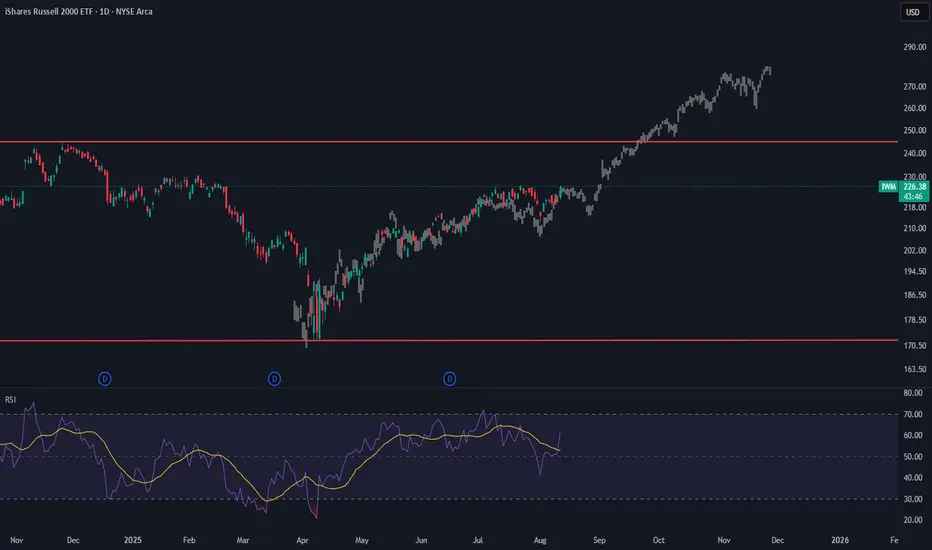
IWM Weekly QuantSignals V3: Bearish Flow-Driven Put StrategyIWM Weekly Signal | 2026-01-23
📊 TRADE DETAILS 📊
🎯 Instrument: IWM
🔀 Direction: PUT (SHORT)
🎯 Strike: 267.00
💵 Entry Price: 2.77
🎯 Profit Target: 5.54
🛑 Stop Loss: 1.39
📅 Expiry: 2026-01-30
📏 Size: 2.0
📈 Confidence: 65%
⏰ Entry Timing: N/A
🕒 Signal Time: 2026-01-23 10:57:56 EST
MODERATE RISK WARNI
Key stats
About iShares Russell 2000 ETF
Home page
Inception date
May 22, 2000
Structure
Open-Ended Fund
Replication method
Physical
Dividend treatment
Distributes
Distribution tax treatment
Qualified dividends
Income tax type
Capital Gains
Max ST capital gains rate
39.60%
Max LT capital gains rate
20.00%
Primary advisor
BlackRock Fund Advisors
Distributor
BlackRock Investments LLC
Identifiers
3
ISIN US4642876555
IWM is among the best choices in the crowded US small-cap field. The fund tracks the popular Russell 2000 index. IWM's broad basket makes it one of the most diversified funds in the segment. Notably, the fund delves into micro-cap territory, and has often been riskier than our neutral benchmark (as measured by beta) as a consequence. However, including micro-caps is a valid and possibly desirable approach to small-caps, and IWM looks reasonably similar to the benchmark in most other respects.
Related funds
Classification
What's in the fund
Exposure type
Finance
Health Technology
Electronic Technology
Stock breakdown by region
Top 10 holdings
Small Caps Pause on Tariffs – Key Levels to Trade IWMAMEX:IWM Daily Outlook 📈
Tariff headlines cooled the hot streak, but structure stays bullish while above 261.32. Small caps still showing relative strength vs SPY/QQQ — this is chop, not a trend reversal (for now).
🔑 Key Levels
• Pivot: 261.32 🎯
• Resistance: 265.75 → 267.18 🚧
• Support: 259.27 →
IWM near important key level that may break during premarketSunday Jan 25/2026
I like to trade IWM with Options because contracts are relatively cheap. You get contracts around $30-$50 and if traded properly you can make up to 100% or even more every day.
So what i'm seeing for this week, or even tomorrow, is that price has rejected an all time high and n
Opening (IRA): IWM March 20th 251 Monied Covered Call... for a 246.77 debit.
Comments: Starter position, buying a one lot and selling the -75 delta call against to emulate the delta metrics of a 25 delta put, but with the built-in defense of the short call and to take advantage of hightened IV on the call side.
Metrics:
Max Profit: 4.23 ($423)
BPE
IWM next few daysHow I see the next few days playing out for IWM, with a top and good short entry for the next few weeks happening sometime early next week. Just my two cents. Thank you. I expect it to breakout and squeeze shorts on Friday. Monday will be the short down to the 20ema. wednesday will double top the ap
IWM Is Compressing: $300 Small-Cap Breakout SetupSmall Caps (IWM) Prediction 2026: Is the Russell 2000 ready to explode? In this video, I break down the massive technical wedge forming on the IWM chart and why a short squeeze could send Small Caps to $300.
What's Inside: While the Magnificent 7 pauses, money is rotating. We are looking at a "Macr
The same applies to the other pattern, IWM: 259.93. In part #1www.tradingview.com
we mentioned a bullish entry point above 260.00 with significant upside potential.
And the bearish entry point was below 258.00, which could also act as a support zone. However, only the first part of the we said was fulfilled, with the stock opening within the 260.00 range be
See all ideas
Summarizing what the indicators are suggesting.
Oscillators
Neutral
SellBuy
Strong sellStrong buy
Strong sellSellNeutralBuyStrong buy
Oscillators
Neutral
SellBuy
Strong sellStrong buy
Strong sellSellNeutralBuyStrong buy
Summary
Neutral
SellBuy
Strong sellStrong buy
Strong sellSellNeutralBuyStrong buy
Summary
Neutral
SellBuy
Strong sellStrong buy
Strong sellSellNeutralBuyStrong buy
Summary
Neutral
SellBuy
Strong sellStrong buy
Strong sellSellNeutralBuyStrong buy
Moving Averages
Neutral
SellBuy
Strong sellStrong buy
Strong sellSellNeutralBuyStrong buy
Moving Averages
Neutral
SellBuy
Strong sellStrong buy
Strong sellSellNeutralBuyStrong buy
Displays a symbol's price movements over previous years to identify recurring trends.
Frequently Asked Questions
An exchange-traded fund (ETF) is a collection of assets (stocks, bonds, commodities, etc.) that track an underlying index and can be bought on an exchange like individual stocks.
IWM trades at 264.73 USD today, its price has fallen −0.24% in the past 24 hours. Track more dynamics on IWM price chart.
IWM net asset value is 263.96 today — it's risen 5.04% over the past month. NAV represents the total value of the fund's assets less liabilities and serves as a gauge of the fund's performance.
IWM assets under management is 76.54 B USD. AUM is an important metric as it reflects the fund's size and can serve as a gauge of how successful the fund is in attracting investors, which, in its turn, can influence decision-making.
IWM price has risen by 4.27% over the last month, and its yearly performance shows a 16.77% increase. See more dynamics on IWM price chart.
NAV returns, another gauge of an ETF dynamics, have risen by 5.04% over the last month, showed a 6.13% increase in three-month performance and has increased by 16.72% in a year.
IWM fund flows account for −6.81 B USD (1 year). Many traders use this metric to get insight into investors' sentiment and evaluate whether it's time to buy or sell the fund.
Since ETFs work like an individual stock, they can be bought and sold on exchanges (e.g. NASDAQ, NYSE, EURONEXT). As it happens with stocks, you need to select a brokerage to access trading. Explore our list of available brokers to find the one to help execute your strategies. Don't forget to do your research before getting to trading. Explore ETFs metrics in our ETF screener to find a reliable opportunity.
IWM invests in stocks. See more details in our Analysis section.
IWM expense ratio is 0.19%. It's an important metric for helping traders understand the fund's operating costs relative to assets and how expensive it would be to hold the fund.
No, IWM isn't leveraged, meaning it doesn't use borrowings or financial derivatives to magnify the performance of the underlying assets or index it follows.
In some ways, ETFs are safe investments, but in a broader sense, they're not safer than any other asset, so it's crucial to analyze a fund before investing. But if your research gives a vague answer, you can always refer to technical analysis.
Today, IWM technical analysis shows the buy rating and its 1-week rating is buy. Since market conditions are prone to changes, it's worth looking a bit further into the future — according to the 1-month rating IWM shows the strong buy signal. See more of IWM technicals for a more comprehensive analysis.
Yes, IWM pays dividends to its holders with the dividend yield of 0.97%.
IWM trades at a premium (0.01%).
Premium/discount to NAV expresses the difference between the ETF’s price and its NAV value. A positive percentage indicates a premium, meaning the ETF trades at a higher price than the calculated NAV. Conversely, a negative percentage indicates a discount, suggesting the ETF trades at a lower price than NAV.
IWM shares are issued by BlackRock, Inc.
IWM follows the Russell 2000. ETFs usually track some benchmark seeking to replicate its performance and guide asset selection and objectives.
The fund started trading on May 22, 2000.
The fund's management style is passive, meaning it's aiming to replicate the performance of the underlying index by holding assets in the same proportions as the index. The goal is to match the index's returns.