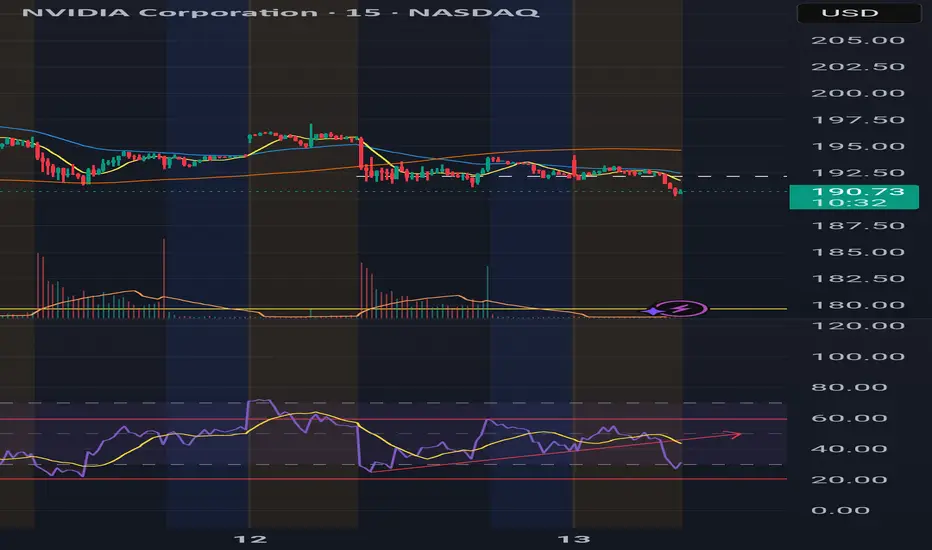
NVDA using TrenVantage LITEQuick look at nvidia using the TrenVantage LITE indicator. Clearly in a downtrend here, close levels plotted are daily's that have been tested, chances are they wont hold. Would expect to see the lower levels since this has already turned into a downtrend. Weekly Monthly and Daily Key Levels all plotted.
Trade ideas
Elliott Waves Don’t Lie: NVDA’s Path to $26,000Summary: “Elliott Waves, Fibonacci, and Smart Money align perfectly — NVIDIA’s long-term chart points to an AI-powered Supercycle with massive upside." 💎📊
🚀 NVDA | The Supercycle of the AI Era! 💚
🌀 Elliott Wave Supercycle Breakdown
NVIDIA’s price action over the past two decades is a textbook example of a multi-decade Elliott Wave Supercycle — where technical , fundamentals , and Smart Money flows perfectly align to form a once-in-a-generation structure 🌎
Let’s break it down step-by-step 👇
Super Cycle Wave (1) — launched in the early 2000s, marking NVDA’s first growth phase during the birth of consumer GPUs 🎮.
Super Cycle Wave (2) — deep correction into 2002, retracing a 0.786 Fibonacci, cleansing early euphoria and creating the foundation for institutional accumulation 💼.
Then began the Super Cycle Wave (3) — the most powerful phase of all. Within it, we have distinct macro sub-waves:
1️⃣ Macro Wave (1) — ended in 2007 , aligning with the first institutional wave of adoption.
2️⃣ Macro Wave (2) — retraced 0.618 in 2008 , coinciding with the global financial crisis (perfect Smart Money shakeout).
3️⃣ Macro Wave (3) — the current dominant leg, fueled by exponential AI and data center growth . It’s extending toward the 3.618 Fibonacci extension (~$256) , confirming wave strength and institutional conviction.
4️⃣ Macro Wave (4) — expected between 2026–2027, likely retracing 0.236–0.382, a natural cooling period before the next breakout.
5️⃣ Macro Wave (5) — projected to rally toward 4.618 extension (~$2,500) , completing Super Cycle Wave (3) near 2029 🏁
From there, a larger Super Cycle Wave (4) correction could unfold before the final parabolic Super Cycle Wave (5) run to the 5.618 Fibonacci extension (~$26,000) — the climax of NVDA’s decades-long AI expansion super-trend 🌕
💰 Smart Money Concept (SMC) Perspective
The chart structure clearly shows Smart Money accumulation patterns in every correction phase:
Re-accumulation ranges appeared at every 0.618 retracement level 📊
Liquidity grabs below previous swing lows before strong impulsive moves ⚡
Fair Value Gaps (FVGs) filled during corrections, creating perfect liquidity imbalances that institutional players exploit
Currently, NVDA trades near a premium zone of Macro Wave (3), but Smart Money will likely reaccumulate during the upcoming Macro Wave (4) discount phase (2026–2027).
Expect Order Block re-tests and liquidity sweeps around discounted Fibonacci retracement zones (0.236–0.382) before the next major rally 📉➡️📈
📈 Price Action Structure
NVDA’s macro structure remains strongly bullish:
The multi-decade trend has respected every higher high and higher low sequence since 2008.
Each impulse is followed by a healthy re-accumulation range, never breaking long-term structure.
Expect distribution near the $250–$300 (split-adjusted) region as Wave (3) matures, followed by a macro correction that offers generational entries for long-term investors 🧠
🔢 Fibonacci Confluence & Technical Harmony
Fibonacci has been the invisible hand guiding NVDA’s growth 👇
0.786 retracement (2002) → deep liquidity reset
0.618 retracement (2008) → institutional re-entry
3.618 extension (256) → current macro resistance target
4.618 extension (2500) → Super Cycle Wave (3) final target
5.618 extension (26K) → ultimate Super Cycle Wave (5) projection
Each impulse and retracement aligns perfectly with Fibonacci’s geometric rhythm , proving the power of confluence between time, price, and sentiment.
🧠 Fundamentals — The Energy Behind the Waves
Behind the technicals lies unmatched fundamental growth :
💾 AI & Data Centers: NVIDIA is the core infrastructure for modern AI compute and cloud training workloads.
🧩 CUDA Ecosystem: A software moat that ties developers and enterprises directly to NVIDIA’s architecture.
🌐 Omniverse & Robotics: Positioning NVDA as a leader in 3D simulation, robotics, and digital twins — future trillion-dollar markets.
⚙️ Strategic Partnerships: Expanding across hyperscalers, automotives, and enterprise AI.
Each innovation wave fuels a new Elliott Wave impulse , with the AI revolution now driving the strongest macro leg in NVDA’s history.
⚡ Macro Outlook & Timeline
✅ Now (2025): Completing Macro Wave (3) of Super Cycle (3) → heading toward $256 target
⚠️ 2026–2027: Macro Wave (4) correction to 0.236–0.382 (Smart Money entry)
🚀 2028–2029: Macro Wave (5) push → Super Cycle (3) peak near $2,500
🌊 2030–2032: Super Cycle (4) correction — consolidation phase
💎 2035–2040+: Super Cycle (5) → ultimate 5.618 target near $26K
💬 Final Thoughts
"Every correction is a setup for the next expansion. Smart Money buys fear — not euphoria."
NVIDIA is the heartbeat of the AI revolution , the core of data-driven computing , and a living Fibonacci sequence in motion.
As long as fundamentals stay aligned with the wave rhythm, NVDA’s Supercycle will continue to redefine what’s possible in long-term growth. 🌌
#NVDA #ElliottWaveAnalysis #SmartMoneyConcept #PriceActionTrading #FibonacciMagic #AIRevolution #StockMarket #Investing #TradingViewCommunity #TechSupercycle #NVDAtoTheMoon #LongTermInvesting
💬 Traders, analysts, and wave watchers — your insights matter!
Have you spotted NVDA’s next move? Drop your Elliott Wave counts, confirmations, or constructive critiques below 👇 Let’s discuss NVIDIA’s structural evolution, AI-driven Supercycle, and long-term growth potential together 🚀💚
Every comment adds perspective — let’s decode this massive wave as a community! 🌊📈
— Team FIBCOS ⚡💎
I'm betting for a big pullback in NVDANVDA is still strong in the broader sense, but the shorter-term internal strength (momentum, volume) is waning. If it busts above ~$190-195 with volume, it could resume big.
If it doesn’t, beware the risk of a pullback or consolidation.
Choose your option path accordingly.
NVDA is still strong in the broader sense, but the shorter-term internal strength (momentum, volume) is waning. If it busts above ~$190-195 with volume, it could resume big.
If it doesn’t, beware the risk of a pullback or consolidation. Choose your option path accordingly.
Nvidia - Squeezing every single bear!🧯NVidia ( NASDAQ:NVDA ) is finally breaking out:
🔎Analysis summary:
Over the course of the past couple of months, Nvidia has been rallying +125%. Considering the market cap of Nvidia, this is already an insane move but clearly not the end. We can still see another +25% from here, before Nvidia will then retest the next resistance.
📝Levels to watch:
$250
SwingTraderPhil
SwingTrading.Simplified. | Investing.Simplified. | #LONGTERMVISION
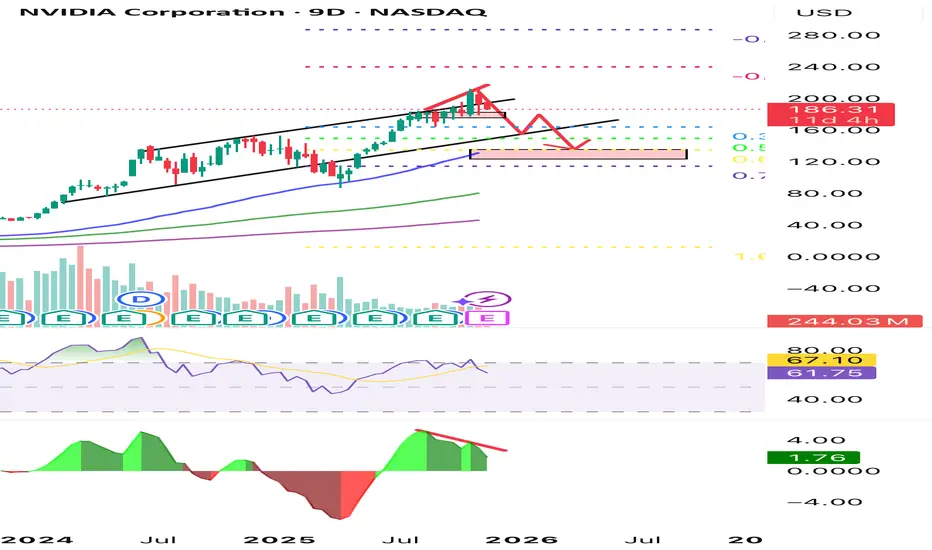
Bearish Divergence Triggering a Mid-Cycle Cooldown?NVDA is flashing a notable momentum deceleration. Price keeps printing higher highs while both RSI and MACD histogram carve lower highs — a classic bearish divergence signaling a potential medium-term pullback.
Price has also broken below the rising micro-channel, suggesting exhaustion after an aggressive vertical rally. If sellers maintain control, the next liquidity pockets sit around the Fibonacci cluster between 0.5 and 0.618, roughly the $145–$155 zone. A deeper corrective flush could extend toward the $130–$115 demand block highlighted on the chart.
The broader trend remains structurally bullish, but current signals point to a healthy corrective phase rather than immediate continuation. Watching how price behaves on the retest of the broken channel will be key to confirming further downside.
Market is shifting from momentum-driven expansion to controlled mean reversion.
Nvidia Denies $1B Mexico Plan, Eyes Key SupportNvidia Corporation (NASDAQ: NASDAQ:NVDA ) came under brief scrutiny on Wednesday after reports suggested a $1 billion investment in a new data center project in Nuevo León, Mexico. The tech giant has since denied any financial involvement, clarifying that its role in Latin America remains limited to collaborative initiatives, research, and talent development, not direct infrastructure spending.
The confusion began when the state’s governor, Samuel García, publicly announced the investment alongside individuals presented as Nvidia representatives. However, later corrections confirmed that the green hydrogen data center would actually be built by CIPRE Holding, utilizing Nvidia’s technology rather than capital.
Despite the miscommunication, the news had little fundamental impact on Nvidia’s long-term growth narrative. The company remains the dominant force in AI semiconductors, with global demand for GPUs powering everything from data centers to generative AI models. However, short-term volatility persists amid global tech supply pressures, tighter U.S.–China chip export controls, and broader market repricing ahead of potential U.S. interest rate cuts in December.
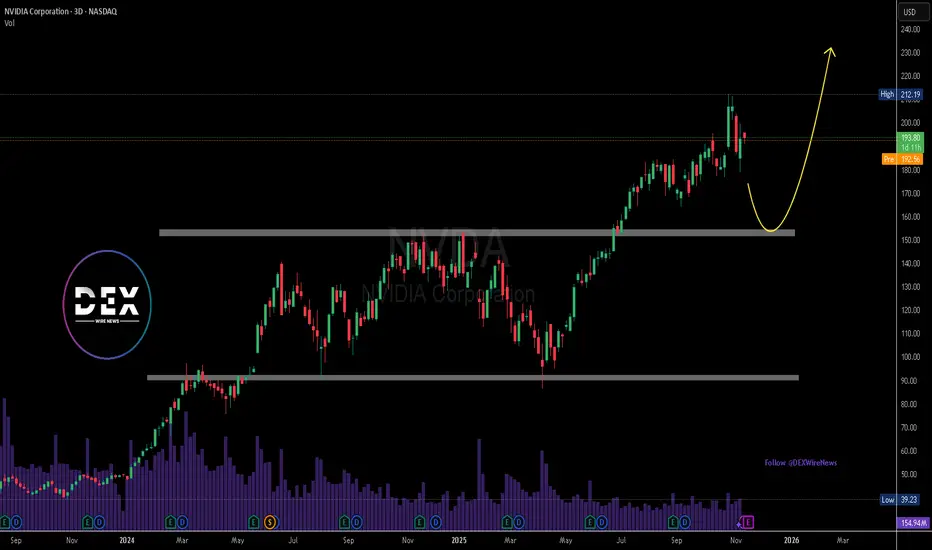
From a technical perspective, NVDA recently hit resistance near the $212 high before retracing. The chart suggests potential for a healthy correction toward the $155 support range, which coincides with a strong accumulation zone from mid-2025. A rebound from this level could fuel a continuation toward $230–$240, resuming Nvidia’s dominant uptrend.
Investors remain focused on upcoming quarterly earnings and the broader market’s reaction to monetary easing expectations. A confirmed rate cut could renew institutional appetite for high-growth tech names, keeping Nvidia positioned as one of the most favored equities in the AI sector.
NVDA Big Move Loading. TA for Nov. 12–15NVDA at a Critical GEX Compression Zone
NVDA has been moving like a stock caught between two worlds — heavy enough to stay suppressed, but supported enough to avoid a real breakdown. When you zoom out, the candles almost look like they’re waiting for someone to flip a switch.
In reality, NVDA is not being moved by momentum alone — it’s being shaped by something deeper:
gamma exposure (GEX) compression.
And this GEX structure is telling a very clear story about what’s coming next.
4H Chart — Structure Meets Hidden Liquidity
NVDA has been respecting a rising structural band that stretches across early November. Every major reaction — every sweep, every bounce — has happened along this diagonal liquidity path.
This is not random.
It’s where past BOS and CHoCH events have clustered, and it’s also where NVDA’s GEX shifts from defensive to neutral.
Price recently tapped this diagonal trendline again and stabilized right above the 178–180 GEX shelf. The reaction wasn’t explosive — but it was steady. That’s exactly what you see when larger players are quietly absorbing liquidity.
The story here is simple:
NVDA is compressing toward a decision.
1H Chart — Short-Term Drift Toward a Break
On the 1H timeframe, NVDA’s price is drifting inside a narrow pocket between 188–196. Sellers are pressing from above, but bulls are defending from below — and neither side is gaining ground.
This is classic GEX neutral-pocket behavior:
* Low volatility
* Wicks on both ends
* Lack of follow-through
* Clean candles but no conviction
The moment NVDA breaks OUT of this pocket, the move will be far more decisive than anything we’ve seen this week.
GEX Data — The REAL Battlefield
(Refer to screenshot below)
This GEX landscape is incredibly clear and incredibly important.
🔹 Positive GEX cluster at 200–210
This is the heavy CALL/GEX shelf that acts like a magnet AND a ceiling.
When NVDA pushes into this zone, hedging flows stabilize the move, but upside becomes controlled.
This is why the last rally failed at 202–205.
🔹 Neutral GEX zone between 188–196
This is the pocket where NVDA is trading right now.
Neutral pockets compress price and load energy for the next breakout.
This is where NVDA is stuck — for now.
🔹 Negative GEX zone below 185
This is the danger zone.
If NVDA breaks below 185, hedging pressure flips aggressively bearish.
That’s why 185 is your key line in the sand.
🔥 Trading Suggestions Based on Structure + GEX
📌 Bullish Scenario (Higher Probability)
ONLY valid if NVDA holds above 188–190 and breaks above 195.
ENTRY ZONE:
193–195 (1H reclaim)
TARGETS:
* 197.50 (first GEX magnet)
* 202.50 (second GEX shelf)
* 210.00 (major GEX wall / highest positive NET GEX)
STOP-LOSS:
Below 188
(Below this, NVDA re-enters GEX compression = chop)
WHY IT WORKS:
As soon as NVDA clears 195, it enters a staircase of positive GEX levels. These levels act like magnets and guide price toward the CALL walls.
📌 Bearish Breakdown Scenario
ONLY valid if NVDA loses 185 with conviction.
ENTRY:
Break below 184.80
TARGETS:
* 181.00
* 178.90 (big negative GEX shelf)
* 175.00
STOP-LOSS:
Above 188
WHY IT WORKS:
Below 185, NVDA enters a negative GEX zone, where dealer hedging accelerates selling.
🔥 Options Trading Suggestions (GEX-Based)
📌 Bullish Options Play (if NVDA reclaims 195)
Buy:
NVDA 200C or 205C (1–2 weeks out)
Reason:
These levels sit directly in the positive GEX zone, where price often drifts upward in controlled channels.
Safer Play:
195/205 Call Debit Spread
Perfect for GEX-guided upside.
📌 Bearish Options Play (if NVDA breaks 185)
Buy:
NVDA 180P or 175P
Reason:
Once NVDA enters the negative GEX field, volatility expands downward and puts gain value quickly.
Safer Bearish Spread:
185/175 Put Debit Spread
📌 Neutral Play (if price stays stuck 188–196)
This is a premium-decay zone.
Sell Premium Strategy:
* Short Strangle
* Iron Condor
* Credit Spread
Neutral GEX = low volatility = high time decay.
My Thought
NVDA is sitting in one of the cleanest GEX compression structures we’ve seen all month. Price is wedged between a rising liquidity structure and a neutral gamma pocket that’s choking volatility.
This kind of setup usually leads to a single explosive move, not a slow grind.
The roadmap is simple:
* Above 195 → NVDA targets 202–210
* Below 185 → NVDA slides into negative gamma
* Inside 188–196 → chop and premium decay
The next breakout is going to be clean — and GEX is already showing where the path of least resistance lies.
This outlook is for educational purposes only and not financial advice. Always manage your risk and trade your plan.
NVDA Weekly Options SignalNVDA Weekly Options Analysis – 2025-11-12
Current Price: $192.38
Trend: Neutral (Weekly Momentum: Bearish -1.73%)
Confidence: 58% | Conviction: Low
Expiry: 2025-11-14 (2 days)
Recommended Strike: $192.50
Technical Overview:
Price in the middle of weekly range ($178.91–$200.05)
EMA alignment confirms bearish weekly trend
VWAP at $190.89 offers near-term support
Volume spike (26.4x previous week) indicates potential capitulation
Options Flow:
Extremely bullish, PCR 0.42 → heavy call buying
Max volume at $262 call shows institutional positioning
High gamma risk, volatility potential elevated
Trade Setup:
Direction: Buy Calls (Long)
Entry: $2.74
Target 1: $3.70 (+35%)
Target 2: $4.50 (+64%)
Stop Loss: $2.05 (-25%)
Position Size: 2% portfolio (Low conviction)
Summary Insight:
Katy AI shows neutral/bearish signals, but options flow suggests bullish institutional interest
High-risk, low-conviction setup; small position recommended
Mixed technicals and news sentiment → use tight risk management
⚠️ Risk Warning:
Conflicting signals → only small size recommended
Not financial advice; educational commentary for QS Premium members
NVIDIA – Best Buy of the Decade (4T Record but now resistance)🚀🔥 NVIDIA – Best Buy of the Decade Post #6
💡📉 Great but why am I taking half profits Today?
Back in July 2021, I named NVIDIA "The Best Buy of the Decade. " Today, it just hit a mind-blowing milestone — becoming the first company to reach a $4 trillion market cap. But here's the thing... that happened right at major resistance.
From our initial call in 2021 , to the target at $143.85 drawn via parabola in 2023, to the April 2025 re-entry at $95, it’s all on the chart — and it's been a textbook ride so far.
At the current level of $163.89, we’re pressing into serious overhead resistance. This doesn’t mean the story is over — not even close. But it could mean we take a breather before the next leg higher.
🧭 Targets ahead remain unchanged:
🔹 First stop: $182.85
🔹 Long-term vision: $227.41
What started as a bold macro call in 2021 has now become a multi-year thesis with precision updates along the way. This is post #6 in the NVIDIA journey — and if you scroll back through the chart, each piece has built on the last with clarity and conviction.
🎯 NVIDIA is not just a tech stock — it’s the AI backbone. But every cycle has pauses, and this one looks ready for a short rest before we see the next breakout.
Stay sharp, follow the structure, and honor the parabola.
One Love,
The FX PROFESSOR 💙
Additional info, for those who like to dive deeper into NVDA:
🔍 Technical Breakdown Version
For the chartists and structure followers, here’s the breakdown:
📌 2021: Original call — "Best Buy of the Decade"
📌 2023: First parabola plotted, projecting toward $143.85 — target hit precisely
📌 April 2025: Market offered $95 re-entry — second parabola begins
📌 Now: Price sits at $163.89, testing resistance from both structure and Fibonacci
📌 Next levels:
- $182.85 → Key extension level
- $227.41 → Long-term target based on full parabolic arc
Current structure suggests a possible pause before continuation. No need for panic — parabola remains valid unless structure is broken. Volume still supportive, and price action is following projection beautifully.
🧠 AI Macro Narrative Version
The big picture? NVIDIA isn't just another semi stock — it’s the nervous system of the AI revolution.
From gaming → crypto → AI, NVIDIA has consistently been first to adapt, and now it’s the leader in AI hardware infrastructure. The $4 trillion milestone is more than symbolic — it represents capital reallocation toward AI as the next dominant sector.
🧠 Key macro takeaways:
AI demand is insatiable
Data centers need NVIDIA
Generative AI isn't slowing down
Institutions are still buying — not selling
The resistance we see now isn’t weakness — it’s the market pausing to digest before another acceleration. Just like every past cycle... we ride, retrace, reload, and resume.
Disclosure: I am happy to be part of the Trade Nation's Influencer program and receive a monthly fee for using their TradingView charts in my analysis. Awesome broker, where the trader really comes first! 🌟🤝📈
nvidia is rangeThe inability of the price to break the 140 area and return to the 91 dollar area can be imagined in three scenarios:
1. The market will suffer in this area until the decision is reached
2. Breaking the 140 area and continuing the upward trend
3. Breaking the $75 support area and trying to reach the $53 area is out of the question at the moment.
Nvidia Stock Fails to Return to the $200 LevelAlthough Nvidia seemed poised to start the week with an optimistic bias, partly driven by the end of the U.S. government shutdown, which has generated a short-term confidence boost, the stock has begun to show a bearish tone in the current session, posting a decline of more than 2%. This weakness is mainly due to recent comments from the SoftBank Group, which sold its entire stake in Nvidia for approximately US$ 5.8 billion, raising concerns about a possible reduction in exposure to the semiconductor industry in the short term. This event has led to growing investor caution toward the stock and currently maintains a notable selling bias in the market.
Uptrend Tries to Hold
Despite recent downward corrections that have halted the stock’s steady advance, Nvidia has yet to show a decisive bearish move that would end the long-term uptrend line. In the broader picture, buying momentum continues to hold firm. However, if selling pressure continues to strengthen, the uptrend could be at risk, especially if the price falls below the 50-period moving average.
RSI
The RSI indicator line is gradually approaching the neutral level of 50, suggesting a balance between buying and selling forces over the last 14 trading sessions. As long as this equilibrium remains, the stock is likely to continue showing indecisive movements in the coming days.
TRIX
The TRIX indicator remains above the neutral level of 0, indicating that in the long-term outlook, bullish strength continues to dominate the average of exponential moving averages. As long as the TRIX stays above this level, the bullish bias may remain intact, allowing the uptrend line to continue defending its position over the coming weeks.
Key Levels to Watch:
208 USD – Major Resistance: Corresponds to the area of recent highs. Price movements breaking above this level could trigger stronger buying pressure, reinforcing the current uptrend.
200 USD – Nearby Resistance: A key psychological level. Price action above this zone would reactivate a short-term bullish bias and reduce the risk of a trendline breakdown.
184 USD – Key Support: This is the most relevant support area, coinciding with the 50-period moving average and the Ichimoku cloud, which increases its significance. Downward movements reaching this zone could end the long-term bullish structure and lead to a period of indecision or the formation of a short-term consolidation range.
Written by Julian Pineda, CFA, CMT – Market Analyst
Is SoftBank selling NVIDIA worrying you?Softbank has announced that it has pocketed all returns from their investment in NASDAQ:NVDA . I do not think this should concern anyone as it is logical to bank profits after a point where you want to redistribute cash. I do believe NVIDIA needs to take a small breath and might dip to $160 - $170 (near the gap it has created/ 1 x A Fib extension levels), as this will create some downward pressure to the already existing overvaluations. However, I think this is a setup to an amazing end of year rally.
Global Market Participants1. Introduction to Global Market Participants
Global market participants are entities that take part in international financial transactions. These include individual investors, institutional investors, corporations, governments, central banks, and intermediaries. Their activities impact the stability, efficiency, and development of the financial markets. The diversity among these participants ensures liquidity, facilitates price discovery, and contributes to economic growth by channeling funds from savers to borrowers worldwide.
2. Individual Investors
Individual investors, often called retail investors, are private persons who invest their own money in various financial assets such as stocks, bonds, mutual funds, or cryptocurrencies. Their primary goals are to grow wealth, earn income, and achieve financial security.
Key Characteristics:
Smaller investment amounts compared to institutions.
Focus on long-term capital appreciation or short-term trading profits.
Tend to rely on brokers, financial advisors, and digital trading platforms.
Role in the Market:
Retail investors enhance market liquidity and promote diversity in trading behaviors. With the rise of online trading platforms and fintech innovation, the participation of individuals in global markets has increased significantly. Social media and global connectivity now allow retail investors to influence markets, as seen during events like the 2021 “meme stock” phenomenon.
3. Institutional Investors
Institutional investors are large entities that pool money from clients or members and invest in financial markets to achieve specific objectives. They include pension funds, insurance companies, mutual funds, hedge funds, and sovereign wealth funds.
a. Pension Funds:
Pension funds invest the savings of employees to ensure financial security after retirement. They typically favor long-term, stable investments like bonds and blue-chip stocks.
b. Insurance Companies:
Insurance firms invest premiums collected from policyholders in relatively safe and income-generating assets to meet future claims.
c. Mutual Funds:
These funds pool money from numerous investors to invest in diversified portfolios of stocks, bonds, or other assets. They enable individuals to access professional management and diversification benefits.
d. Hedge Funds:
Hedge funds target high returns through aggressive strategies, including leverage, derivatives trading, and short-selling. They often cater to high-net-worth individuals and institutions.
e. Sovereign Wealth Funds (SWFs):
These are government-owned investment funds that manage national reserves, often derived from oil revenues or trade surpluses. Examples include Norway’s Government Pension Fund Global and Singapore’s GIC.
Impact on Global Markets:
Institutional investors dominate global capital flows and can significantly influence market trends. Their large-scale investments affect prices, volatility, and even government bond yields.
4. Corporations and Multinational Companies (MNCs)
Corporations participate in global financial markets for financing, investment, and risk management purposes.
Key Activities:
Raising Capital: Through issuing stocks or bonds to finance expansion.
Foreign Exchange Management: Engaging in currency markets to hedge exchange rate risks.
Mergers and Acquisitions: Companies use global capital markets to fund cross-border deals.
Example:
A U.S.-based company operating in Europe may use derivatives to hedge against euro-dollar exchange rate fluctuations. Multinational corporations also issue global or Eurobonds to attract international investors.
5. Governments
Governments are major players in global markets, primarily as issuers of sovereign debt and regulators of financial systems.
Roles:
Issuers of Government Bonds: To finance public spending and infrastructure projects.
Market Regulators: Setting and enforcing financial regulations to maintain transparency, stability, and investor confidence.
Participants in the Currency Market: Governments manage foreign exchange reserves to stabilize national currencies and support trade balances.
Example:
The U.S. Treasury issues bonds that serve as global benchmarks for risk-free assets, while developing nations issue sovereign debt to attract foreign capital.
6. Central Banks
Central banks, such as the U.S. Federal Reserve, the European Central Bank (ECB), and the Reserve Bank of India (RBI), are among the most influential market participants.
Key Functions:
Monetary Policy: Controlling money supply and interest rates to manage inflation and stimulate growth.
Foreign Exchange Operations: Buying and selling currencies to stabilize exchange rates.
Liquidity Provider: Acting as lenders of last resort to the banking system.
Central banks also influence global markets through quantitative easing, where they purchase government bonds to inject liquidity into the economy. Their decisions can trigger global reactions, affecting stock, bond, and currency markets worldwide.
7. Financial Intermediaries
Financial intermediaries connect savers with borrowers, facilitating the flow of funds across the economy. These include commercial banks, investment banks, brokers, and exchanges.
a. Commercial Banks:
Provide loans, accept deposits, and offer payment systems. They are key in credit creation and financial stability.
b. Investment Banks:
Help corporations and governments raise capital through underwriting securities and managing mergers and acquisitions.
c. Brokers and Dealers:
Act as agents for investors, executing trades and providing liquidity in financial markets.
d. Exchanges:
Stock and commodity exchanges provide regulated platforms for buying and selling financial instruments. Examples include the New York Stock Exchange (NYSE), London Stock Exchange (LSE), and the Bombay Stock Exchange (BSE).
8. Speculators and Traders
Speculators take on financial risk in the hope of profiting from price movements. While often viewed as risk-takers, they serve an important function by adding liquidity and aiding price discovery.
Types of Traders:
Day Traders: Engage in short-term trades for quick profits.
Arbitrageurs: Exploit price differences between markets or instruments.
Algorithmic Traders: Use computer programs to execute high-frequency trades.
Their activities ensure continuous market operation, even during volatile periods.
9. Credit Rating Agencies
Agencies such as Moody’s, Standard & Poor’s (S&P), and Fitch Ratings assess the creditworthiness of companies, governments, and financial instruments. Their ratings influence investor confidence, bond yields, and borrowing costs.
Role in Global Markets:
Facilitate informed investment decisions.
Help maintain transparency and discipline among borrowers.
Influence capital allocation by institutional investors.
However, rating agencies have faced criticism for conflicts of interest and their role in past financial crises, such as the 2008 global meltdown.
10. International Financial Institutions
Organizations such as the International Monetary Fund (IMF) and the World Bank play a stabilizing role in the global market.
The IMF:
Provides financial assistance to countries facing balance-of-payments crises and promotes exchange rate stability.
The World Bank:
Funds infrastructure and development projects in emerging economies to promote long-term economic growth.
Their involvement ensures global financial stability and supports developing nations in integrating into global markets.
11. Hedge Funds and Private Equity Firms
Hedge funds and private equity firms are specialized investment entities managing large pools of capital with flexible strategies.
Hedge Funds: Focus on generating high returns through trading and leverage.
Private Equity Firms: Invest directly in private companies or buy out public firms to restructure them.
They are crucial in improving corporate efficiency, promoting innovation, and influencing global capital allocation.
12. Conclusion
Global market participants collectively form the backbone of the world’s financial system. From individual investors to powerful institutions like central banks and sovereign wealth funds, each plays a unique role in shaping market behavior and economic outcomes. Their interactions drive capital flows, influence asset prices, and impact global growth and stability.
Understanding these participants helps explain how financial markets function and respond to economic, political, and technological changes. In an increasingly interconnected world, the balance between these entities determines the resilience and sustainability of the global financial ecosystem.
In essence, the global market is a dynamic arena where diverse participants—each with distinct motives and influences—interact to create a continuously evolving landscape of opportunity, competition, and innovation.
NVDA (NVIDIA) – Buy PlanNVDA (NVIDIA) – Buy Plan
📊 Market Sentiment
On October 29, the FED lowered rates by 25bps as expected. However, Powell’s remarks introduced uncertainty around further cuts in December, emphasizing that future policy will depend on incoming data.
One FED member dissented, preferring no cut this cycle — a notable shift from September’s unanimous decision.
Additionally, ADP Non-Farm Employment Change came at 42K versus 32K expected. It’s slightly higher, but since other macro data are missing due to the U.S. government shutdown, the overall sentiment remains mixed.
For now, macro sentiment leans bearish, as rate cuts may be delayed into 2026.
However, with NVDA earnings approaching, we could see a short-term bullish sentiment building around the stock.
📈 Technical Analysis
NVDA is currently trading around the 0.5 equilibrium zone, which aligns with the HTF bullish trendline.
This area could provide temporary support and a potential bounce setup.
However, it’s crucial to watch the SPY structure as it may influence NVDA’s short-term movement.
📌 Game Plan / Expectations
I’ll be watching the $185–$180 range as a key HTF support zone.
This area also aligns with a possible trendline deviation, where price could manipulate below the trendline to trap sellers before reclaiming it.
I plan to buy call options within this range, targeting a continuation of the bullish leg post-earnings.
💬 If this breakdown aligns with your outlook, like and comment below.
For deeper sentiment and strategy insights, subscribe to my Substack — free access available.
⚠️ Disclaimer
This analysis is for educational purposes only and does not constitute financial advice. Always conduct your own research before trading or investing.
Buffett says buy when everyone else is selling, right?Long at 188.08. Even if you assume that NVDA and the whole market are correcting, I say so what. There are lots worse places to ride out a market correction than NVDA.
And not for nothing, but I've posted 7 ideas on NVDA here so far. 6 of them were during its 36% drop from Nov '24 to Apr '25. All 12 trades that were part of those ideas paid me. Every. Single. One. The average gain on those 12 trades was nearly 6%. You can make money long while stocks drop. I do it all the time.
Those were also times when people were saying the AI bubble was popping, that AI was over hyped. Michael Burry was shorting NVDA during at least part of that. I don't care. Those kinds of things don't have much to do with day to day stock movements, and what I do has mountains of data behind it that show that kind of thing isn't relevant to what I do.
Going to zero quickly is the big risk to what I'm doing here, and I assure you, if NVDA goes to zero quickly, there will be nowhere to hide. I'll take my chances with the company that takes in $500M a DAY in revenues. This stock's fall is extremely overdone currently, in my opinion, adding to this trade's allure for me.
I will exit here fairly quickly - no need to give back what the market gives me. I'm no HODLer. I take my money and run. If I can do it in one day, so much the better. If I'm forced to hold, tactically adding and selling until I close the position overall will be done according to price action.
As always - this is intended as "edutainment" and my perspective on what I am or would be doing, not a recommendation for you to buy or sell. Act accordingly and invest at your own risk. DYOR and only make investments that make good financial sense for you in your current situation.
$NVDA NVIDIA CORPORATIONExecutive Summary:
NVIDIA Corporation ( NASDAQ:NVDA ) has demonstrated remarkable resilience and sustained growth over multiple market cycles, consistently defending its leadership position despite intense competition within the semiconductor and AI sectors. This analysis outlines a structured, multi-layered support framework derived from Fibonacci retracement theory, which identifies strategic price levels for potential entry. Our primary area of interest converges around the $150.00 psychological level, which aligns with a key Fibonacci midpoint and is anticipated to serve as a robust zone for buyer participation.
Detailed Technical Framework:
1. A History of Defending Its Turf:
NVDA's impressive performance is not merely a function of bullish markets but a testament to its fundamental dominance, particularly in the parallel processing and AI revolutions. The company has repeatedly validated its market strength by navigating competitive threats and leveraging its technological moat, which in turn has created a foundation of strong investor confidence. This fundamental strength is often mirrored in its technical charts, where pullbacks are frequently met with aggressive buying at key value areas.
2. The Fibonacci Support Ladder: A Tiered Defense System
By applying Fibonacci retracement levels to a significant prior upward swing, we can map a hierarchy of potential support zones. These levels do not operate in isolation but represent a cascading series of defenses where buyers have historically stepped in. Our analysis identifies the following critical tiers, from shallowest to deepest:
First Line of Defense (Shallow Pullback):
23.6% Level ($182.53): This level represents a mild, healthy pullback. A hold here would signify exceptionally strong momentum and would likely be a continuation pattern rather than a deep correction.
Secondary Support Zone (Moderate Correction):
38.2% Level ($164.02): A retracement to this level indicates a more pronounced correction but remains within the bounds of a strong uptrend. This is a common level for institutions to begin accumulating positions.
50.0% Level ($149.39): The halfway point of the prior major move is a critical psychological and technical battleground. A successful bounce from this level suggests the overall bull trend remains intact and that market sentiment has found a balance.
Tertiary & Deep Value Zones (Significant Correction):
61.8% Level ($134.58): Known as the "Golden Ratio," this is a deep retracement that often holds in volatile but fundamentally sound assets. A test of this level would indicate a major correction is underway, presenting a higher-risk but potentially high-reward entry point for long-term believers.
78.6% Level ($113.49): This is a deep, rarely-tested retracement level. A move to this zone would signal a severe market downturn or a fundamental reassessment of the stock, but it would also represent a potentially profound long-term value opportunity.
The Ultimate Major Support:
The $100.00 Psychological Level: Beyond the Fibonacci structure, the triple-digit benchmark at $100.00 stands as a monumental psychological and technical support. It represents a round number that often attracts immense buying interest and would be considered a "line in the sand" for the long-term thesis.
3. Primary Strategic Interest & Risk Management:
While the Fibonacci ladder provides multiple potential entry points, our primary area of strategic interest converges around the $150.00 level. This is not a single price point but a zone encompassing the 50% Fibonacci level at $149.39. The rationale for favoring this zone is twofold:
Technical Significance: It is a classic "value area" in a strong trend, offering a favorable balance of potential upside and managed risk.
Psychological Strength: The $150 level is a major round number that is easy for the market to identify and act upon.
A decisive reversal at or near this $150 zone, confirmed by bullish price action (e.g., hammer candlesticks, increased volume on up-days), would provide a strong signal for capital deployment. As with any investment, this thesis requires disciplined risk management; a sustained break below the deeper supports, particularly the $134.58 (61.8%) level, would necessitate a re-evaluation of the near-term bullish outlook.
NVDA Rebounds From Demand Zone, Eyeing $210 Supply AreaNASDAQ:NVDA has shown a strong rebound from the $177–$180 demand zone, signaling potential bullish momentum after a steep correction. The 1-hour chart shows a shift in structure, with higher lows beginning to form, suggesting renewed buyer interest.
As long as the price holds above $182, the short-term outlook remains constructive. A breakout above $190 could accelerate the move toward the $210–$213 supply zone, where sellers previously regained control.
However, if NVDA fails to maintain above $182, the bullish setup may be invalidated, and price could revisit the $177 support.
🟢 Entry: $186–$188
🔴 Invalidation: Below $177
🎯 Target: $210–$213
NVDA Pullback or Trend Break? (Nov 10–14)Full Multi-Timeframe Outlook
NVDA just had one of its sharpest weekly pullbacks in months, and this week is all about figuring out whether this drop is simply a reset inside the bigger bullish trend or the start of a deeper correction. I’ll walk through each timeframe so traders can understand the structure clearly.
1. Weekly Timeframe (1W)
Macro Structure
NVDA finally tapped the top of the long-term rising wedge and rejected aggressively. Even with the deep weekly red candle, the bigger structure hasn’t broken yet — NVDA is still sitting above the main weekly trendline that carried the entire 2023–2025 bull run.
Weekly demand starts around 153–160. Price hasn’t reached that level yet, but the rejection candle shows sellers finally stepping in with size.
Weekly MACD is rolling over for the first time since mid-summer. Stoch RSI is turning down from overbought. Both suggest momentum is cooling on the larger timeframe.
Weekly Trade View
Watch how NVDA reacts around the trendline near 184–188. As long as NVDA stays above 153–160, the larger trend remains bullish, but a break below 184 adds pressure.
Weekly GEX Perspective
Below 180, negative GEX expands heavily, which tends to increase volatility on the downside.
Above 200, positive GEX slows the upside.
This places NVDA in the middle of a high-energy zone — whichever way it breaks next will likely extend for days.
2. Daily Timeframe (1D)
Daily Trend and Structure
The daily chart is where the weakness is more visible. We already printed a downside CHoCH, confirming a short-term trend shift. NVDA has also broken its rising channel from September, which means sellers took control temporarily.
Key daily support sits at 176–184. That’s a demand cluster plus the midpoint of the previous impulse. The daily candle you posted shows NVDA sitting right on this zone.
Daily MACD crossed bearish and continues to widen. Stoch RSI is oversold but hasn’t curled yet — usually a sign that a bounce needs more time to develop.
Daily Trade View
Hold 184 → NVDA can bounce back toward 195 then 202.
Break 176 → opens a deeper retracement toward 164 and even 153.
Daily GEX View
There is a major put wall around 178–180.
This level often acts like a gravitational pull, especially in pullbacks.
The next put concentration is near 164.
Unless NVDA reclaims 190–195 quickly, the daily structure still favors a retest of these lower zones.
3. 1-Hour Timeframe (1H)
Short-Term Structure
You can see NVDA has been sliding down the descending intraday channel for days. The most recent BOS is bearish, but the latest CHoCH shows buyers finally trying to step in around 178.
Price is now approaching the 190 resistance — this is the intraday pivot for the week.
1H MACD is curling upward, showing the first momentum shift since early November. Stoch RSI is rising fast, confirming short-term buyers entering.
1H Trade View
Above 190 → opens room toward 195 then 202.
Reject 190 → NVDA likely rolls back toward 184 then 178.
The 190 break is the whole game for intraday momentum.
4. 15-Minute Timeframe (15M)
Intraday View
The 15M shows the cleanest structure:
A strong BOS just formed, and NVDA broke the intraday trendline. This is the first real bullish sign since the selloff started.
However, the CHoCH that printed after the BOS is sitting right underneath the 188–190 ceiling. That means the sellers still sit overhead waiting.
MACD on 15M is trending strongly upward — momentum is on the bulls’ side right now.
15M Trade View
Break and hold above 188–190 → intraday long toward 195.
Reject 188–190 → expect a fade back toward 184.
This level aligns across all lower timeframes, which makes it extremely important for Monday and Tuesday.
5. GEX Map & Options Strategy
GEX Interpretation for NVDA (This Week)
The GEX chart shows:
Positive GEX at 195–205
Negative GEX at 178–180
A major put wall at 178.91
A major call wall at 202–205
What this means:
Under 180 → volatility expands downward as dealers hedge.
Over 195 → upside will feel slower and grindy, not explosive.
202–205 → heavy call wall likely to act as a ceiling unless NVDA has strong momentum.
Options Strategy
If NVDA rejects 188–190:
Short-dated puts targeting 180 or 178 make sense.
If NVDA reclaims 190 and holds:
Short-dated calls targeting 195 or 202 are the better play.
Avoid chasing anything above 205 — that’s deep inside positive GEX and tends to stall.
My Thought
NVDA is in a very interesting spot going into the week. Higher timeframes are still bullish, but the daily and intraday charts clearly show the momentum shift to the downside. Everything comes down to how price reacts between 188 and 190.
Rejecting that zone keeps the pullback alive toward 184–178.
Breaking above that zone starts the recovery toward 195–202.
This is a week where levels matter more than bias. The reaction at 188–190 will decide which side controls NVDA next.
Disclaimer
This analysis is for educational purposes only and not financial advice. Always trade your own plan and manage your risk. If you want a breakdown on another ticker, just drop it in the comments.
Inflection Point NVDA has a hammerhead candle on a key level and the 50 EMA and the 0.786 Fibonacci level.
Oscillators are flashing oversold. For bullish activity we need a bullish candle with a close above 188.15 and next resistance will be around 191 or 190.70. If price breaks below the 50 EMA(185.19) next key level will be 177.10
NVIDIA Technical Breakdown – November 2025Structure : Price broke out of a descending channel, retested the breakout zone, and is now hovering near a double top resistance.
Fibonacci Confluence: Price is reacting near the 50–61.8% retracement zone, a key decision area for continuation or rejection.
Liquidity Grab: A red-marked zone below shows where stop-losses were likely triggered before reversal — classic accumulation behavior.
Volume & RSI: Volume faded post-breakout, and RSI shows early signs of divergence — momentum is slowing, but not yet reversing.
Scenario Planning:
Bullish: Break and hold above double top zone with volume → target $206–$214.
Bearish: Rejection + RSI divergence → pullback to $183–$178 support.
Watching for confirmation above the double top zone. Liquidity grab + fib confluence suggest potential continuation, but momentum needs to align.
Follow @GoldenZoneFX for more content and valuable insights.