NVIDIA Technical Breakdown – November 2025Structure : Price broke out of a descending channel, retested the breakout zone, and is now hovering near a double top resistance.
Fibonacci Confluence: Price is reacting near the 50–61.8% retracement zone, a key decision area for continuation or rejection.
Liquidity Grab: A red-marked zone below shows where stop-losses were likely triggered before reversal — classic accumulation behavior.
Volume & RSI: Volume faded post-breakout, and RSI shows early signs of divergence — momentum is slowing, but not yet reversing.
Scenario Planning:
Bullish: Break and hold above double top zone with volume → target $206–$214.
Bearish: Rejection + RSI divergence → pullback to $183–$178 support.
Watching for confirmation above the double top zone. Liquidity grab + fib confluence suggest potential continuation, but momentum needs to align.
Follow @GoldenZoneFX for more content and valuable insights.
Trade ideas
Definition and Relationship between Interest Rates and InflationIntroduction
Interest rates and inflation are two of the most important macroeconomic variables that influence the health, stability, and direction of any economy. They play a vital role in shaping economic growth, consumption patterns, investment decisions, and monetary policy. Economists, central banks, and policymakers constantly monitor the movement of interest rates and inflation because they are closely interconnected. A change in one often triggers a response in the other. Understanding their definitions, types, and interrelationship provides insight into how monetary policy stabilizes the economy and controls price levels.
Definition of Interest Rates
An interest rate is the cost of borrowing money or the return earned on savings or investments, expressed as a percentage of the principal amount per unit of time (usually per year). Essentially, it represents the price of money. When individuals, businesses, or governments borrow funds, they pay interest as compensation to the lender for parting with liquidity and bearing risk.
From an economic standpoint, interest rates are a tool to balance the demand for and supply of money. Central banks, such as the Reserve Bank of India (RBI) or the Federal Reserve in the U.S., use interest rates as a primary monetary policy instrument to influence economic activity.
Types of Interest Rates
Nominal Interest Rate: The stated rate without adjusting for inflation. It represents the actual amount paid or received in monetary terms.
Real Interest Rate: The nominal rate adjusted for inflation. It reflects the true cost of borrowing and the real return to lenders. The relationship is given by:
Real Interest Rate
=
Nominal Interest Rate
−
Inflation Rate
Real Interest Rate=Nominal Interest Rate−Inflation Rate
Policy Rate: The rate set by the central bank to regulate credit in the economy. Examples include the repo rate and reverse repo rate in India.
Market Interest Rate: Determined by the forces of demand and supply of money in financial markets.
Definition of Inflation
Inflation refers to the sustained increase in the general price level of goods and services in an economy over a period of time. When prices rise, the purchasing power of money decreases, meaning that each unit of currency buys fewer goods and services.
Inflation is not inherently bad—moderate inflation encourages spending and investment. However, excessive inflation erodes the value of savings, disrupts economic planning, and may lead to social and economic instability. Conversely, deflation, or the decline in prices, can be equally harmful because it discourages spending and investment, leading to lower economic growth.
Types of Inflation
Demand-Pull Inflation: Occurs when aggregate demand exceeds aggregate supply, causing upward pressure on prices.
Cost-Push Inflation: Arises when production costs (like wages and raw materials) increase, leading to higher prices for goods and services.
Built-In Inflation: Stems from the wage-price spiral, where workers demand higher wages to keep up with rising prices, which in turn increases production costs.
Hyperinflation: Extremely rapid and uncontrolled inflation, usually above 50% per month.
Stagflation: A condition where inflation and unemployment rise simultaneously, posing a severe challenge for policymakers.
The Relationship between Interest Rates and Inflation
Interest rates and inflation share a strong, inverse, and dynamic relationship. Generally, when inflation rises, central banks increase interest rates to control it. Conversely, when inflation falls or economic growth slows, they reduce interest rates to encourage borrowing and spending.
The interaction between the two can be understood through the following mechanisms:
1. The Fisher Effect
The Fisher Effect, named after economist Irving Fisher, explains the relationship between nominal interest rates, real interest rates, and expected inflation. According to this theory, the nominal interest rate is equal to the sum of the real interest rate and the expected inflation rate.
𝑖
=
𝑟
+
𝜋
𝑒
i=r+π
e
Where,
𝑖
i = Nominal interest rate
𝑟
r = Real interest rate
𝜋
𝑒
π
e
= Expected inflation rate
If inflation expectations rise, lenders demand higher nominal rates to maintain the same real return. This mechanism ensures that real returns remain stable despite fluctuations in price levels.
2. Central Bank Policy Response
Central banks play a key role in managing the relationship between interest rates and inflation. When inflation rises beyond the target (for example, above the RBI’s comfort zone of 4 ± 2%), the central bank raises policy rates such as the repo rate. This increases the cost of borrowing, reduces money supply, and cools down demand, thereby reducing inflationary pressure.
On the other hand, during periods of low inflation or deflation, the central bank cuts interest rates to stimulate borrowing, investment, and spending, which helps increase demand and stabilize prices.
3. Transmission Mechanism
Changes in policy rates affect inflation through the monetary policy transmission mechanism:
Higher interest rates → Higher borrowing costs → Reduced consumer spending and business investment → Lower aggregate demand → Reduced inflation.
Lower interest rates → Cheaper credit → Increased spending and investment → Higher aggregate demand → Rising inflation.
This process, however, takes time, and the impact may vary depending on the economy’s structure and financial system efficiency.
4. Inflation Expectations and Real Interest Rate
Inflation expectations influence both consumer behavior and monetary policy. If people expect future inflation to be high, they tend to spend more now, further driving up prices. Central banks, therefore, aim to anchor inflation expectations by maintaining credibility in their policies. Real interest rates (nominal minus inflation) provide the true measure of whether monetary policy is expansionary or contractionary.
For instance, if the nominal rate is 6% and inflation is 5%, the real interest rate is only 1%, indicating easy monetary conditions. Conversely, if inflation is 2% and the nominal rate is 6%, the real rate is 4%, signaling a tighter policy stance.
Impact of Inflation on Interest Rates
Rising Inflation → Higher Interest Rates:
When inflation increases, lenders demand higher nominal interest rates to offset the loss in purchasing power. Central banks raise policy rates to control excess demand and price rises.
Falling Inflation → Lower Interest Rates:
Low inflation reduces the pressure on monetary authorities, allowing them to lower interest rates and stimulate growth.
Unexpected Inflation → Distorted Interest Rates:
If inflation rises unexpectedly, borrowers benefit because they repay loans with money that has less value, while lenders lose purchasing power.
Impact of Interest Rates on Inflation
Tight Monetary Policy:
Raising interest rates reduces credit availability, slows economic activity, and curbs inflationary trends.
Loose Monetary Policy:
Lowering interest rates encourages borrowing and spending, potentially leading to inflation if demand exceeds supply.
Interest Rate Lag Effect:
Monetary policy operates with a time lag. It may take several months for interest rate changes to influence inflation meaningfully.
Practical Examples
United States: In the 1980s, the Federal Reserve under Paul Volcker sharply increased interest rates to curb double-digit inflation, successfully restoring price stability.
India: The Reserve Bank of India often adjusts the repo rate in response to consumer price index (CPI) inflation. For instance, during high inflation periods such as 2013 or 2022, the RBI raised rates to maintain price stability.
Conclusion
The relationship between interest rates and inflation is one of the cornerstones of modern macroeconomic management. While inflation represents the rate at which prices increase, interest rates determine the cost of borrowing and the reward for saving. The two are intricately linked through expectations, monetary policy, and the overall balance of demand and supply in the economy.
An optimal policy aims to maintain a balance—interest rates that are neither too high to stifle growth nor too low to fuel inflation. Central banks, through careful monitoring and policy adjustments, strive to achieve price stability and sustainable economic growth. Understanding this delicate relationship is essential for investors, businesses, and policymakers in making informed economic decisions.
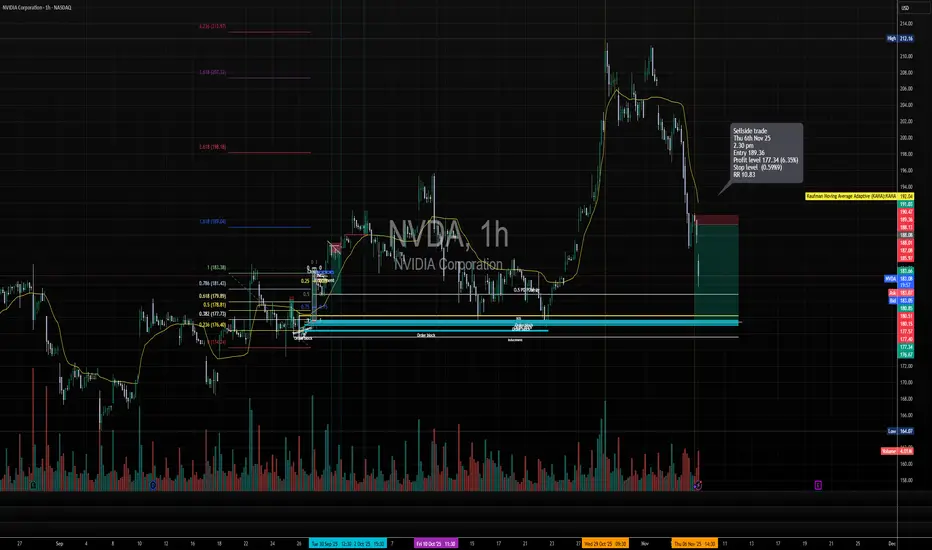
Short trade 📘 Trade Summary
Pair: NVDA (NASDAQ)
Direction: Sell-side Trade
Date: Thu 6 Nov 25
Time: 2:30 pm
Entry: 189.36
Profit Level: 177.34 (+6.35%)
Stop Level: 189.99 (–0.59%)
Risk-Reward (RR): 10.83
🧩 Technical Context
Price Structure: Market rejected near the previous swing high (~$197–$200 region) after failing to sustain above the 1.618 extension level.
Fibonacci Context: Retracement zones from 0.382 – 0.786 aligned with prior accumulation zones, showing resistance at 0.618 (≈ 179.89) and 0.786 (≈ 181.43).
Order Block Alignment: Two visible order blocks (highlighted in blue) show prior demand zones — price is expected to retrace into these for potential take-profit liquidity.
Volume Spike: Noticeable volume at the rejection candle near $190–$191 indicates institutional sell orders stepping in.
EMA Context: Price fell below the Kaufman Adaptive Moving Average (KAMA), confirming a short-term shift to bearish momentum.
🧠 Trade Narrative
This short setup capitalises on:
A failed breakout at the prior liquidity high (~$197),
Break of structure (BOS) confirming downside shift, and
Entry at the retest of a supply zone near $189.
Targeting liquidity sweep of prior accumulation zone around $177, where confluence with the lower order block exists.
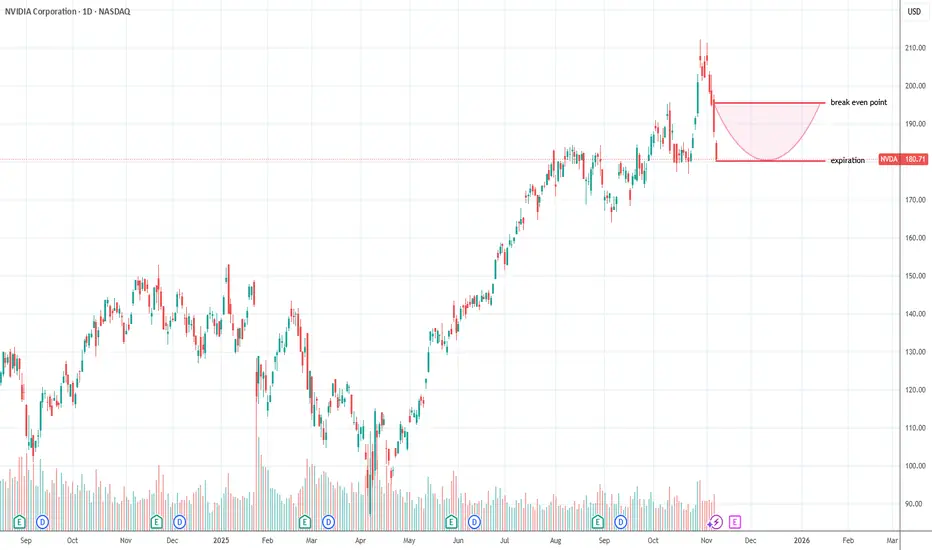
Nvidia Corp.($NVDA) Drops as U.S. Blocks AI Chip Sales to China Nvidia Corp. (Nasdaq: NASDAQ:NVDA ) shares dropped 4.18% to $180.22 on Friday after reports that Washington will block the company’s sales of scaled-down AI chips to China. The decision marks another escalation in U.S. restrictions on advanced semiconductor exports.
According to The Information, the White House informed several federal agencies that Nvidia will not be allowed to sell its new B30A AI chip to Chinese firms. Nvidia had already provided samples to some customers in China before the ban was confirmed.
The B30A was designed to meet U.S. export thresholds while retaining enough computing power for AI training when used in large clusters. However, U.S. officials reportedly concluded that the chip still poses national security risks.
Compounding Nvidia’s challenges, Beijing has issued new guidelines restricting foreign chips in state-backed data centers. Reuters reported that China will require all new projects using government funding to rely solely on domestically developed processors. Data centers less than 30% complete must remove foreign chips, while advanced projects will face case-by-case reviews.
Technical View
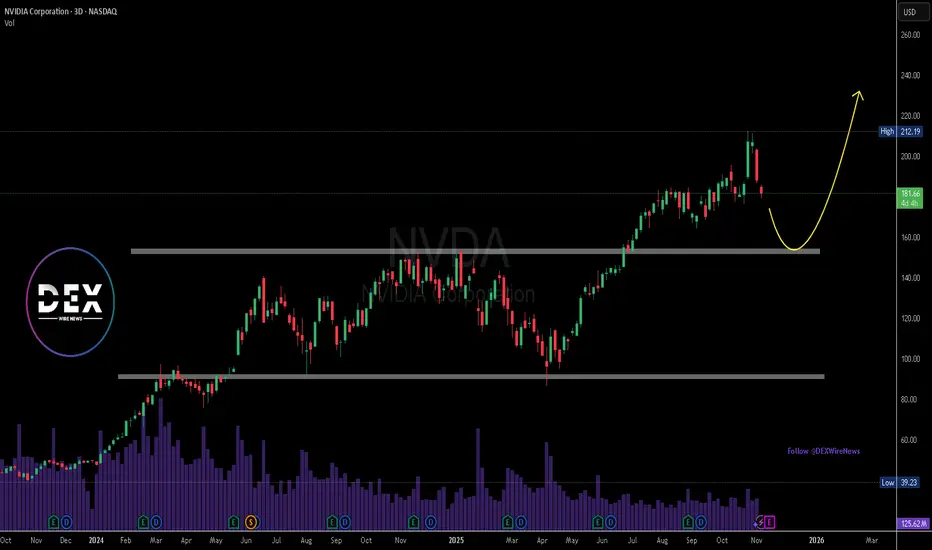
The NVDA chart shows a recent rejection from the $212 level, with price sliding toward $180. A further decline toward $160 support is possible before a rebound, as indicated by the yellow curve. Long-term structure remains bullish, but near-term weakness persists under regulatory pressure
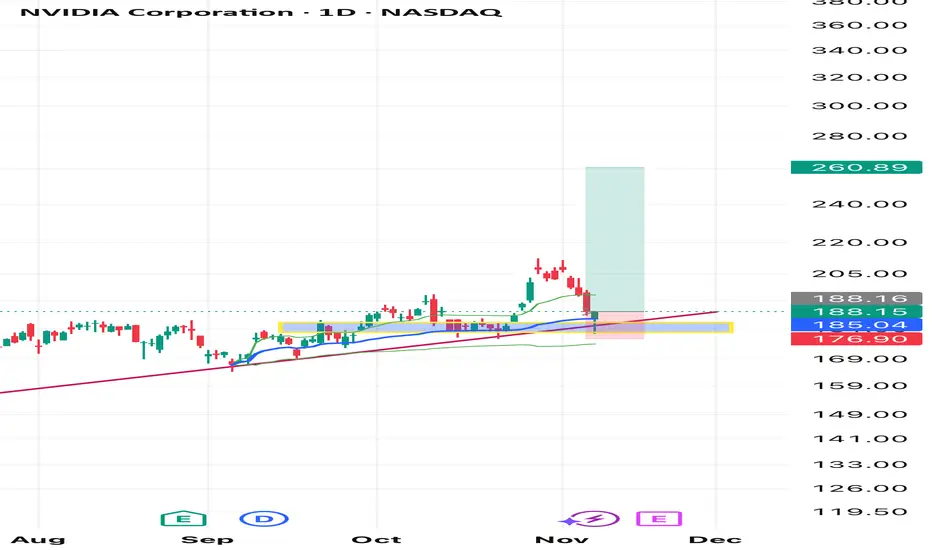
NASDAQ:NVDA — pre-earnings Swing Trade Breakdown💰 NVDA — Swing Trade Breakdown
Ticker: NASDAQ:NVDA
Duration: Short-term swing (pre-earnings setup, ~12 days before report)
🏢 Company Snapshot
NVIDIA is the global leader in GPUs and AI computing hardware. The stock remains a momentum anchor in the semiconductor space, benefiting from continued AI data-center demand and strong cash flow expansion. Current setup follows a steep pullback — RSI(2) at 6.32, signaling short-term exhaustion and potential bounce zone.
📊 Fundamentals
P/E: ~56× (vs ~35× industry average) → Premium valuation justified by hyper-growth.
P/B: ~48× → Reflects asset-light, high-margin structure.
Debt/Equity: ~0.09 → Very low leverage, excellent balance sheet.
ROE: > 100 % → Exceptional profitability.
Dividend Yield: 0.02 % → Pure growth focus.
Free Cash Flow: ~$72 B TTM → Strong liquidity and reinvestment potential.
Cash on Hand: High, current ratio ~4.2× → Excellent short-term flexibility.
Summary: Outstanding profitability and balance sheet strength, but valuation remains stretched.
📈 Trends & Catalysts
Revenue Growth: +60 % YoY (AI infrastructure and data-center demand).
EPS Trend: Rising sharply with margin expansion.
Cash Flow Trend: Explosive FCF growth — from ~$4 B (2023) to ~$60 B (2025).
Balance Sheet: Minimal debt, huge cash reserves.
Catalysts: Upcoming earnings (~12 days), AI build-out momentum, tech rotation inflows.
Risks: Elevated valuation, potential multiple compression post-earnings, high beta (~2.1).
🪙 Industry Overview
Semiconductors remain one of the strongest global sectors.
Weekly: Up ~2-4 % — rotation into large-cap AI plays.
Monthly: Up ~8-12 % — capital inflows favoring high-growth tech.
12-Month: Strong outperformer vs. S&P; macro driven by AI demand cycle.
📐 Technicals
Price: ~$188.08
50-SMA: ~175 – 180 → currently testing zone.
200-SMA: ~145 – 150 → long-term uptrend intact.
RSI(2): 6.32 → extremely oversold, near reversal zone.
Pattern: Short-term consolidation after parabolic run; possible breakout retest.
Support: $165 – 175
Resistance: $205 – 215
Volume: Watch for accumulation spikes near support for confirmation.
🎯 Trade Plan
Entry Zone: $180 (buy near support on strength confirmation).
Stop Loss: $175 (below key support / invalidation).
Target: $190 (first swing resistance).
Risk/Reward: ~2:1 if entered near $180.
Alternate Setup: Continuation breakout > $215 for momentum traders.
🧠 My Take
NVDA remains the king of AI momentum. Fundamentally bulletproof, technically oversold, and sitting on key support ahead of earnings. Ideal setup for a 2:1 swing bounce — but exit before the earnings date to avoid volatility risk. Watching for a reversal candle or volume confirmation near the 50-SMA zone.
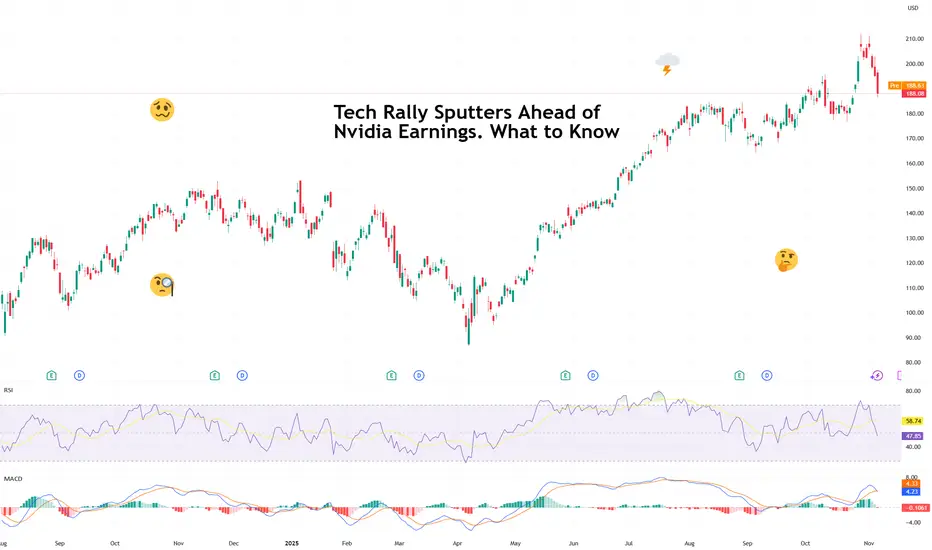
Tech Rally Sputters Ahead of Nvidia Earnings. What to KnowIs the powerful AI sector finally out of breath? With valuations that stretched, some investors fear if we all took it too far.
After months of seemingly unstoppable gains, the tech trade is finally showing signs of fatigue. Stocks are back in the red this week, with technology — the sector that’s carried the entire market on its silicon shoulders — leading the declines.
The S&P 500 SP:SPX , up more than 35% since its April lows and boasting 36 record closes this year, has been powered almost entirely by a handful of tech heavyweights.
The Magnificent Seven now make up nearly 40% of the index’s market value and roughly a third of its earnings.
But now, investors are wondering if the rally’s run too far, too fast. The question echoing across trading desks: Is AI finally out of breath?
💸 The Price of Perfection
It’s not that tech earnings have been bad — in fact, they’ve been stellar. Microsoft NASDAQ:MSFT , Amazon NASDAQ:AMZN , Meta NASDAQ:META , and Alphabet NASDAQ:GOOGL all beat expectations last week and promised even more AI spending next year. Translation: more orders for Nvidia’s chips, more data centers, more server farms, more everything.
But good news isn’t moving the needle right now. When valuations stretch this far, even “great” can start to look “meh.” Investors are realizing that the higher you climb, the thinner the air gets.
The entire AI complex — from semiconductors to cloud computing — now trades at multiples that assume not just perfection, but sustained, exponential perfection. And that’s a tough sell when rates are still relatively high, inflation is sticky, and the Fed remains data-deprived thanks to a looming government shutdown (now the longest in history).
🧠 Nvidia: The Market’s Favorite Crystal Ball
Which brings us to Nvidia NASDAQ:NVDA — the stock that can save the day. The chipmaker reports fiscal third-quarter earnings on November 19, and it’s shaping up to be a defining moment for the entire market.
Expectations are sky-high: analysts see earnings per share of $1.25, up from $0.81 a year ago , and revenue of $54.6 billion, a jaw-dropping 56% increase from last year’s $35 billion.
If Nvidia delivers (again), it could reignite the rally and remind investors why they fell in love with AI in the first place. But if there’s even a hint of deceleration — a cautious forecast, a whisper of supply constraints — the selloff could accelerate.
Simply put: as goes Nvidia, so goes the market. Fast fact: Nvidia washed out more than $450 billion from its valuation in just the last three days .
🔌 The Waiting Game
With two long weeks until Nvidia’s report, traders are stuck in a sort of limbo. Without a fresh catalyst, the market could decide to churn sideways — or drift lower — as profit-takers cash in on their massive gains.
The uncertainty isn’t helping either. A government shutdown delays key economic data, leaving the Fed flying in the dark just as investors are trying to gauge when rate cuts might actually arrive.
That means more guesswork, less conviction, and a good chance of exaggerated market swings.
So don’t be surprised if volatility ticks higher before Nvidia’s big reveal — the gem of the earnings calendar .
Off to you : How do you see the next two weeks unfolding? And, more importantly, are you bullish or bearish on Nvidia’s earnings report?
Nvidia: Acceleration Toward New Highs Nvidia gained strong upward momentum shortly after our last update, surging past the $196.45 mark, which had previously served as resistance. As a result, our prior short-term alternative scenario was triggered, and we have now adjusted the chart accordingly (with minor modifications). We now view the green wave as complete and believe that the joint top of green wave and beige wave III, as well as the low of wave IV, have already been established. The Target Zone we had initially set for the wave- low has therefore been removed. In our updated short-term alternative scenario, we still see a 30% probability of a new low for beige wave alt.IV below the $176.21 support level. In this case, however, price would likely rebound above the lower $145.50 level.
NVIDIA STOCKS TECHNICAL DETAILS FOR AI STOCKS NVIDIA.
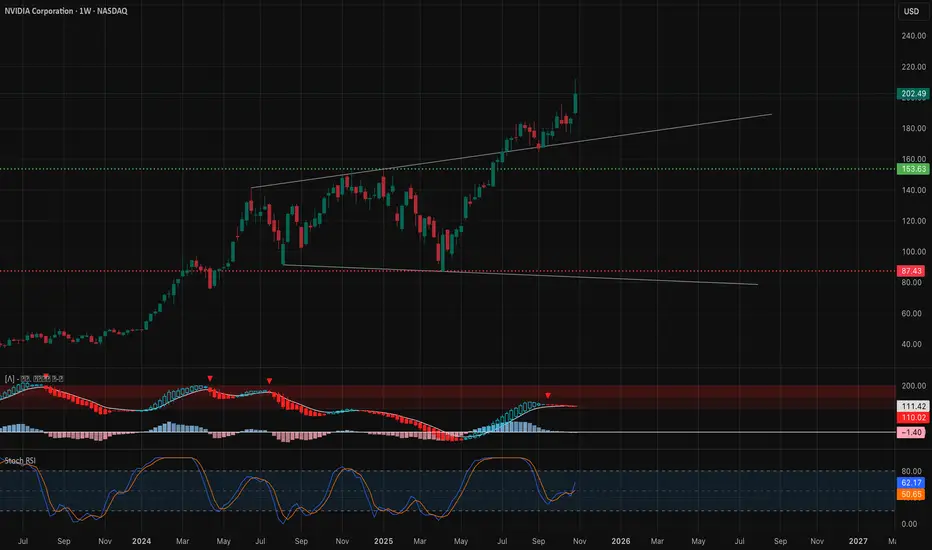
AFTER A RALLY COMES A CORRECTION TO KEEP A HEALTHY TREND.NVIDIA WEEKLY REJECTION LEVEL AT 213$ WILLHAVE THE FIB 0.382 (165.32$) DEMAND FLOOR WATCHED FOR POTENTIAL BUY.
THE NEXT DEMAND FLOOR IS 50% FIBONACCI 150.52$ A STRONG PSYCHOLOGICAL DEMAND FLOOR AND THE WEEKLY SMA 50 PROVIDING BUY BIAS. TO THE NEXT DEMAND FLOOR AT 150.52$ FOR NVIDIA .
FUNDAMENTAL OUTLOOK.
Reasons for Recent Stock Drop:
Concerns over valuation: The stock trades at a high forward P/E (~59x), raising worries about near-term growth sustainability.
Competitive pressures: Emerging competitors (e.g., AMD, Intel) and Chinese startups with cost-effective AI models (like DeepSeek) create market uncertainties.
Regulatory and geopolitical risks: US export restrictions on advanced AI chips may constrain NVIDIA’s international growth.
Profit margin pressure: Expectations of tighter profit margins due to accelerated rollout of new chip architecture (Blackwell).
Broader tech sector pullbacks driven by rising bond yields and inflation fears have also weighed on NVIDIA.
Overall, while NVIDIA's long-term outlook in AI remains positive, short-term market dynamics including valuation concerns and increased competition caused the stock to retreat after reaching highs near $213.
#STOCKS #NVIDIA
NVDA Wave Analysis – 5 November 2025
- NVDA reversed from resistance area
- Likely to fall to support level 193.75
NVDA recently reversed from the resistance area between the key resistance level 210.00 (which stopped the previous impulse wave i), resistance trendline of the daily up channel from June and the upper daily Bollinger Band.
The downward reversal from this resistance area started the active short-term ABC correction ii – which belongs to wave iii from last month.
Given the strength of the resistance level 210.00 and the bearish divergence on the daily Stochastic indicator, NVDA can be expected to fall to the next support level 193.75, former resistance from the start of October.
Inflation and Interest Rates Impact in the Global Market1. Understanding Inflation and Interest Rates
Inflation refers to the sustained increase in the general price level of goods and services over time. It reduces the purchasing power of money—meaning each unit of currency buys fewer goods than before. Moderate inflation is a sign of economic growth, while excessive inflation (hyperinflation) can destabilize economies.
Interest rates, on the other hand, represent the cost of borrowing money. They are typically set by a country's central bank, such as the U.S. Federal Reserve (Fed), the European Central Bank (ECB), or the Reserve Bank of India (RBI). When inflation rises, central banks usually raise interest rates to control it; when inflation falls, they lower rates to stimulate borrowing and investment.
2. The Relationship Between Inflation and Interest Rates
The link between inflation and interest rates is both direct and inverse:
When inflation increases, central banks raise interest rates to slow down demand and stabilize prices.
When inflation decreases, interest rates are lowered to encourage spending and investment.
This balancing act aims to maintain price stability without hurting economic growth. However, in a globally connected economy, these changes affect not just domestic markets but also cross-border trade, capital flows, and investment sentiment.
3. Impact on Global Financial Markets
a. Stock Markets
Inflation and interest rates play a major role in determining stock market trends.
High Inflation: When inflation is high, companies face higher input costs (such as raw materials and wages), which reduce profit margins. Investors may anticipate lower earnings and reduce exposure to equities, causing stock prices to fall.
Rising Interest Rates: As borrowing becomes more expensive, businesses cut down on expansion plans, and consumers reduce spending. This lowers corporate revenues and earnings, leading to a bearish market.
For example, in 2022, the U.S. Federal Reserve’s aggressive rate hikes to curb inflation caused major global indices like the S&P 500 and NASDAQ to decline sharply. Technology and growth stocks were particularly affected due to their dependency on low borrowing costs.
b. Bond Markets
Bond prices and interest rates move in opposite directions.
When interest rates rise, the yields on newly issued bonds become more attractive, leading to a decline in the prices of existing bonds.
When rates fall, older bonds with higher yields gain value.
Global investors often shift between bonds and equities depending on the interest rate environment. For instance, when inflation is high and rates rise, investors may prefer short-term bonds or inflation-protected securities.
c. Currency Markets (Forex)
Inflation and interest rates significantly affect currency values.
A country with high interest rates often attracts foreign investors seeking higher returns, leading to currency appreciation.
Conversely, high inflation tends to devalue a currency, as its purchasing power erodes.
This dynamic can create volatility in foreign exchange markets. For example, the U.S. dollar typically strengthens when the Federal Reserve raises rates, as global investors move capital to dollar-denominated assets.
d. Commodity Markets
Commodities such as gold, oil, and agricultural products are closely tied to inflation trends.
High Inflation: Commodities often rise in price because investors use them as a hedge against inflation. Gold, for instance, tends to perform well when inflation is high or when real interest rates are negative.
Interest Rate Hikes: Higher interest rates can reduce demand for commodities by strengthening the currency and making holding physical assets less attractive.
In 2022–2023, oil and gold prices fluctuated heavily in response to inflationary pressures and central bank rate adjustments worldwide.
4. Impact on International Trade and Investment
a. Trade Balances
Inflation can affect a country's trade competitiveness. When domestic prices rise faster than those of trading partners, exports become more expensive, reducing demand from foreign buyers. Meanwhile, imports may become cheaper, worsening the trade balance.
Interest rates also influence trade. Higher rates tend to strengthen the domestic currency, making exports less competitive and imports cheaper—again, affecting trade dynamics.
b. Foreign Direct Investment (FDI)
Global investors closely monitor inflation and interest rate trends before committing capital.
Stable inflation and moderate interest rates attract long-term investment, as they indicate economic predictability.
High inflation and volatile rates discourage FDI due to uncertainty about future returns and exchange rate risks.
For example, emerging markets like India or Brazil attract foreign capital when inflation is under control and real interest rates are favorable.
5. Impact on Emerging and Developed Economies
a. Developed Economies
In advanced economies like the U.S., Japan, or the Eurozone, central banks use sophisticated tools to manage inflation and interest rates. However, global shocks—such as the COVID-19 pandemic or energy price spikes—can still cause inflationary surges that ripple through global markets.
Rising rates in these economies often lead to capital outflows from emerging markets as investors seek safer returns in stable currencies. This can cause volatility in developing countries’ stock and bond markets.
b. Emerging Markets
Emerging economies are more vulnerable to inflation and interest rate fluctuations because they rely heavily on foreign investment and imported goods. When global interest rates rise, these countries face higher borrowing costs and currency depreciation.
For instance, when the U.S. Federal Reserve increases rates, countries like India, Indonesia, or South Africa often experience currency pressure and foreign capital outflows. This impacts their stock markets and economic growth prospects.
6. Central Bank Strategies and Global Coordination
Central banks play a crucial role in managing inflation and interest rates. Major institutions such as the Federal Reserve, European Central Bank, Bank of England, and Bank of Japan use tools like:
Open market operations (buying or selling government bonds)
Reserve requirements
Policy interest rate adjustments
Global coordination among central banks is often necessary to avoid severe currency fluctuations or market shocks. For instance, during the 2008 financial crisis and the 2020 pandemic, major central banks collaborated to maintain global liquidity and stabilize financial systems.
7. Long-Term Implications for Global Markets
The long-term impact of inflation and interest rate movements includes:
Shift in Investment Strategies: Investors move between asset classes (equities, bonds, commodities) depending on rate trends.
Corporate Debt Management: Companies may restructure their debt portfolios to minimize interest burdens.
Economic Growth Patterns: Prolonged high rates may slow global growth, while ultra-low rates risk creating asset bubbles.
Policy Dilemmas: Central banks must balance fighting inflation with avoiding recession—a challenge seen frequently in recent years.
8. Conclusion
Inflation and interest rates act as the twin levers of the global economy. Their interplay determines the rhythm of economic growth, the flow of international capital, and the behavior of financial markets. While moderate inflation and balanced interest rates indicate a healthy economy, extreme conditions—either high inflation or rapid rate hikes—can trigger global instability.
For investors and policymakers, understanding this relationship is crucial. A rise in inflation signals the need for vigilance in portfolio management and monetary policy, while changing interest rates dictate shifts in market behavior across sectors and nations. In an interconnected world, the effects of these two forces transcend borders, shaping the future of trade, investment, and financial stability worldwide.
NVDA at the $200 BattlefieldThe daily chart of NVIDIA (NVDA) shows that after a sharp rally from around $180, the price is now consolidating near a key resistance zone between $200–$205. This level has previously acted as a major resistance area, and it’s now a critical decision point for the next move.
Short-Term Outlook (next few days to weeks):
In the short term, how the price reacts to the $200 zone will be crucial. The latest candle shows a long upper wick and a close below the day’s high, signaling selling pressure. If the price fails to hold $200, a pullback toward the 50-day SMA near $183 is likely.
However, if NVDA can regain and close firmly above $205, bullish momentum could accelerate, targeting the $215–$220 area next.
• Bullish short-term target: $215–$220
• Bullish stop loss: Below $198
• Bearish short-term target: $185 (near the 50-day SMA)
• Bearish stop loss: Above $206
Long-Term Outlook (1–3 months):
The broader trend remains bullish as the 50-day SMA is sloping upward and price remains above it. Sustained closes above $205–$210 would likely confirm a continuation of the uptrend, potentially leading to new highs around $230–$245.
If the $180 support fails, however, the medium-term structure would weaken, opening the door for a deeper correction toward $160.
• Bullish long-term target: $230–$245
• Long-term stop loss: Below $180
In summary, the $200 level is the market’s decision point — a confirmed breakout above it could spark another leg higher, while a breakdown below may lead to a healthy but notable correction.
Regional Growth Strategies in the Global Market1. Understanding Regional Growth Strategies
A regional growth strategy is a structured plan that focuses on expanding a company’s presence and market share within a specific geographic area—such as Asia-Pacific, Europe, Latin America, or Africa—rather than globally all at once. The strategy involves understanding local consumer behavior, economic conditions, legal frameworks, and cultural norms to align business goals with regional opportunities.
For example, a multinational company might apply different strategies in North America and Southeast Asia, depending on the maturity of markets, consumer preferences, and economic development levels. Regional strategies often integrate global goals with local execution—creating a balance between standardization and localization.
2. Importance of Regional Growth in the Global Market
Global markets are not uniform. Every region has unique growth potential and challenges. Companies that focus on regional strategies gain several advantages:
Market Diversification: Expanding regionally helps reduce dependence on a single country or market. For instance, if a business faces a slowdown in Europe, strong demand in Asia can balance overall performance.
Adaptation to Local Needs: Regional strategies allow businesses to adapt their offerings to local cultures, tastes, and regulations, increasing acceptance and customer loyalty.
Cost Efficiency and Supply Chain Optimization: Regional production hubs can reduce logistics costs and improve efficiency. For instance, companies may set up manufacturing in Southeast Asia to serve Asia-Pacific markets.
Regulatory Compliance: Understanding and aligning with local rules and trade policies help avoid legal risks and penalties.
Competitive Advantage: A company that understands local consumer behavior and cultural nuances gains an edge over global rivals that use one-size-fits-all approaches.
Thus, regional growth strategies are not just about expansion—they are about sustainable adaptation and long-term competitiveness.
3. Core Elements of a Regional Growth Strategy
A well-structured regional growth plan typically involves several interconnected components:
a. Market Research and Segmentation
Understanding the market is the first step. Businesses analyze demographic trends, purchasing power, consumer behavior, and local competitors. For example, companies entering India must understand price sensitivity and the growing demand for value-for-money products.
b. Localization of Products and Services
Localization goes beyond language translation. It involves adapting products to suit regional preferences. For instance, McDonald’s offers McSpicy Paneer burgers in India and Teriyaki burgers in Japan, catering to local tastes.
c. Strategic Partnerships and Alliances
Local partnerships—such as joint ventures or distribution alliances—help global firms navigate regulatory and cultural complexities. Partnerships also provide access to established networks and regional expertise.
d. Supply Chain and Infrastructure Development
Building regional supply chains ensures faster delivery and lower costs. For instance, automobile companies often establish regional assembly plants to meet local demand efficiently.
e. Branding and Marketing Adaptation
Marketing strategies should reflect regional culture, values, and communication styles. For example, Coca-Cola’s campaigns in Asia often emphasize community and celebration, aligning with cultural values.
f. Regulatory and Policy Alignment
Businesses must understand trade laws, tariffs, and regional trade agreements like ASEAN, EU, or NAFTA (now USMCA). Complying with local policies is key to smooth operations.
4. Types of Regional Growth Strategies
Different approaches are used depending on company goals, market maturity, and competition levels:
a. Market Penetration Strategy
Focusing on increasing market share within an existing regional market through pricing strategies, promotions, or better customer service.
b. Market Development Strategy
Introducing existing products into new regional markets. For instance, a European skincare brand entering Middle Eastern markets.
c. Product Development Strategy
Developing new or modified products to fit regional needs. For example, Samsung designs region-specific smartphone models based on network availability and local preferences.
d. Diversification Strategy
Entering new regions with entirely new products or services. This approach is riskier but can lead to higher rewards in emerging markets.
e. Regional Hub Strategy
Establishing a key operational hub (for example, Singapore for Southeast Asia or Dubai for the Middle East) to coordinate and manage operations across multiple countries.
5. Challenges in Implementing Regional Growth Strategies
While regional expansion offers great potential, it also presents significant challenges:
Cultural Barriers: Misunderstanding local customs and consumer behavior can lead to marketing failures or brand rejection.
Regulatory Complexity: Each country has its own laws, tax systems, and labor regulations that complicate operations.
Political Instability: In some regions, political changes or conflicts can disrupt business continuity.
Infrastructure Gaps: Emerging regions may lack efficient transportation or technology infrastructure, affecting supply chains.
Currency and Economic Risks: Fluctuations in exchange rates and inflation can affect profitability.
Talent Management: Recruiting and retaining skilled employees with regional expertise can be difficult.
Successful firms must anticipate and manage these risks through careful planning and local engagement.
6. Successful Examples of Regional Growth
Apple in China and India
Apple has strategically localized its regional operations in Asia. It opened retail stores in major Indian cities, offered region-specific financing options, and even began assembling iPhones locally to reduce import taxes. This regional approach improved affordability and expanded market reach.
Toyota in North America
Toyota localized production in the United States and Canada, adapting car designs to local preferences and regulatory standards. This reduced costs and built a strong regional brand image.
Netflix in Latin America and Asia
Netflix produces regional content like Korean dramas and Indian web series, reflecting cultural preferences and expanding its subscriber base. This localization has been key to its global dominance.
7. The Role of Digital Transformation in Regional Growth
Technology plays a vital role in modern regional strategies. Digital platforms enable companies to understand consumer data, predict trends, and market products regionally.
E-commerce platforms like Amazon or Alibaba use data analytics to tailor regional offers.
Social media marketing allows precise targeting of regional audiences.
Digital payment systems and mobile apps make products accessible in regions with developing banking systems.
The integration of technology allows companies to achieve scalable, efficient, and localized growth.
8. Future Outlook for Regional Strategies
As global markets become more interconnected yet regionally diverse, companies will increasingly adopt “glocalization”—thinking globally but acting locally. Regional trade blocs, sustainability goals, and digital ecosystems will shape the next phase of growth.
Businesses that blend global expertise with regional sensitivity will thrive in this evolving landscape. Emerging markets in Asia, Africa, and Latin America will continue to offer high-growth potential, while digital tools will make regional adaptation faster and smarter.
Conclusion
Regional growth strategies are at the heart of global business success. They enable companies to bridge the gap between global ambitions and local realities by understanding regional diversity and adapting operations accordingly. Through careful research, localization, partnerships, and technological integration, businesses can capture regional opportunities and build long-term competitiveness. While challenges exist—from cultural barriers to regulatory complexity—firms that master regional strategies not only expand their market reach but also create stronger, more resilient global brands.
NVDA-Bulls Defend Trendline Into Gamma Week (Nov. 3–7)NVDA Weekly Squeeze Setup 🔥
WEEKLY TIMEFRAME ANALYSIS
1. Market Structure
NVDA remains in a strong macro uptrend on the weekly. Recent BOS confirmations to the upside are intact, and the latest pullback retested the long-term ascending trendline perfectly. We’ve seen a subtle CHoCH attempt in prior weeks, but buyers stepped in aggressively on structure breaks. Liquidity remains stacked below around $153–$160, and smart money continues defending dips rather than chasing breakouts — a healthy sign of accumulation rather than distribution.
2. Supply & Demand / Order Blocks
There’s a key demand pocket sitting around $180–$190 from previous imbalance fills. The closest unmitigated bullish order block lives near $153 — that’s the nuclear level if we ever wash out. On the supply side, overhead inefficiency spans between $220–$230, where sellers historically rotate in. If price pushes into that region with thin volume, expect reactions.
3. Indicator Confluence
The 9EMA remains firmly above the 21EMA with a positive slope, confirming trend continuation. MACD histogram is still green, though showing early signs of momentum slowing — not reversal. RSI is elevated, but not at exhaustion levels. Weekly volume looks constructive; we’re not seeing blow-off distribution.
4. Weekly Tone
As long as NVDA stays above the weekly trendline near $195, bulls maintain control. Break below that, and things could get uncomfortable fast. The structure favors continuation, but expect profit-taking wicks.
DAILY TIMEFRAME ANALYSIS
1. Market Structure
Daily structure flipped bullish after a clean BOS from the prior swing high. The recent pullback respected support at $195.62 and reclaimed structure. Liquidity is still stacked at $190 and $184 — levels shorts would love to hunt. Smart money tends to dip price into these zones before running it into fresh highs.
2. Supply & Demand / Order Blocks
There’s a visible demand block at $184–$190 that has been tapped, but not fully mitigated. Supply overhead sits around $212–$217, which aligns with prior liquidity sweeps. If price pushes into that band with increasing volume, we could see continuation; otherwise, emotional wicks can form.
3. Indicator Confluence
9EMA curling sharply upward over the 21EMA — textbook bullish engine. MACD histogram shows expansion but with minor slowing bars; keep an eye on that slope. RSI remains healthy around mid–upper band, signaling momentum not overheated. Volume expansion shows the buyers aren’t exhausted yet.
4. Daily Tone
Bulls want to keep price above $200 to avoid gamma pressure on the downside. Below $198, we start inviting liquidity hunts.
15–MINUTE INTRADAY STRUCTURE
1. Market Structure
Short-term structure on 15m printed a CHoCH followed by BOS continuation into the closing session. We now have a small wedge structure forming just above intraday liquidity around $202.08–$202.36. If bulls defend these micro OBs, we can see a morning leg up.
Weak hands got shaken near $201, and smart money collected stops. Classic intraday accumulation profile.
2. Supply & Demand / Order Blocks
Demand sits at:
• $202.30–$202.60
• $201.80–$202.10
Below that? $199–$200 is the bigger reload pocket.
Supply zones to watch:
• $204.75–$205.10
• $207.90–$208.20
Everything in between is chop bait.
3. Indicator Confluence
9EMA trying to curl back up toward 21EMA. MACD histogram contracting to flat — sign of potential inflection. RSI pushing toward mid-band, which usually favors a scalp bounce early session if defended.
4. Intraday Tone
Expect a morning decision candle. If bulls can take $204.75 clean, we likely rotate into the $207 liquidity pocket.
GEX (Gamma Exposure) & OPTIONS SENTIMENT
Options flow favors call-side interest, with meaningful call walls stacked at:
• $210
• $217.5
• $220
Gamma walls often behave like magnets when price gets within 1–2%.
Noteworthy negative gamma sits lower at:
• $179–$180
If NVDA ever flushes below $195, dealers must hedge into downside momentum — accelerating moves. Conversely, above $205, dealer hedging acts as fuel for upside squeezes.
Max pain appears around $200 — this explains why price has gravitated around this area into the weekend.
How to use this:
• Above $205 → scalp continuation long into $207–$210.
• Below $200 → volatility spikes, favor puts.
Expect volatility compression between $200–$205 early week, then a directional release.
TRADE SCENARIOS (Nov. 3–7)
✅ Bullish Setup
Trigger: Break and hold above $204.75
Entry: Retest of $204.40–$204.60
Targets: $207.80 → $210 → potential wick into $217
Stop: Below $202.50
Invalidation: 15m CHoCH to downside at $202.10.
✅ Bearish Setup
Trigger: Break below $200 with heavy volume
Entry: Retest of $200–$200.30
Targets: $195.60 → $190 liquidity sweep
Stop: Above $202.50
Invalidation: reclaim of $204.75.
CLOSING OUTLOOK
This week sets up like a controlled grind with pockets of volatility. If bulls defend $200–$202 early, it can ignite a squeeze toward $210 and possibly tap the $217 gamma pocket. Failure at $200, especially with broad market weakness, flips this into a liquidity hunt down to $190.
Personally, I’m watching for liquidity traps around $202 early week — if I see absorption, I’ll lean long into call walls. But if we reject from $204.75 again with declining volume, expect a fast unwind.
DISCLAIMER
This analysis is for educational purposes only and does not constitute financial advice. Always manage risk and trade based on your own plan.
NVDA Bull Flag: Breakout Toward 220–230NVDA’s 1D chart remains firmly bullish. Price cleared the ~$195 “BOS” and pushed to fresh highs above $205, with MA20 > MA60 > MA120 and widening bands supporting momentum. The near-term map is clear: Demand sits around $183 (former ceiling turned floor), while supply is forming at the new swing high near $209.50.
Primary path: I’m looking for continuation on strength. A daily close above 209.50 would confirm buyers in control and opens room toward 220–225, with a stretch scope to 230 if momentum persists. If price hesitates first, a constructive retest of 195–198 (prior breakout area) can serve as the higher-low buy zone—especially if volume firms and intraday closes reclaim $200–203 quickly.
Alternative: Failure to hold recent gains brings a deeper check. A daily close below 203.00 risks a slide toward the $200 psych handle and then $195–198. The broader bullish thesis is invalidated on a decisive daily close below 183.00, which would mark a clear break of structure and shift the bias back to neutral/bearish until reclaimed.
Triggers to watch: daily close > 209.50 for continuation; weakness below 203.00 for a corrective leg. Manage entries around 195–198 or on strength through 209.50, and keep risk tight relative to 203/183 lines. This is a study, not financial advice. Manage risk and invalidations.
Nvidia Daily Outlook!NVDA is in an uptrend! Those who are already holding the stock can use $200 as a stop loss for short-term traders. Long-term traders can use $176 as a stop loss if the price falls below $176, it breaks below the short-term channel, which could push the price down first to the 200-day EMA(156.50$) and then to the horizontal support around $150.
For those looking to make additional or new entries, they should wait for $183 and place a stop loss just below that level.
I can’t predict whether it will go up or down I’m not a fortune teller :)) but this is what the technical analysis suggests.
Good luck and profitable trades! This is not financial advice.