Trade ideas
Gold (GC1!) Forecast: The Squeeze & Release Path via DSRTL MatriCategory: Trend Analysis / Chart Patterns
Symbol: GC1! (Gold Futures)
In this analysis, we use the DSRTL-ML (Dynamic Support & Resistance) engine to map the current structural context for Gold. The indicator is tagging the state as “TESTING RES – Bias: Neutral”, highlighting a consolidation phase right underneath a major resistance band. Structurally, this is a spot where static friction meets dynamic momentum.
1. The Current Structure: Compression Phase
The Matrix currently sits at S2 | D3 (Testing Resistance).
- The Ceiling (Static R): Price is capped by a high-volume resistance node (orange zone: ~4.24K–4.31K), acting as a lid on price action.
- The Floor (Dynamic S): At the same time, the rising DSRTL trend line (dynamic support) is pushing the lows higher inside the channel.
Taken together, this can be viewed as an early ascending-triangle–style squeeze: price is consolidating between a flat static lid and a rising dynamic floor, while DSRTL keeps the official bias neutral and labels the state as a resistance test.
2. Path of Least Resistance
The dashboard shows a positive Net Delta of +8.36K, suggesting that buyers have been active right below the resistance band.
- Projected Path: In the absence of a clear break, price can continue to oscillate within this narrowing pocket between static resistance and the rising channel.
- Breakout Vector: The combination of constructive volume flow and an upward-sloping dynamic channel creates a supportive backdrop if an upside break occurs, even though DSRTL itself still prints a Neutral bias here.
3. Scenario & Structural Objectives
- Trigger: A confirmed close above the top of the Static R band (~4.31K) would move the Matrix out of its S2 “testing” state toward an S1-type breakout environment.
- Next Structural Area: Above that level, the next area of interest becomes the upper rail of the DSRTL dynamic channel (pink line), where the system could start migrating toward its higher “extension” states.
Invalidation:
If price breaks and closes below the rising pink dynamic support, the bullish squeeze thesis is invalidated. In that case, the Matrix would likely rotate toward Neutral/Bearish or Bearish-Pullback configurations, depending on how price interacts with the underlying static support band.
Disclaimer: This forecast is based on structural scenarios derived from the DSRTL-ML engine and is provided strictly for educational and illustrative purposes.
GOLD - H12Since October 27 Gold is recovering into an upward move. The chart is still respecting the Major Blue ascending channel. But recently a new Purple one evolved inside the Blue channel.
The Strong support zone was retested twice pushing the chart into a favorable bullish momentum. The 2nd Support zone is actually being confirmed as solid, right now.
If it holds, we will have a strong upward move inside the purple channel, or a less powerful one potentially respecting the middle blue line. Both Scenarios will be eventually on the way to breach the red zone & making a new Top.
If the actual support zone is weak, Gold will breach down the purple channel, back to the Blue one, closing in again on the Strong Support zone.
I still favor an Upward move even if it might go a bit sideways 1st.
Trade Safe.
Gold | Zone-Based High-RR Long Setup | Bullish BiasGold | Zone-Based High-RR Long Setup | Bullish Bias
I currently carry a bullish bias on Gold. Price is approaching a pre-defined demand zone marked on the chart — this is a reaction area, not a prediction. I only engage after confirmation from within the zone. If the zone holds, continuation toward the marked resistance is expected. If it fails, the idea is invalidated immediately. IT WORKS 90% OF THE TIMES THOUGH!
This setup is independent of session or time. Execution, risk management, and psychology decide the outcome — analysis only provides the framework. Risk is always predefined. No chasing. No emotional trades.
Trade the zone. Manage the risk. Let the market do the rest.
Happy Trading.
Short Covering vs. New Money (Waiting for the Catalyst)COMEX:GC1! COMEX_MINI:MGCG2026 FOREXCOM:XAUUSD
Traders. Mid-week context check as we wait for institutional commitment.
Market Context (The Mechanical Bounce): As noted in the previous update, yesterday's rotation was driven by Short Covering—old money exiting profitable shorts—rather than Initiative Buying (New Money) entering fresh longs.
The Trap: Short covering can lift the auction, but it lacks the sustained energy to break new highs. We are seeing price drift without aggressive volume.
Inventory: We are currently balancing above the Previous Week High (PWH). This zone is holding, but the auction feels "heavy" without fresh inflows.
The Fundamental "Hold" (Why Big Funds are Waiting): "Big Funds" are likely sidelined ahead of the tier-1 data dump. They need clarity before deploying serious capital for the week.
Today (Wed): ADP Payrolls & ISM Services.
Friday: The NFP (Non-Farm Payrolls).
The Reality: Until these numbers drop, we may remain in a "chop" or "balance" phase as institutions hedge rather than commit.
Plan & Execution:
Bias: Slightly Long, strictly conditional on holding above the PWH.
The Trigger: I need to see Follow Through. We need a volume spike (Initiative Buying) to confirm that "New Money" has arrived to defend this breakout.
Caution: If we fail to find acceptance higher and lose the PWH, expect a rotation back inside the previous balance to find liquidity.
Talk to you for the next update.
Liquidation Break & The "New Money" TestCOMEX:GC1! COMEX_MINI:MGCG2026 FOREXCOM:XAUUSD
Following up on the previous context regarding the "Thin Structure Repair."
Market Context (The Repair): As anticipated, the auction corrected lower to repair the thin profile left behind by the holiday drift.
Monday: Developed as a Balance Day, digesting the recent move.
Today: We saw a Liquidation Break early in the session, effectively flushing out weak hands, followed by a rotation back up.
Structure & Inventory (The "Tell"): The current bounce is characteristic of Short Covering (old money exiting winning shorts) rather than Initiative Buying (new money entering longs).
The Trap: Short covering can rally price, but it is mechanical and temporary. It creates a "hollow" move if not supported by fresh volume.
The Requirement: To re-test and break the All-Time Highs, we need to see "New Money" step in. Without this sustained buying flow, the auction will lack the energy to hold higher prices.
Plan & Execution:
Stance: Cautious / Monitoring for flow confirmation.
Scenario A (Bullish): If we see aggressive Initiative Buying absorbing offers above the short-covering highs, we target the ATH.
Scenario B (Bearish): If the rally stalls and "new money" fails to show up, expect the market to rotate deeper to find supportive bids (value) at lower levels.
Talk to you for the next update.
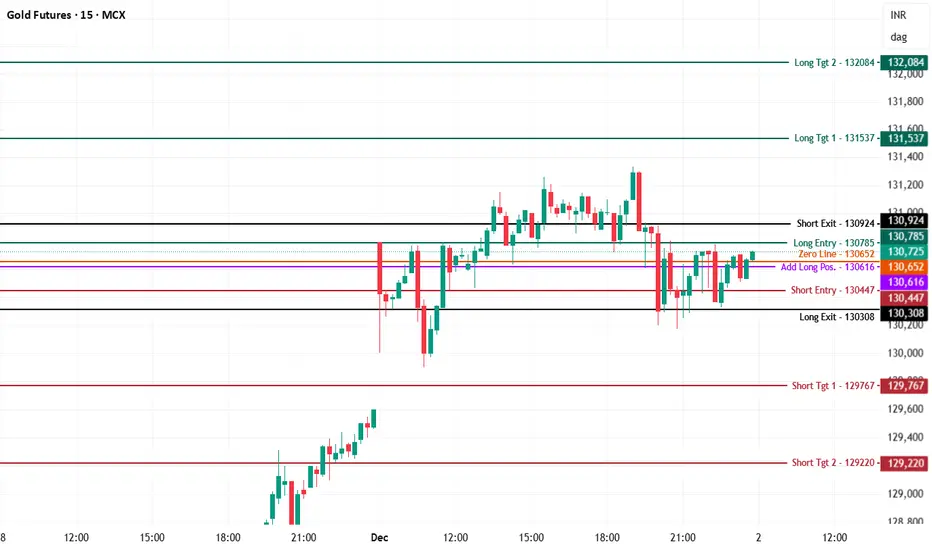
Gold Feb Fut. MCX Intraday Technical Analysis - 2nd Dec., 25MCX:GOLD2!
Gold MCX Futures — Chart Pathik Intraday Levels for 02-Dec-2025
(If these levels add value to your trades, a quick boost or comment goes a long way in supporting this free content and keeping our trading community thriving!)
Gold Futures are trading near 130,725, pushing just above the zero line at 130,652 and testing the Long Entry band at 130,785 after recovering from a sharp intraday dip, signalling an emerging bullish attempt against prior supply. Each comment or share builds the momentum for disciplined, structured analysis across our trading community!
Bullish Structure
Longs activate above the Long Entry level at 130,785, with stronger conviction if price sustains above the zero line at 130,652 and holds the Add Long Position level at 130,616 as support on intraday pullbacks.
Targets: 131,537 (Long Target 1 / primary booking zone) and 132,084 (Long Target 2 / extended upside leg on strong breakout).
Control: Place stop or trail near 130,447–130,308 (Short Entry and Long Exit band) to keep risk defined while bullish structure remains active.
Bearish Structure
Shorts open below the Short Entry level at 130,447 or on clear rejection between 130,785 and the Short Exit supply zone at 130,924 after failed upside attempts.
Targets: 129,767 (Short Target 1 / partial or scalp booking) and 129,220 (Short Target 2 / extended downside if breakdown sustains).
Control: Fast short covers are required back above 130,785–130,924 where bearish structure weakens and trapped shorts risk a squeeze.
Neutral Zone
130,652 is today’s inflection and zero line—expect sideways, noisy moves while gold oscillates between roughly 130,447 and 130,785 without decisive 5-minute closes outside this band.
Every setup is designed for structure, plan, and logic—let the chart work for you, not your emotions.
Boost or comment if these levels help your preparation—help Chart Pathik keep delivering quality analysis to more intraday traders!
How to Trade with Bollinger Bands in TradingViewBollinger Bands are a volatility indicator that helps traders identify market extremes, trend strength, and potential breakout setups by measuring how far price moves away from its average.
What You’ll Learn:
• Understanding Bollinger Bands as a volatility-based trading tool built around a moving average
• How the middle band represents the 20-period simple moving average (SMA)
• How the upper and lower bands are calculated as two standard deviations above and below that SMA
• Why expanding bands signal rising volatility — and tightening bands signal market compression
• Recognizing overbought and oversold conditions when price touches or moves beyond the upper or lower bands
• Why these signals aren’t automatic buy or sell triggers, and how to confirm them with other tools like RSI or MACD
• Identifying the “Bollinger Band squeeze,” a setup that often precedes major breakouts
• Spotting potential mean-reversion trades when price closes back inside the bands after moving outside
• How to add Bollinger Bands on TradingView via the Indicators menu
• Understanding the default settings (20, 2) and how adjusting the period or deviation affects sensitivity
• Practical examples using the E-mini S&P 500 futures chart
• Applying Bollinger Bands across daily, weekly, and intraday timeframes for volatility analysis and signal confirmation
This tutorial is designed for futures traders, swing traders, and technical analysts who want to integrate volatility dynamics into their trading approach.
The methods discussed may help you identify breakout conditions, trend continuation signals, and potential reversal zones across multiple markets and timeframes.
Learn more about futures trading with TradingView:
optimusfutures.com
Disclaimer
There is a substantial risk of loss in futures trading. Past performance is not indicative of future results. Please trade only with risk capital. We are not responsible for any third-party links, comments, or content shared on TradingView. Any opinions, links, or messages posted by users on TradingView do not represent our views or recommendations. Please exercise your own judgment and due diligence when engaging with any external content or user commentary.
This video represents the opinion of Optimus Futures and is intended for educational purposes only.
Chart interpretations are presented solely to illustrate objective technical concepts and should not be viewed as predictive of future market behavior. In our opinion, charts are analytical tools — not forecasting instruments.
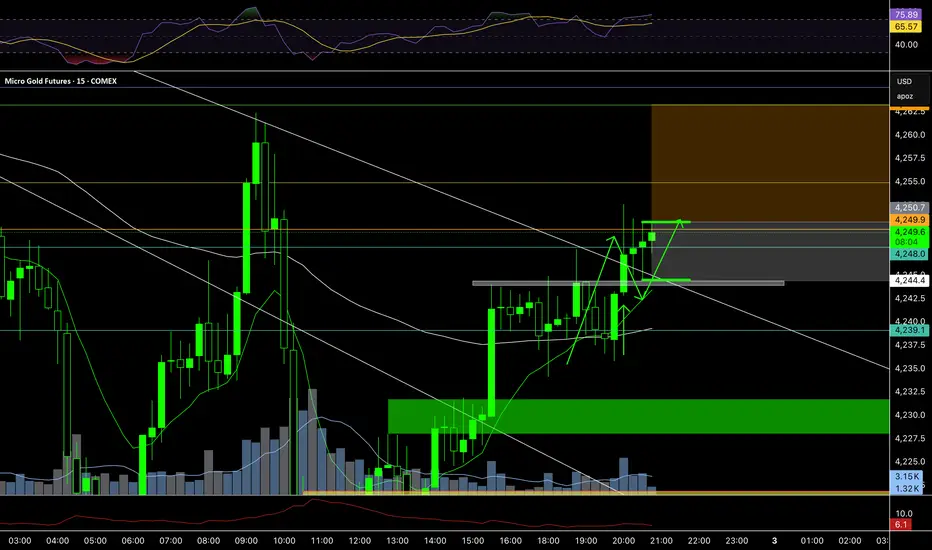
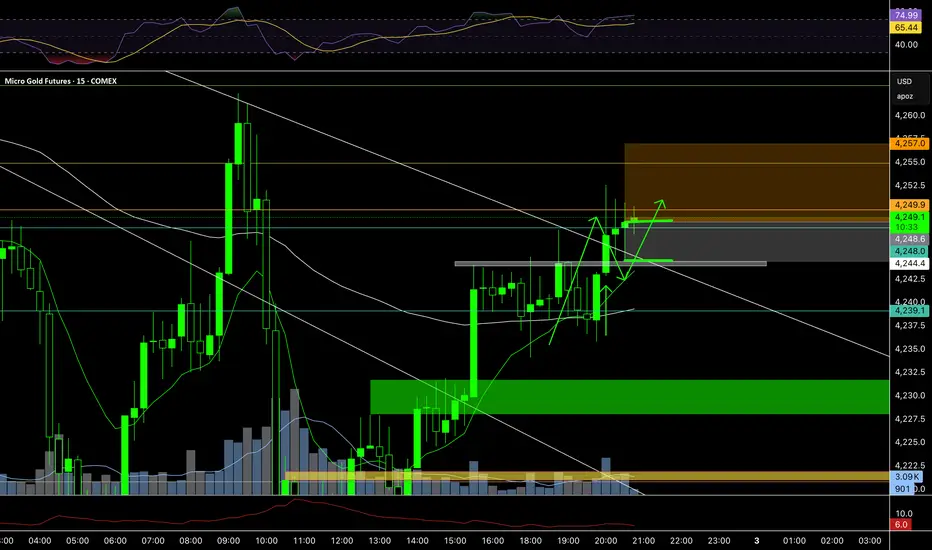
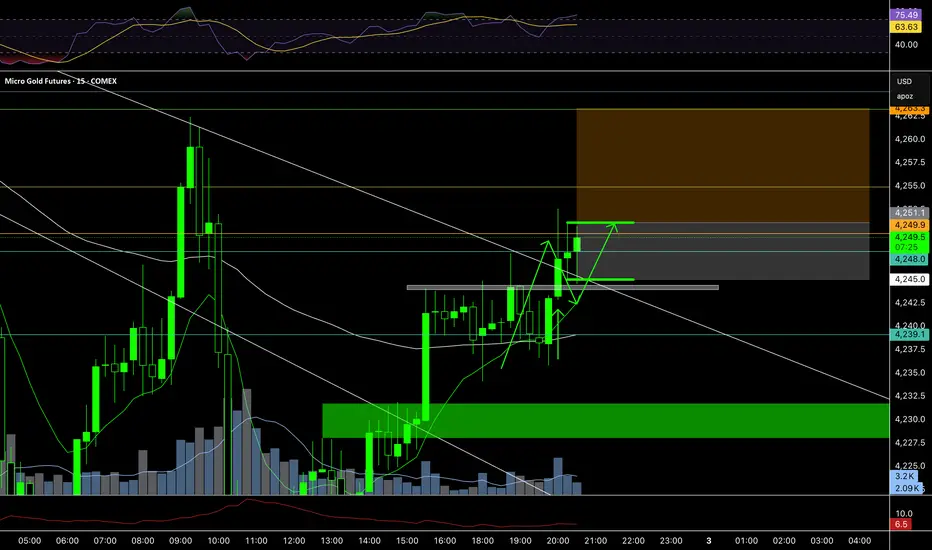
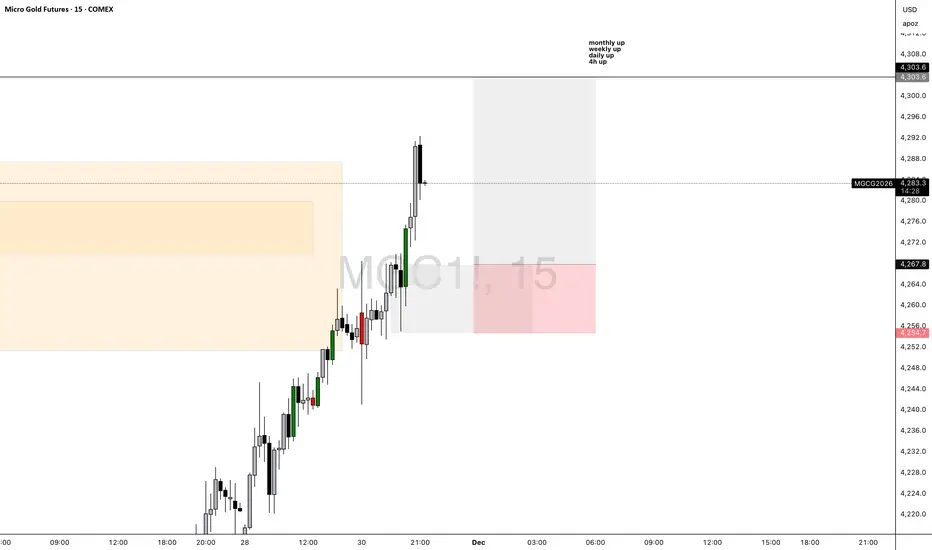
15Min Rally-Base-Rally Long Setup | Daily & 4H Demand in Controlaily and 4H remain bullish with demand in control. Price is reacting at the base of a 15-minute Rally-Base-Rally demand zone that removed opposing 15M supply and is nested within 4H structure.
Despite being high in the range, execution is only for longs in alignment with HTF demand. Patience and risk management first.