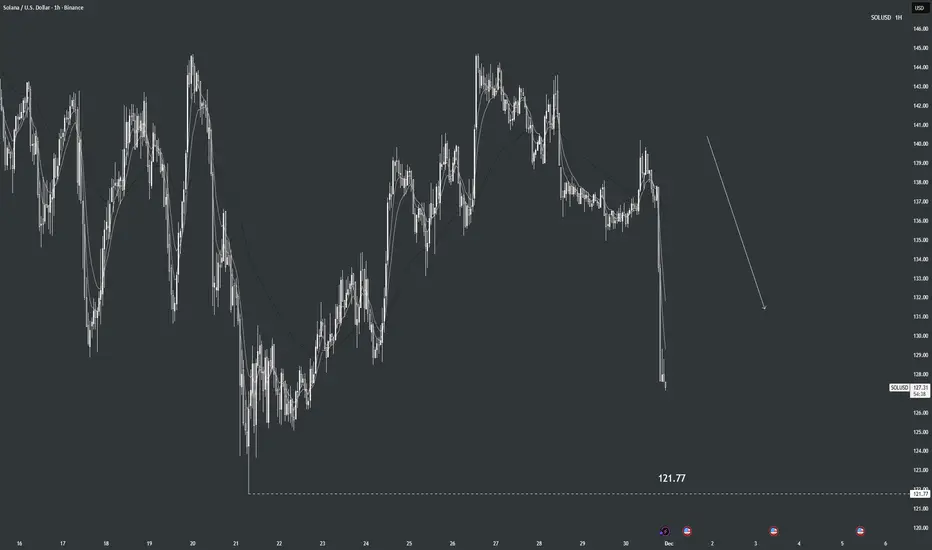
Solana Pay BUY UNDER THE RED LEVELtry this and don't get confused , it's time for a reversal , solana couldn't break under the 127 ; and buyer are getting into the market now Longby thetradinglord284
SOL Daily Outlook | November 30, 2025Timeframe 1 Hour (1H) EMAs Used 5 EMA 10 EMA 50 EMA Market Structure SOL has shifted into a bearish impulse–correction sequence on the 1H chart. Price broke structure to the downside and followed with a sharp impulse lower. The recent correction has failed to reclaim previous highs, and the 5, 10, and 50 EMAs are now aligned bearishly, supporting continued downside movement. What I Want to See I want to see SOL continue this bearish sequence, using any smaller corrections as fuel for the next impulse down. Bias Bearish.by icixbt2
SELLS STILL STRONG..By 30mins time, if that candle stays red, we keep pushing this pair downwards 🍏✨🍏 *TRUST THE SYSTEM*Shortby KCFX-NGN2
bullish momentum solana is in a symtric triangle . entry between 134.8 and 135.3 stop loss 133 tp 144 good luckby kataya1223
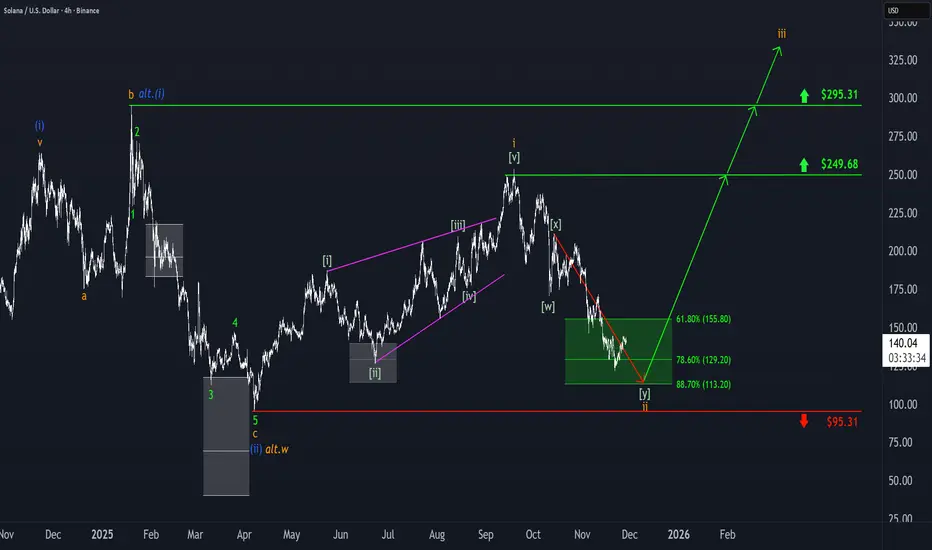
Solana: Is the Bottom In, or More Downside Ahead?SOL has already climbed more than 15% from last Friday’s low at its peak, potentially signaling the completion of wave ii in orange. For now, however, we’re still keeping open the possibility that this move could dip to a new low—within our green Target Zone ($155.80–$113.20). In any case, once this interim correction wraps up, wave iii in orange should kick off an impulsive rally, only losing steam above resistance at $295.31.by HKCM_Global2
Solana: Is the Bottom In, or More Downside Ahead? SOL has already climbed more than 15% from last Friday’s low at its peak, potentially signaling the completion of wave ii in orange. For now, however, we’re still keeping open the possibility that this move could dip to a new low—within our green Target Zone ($155.80–$113.20). In any case, once this interim correction wraps up, wave iii in orange should kick off an impulsive rally, only losing steam above resistance at $295.31.Short00:39by HKCM_Global4
SOL Bleeds Below 130 – Sellers Take Full ControlSolana broke down again, slicing through 130 support after repeated rejections from the 180–220 OB cluster. Structure is fully bearish with no bullish MSB to confirm a reversal. RSI dropped to 36 and MACD just crossed back bearish. This chart screams continuation unless bulls pull off a fast reclaim of 140. Momentum is fading hard. Expect lower prices if trend stays intact. Bias: Bearish Pair: SOL/USDT Timeframe: 12H This is not financial advice, only data analysis. Please consult a qualified financial professional for personalized guidance.Shortby tomas_jntx1
SOLUSDT Holds Support – Eyes on 148–150 ZoneLooking at the H4 chart, SOL has just broken above the green FVG cluster at 136–140 and is now holding above it, turning this area into new support. Multiple H4 candles closing above 140 indicate selling pressure below has weakened, and buyers are accepting higher prices. The lower Ichimoku cloud is starting to curve up, signaling that the previous downward momentum has lost strength, and a corrective upswing is forming. Above, the large FVG cluster around 148–150 remains untested, likely acting as a “price magnet” for the current move. My only forecast for SOLUSDT: I expect SOL to continue rising. In the short term, price may pull back slightly to 140–138 to retest the green FVG and attract more buying. As long as SOL holds above 136, these dips are just pullbacks within the uptrend. From the current base, SOL could gradually climb toward 148–150 USDT, where strong FVG and resistance are located, making it an area to watch in the coming sessions.Longby MomonooUpdated 121219
BTC ETH SOL MSTR The Bounce Seems To Be OverRemember that Socrates analysis has daily closings at 6pm Eastern Time and Weekly closing on Friday at 6pm. It appears that November 28th was an important HIGH, Socrates is pointing to a likely resumption of the downtrend for the next 3 weeks, which price action should begin to confirm in the next 2 days or so however, price action will do what it will do, meaning that if by Wednesday price action continues to push strongly higher then we should immediately turn BULLISH but, I'm betting that the price will resume its downward trajectory starting around December 2nd. Now for much better news for crypto: BTC, ETH and SOL have generated a new channel lines from the HIGH on November 28th which implies a more sideways trajectory to an eventual important LOW in mid-December. I suspect that for BTC the bottom support of the long-term up-trend channel around +$70k will probably hold by mid-December which should give us a very strong rally into February. As for MSTR, this coming week is a WEEKLY PANIC CYCLE which implies that this coming week should open higher than last week and close the week BELOW the prior week, in other words, a move back down to around 167 by end of this coming week.Shortby alejandroscotti113
sol usdHI GUYS, SOL does not accurately follow BTC esp if u are using previous highs and lows for limit order entries be it buy or sell. However it does respect price pattern within the days of the week.Longby joetamale1282
solana is ready to pump?currently I see solana ascending and getting ready to decide where we are heading, the way the market looks I dont want to get in a trade and get sandwiched in. were either going to be * bouncing off the small yellow trend line and go up to $145 and break towards the upside ^ * bounce off the small yellow trend line hit $145 to reject that level and head down to $135 again and finally bounce back up and retest to break $145 ^ * break small trend line and go lower towards $120 again and lower. by DIIINEROUpdated 220
Solana Sophocatesas we marked the support and resistence of the solana chat , we can se it's bullish movement creating higher highs and higher lows , as long as seller are sitting at this level historically ; we have to wiat for the continuation of the trend and once it breaks we take our buy position with no fears Longby thetradinglord281
SOL USDHI GUYS, Btc usd is moving, well SOL USD is following NOTE. always use Btc analysis to confirm trades on small coinsShortby joetamale1281
$SOL - Overall SituationCRYPTOCAP:SOL - everyone sees this as H&S, but I'm Bullish on SOL. Sol will start its race when nobody expects. According to my last analysis, it has reached its first target; it could reach $126 too before the real move.by KnownasEliotUpdated 1
$SOL Long IdeaPrice swept sell-side liquidity and then broke structure to the upside, confirming a bullish shift. After the break, price pulled back to the 0.70 Fibonacci level, which also lines up with a fair value gap on the 1H/4H timeframe. This retracement into support gives a clean long setup as price respects bullish structure.Longby ggeorgiev9pm1
Solana Sitting in Wholesale Zone: Here’s What the Chart ShowsA **Fibonacci retracement** from ~95 (0 level) to ~296 (1.0 level). The major levels highlighted: 0.382 ≈ 171.87 0.618 ≈ 219.37 1.0 ≈ 296.25 1.618 ≈ 420.63 Price currently around 135–136 Region coloring: Wholesale zone** (green, ~95–140) Equilibrium zone** (yellow/green, ~170–220) Retail zone** (red, ~296+) The dotted trendline beneath price suggests long-term support rising over time. 🧠 What This Chart Appears to Communicate (Educational Interpretation) 1. **Price is currently in the “Wholesale” or Discount Zone Visually, this means: According to the chart’s structure, this is the lower end of the recent multi-year range. This part of the chart is often interpreted as the “accumulation” region. This is NOT advice, just a description of how the chart is labeled. Equilibrium Levels Above Price (171–220 Zone) These levels are often seen as: Areas where previous sellers and buyers met Places where price consolidates before choosing direction 3. Retail Zone (296+) This is where: Prior highs exist Buyers in that zone historically may have been late Higher risk of reversal historically in charts marked this way Again, not advice, just technical labeling. 4. The 1.618 extension (≈420) marks the aggressive upside target This is a classic Fib extension often referenced in trend-continuation models. 💡 Neutral, Educational “Trade Idea Structure” Based on the Chart 🟩 Scenario A: Range Reversion Toward Equilibrium (Educational) If price stays above the rising trendline near ~130: Hypothetical target zones: First structural zone: **0.382 (~171.87)** Secondary zone: **0.618 (~219.37)** Reasoning (educational only): Price often revisits equilibrium after spending time in deep discount zones. 🟧 Scenario B: Midrange to High-End Rotation (Hypothetical) If price breaks above ~220 and holds weekly structure: Targets shown on chart: 1.0 Fib (~296) 1.618 extension (~420) This represents a trend-continuation idea. 🟥 Scenario C: Breakdown of Wholesale Zone If the weekly structure fails and price falls below ~95: Risk zone technically identified: Price could revisit prior demand zones not shown on this chart. This is what invalidation could look like from a purely chart-structural perspective. Observations (No prediction) Solana's weekly structure has made *higher lows since Oct/Nov*, which can indicate strengthening relative structure. Price is currently sitting on trendline-like support. The 171–220 band is a major pivot region visible on the chart. Longby ImmaculateTony0
Solana Buy Now 1 : 3 RRit's time for another spike on solana baaby , give it a full motion , higher high are confirming the bullish momentum Longby thetradinglord280
Solana : Value Buying AvailableThis is base formation. Accumulation phase of Solana. CMP : 139.24 Investment Opportunity. Add if decline 121-113 Levels. SL : 99 Target : 302++ Review. Manage your Risk and Proper Risk control. Longby mentalFish937190
sol usdHI GUYS, SOL is beautifully following its boss BTC I expect buys tomorrow NOTE The trading duration is almost running out as illustrated 8 days and 7 hours is what i had from the start on btc.Longby joetamale128Updated 0
Solana Bullishthe red stick is your parametrer to enter the trade , once price cross over it , take you position as the market is already showing a bullish momentum Longby thetradinglord280
SOL Rejected from 150 – Failing to Reclaim StructureAfter flipping MSB at 170, Solana failed to maintain bullish structure and rolled over. The 130–140 zone has held as a floor, but RSI is flatlining below 50 and MACD is fading again. Price remains trapped under stacked OB zones between 180 and 240. No bullish follow-through yet — lower high scenario still valid. A break under 130 would confirm further downside. Bias: Bearish Pair: SOL/USDT Timeframe: 12HShortby tomas_jntx0
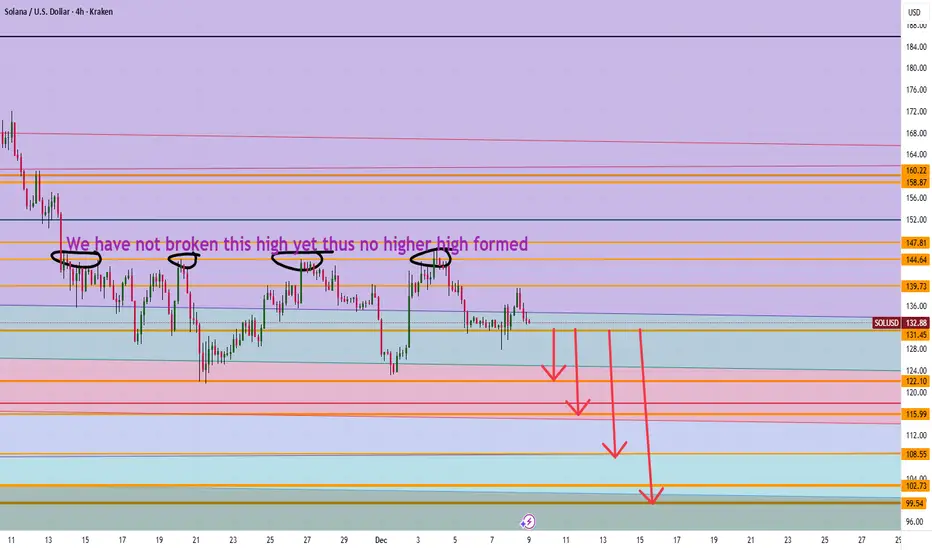
Is Solana heading to $100 It appears we have not made new higher highs in price action on the 4 hour and thus a possible movement down to $108 then 100 levels make sense. However if we can break 139 level then 147 can make sense going up. Trade Smarter Live Better Kris Shortby Mindbloome-Trading1
Global Currency StabilityUnderstanding Its Dynamics, Drivers, and Implications Currency stability is a cornerstone of global economic health. When currencies maintain predictable value relative to one another, international trade, investment, and economic planning become more efficient and less risky. Conversely, volatile or unstable currencies can disrupt markets, reduce investor confidence, and strain national economies. Global currency stability refers to the overall steadiness of major currencies across countries and regions, which plays a vital role in maintaining economic growth, promoting trade, and fostering international financial confidence. 1. The Concept of Currency Stability Currency stability is often defined by the minimal fluctuations in a currency’s exchange rate over time. A stable currency has predictable purchasing power both domestically and internationally. This stability allows businesses and governments to make long-term financial decisions with greater confidence. Central to the concept is exchange rate stability, which indicates the relative value of one currency compared to others. Stability reduces uncertainty in international transactions, investment flows, and cross-border trade contracts. Currencies can be stable in nominal terms, meaning their exchange rate relative to another currency does not fluctuate excessively, or in real terms, which takes into account domestic inflation rates. Both forms of stability are crucial, as a nominally stable currency experiencing high domestic inflation may still lose purchasing power and create economic uncertainty. 2. Factors Influencing Global Currency Stability Currency stability is determined by a combination of domestic and international economic factors. Some of the primary drivers include: a. Monetary Policy: Central banks play a key role in maintaining currency stability through interest rate adjustments, open market operations, and foreign exchange interventions. A credible and transparent monetary policy can stabilize a currency by controlling inflation, supporting investor confidence, and ensuring liquidity in financial markets. For instance, the Federal Reserve in the United States or the European Central Bank employs policy tools to manage the value of their currencies, indirectly impacting global stability. b. Fiscal Policy and Government Debt: Governments influence currency stability through their spending and borrowing patterns. Excessive public debt or budget deficits can weaken confidence in a currency, leading to depreciation and volatility. Conversely, responsible fiscal management enhances credibility, attracting foreign investment and supporting stable currency conditions. c. Trade Balances: Countries with consistent trade surpluses often experience currency appreciation, while persistent trade deficits may lead to depreciation. A balanced trade scenario contributes to predictable currency values and reduces the risk of sudden shifts caused by external imbalances. d. Capital Flows: Cross-border investment flows, including foreign direct investment and portfolio investment, directly affect currency demand and supply. Sudden inflows can strengthen a currency, while abrupt outflows can trigger instability. Countries with robust capital markets and regulatory frameworks can better manage these fluctuations, contributing to global stability. e. Political Stability and Governance: Political uncertainty, policy changes, or geopolitical risks can undermine confidence in a currency. Stable governments with transparent institutions are more likely to maintain consistent economic policies, supporting predictable currency values. f. Global Economic Conditions: Events such as global recessions, commodity price shocks, and financial crises influence currency stability. For example, a decline in oil prices may weaken oil-exporting countries’ currencies, impacting broader trade and investment networks. 3. The Role of Major Currencies in Global Stability Certain currencies, often referred to as reserve currencies, play a disproportionate role in global stability. The US Dollar (USD), Euro (EUR), Japanese Yen (JPY), and recently, the Chinese Yuan (CNY), are central to international trade, finance, and reserves. These currencies are widely used for cross-border transactions, denominating global commodities, and holding central bank reserves. The stability of these major currencies directly affects global markets. A stable US Dollar, for instance, reduces transaction risk for international traders and investors. Conversely, volatility in these currencies can trigger ripple effects, affecting emerging markets, global trade pricing, and international debt servicing. 4. Mechanisms for Maintaining Currency Stability Countries and international institutions employ multiple strategies to maintain currency stability: a. Fixed and Managed Exchange Rate Systems: Some nations peg their currencies to a stable foreign currency, like the USD or EUR. Pegging provides predictability, reduces speculative volatility, and can anchor inflation expectations. Managed exchange rates allow limited flexibility while preventing extreme fluctuations. b. Foreign Exchange Reserves: Central banks maintain reserves of foreign currencies to intervene in currency markets when excessive volatility occurs. By buying or selling their own currency or foreign currency, central banks can stabilize exchange rates temporarily or support longer-term credibility. c. International Coordination: Organizations such as the International Monetary Fund (IMF) provide frameworks for stabilizing currencies through lending, policy advice, and financial monitoring. During crises, coordinated actions by multiple countries can prevent global contagion and stabilize volatile currency markets. d. Monetary Policy Transparency and Credibility: Consistent communication and clear policy objectives reduce market uncertainty. Investors and traders can anticipate central bank actions, decreasing speculative attacks that could destabilize currencies. 5. Implications of Currency Instability Unstable currencies have broad economic consequences: Inflation and Purchasing Power Erosion: Rapid depreciation can increase import prices, fueling domestic inflation and reducing living standards. Investment Hesitancy: Investors prefer predictable returns. Currency volatility can deter both domestic and foreign investment, slowing economic growth. Trade Disruption: Unpredictable exchange rates complicate pricing, contract negotiation, and profit planning for exporters and importers. Debt Servicing Risks: Countries with foreign-denominated debt face higher repayment costs if their currency weakens, potentially triggering defaults or fiscal crises. 6. The Interconnected Nature of Global Currency Stability In today’s globalized economy, currency stability is not just a national concern but an international one. Global trade, financial markets, and capital flows are deeply interconnected. Instability in a major currency, such as the USD or Euro, can transmit shocks across multiple countries, especially emerging markets with weaker financial systems. Conversely, stable currency regimes promote confidence, facilitate trade, and support sustainable growth worldwide. 7. Challenges to Global Currency Stability Despite mechanisms to maintain stability, several challenges persist: Geopolitical Tensions: Conflicts, sanctions, and political instability can disrupt currency markets. Speculative Attacks: Currency traders sometimes engage in large-scale speculation, causing sudden and severe exchange rate movements. Emerging Market Vulnerabilities: Less developed financial systems may struggle to manage sudden capital flow reversals or external shocks. Global Economic Shocks: Events like pandemics, financial crises, or commodity price collapses can trigger synchronized instability across multiple currencies. 8. Conclusion Global currency stability is a fundamental pillar of international economic health. It ensures predictability in trade, investment, and financial planning, reducing systemic risk and fostering economic growth. Achieving stability requires coordinated monetary and fiscal policies, strong institutional frameworks, and proactive management of trade and capital flows. While challenges such as geopolitical uncertainty and market speculation persist, transparent and credible governance, combined with global cooperation, can support resilient currency systems. Stable currencies not only benefit individual nations but also underpin the smooth functioning of the global economy, enabling sustainable development and prosperity worldwide.Educationby GlobalWolfStreet1