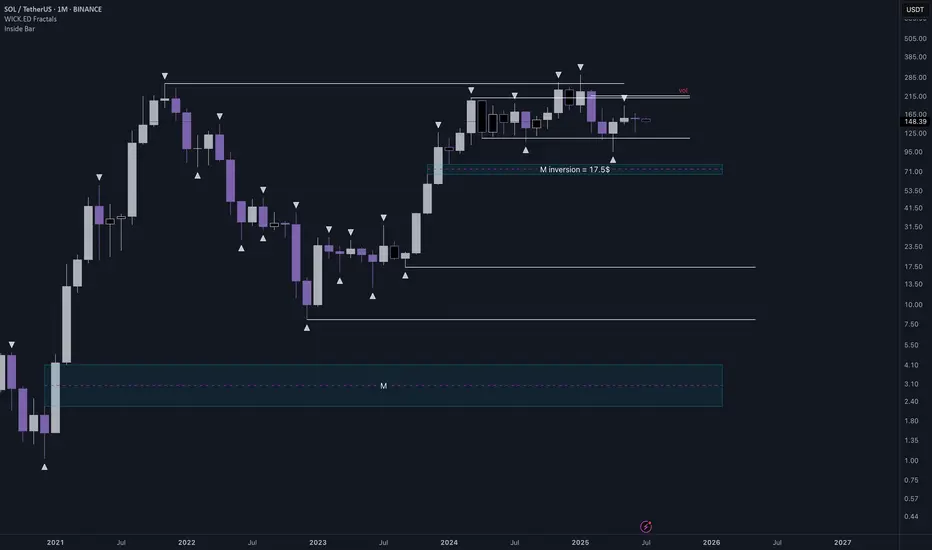
SOLUSDTThere is no confirmation about short scenario yet, but I think we are in distribution phase, so I will wait for short opportunity in 190-220$ zone
News about Solana ETF with staking just give more confidence in such scenario
First target is 80$.
Also we have much lower targets but it is too early to say about them
Trade ideas
Why SOL is my bet for the next leg of the cycle Where some people are afraid and selling, others see an opportunity. Moments like this allow us to accumulate spot positions at good prices. They also help identify obvious market leaders — those who hold stronger than others. Today I will explain why, after analyzing the market, I came to the conclusion that SOL currently looks stronger than Bitcoin and why I’m placing my bet on it.
Last week there were days when SOL dropped less in percentage than BTC. Which is basically nonsense for crypto.
➡️ This is primarily related to the newly launched SOL ETF, which has seen inflows from the very first days. And, you know, this is actually the most successful start for a crypto ETF. Because BTC and ETH saw only outflows during the first weeks.
➡️ What we see on the chart: first — yes, a liquidity divergence on the Money Flow has formed. But this is not a secret to anyone, liquidity really leaves the market during such periods and starts returning closer to the bottom.
➡️ Next — the drop was extremely uneven. Despite the lack of major selling volumes, there are a lot of rumors about liquidations and market makers exiting the market, which in turn removed liquidity and now the price moves 10% per day.
➡️ Also, we see harmony in the selling volumes throughout the entire correction. This means the correction is not near its end and sellers are still in control. But no one said SOL will rocket tomorrow.
The first thing to look at — where the price may potentially reverse. And the first of such levels is $147. This is a key level of one of the ATHs of the current cycle, which later became an important support level.
Below that, there is an order block on the daily timeframe at $135–132. This is where the new impulsive move started back in April this year, therefore the level is important.
➡️ The Supply & Demand indicator shows that major demand has formed around $154–146, confirming the first target where a reaction may occur.
I expect Bitcoin to at least retest $99,000 before showing any meaningful bounce. Therefore, the current target levels for SOL look logical.
Drop a comment if you’re still alive in this market! 👇
sol usdt pattern identified inverse head and shoulders with chan🧠 Technical Analysis (SOL/USDT – 4H Timeframe)
🔍 Pattern Identified: Inverse Head & Shoulders
Left Shoulder: Around $137
Head: Dipped to ~$126
Right Shoulder: Formed around $135
Neckline Breakout: Successfully broken near $148–$150 zone
This classic bullish reversal pattern indicates a potential trend shift from bearish to bullish.
📈 Trend & Channel
The price was previously trading inside a descending parallel channel (marked in yellow).
The breakout from the upper channel boundary confirms strength and momentum shift.
🚀 Price Targets (Resistance Levels Ahead):
$158.36 – First resistance level (short-term target)
$168.52 – Mid-level resistance (medium-term)
$187.56 – Key resistance (long-term target area)
✅ Bullish Confirmation:
Breakout with volume from both descending channel and head & shoulders neckline
Price holding above neckline now acting as support
⚠️ Risk Note:
A retest of the breakout zone ($148–$150) can occur before moving higher
Invalid if SOL drops back below neckline and fails to hold above $145 support zone
SOL Follows Red Scenario — Key Support at 138–126Last week, Solana followed our red scenario. At the moment, the price is trading below the weekly levels.
If Bitcoin continues to decline, Solana’s price could drop into the 138–126 support zone. A return to a bullish trend will only be possible after breaking above 190 .
Solana, more down side to see? SOLUSDT / 1D
Hello Traders, welcome back to another market breakdown.
SOLANA is currently trading within a down trend, maintaining a bearish structure. I'll be looking for a short pull-back higher to get a position.
If the pullback holds and sell mode confirms, the next leg higher could target new lows.
Stay disciplined, wait for the market to come to you, and trade with confidence!
Trade safely,
Trader Leo.
SOL USDT LONG SIGNAL---
⚠️ Disclaimer:
This analysis reflects my personal opinion only and is not a financial advice or buy/sell signal.
Please analyze the chart carefully and apply strict risk management before entering any trade.
📢 Signal Alert
🔹 Pair: SOL / USDT
📈 Trade Type: Long
💰 Entry Price: 157.07
🎯 Take-Profit Targets:
TP1 = 160.68
TP2 = 164.06
TP3 = 167.60
🛑 Stop-Loss: 155.30
📊 Timeframe: 1H
⚖️ Risk/Reward Ratio: 6.29
📌 Suggested Leverage: 10x
🔄 After TP1 is reached, move Stop-Loss to Entry to secure profits.
---
🧠 Technical Analysis Explanation:
SOL is showing bullish continuation signals after successfully holding above the 155.00 support zone, which has been tested multiple times with strong buying pressure.
The price structure remains in a clear uptrend, forming higher lows and maintaining movement above both the EMA 50 and EMA 200, which are acting as dynamic supports.
The RSI has bounced from the 50–55 zone, confirming renewed bullish momentum, while the volume profile suggests accumulation at the current level by smart money.
The entry point at 157.07 aligns closely with a previous breakout retest, offering a high-probability setup with minimal downside risk.
Profit targets are based on key resistance levels and Fibonacci extensions from recent swings.
The stop-loss at 155.30 is placed just below the last local low, protecting against false pullbacks.
⚙️ Trade Management Tip:
Wait for a bullish confirmation candle (1H engulfing or strong rejection from support) before entry.
Secure partial profits at each TP and adjust SL to entry after TP1 for maximum safety.
---
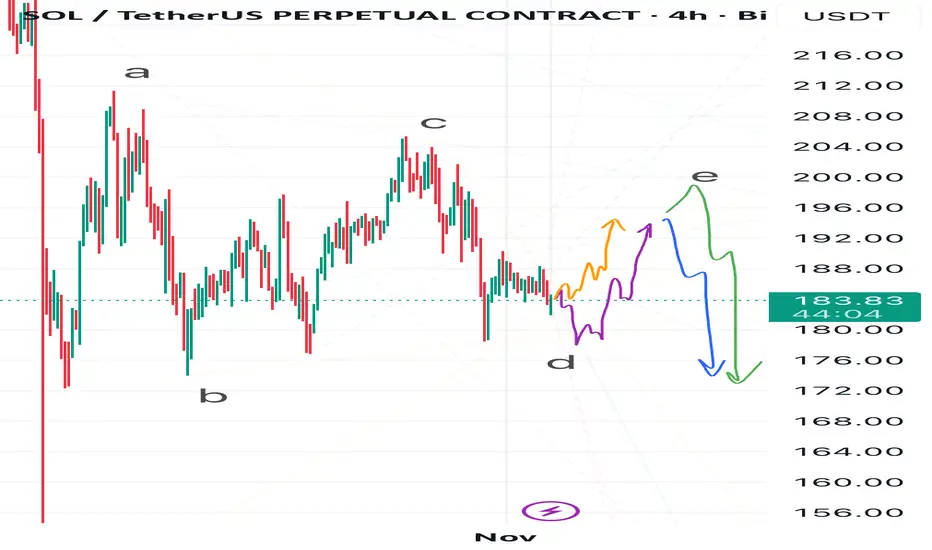
Solana Swing — D or E in the Ring?I see several possible scenarios for Solana at the moment.
In my view, either wave D of the corrective ABCDE triangle has already formed, and the price will follow the orange path, starting to build wave E —
or wave D isn’t complete yet, and Solana might still drop toward 178 or even lower, following the purple path, before beginning wave E.
As for wave E, I also see two possible outcomes:
• The green path, where wave E extends up to around 200,
• Or the blue path, where wave E ends near 194–196, followed by a downside breakout from the triangle, sending Solana toward ~170 or even lower.
💬 Which scenario do you find more likely? Share your thoughts in the comments!
[SeoVereign] SOLANA BEARISH Outlook – November 03, 2025I would like to share my Solana idea as of November 3.
This idea is an extension of the one from October 27. The short positions entered on the 27th will be closed in profit in connection with this idea, and I plan to add some additional positions at the same time.
Basis — FIBONACCI 0.786 Retracement & Breakdown Around 176 USDT
Currently, Solana is showing a clear breakdown signal after reaching the 0.786 retracement level relative to the previous upward wave (around 176 USDT).
This zone represents a typical transition area where upward momentum becomes exhausted,
indicating the potential for a trend reversal.
Accordingly, I set the average target price around 154 USDT.
Further position management and updates will be provided depending on market developments.
Thank you for reading.
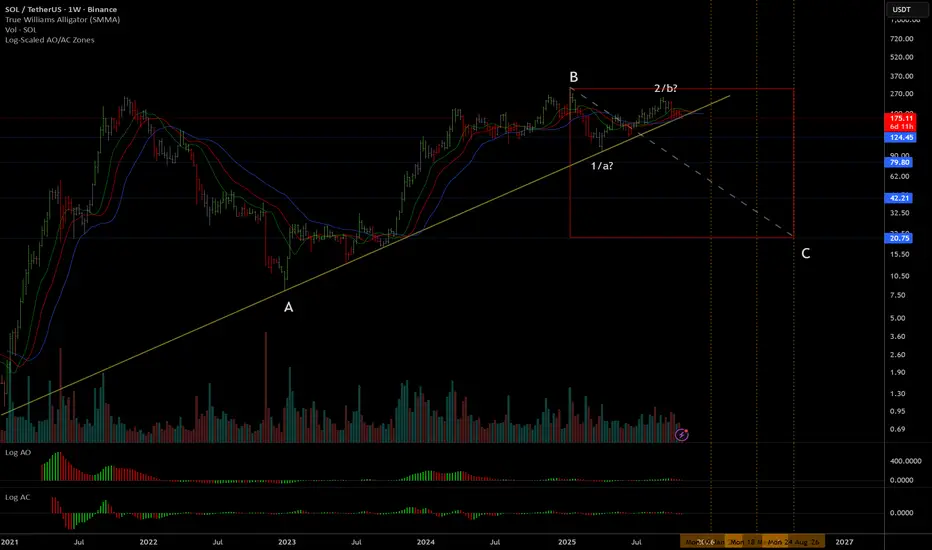
Solana Multi-Year BreakdownSOL is breaking down from this multi-year trendline which has 4 solid touch points. It's difficult to say how low it will go, worst case is probably around $20, but there are definitely other paths it could take as well.
Without forecasting the exact future price, I will say that probabilities are favoring a continuation of the downtrend which began in January after Trump launched his memecoin on Solana.
After we see how fast and far this drops, we can probably get a better idea of what is developing here. Right now, it looks like wave-B ended in January, and we are in a very large wave-C now, but there are some other possibilities as well. The wave-B possibility is closest to the middle so that's the one I am favoring now.
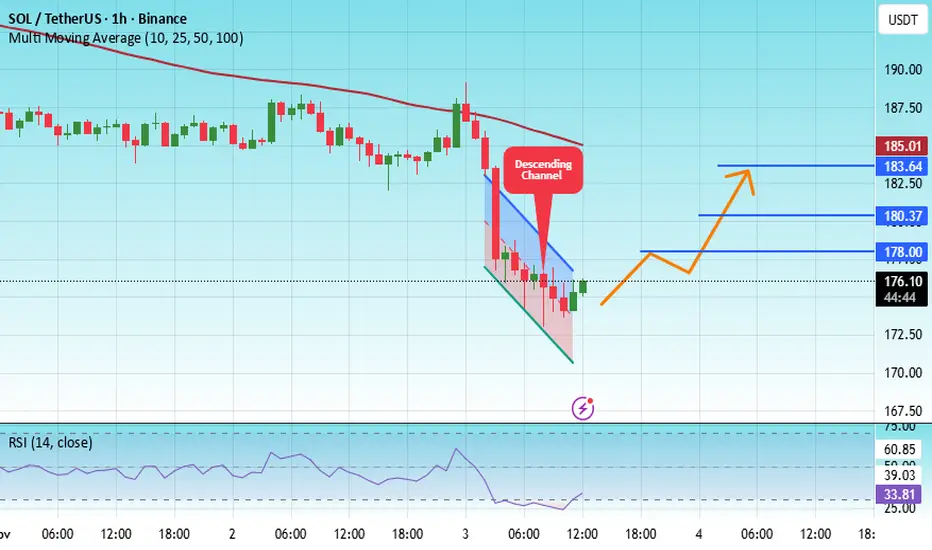
#SOL/USDT The Next Explosion, Hidden Clues in Price Behavior
#SOL
The price is moving within an ascending channel on the 1-hour timeframe and is adhering to it well. It is poised to break out strongly and retest the channel.
We have a downtrend line on the RSI indicator that is about to break and retest, which supports the upward move.
There is a key support zone in green at 172.80, representing a strong support point.
We have a trend to stabilize above the 100-period moving average.
Entry price: 175.50
First target: 178
Second target: 180
Third target: 183
Don't forget a simple money management rule:
Place your stop-loss order below the support zone in green.
Once the first target is reached, save some money and then change your stop-loss order to an entry order.
For any questions, please leave a comment.
Thank you.
Solana — Triangle Tale Before the Pale As you might remember from my previous publications, I’m expecting Solana to decline toward 164 and possibly even lower.
At the moment, I’d like to see it around 178, and depending on how the move toward this level develops, I’ll decide on my next steps — which you’ll see in my upcoming updates.
I have a thought that after reaching 178, Solana might move upward first, forming a corrective triangle, and only later drop to 164 or even below.
The invalidation zone for the current plan is marked in red on the chart.
📉 Follow me so you don’t miss my next analyses and scenario updates
SOL USDT LONG SIGNAL---
📢 Signal Alert
🔹 Pair: SOL / USDT
📈 Trade Type: Long
💰 Entry Zone: 175.75
🎯 Take-Profit Targets:
TP1 = 178.53
TP2 = 182.14
TP3 = 187.54
🛑 Stop-Loss: 171.69
📊 Timeframe: 1H
⚖️ Risk/Reward Ratio: ≈ 3.0
📌 Suggested Leverage: 5x–10x
🔄 After TP1 is reached, move Stop-Loss to Entry to secure profits.
---
🧠 Technical Analysis Explanation
SOL is showing strong bullish continuation momentum after bouncing from the 171.50 demand zone, where buyers stepped in aggressively.
The market has broken above the short-term descending channel, confirming a trend reversal on lower timeframes.
The entry level at 175.75 aligns with the retest of the breakout zone and the EMA 50, which acts as dynamic support.
RSI has crossed above 50, indicating renewed bullish momentum, while volume shows increasing buyer participation.
Take-profit levels are based on major resistance zones and Fibonacci extension projections from the last impulse move.
The stop-loss at 171.69 is set just below the key support area to prevent losses in case of a false breakout.
---
⚙️ Trade Management Tip:
Always confirm entry with a bullish candle pattern (e.g., engulfing or hammer) before executing.
Use partial take-profits and adjust your stop-loss progressively as price advances toward higher targets.
SOL/USDT Update — Bullish Trend Structure and Resistance Ahead“🚨 Solana vs Tether: Bullish Heist on SOL/USDT 💰”
📊 Description
Market: SOL/USDT
Bias: Bullish (Swing / Day Trade)
✅ Trade Plan
Entry: 🎯 Any good support / demand area — stay alert & flexible.
Stop Loss: 🛡️ “Thief SL” @ 160.00 USDT — this is my SL, not yours. Manage your own risk!
Targets (TP):
• 🎯 Target 1: 215.00 USDT
• 🏁 Target 2: 240.00 USDT
⚠️ Heads up: Use your discretion. Do not blindly follow my SL/TP — trade responsibly, at your own risk.
🔍 Key Insights / Logic
🚧 Expect resistance & traps near 215–240 — don’t get stuck in overbought zones.
📈 Momentum is building; structure is favorable on retests.
🔊 Watch volume on impulsive moves — rising volume = strength.
🔄 Related pairs / correlation watch:
• BINANCE:SOLBTC — strength vs BTC strengthens the bullish case.
• BINANCE:ETHUSDT — altcoin momentum may carry SOL upward.
• BINANCE:BNBUSDT — BNB strength can support ecosystem flow.
✨ “If you find value in my analysis, a 👍 and 🚀 boost is much appreciated — it helps me share more setups with the community!”
#SOL #SOLUSDT #Solana #CryptoSwing #CryptoDayTrade #AltcoinAnalysis #TradingViewIdeas #CryptoFun
Reserves and Their Role in Controlling InflationIntroduction
Inflation — the sustained rise in the general price level of goods and services — is a central concern for every economy. When prices rise too quickly, purchasing power declines, savings lose value, and economic uncertainty increases. To manage inflation, policymakers and central banks rely on several tools, and reserves play a crucial role among them.
Reserves, in an economic and financial sense, refer to the assets or holdings that a central bank or a nation keeps to stabilize its currency, support the banking system, and influence liquidity in the economy. They are the backbone of monetary policy — providing a safety net during crises and a lever to control inflationary or deflationary pressures.
This article explores what reserves are, the types of reserves, how they interact with the broader economy, and most importantly, how they are used as instruments to control inflation.
1. Understanding Reserves
1.1 Definition
Reserves are the portion of assets that financial institutions or nations hold and do not actively circulate in the economy. They are typically kept in the form of:
Foreign exchange reserves (foreign currencies, gold, IMF Special Drawing Rights)
Bank reserves (funds held by commercial banks with the central bank)
Strategic reserves (such as oil or commodities held by governments for stability)
Monetary reserves (central bank’s holdings that back the issuance of currency)
In the context of inflation control, foreign exchange reserves and bank reserves are most relevant.
2. Types of Reserves and Their Economic Importance
2.1 Bank Reserves
Bank reserves refer to the cash or deposits that commercial banks hold with the central bank. These reserves are essential for meeting withdrawal demands, ensuring liquidity, and adhering to regulatory requirements.
Required Reserves: The minimum percentage of deposits that banks must hold and not lend out, set by the central bank.
Excess Reserves: Any reserves that banks hold beyond the required minimum.
2.2 Foreign Exchange Reserves
Foreign exchange reserves are assets held by a central bank in foreign currencies. These reserves include:
U.S. dollars, euros, or yen
Gold holdings
IMF’s Special Drawing Rights (SDRs)
These reserves help stabilize a nation’s currency and manage exchange rate volatility, both of which directly affect inflation levels.
2.3 Strategic Reserves
Governments often maintain reserves of essential commodities like crude oil, food grains, and fertilizers. These strategic reserves protect the economy from supply shocks, which could lead to cost-push inflation if shortages occur.
3. How Reserves Influence Inflation
Reserves act as a monetary control mechanism. By adjusting reserve requirements, managing liquidity, and using foreign reserves strategically, a central bank can control money supply — the key driver of inflation.
3.1 The Link Between Money Supply and Inflation
According to the Quantity Theory of Money, expressed as:
MV = PQ
Where:
M = Money supply
V = Velocity of money
P = Price level
Q = Output
If money supply (M) increases faster than economic output (Q), prices (P) rise — leading to inflation.
Hence, controlling money supply via reserves becomes a vital anti-inflationary tool.
4. Mechanisms: How Reserves Help Control Inflation
4.1 Reserve Requirement Ratio (RRR)
The reserve requirement is the percentage of deposits that banks must hold with the central bank and cannot lend.
When inflation is high, central banks increase the reserve ratio, reducing banks’ capacity to lend.
→ This decreases money supply and dampens spending, cooling inflation.
When inflation is low or the economy is slowing, the ratio is reduced to encourage lending and spending.
For example, if the Reserve Bank of India (RBI) raises the Cash Reserve Ratio (CRR), commercial banks have less liquidity to issue new loans, thereby reducing credit growth and inflationary pressure.
4.2 Open Market Operations (OMO)
Central banks use reserves to buy or sell government securities:
Selling securities → absorbs liquidity → reduces money supply → controls inflation.
Buying securities → injects liquidity → increases money supply → combats deflation.
Thus, OMOs are a dynamic way of using reserves to regulate inflation without drastic policy shifts.
4.3 Managing Foreign Exchange Reserves
Foreign reserves can indirectly control inflation through exchange rate management:
When a currency depreciates, import prices rise, increasing inflation (imported inflation).
Central banks can use foreign reserves to buy their own currency, strengthening it and reducing inflationary pressure.
Conversely, when inflation is low, the central bank may allow the currency to weaken slightly to boost exports and growth.
4.4 Sterilization Policy
When a country experiences large foreign capital inflows, it increases domestic money supply and may fuel inflation.
To counter this, central banks conduct sterilization — selling government securities to absorb the excess liquidity created by foreign inflows.
4.5 Interest Rate Adjustments Using Reserves
Reserves influence interbank liquidity, which affects interest rates.
When reserves are high, liquidity is ample, and short-term rates fall — boosting spending.
To control inflation, the central bank may reduce liquidity (through higher CRR or OMO sales), pushing up rates and discouraging borrowing.
5. Case Studies: Reserves in Action
5.1 India – Reserve Bank of India (RBI)
The RBI actively uses CRR and Statutory Liquidity Ratio (SLR) to control inflation.
For instance:
During the 2010–2011 period, when inflation crossed 9%, RBI raised CRR to restrict liquidity.
Conversely, in 2020 (pandemic period), RBI reduced CRR from 4% to 3% to ease liquidity and support economic recovery.
Additionally, RBI manages over $650 billion in forex reserves, which it uses to stabilize the rupee and prevent imported inflation caused by a depreciating currency.
5.2 United States – Federal Reserve System
The U.S. Federal Reserve influences inflation through reserve balances and open market operations.
During high inflation (e.g., post-2021 pandemic period), the Fed reduced excess reserves in the banking system through Quantitative Tightening (QT) — selling bonds and raising interest rates to control money supply.
5.3 China – People’s Bank of China (PBOC)
China maintains one of the world’s largest foreign exchange reserves (over $3 trillion).
It uses these reserves to:
Stabilize the yuan’s exchange rate
Control import-export price volatility
Manage inflation driven by currency movements
6. Relationship Between Reserves and Exchange Rate Stability
Exchange rate stability is directly linked to inflation control.
A strong domestic currency reduces the cost of imported goods and keeps inflation low.
A weak currency, on the other hand, makes imports expensive, triggering inflation.
By holding substantial forex reserves, central banks can intervene in currency markets — buying or selling domestic currency to maintain a stable exchange rate and prevent inflationary shocks.
7. The Role of Gold and Commodity Reserves
Gold reserves historically backed national currencies and still act as a hedge against inflation.
When inflation rises globally and fiat currencies lose value, central banks often increase gold reserves to preserve asset value and stability.
Similarly, commodity reserves like oil and grains help governments buffer supply-side shocks, which are a major cause of inflation spikes (e.g., oil crises or food shortages).
8. Challenges and Limitations
While reserves are powerful tools, their use in inflation control faces several challenges:
8.1 Limited Effectiveness in Supply-Side Inflation
Reserves can control demand-pull inflation (caused by excessive spending) but are less effective against cost-push inflation (caused by supply shocks like oil price hikes).
8.2 Risk of Over-tightening
Excessive tightening through high reserve requirements or OMO sales can stifle credit growth and economic expansion, leading to recession.
8.3 Foreign Exchange Volatility
Using forex reserves for inflation control via currency stabilization can deplete reserves quickly if global market pressures persist.
8.4 Sterilization Cost
Sterilization operations (offsetting capital inflows) can be expensive and may strain central bank balance sheets.
9. Coordinated Use of Reserves and Other Tools
For effective inflation management, reserves are used in conjunction with:
Interest rate policy
Fiscal discipline
Supply-side reforms
Targeted liquidity management
A well-coordinated monetary-fiscal framework ensures that reserves act as a stabilizing force rather than a reactive one.
10. Future Outlook: Reserves and Inflation in the Global Economy
In today’s interconnected world, inflation control is not just a domestic concern.
Global commodity prices, exchange rate fluctuations, and capital flows can all influence inflation levels.
As digital currencies, blockchain-based payment systems, and cross-border trade evolve, the composition and management of reserves will also transform.
Central banks may diversify away from traditional reserves like the U.S. dollar and hold multi-currency baskets, digital assets, or even climate-linked reserves to ensure sustainable control of inflation.
Conclusion
Reserves — whether held by central banks, governments, or financial institutions — form the foundation of monetary stability. They serve as both a defensive shield and an active instrument in combating inflation.
By managing bank reserves, foreign exchange holdings, and strategic commodities, policymakers can influence liquidity, exchange rates, and overall price stability.
However, the effectiveness of reserves depends on timely policy coordination, global conditions, and domestic fiscal discipline.
In essence, reserves are not merely a pile of assets — they are a reflection of a nation’s economic strength, policy credibility, and capacity to maintain price stability. Through prudent reserve management, central banks can ensure sustainable growth while keeping inflation under control — achieving the delicate balance every economy strives for.
Solana Price Action Turns BearishSolana’s market structure shows a gradual weakening of bullish momentum after an extended upward phase earlier in the month. The asset experienced a breakout that temporarily fueled optimism among traders, but recent sessions indicate a loss of strength as sellers began to dominate. The volume profile suggests that market participants are shifting focus from accumulation to potential distribution, reflecting caution ahead of broader market developments.
Price movements over the past few weeks show that Solana has transitioned from impulsive bullish waves into a corrective environment. This phase reflects uncertainty and potential repositioning by large holders. The consolidation seen mid-cycle indicates a period of balance before a directional move resumes. Current activity implies that short-term liquidity adjustments are occurring, and volatility may expand in the coming sessions.
Market sentiment remains sensitive, with investor confidence depending largely on macroeconomic flows and digital asset liquidity trends. Solana’s performance continues to mirror broader crypto risk appetite, where speculative behavior is being tempered by cautious profit-taking. If momentum continues to decline, extended corrective movement could unfold as participants await new catalysts.
Overall, the report indicates that Solana is entering a controlled phase of distribution where institutional participants may be preparing for another medium-term adjustment in valuation.