Market insights
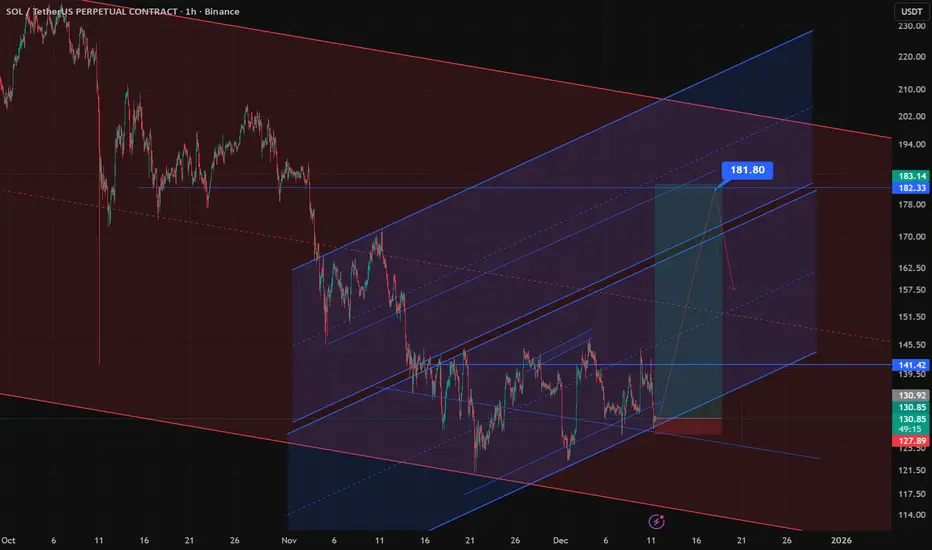
SOL/USDT | a drop before going bullish again? (READ THE CAPTION)As you can see, SOLUSDT is now consolidating in the main demand zone after a rise to $146 now is trading at 131.50 level. If buyers fail to keep SOL in the demand zone, a further fall is expected to $105 bullish zone, before it regains its bullish momentum with accumulating more liquidity and then goes up high again.
Make sure to like and comment to keep me motivated folks.
$sol shortSOL failed to break structure to the upside and instead delivered a clean retracement into premium, rejecting right at the supply zone + Alligator alignment.
This is classic continuation orderflow.
1️⃣ Premium Retracement Complete
Price traded up into the bearish supply block (green zone)
aligned with the Alligator’s sell bias (bearish mouth formation).
Smart money sells inside this region → displacement follows.
2️⃣ Lower-Timeframe Breakdown Confirmed
A clean bearish break and retest formed after the tap:
• Trendline break
• Shift in micro-structure
• Weak reaction back down → showing no bullish strength
All confirm continuation lower.
3️⃣ Targets Below Remain Untouched
The next draw on liquidity sits at the 121.49 inefficiency/untapped zone.
Trade Idea – Short
Entry:
🔴 132.8 – 133.5 (supply zone retest)
Stop Loss:
⛔ 137.66
(above the supply block & invalidation)
Targets:
🎯 TP1: 127.00
🎯 TP2: 121.49 (main liquidity draw)
Model:
⚡ Bearish Continuation after Premium Retracement
Alligator confirmation
Supply rejection
Trendline break → retest
SOLUSDT — Range Accumulation After Demand ReactionSOLUSDT reacted strongly from the demand zone area, where price formed a head and shoulders structure that supported a move from lower levels to the upside. After the recovery, the market entered a consolidation range, showing balance between buyers and sellers.
Price is now holding above demand and building pressure below the buyer zone. A clean breakout from this level would confirm bullish continuation, opening the path toward the marked target area.
As long as demand holds, the structure favors upside continuation, while failure to break out may keep the market ranging before the next directional move.
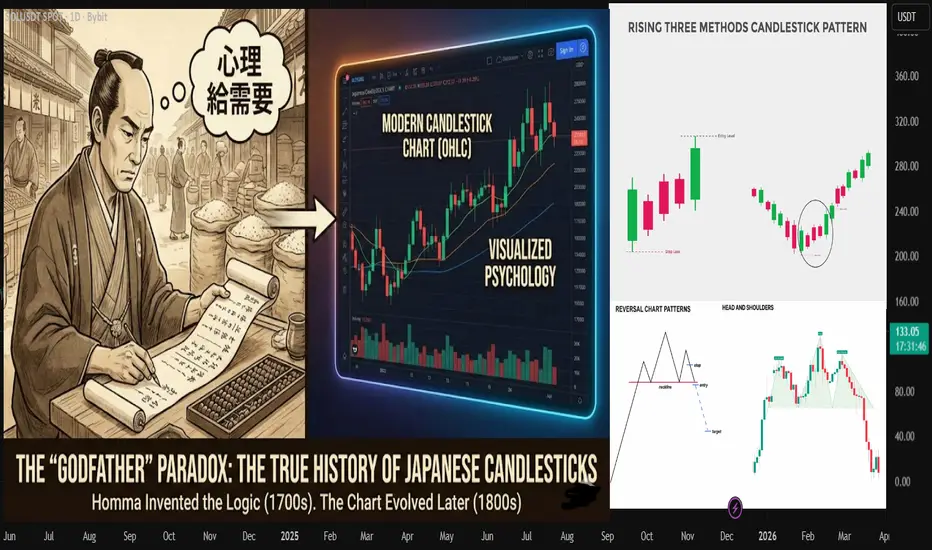
"Godfather" Paradox: The True History of Japanese CandlesticksIf you open any technical analysis textbook, you will likely find the same origin story: "Munehisa
Homma, a legendary rice trader in the 18th century, invented candlestick charts."
This is the most repeated "half-truth" in financial history.
While Munehisa Homma is indeed the "Godfather" of price action trading, he likely never drew a
candlestick in his life. The visual box-and-whisker charts we use today were developed nearly a
century later.
Why does this history lesson matter to your P&L? Because when you realize Homma wasn't
just drawing shapes, but defining market psychology, the patterns you see on your screen
suddenly make much more sense.
This article explores the true history of Japanese candlesticks, the critical distinction between
the "method" and the "chart," and how the ancient Sakata Rules still govern modern markets.
The "Software" vs. The "Hardware"
To understand where candlesticks actually came from, it helps to view technical analysis
through a computing analogy. We must distinguish between the visual tool and the underlying
logic.
1. The Hardware: The Modern Chart
The modern candlestick (with its distinct Open, High, Low, Close body and wicks) is a data
visualization tool. It colors the "body" to show direction and uses "wicks" to show rejection.
This specific visual format—the "hardware"—likely evolved during the Meiji Period (late 1800s),
long after Homma passed away. It was the result of generations of Japanese chartists refining
price data into a format that allowed for faster interpretation of momentum.
2. The Software: The Psychology
This is what Munehisa Homma actually invented. Trading in the Dojima Rice Exchange in
Osaka (the world's first futures market), he was the first to realize that price does not equal
value.
He identified that markets are driven by the emotions of fear and greed (Yin and Yang) and that
these emotions repeat in predictable cycles. Homma used primitive price notations, not modern
charts, but his genius was in the Sakata Rules (Sakata Goho)—a set of five methodologies
that describe the "market phases" caused by human emotion.
The Sakata Five Methods: Ancient Wisdom, Modern
Patterns
When Western traders finally imported candlesticks in the 1980s, they often focused on
single-candle signals (like the Doji or Hammer). However, Homma’s original system was built on
market structure and context.
Here are the original "Sakata Five Methods" and their modern equivalents:
1. San Zan (Three Mountains)
● The Concept: The market attempts to push prices higher three distinct times and fails.
The "mountains" represent the exhaustion of buyers.
● Modern Equivalent: Triple Top or Head and Shoulders.
● The Psychology: After a strong uptrend, the market becomes "heavy." It takes three
waves of buying to finally realize the supply is too strong to overcome.
2. San Sen (Three Rivers)
● The Concept: The inverse of the Three Mountains. The market tests a low price three
times, effectively drying up the selling pressure.
● Modern Equivalent: Triple Bottom or Inverted Head and Shoulders.
● The Psychology: This is not just a "support level"; it is a battle where bears exhaust
their ammunition (rice/shares) three times before bulls take control.
3. San Ku (Three Gaps)
● The Concept: "Ku" means empty space. Homma believed that if a market gaps violently
three times in the direction of the trend, the move is overextended.
● Modern Equivalent: Exhaustion Gaps.
● The Psychology: The first gap is news; the second is reaction; the third is hysteria.
Smart money sells into the hysteria of the third gap.
4. San Pei (Three Parallel Lines)
● The Concept: Three strong candles of similar size moving in one direction with very little
overlap.
● Modern Equivalent: Three White Soldiers (Bullish) or Three Black Crows (Bearish).
● The Psychology: Unlike the "Three Mountains" which shows stalling, this shows
momentum. It indicates a trend that has conviction and is likely to continue.
5. San Po (Three Methods)
● The Concept: A strong move, followed by a period of rest (small candles staying within
the previous candle's range), followed by a resumption of the move.
● Modern Equivalent: Rising/Falling Three Methods or Bull/Bear Flags.
● The Psychology: Homma recognized that markets cannot sprint forever. They must
breathe. A "rest" phase that doesn't reverse the trend is the most powerful signal to add
to a position.
The "Lost Century": Why Was This a Secret?
If these methods are so effective, why did the West only discover them in the 1980s? It wasn't
just a language barrier; it was a technological and cultural "perfect storm" that kept these
methods isolated in Japan for nearly 200 years.
1. The "Analog" Barrier (No Digital Charts) Before the PC revolution, Western "chartists"
were employees who drew charts by hand on graph paper. Switching to candlesticks wasn't a
simple software setting—it required retraining an entire workforce to draw boxes instead of
lines. The "Hardware" (Candlesticks) needed the "Software" (PCs) to finally go global.
2. The Guild Mentality In Feudal Japan, specific charting techniques were treated like martial
arts secrets. The Sakata Rules were not public domain; they were proprietary edges kept within
families or trading guilds to maintain dominance at the Dojima Rice Exchange.
3. The Conceptual Gap Western analysis (like Dow Theory) tried to be rigid and scientific.
Japanese analysis was built on military strategy and poetry (e.g., "Night Attack," "Abandoned
Baby"). It took analysts like Steve Nison to bridge the gap and explain that "Hanging Man"
wasn't a threat, but a specific reversal signal.
The Takeaway
When you turn on your TradingView charts today, you are looking at a 19th-century interface
running on 18th-century logic.
Don't just look for a "Shooting Star" in isolation. Look for the Sakata structure: Are we in a
"Three Mountain" exhaustion phase? Or a "Three Parallel" momentum phase?
Homma didn't leave us a drawing tool; he left us a map of human emotion.
- TuffyCalls (Team Mubite)
SOL/USDT Chart Analysis 10-Dec-25 Trading Strategy: Bullish Reversal Opportunity
Analysis Overview:
Following a sustained bearish trend that began on September 20th, technical indicators, notably a clear divergence observed in the Relative Strength Index (RSI), suggest a potential shift in momentum. The current outlook is bullish, aiming for several projected profit targets (TPs).
Key Levels & Management:
Order Type Price Level Notes
Buy Stop Entry 146 Entry trigger point to initiate the long position.
Stop Loss (SL) 121 Maximum acceptable risk level to protect capital.
Take Profit 1 (TP1) 171 First profit objective.
Take Profit 2 (TP2) 197 Second profit objective.
Take Profit 3 (TP3) 222 Third profit objective.
Take Profit 4 (TP4) 247 Final profit objective.
Important Disclaimer & Risk Warning:
All trading involves significant risk. The provided levels are for informational and educational purposes only and are not financial advice.
Always utilize stringent, disciplined risk management.
Prioritize the protection of your trading capital by strictly adhering to the defined stop-loss order (121).
Past performance is not indicative of future results.
SOLUSDT Relief Rally into Supply Big Move ComingSOLUSDT has been grinding through a deep corrective phase since the January 2025 ATH. Wave A established the base, and price action is now developing the final leg of the structure. If the pattern completes fully, the extension could stretch toward the $80 zone before true recovery begins.
For now, the market is attempting a relief rally from the $123 support. Price is heading straight into a key supply block, and this zone will decide everything:
🔺 Break and hold above = bullish shift resumes
🔻 Rejection = deeper correction, wave C continues
This is the moment where trend direction becomes clear. Any breakout from this supply area will ignite strong momentum and could change the narrative completely. The structure remains clean, and volatility is building. The thread will be updated as the move develops.
Drop your thoughts below, are you watching the same zone?
SOLANA (SOL) ANALYSIS: 3 MODELS TO TRADE THE SWEEP & BREAKOUTMARKET STRUCTURE & ANALYSIS
Solana (SOL) has been trading within a defined accumulation range. We are currently sitting in the middle "no-trade zone," waiting for a decisive move.
Smart money often hunts for liquidity before the real move begins. We have identified a High Time Frame (HTF) Sweep Zone & Order Block (Green Box) below us, and a breakout level above us.
Here are the 3 SPECIFIC MODELS to trade this setup, depending on your risk tolerance:
MODEL 1: ENTRY AT OB (HIGH RISK, HIGH REWARD) The Sniper Approach
This is the aggressive entry for traders who want the best possible price.
The Plan: Set limit orders directly inside the HTF Sweep Zone / Bullish Order Block (Green Box)
The Logic: You are "catching the knife" based on strong institutional demand in this area.
Risk: Price could continue lower. This model requires a strict Stop Loss but offers the massive Risk-to-Reward (R:R) potential.
MODEL 2: WAIT FOR THE SWEEP & TAKE ENTRY (CONSERVATIVE) The Confirmation Approach
This is the safer alternative to Model 1.
The Plan: Let the price drop into the Green Box to sweep liquidity. Do not buy yet.
The Trigger: Wait for the price to pump back up and close a 4H candle back inside the range (reclaiming the support level).
Entry: Enter on the close of that reclamation candle.
Logic: This confirms that the dip was just a "bear trap" and buyers have stepped back in.
MODEL 3: LONG AFTER BREAKOUT & RETEST (CONTINUATION) The Momentum Approach
This model plays the breakout of the upper resistance (White Line, ~$148).
The Plan: Wait for price to break clearly above the resistance.
The Trigger: Wait for a SUCCESSFUL RETEST. Price must come down, touch the old resistance, turn it into support, and bounce.
Entry: Long the bounce after the retest holds.
CRITICAL WARNING: THE "TOP LIQUIDITY SWEEP" TRAP Do not get trapped here.
Model 3 has a specific danger: The Fakeout. If price breaks above the resistance but FAILS to hold the retest (i.e., it crashes back down into the range), this was NOT a breakout. It was a Top Liquidity Sweep (a trap to catch early longs).
Rule: If the retest fails, Model 3 is invalid. Do not FOMO long at the highs without confirmation.
SUMMARY
Aggressive? Use Model 1 in the Green Box.
Conservative? Use Model 2 and wait for the reclaim.
Momentum? Use Model 3 but ONLY if the retest holds.
Which model fits your style? Let me know in the comments!
Disclaimer: This analysis is for educational purposes only. Cryptocurrency trading involves high risk. Always manage your risk properly.
How to survive a losing streak without blowing up your accountHow to survive a losing streak without blowing up your account
Drawdown hits the account, but the real damage lands in your head.
A real trading career always includes stretches of pure red. Five, seven, even ten losses in a row can appear without anything "being wrong" with the setup. At that point the market stops looking like candles and levels, and starts looking like a personal enemy. Without a plan written in advance, the usual reaction is to increase size and "win it back."
The drawdown itself is not the main threat. The danger sits in what happens inside the drawdown: revenge trades, oversized positions, random entries just to feel in control again.
Turn the losing streak into numbers
The feeling "everything goes wrong" is vague and dangerous. Numbers are less emotional.
Simple tracking is enough:
Current drawdown in percent from the equity peak
Number of losing trades in a row
Total hit of the streak in R (risk units per trade)
Example: risk per trade is 1%, and you take five consecutive stops. That is -5%. With a personal limit of 10% drawdown, the account is still alive, but the mind is already tense. At that point the numbers matter more than mood. They show whether there is still room to act or time to stop and regroup.
Why losing streaks bend your thinking
The market does not change during a streak. The trader does.
Typical thoughts:
"The strategy is dead" after only a few stops
Desire to prove to the market that you were right
Sudden shift from clear setups to anything that "might move"
In reality it is normal distribution at work. Losses cluster. Most traders know that in theory, but very few accept it in advance and prepare a plan for that specific phase.
Build a risk frame for bad runs
Risk rules for streaks should live in writing, not in memory.
For example:
Define 1R as 0.5–1% of account size
Daily loss limit in R
Weekly loss limit in R
Conditions for a mandatory trading pause
A simple version:
1R = 1%
Stop trading for the day once -3R is reached
Stop trading for the week once -6R is reached
After a weekly stop, take at least two market sessions off from active trading
This does not make performance look pretty. It simply keeps one emotional spike from turning into a full account blow-up.
A protocol for losing streaks
Rules are easier to follow when they read like a checklist, not a philosophy.
Sample protocol:
After 3 consecutive losses: cut position size in half for the rest of the day
After 4 consecutive losses: stop trading for that day
After 5 or more consecutive losses: take at least one full day off and do only review and backtesting
Return to normal size only after a small series of well-executed trades where rules were respected
Printed rules next to the monitor work better than "mental promises." In stress the brain does not recall theory, it reads whatever sits in front of the eyes.
A drawdown journal
A regular trade log tracks entries and exits. During drawdowns you need an extra layer dedicated to the streak.
For each drawdown period, you can record:
Start date and equity at the beginning
Maximum drawdown in percent and in R
Main source of damage: risk, discipline, setup quality, or flat market conditions
Any mid-streak changes to the original plan
Outside factors such as sleep, stress, or heavy workload
After some months, the journal starts to show patterns. Many discover that the deepest drawdowns came not from the market, but from trading while tired, distracted, or under pressure outside the screen.
Coming back from a drawdown
The drawdown will end. The key part is the exit from it. Jumping straight back to full size is an easy way to start a new streak of losses.
You can describe the return process in stages:
Stage 1. One or two days off from live trading. Only review, markups, statistics.
Stage 2. Half-size positions, only the cleanest setups, strict cap on trade count.
Stage 3. Back to normal risk after a short series of trades where rules were followed, even if the profit is modest.
The drawdown is over not when the equity line prints a new high, but when decisions are again based on the plan instead of the urge to "get it all back."
Where tools and indicators help
A big part of the pressure in a streak comes from the mental load: levels, trend filters, volatility, news, open positions. That is why many traders rely on indicator sets that highlight key zones, measure risk to reward, send alerts when conditions line up, and reduce the need to stare at the screen all day. These tools do not replace discipline, but they take some of the routine off your plate and give more energy for the hard part: staying calm while the equity curve is under water.
sol usdt long signal---
📢 Official Trade Signal – SOL/USDT
📈 Position Type: LONG
💰 Entry Price: 137.92
---
🎯 Take-Profit Targets (Partial Exits):
• TP1: 139.80
• TP2: 141.72
• TP3: 144.00
• TP4: 145.98
• TP5: —
• TP6: —
---
🛑 Stop-Loss: 131.15
📊 Timeframe: 15m
⚖️ Risk/Reward Ratio: ≈ 1.19 (based on TP4)
💥 Suggested Leverage: 5× – 10×
---
🧠 Technical Analysis Summary
SOL shows potential bullish momentum after testing a key support zone around 137–138.
Market structure on the 15m chart indicates a possible shift upward if resistance near 140 is broken.
Buying pressure may increase upon confirmation of higher lows and a clear break above local resistance.
The critical upside targets:
139.80 → 141.72 → 144.00 → 145.98
A sustained move above 139.80 (TP1) could accelerate momentum toward higher liquidity zones near 144 and 146.
---
⚙️ Trade Management Rules
✔ Partial profit at each TP level
✔ Move SL to entry (break-even) once TP1 is hit
✔ Trail SL as price advances toward higher targets
✔ No re-entry if SL (131.15) is triggered
✔ Confirm bullish structure before entering
---
📌 TradingView Hashtags
#SOLUSDT #SOL #CryptoSignal #LongSetup
#TradingView #FuturesTrading #TechnicalAnalysis
---
Let me know if you'd like this translated to Persian or adjusted for a different platform.
SOL/USDT : SIGNALHello friends
Given the decline we had and the strength of the sellers, the price has reached the support areas we identified and has been well supported by the buyers in this area and has managed to hit higher lows.
The price is now in an important support area, and if buyers show support from this area, the price could grow and move to the specified targets.
Please note that this analysis is purely technical and does not constitute a buy or sell offer, so do not act emotionally and observe capital management.
*Trade safely with us*
SOL/USDT Update — Bullish Trend Structure and Resistance Ahead“🚨 Solana vs Tether: Bullish Heist on SOL/USDT 💰”
📊 Description
Market: SOL/USDT
Bias: Bullish (Swing / Day Trade)
✅ Trade Plan
Entry: 🎯 Any good support / demand area — stay alert & flexible.
Stop Loss: 🛡️ “Thief SL” @ 160.00 USDT — this is my SL, not yours. Manage your own risk!
Targets (TP):
• 🎯 Target 1: 215.00 USDT
• 🏁 Target 2: 240.00 USDT
⚠️ Heads up: Use your discretion. Do not blindly follow my SL/TP — trade responsibly, at your own risk.
🔍 Key Insights / Logic
🚧 Expect resistance & traps near 215–240 — don’t get stuck in overbought zones.
📈 Momentum is building; structure is favorable on retests.
🔊 Watch volume on impulsive moves — rising volume = strength.
🔄 Related pairs / correlation watch:
• BINANCE:SOLBTC — strength vs BTC strengthens the bullish case.
• BINANCE:ETHUSDT — altcoin momentum may carry SOL upward.
• BINANCE:BNBUSDT — BNB strength can support ecosystem flow.
✨ “If you find value in my analysis, a 👍 and 🚀 boost is much appreciated — it helps me share more setups with the community!”
#SOL #SOLUSDT #Solana #CryptoSwing #CryptoDayTrade #AltcoinAnalysis #TradingViewIdeas #CryptoFun
New Year rally: a seasonal move without the fairy taleNew Year rally: a seasonal move without the fairy tale
The “New Year rally” sounds like free money on holidays. In reality it is just a seasonal pattern that sometimes helps and sometimes only pushes traders into random entries.
The point is to understand what qualifies as a rally, when it usually appears, and how to plug it into an existing system instead of trading by calendar alone.
What traders call a New Year rally
A New Year rally is usually described as a sequence of trading sessions with a clear bullish bias in late December and in the first days of January.
Typical features:
several days in a row with closes near daily highs
local highs on indexes and leading names get taken out
stronger appetite for risk assets
sellers try to push back but fail to create real follow-through
On crypto the picture is less clean, but the logic is similar: toward year end, demand for risk often increases.
Why markets tend to rise into year end
The drivers are very down to earth.
Funds and year-end reports
Portfolio managers want their performance to look better on the final statement. They add strong names and trim clear losers.
Tax and position cleanup
In markets where taxes are tied to the calendar year, some players close losing trades earlier, then come back closer to the holidays with fresh positioning.
Holiday mood
With neutral or mildly positive news flow, participants are more willing to buy. Any positive surprise on rates, inflation, or earnings gets amplified by sentiment.
Lower liquidity
Many traders and funds are away. Order books are thinner and big buyers can move price more easily.
When it makes sense to look for it
On traditional stock markets, traders usually watch for the New Year rally:
during the last 5 trading days of December
during the first 2–5 trading days of January
On crypto there is no strict calendar rule. It helps to track:
behavior of major coins
dominance shifts
whether the trend is exhausted or still fresh
A practical trick: mark the transition from December to January for several past years on the chart and see what your market actually did in those windows.
How to avoid turning it into a lottery
A simple checklist before trading a “seasonal” move:
higher timeframes show an uptrend or at least a clear pause in the prior selloff
main indexes or key coins move in the same direction instead of diverging
no fresh, heavy supply zone sitting just above current price
risk per trade is fixed in advance: stop, position size, % of equity
exit plan exists: partial take-profit levels and a clear invalidation point
If one of these items fails, it is better to treat the move as market context, not an entry signal.
Common mistakes in New Year rallies
entering just because the calendar says “late December”
doubling position size “to catch the move before holidays”
buying right at the end of the impulse when distribution has already started
skipping the stop because “they will not dump the market into New Year”
Seasonal patterns never replace risk management. A setup that does not survive March will not magically improve in December.
A note on indicators and saving time
Many traders prefer not to redraw the whole market every December. It is convenient when an indicator highlights trend, key zones and momentum, and the trader only has to read the setup. In that case New Year rallies become just one more pattern inside a consistent framework, not a separate holiday legend.
SOL in Downtrend: Crypto Winter Hits HardFinally, Solana has broken out of its stagnation.
For a long time, the chart has been building a consolidation in the form of a three-wave WXY correction.
Right now, wave Y is wrapping up. I believe this wave could play out in two scenarios:
🔻• Solana drops from current levels to around 116-118;
🔻• or we see it much lower, in the 108 area.
I’m leaning more toward the second option because the consolidation has been quite prolonged. Plus, as I mentioned earlier, I think we’ve entered a downtrend. Crypto winter has already kicked off and is in full swing.
❌ The invalidation level for my bearish plan is 131.8 — any touch, even briefly, would cancel this scenario.
⚠️Be cautious: don’t trade without stop-losses, and avoid trying to catch the bottom, or you might end up with an unwanted “gift.”
🚀Drop reactions and comments if you want me to post daily updates on Solana.
#SOL/USDT Final Liquidity Zone Before Expansion ?#SOL
The price is moving in a descending channel on the 1-hour timeframe. It has reached the lower boundary and is heading towards a breakout, with a retest of the upper boundary expected.
We are seeing a bearish bias in the Relative Strength Index (RSI), which has reached near the lower boundary, and an upward bounce is expected.
There is a key support zone in green at 128, and the price has bounced from this level several times. Another bounce is expected.
We are seeing a trend towards stabilizing above the 100-period moving average, which we are approaching, supporting the upward trend.
Entry Price: 133
First Target: 134
Second Target: 137
Third Target: 140
Remember a simple principle: Money Management.
Place your stop-loss order below the green support zone.
For any questions, please leave a comment.
Thank you.
Calm Before the SOL Breakout!#SOL is still trading inside a big accumulation zone while sitting right under the major trendline.
This is the calm before the breakout…
Once CRYPTOCAP:SOL breaks this trendline, a strong move possibly 50% becomes very realistic.
Accumulation here has been building for weeks.
Stay ready
SOL/USDT Momentum LongWhy: The 5m chart shows a strong impulsive move up from 131 to 137, followed by a consolidation (Bull Flag). This is usually a continuation pattern.
Direction: LONG
The Trigger: Wait for a 5-minute candle to close ABOVE 137.50.
Do not enter if it just wicks above. It must CLOSE above.
Entry Price: ~137.55 (Market buy on close).
Stop Loss: 134.80 (Just below the consolidation lows).
Take Profit Target: 144.50 (This gives you the ~5% move needed for 100% ROE on 20x).
SOL – 15m Long SetupLast trade idea for today
Bias: Short-term bullish
Reason: A bullish MSS on Total Market Cap
Key Levels i am watching
Monthly VWAP: needs to be reclaimed
Monthly Open: secondary confirmation
Fib 0.382: preferred retest zone for the long setup
Additional Reasoning
We have a bullish MSS on the 15m after a liquidity sweep,
As long as SOL reclaims Monthly VWAP + Monthly Open after the retest, continuation is likely in my opinion.
Risk Management
Once the first target (MH zone) is hit, I am moving my SL to entry.
This is especially important due to upcoming macro volatility — FOMC is scheduled for tomorrow.
Expect increased volatility and potential fakeouts before and after the announcement.
If you have any questions, drop them below.
Mr C
SOL : LIVE TRADEHello friends
as you can see, after the resistance we set was broken, the price has grown well, and now with this red shadow, there is a sign of sellers entering, and there is a possibility of price correction, and the price can grow again from these areas and move to our targets, of course, if buyers support the support area again...
This analysis is purely from a technical perspective and is not a buy or sell recommendation, so please follow risk and capital management.
*Trade safely with us*