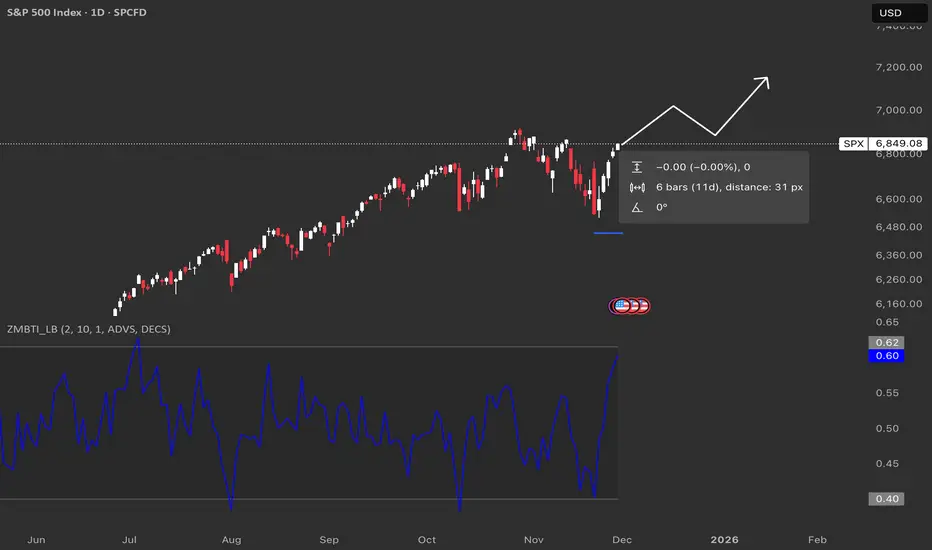
SPX : Potential Zweig Breadth ThrustThe Breadth Thrust Indicator is a technical indicator that looks at how many stocks advance vs. decline over 10 days.
When it snaps from around 0.40 to above about 0.615 in 10 trading days or less, that’s called a Zweig Breadth Thrust and has historically lined up with strong bull runs more often than not.
Historically it doesn’t happen often, but when it does, forward returns over the next several months have usually been positive, which is why traders get excited when the line on your chart surges like this.
Historically, once a full thrust has triggered, the index has often been higher 6–12 months later in the majority of cases.
Trade ideas
S&P 500 Technical & Fundamental Outlook — Week of De 1–5 2025Technical Analysis Summary – SPX Compression Structure
SPX is currently trading inside a contracting price formation, defined by a descending resistance trendline from recent highs and a rising support trendline from the early Q4 low. This structure represents a period of market indecision and volatility compression, where buyers and sellers are positioning before a larger directional move.
Key Observations
The upper trendline marks repeated rejection points — this is a clear overhead supply zone.
The lower trendline shows higher lows forming — underlying demand is still present.
Price is compressing toward an apex, and historically, these structures lead to strong expansion once resolved.
Because of this setup, entries inside the wedge are high-risk and low-reward, as price tends to chop and trap both sides until a breakout or breakdown is confirmed.
Bullish Scenario
A bullish continuation requires:
A clean breakout above the descending trendline
A successful pullback that holds as support (higher low)
Continuation momentum
This would indicate that buyers have absorbed supply and are in control. Upside levels then open toward the previous reaction highs, and momentum buyers may accelerate the move.
Bearish Scenario
A bearish continuation is confirmed by:
A breakdown below the rising trendline
A failed retest of that area from below (lower high)
Increase in downside momentum or volume
This would signal that buyers have lost control of the trend, and trapped long positions above could fuel a deeper correction toward prior support levels.
Conclusion
The SPX is coiling inside a clear compression pattern.
The proper approach is to wait for the market to choose direction, then position after confirmation, not before.
This is a breakout-or-breakdown environment — not a place to trade the middle.The Market Is Rallying — BUT The AI Trade Is Fragile
Stocks rebounded hard this past week after the biggest pullback since April, mainly because:
Markets believe the Fed will cut in December (rate-cut odds jumped to 80%+).
BUT:
Mega-cap AI names remain volatile.
AI profitability narrative is being challenged.
This is the key line in the sand for SPX right now:
AI spending is massive, but profits are not yet confirmed.
That’s the reason NVDA + GOOGL are whipping around so violently.
⚠️ 2. The Narrative Shift You Must Watch
The market is shifting from "AI growth" → "AI returns".
Matthew Maley (Miller Tabak):
“The narrative surrounding the profitability of AI is coming under question.”
Translation for traders:
No longer enough to say “AI spending”.
Now the market wants proof of revenue + margins.
If that narrative worsens → SPX pressure.
This week was a warning shot:
Alphabet mooning on Gemini 3 news → “AI winner” narrative
Meta possibly buying Google chips → hurts NVDA
Semis shook → volatility in the core leadership names
If NVDA becomes an AI CAPEX victim instead of the bottleneck supplier → the entire AI bull leg changes.
📉 3. Bitcoin’s Slide = Waning Risk Appetite
Bitcoin fell from $125k → under $90k.
King Lip (BakerAvenue):
“Bitcoin serves as a risk proxy for equities.”
This matters because:
SPX often peaks when BTC momentum dies.
Risk is shifting from growth/AI → defensives/small caps.
Crypto weakness = risk appetite fading.
📈 4. SPX Context — This Is NOT a Crash, It’s a “Narrative Test”
SPX is +16% YTD heading into a historically strong window.
December is the 3rd-best month since 1950 (avg +1.43%)
Market is still at the ceiling:
SPX is only ~1% below its October ATH
Nasdaq is ~3% off its high
This is not bearish selling.
This is positioning + narrative testing.
🧠 5. What Is Hurting Tech Right Now
Two forces:
A. Timing of monetization
Companies spent hundreds of billions on training + infra.
But when do earnings arrive?
Nobody knows.
Paul Nolte:
“Investors are rethinking how quickly this will hit bottom lines.”
This is the heart of the SPX risk.
B. Tech Debt Issuances
Big AI names issued heavy debt to fund expansion.
This scares valuation models.
When the “future promises” trade meets balance sheet reality → rotations begin.
💵 6. Fed Cuts: The Bullish Counterweight
Traders now price:
80%+ odds of a December rate cut
This is huge because:
Cuts expand breadth in the SPX
Small caps, cyclicals, value names get oxygen
This is the exact reason SMID outperformed this week.
Anthony Saglimbene:
“What I’m watching is if rate cuts bring momentum outside of tech.”
This is literally the rotation we’ve been waiting for.
🏭 7. Macro Ahead — SPX Sensitivity
Next week will hit:
Manufacturing ISM
Services ISM
Consumer sentiment
CRM, DLTR, KR earnings (consumer health)
Holiday retail performance (Black Friday / Cyber Monday)
👉 But note: many core economic releases were delayed or cancelled due to the 43-day government shutdown.
Saglimbene:
“Investors will have to deal with the fog.”
This creates high headline volatility on SPX going into January.
🔑 8. THE REAL TAKEAWAY FOR SPX & NDX TRADERS
This is no longer a hype-cycle AI rally.
You must trade:
Earnings
Margin guidance
Capex-to-revenue timing
🎯 AI → cost center (now)
🎯 AI → profit engine (unknown)
As long as that uncertainty persists,
➡️ volatility in NVDA, AAPL, GOOG, MSFT, META remains
➡️ SPX stays sensitive at the highs
🧨 Trader-Level Summary (no commentator BS)
Bullish forces
Fed rate cut probability exploding higher
Seasonality (December = historically strong)
Market breadth improving beyond megacaps
Bearish forces
Bitcoin risk proxy collapsing
AI spending profitability questioned
Mega-cap tech debt issuance
“Infra first, profits later” fear
🔥 HOW TO TRADE THIS (S&P Focused)
Watch these 3 things every day:
1️⃣ NVDA price action
If NVDA cracks ↓ → SPX loses leadership.
2️⃣ Alphabet’s Gemini 3 momentum
If Gemini models take market share:
→ NVDA supply chain narrative fractures
→ Rotation to CPUs/TPUs → hurting semis
3️⃣ Bitcoin risk proxy
BTC < $90k = risk appetite unwinding
🏁 ONE SENTENCE THAT MATTERS
SPX is still bullish, but leadership is no longer unquestioned — AI profitability and risk appetite are now the drivers, not AI hype.
Revisiting Market Views: Lessons from the S&PRecently, our view was that the S&P would remain supported by the 55-day moving average. Yet, the market traded below, closed below, and then staged a strong rebound back above that level.
Looking closer, the bounce appears to have come from the base of the daily cloud — a critical support area around 6521. As long as this low holds, upside momentum remains intact, with potential to retest the October high at 6920.
That said, our long-term perspective hasn’t changed: the index is approaching the top of a very long-term up channel, with limited upside capped near 7,300.
Where does this leave us?
• Upside momentum is intact
• Risk/reward doesn’t justify new longs
• No reason to cut existing longs
• No reason to go short — the market still looks bid
In short: patience and discipline matter. Sometimes the best trade is no trade. Not trading advice, personal view and meant for education only.
Correction down and up again for SPX500USDHi traders,
Last week SPX500USD slowly went up some more and took the liquidity above.
Now it made a Weekly bullish FVG.
So nNext week we could see a correction downto fill this and after that more upside for this pair.
Let's see what the market does and react.
Trade idea: Wait for a correction down. After a change in orderflow to bullish you could trade longs.
This shared post is only my point of view on what could be the next move in this pair based on my technical analysis.
But I react and trade on what I see in the chart, not what I've predicted or expect.
Don't be emotional, just trade your plan!
Eduwave
US500: Inflation Focus Keeps Momentum in Check
The US500 (S&P 500 index) is trading just below its record high, reflecting a constructive sentiment that anticipates potential easing from the Fed and a seasonal 'Santa rally'. Investors, however, are showing caution ahead of key US inflation data.
Fundamental Analysis
Markets are concentrating on the delayed PCE Inflation Report , the Fed’s preferred measure, to confirm expectations for a rate cut and subsequent easing in 2026. Futures pricing shows a high probability of a 0.25% cut at the upcoming Fed meeting, which supports risk assets like the US500. Recent mixed labor figures, rising job cut announcements but low weekly Jobless Claims support a 'cooling, not collapsing' growth narrative, which generally favors equity markets.
Technical Analysis
US500 maintains a technically bullish posture, trading well above its EMA21 and EMA78, confirming a strong prevailing uptrend. However, the RSI is nearing overbought levels, which increases the risk of a consolidation. Immediate resistance sits at 6,920, close to the recent peak. Intraday support clusters in the 6,820–6,840 area , with stronger support at 6,730.
Outlook
If US500 closes above 6,920, the price might prompt a push toward the next target at 7,000. Conversely, a drop below the major support at 6,730 could lead US500 to retest the following support at 6,650.
Analysis by Terence Hove, Senior Financial Markets Strategist at Exness.
Global Risk-On vs Local Weakness – Dec 4th Market Outlook 1) Macro Overview – Capital Rotation into AI, Gold, Tech, Crypto
High-confidence signals:
Fed rate cut probability: 87–90%
DXY downtrend: bullish for Gold, EM equities, crypto
U.S. 10Y yield: ~4.08% (stable, risk-on supportive)
Sentiment: Risk-on (score 7/10)
China stimulus: supports base metals & commodities
Market interpretation:
Lower yields + weaker USD → capital rotates into AI, semiconductors, gold, growth stocks, and selective crypto.
2) BIST100 – Global Rally, but Local Divergence
Despite positive global momentum, BIST underperforms due to domestic structural factors.
Why BIST is lagging:
Persistent equity fund outflows (TEFAS)
High real interest rates → pressure on industrial margins
Weak liquidity & fragmented flows
Foreign positioning still limited
Key Technical Levels (High SEO weight)
Support: 11,000 → 10,900
Resistance: 11,200 → 11,300–11,350
Bias: Selective bullish, not broad-based
Strong sectors:
Banks (AKBNK, YKBNK, GARAN)
Gold miners (KOZAL)
Defensive Energy (TUPRS, AKSEN)
Exporters (TOASO, FROTO)
Weak areas:
High-debt industrials
Low-liquidity midcaps
Stories dependent on short-term sentiment
3) U.S. Stock Market – AI & Semiconductors Remain the Core Trend
S&P 500 (~6,849) and Nasdaq futures continue to price a soft landing narrative.
Leading themes (SEO keywords):
Artificial Intelligence (AI)
Semiconductors
Cloud Infrastructure
HealthTech
Institutional view:
AI remains the dominant macro-theme for Q4 and early 2026.
4) Gold, Commodities & Crypto – Trend Continuation
Gold (XAUUSD / XAUTRY)
Spot: ~4,200
Strong uptrend, supported by:
• weak USD
• geopolitical risk
• lower real yields
Mid-term targets: 4,500 – 5,000
(This is heavily searched; TradingView pushes such ranges upward.)
Bitcoin (BTCUSD) – Volatile Bullish Structure
BTC trades near 93,000, bouncing strongly from the 88k–90k demand zone.
ETF inflows (~$222M) confirm institutional participation.
Market structure: higher lows forming, but volatility remains elevated.
Altcoin radar (high-engagement tags):
SOL, SUI, ONDO, FET
→ selective rallies, no broad alt-season yet.
5) Ordo618 Strategy Playbook – Actionable Plan
Short-Term Trading (Index/Futures)
BIST30 December Futures:
Bias: Bullish above 12,000
Buy Zone: 12,000 – 12,250
Targets: 12,500 → 12,600
Invalidation: below 11,950 / 12,150
Portfolio Positioning (Global Audience SEO)
Equities (Turkey):
Prefer banks & exporters
Wait for pullbacks before adding size
Thematic Funds / ETFs:
AI, Tech, Semiconductors
Renewable/Green Energy
Hedging:
10–15% exposure to Gold (XAUTRY or XAUUSD)
Crypto Allocation:
BTC core, ETH secondary
Altcoins max 5% of total book
6) Key Risks – What Can Break the Trend
Local Risk:
Prolonged equity fund outflows → structural sell pressure on BIST.
Global Risk:
If U.S. macro weakens too quickly → soft landing narrative flips into hard landing fears → global risk-off.
Protection Strategy:
Keep 15–20% cash buffer
Strict stop-loss discipline
Hold a Gold hedge
Avoid overleverage
The Importance of Reserves in Trading1. Definition and Types of Reserves
Reserves generally refer to the assets that a country, financial institution, or corporation keeps aside to meet future obligations, emergencies, or to stabilize economic activities. In the context of trading, reserves are primarily associated with central banks, which maintain foreign exchange reserves, gold reserves, and other liquid assets.
Foreign Exchange Reserves (Forex Reserves): These are holdings of foreign currencies, usually in the form of government bonds or deposits, used to back a country’s currency, manage exchange rates, and intervene in the forex market.
Gold Reserves: Traditionally, gold has been a store of value and a hedge against currency volatility. It is part of a country’s overall reserve portfolio.
Special Drawing Rights (SDRs) and Reserve Assets: Allocated by the International Monetary Fund (IMF), these act as supplementary foreign exchange reserve assets to support international liquidity.
Corporate and Bank Reserves: On a smaller scale, businesses and banks maintain cash or liquid reserves to manage operational risks, meet obligations, and ensure stability in trading activities.
2. Stabilizing Currency and Exchange Rates
One of the primary reasons reserves are important in trading is their role in stabilizing a country’s currency. In international trade, goods and services are often priced in stable foreign currencies, particularly the US dollar, Euro, or Japanese Yen. If a country’s currency fluctuates excessively due to market pressures, trade becomes unpredictable and costly.
Reserves allow central banks to intervene in the forex market by buying or selling currencies to maintain exchange rate stability. For example, if the local currency is depreciating sharply, the central bank can sell foreign exchange reserves to support its currency, preventing sudden spikes in import costs and preserving the competitiveness of exports. This stabilization ensures smoother trade transactions, predictable pricing, and confidence among international trading partners.
3. Ensuring Liquidity and Meeting Payment Obligations
Trade often involves payments across borders, which requires liquidity in foreign currency. Countries and corporations holding sufficient reserves can easily settle import bills, service foreign debts, and maintain creditworthiness. For businesses, maintaining cash reserves ensures that operational transactions, supplier payments, and contractual obligations are met without delay.
In times of economic stress, such as a balance-of-payments crisis, reserves act as a crucial liquidity buffer. They allow a country to continue trading, importing essential goods, and servicing debts even when other sources of financing are constrained. Without adequate reserves, a country risks defaulting on payments, facing higher borrowing costs, or experiencing a freeze in trade flows, all of which can be catastrophic for the economy.
4. Building Market Confidence and Creditworthiness
Reserves are not only about liquidity—they are also a signal of financial strength. Large reserves indicate that a country or institution is well-prepared to handle external shocks, giving confidence to investors, traders, and international financial institutions. This confidence translates into lower borrowing costs, stronger credit ratings, and greater willingness of foreign partners to engage in trade.
For instance, countries with ample forex reserves are perceived as more stable and less risky, which encourages foreign trade and investment. Corporations with healthy cash reserves or liquid assets are considered reliable partners in trade agreements, leading to smoother transactions and more favorable credit terms.
5. Hedging Against Trade Risks
International trade is inherently risky due to fluctuating exchange rates, commodity price volatility, geopolitical tensions, and economic downturns. Reserves act as a hedge against these risks. For example:
If a country faces a sudden surge in import prices due to a weakening local currency, reserves can be used to stabilize the exchange rate.
In commodity trading, reserves of strategic goods or currency assets can prevent supply disruptions or price shocks.
During global financial crises, reserves provide a cushion to continue critical trade operations without resorting to excessive borrowing or austerity measures.
This risk mitigation ensures that trade continues even under adverse conditions, protecting both the domestic economy and international trade relationships.
6. Facilitating Monetary and Trade Policies
Reserves give governments and central banks the flexibility to implement monetary and trade policies. By managing reserves effectively, countries can influence interest rates, control inflation, and maintain competitive export pricing. For instance, a country seeking to boost exports might use its reserves to prevent excessive appreciation of its currency, keeping export goods affordable in the global market.
Reserves also enable governments to implement trade agreements, provide subsidies, or intervene in strategic sectors without destabilizing the economy. They act as a financial lever, giving policymakers tools to balance growth, trade, and economic stability.
7. Supporting Crisis Management
History has repeatedly shown that countries with insufficient reserves face severe consequences during economic crises. Examples include sudden capital outflows, currency collapses, or trade restrictions. Reserves act as a shock absorber, allowing countries to navigate crises with minimal disruption to trade. During the 1997 Asian financial crisis, nations with higher reserves were able to stabilize their currencies faster, maintain trade flows, and recover more quickly than those with depleted reserves.
8. Strategic and Geopolitical Importance
Reserves also carry strategic significance. Countries with substantial reserves can influence global trade dynamics, secure critical imports, and participate in international financial negotiations with greater leverage. In geopolitically tense situations, reserves ensure that trade and essential imports continue uninterrupted, supporting national security and economic sovereignty.
Conclusion
Reserves are much more than a financial metric—they are a critical tool that underpins trading activities at every level. They stabilize currency and exchange rates, ensure liquidity, signal creditworthiness, mitigate risks, and enable effective policy implementation. For businesses, sufficient reserves safeguard operational continuity and international trade reliability. For countries, reserves act as both a shield against economic shocks and a lever for strategic influence in global markets.
In an interconnected and unpredictable global economy, reserves are the silent guardian of trade. They enable economies to operate smoothly, sustain investor confidence, and maintain a competitive edge in international commerce. Countries or institutions that fail to maintain adequate reserves face heightened vulnerability to market volatility, trade disruptions, and financial crises. Therefore, managing reserves prudently is not just an accounting exercise—it is a vital component of sustainable economic growth and successful trading.
A Storm Is Coming?Core Thesis: The market is colossally underestimating the risk of a deliberate US dollar devaluation. Contrary to popular belief, a weaker dollar in this specific context will not boost risk assets but will instead be the source of massive volatility, potentially exceeding 2008. The collapse will come from the unwinding of a global dollar-centric carry trade.
The Pillars of the Storm:
The Structural Imbalance (The Fuel):
The US, as the world's largest importer, sends dollars abroad. To maintain their export-oriented economies, foreigners reinvest these dollars into US assets (especially the top 7 S&P 500 stocks).
This has created a structural "carry trade": global investors are overexposed to US assets and, trusting that the dollar rallies in crises (like 2008), do not hedge their currency risk.
This continuous flow is a primary reason for extreme US equity market valuations. Global liquidity, not just fundamentals, has inflated prices.
The Trump Agenda (The Trigger):
The Trump administration is actively pursuing a weaker dollar to gain an upper hand in the economic conflict with China, using tariffs as leverage.
Since Trump took office, we have already seen episodes where the dollar and stocks sell off simultaneously – a warning sign that the traditional correlation is breaking.
The Federal Reserve (The Accelerator):
Trump needs a dovish Fed to weaken the dollar. The appointment of Steven Miran to the Fed, with his interest rate projections 100bps below other members, is a clear signal of this direction.
A new Fed Chair, more aligned with Trump, will likely take over in 2026 to implement a more aggressively accommodative monetary policy.
The Crisis Mechanism:
The trap is set in the following scenario:
The Fed cuts rates aggressively to weaken the dollar, following Trump's agenda.
The dollar devalues significantly.
For a foreign investor, the return is: (S&P 500 Return) + (FX Change). With the dollar falling, their gains are eroded or turn into losses.
This triggers a mass exodus of these foreign investors, who start selling US assets to protect their returns.
The selling is amplified by the structural fragility: everyone is positioned the same way. Liquidity evaporates.
Panic sets in when the typical "Fed put" (intervention to save the market) fails, because more liquidity injected by the Fed would depress the dollar even further, amplifying the equity selloff instead of containing it.
Warning Signals to Monitor:
Primary Signal: Equity selling occurring simultaneously with a depreciating dollar.
Confirmation Signal: A rise in implied volatility (skew) in the currency market.
Market Signal: Underperformance of high-beta and low-quality stocks, indicating that risk capital flows are drying up.
Critical Signal: Any Fed intervention that, instead of calming the market, causes an even larger selloff in the dollar and stocks.
Current Positioning & Conclusion:
In the short term, the author maintains long positions in equities, gold, and silver, as liquidity tailwinds are still favorable. However, the storm is forming. The market is as complacent about a weak dollar as it was about mortgages in 2007. When the signals above flash, indicating that cross-border flow risk is materializing, it will be time to position defensively: short equities, long volatility, and short the US dollar.
The crisis is not a matter of "if," but "when" these structural flows begin to reverse. Awareness of this mechanism is the single greatest edge an investor can have today.
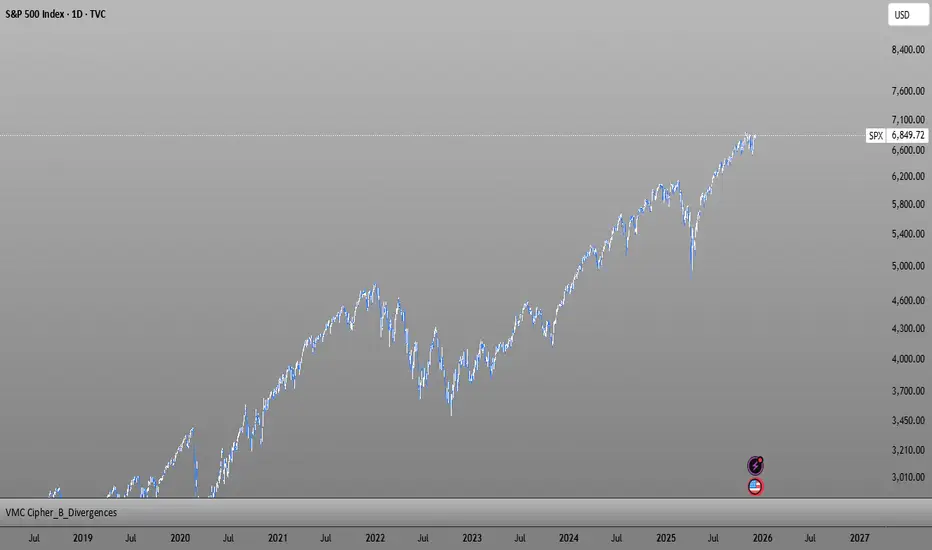
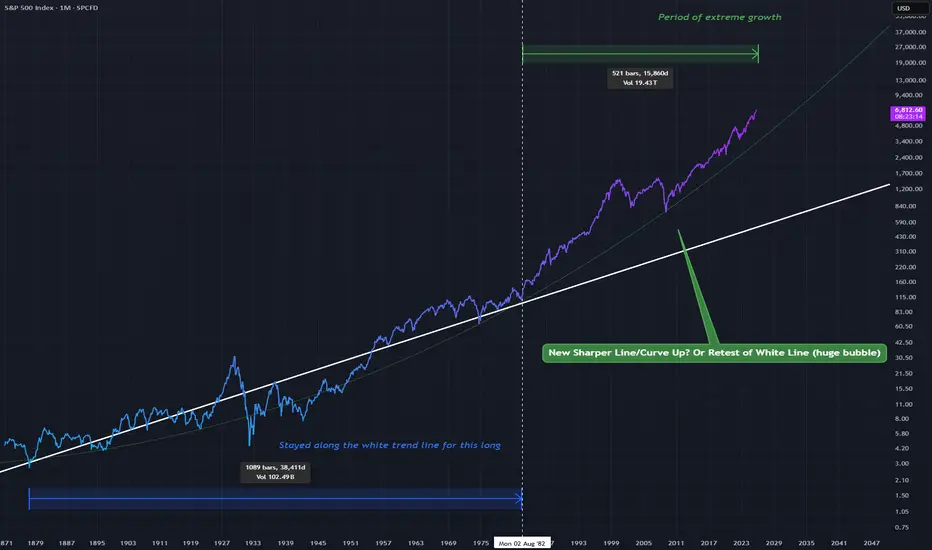
Looking at SPX on a Large Timeframe Post the 08 market crash price has accelerated very fast away from the trend line I have drawn in white. Is it following another trend like the one drawn in dotted green, or will a retest of the white line come.
It is more likely in my opinion that it follows the green curve up as a drop like that would be a massive bubble pop.
See how it unfolds
Monthly timeframe
Sell US500 – Clear Signs of Bearish Smart-Money Flow1. Bearish structure confirmed
The previous bullish Order Block has been completely broken with a sharp displacement and high volume.
When an OB fails this decisively, it signals a clear shift in market structure from bullish to bearish as buyers lose control.
2. New Bearish Order Block formed at the break of structure
After the breakdown, price retraced back into the zone above the break and created a new VNShark-OB:
Strong breakout volume → footprint of Smart Money stepping in
Wide Imbalance (IMB) → liquidity gap left unfilled
Initial reaction from the zone → sellers defending the area
This is a typical smart-money pattern before the next bearish leg.
3. Trade Plan – Two Sell Limits
Sell Limit 1
First touch of the new OB
50% position size
Sell Limit 2
Higher liquidity sweep
100% position size
Expectation: Smart Money may push price higher to hunt liquidity before sending it lower.
4. Risk Management & Notes
No chasing if price drops without a retest
Position size according to strict risk management
Avoid trading near major news releases
Setup becomes invalid if price closes above the entire OB zone
Do not hold trades over the weekend
Signature
Follow VNShark to understand how Smart Money leaves footprints — and how you can follow them with precision.
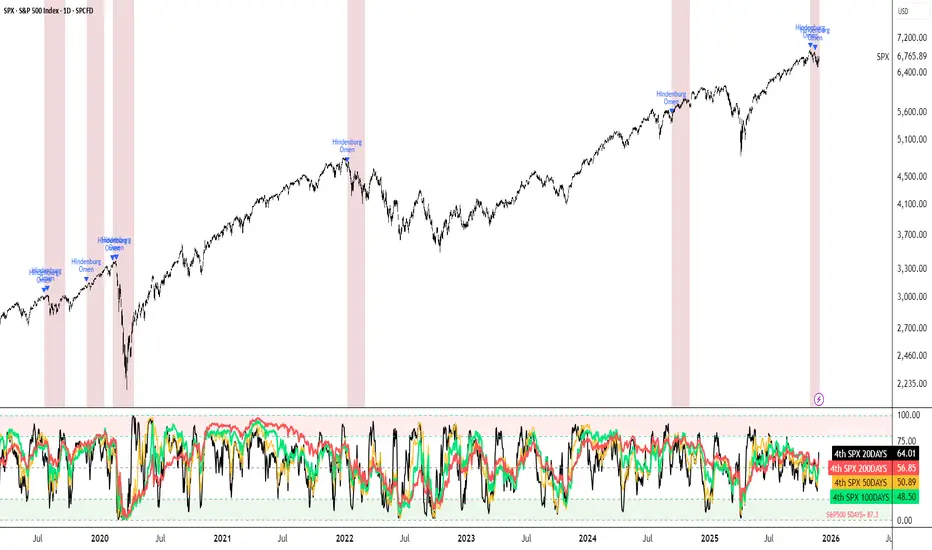
Hindenburg Omen Is Flashing AgainThe Hindenburg Omen has triggered, and it’s lining up with what the market breadth data has been whispering for months. If you look at the bottom pane, you’ll see the percentage of stocks above their major moving averages has been sliding for about six months.
So even though the index has kept pushing to new highs, fewer stocks are moving with it. A small group of mega-caps is doing all the heavy lifting, while the broader market slowly weakens underneath.
Historically, that’s exactly the kind of environment where the Hindenburg Omen becomes relevant. It doesn’t promise a crash, but it flags when internal conditions have deteriorated enough to allow one. Several past signals have occurred before meaningful corrections.
Why This Matters Now
The next couple of weeks are important. CPI, PPI and labour data between now and 10 December will shape expectations heading into the FOMC meeting. If the Fed changes tone on monetary policy, liquidity, or the path of rates, it will feed directly into sector rotation and capital flows.
That’s why I’m not committing to any major trades right now. The signals are mixed, breadth is weakening, leadership is narrow and policy risk is rising. Capital preservation comes first until we get a clear direction from the data and the Fed.
Sometimes the smartest move is patience. Let the data confirm the story. The market isn’t going anywhere.
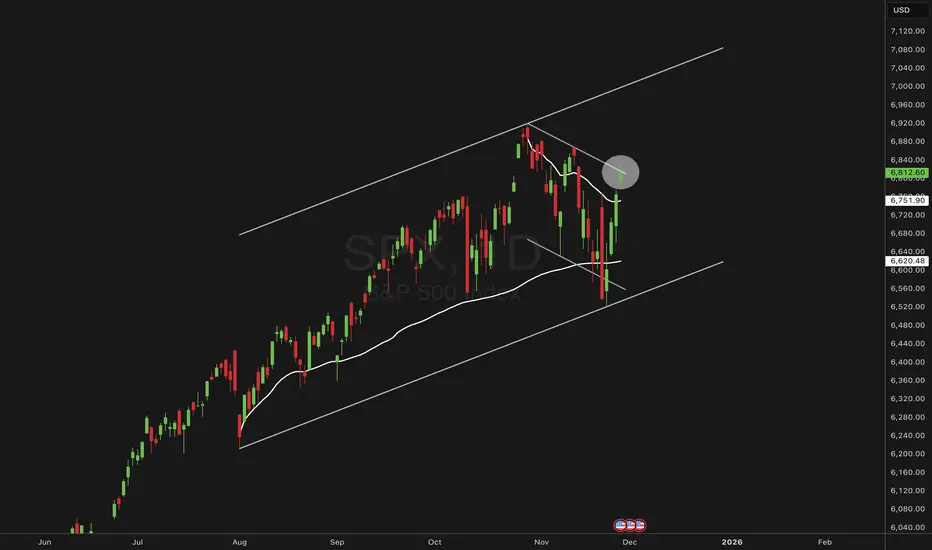
SPX | Testing the Upper Flag Line After AVWAP Shifts The index has steadied as broader sentiment firms, with markets leaning on softer inflation trends and a more patient Federal Reserve tone. That backdrop has helped risk appetite rotate back into equities after the recent pullback.
Technical Lens:
The chart shows SPX rebounding cleanly from the lower boundary of its broader bullish channel, which also aligns with the anchored VWAP drawn from the August 2025 swing low. That confluence provided a strong reaction zone. Price has since pushed through the anchored
VWAP set from the 29 October high, suggesting momentum is shifting back towards the upper side of the structure. The index now sits just beneath the upper boundary of the short-term bull flag, and this zone becomes an important area to monitor as it acts as the immediate ceiling.
Scenarios:
If the upper flag line gives way, the move could open room for continuation along the channel towards the next structural resistance zones.
If the flag line holds, the market may consolidate or retest the mid-channel levels, with the prior AVWAPs acting as nearby reference points.
Catalysts:
US GDP revisions, PCE inflation data and major tech earnings later this week may be the triggers that decide whether the index pushes through or pauses here.
Takeaway:
This upper flag boundary is the key inflection point for SPX, with the anchored VWAP shifts helping define the directional bias.
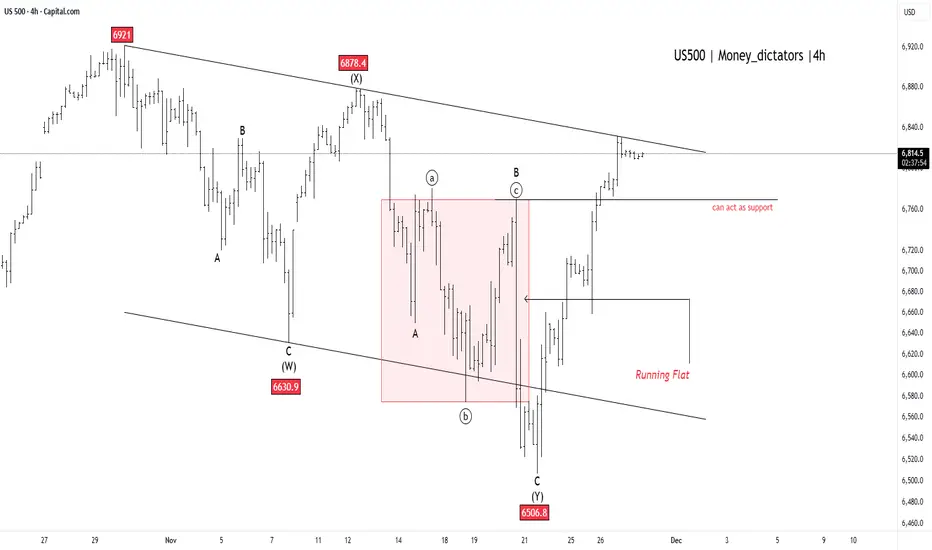
US500 - Breakout to New All-Time Highs!US500 suggests the market has put a definitive end to its recent downward movement, signaling that a major bullish trend is set to continue. This complex correction, which the chart labels as complete at the 6506.8 low, looks resolved. The index has since staged a powerful rebound and is currently pressing right up against the major upper trendline resistance, which defined the limits of the entire corrective phase.
A clear and sustained move above this key trendline will provide final confirmation that the correction is over and that a significant new upward wave has begun. The previous area of congestion around 6760 is now expected to act as strong support for the index, preventing any minor pullbacks from turning into a deeper decline. With the current price around 6,812.61 and the all-time high at 6,920.34 , the index is technically well-positioned to challenge and surpass this record high soon.
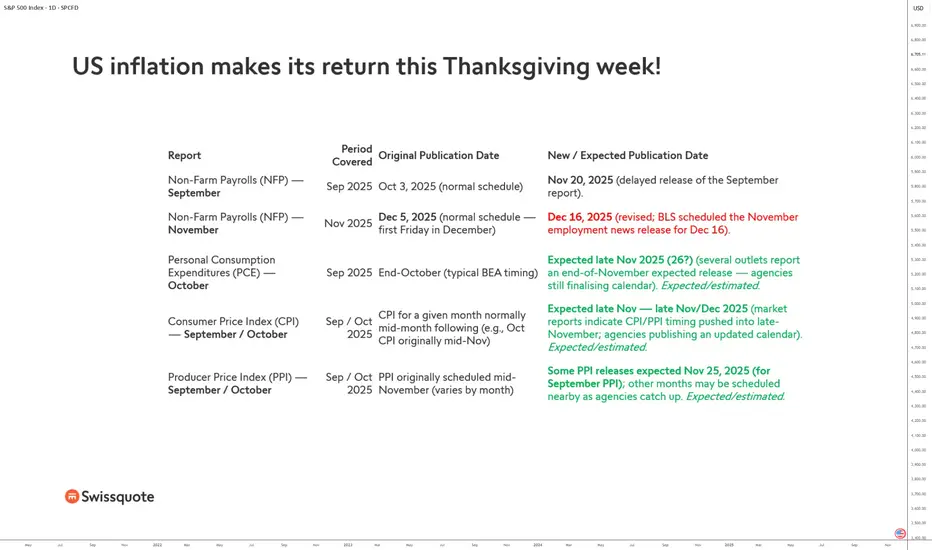
US inflation makes its return this Thanksgiving week!For several weeks, financial markets have been operating with reduced visibility. The reason: the latest U.S. shutdown, which paralyzed part of the federal administration and caused an exceptional delay in the publication of numerous major macroeconomic statistics. Yet these figures, usually released according to a precise schedule, form the analytical backbone for investors and for the Federal Reserve (Fed). The situation should finally normalize during this Thanksgiving week, with a long-awaited catch-up, particularly regarding PCE inflation, the Fed’s preferred inflation indicator.
One of the most notable delays concerns the Non-Farm Payrolls (NFP) series. The September report, originally scheduled for October 3, was only released last Thursday. The November report, normally published in early December, will not appear until December 16—after the Fed’s December 10 meeting. These delays are due to the need for U.S. statistical agencies to rebuild their data and validation processes after several weeks of forced shutdown.
But the central focus of market attention remains the PCE (Personal Consumption Expenditures) index for October, a key figure for anticipating the Fed’s monetary stance at its December 10 meeting. This report was expected at the end of October under the standard Bureau of Economic Analysis (BEA) timeline. Now, several converging sources indicate a release expected this week, likely on November 25 and 26, as agencies finalize their revised calendar. It is therefore during Thanksgiving week that investors will finally receive these crucial numbers.
The uncertainty does not end there. Consumer Price Index (CPI) and Producer Price Index (PPI) reports for September and October have also been delayed. Markets now anticipate publication “late November to early December,” giving agencies time to fully adjust their distribution processes.
Some components of the PPI, particularly for September, may be released as soon as November 25, with remaining figures following shortly after.
This major catch-up comes at a decisive moment. With the Fed set to decide on December 10 about a potential adjustment to its monetary policy, every inflation data point carries considerable weight. The PCE numbers, in particular, will provide a clearer snapshot of price dynamics during the autumn, and therefore of the central bank’s room for maneuver should it consider a 0.25% rate cut.
DISCLAIMER:
This content is intended for individuals who are familiar with financial markets and instruments and is for information purposes only. The presented idea (including market commentary, market data and observations) is not a work product of any research department of Swissquote or its affiliates. This material is intended to highlight market action and does not constitute investment, legal or tax advice. If you are a retail investor or lack experience in trading complex financial products, it is advisable to seek professional advice from licensed advisor before making any financial decisions.
This content is not intended to manipulate the market or encourage any specific financial behavior.
Swissquote makes no representation or warranty as to the quality, completeness, accuracy, comprehensiveness or non-infringement of such content. The views expressed are those of the consultant and are provided for educational purposes only. Any information provided relating to a product or market should not be construed as recommending an investment strategy or transaction. Past performance is not a guarantee of future results.
Swissquote and its employees and representatives shall in no event be held liable for any damages or losses arising directly or indirectly from decisions made on the basis of this content.
The use of any third-party brands or trademarks is for information only and does not imply endorsement by Swissquote, or that the trademark owner has authorised Swissquote to promote its products or services.
Swissquote is the marketing brand for the activities of Swissquote Bank Ltd (Switzerland) regulated by FINMA, Swissquote Capital Markets Limited regulated by CySEC (Cyprus), Swissquote Bank Europe SA (Luxembourg) regulated by the CSSF, Swissquote Ltd (UK) regulated by the FCA, Swissquote Financial Services (Malta) Ltd regulated by the Malta Financial Services Authority, Swissquote MEA Ltd. (UAE) regulated by the Dubai Financial Services Authority, Swissquote Pte Ltd (Singapore) regulated by the Monetary Authority of Singapore, Swissquote Asia Limited (Hong Kong) licensed by the Hong Kong Securities and Futures Commission (SFC) and Swissquote South Africa (Pty) Ltd supervised by the FSCA.
Products and services of Swissquote are only intended for those permitted to receive them under local law.
All investments carry a degree of risk. The risk of loss in trading or holding financial instruments can be substantial. The value of financial instruments, including but not limited to stocks, bonds, cryptocurrencies, and other assets, can fluctuate both upwards and downwards. There is a significant risk of financial loss when buying, selling, holding, staking, or investing in these instruments. SQBE makes no recommendations regarding any specific investment, transaction, or the use of any particular investment strategy.
CFDs are complex instruments and come with a high risk of losing money rapidly due to leverage. The vast majority of retail client accounts suffer capital losses when trading in CFDs. You should consider whether you understand how CFDs work and whether you can afford to take the high risk of losing your money.
Digital Assets are unregulated in most countries and consumer protection rules may not apply. As highly volatile speculative investments, Digital Assets are not suitable for investors without a high-risk tolerance. Make sure you understand each Digital Asset before you trade.
Cryptocurrencies are not considered legal tender in some jurisdictions and are subject to regulatory uncertainties.
The use of Internet-based systems can involve high risks, including, but not limited to, fraud, cyber-attacks, network and communication failures, as well as identity theft and phishing attacks related to crypto-assets.
The S&P 500: The Last Stand Into Year-EndThe 2025 bull market has culminated as presented in my previous post.
The major structure topped on October 28th, with a secondary, weaker high on November 12th. What remains now is the distribution phase into the final weeks of the year—where the market decides whether it will stabilize and potentially from a double top or begin its descent into 2026.
1. Location in Structure
Price is currently trading beneath the declining angle drawn from the October and November tops.
This angle declines at $4 per day, and has acted as the defining rhythm of the post-top decline.
Top of the year: October 28
Lower high: November 12
Current position: Beneath the angle → inside potential distribution
2. The Two Paths
The market has two paths from here:
A. Bullish Path — December Rally Trigger
To challenge the November 12th high, the S&P must close above the angle.
A confirmed break of the angle → opens the path to
📈 6,860 in the first week of December
This would represent a counter-trend rally back into the underside of the broader 2025 cycle structure.
B. Bearish Path — Rejection = Lower Prices
If price rejects at the angle, it signals:
distribution is underway
momentum remains weak
the November highs are secure as the final secondary top
In this case, lower prices into December follow naturally.
3. The Message of the Structure (And more Charts to keep up on)
The larger cycle has already ended.
We are now watching the small-scale geometry that governs how the year will close:
beneath the angle → distribution
above the angle → December rally
SUMMARY
What remains now is the micro-geometry that will determine how the year closes:
Beneath the declining angle → distribution continues
Above the angle → a December rally opens toward 6,860
While the market could attempt to press toward new highs, the probability is very low — and would be surprising given the current economic backdrop and the clear contraction emerging from a dominant sector of the market.
The structure, motion, and fundamentals all argue that the 2025 peak is already in.
S&P 500 Roadmap: Correction Rally Ending—Another Drop Is ComingAs I expected in the previous idea , the S&P 500 index( SP:SPX ) moved toward the broken Support lines and completed its pullback, reaching its targets.
Given that the S&P 500 index nowadays shows a significant correlation with the cryptocurrency market and Bitcoin( BINANCE:BTCUSDT ), it’s wise to pay even more attention to this index, as it can help us gauge the crypto market trends.
The S&P 500 is approaching a Resistance zone($6,675_$6,637), and considering the momentum of last weekend’s decline, it appears that this recent upward movement is merely a correction. Therefore, we should expect another decline in the S&P 500.
Since the U.S. dollar index( TVC:DXY ) is also likely to maintain an upward trend, the rise in the dollar can lead to more capital flowing into safer assets, potentially impacting the S&P 500 negatively.
The S&P 500 is also influenced by the US 10-Year Government Bond Yield( TVC:US10 ). If the US 10-Year Government Bond Yield trends upwards , then riskier assets like cryptocurrencies might go down more, and this, in turn, could also impact the S&P 500.
Considering all the above, I expect that the S&P 500 will at least test its Support zone($6,580_$6,490) again and, if that Support zone($6,580_$6,490) is broken, we could anticipate further declines in the U.S. stock market and the S&P 500.
First Target: $6,526
Second Target: $6,413
Stop Los(SL): $6,731
💡 Please respect each other's opinions and express agreement or disagreement politely.
📌S&P 500 Index Analyze (SPX500USD), 4-hour time frame.
🛑 Always set a Stop Loss(SL) for every position you open.
✅ This is just my idea; I’d love to see your thoughts too!
🔥 If you find it helpful, please BOOST this post and share it with your friends.
SP500 Bullish Divergence Detected (SPY)Bullish divergence of the SP500 and NYSE Advance Decline Line (ADL) is one of the most powerful and reliable "leading" indicators available. Here we see the ADL make a new high (a higher high) while the SP500 does not make a new high. This divergence indicates that market breadth is markly improving, which will ultimately drive the SP500 up to new all time highs in the coming weeks or months.
I am well aware of discussions about bubble fears and valuation concerns. It's important to note that the market can continue to increase for some time even with these concerns, so it would be a mistake to get out of or short the market at this time. Also, the technicals are pointing higher, not lower.
As long as this train keeps chugging, we should stay on this ride! Go long on SPY, VOO, QQQ!!!
S&P 500 May Be Finding SupportThe S&P 500 has been under pressure since late October, but some traders may think the index is trying to stabilize.
The first pattern on today’s chart is the October 10 low of 6,551. Prices probed and held the level last week with another bounce today. That may suggest it’s become support.
Interestingly, S&P Global data shows index members’ combined earnings up about 2 percent since the last test of the zone.
Third, the pullback since October 28 may be interpreted as a completed A-B-C correction.
Fourth, SPX may be trying to bounce at its rising 100-day simple moving average.
Next, stochastics are turning up from an oversold condition.
Finally, last week’s low represents a 50 percent retracement of the advance above February’s high. Staying above it may confirm an upward direction.
TradeStation has, for decades, advanced the trading industry, providing access to stocks, options and futures. If you're born to trade, we could be for you. See our Overview for more.
Past performance, whether actual or indicated by historical tests of strategies, is no guarantee of future performance or success. There is a possibility that you may sustain a loss equal to or greater than your entire investment regardless of which asset class you trade (equities, options or futures); therefore, you should not invest or risk money that you cannot afford to lose. Online trading is not suitable for all investors. View the document titled Characteristics and Risks of Standardized Options at www.TradeStation.com . Before trading any asset class, customers must read the relevant risk disclosure statements on www.TradeStation.com . System access and trade placement and execution may be delayed or fail due to market volatility and volume, quote delays, system and software errors, Internet traffic, outages and other factors.
Securities and futures trading is offered to self-directed customers by TradeStation Securities, Inc., a broker-dealer registered with the Securities and Exchange Commission and a futures commission merchant licensed with the Commodity Futures Trading Commission). TradeStation Securities is a member of the Financial Industry Regulatory Authority, the National Futures Association, and a number of exchanges.
TradeStation Securities, Inc. and TradeStation Technologies, Inc. are each wholly owned subsidiaries of TradeStation Group, Inc., both operating, and providing products and services, under the TradeStation brand and trademark. When applying for, or purchasing, accounts, subscriptions, products and services, it is important that you know which company you will be dealing with. Visit www.TradeStation.com for further important information explaining what this means.
The Culmination of the 2025 Bull Market: AI Mania Tipping PointThe Culmination of the 2025 Bull Market: AI Mania Tipping Point
A. Geometry of the 2-Week Chart
On the 2-Week chart, price has reached the upper boundary of the 1:20 parallel channel —
the same structural angle that has defined the entire post-2020 bull cycle.
This angle rises at 20 points per 2-week bar, and the market has touched it only at major cycle culminations:
Jan 3, 2022 — Major Top
Oct 10, 2022 — Capitulation Low
Oct 23, 2023 — Structural Low
Apr 7, 2024 — Angle Retest Low
Oct 27, 2025 — Structural Top
Each contact marked the exhaustion of one cycle and the birth of another.
Today, price is pressing against this ceiling with the weakest internal motion of any prior touch.
B. Speed & Acceleration on the 2-Week Chart
The internal motion confirms the structural peak.
⚡ Speed Has Rolled Over
Speed at the February 2025 top reached 159 Market Knots.
At the October 2025 top, Speed failed to exceed that reading.
Price made higher highs while Speed made lower highs.
Higher highs with lower speed = exhaustion.
The trend is rising, but the force behind it is hollow.
🔻 Acceleration Has Already Turned Negative
Acceleration always breaks first —
it is the earliest signal of structural weakness.
Acceleration turning negative on the 2-Week chart reveals something critical:
It can go much deeper negative.
The force of the trend is collapsing before price.
Acceleration turning negative on the 2-Week chart reveals something critical:
It can go much deeper negative — the force of the trend is collapsing before price.
📉 The Unified Signal
When both Speed and Acceleration deteriorate at the highs,
the market becomes structurally vulnerable.
C. The 2-Day Chart — Short-Term Angles Breaking
Inside the broader structure, the rise has been carried by two steep geometric angles:
The $4-per-degree angle
From the Oct 27, 2023 low
(1° = 4 points)
The $8-per-degree angle
From the Apr 7, 2025 low
(1° = 8 points, the steepest of the advance)
Both angles have now broken.
This confirms what the 2-Week structure already signaled:
the completion of a cycle.
D. 2-Day Motion (Market Knots) — Internal Force Collapsing
The 2-Day chart reveals what the price action hides:
the internal engine of the trend has failed while price still sits near the highs.
⚡ Speed has imploded
Price is still hovering near peak levels
But Speed has collapsed straight downward
This is one of the strongest exhaustion signatures the Market Knots System can print
When Speed collapses while price remains elevated, the trend is no longer supported —
it is hanging at the highs without the force that once carried it and dangerously no structure beneath .
🔻 Acceleration is deeply negative
Acceleration has plunged into the deepest negative zone since 2022
The internal force behind the advance is not just fading —
it has completely reversed
Acceleration is violently negative.
This creates a structurally fragile condition:
The trend’s internal force has shut down, and price is standing on hollow ground.
2. CONVERGENCE OF CYCLES — December as the Stress Point
This breakdown occurs precisely as multiple independent cycles converge into the same temporal window —
a natural stress point in the market’s architecture.
• The 2020 Cycle — Five Years Completed
The post-pandemic cycle that began in March 2020 now enters year five —
a common terminal phase in Gann-based cycle structures.
Five-year expansions often mark major growth culminations before a structural reset.
• The 2021/2022 High — A 3-Year Echo
The December 2021–January 2022 top forms a three-year resonance window.
Markets often return to the vibration of prior highs on a three-year cadence.
Once again, we arrive in the December–January window.
• The 7-Year Cycle (2520°) — The Echo of 2018
In 2018, the market peaked early in Q4 and panicked into December
as liquidity tightened and the long structural angle exhausted.
Seven years later, in 2025, price stands in the same geometric position:
touching the top of its structure, with motion collapsing and key angles broken.
Seven-year cycles often carry the potential for panics, sharp declines, and structural breaks
when the underlying geometry reaches full extension.
3. VALUATIONS — A Market Lifted by the Few
The 2025 advance has been extraordinarily narrow.
Nine companies now represent 37.64% of the S&P 500:
NVIDIA
Apple
Microsoft
Amazon
Alphabet (GOOGL + GOOG)
Broadcom
Meta
Tesla
This is not a broad-based advance.
It is an AI megacluster lifting the entire index.
Top S&P 500 YTD Performers (AI/Tech-Linked)
And the top S&P 500 YTD performers inside the index are also AI/Tech domiannt.
Western Digital (WDC) — +208.82%
Robinhood (HOOD) — +187.98%
Seagate (STX) — +175.16%
Micron (MU) — +146.40%
Palantir (PLTR) — +104.75% (Ranked #7 on official S&P list)
Lam Research (LRCX) — +97.49% (Ranked #8 on official S&P list)
AI Mania Is the Only Engine
The market’s strongest performers — both mega-cap and mid-cap — are uniformly driven by:
AI hardware
AI compute capacity
AI storage and memory
AI cloud infrastructure
AI-driven speculation flow
This is not organic economic breadth.
It is a narrow, leveraged bet on a single technological axis, carrying the S&P to its ceiling.
A Structural Imbalance
When nearly 40% of index weight — and nearly all performance — comes from one cluster,
the structure becomes top-heavy, like a building with all its weight on a single floor.
The index reached its 2025 peak
not through collective expansion,
but because a handful of megacap Tech/AI companies propelled it upward in stalling economy.
5. SYNTHESIS — A Moment of Completion
The 2025 bull market has reached its culmination.
A cycle viscously powered by a narrow AI concentration.
The market stands at the top of its orbit,
supported by a structure whose internal beams are already failing.
Historically, this alignment produces volatility as one cycle completes and the next takes form.
Multiple independent cycles — 5-year, 3-year, and 7-year — are converging into the December/January window
Our geometric measurements indicate a contraction of prices in December and into Q1 of next year. This will initiate a price decline back toward the 1:20 angle into 2026, followed by a resumption of higher prices into 2027.
Nana Hermes —
All Things Move by Measure.
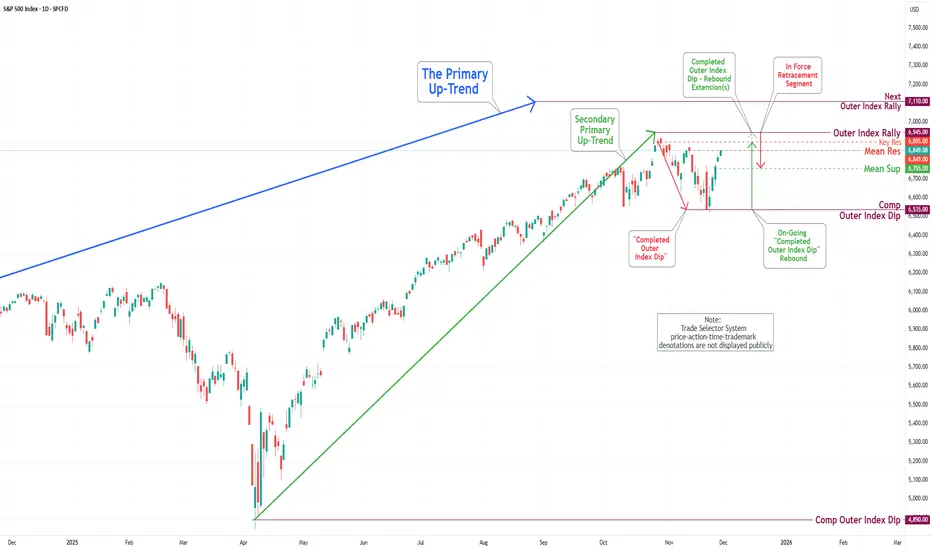
S&P 500 Daily Chart Analysis For Week of Nov 28, 2025Technical Analysis and Outlook:
In this abbreviated weekly trading session, influenced by a significant U.S. holiday and a cooling issue at the CyrusOne data centers at CME, the S&P 500 Index posted notable gains, reaching our primary target, the Mean Resistance at 6,849.
At present, this position suggests the potential for further upward movement, with primary targets established for a continuation of the robust trend toward Key Resistance at 6,895, followed by an extended target identified as the Outer Index Rally at 6,945.
Nevertheless, it is crucial to recognize that, given the prevailing market dynamics, there exists a considerable likelihood of an In-Force pullback from the aforementioned price targets.
More upside for SPX500USDHi traders,
Last week SPX500USD went up again just as I've said in my previous outlook.
Next week we could see a correction down and more upside for this pair.
Let's see what the market does and react.
Trade idea: Wait for a correction down. After a change in orderflow to bullish you could trade longs.
This shared post is only my point of view on what could be the next move in this pair based on my technical analysis.
But I react and trade on what I see in the chart, not what I've predicted or expect.
Don't be emotional, just trade your plan!
Eduwave