The Impact of a Global Market Crash1. Economic Impact
The immediate economic consequences of a global market crash are often severe. Equity markets, commodity markets, and bond markets typically experience significant declines, undermining investor wealth and reducing consumer confidence. As stock prices plummet, households and businesses see a decline in their net worth, which can lead to reduced spending and investment. Since consumption and capital investment are core drivers of economic growth, the contraction in these areas can trigger a broader economic slowdown or even a recession.
A crash can also cause a tightening of credit conditions. Banks and financial institutions, facing losses on their investments and worried about counterparty risk, often become more risk-averse, reducing lending to businesses and consumers. This credit contraction further slows economic activity, as companies find it difficult to finance operations or expansion, and households struggle to secure loans for major purchases like homes and vehicles.
2. Impact on Financial Institutions
Financial institutions are directly impacted by a market crash, as the value of their holdings in equities, bonds, derivatives, and other financial instruments decline. Banks, hedge funds, insurance companies, and investment firms may incur massive losses, potentially leading to insolvency or bankruptcy. The interconnected nature of global finance means that the failure of one major institution can have a domino effect, threatening the stability of other financial entities. The 2008 global financial crisis exemplifies this, where the collapse of Lehman Brothers triggered panic across the banking sector and required coordinated government interventions.
Moreover, liquidity crises often accompany market crashes. When investors rush to sell assets, the markets may not have enough buyers, causing asset prices to fall even further. Financial institutions that rely on short-term funding or that have leveraged positions may find themselves unable to meet obligations, further exacerbating systemic risks.
3. Impact on Businesses
The effect of a global market crash extends beyond the financial sector into real-world business operations. Companies face declining stock prices, reduced access to capital, and a contraction in consumer demand. Many firms may be forced to delay expansion plans, cut costs, or lay off employees to preserve cash flow. Industries heavily reliant on discretionary spending, such as travel, luxury goods, and automobiles, are particularly vulnerable.
Global supply chains may also be disrupted. Firms may reduce production in response to decreased demand, which can create ripple effects across suppliers and manufacturers worldwide. Additionally, companies engaged in international trade may face currency volatility and reduced foreign investment, compounding the financial strain.
4. Impact on Governments and Fiscal Policy
Governments are not immune to the effects of a global market crash. Falling asset prices reduce tax revenues from capital gains, corporate profits, and wealth taxes. Lower revenues combined with increased public spending to stimulate the economy can strain government budgets and increase fiscal deficits. Governments may be forced to implement stimulus measures, such as interest rate cuts, quantitative easing, or direct fiscal support, to stabilize markets and prevent a deeper recession.
Central banks often play a critical role during a market crash, using monetary policy tools to provide liquidity, stabilize financial institutions, and encourage lending. However, prolonged crises may limit the effectiveness of these measures, especially if investor and consumer confidence remains low. Additionally, countries with high debt levels or weak economic fundamentals may face challenges in implementing effective countermeasures.
5. Impact on Investors and Households
Individual investors often experience significant financial losses during a global market crash. Retirement savings, investment portfolios, and other forms of personal wealth can erode rapidly, affecting long-term financial security. Panic selling is common, leading to further declines in asset prices. Investors with leveraged positions or exposure to high-risk assets may face margin calls or forced liquidation, amplifying losses.
Households may also experience indirect effects, such as rising unemployment, reduced wages, and limited access to credit. Economic uncertainty can lead to changes in consumption patterns, with families prioritizing essential spending and reducing discretionary expenditures. This reduction in consumption can feed back into the broader economic slowdown, creating a cycle of declining demand and increasing financial stress.
6. Global Trade and Investment
A market crash in one region can quickly spread to others due to globalization and financial interconnectedness. Capital flows may reverse, with foreign investors withdrawing from emerging markets to seek safety in developed economies, causing currency depreciation and financial instability in affected countries. International trade can decline as businesses postpone investment, and demand for imported goods falls. Cross-border investments and mergers may be canceled or delayed, reducing economic growth opportunities and increasing geopolitical tensions.
7. Psychological and Social Impact
Beyond tangible financial consequences, a global market crash can have significant psychological and social effects. Investor confidence and public sentiment often deteriorate, leading to fear-driven behavior in both markets and daily life. Anxiety about job security, savings, and retirement can influence consumer behavior, affecting spending and investment decisions. In severe cases, prolonged economic hardship can exacerbate social inequalities, trigger political unrest, and challenge social cohesion.
8. Long-Term Consequences and Recovery
The recovery from a global market crash can take months or even years, depending on the underlying causes and policy responses. Market crashes often prompt regulatory reforms aimed at strengthening financial systems and reducing systemic risks. For example, the 2008 financial crisis led to significant changes in banking regulation, risk management practices, and global oversight mechanisms.
However, repeated or prolonged market crashes can erode trust in financial institutions, government policy, and market mechanisms. Investors may become more risk-averse, reducing the flow of capital to businesses and slowing economic innovation. Long-term structural unemployment, reduced income growth, and increased debt burdens can persist well beyond the initial crash period.
9. Mitigation Strategies
While the effects of a global market crash are profound, there are strategies to mitigate risks and cushion the impact. Diversification of investment portfolios across asset classes, sectors, and geographies can reduce exposure to systemic shocks. Governments and central banks can implement preemptive regulatory and monetary measures to ensure liquidity and maintain financial stability. For businesses, maintaining strong balance sheets, prudent debt levels, and flexible operational strategies can enhance resilience.
Education and awareness are equally important. Investors who understand market cycles and maintain long-term investment perspectives are less likely to engage in panic selling, preserving wealth and contributing to overall market stability.
Conclusion
A global market crash is more than just a financial phenomenon—it is an economic, social, and psychological event with far-reaching consequences. From financial institutions to households, from governments to multinational corporations, the impact is pervasive, highlighting the interconnectedness of modern economies. While market crashes are inevitable over time due to economic cycles and external shocks, their severity and duration can be influenced by effective policy responses, prudent financial management, and a resilient global economic system. Understanding these impacts is crucial for investors, policymakers, and businesses alike, helping to navigate crises, protect wealth, and foster sustainable recovery.
Meta Platforms Inc Shs -A CAD hedged- Canadian Depositary Receipt Repr Shs Reg S
No trades
Trade ideas
META’s Run Today Was Strong — Watching These Levels for Nov 26
META had one of the cleaner intraday trends today. The move off the morning base was almost textbook: steady higher highs, shallow pullbacks, and candles riding right along that rising trendline you drew on the 15-minute chart. Whenever you get a move that smooth, it usually means the order flow is very one-sided — and judging by the absence of deep pullbacks, buyers were the ones in control all day.
But after that last push into the 635–637 zone, the pace changed. The candles started flattening out, and META began drifting sideways right under resistance. That’s usually where the market takes a breath and waits for new orders to come in. The trend is still intact — nothing about the structure looks weak — but the last few candles clearly show hesitation near the top of the day’s range.
Let heck the 1-hour GEX chart below, the hesitation makes sense. The entire area above 637 is loaded with call walls. You’ve got multiple levels stacked between 640, 645, and then 650. When price runs into heavy GEX resistance like that, it often slows down because market makers start hedging the other way. It doesn’t mean META is bearish — it just means it needs real momentum or volume to break through those overhead layers.
Below price, META actually has a pretty friendly GEX landscape. There’s solid put support around the 615–620 zone, and a deeper cushion around 592 if the market ever decides to do a full reset. That lower band is why META rarely dipped today — option structure was keeping a floor beneath it.
Going into Nov 26, the levels are straightforward:
If META can break through 637 with a decisive candle — not just a wick — then 640 becomes the next magnet. And if the stock gets enough push to chew through that, the next meaningful level is 645. That’s where the thicker call wall sits.
If META slips back under 630 and stays there, we probably see a cleaner pullback into 625 or even 620 just to cool the trend. That’s the zone where buyers likely step back in, since it lines up with both intraday structure and GEX support.
Option Trading Plan
Calls only make sense if META can actually get a clean break over 637. That’s where the air pocket sits. Between 637 and 640, META usually moves fast because there’s less hedging friction.
Puts don’t make sense unless price loses 630 with conviction. Below that, 625 and 620 become natural targets. Above 630, put premiums will get eaten alive because the overall GEX structure still favors the long side.
Disclaimer
This is just my personal view based on chart behavior and options data. It’s not financial advice — always trade your own plan and manage your risk.
LONG META ~630 - TARGETING 730-750After the stock took a major hit driven by a one-time tax charge, we could see the buyers decided to come in at ~600 level, the stock was bought the whole trading day of Nov 25th, and we can see it is turning into a bullish pattern.
RR is very good here and this potentially could lead to a huge move upwards.
Target price should be previous local highs - 740-750 (Feb/Jun/Oct)
Stop should be placed bellow 600 price level, and lose of that level should signal that this was a false move.
This move can lead to a 15-18% uptrend.
BH
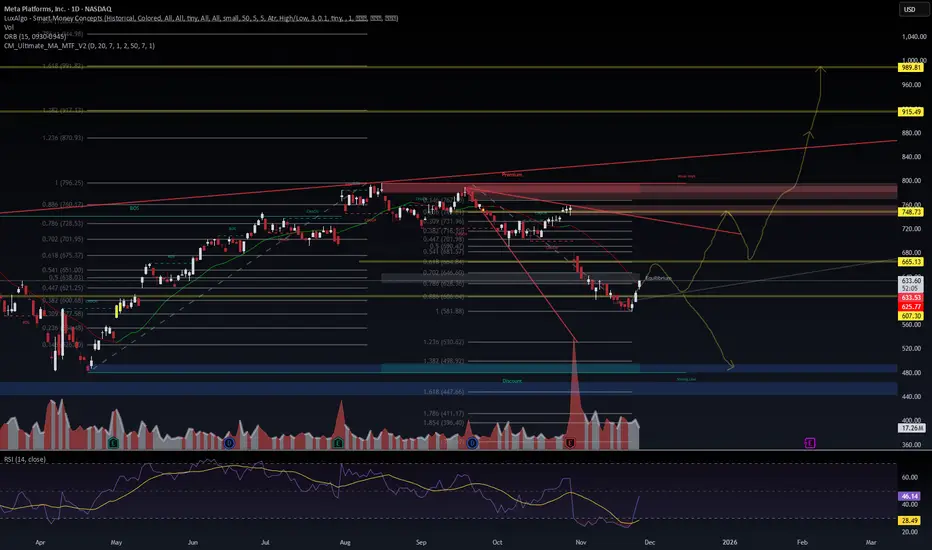
$META — Still Tracking This Path (VolanX Watchlist)I am watching this. 📌 Price: 633.20
Price reacted exactly at the HTF equilibrium zone — classic mid-range fight.
Structure still favors a two-path scenario:
Bull Path: Hold 625–630 → reclaim 665 → expansion toward 748 liquidity pocket, then continuation toward 915 and 989 HTF targets.
Bear Path: Reject 665 → slip under 607 → liquidity sweep into 530 → 480 discount block.
Trendline compression + falling wedge behavior is forming, but not confirmed until 665 breaks.
RSI recovering from deep discount territory — momentum is shifting, but still fragile.
🎯 Watching:
The 665 reclaim or rejection — this is the decision point that chooses the Y-path.
⚙️ VolanX DSS Notes:
Transition signal present but not confirmed.
LRG still treating this as a reactive bounce, not a full reversal yet.
📚 Reference: Liquidity-based equilibrium concepts emphasize premium/discount mapping and liquidity draw mechanics (ICT, 2023).
Too Late to Buy Meta stock?META just reached the monthly demand imbalance at $592 and is reacting as expected using pure supply and demand price action. In this video, I show how META’s big drop was predictable from the monthly and weekly imbalances, and how the current reaction was part of the plan all along. Expecting a decent rally.
Resource Commodity Supercycle in the Global Market1. What Is a Commodity Supercycle?
A commodity supercycle refers to a prolonged period—usually lasting 20–30 years—where prices of essential resources such as energy, metals, and agricultural goods experience sustained growth. Unlike short-term price spikes caused by temporary supply issues, supercycles emerge from deep structural shifts in the global economy.
A supercycle typically forms when:
A massive demand increase arises from industrialization or technological transformation.
Supply takes years to catch up due to long project lead times, lack of investment, or logistic constraints.
Prices remain elevated for years, pushing producers to expand capacity.
The end of a supercycle occurs when new supply finally exceeds demand or global economic growth slows.
2. Historical Commodity Supercycles
Analysts typically recognize four major supercycles in the last 150 years:
1. The Late 1800s Industrialization Boom
Fueled by:
U.S. and European industrial expansion
Rapid railway development
Urbanization and manufacturing growth
This cycle saw rising demand for steel, coal, copper, and agricultural products.
2. Post-World War II Reconstruction (1940s–1960s)
Countries devastated by war needed enormous resources to rebuild:
Europe’s reconstruction under the Marshall Plan
Japan’s industrial revival
Oil, metals, and food commodities experienced long-term price strength.
3. The Oil Supercycle (1970s–1980s)
Triggered by:
OPEC oil embargo in 1973
Geopolitical conflicts in the Middle East
Oil prices surged, reshaping global energy markets and pushing investment into oil exploration.
4. The China-Driven Supercycle (2000–2014)
The most powerful modern supercycle was driven by:
China’s entry into the WTO
Massive infrastructure, manufacturing, and housing expansion
Urbanization of over 300 million people
Demand for iron ore, copper, aluminum, coal, and crude oil skyrocketed.
This cycle slowed around 2014 as China shifted from infrastructure-led growth to services and technology.
3. Why Supercycles Matter in Today’s Global Market
A. They Shape Global Inflation
High commodity prices raise:
Manufacturing costs
Transportation expenses
Food prices
This can create global inflation waves, affecting interest rates and monetary policy.
B. They Influence Currency Markets
Countries that export commodities (e.g., Australia, Brazil, Canada, Russia) see stronger currencies during supercycles. Import-dependent countries face currency pressure and trade deficits.
C. They Impact Corporate Profits and Investment
Industries like:
Mining
Energy
Infrastructure
Fertilizer and agriculture
experience earnings booms, leading to stock market rallies.
D. They Shift Geopolitical Power
Nations rich in resources gain strategic leverage. For example:
Middle Eastern countries influence global oil supply decisions
African countries become key suppliers of metals needed for modern technology
4. Drivers Behind Modern Resource Commodity Supercycles
A. Urbanization and Infrastructure Growth
Large emerging economies such as India, Indonesia, Vietnam, and African nations are expanding rapidly. This increases demand for:
Steel
Cement
Copper
Coal
Crude oil
B. The Green Energy Transition
A powerful emerging driver is the global push for clean energy. Technologies such as electric vehicles (EVs), solar power, wind turbines, and grid batteries require huge quantities of metals like:
Lithium
Nickel
Cobalt
Graphite
Rare earth elements
Copper
Copper alone is essential for wiring, EV motors, and renewable energy grids. Demand may double over the next 20 years, making it a central metal in the next supercycle.
C. Supply Constraints and Underinvestment
For nearly a decade after 2014, mining and oil companies faced:
Low prices
Investor pressure to reduce debt
Capital discipline
As a result:
New oil fields were not developed
Few mega-mines came online
Exploration budgets were cut
Thus, supply is tight just when demand is rising, feeding a potential supercycle.
D. Geopolitical Conflicts
Issues such as:
Russia–Ukraine war
U.S.–China trade tensions
Middle East conflicts
Shipping disruptions (Red Sea, Panama Canal)
increase risks and disrupt supply chains, pushing prices up.
E. Monetary and Fiscal Stimulus
Large government spending on infrastructure, clean energy, and defence increases demand for raw materials. Meanwhile, inflation reduces purchasing power and encourages investment in commodities as a hedge.
5. Types of Commodities Affected in a Supercycle
1. Energy Commodities
Crude oil
Natural gas
Coal
Demand rises with industrial growth, transportation, and manufacturing.
2. Metals
Base metals: copper, aluminum, nickel, zinc
Precious metals: gold, silver
Battery metals: lithium, cobalt, rare earths
Metals are central to construction, electronics, EVs, renewable energy, and defence.
3. Agricultural Commodities
Wheat
Corn
Soybeans
Sugar
Edible oils
Agri supercycles are triggered by population growth, climate disruptions, and biofuel demand.
4. Soft Commodities
Cotton
Coffee
Cocoa
They respond to supply shocks from weather, pests, and geopolitical disruptions.
6. Signs That a New Commodity Supercycle May Be Emerging
Economists and market analysts look at structural indicators, including:
A. Rising Long-Term Demand
India’s growth, rising consumption in Africa, and global electrification indicate sustained demand for metals and energy.
B. Years of Underinvestment in Extraction
Supply gaps in oil and metals show that companies need a decade to catch up, creating prolonged price pressures.
C. Green Technology Boom
EV adoption, solar and wind installations, and smart grids require unprecedented quantities of metals.
D. Geopolitical Realignments
Countries are seeking secure supply chains through:
“Friendshoring”
“Resource nationalism”
Strategic reserves
These moves can raise prices across the board.
E. Climate-Driven Agricultural Volatility
Extreme weather events increase uncertainty in food supply, potentially driving long-term price trends.
7. Impact of a Commodity Supercycle on Global Stakeholders
A. For Investors
A supercycle can create multi-year opportunities in:
Mining and metal stocks
Oil and gas companies
Renewable energy miners (lithium, REEs)
Agriculture and fertilizer companies
B. For Countries
Resource-rich countries benefit through higher export revenues and stronger currencies.
Import-dependent countries face inflation and trade deficits.
C. For Businesses
Costs rise for manufacturers, construction firms, and energy-intensive industries.
D. For Consumers
Inflation affects:
Fuel prices
Food costs
Housing and infrastructure prices
Conclusion
A resource commodity supercycle is a powerful force that reshapes global markets, economies, and investment landscapes. Driven by structural megatrends—urbanization, green energy transition, supply shortages, and geopolitical shifts—today’s global economy may be entering a new and long-lasting supercycle. Understanding its mechanics helps investors, policymakers, and businesses position themselves strategically for the next decade.
Meta Platforms (META) – Strong Reaction at Key Demand ZoneMETA has retraced sharply and is now testing a major demand zone around 600 – 585, aligned with the 0.236 Fibonacci level (597). This area represents the first strong support after the recent corrective wave.
The latest candles show early signs of buyer interest, suggesting that the market may attempt a rebound if this zone continues to hold.
If META confirms support here, the next upside levels are:
637 (0.333 Fib)
665 (0.4 Fib)
707 (0.5 Fib)
749 – 755 (0.618 Fib)
811 (0.75 Fib)
A daily close below 585 would signal further weakness and expose the next downside level near 561 (0.15 Fib).
As long as the demand zone holds, the bullish recovery scenario remains valid, with the long-term target set at 916.23.
$META: Wave 3 to start soonNASDAQ:META : The bear market of 2021-2022 ended a higher degree 5-wave sequence and started a new 5-wave sequence, which is Wave .
Tariff scare completed Waves I and II of . Wave III of started at the bottom.
We've had a very aggressive Wave 1 of III and a deep Wave 2 of III. I expect Wave 3 of III to make a new high, reaching 1.618% length of Wave 1.
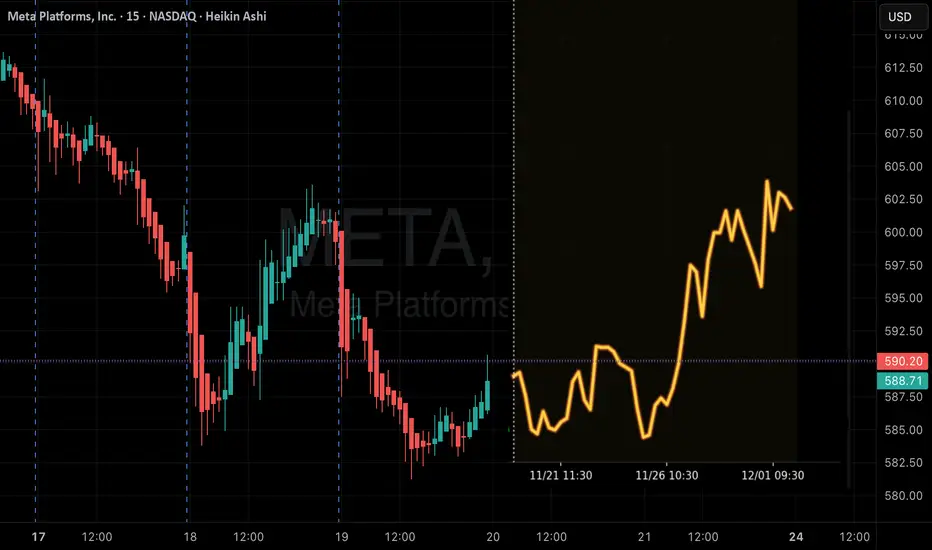
Facebook (Meta) dip-buying momentum points to rebound this week
Current Price: $588.18
Direction: LONG
Confidence Level: 70% (Several professional traders highlight strong fundamentals and are actively buying dips; X sentiment leans bullish despite recent pullback)
Targets:
- T1 = $605.00
- T2 = $625.00
Stop Levels:
- S1 = $580.00
- S2 = $570.00
**Wisdom of Professional Traders:**
Bringing together the collective insights of numerous professional traders, the consensus is that Meta’s recent 20–27% pullback from the $750 highs is creating a buying opportunity. Many traders are accumulating positions below the $615 level, noting that the fundamentals—$189 billion in revenue, $58 billion net income, aggressive AI infrastructure investment—remain intact. Several traders characterize Meta as deeply undervalued compared to other tech peers, with fair values well above current prices. This crowd wisdom suggests the stock has room for a short-term rebound.
**Key Insights:**
The main thing I’m watching is the aggressive dip-buying discussed in multiple analyses. Several traders pointed out that the 20–23% correction from recent highs has brought the price into a strong support zone around $580–$590. This level has been mentioned repeatedly as a line-in-the-sand for stopping further downside. The bullish bias is reinforced by the fact Meta’s P/E ratio is far lower than that of many speculative tech names, giving it more resilience during market volatility.
What’s interesting is that despite near-term technical weakness (trading below the 233-day moving average), the majority of traders I’ve tracked believe this is a short-term oversold condition rather than the start of a deeper downtrend. Combining that with X sentiment showing a majority of bullish tweets suggests momentum could turn higher quickly if that support holds.
**Recent Performance:**
This all played out in the price action last week—Meta slid from $615 toward $580, marking over a 20% drop from its October highs. Large-volume selling early in the week was met with accumulation by dip buyers towards Friday. For context, this correction is in line with other Magnificent Seven stocks, but traders note Meta’s relative value is stronger than most, making it a prime candidate for a bounce.
**Expert Analysis:**
Multiple professional traders are watching for a rebound toward $605–$625 in the short-term, citing repeat tests of the $580–$590 support zone. Several identify upside catalysts in AI and infrastructure expansion, alongside share buybacks, which could bolster earnings per share. The trader consensus often references fair value estimates well above $660, meaning this week’s targets remain conservative, focusing on achievable levels based on near-term technicals.
The $615 line is widely watched as the first hurdle for upside momentum; closing above it would likely trigger heavier buying.
**News Impact:**
Recent headlines around Meta’s half-trillion-dollar AI data center investment over the next three years are bolstering long-term sentiment. While there have been concerns about high capital expenditures and VR product traction, these haven’t shaken long-term bullish fundamentals. The market’s reaction to the pullback appears more tied to sector-wide tech corrections than company-specific weakness. This creates an environment where news about AI initiatives and user scale—3.5 billion daily active users—could serve as upside catalysts.
**Trading Recommendation:**
Here’s my take: with strong underlying fundamentals, visible accumulation at current levels, and bullish sentiment on X, I’m going LONG Meta this week. I’d enter here with partial allocation, aiming for $605 first and $625 as a secondary target, keeping stops tight at $580 and $570 to protect against a breakdown. Position sizing should account for potential continued volatility in tech stocks, but given the widespread trader consensus on undervaluation and the clear support zone, the risk-reward here looks favorable for a short-term bounce.
Midterm Stock Forecast for METANASDAQ:META At $594, Meta enters a buy zone after the sharp decline since late October. H1 technicals show stabilizing momentum. First target stands at $660, and extension toward $760 remains possible if ad revenue and AI-driven engagement trends stay strong. Valuation still supports midterm upside after the recent correction.
META: Daily Oversold, Weekly Vulnerable — Key Levels to WatchBull Case:
META is testing a long-term ascending trendline and a major demand zone between $579–$595. Daily RSI is oversold, suggesting a potential short-term reversal. If buyers defend this level, key upside pivots sit at $635, followed by $676–684, and a full mean-reversion target near $691. The broader uptrend remains intact as long as the stock holds above $562.
Bear Case:
While the daily chart is positioned for a bounce, the weekly structure is still weakening. META has lost multiple EMAs on the weekly timeframe, momentum remains bearish, and weekly RSI has broken its bull range. A breakdown below $579 opens downside continuation toward $562 and $548, with deeper support near the mid-$400s if selling pressure accelerates.
Summary:
The daily chart shows potential for a near-term rebound, but the weekly trend still favors caution. A sustained close back above $635 strengthens the bullish scenario, while a failure to hold $579 shifts control firmly to the bears.
Key Levels to Watch
Bullish Levels
$595 / $579 — must hold (trendline + demand)
$635 — first resistance / short-term trend flip
$676–$684 — major supply zone
$691 — full mean-reversion target
Bearish Levels
$579 — breakdown trigger
$562 — next liquidity zone
$548 — deeper support
$480s — weekly structural support if selling accelerates
How the Stock Is Leaning:-
Short-term (daily): Leaning bullish for a bounce — oversold, testing major support.
Medium-term (weekly): Leaning bearish — trend damaged, EMAs rolling over, RSI in a downtrend.
Overall: Two-timeframe divergence. Daily wants a reversal, weekly still argues for lower levels unless $635 is reclaimed.
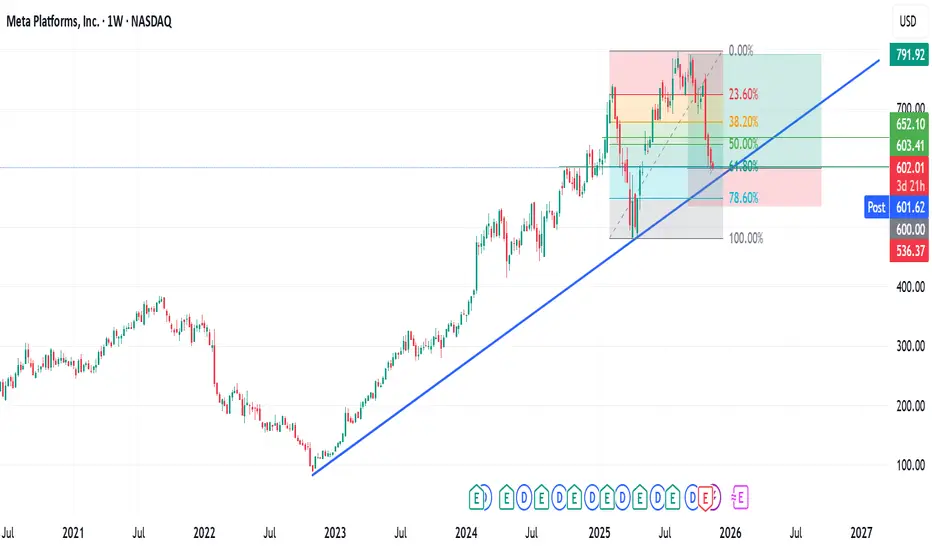
META now close to a critical trendlineMETA is approaching a significant technical region.
The trendline currently in focus originated on 31 October 2022, and it has remained relevant over time.
This same trendline was retested twice in April of this year, and price action is once again moving toward it after achieving a new all-time high.
At the moment, the asset is sitting at the Fibonacci 61.8% retracement level — a well-known zone where reversals often occur. Based on this structure, the asset may begin its upward move from the current region, or it may decline by an additional $10–$20 to retest the ascending trendline.
I have taken my initial positions in META during this pullback and may increase my exposure if price reaches the trendline.
Overall, my outlook remains bullish.
Trade responsibly.
Entry: RR is 1:3
Confidence: High
ESG & Green Energy Investments1. What ESG Actually Means
ESG refers to a set of standards for evaluating how responsibly and sustainably a company operates. These three dimensions—Environmental, Social, and Governance—serve as a framework to understand non-financial risks that can influence long-term performance.
Environmental (E)
Focuses on how a company interacts with the natural world. Key considerations include:
Carbon emissions and net-zero commitments
Renewable energy usage
Waste management and circular economy practices
Water conservation
Pollution control
Biodiversity impact
Companies that manage environmental risks well are better positioned for regulatory changes, resource scarcity, and the transition to a low-carbon economy.
Social (S)
Covers how a company manages relationships with employees, suppliers, customers, and communities. Factors include:
Labor standards and worker welfare
Diversity and inclusion
Human rights compliance
Customer safety
Community development
Data privacy and cyber security
Strong social practices improve productivity, reduce legal risks, and enhance brand value.
Governance (G)
Refers to corporate leadership and internal controls. Key governance metrics include:
Board independence and diversity
Executive compensation
Anti-corruption policies
Shareholder rights
Ethical conduct
Transparency and accountability
Good governance reduces fraud, mismanagement, and regulatory penalties—factors that directly influence shareholder returns.
2. Why ESG Matters for Investors
There are several reasons why ESG has become integral to investment decision-making:
a. Risk Mitigation
Companies with strong ESG profiles tend to face fewer controversies, regulatory penalties, or reputational setbacks. Climate-related risks—such as extreme weather, carbon taxes, and energy transition timelines—now directly influence asset prices.
b. Superior Financial Performance
Numerous studies show that companies with strong ESG adherence have:
Lower capital costs
Higher operational efficiency
Better long-term profitability
More stable cash flows
Investors increasingly see ESG not as a cost but as a value-creation strategy.
c. Growing Global Regulations
Governments worldwide are mandating sustainability reporting and emissions reduction, pushing ESG integration into standard business practice. For example, the EU’s Corporate Sustainability Reporting Directive (CSRD) and India’s BRSR framework compel listed companies to disclose ESG metrics.
d. Institutional Investor Influence
Pension funds, sovereign wealth funds, insurance companies, and large asset managers now screen investments using ESG criteria. Their portfolios are shifting toward green sectors, influencing global capital flows.
e. Consumer and Market Sentiment
Consumers prefer companies aligned with sustainability. Firms with strong ESG profiles often benefit from brand loyalty and long-term demand stability.
3. Green Energy Investments: The Core of the ESG Transition
Green energy investments refer to capital allocated to renewable and sustainable energy sources such as:
Solar
Wind
Hydro
Geothermal
Biomass
Green hydrogen
Energy storage solutions
Carbon capture and renewable fuels
The energy transition is accelerating as the world moves away from fossil fuels. Several forces drive this shift:
a. Climate Change Imperatives
Global warming concerns and carbon reduction targets under the Paris Agreement have pushed governments to accelerate renewable energy adoption.
b. Declining Renewable Costs
Technology advancements and economies of scale have drastically reduced the cost per unit of solar and wind power, making them competitive with coal and natural gas.
c. Technological Breakthroughs
Innovations in battery storage, smart grids, electric mobility, and green hydrogen are reshaping the energy sector and creating massive investment opportunities.
d. Corporate Clean Energy Demand
Tech giants, manufacturing companies, and industrial firms are increasingly committing to 100% renewable energy to meet ESG goals.
4. Key Green Energy Investment Themes
1. Solar Energy
Solar remains the fastest-growing renewable sector due to falling panel prices and rising adoption across households, industries, and grid-scale plants. Rooftop solar, floating solar, and utility-scale installations represent major avenues for investors.
2. Wind Energy
Both onshore and offshore wind offer strong long-term growth, with offshore wind emerging as a trillion-dollar market driven by advanced turbine designs and coastal infrastructure investment.
3. Green Hydrogen
Seen as the "fuel of the future," green hydrogen can decarbonize heavy industries like steel, chemicals, and shipping. Massive government subsidies globally are accelerating the sector.
4. Electric Vehicles & Charging Infrastructure
EV adoption is surging, supported by clean energy policies and consumer demand. Charging networks, battery manufacturing, and EV components represent high-potential themes.
5. Energy Storage
As renewable usage increases, storage becomes essential to stabilize grids. Lithium-ion batteries, solid-state batteries, and flow batteries are attracting significant investment.
6. Carbon Capture & Utilization
Companies are developing carbon removal technologies to meet net-zero mandates. This includes direct air capture, storage, and carbon-to-fuels technologies.
5. ESG Investing Strategies
Investors approach ESG in several structured ways:
a. Negative Screening
Excluding harmful sectors such as:
Tobacco
Weapons
Coal
Oil & gas
Gambling
Alcohol
b. Positive Screening
Selecting companies with strong ESG scores or leadership in sustainability practices.
c. ESG Integration
Embedding ESG factors into fundamental financial analysis to improve risk-adjusted return potential.
d. Thematic Investing
Focusing on themes such as renewable energy, clean technology, water conservation, electric vehicles, or circular economy.
e. Impact Investing
Investing specifically to achieve measurable social or environmental outcomes alongside financial returns.
f. Best-in-Class Approach
Investing in industry leaders with the highest ESG performance within their sector.
6. Benefits of ESG & Green Energy Investing
Lower long-term risks
Increased portfolio resilience
Exposure to fast-growing sectors
Regulatory advantages
Improved brand value and stakeholder trust
Alignment with global sustainability goals
Potential for long-term outperformance
7. Challenges and Concerns
While ESG investing is powerful, it is not without challenges:
1. Greenwashing
Some companies exaggerate ESG claims without genuine action. Investors must verify data authenticity.
2. Lack of Standardization
Different ESG rating agencies use different methodologies, creating inconsistencies.
3. Short-Term Costs
Sustainability investments often require high upfront capital.
4. Policy Uncertainties
Changes in government regulations can influence renewable project viability.
8. The Future of ESG & Green Energy Investments
The future is characterized by:
Stricter sustainability regulations
Growth of carbon markets
Increased corporate and investor accountability
Scaling of green hydrogen and storage technologies
AI-driven ESG analytics
Trillions of dollars flowing into the global energy transition
ESG and green energy investments are expected to dominate global markets for decades as climate change, technological innovation, and policy support reshape the global financial landscape.
META 1HRChart Description – META 1H Analysis
This chart presents a technical breakdown of Meta Platforms (META) on the 1-hour timeframe, highlighting a completed topping structure, a breakdown, potential support zones, and upside/downside targets.
1. Large Rounded Top Pattern (Bearish Structure)
The chart shows a large rounded-top arc, transitioning from green → yellow → red.
This shape indicates momentum exhaustion and a shift from strength to weakness.
Price ultimately broke down under the neckline.
2. Breakout / Breakdown Level
The horizontal yellow dashed line marks a key support level (the “neckline”).
Price broke below this level, confirmed by the red arrow, signaling a bearish breakdown.
3. Support Zones
Two immediate supports are illustrated:
Support 1 (Dotted Green Line)
A near-term rising trendline showing temporary relief or bounce potential.
Support 2 (Higher Dotted Green Line)
A longer-term diagonal support that could act as a deeper bounce point if Support 1 fails.
4. Upside Target
A green target zone around ~700–750 is labeled “TARGET”.
This is likely the projected upside if price reclaims the neckline and begins a bullish reversal.
5. Gap Fill Zones (Bearish Targets)
Two red/orange zones labeled “GAP FILL – TARGET” mark potential downside objectives:
Gap Fill Target 1 (~560–570 area)
First bearish target after the breakdown.
Gap Fill Target 2 (~500–520 area)
A deeper gap and major bearish target if selling fully extends.
These zones represent areas where previous price gaps may attract price back to “fill” them.
6. Current Position
Price is shown around $589–599, sitting just under the breakdown level.
Market sits between support test and gap-fill risk.
Overall Interpretation
The rounded-top formation and clean breakdown suggest bearish momentum.
Price is hovering near initial supports, deciding whether to bounce or continue lower into gap-fill territories.
A recovery above the neckline opens the door to the large $700+ upside target.
Failure at support points likely exposes the two gap-fill zones below.
META at a Critical Breakdown Zone – Nov. 211️⃣ 1H Trendline Chart View
META continues trading inside a broad descending channel. Price recently bounced from the lower trendline, but momentum remains weak. Sellers continue to control unless META breaks above 590 and holds.
Key 1H levels:
* 612.5 – major resistance
* 610 – supply
* 590 – pivot
* 587.6 – minor support
* 583.3 – key support
* 581.2 – breakdown level
1H Bias: Still bearish under 590.
2️⃣ 15M Structure View (Smart Planner)
Trend: Bearish
Last Event: Liquidity Sweep (Low)
Bias: Mixed
Premium/Discount: Premium
Mode: Choppy
META remains below EMAs and VWAP. There is a small CHoCH inside a falling wedge, but buyers have not proven strength yet. Multiple supply zones remain overhead from 590 → 600 → 612.
For CALLS: Needs a clean reclaim of 590 with EMAs + VWAP aligned.
For PUTS: Break and retest of 583 confirms downside continuation.
3️⃣ 1H GEX View
GEX flow is still heavily bearish:
* 612.5 – strong CALL wall
* 600 – call resistance
* 590 – major GEX pivot
* 581–575 – highest negative NET GEX (PUT support cluster)
If META stays below 590, negative gamma continues to pull price toward 581–575.
4️⃣ Trade Plan
CALL Setup
* Entry: Reclaim + hold above 590
* Targets: 600 → 612.5
* Stop: Under 587
PUT Setup
* Entry: Reject 590 OR clean break of 583
* Targets: 581 → 575
* Stop: 592–595 depending on entry
Bias for Nov. 21
META stays bearish-to-neutral unless bulls reclaim 590.
Below 590 → sellers control toward 581–575.
Disclaimer
This analysis is for educational purposes only and not financial advice. Trade at your own risk.
META – Structurally Oversold With a Completed Falling WedgeMETA – Structurally Oversold With a Completed Falling Wedge: Watching for a Counter-Trend ABC Recovery
META continues to trade under significant downside pressure, but the short-term structure is becoming increasingly constructive. Price action has carved out a well-defined falling wedge, accompanied by a clear five-wave internal decline that appears to be completing. Momentum is decelerating, candles are compressing tightly toward wedge support, and buyers are beginning to show initial absorption at the lower boundary.
META is showing early signs of stabilization after a prolonged decline. With a completed falling wedge pattern and evidence of structural exhaustion, the probability of a short-term bullish corrective phase is rising. A measured ABC recovery remains the primary scenario, contingent on a confirmed breakout above wedge resistance.
Close monitoring of intraday strength, breakout confirmation, and volume follow-through will be essential in validating the emerging reversal. A break from this support opens the door to the gap below.
These conditions set the stage for a potential relief rally into the final weeks of November and early December.
$META: at the 100 WMANASDAQ:META : I believe April 2025 low started a new 5-wave sequence for $META. Wave 1-2 completed. Wave 1 of 3 completed and it's in Wave 2 of 3 correction.
Wave 2 can retrace very deep. It has already retraced 61.8% of Wave 1. There is also a trendline support formed by connecting 2022 low with April 2025 low.
It's also right at the 100 Week MA.
My count is invalidated if NASDAQ:META drops below the beginning of Wave 1 at $480.
My position
I'm a long term investor of $META. I'm holding my shares. It's already a large position so I do not plan to add. I'm comfortable with just holding my position long term.
QuantSignals V3 | META Counter-Trend CALL SetupMETA QuantSignals V3 – Swing CALL Trade (2025-11-19)
Trade Signal:
Direction: BUY CALLS (Long)
Strike Price: $550.00
Entry Range: $40.80–$41.20 (mid $41.00)
Target 1: $61.20 (50% gain)
Target 2: $71.40 (75% gain)
Stop Loss: $32.64 (20% risk)
Expiry: 2025-12-05 (16 days)
Position Size: 3% of portfolio
Confidence: 65% (Medium)
Market Analysis:
Trend: Oversold bounce play, RSI 17.5
Price Action: Current $41 near bottom of 16-day swing ($581.25–$613.68), MACD bearish but reversal potential
Support/Resistance: Support $574–$581, resistance near $600+
Volume: 1.0× prior swing, normal participation
Options Flow: Neutral-to-bullish, PCR 0.89, unusual $735 put activity
News Sentiment: Mixed – positive SAM 3/3D updates, minor compliance headwinds
Competitive Edge:
Capitalizes on extreme oversold conditions and Katy AI predicted bounce to ~$600+
Balanced risk/reward with 16-day horizon and Delta 0.778
Tight stop limits downside while allowing for recovery
Risk Notes:
Counter-trend play – monitor breakdown below $574 support
Medium conviction due to conflict with composite bearish guidance
Consider scaling in if initial position performs well
Strategy Rationale:
Overrides short-term bearish momentum due to clear oversold conditions, technical support, and Katy AI forecast
Swing horizon allows time for predicted recovery
#META The Next WaveHello everyone, I hope you are all well
Today I will be updating MetaTrader's stock for the coming months. The price has risen significantly after the recent crash, which was due to inflation and other geopolitical factors. I previously predicted the bottom, and the stock has reached almost all of its targets. You can see the idea below. Now I expect to see a decline in the coming months, and the targets are as outlined in the analysis. Warning: Be careful about using leverage. This is because we may see manipulation before the drop, and this will cause you losses
When I predicted the bottom previously
META: The Reversal Zone | Short term Swing Long Trade PlanThe chart shows the price has fallen sharply and is currently testing a zone where three significant technical features converge:
Long-Term Trend Line (Yellow): The price has fallen back to the long-term ascending yellow trend line. This line represents the primary bullish trend established since the major low (around 2022/2023). A successful bounce here is essential for maintaining the longer-term uptrend.
Horizontal Pivot Line (Pink/White): The current price is sitting directly on the horizontal support/resistance line (pink or white line near the price). This level acted as a strong pivot point in the past, suggesting significant trading interest.
Breakout Retest (Red Line): The price is also re-testing the long-term descending red trend line from which it previously broke out. This former resistance line often turns into new support.
Conclusion: The convergence of the ascending yellow trend line, the horizontal pivot, and the retest of the old red resistance creates an extremely strong confluence support zone in the $573 to $590 region.
Trade Idea:
ENTRY $590 - $598 Enter upon confirmation of support holding (e.g., an intraday reversal candle).
TARGET 1 $652 This is the recent short-term resistance pivot shown on the chart. This is the primary target for a short-term swing trade.