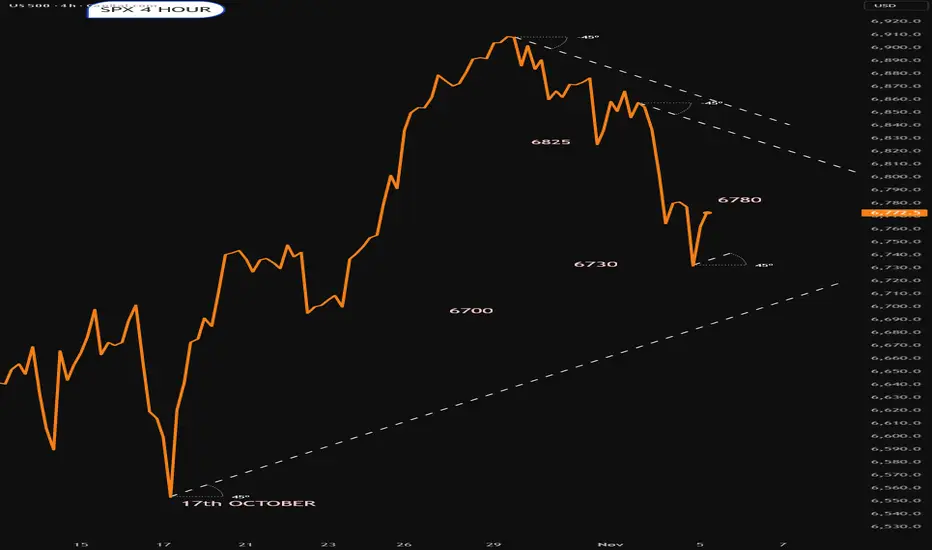
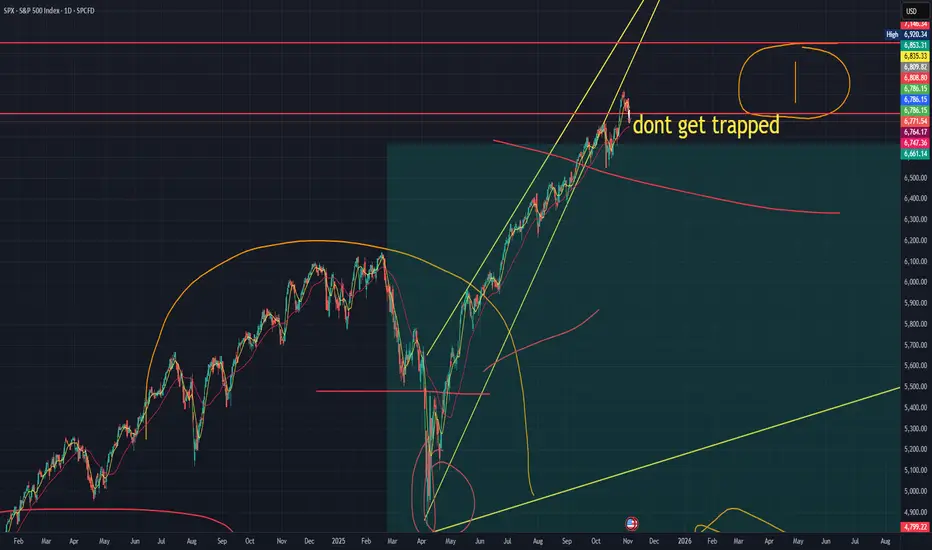
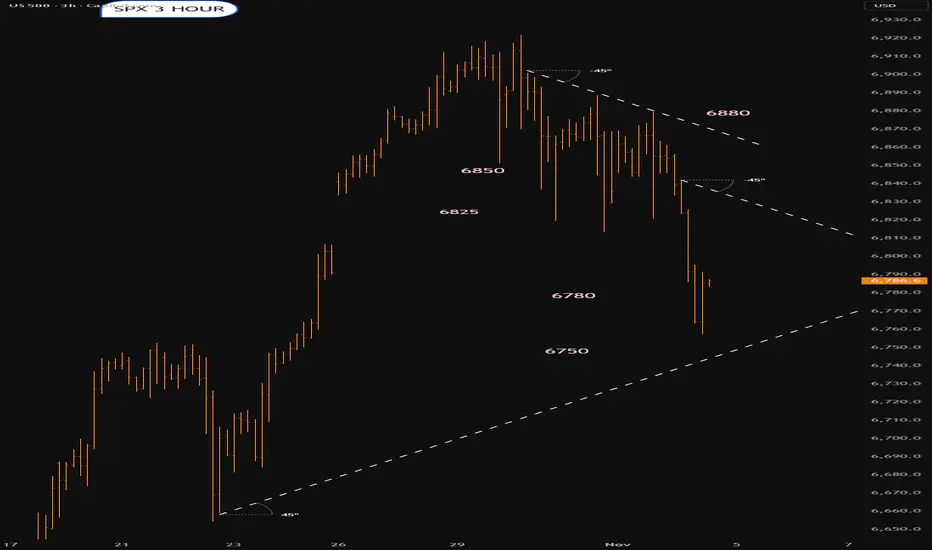
NQ / Future'sToday’s price action was a clear example of structural breakdown. The clues started forming about a week ago and began to solidify by Monday morning, with confirmation coming early Tuesday. It’s simple — once you understand market structure, you can avoid bad entries and emotional trades. I alerted everyone ahead of time not to go long and outlined the most likely scenario, which played out exactly as expected. You had clue's from bitcoin, you had clue's from SPX. Everybody becomes suprised when the market rips and or drops but you have the answers in front of you 24/7, literally.
Trade ideas
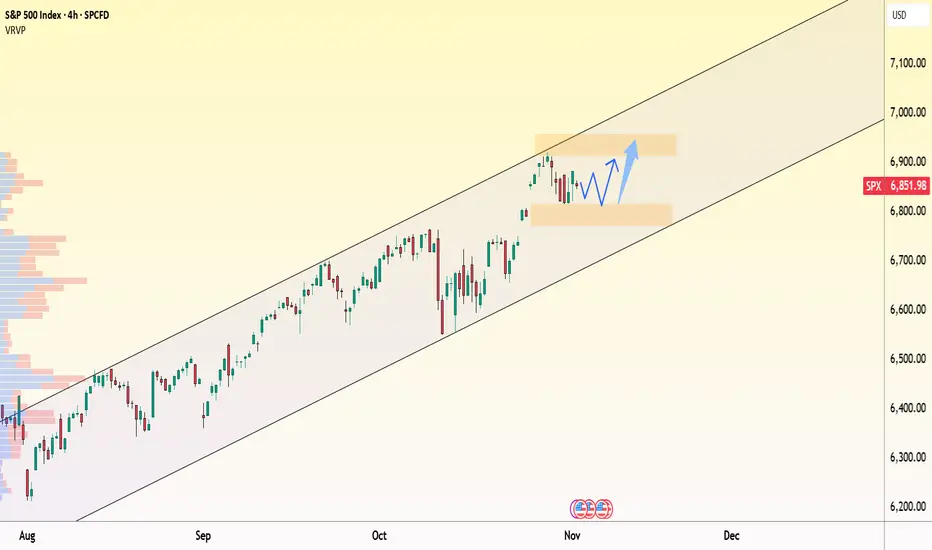
S&P500 Possibly the last buy signal before Bull Cycle ends.The S&P500 index (SPX) has been trading within a 5-month Channel Up and is currently about to complete its latest Bearish Leg. All such pull-back sequences have reached at least the 4H MA200 (orange trend-line) before rebounding and kick-starting the next Bullish Leg, with the 1D MA50 (red trend-line) providing the ultimate Support of this pattern.
As a result, especially since the 4H RSI also hit the 30.00 oversold barrier, we expect the index to initiate the new Bullish Leg and aim for a Higher High near the 2.5 Fibonacci extension. Our Target is 7150.
-------------------------------------------------------------------------------
** Please LIKE 👍, FOLLOW ✅, SHARE 🙌 and COMMENT ✍ if you enjoy this idea! Also share your ideas and charts in the comments section below! This is best way to keep it relevant, support us, keep the content here free and allow the idea to reach as many people as possible. **
-------------------------------------------------------------------------------
💸💸💸💸💸💸
👇 👇 👇 👇 👇 👇
SPX | Daily Analysis #11 - 4 November 2025Hello and Welcome back to DP
Review and News Coverage:
As mentioned in the previous daily analysis, the market saw a nice decline — even breaking through the 6811 area and reaching down to 6766. There wasn’t any major news driving the move; it seems the market simply took a breather to gather strength for the next potential rally.
Now that the past move is complete, our focus shifts forward. Tomorrow brings key economic events — NFP (Non-Farm Payrolls) and PMI data — both of which are likely to bring significant volatility to the market.
1H Time Frame Technical Analysis:
At the moment, this bull run could face resistance around the 6826 area. From there, a short-term correction toward the 6800 zone is possible (6811 is no longer relevant).
Personally, I believe the recent downside move has finished, and we should now start looking for buy opportunities. If the price retraces and holds above 6800, it could open the door for long entries and a continuation of the bullish move.
Summary:
• Resistance: 6826
• Support: 6800
• Bias: Bullish (Buy on dips)
• Key Events Tomorrow: NFP & PMI — expect high volatility
Disclaimer:
This content is for informational purposes only and does not constitute financial or investment advice. © DIBAPRISM
Amir D.Kohn
Maximum profit: Top 5 indices of OctoberIn October, client activity peaked around #SP500, #NQ100, #DAX30, #FTSE100, and #NIKKEI . These five indices not only showed the highest share of profitable trades but also delivered the best returns across all index instruments. Strong corporate earnings, steady demand, and a positive news backdrop continue to support their growth potential.
Growth outlook for key indices through the end of 2025:
• #SP500: New record highs, solid earnings from major players, and expectations of a Fed rate cut support buying the dip with moderate risk.
• #NQ100: Tech demand remains strong as firms invest in data centers and AI infrastructure. If earnings stay on track, there’s still room to grow.
• #DAX30: After hitting new all-time highs in 2025, the German index benefits from improved global trade sentiment and stable EU data. Exporters thrive on robust external demand.
• #FTSE100: The UK market remains near its highs, supported by strong performance in key sectors and commodities. Year-end liquidity may further reinforce the uptrend.
• #NIKKEI: Japan’s index keeps climbing, helped by a weak yen boosting exports and a predictable monetary environment. Further gains are possible if global conditions remain calm.
FreshForex analysts believe short-term index performance hinges on three main factors: current earnings season results, inflation trends, and central bank decisions. Risk management and awareness of the macro calendar remain essential.
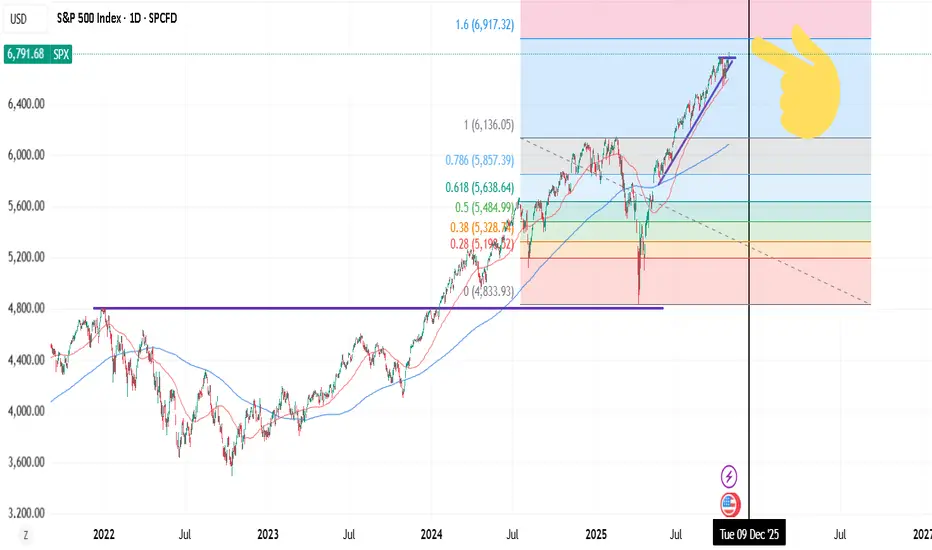
1.6 FIB Ceiling - Stock market correction soon in NOV/DEC.You can apply 1.6 FIB to FAANG or QQQ for high probability ceilings. VIX "structure" (pattern) or setup also indicates it. Stocks forming a sharp "wedge drop", extension from 50dma.
Bullish near term (probably?), correction in NOV/DEC.
I wonder if the first 5 (monthly) trading days in NOV are not volatile AF. 😂
S&P500 pullback reaching pivotal zone at 6748The S&P 500 (+0.17%) eked out a small gain yesterday, but market breadth remained weak. The Magnificent 7 (+1.18%) continued to drive performance while the S&P 500 ex-Mag 7 (-0.30%) and equal-weighted index (-0.30%) both declined, highlighting the narrow leadership.
The main positive driver came from another AI-related deal—Amazon’s partnership with OpenAI, which boosted sentiment in large-cap tech. However, overall momentum was capped by soft economic data, hawkish Fed commentary, and concerns around a prolonged U.S. government shutdown, now matching the longest on record and set to surpass it by midnight.
Overnight sentiment turned weaker, with Palantir (-4% after hours) dragging tech sentiment lower after offering limited 2026 guidance despite solid results. Nasdaq and S&P futures are down -0.85% and -0.59%, respectively, and Asian markets are mostly lower, adding to the cautious tone.
Today’s focus:
Earnings: A busy session with results from AMD, Shopify, Uber, Pfizer, BP, and others, likely to shape sector moves.
Politics: U.S. state elections (New York mayoral, New Jersey and Virginia gubernatorial races) could test political sentiment but are unlikely to have major near-term market impact.
Outlook: Expect a softer start for the S&P 500 as tech momentum fades and macro uncertainty persists, with investor focus shifting to corporate earnings and central bank commentary for direction.
Key Support and Resistance Levels
Resistance Level 1: 6830
Resistance Level 2: 6857
Resistance Level 3: 6880
Support Level 1: 6748
Support Level 2: 6727
Support Level 3: 6707
This communication is for informational purposes only and should not be viewed as any form of recommendation as to a particular course of action or as investment advice. It is not intended as an offer or solicitation for the purchase or sale of any financial instrument or as an official confirmation of any transaction. Opinions, estimates and assumptions expressed herein are made as of the date of this communication and are subject to change without notice. This communication has been prepared based upon information, including market prices, data and other information, believed to be reliable; however, Trade Nation does not warrant its completeness or accuracy. All market prices and market data contained in or attached to this communication are indicative and subject to change without notice.
SPX500 | Futures Steady Near Highs, Key Level 6,877 in FocusSPX500 – MARKET OUTLOOK | Futures Edge Higher as Earnings Season Heats Up 🇺🇸
U.S. stock futures inched higher on the first trading day of the month, as traders focus on a busy week of earnings across major sectors.
🔽 Below 6,877: Bearish momentum toward 6,842 → 6,800 → 6,770.
🔼 Above 6,888: Bullish reversal toward 6,918 → 6,941.
Pivot: 6,877
Support: 6,843 · 6,800 · 6,770
Resistance: 6,918 · 6,941
SPX500 remains bearish while below 6,877, though earnings results could trigger short-term volatility or a potential breakout.
S&P 500 Bulls Back in Control – New All-Time High Ahead?As I expected in my previous idea , the S&P 500 index( SP:SPX ) pulled back from its Resistance lines and hit its target.
Right now, the S&P 500 index is in the process of breaking through a Resistance zone($6,894_$6,859). Just a few hours ago, it successfully broke above the upper line of a descending channel , which is a positive sign for a renewed upward move .
From an Elliott Wave perspective, it seems that the S&P 500 index has completed its main wave four, and after breaking this Resistance zone($6,894_$6,859) , we can anticipate the start of a main wave 5 .
I expect that once the S&P 500 index breaks through this Resistance zone($6,894_$6,859) , it will likely climb at least up to the next Resistance lines and the Potential Reversal Zone (PRZ) .
Note: The cryptocurrency market, and especially Bitcoin( BINANCE:BTCUSDT ), has been highly correlated with the S&P 500 index these weeks.
Please respect each other's ideas and express them politely if you agree or disagree.
S&P 500 Index Analyze (SPX500USD), 1-hour time frame.
Be sure to follow the updated ideas.
Do not forget to put a Stop loss for your positions (For every position you want to open).
Please follow your strategy and updates; this is just my Idea, and I will gladly see your ideas in this post.
Please do not forget the ✅' like '✅ button 🙏😊 & Share it with your friends; thanks, and Trade safe.
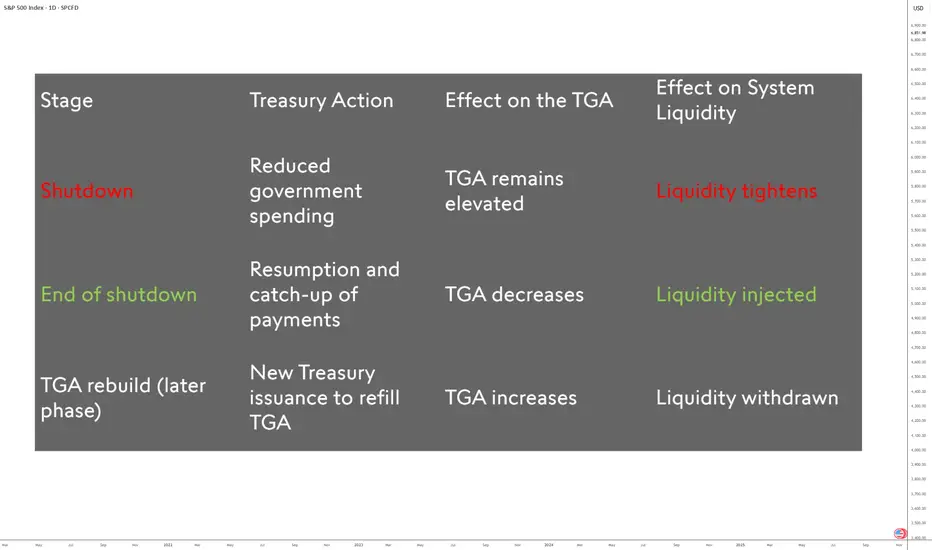
Upcoming End of the Shutdown & Market LiquidityThe end of a U.S. government shutdown is often interpreted as a mere political signal. Yet, from a financial perspective, this event can mark a major turning point for global liquidity. One of the most direct mechanisms through which this occurs is the Treasury General Account (TGA) — the U.S. Treasury’s main account at the Federal Reserve (Fed).
1) The TGA: a true liquidity reservoir
The TGA functions as the federal government’s current account.
When it receives revenues (taxes, bond issuance, etc.), funds are deposited there. When it spends — salaries, contractor payments, social programs — those amounts leave the TGA and flow toward commercial banks and households.
Each dollar spent by the Treasury exits the Fed and enters the private sector, increasing bank reserves and overall financial system liquidity.
Conversely, when the Treasury issues bonds and collects money from investors, bank reserves decline since those funds are transferred into the TGA.
2) Shutdown: a period of silent contraction
During a shutdown, the government is largely paralyzed. Many payments are suspended or delayed, reducing cash outflows.
As a result, the TGA drains much more slowly, and available liquidity in the financial system decreases. It is worth noting that the TGA had just finished refilling in early October — exactly at the onset of the shutdown.
3) The end of the shutdown: a sharp reinjection
As soon as the shutdown ends, the U.S. Treasury must catch up on deferred spending — wages, contracts, and federal programs.
These large disbursements cause a rapid decline in the TGA, equivalent to a direct injection of liquidity into the economy.
Bank reserves increase mechanically, repo rates may ease, and risk assets — equities, high-yield bonds, crypto-assets — often experience a short-term rebound.
This liquidity surge is not sustainable: once payments are settled, the Treasury usually reissues debt to rebuild the TGA to its target level. This reverse phase then withdraws the excess liquidity from the market.
In the short term, however, the end of a shutdown acts as a positive liquidity pump, capable of influencing the trend of risk assets on financial markets.
DISCLAIMER:
This content is intended for individuals who are familiar with financial markets and instruments and is for information purposes only. The presented idea (including market commentary, market data and observations) is not a work product of any research department of Swissquote or its affiliates. This material is intended to highlight market action and does not constitute investment, legal or tax advice. If you are a retail investor or lack experience in trading complex financial products, it is advisable to seek professional advice from licensed advisor before making any financial decisions.
This content is not intended to manipulate the market or encourage any specific financial behavior.
Swissquote makes no representation or warranty as to the quality, completeness, accuracy, comprehensiveness or non-infringement of such content. The views expressed are those of the consultant and are provided for educational purposes only. Any information provided relating to a product or market should not be construed as recommending an investment strategy or transaction. Past performance is not a guarantee of future results.
Swissquote and its employees and representatives shall in no event be held liable for any damages or losses arising directly or indirectly from decisions made on the basis of this content.
The use of any third-party brands or trademarks is for information only and does not imply endorsement by Swissquote, or that the trademark owner has authorised Swissquote to promote its products or services.
Swissquote is the marketing brand for the activities of Swissquote Bank Ltd (Switzerland) regulated by FINMA, Swissquote Capital Markets Limited regulated by CySEC (Cyprus), Swissquote Bank Europe SA (Luxembourg) regulated by the CSSF, Swissquote Ltd (UK) regulated by the FCA, Swissquote Financial Services (Malta) Ltd regulated by the Malta Financial Services Authority, Swissquote MEA Ltd. (UAE) regulated by the Dubai Financial Services Authority, Swissquote Pte Ltd (Singapore) regulated by the Monetary Authority of Singapore, Swissquote Asia Limited (Hong Kong) licensed by the Hong Kong Securities and Futures Commission (SFC) and Swissquote South Africa (Pty) Ltd supervised by the FSCA.
Products and services of Swissquote are only intended for those permitted to receive them under local law.
All investments carry a degree of risk. The risk of loss in trading or holding financial instruments can be substantial. The value of financial instruments, including but not limited to stocks, bonds, cryptocurrencies, and other assets, can fluctuate both upwards and downwards. There is a significant risk of financial loss when buying, selling, holding, staking, or investing in these instruments. SQBE makes no recommendations regarding any specific investment, transaction, or the use of any particular investment strategy.
CFDs are complex instruments and come with a high risk of losing money rapidly due to leverage. The vast majority of retail client accounts suffer capital losses when trading in CFDs. You should consider whether you understand how CFDs work and whether you can afford to take the high risk of losing your money.
Digital Assets are unregulated in most countries and consumer protection rules may not apply. As highly volatile speculative investments, Digital Assets are not suitable for investors without a high-risk tolerance. Make sure you understand each Digital Asset before you trade.
Cryptocurrencies are not considered legal tender in some jurisdictions and are subject to regulatory uncertainties.
The use of Internet-based systems can involve high risks, including, but not limited to, fraud, cyber-attacks, network and communication failures, as well as identity theft and phishing attacks related to crypto-assets.
Risks and Opportunities in the Global Market1. Introduction: The Global Market Landscape
The global market is a dynamic system where goods, services, and capital flow freely across national borders. This system thrives on globalization — the process of increasing interdependence among nations through trade, investment, technology, and finance. Over the last few decades, international trade agreements, technological advancements, and digital transformation have made global markets more accessible.
However, with this increased connectivity comes vulnerability. A crisis in one country can ripple across continents, as seen during the 2008 financial crisis or the COVID-19 pandemic. Thus, participants in the global market must constantly balance risk management and opportunity recognition.
2. Major Risks in the Global Market
a. Economic and Financial Risks
Economic fluctuations, inflation, and interest rate volatility are among the biggest risks in the global market. For instance, a sudden rise in U.S. interest rates can trigger capital outflows from emerging markets, leading to currency depreciation and financial instability.
Global recessions or slowdowns also reduce demand for exports, affecting developing economies reliant on trade. Moreover, the interconnected nature of financial markets means that a crisis in one major economy often spreads rapidly worldwide.
b. Geopolitical Risks
Political instability, trade wars, sanctions, and conflicts can disrupt global supply chains and impact investor sentiment. Recent examples include the Russia-Ukraine war and tensions in the Middle East, both of which caused oil price volatility and uncertainty in global energy markets.
Geopolitical risks can also lead to protectionism — where countries impose tariffs or restrict trade to protect domestic industries, slowing global commerce and increasing costs.
c. Currency and Exchange Rate Risks
In global business, currency fluctuations can significantly affect profits. When a company operates across multiple countries, it earns revenue in different currencies. If one currency weakens, it can reduce the company’s overall earnings when converted back to the home currency.
For instance, exporters from Japan or Europe often face profit declines when their local currency strengthens against the U.S. dollar. Managing this risk often requires complex hedging strategies.
d. Supply Chain Disruptions
Global supply chains have become more fragile due to over-dependence on certain regions for manufacturing and raw materials. Events like natural disasters, pandemics, or geopolitical tensions can halt production and raise costs. The COVID-19 pandemic exposed how vulnerable global supply networks are, leading many companies to rethink their sourcing strategies and focus on supply chain diversification.
e. Technological and Cybersecurity Risks
While technology drives globalization, it also introduces cyber threats and data privacy issues. Hackers and cybercriminals target multinational companies, leading to financial losses and reputational damage.
Moreover, as automation and artificial intelligence (AI) reshape industries, there’s a risk of job displacement and unequal technological adoption between countries, which can widen global inequality.
f. Environmental and Regulatory Risks
Climate change and environmental degradation are becoming major global concerns. Governments worldwide are enforcing stricter environmental laws and carbon regulations. Businesses that fail to adopt sustainable practices face penalties, reputational harm, or exclusion from eco-conscious markets.
At the same time, frequent natural disasters and changing weather patterns threaten agricultural output, infrastructure, and supply stability.
3. Key Opportunities in the Global Market
a. Expansion of Emerging Markets
Emerging economies like India, Indonesia, Vietnam, and several African nations are projected to lead global growth in the coming decades. These regions have young populations, expanding middle classes, and growing consumer demand.
For investors and multinational companies, emerging markets offer new avenues for trade, infrastructure development, and technology adoption. Global brands can tap into these markets by offering affordable, localized products and services.
b. Technological Innovation and Digital Transformation
Digital technologies — from AI to blockchain and 5G — are revolutionizing how businesses operate globally. E-commerce, fintech, and cloud computing have reduced entry barriers for small and medium enterprises (SMEs) to reach international customers.
Companies that embrace digital transformation gain efficiency, lower costs, and can compete globally. Moreover, digital finance and cryptocurrencies are opening new frontiers for cross-border transactions.
c. Sustainability and Green Investments
The global shift toward sustainability presents enormous opportunities. Clean energy, electric vehicles, and carbon-neutral products are attracting massive investment. Governments and institutions are pushing for green finance and environmental, social, and governance (ESG) compliance.
Investors who focus on sustainable assets are likely to benefit as the world transitions to a low-carbon economy. This creates new markets in renewable energy, waste management, and sustainable agriculture.
d. Diversification and Strategic Alliances
Globalization allows companies to diversify their production, investment, and sourcing strategies. Instead of depending on a single region, businesses can build strategic alliances and joint ventures across countries.
For example, technology partnerships between Western and Asian firms allow access to new technologies and talent pools, enhancing innovation and competitiveness.
e. Global Talent and Knowledge Sharing
The digital era has made it possible for organizations to tap into global talent pools. Remote work and cross-border collaboration have become common, allowing firms to recruit the best minds from anywhere in the world.
Knowledge sharing across borders fosters innovation, research, and cultural exchange, enriching global productivity and creativity.
f. Rising Global Consumer Base
The global middle class is expanding rapidly — especially in Asia and Africa. This surge in purchasing power offers companies a vast consumer market. Industries like e-commerce, entertainment, finance, and healthcare are seeing strong growth due to changing lifestyles and increasing digital adoption.
4. Balancing Risks and Opportunities
To succeed in the global market, companies and investors must skillfully balance risk management with opportunity pursuit.
Some effective strategies include:
Diversification: Investing across countries, sectors, and currencies to reduce exposure to regional risks.
Hedging: Using financial instruments like futures, options, and swaps to mitigate currency and interest rate risks.
Scenario Planning: Preparing for multiple future possibilities by forecasting economic, political, and technological shifts.
Sustainability Integration: Adopting green practices not only reduces risk but also attracts conscious investors and customers.
Agile Operations: Building flexible supply chains and digital infrastructure to adapt quickly to global disruptions.
5. Conclusion
The global market is a double-edged sword — filled with unprecedented opportunities but also heightened risks. Businesses that understand this balance and adapt proactively are best positioned to thrive.
While risks such as economic volatility, geopolitical conflicts, and regulatory challenges cannot be fully eliminated, they can be managed through strategic planning and diversification.
At the same time, opportunities arising from digital transformation, sustainability, and emerging markets provide pathways to long-term growth and profitability.
In the evolving global landscape, success will depend not just on expansion but on resilience, adaptability, and foresight — the ability to navigate uncertainty while seizing the immense potential the global market offers.
S&P 500 Technical & Fundamental Outlook — Week of Nov 3–7, 2025🧭 S&P 500 Technical & Fundamental Outlook — Week of Nov 3–7, 2025
Chart View:
Price is consolidating between 6,815 support and 6,921–6,940 resistance, holding just above the major ascending trend line from October.
This area marks a critical inflection: will buyers defend the trend, or will we finally break structure?
📊 Technical Breakdown
Primary Trend: Uptrend intact while above trend line support.
Key Support Zone: 6,800 – 6,815 (buyers last defended strongly).
Major Breakdown Level: Below 6,656 opens the door to 6,550 and new lower lows.
Resistance Zone: 6,921 – 6,940 (previous swing high & supply area).
Bias: Neutral-to-bullish while above 6,815; bearish momentum accelerates under 6,656.
🟢 Bullish Path: Use the trend line as a launchpad to retest 6,921+.
🔴 Bearish Path: Break and close below 6,815 → target 6,656 then 6,550.
🗓 Macro Calendar – Key Events to Watch
Mon (Nov 3) – ISM Manufacturing PMI (48.7 vs 49.4 prior)
→ Soft manufacturing data keeps Fed-cut expectations alive.
Tue (Nov 4) – ECB President Lagarde speaks (2 appearances)
→ Watch EUR/USD volatility; global equity tone may shift if dovish.
Wed (Nov 5) – ADP Employment (+31K expected after –32K prior); ISM Services PMI (50.7 exp)
→ Jobs rebound or slowdown will steer rate-cut bets and risk appetite.
Thu (Nov 6) – Bank of England rate decision (4.00% expected hold) + Governor Bailey speech; FOMC Member Waller speaks (2:30 PM ET)
→ Cross-market rate tone could affect bond yields → equity valuations.
Fri (Nov 7) – U.S. Non-Farm Payrolls + Unemployment + UoM Sentiment (53.0 exp)
→ This is the week’s main volatility catalyst. Strong jobs = hawkish pressure; weak jobs = bullish equities.
💬 Market Sentiment & Headlines
AI Mania Continues: Amazon hit a record after a $38 B OpenAI deal via AWS, fueling tech momentum.
Earnings Strength: 80% of S&P companies beat Q3 estimates; megacap tech remains the driver.
Breadth Concerns: 300+ S&P names closed red Monday — showing the rally is narrow and fragile.
Other Corporate Moves: Kimberly-Clark to acquire Kenvue ($48.7 B), Starbucks China JV announcement.
Macro Backdrop: Investors await clarity on Fed policy path and global rate decisions amid softening manufacturing data.
🧩 Trader’s Take
This week is all about trend-line defense vs breakdown.
Stay flexible:
Above 6,815 → trend continuation bias.
Below 6,656 → prepare for deeper retracement toward 6,550.
Macro data + AI headlines are creating a push-pull market: tech buoyancy vs broader weakness.
📅 Watch the reaction during ISM & NFP — these will likely decide direction for mid-November.
#SPX #SP500 #Futures #TradingView #PriceAction #Fundamentals #TechnicalAnalysis #StockMarket #AIStocks #MacroWeek #NFP #ISM #Fed #Equities #Amazon #OpenAI #NASDAQ #SPX500
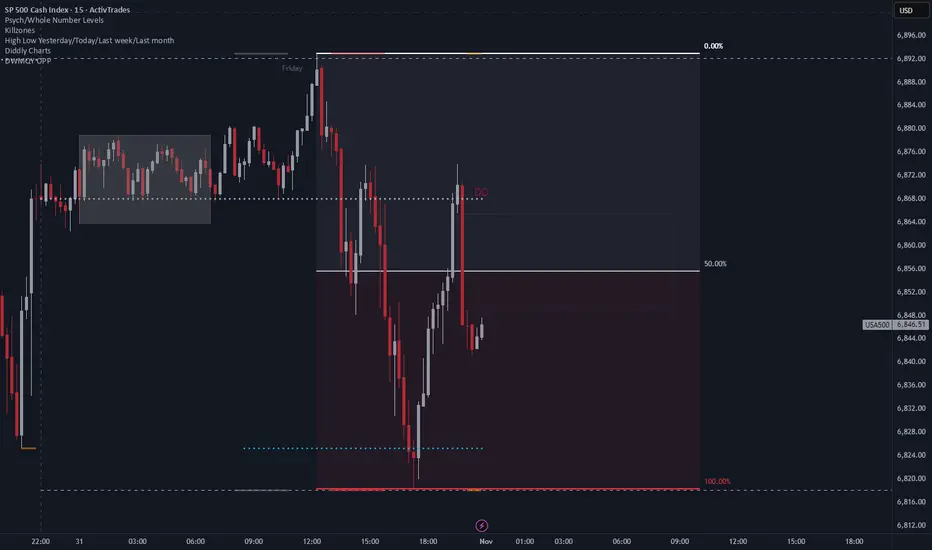
Intraday Range Expansion and Potential Repricing on the SPXFollowing a clean sweep of Friday’s high, price delivered a strong displacement to the downside, breaking short-term structure and rebalancing inefficiencies left behind. The subsequent rebound towards the daily open suggests a retracement into a premium area, potentially setting up for continuation lower if rejection holds around that zone.
If buyers fail to sustain price above the daily open, the market could aim for a full range fill back toward the previous low or discount zones below, maintaining the current bearish intraday order flow.
Potential Range Rebalance After Bullish Exhaustion on SP500Based on Candle Range Theory , the recent large bullish range has been followed by a series of smaller bearish candles, showing reduced momentum and potential exhaustion from buyers. Price is currently retracing into the lower range of the previous expansion, indicating that liquidity may be resting below.
If price fails to reclaim the upper range of the previous bullish candle, we could see continuation to the downside as the market seeks equilibrium within or below that expansion range. However, a strong rejection from the lower boundary could confirm range preservation and set up another bullish leg.
In short : the market’s next move depends on whether this retracement turns into a liquidity grab or a deeper correction beneath the prior candle range.
Backtesting 101: How to Turn an Idea Into a Tested StrategyEvery trader has thought it:
“If I’d just followed that setup every time, I’d be up big.”
That’s where backtesting steps in, it separates luck from logic.
It’s how you find out whether your strategy has a real edge, or just worked in hindsight.
Most traders skip it, not because it’s useless, but because it forces them to face the truth.
But if you can handle that truth, backtesting will make you a far more confident trader.
What Backtesting Really Is
Backtesting means applying your trading rules to historical data to see how your system would have performed.
It’s not about predicting the future, it’s about proving whether your idea works in different market conditions.
When done properly, it gives you three key insights:
Profitability: does your edge actually exist?
Risk: how deep are the drawdowns, and can you handle them?
Consistency: does it work across bull, bear, and sideways markets?
A solid backtest gives you confidence, not because it guarantees profit, but because it exposes weakness before the market does.
The Most Common Mistakes
Curve-fitting: tweaking rules until the past looks perfect.
Ignoring fees and slippage: small costs that quietly erase profits.
Testing too little data: short periods create false confidence.
Focusing on one market: edges must survive different conditions.
If your backtest looks too clean, it’s probably lying to you.
Why It Matters
Backtesting builds trust in your system and discipline in yourself.
When you know your data, you stop second-guessing every trade.
Losing trades stop feeling like failure, because you understand they’re part of a proven edge.
Even bots rely on backtesting. Without it, automation is just random execution.
With it, every trade follows structure, not emotion.
All of these points make a difference between a winning or losing strategy.
From Idea to System
Every strategy starts as a hypothesis.
Backtesting turns that hypothesis into data.
Data turns into structure.
Structure turns into consistency.
That’s the real path to professional trading - logic first, emotion second.
SPX | Daily Analysis #10 - 3 November 2025Hello and Welcome Back to DP,
Review & News Coverage:
Since our last SPX analysis, we mentioned that a broken trendline could open the door for downside movement. As we can see on the chart, the index fell toward the 1.68 Fibonacci zone before bouncing back.
This drop created about $44 of volatility — hopefully, you managed to catch that move! We had highlighted the 6811 area as a potential buy zone, and indeed, that level opened an opportunity for entries (I personally missed it since I needed more confirmation, but I hope some of you caught it).
From both the economic and political sides, several developments could shape SPX sentiment and direction:
Economic Calendar:
Monday: ISM Manufacturing PMI
Wednesday: ADP Non-Farm Employment Change & ISM Services PMI
Friday: Tentative Unemployment Rate
Stronger-than-expected data could strengthen the dollar and weigh on equities, while weaker readings may support a rebound if markets price in potential rate relief.
Political Landscape:
Watch for new announcements on funding negotiations or relief measures — any progress (or setback) in the government-shutdown talks could move markets.
The U.S. government shutdown remains a risk factor, with pressure building from expiring healthcare tax credits and food assistance programs.
And most importantly — keep an eye on “Trump’s Indicator” (his posts or tweets). His remarks often create sharp, short-term volatility across indices and sectors.
1H - 4H Technical Analysis:
On the charts, the SPX is struggling to regain upward momentum.
If price breaks the intraday trendline, room opens for a move down toward 6844 and 6829.
If those zones show strong volume and bullish candle patterns, we could look for buy entries around that range.
The key is to wait for confirmation — volume support and candle behavior will guide whether the market finds its footing or continues to slide.
Summary:
Short-term tone remains cautiously bullish while above 6811, but pressure remains from macro and political uncertainty.
Watch mid-week data and political headlines for volatility spikes.
Technical zones: Support 6829–6811, Resistance 6895–6920 (potential retest if sentiment turns).
Disclaimer:
This content is for informational purposes only and does not constitute financial or investment advice. © DIBAPRISM
Amir D.Kohn
SPX - clear bullish signs ahead..SPX Has recently tested major support levels but struggled to break through below and bounced back up to the upside. The price also broke through the resistance trendline to the upside which is a major clear sign that SPX will be hitting the next upward target (fibonacci extension) shown on the chart
SPX: Bullish Exhaustion Signals a Short-Term PullbackThe TVC:SPX is currently showing signs of a potential short-term retracement after rejecting the 6,860–6,880 supply zone. The recent upswing into this zone lacked strong bullish momentum, suggesting that buyers are losing control. If price maintains below this resistance area, it could indicate the continuation of the short-term bearish structure.
The red zone marks a clear supply area where previous bullish attempts were absorbed, while the green zone below highlights a demand area between 6,740–6,770 — a potential target for sellers. A clean break below the recent intraday low would likely accelerate bearish momentum toward that zone.
Traders may look for confirmation from lower timeframes before shorting, as the broader structure still remains within a corrective phase after the prior rally.