Trade ideas
AUD/USD Kicks Off the Week with a Risk-On BreakoutWe’ve seen a risk-on start to the week’s trading, with global markets rallying on hopes that Donald Trump and Xi Jinping will agree to extend their trade truce during a high-stakes meeting in South Korea. Asian equities surged, commodity prices strengthened, and risk-sensitive currencies like the Australian dollar gapped higher at the Sunday open.
Optimism Sweeps Across Asia
Asia led the charge, with Japan’s Nikkei 225 climbing to break above 50,000 for the first time, while South Korea’s Kospi hit fresh record highs. Optimism around US–China trade relations and Japan’s new Prime Minister Sanae Takaichi’s pro-growth agenda fuelled strong inflows into equities. Meanwhile, gold fell more than 1% and Bitcoin extended its weekend rally, reflecting a broad shift away from defensive assets.
For the Aussie dollar, this improving sentiment and stronger tone in global commodities provided the perfect spark. As one of the most cyclical major currencies, the Aussie tends to thrive when markets embrace risk and the growth outlook stabilises. The question now is whether the pair can build on its initial burst of momentum as liquidity deepens through the London and US sessions.
Compression Turns to Expansion
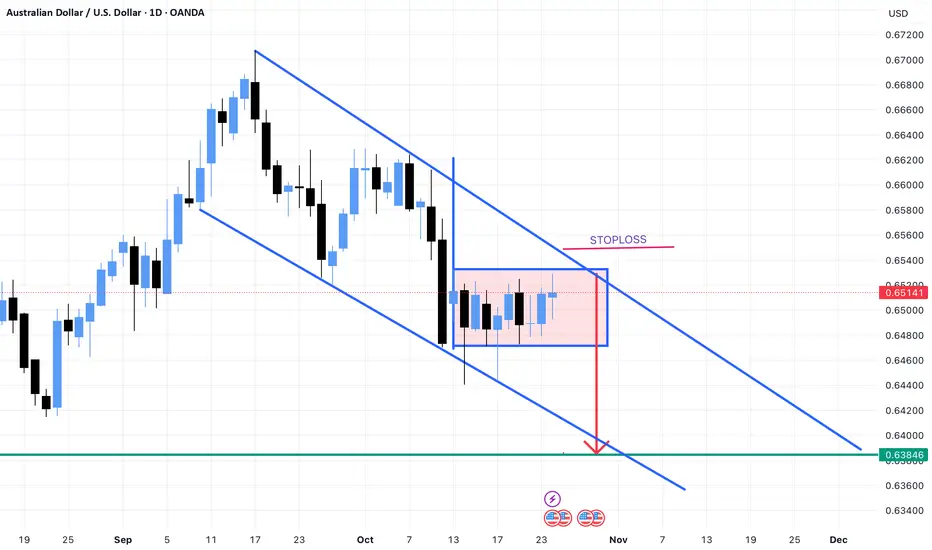
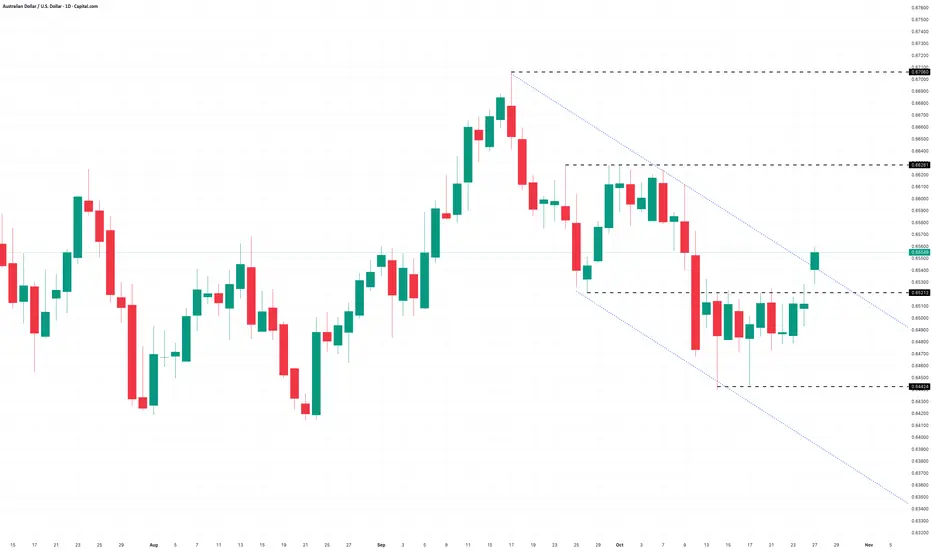
AUD/USD’s technical landscape has been a story of compression and expansion. Since mid-September, prices have been expanding lower and compressing sideways, forming a clearly defined series of lower swing highs. Today’s price action is trying to buck that trend… having expanded lower at the start of October, the market spent the last three weeks coiling within a tight range (blue box) just beneath horizontal swing resistance.
Today’s gap higher saw the pair break through that resistance, signalling a potential shift from compression to expansion higher. However, price is now testing the descending trendline drawn from the recent series of lower highs. Traders will be watching for a daily close above this level to confirm a short-term change in momentum and trend dynamics.
AUD/USD Daily Candle Chart
Past performance is not a reliable indicator of future results
Zooming into the hourly chart, we can see how the breakout unfolded with a clean move above range resistance, followed by a brief pullback and stabilisation just beneath the trendline. Sustained trade above this area could invite follow-through buying, while a sharp rejection would risk pulling price back into the prior range.
AUD/USD Hourly Candle Chart
Past performance is not a reliable indicator of future results
Disclaimer: This is for information and learning purposes only. The information provided does not constitute investment advice nor take into account the individual financial circumstances or objectives of any investor. Any information that may be provided relating to past performance is not a reliable indicator of future results or performance. Social media channels are not relevant for UK residents.
Spread bets and CFDs are complex instruments and come with a high risk of losing money rapidly due to leverage. 85.24% of retail investor accounts lose money when trading spread bets and CFDs with this provider. You should consider whether you understand how spread bets and CFDs work and whether you can afford to take the high risk of losing your money.
AUDUSD Eyes 0.6500 as Softer CPI and Weak Jobs Data Weigh on USDHey Traders,
In the coming week, we’re monitoring AUDUSD for a potential buying opportunity around the 0.65000 zone. The pair remains in a broader uptrend, with the current pullback shaping up as a healthy correction toward key structural support.
Structure:
Price continues to respect its ascending trendline, and the 0.65000 area aligns with a strong confluence of horizontal support and dynamic trend structure — a level that has previously attracted strong buying momentum.
Macro Outlook:
The latest U.S. inflation print came in softer at 3.0%, undershooting expectations, while labour market data continues to signal cooling conditions. Together, these developments reinforce a dovish shift in Fed sentiment, weighing on the U.S. Dollar Index (DXY).
At the same time, Gold continues to rally, underpinned by the weakening Dollar and rising safe-haven demand. Given the positive correlation between AUD and Gold, this macro backdrop strengthens the bullish case for AUDUSD in the coming sessions.
Next Move:
A sustained bid around 0.65000 could mark the start of another impulse leg higher — targeting a retest of recent highs if momentum confirms.
Trade safe,
Joe
AUD/USD Analysis: Upward Momentum Amid USD Weakness?The AUD/USD pair has shown upward momentum today, trading at around 0.6522 after opening at 0.6487, marking a gain of about 0.54%. This follows a rebound from recent lows near 0.6440, supported by a dovish tone from the Federal Reserve that has pressured the US dollar, alongside resilient commodity prices boosting the Australian dollar.
Key technical levels include support around 0.6480-0.6500, where the pair has found buying interest, and resistance near 0.6535-0.6600, which could cap further advances if tested.
Fundamental drivers include ongoing US-China trade tensions, which introduce downside risks for the AUD due to Australia's economic ties to China, though softer US data and potential rate cut expectations have offset some pressure. No major high-impact economic releases are flagged for today, leaving market focus on broader sentiment and upcoming Australian employment figures later in the week.
From a technical perspective, indicators like RSI point to buy signals with the pair recovering from oversold conditions, and a bullish hammer pattern suggests potential for continued gains if it holds above the 200-day SMA. However, some views highlight bearish risks if it breaks below 0.6439, targeting lower supports.
Market sentiment leans positive for the session, with recovery noted in real-time discussions and a grind higher amid USD weakness. Expect the direction to remain upward unless fresh negative catalysts emerge, with a bias toward testing higher levels like 0.6535.
AUD USD long....'risk on' tradeIt's a 'risk on' trade, thanks to boosted optimism surrounding US / CHINA.
The JPY is the obvious short choice, I've chosen the USD because I feel the USD daily charts have more room to the upside. Maybe I'm trying to be too shrewd there, although Friday's CPI data does add weight to a USD short.
The risk to the trade is negative market sentiment, possible tempering of US rate cut expectations, or simply that I'll look back I think I should have just stuck with JPY short.
Indecently, I still think AUD NZD long is a good option
AUDUSD POSSIBLE SELL SETUP🧭 Market Structure Overview
Current price: around 0.6547
The chart shows a bearish structure shift — after price reached a high near 0.6560–0.6565, it created:
A Break of Structure (BOS) to the downside.
A Change of Character (CHoCH) confirming a transition from bullish to bearish momentum.
🧱 Key Supply and Demand Zones
Supply zone (short entry area):
Marked in red around 0.6550–0.6560
This is where sellers previously entered and broke structure — potential retest zone for short entry.
Demand zones (targets):
Minor demand: around 0.6530–0.6535
Major demand / final target: near 0.6515–0.6510
📉 Trade Plan (Sell Setup)
Bias: Bearish
Entry zone (sell):
Wait for a retracement into 0.6550–0.6555 (supply zone retest)
Confirmation:
Look for lower time frame rejection (e.g. bearish engulfing, BOS down on 1–5m chart) at that zone.
Stop loss:
Above 0.6565 (just beyond the BOS high / supply zone)
Take profit targets:
TP1: 0.6535 (first demand / liquidity pocket)
TP2: 0.6515 (main target, strong demand zone)
Risk-to-reward (approx):
1:3 to 1:4, depending on entry precision
🔍 Market Logic
Price made a lower high and broke structure to the downside.
The CHoCH confirms momentum has shifted.
The liquidity above 0.6560 has been swept — institutions likely distributed there.
Expect a retracement into supply before the next impulsive leg down.
⚠️ Trade Management Tips
If price fails to reach 0.6550 and instead breaks below 0.6535 decisively, consider waiting for a pullback to 0.6540 for re-entry.
Move SL to breakeven after TP1 is hit.
AUDUSD reaching important resistance at 0.6560The AUDUSD remains in a neutral trend, with recent price action indicating a potential resistance retest within the broader uptrend.
Resistance Zone: 0.6560 – a key level from previous consolidation. Price is currently testing or approaching this level.
A bearish rebound from 0.6560 would confirm ongoing downside momentum, with potential targets at:
0.6500 – initial support
0.6490 – psychological and structural level
0.64800 – extended support on the longer-term chart
Bullish Scenario:
A confirmed break and daily close above 0.6560 would weaken the bullish outlook and suggest deeper downside risk toward:
0.6576 – minor resistance
0.6590 – stronger resistance and potential supply zone
Outlook:
Neutral bias remains intact while the AUDUSD trades around the pivotal 0.6560 level. A sustained break below or above this level could shift momentum.
This communication is for informational purposes only and should not be viewed as any form of recommendation as to a particular course of action or as investment advice. It is not intended as an offer or solicitation for the purchase or sale of any financial instrument or as an official confirmation of any transaction. Opinions, estimates and assumptions expressed herein are made as of the date of this communication and are subject to change without notice. This communication has been prepared based upon information, including market prices, data and other information, believed to be reliable; however, Trade Nation does not warrant its completeness or accuracy. All market prices and market data contained in or attached to this communication are indicative and subject to change without notice.
AUD/USD Gap-Fill Support (0.6513) - High-Probability Long SetupAUD/USD created an opening gap with a strong heavy-volume zone behind it, a rare but powerful setup. I expect price to pull back, fill the gap, and react at the key support at 0.6513. If price returns there, I plan to go long, looking for a strong bounce from this institutional volume area.
AUDUSD Trade Plan - Waiting for a Pullback & Structure Break.The AUDUSD has officially broken structure to the upside, signaling bullish momentum ✅.
I’m currently waiting for price to retrace back into equilibrium within the previous swing range before considering any long positions—price is overextended at current levels and chasing here wouldn’t be smart ⚖️📉.
Patience is key as I wait for premium liquidity zones to be tapped for a high-probability entry setup 🎯.
⚠️ Disclaimer: This is market analysis and not financial advice.
AUDUSD Trade Plan - Waiting for a Pullback & Structure Break.
AUDUSD My Opinion! SELL!
My dear followers,
This is my opinion on the AUDUSD next move:
The asset is approaching an important pivot point 0.6538
Bias - Bearish
Technical Indicators: Supper Trend generates a clear short signal while Pivot Point HL is currently determining the overall Bearish trend of the market.
Goal - 0.6510
About Used Indicators:
For more efficient signals, super-trend is used in combination with other indicators like Pivot Points.
Disclosure: I am part of Trade Nation's Influencer program and receive a monthly fee for using their TradingView charts in my analysis.
———————————
WISH YOU ALL LUCK
Is Geopolitical Re-Alignment the New AUD Catalyst?The Australian Dollar's (AUD) sharp surge against the US Dollar (USD) is driven by a powerful synergy of geopolitical de-escalation and structural economic realignment. Near-term momentum stems from optimism surrounding an imminent US-China trade deal. As a primary commodity exporter and a financial 'China proxy', Australia's currency benefits directly from reduced Sino-American trade tensions, prompting a global "risk-on" rally that lifted commodity prices and commodity-linked currencies. Simultaneously, softer-than-expected US inflation data has amplified expectations for a Federal Reserve rate cut in December, weakening the USD by narrowing the interest rate differential in favor of the Aussie.
Structurally, the AUD gains foundational strength from a landmark $8.5 billion US-Australia Critical Minerals Agreement. This strategic pact, targeting vital rare-earth elements, aims to secure a Western supply chain for high-tech and defense industries, directly countering China's resource dominance. The joint commitment of over $1 billion in near-term investment into Australian mining and processing facilities introduces significant foreign capital and long-term economic diversification. This geostrategic pivot transforms Australia into a key node in the non-Chinese supply of materials essential for the global clean energy transition and advanced cyber systems, moving the AUD beyond purely cyclical commodity flows.
In essence, the $AUD/USD rally is a dual narrative: a cyclical uplift from cooling trade wars and a structural upgrade from a new science and technology alliance with the US. While markets await specific details from the upcoming high-level trade talks and the Federal Reserve's next move, this combination of favorable macroeconomic divergence and a foundational critical minerals investment provides a robust, multi-domain argument for sustained Australian Dollar strength.
AUD/USD BEST PLACE TO BUY FROM|LONG
AUD/USD SIGNAL
Trade Direction: long
Entry Level: 0.649
Target Level: 0.651
Stop Loss: 0.648
RISK PROFILE
Risk level: medium
Suggested risk: 1%
Timeframe: 1h
Disclosure: I am part of Trade Nation's Influencer program and receive a monthly fee for using their TradingView charts in my analysis.
✅LIKE AND COMMENT MY IDEAS✅
AUDUSD – Monday Gap Fill Setup (Institutional Play)This week opened with a Gap Up relative to last Friday’s close (~0.65122).
A Gap Up typically suggests that price may retrace downward to fill the imbalance left behind over the weekend — as long as structure confirms the continuation move.
How the Setup Developed
1. Friday Close was marked as the Gap Fill Target.
2. At Monday open, AUDUSD opened above this level → SELL bias.
3. Early session showed a liquidity sweep (stop-hunt wick) above previous swing highs — a common institutional liquidity grab.
4. After the sweep, price broke structure to the downside (BOS).
5. The market pulled back into the BOS zone, offering a sell entry with stop loss placed above the sweep high.
6. Management rule: SL moves to break-even only after a 5-minute candle closes below the BOS trigger line (not just a wick).
Target
→ Friday Close Gap Fill (0.65122 region)
This target reflects the principle that weekend gaps tend to close due to price seeking efficiency after an imbalance.
Disclaimer:
This content is intended for educational and informational purposes only. It does not constitute investment advice, financial advice, trading advice, or any form of recommendation. Trading involves risk, and you are responsible for your own decisions.
AUDUSD FRGNT Daily Forecast -Q4 | W44 | D27| Y25 | GAP FILL !📅 Q4 | W44 | D27| Y25 |
📊 AUDUSD FRGNT Daily Forecast
🔍 Analysis Approach:
I’m applying Smart Money Concepts, focusing on:
Identifying Points of Interest on the Higher Time Frames (HTFs) 🕰️
Using those POIs to define a clear trading range 📐
Refining those zones on Lower Time Frames (LTFs) 🔎
Waiting for a Break of Structure (BoS) for confirmation ✅
This method allows me to stay precise, disciplined, and aligned with the market narrative, rather than chasing price.
💡 My Motto:
"Capital management, discipline, and consistency in your trading edge."
A positive risk-to-reward ratio, paired with a high win rate, is the backbone of any solid trading plan 📈🔐
⚠️ Losses?
They’re part of the mathematical game of trading 🎲
They don’t define you — they’re necessary, they happen, and we move forward 📊➡️
🙏 I appreciate you taking the time to review my Daily Forecast.
Stay sharp, stay consistent, and protect your capital
— FRNGT 🚀
OANDA:AUDUSD
Bearish reversal off major resistance?The Aussie (AUD/USD) is rising towards the pivot, which has been identified as an overlap resistance that aligns with the 38.2% Fibonacci retracement and oculd reverse to the 1st support, which acts as a multi swing low support.
Pivot: 0.6545
1st Support: 0.6422
1st Resistance: 0.6628
Disclaimer:
The above opinions given constitute general market commentary, and do not constitute the opinion or advice of IC Markets or any form of personal or investment advice.
Any opinions, news, research, analyses, prices, other information, or links to third-party sites contained on this website are provided on an "as-is" basis, are intended only to be informative, is not an advice nor a recommendation, nor research, or a record of our trading prices, or an offer of, or solicitation for a transaction in any financial instrument and thus should not be treated as such. The information provided does not involve any specific investment objectives, financial situation and needs of any specific person who may receive it. Please be aware, that past performance is not a reliable indicator of future performance and/or results. Past Performance or Forward-looking scenarios based upon the reasonable beliefs of the third-party provider are not a guarantee of future performance. Actual results may differ materially from those anticipated in forward-looking or past performance statements. IC Markets makes no representation or warranty and assumes no liability as to the accuracy or completeness of the information provided, nor any loss arising from any investment based on a recommendation, forecast or any information supplied by any third-party.
Potential bullish bounce?AUD/USD has bounced off the support level, which serves as a pullback support and could rise from this level to our take-profit target.
Entry: 0.6500
Why we like it:
There is a pullback support level.
Stop loss: 0.6481
Why we like it:
There is a pullback support level.
Take profit: 0.6542
Why we like it:
There is a pullback resistance level.
Enjoying your TradingView experience? Review us!
Please be advised that the information presented on TradingView is provided to Vantage (‘Vantage Global Limited’, ‘we’) by a third-party provider (‘Everest Fortune Group’). Please be reminded that you are solely responsible for the trading decisions on your account. There is a very high degree of risk involved in trading. Any information and/or content is intended entirely for research, educational and informational purposes only and does not constitute investment or consultation advice or investment strategy. The information is not tailored to the investment needs of any specific person and therefore does not involve a consideration of any of the investment objectives, financial situation or needs of any viewer that may receive it. Kindly also note that past performance is not a reliable indicator of future results. Actual results may differ materially from those anticipated in forward-looking or past performance statements. We assume no liability as to the accuracy or completeness of any of the information and/or content provided herein and the Company cannot be held responsible for any omission, mistake nor for any loss or damage including without limitation to any loss of profit which may arise from reliance on any information supplied by Everest Fortune Group.
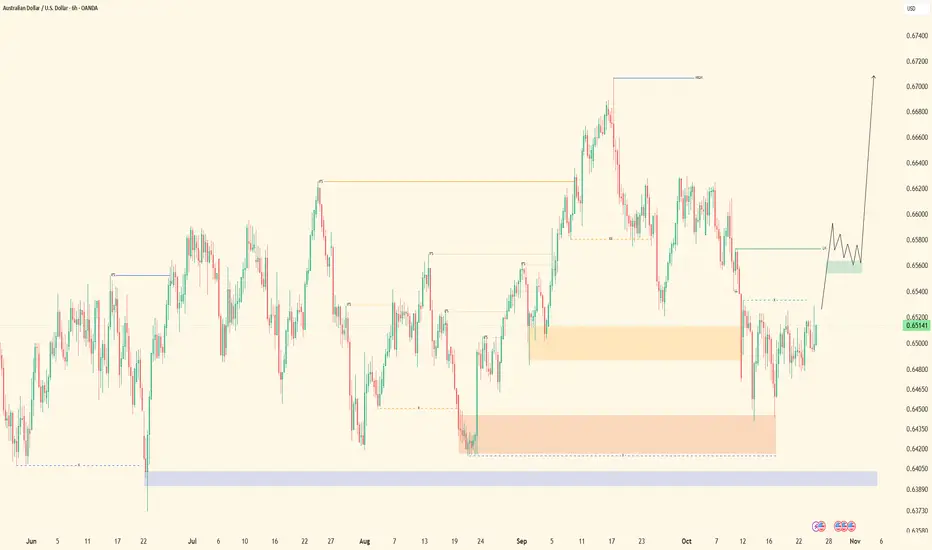
AUDUSD| Bullish Range Intact-Refining Structure for Continuation
Price remains in a bullish uptrend, continuing to respect higher timeframe structure from previous weeks. The market is still operating within its higher timeframe range, and current momentum shows intent for continuation to the upside.
Dropping into mid and lower timeframes, we’ve refined structure and identified order blocks within discounted areas. Both the lighter and darker orange zones represent key mitigation areas where price has already shown reaction and respect.
From those zones, we’re now seeking lower timeframe confirmations to align with bullish continuation. On the chart, price is currently climbing toward a lower high, which serves as our next short-term target.
Once that lower high is taken, we’ll anticipate a pullback into the discounted range for deeper mitigation opportunities — that’s where we’ll be looking for our next long entries within the bullish leg.
Until then, it’s all about alignment and patience — following price, following smart money, and letting the structure unfold. Execution will come once delivery confirms it.
Let’s go. 🔥
AUDUSD Technical & Order Flow AnalysisOur analysis is based on a multi-timeframe top-down approach and fundamental analysis.
Based on our assessment, the price is expected to return to the monthly level.
DISCLAIMER: This analysis may change at any time without notice and is solely intended to assist traders in making independent investment decisions. Please note that this is a prediction, and I have no obligation to act on it, nor should you.
Please support our analysis with a boost or comment!
MASTERCLASS: INTRADAY & SWING TRADE AUDUSD 🦘 AUDUSD (0.66112) - COMPREHENSIVE TECHNICAL MASTERCLASS: INTRADAY & SWING TRADE BLUEPRINT 🦘
October 27-31, 2025 | Advanced Multi-Timeframe Trading Forecast
🎯 MARKET OVERVIEW & ANALYSIS SCOPE 🎯
Current Spot Price: 0.66112 | Analysis Date: Oct 25, 2025 | Timeframes: 5M-1D Complete Spectrum | Trading Style: Intraday Scalp + Swing Trade | Conviction: Medium-High
━━━━━━━━━━━━━━━━━━━━━━━━━━━━━━━━━
📊 1. MULTI-TIMEFRAME TREND STRUCTURE & DOW THEORY VALIDATION 📊
🔍 Daily (1D) Timeframe - Primary Market Direction
The 1D chart exhibits mixed consolidation with bearish undertone . Dow Theory framework shows LOWER HIGHS pattern emerging (0.6640 → 0.6620 → 0.6615), signaling potential downtrend initiation. Elliott Wave structure suggests completion of 5-wave impulse (up) targeting reversal near 0.6580-0.6600 levels. RSI reading 48-52 (neutral zone, showing weakness as bearish bias forms). VWAP at 0.6605 acting as temporary support with breach implications downward.
⏰ 4H Timeframe - Swing Trade Risk Structure
Four-hourly demonstrates bearish flag formation with downside target potential . Price consolidating below 0.6625 resistance after failed breakout attempts. Bollinger Bands tightening (squeeze pattern)—volatility expansion imminent. RSI declining from 55 to 48 range (bearish momentum deterioration). Ichimoku Cloud configuration: price trapped between Kijun-sen (resistance) & Senkou Span B (dynamic support)—indecision zone. Downside target: 0.6580-0.6560.
🔥 1H to 5M Intraday Setup - Micro Timeframe Dynamics
One-hour shows head-and-shoulders pattern developing with neckline at 0.6610. Left shoulder complete (0.6625), head forming (0.6620), right shoulder declining (0.6618). Harmonic pattern: Bearish Bat identified at 0.6595 (D-point) suggesting short entry opportunity. 30M timeframe displays EMA50 crossing below EMA200 (bearish crossover just initiated). Volume declining on attempted rallies = selling pressure dominance. 5M shows bear trap formation near 0.6625—trapping bullish retailers before reversal.
━━━━━━━━━━━━━━━━━━━━━━━━━━━━━━━━━
🎯 2. ENTRY & EXIT PROTOCOL + WYCKOFF DISTRIBUTION PHASE 🎯
SWING TRADE SHORT ENTRIES (4H/1D): Sell breakdown below 0.6610 (H&S neckline) with stop @ 0.6635 (Risk:Reward 1:3 minimum). Wyckoff Distribution phase activated—institutional selling pressure accumulating. Target: 0.6560-0.6540 (swing trade 3-5 days hold).
INTRADAY SHORT SCALPS (5M/15M/30M): Multiple entry opportunities: (1) Head-and-shoulders neckline break = 0.6610 entry | (2) Bearish Bat PRZ completion = 0.6595-0.6590 aggressive short | (3) EMA crossover rejection on 30M = 0.6615-0.6620 pullback short entry.
PRIMARY PROFIT TARGETS: 1D: 0.6560 | 4H: 0.6575 | 1H: 0.6600 | 30M: 0.6610 (quick 15-20 pip scalp gains) | Extended: 0.6540 (major support level).
STOP LOSS PLACEMENT STRATEGY: Swing shorts: 0.6640 (above H&S left shoulder) | Intraday: 0.6625 (tight 15-20 pip stops) | Trail stops below Bollinger Band upper band as price descends.
💡 Pro Trading Tip: Use Ichimoku Kijun-sen (26-period) as dynamic resistance/stop level. Lock profits at each support zone identified via Gann angles.
━━━━━━━━━━━━━━━━━━━━━━━━━━━━━━━━━
⚡ 3. REVERSAL SIGNALS & JAPANESE CANDLESTICK PATTERN ANALYSIS ⚡
✅ BEARISH REVERSAL CONFIRMATIONS:
Engulfing pattern visible on 30M chart—red candle engulfing previous green (seller dominance confirmed). Shooting star candlestick near 0.6625 (failed rally rejection). Dark cloud cover pattern on 1H signals seller takeover at highs. Head-and-shoulders neckline (0.6610) acts as critical reversal zone. Ichimoku Chikou Span trading BELOW price action = confirmed bearish structure. Stochastic showing bearish divergence (lower highs on RSI/price higher highs).
⛔ BULLISH REVERSAL WARNINGS & BULL TRAP IDENTIFICATION:
Bull trap currently IN PROGRESS near 0.6625 resistance—retailers buying resistance, institutions distributing. If price breaks above 0.6630 with declining volume, false breakout confirmed. Morning Star pattern absent—no reversal higher probability. VWAP rejection combined with closing below 0.6610 = strong bearish confirmation. Gann resistance at 0.6640 acts as major distribution zone where selling accelerates.
⚠️ CRITICAL LEVEL: 0.6610 (H&S neckline) = REVERSAL THRESHOLD. Break below = Bearish Continuation | Hold above with volume = Bull trap intact
━━━━━━━━━━━━━━━━━━━━━━━━━━━━━━━━━
🔴 4. BREAKDOWN DYNAMICS & BEARISH PATTERN FORMATIONS 🔴
✅ PRIMARY BEARISH BREAKDOWN SCENARIO (65% PROBABILITY):
Head-and-shoulders breakdown below 0.6610 neckline on 1H timeframe with volume confirmation (need 20%+ volume spike below average). Elliott Wave target: 0.6540-0.6500 (5th wave decline in new downtrend cycle). Bollinger Band lower band at 0.6560 = natural extension target. Measured move from pattern: H&S height (0.6625-0.6610 = 15 pips) projected downward = 0.6595 target.
🔷 HARMONIC PATTERN PRECISION DOWNSIDE TARGETS:
Bearish Bat pattern (XA:BC 0.618) D-point entry: 0.6595 with target 0.6540 (161.8% extension downward). Bearish Butterfly on 4H suggesting potential extended move to 0.6480 (extreme scenario). Crab pattern confluence identifies 0.6570 as intermediate support-bounce zone.
⚠️ BULLISH PATTERN - FALLING WEDGE (BULL TRAP) (35% PROBABILITY):
If price holds above 0.6610, 4H chart displays falling wedge formation that could breakout bullishly to 0.6650+. Stochastic confluence on 1H indicates potential bounce setup. However, volume analysis suggests limited upside conviction. Bear trap possible if institutions accumulate after distribution climax. Watch for climactic volume spike—wedge collapse likely either direction.
━━━━━━━━━━━━━━━━━━━━━━━━━━━━━━━━━
📉 5. VOLATILITY METRICS & PRICE ACTION COMPRESSION 📉
🌊 Bollinger Bands - Critical Squeeze Signal:
Band width compressing to 180 pips on 1D (lowest in 12 days)—explosive volatility breakout imminent within 36-48 hours. Intraday Bollinger Bands (5M/15M/30M) showing initial expansion toward lower band—bearish volatility thesis strengthening. Price approaching lower Bollinger Band (0.6580) = oversold setup potential or trend continuation signal depending on volume.
📍 SUPPORT & RESISTANCE ARCHITECTURE:
MAJOR RESISTANCE ZONES: 0.6630 (Bull trap distribution level) | 0.6625 (Recent swing high) | 0.6640 (Gann angle resistance) | 0.6650 (Weekly pivot)
CRITICAL SUPPORT LEVELS: 0.6610 (H&S neckline/VWAP area) | 0.6595 (Harmonic D-point) | 0.6575 (4H support) | 0.6560 (Bollinger lower band) | 0.6540 (Major support)
VWAP PROFILE: Daily VWAP: 0.6605 (trending downward) | Weekly VWAP: 0.6615 (secondary resistance)
📊 Moving Average Divergence - Bearish Alignment:
EMA 50 below EMA 200 on 1H/4H (bearish structure forming). SMA 20 crossing below SMA 50 on 30M = momentum deterioration signal. 5M chart: EMA50 recently crossed below EMA200—intraday downtrend initiation confirmed. Price trading BELOW all major moving averages = weakness confirmed. Wyckoff Distribution phase in progress—institutional selling continuing.
🎯 OVERBOUGHT/OVERSOLD CONDITIONS & MOMENTUM EXHAUSTION:
RSI Status: 48-52 range (neutral sliding toward oversold)—RSI approaching 40 = potential for capitulation move lower. Stochastic on 15M: Declining from 55 toward 30 zone = bearish momentum acceleration. Ichimoku RSI below midline transitioning lower—downside potential significant. CCI on 5M declining below zero (strong bearish momentum without extreme oversold exhaustion). Fast Stochastic declining toward 20 level—room for extended downside run.
━━━━━━━━━━━━━━━━━━━━━━━━━━━━━━━━━
🎓 6. ADVANCED TECHNICAL THEORY INTEGRATION & FRAMEWORKS 🎓
⭐ ELLIOTT WAVE STRUCTURE: 5-wave impulse (up) completed near 0.6625 | Wave A (down) declining toward 0.6595-0.6540 | Correction target: 50% retracement = 0.6575 | Extended target: 161.8% extension = 0.6480 maximum (9-12 trading days)
⭐ GANN THEORY APPLICATION: 45-degree angle resistance @ 0.6640 (broken support becomes resistance) | Square of Nine support @ 0.6540 | Time-Price intersection: 6-8 trading days for major swing completion | Gann fan support @ 0.6560
⭐ WYCKOFF METHODOLOGY - DISTRIBUTION PHASE: Spring pattern failed (no spring reversal) = Distribution confirmation | Markup phase ended, Distribution phase INITIATED | Test & Decline pattern active = institutional distribution continuing | Expected breakdown: 0.6595-0.6540 over 5-7 trading days | Climax alert: Watch for volume spike + wide range candle = distribution completion
⭐ DOW THEORY BEARISH CONFIRMATION: Lower highs: 0.6640 → 0.6625 → 0.6620 | Lower lows: 0.6590 → 0.6585 | Volume declining on rallies = downtrend validation | Trend now firmly bearish-biased
━━━━━━━━━━━━━━━━━━━━━━━━━━━━━━━━━
✨ COMPLETE TRADING ACTION PLAN ✨
🔴 PRIMARY BEARISH SCENARIO (65% Probability):
Entry Zone: 0.6610 (H&S breakdown) or 0.6615-0.6620 (pullback short)
Stop Loss: 0.6640 | Target 1: 0.6595 | Target 2: 0.6575 | Target 3: 0.6560
Risk/Reward: 1:3+ | Hold Duration: Swing (3-5 days) + Intraday scalp (1-3 hours)
Conviction Level: 65% | Setup Quality: Premium Bearish | Volume: Confirming
🟢 SECONDARY BULLISH SCENARIO (35% Probability - Contingency):
Trigger: Hold above 0.6625 + Stochastic bounce + Volume expansion upward
Entry: 0.6630 long | Stop: 0.6610 | Target: 0.6650 (bounce setup only)
Probability: 35% (Lower conviction bull trap risk) | Pattern: Falling wedge breakout
⏱️ TIMEFRAME STRATEGY HIERARCHY: 1D (macro structure) + 4H (swing foundation) + 1H (entry confirmation) + 15M/5M (execution precision)
💰 POSITION SIZING & RISK RULES: Risk max 1-2% portfolio per trade | Scale shorts on 50% pullbacks toward 0.6625 | Trail stops above Bollinger upper band
🔔 PRICE ALERT SYSTEM: Sell signal @ 0.6610 (neckline break) | Stop loss alarm @ 0.6640 | Take profit 1 @ 0.6595 | Full target @ 0.6560 | Extended @ 0.6540
📱 EXECUTION BLUEPRINT: Aggressive breakdown entries (30% position) + Patient pullback shorts (70% position) = risk-balanced approach | Scale out profits at each support zone
⚠️ RISK MANAGEMENT: Bull trap alert at 0.6625-0.6630 | Volume confirmation mandatory on entry | Trail stops religiously | Close to breakeven if volume fails
━━━━━━━━━━━━━━━━━━━━━━━━━━━━━━━━━
⚖️ COMPLIANCE DISCLAIMER: This analysis provided for educational & information purposes ONLY. NOT financial/investment advice. All trading carries substantial risk of loss. Trade only with capital you can afford to lose. Always implement proper risk management. Consult qualified financial advisors before trading. Past performance ≠ future results. Markets unpredictable.
Exotic Options and Structured Products: A Comprehensive Overview1. Introduction
In modern financial markets, investors constantly seek instruments that offer tailored risk–return profiles beyond what standard securities provide. Traditional options and bonds often fail to address specific investor objectives such as capital protection, leveraged exposure, or conditional payoffs. This gap has been bridged by the development of exotic options and structured products — innovative financial instruments engineered to meet diverse investment and hedging needs.
Exotic options are complex derivatives whose payoffs depend on more sophisticated conditions than standard (“plain vanilla”) options. Structured products, on the other hand, are investment vehicles that combine traditional instruments such as bonds or equities with derivatives — often exotic ones — to produce customized returns. Together, they represent the cutting edge of financial engineering, where mathematics, creativity, and market insight intersect.
2. Understanding Exotic Options
Definition
An exotic option is a type of derivative whose structure differs from standard call or put options. While vanilla options derive value solely from the price of an underlying asset at expiration, exotic options may depend on the path of the asset’s price, multiple underlying assets, or certain conditions during the life of the contract.
Exotic options are widely used in corporate risk management, structured finance, and institutional investment strategies because they allow participants to tailor their exposure to specific market scenarios.
3. Types of Exotic Options
There are numerous forms of exotic options, each designed to serve a unique purpose. Below are the main categories:
a. Barrier Options
Barrier options activate or deactivate when the underlying asset’s price crosses a predetermined level (the barrier).
Knock-In Option – Becomes active only if the asset price reaches a specified barrier.
Knock-Out Option – Becomes worthless if the asset price touches a barrier level.
These options are cheaper than vanilla options because the payoff is conditional. For example, a down-and-out call provides protection as long as the price does not fall below a barrier.
b. Asian Options
Also known as average options, these depend on the average price of the underlying asset during a specified period rather than its final price. This reduces exposure to short-term volatility and is often used in commodities or currency markets.
c. Lookback Options
The payoff is based on the maximum or minimum price of the underlying asset during the option’s life. For instance, a lookback call allows the holder to “look back” and choose the lowest price to buy, making it extremely valuable but expensive.
d. Digital (Binary) Options
These options have a fixed payout — either a set amount if the condition is met, or nothing if not. For example, a digital call pays a fixed amount if the asset ends above a strike price. They are often used in speculative or short-term trading strategies.
e. Compound Options
Also called “options on options,” these give the right to buy or sell another option. They are commonly used in corporate financing where uncertainty about future needs justifies layered optionality.
f. Basket and Rainbow Options
These depend on multiple underlying assets, such as a basket of stocks or currencies. A rainbow option might pay based on the best or worst performer among several assets, allowing diversification or correlation plays.
g. Cliquet (Ratchet) Options
These are series of at-the-money options that “lock in” gains periodically. They are popular in structured deposits and capital-protected notes, providing regular profit capture while preserving downside protection.
h. Bermudan Options
These are hybrids between American and European options — they can be exercised only on specific dates before expiration, balancing flexibility and cost.
4. Pricing and Valuation of Exotic Options
Valuing exotic options is significantly more complex than pricing vanilla options. The Black-Scholes model, which works for simple options, must often be extended or replaced by numerical methods.
a. Analytical and Numerical Models
Monte Carlo Simulation – Estimates the option’s value by simulating thousands of random price paths. Useful for path-dependent options like Asians or lookbacks.
Finite Difference Methods – Solve partial differential equations derived from option pricing models.
Binomial and Trinomial Trees – Used for options with discrete events (e.g., barriers or early exercise).
Local and Stochastic Volatility Models – Incorporate changing volatility patterns over time, improving accuracy for complex instruments.
b. Inputs and Sensitivities
Key variables include:
Spot price and strike price
Volatility (often implied)
Risk-free interest rate
Time to maturity
Dividend yield
Correlation (for multi-asset options)
Because exotic options are tailored instruments, market liquidity is limited, and prices often rely on dealer quotes rather than exchange data. Valuation also incorporates model risk, as small assumptions can lead to large pricing differences.
5. Structured Products: Concept and Construction
Definition
A structured product is a pre-packaged investment that combines one or more derivatives (often exotic options) with traditional securities such as bonds or equities. These products are designed to achieve specific outcomes — such as capital protection, enhanced yield, or leveraged participation — under defined market scenarios.
Structured products are typically issued by banks and sold to investors through private placements or public offerings.
6. Components of Structured Products
Most structured products have two primary building blocks:
Fixed-Income Component (Bond or Deposit)
Provides capital protection or guaranteed returns. For example, a zero-coupon bond maturing at face value can ensure that at least part of the principal is preserved.
Derivative Component (Usually an Option or Basket of Options)
Provides market exposure or enhanced upside potential. The derivative could be linked to equities, indices, commodities, currencies, or even interest rates.
For instance, a capital-protected note may invest 90% of the funds in a zero-coupon bond and 10% in a call option on the Nifty 50. If the market rises, the option generates profit; if it falls, the bond ensures capital safety.
7. Types of Structured Products
a. Capital-Protected Notes (CPNs)
Guarantee the return of principal at maturity, while offering upside potential linked to an underlying asset. These are ideal for conservative investors seeking exposure without risking capital.
b. Yield Enhancement Products
These sacrifice downside protection in exchange for higher returns. For example, a reverse convertible bond pays a high coupon but converts into equity if the underlying asset declines.
c. Participation Notes
Allow investors to participate in the performance of an index or asset, often with leverage or caps on returns. They can be structured for bullish or bearish views.
d. Credit-Linked Notes (CLNs)
Combine a bond with a credit default swap, transferring the credit risk of a reference entity to the investor in return for a higher yield.
e. Autocallables and Range Accruals
These include embedded features that trigger automatic redemption or variable coupon payments based on market conditions. For example, an autocallable product may mature early if an index reaches a certain level, locking in profits.
8. Role of Exotic Options in Structured Products
Exotic options are often the hidden engines within structured products. For example:
A capital-protected equity note may include a digital call option to deliver fixed returns if an index ends above a level.
A range-accrual note may embed barrier options determining coupon accrual based on interest rate movements.
A cliquet note uses ratchet options to lock in periodic gains while protecting principal.
Thus, exotic options allow structured product designers to engineer payoffs that are asymmetric, path-dependent, or conditional — catering to virtually any investment outlook.
9. Benefits of Structured Products
Structured products offer a suite of benefits for both institutional and retail investors:
Customization – Tailored to match specific risk tolerance, market outlook, and investment horizon.
Capital Protection – Through fixed-income components and hedging derivatives.
Enhanced Yield – Higher returns via embedded options or credit exposure.
Diversification – Exposure to alternative asset classes or market conditions.
Risk Management – Can hedge against adverse currency, rate, or equity movements.
These features make structured products appealing in low-yield environments or when traditional investments fail to meet portfolio objectives.
10. Risks and Challenges
Despite their appeal, exotic options and structured products carry significant risks:
a. Market Risk
The derivative component’s value is sensitive to changes in the underlying asset. Extreme volatility or unexpected movements can erode returns.
b. Credit Risk
Investors are exposed to the issuer’s creditworthiness. If the issuing bank defaults, even capital-protected notes may lose value.
c. Liquidity Risk
Since most structured products are not exchange-traded, secondary market liquidity is limited. Early redemption may result in losses.
d. Complexity and Transparency
Understanding embedded options requires advanced financial knowledge. Many retail investors underestimate the product’s risk profile.
e. Model Risk
Incorrect pricing assumptions (such as volatility or correlation) can misrepresent true risk or value.
f. Regulatory Risk
Changing regulations may affect taxation, disclosure, or product eligibility, especially in cross-border offerings.
11. Market Trends and Global Outlook
The global market for structured products exceeds trillions of dollars, with strong growth in Asia and Europe. Banks use them to generate fee income, while investors use them to seek alternative returns in low-interest environments.
Recent trends include:
Digitalization and automation of product issuance through fintech platforms.
Sustainability-linked structured products tied to ESG indices.
Tokenized structured notes on blockchain platforms, improving transparency.
Rising use of machine learning models for pricing exotic derivatives.
Regulatory tightening after past mis-selling scandals to protect retail investors.
Post-2020, with volatile markets and fluctuating rates, structured products have regained popularity as flexible tools for yield optimization and risk diversification.
12. Applications in Portfolio Strategy
Institutional investors employ exotic options and structured products for:
Yield enhancement – capturing returns in sideways markets.
Capital protection – maintaining exposure without principal loss.
Hedging – offsetting corporate exposures in currencies, commodities, or rates.
Diversification – achieving non-linear payoffs uncorrelated with standard assets.
Private banks use them to attract affluent investors seeking sophisticated, personalized products that align with their market views.
13. Conclusion
Exotic options and structured products represent the pinnacle of financial innovation, merging mathematical precision with investment creativity. They allow investors and institutions to shape unique payoff profiles — from capital-protected growth to leveraged yield — often unachievable through conventional assets.
However, with this innovation comes complexity. Proper valuation, risk assessment, and transparency are crucial. Investors must understand not only the potential returns but also the embedded risks and the issuer’s credit quality.
In a global financial landscape increasingly characterized by uncertainty, structured products and exotic options serve as versatile instruments for tailored exposure, capital efficiency, and strategic hedging. Yet, they demand expertise, due diligence, and disciplined risk management to harness their full potential responsibly.