

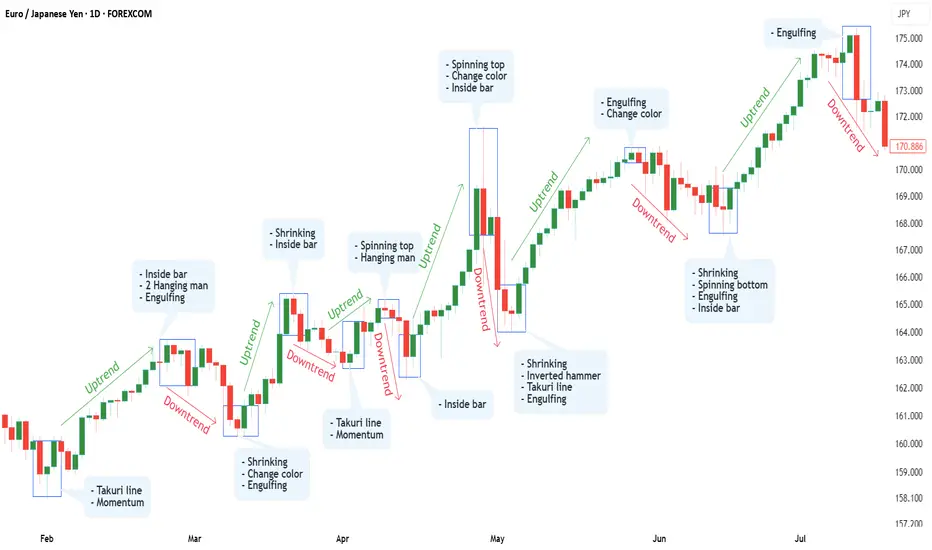
Candlesticks Tutorial – Part 2 | Uptrend Context
In this tutorial, we break down candlestick behavior specifically in an UPTREND context.
Same candlesticks — different meaning. The focus remains on probability, context, and confirmation, not pattern guessing.
You’ll learn how candlesticks behave when buyers are in control, how to read bullish intent, and how to avoid common beginner mistakes when trading candles without context.
🔍 Candlesticks in an Uptrend
Candlesticks represent the ongoing interaction between buyers and sellers.
In an uptrend, the key question is not “Is this candle bullish or bearish?” but:
Does this candle support continuation or warn of weakness?
📘 Candlestick Types Covered in This Tutorial (Uptrend)
📌 1) Shrinking Candlesticks
➡️ Shows loss of bullish momentum and possible pause or pullback — not an automatic reversal.
📌 2) Inside Bar Candlestick
➡️ Indicates consolidation within trend, often before continuation.
📌 3) Takuri Line Candlestick
➡️ Strong bullish rejection from support or pullback zone.
📌 4) Hanging Man Candle
➡️ Context is everything. In an uptrend, it warns of potential weakness — not an instant sell signal.
📌 5) Inverted Hammer
➡️ Shows buyer response after temporary downside pressure.
📌 6) Spinning Top Candle
➡️ Represents temporary indecision within bullish structure.
📌 7) Spinning Bottom Candle
➡️ Suggests hesitation after pullback — often seen before continuation.
📌 8) Engulfing Candle
➡️ Strong bullish momentum when aligned with trend and location.
📌 9) Momentum Candlestick
➡️ Large-bodied candle showing aggressive buying participation.
📌 10) Change Color Candle
➡️ After a sequence of same-colored candles, a color change may signal momentum pause or shift.
🧠 Best Practice
Candlesticks should be read as clusters and sequences, not isolated signals.
This tutorial focuses on how candles stack together within an uptrend to tell a complete story.
⚠️ Important Note
Candlesticks alone are NOT enough.
They must be combined with:
→ Support & Resistance
→ Areas of Confluence
→ Chart Patterns
→ Trendlines
→ Indicators
→ Other high-quality traits
This is how high-probability setups are built.
👍 What’s Next?
Part 3 will focus on ranging markets — where most traders lose money by trading candlesticks the wrong way.
Follow if you want to catch Part 3 when it’s released.
⚠️ DISCLAIMER
This content is for educational purposes only and does not constitute financial advice.
Trading involves risk — always conduct your own analysis.
I am not responsible for any decisions or losses based on this material.
In this tutorial, we break down candlestick behavior specifically in an UPTREND context.
Same candlesticks — different meaning. The focus remains on probability, context, and confirmation, not pattern guessing.
You’ll learn how candlesticks behave when buyers are in control, how to read bullish intent, and how to avoid common beginner mistakes when trading candles without context.
🔍 Candlesticks in an Uptrend
Candlesticks represent the ongoing interaction between buyers and sellers.
In an uptrend, the key question is not “Is this candle bullish or bearish?” but:
Does this candle support continuation or warn of weakness?
📘 Candlestick Types Covered in This Tutorial (Uptrend)
📌 1) Shrinking Candlesticks
➡️ Shows loss of bullish momentum and possible pause or pullback — not an automatic reversal.
📌 2) Inside Bar Candlestick
➡️ Indicates consolidation within trend, often before continuation.
📌 3) Takuri Line Candlestick
➡️ Strong bullish rejection from support or pullback zone.
📌 4) Hanging Man Candle
➡️ Context is everything. In an uptrend, it warns of potential weakness — not an instant sell signal.
📌 5) Inverted Hammer
➡️ Shows buyer response after temporary downside pressure.
📌 6) Spinning Top Candle
➡️ Represents temporary indecision within bullish structure.
📌 7) Spinning Bottom Candle
➡️ Suggests hesitation after pullback — often seen before continuation.
📌 8) Engulfing Candle
➡️ Strong bullish momentum when aligned with trend and location.
📌 9) Momentum Candlestick
➡️ Large-bodied candle showing aggressive buying participation.
📌 10) Change Color Candle
➡️ After a sequence of same-colored candles, a color change may signal momentum pause or shift.
🧠 Best Practice
Candlesticks should be read as clusters and sequences, not isolated signals.
This tutorial focuses on how candles stack together within an uptrend to tell a complete story.
⚠️ Important Note
Candlesticks alone are NOT enough.
They must be combined with:
→ Support & Resistance
→ Areas of Confluence
→ Chart Patterns
→ Trendlines
→ Indicators
→ Other high-quality traits
This is how high-probability setups are built.
👍 What’s Next?
Part 3 will focus on ranging markets — where most traders lose money by trading candlesticks the wrong way.
Follow if you want to catch Part 3 when it’s released.
⚠️ DISCLAIMER
This content is for educational purposes only and does not constitute financial advice.
Trading involves risk — always conduct your own analysis.
I am not responsible for any decisions or losses based on this material.

Related publications
Disclaimer
The information and publications are not meant to be, and do not constitute, financial, investment, trading, or other types of advice or recommendations supplied or endorsed by TradingView. Read more in the Terms of Use.
Related publications
Disclaimer
The information and publications are not meant to be, and do not constitute, financial, investment, trading, or other types of advice or recommendations supplied or endorsed by TradingView. Read more in the Terms of Use.