
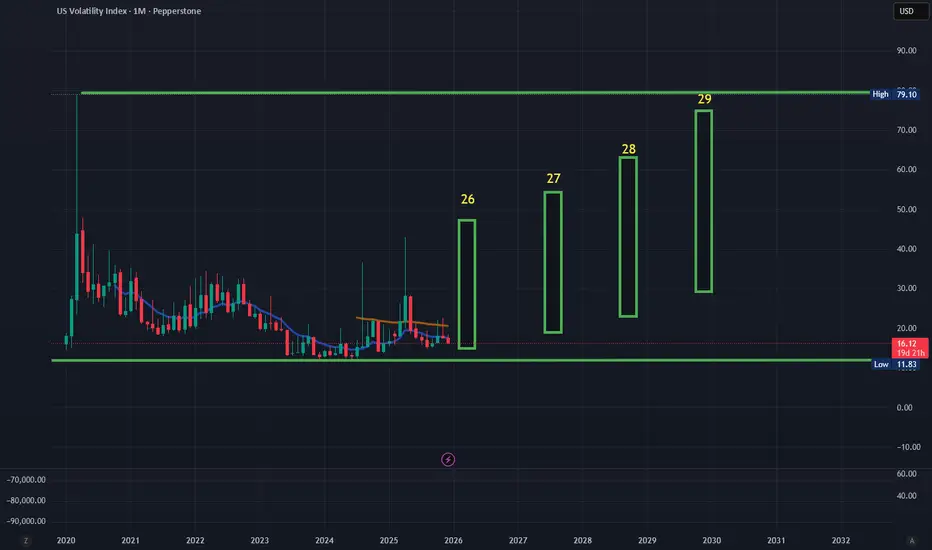
This idea is based on a long-term structural expansion in volatility, driven by escalating geopolitical tensions, prolonged armed conflicts, and an increasingly fragile global order.
We are no longer in a short-cycle news-driven volatility environment. We are entering a regime shift where geopolitical risk becomes persistent rather than episodic.
Key macro drivers supporting this thesis:
Ongoing and unresolved wars increasing global uncertainty
Rising tension between major powers (military, economic, and technological)
Energy security risks and supply chain fragility
Weaponize of trade, sanctions, and financial systems
Increased defense spending and polarization across regions
Historically, periods like this do not resolve quickly. They compound. Volatility compresses, resets, and then expands in higher steps over time.
Technical Context
From a technical perspective, volatility is currently trading near long-term structural lows, an area that historically precedes multi-year expansions. Similar compression phases in the past were followed by aggressive volatility repricing once macro stress surfaced.
The projected zones represent potential volatility expansion cycles, not linear moves. Volatility tends to spike, retrace, and then re-price higher as systemic risks accumulate.
This is not a short-term trade — it is a macro positioning thesis aligned with structural risk buildup.
Why This Matters
Markets are still pricing in mean reversion and conflict normalization. This idea assumes the opposite:
prolonged instability is becoming the baseline.
Volatility is under priced relative to geopolitical reality.
When uncertainty becomes structural, volatility stops being a hedge — it becomes an asset.
Risk Note
This idea assumes continued geopolitical deterioration or instability. A rapid global de-escalation or coordinated diplomatic resolution across major conflicts would invalidate the thesis.
We are no longer in a short-cycle news-driven volatility environment. We are entering a regime shift where geopolitical risk becomes persistent rather than episodic.
Key macro drivers supporting this thesis:
Ongoing and unresolved wars increasing global uncertainty
Rising tension between major powers (military, economic, and technological)
Energy security risks and supply chain fragility
Weaponize of trade, sanctions, and financial systems
Increased defense spending and polarization across regions
Historically, periods like this do not resolve quickly. They compound. Volatility compresses, resets, and then expands in higher steps over time.
Technical Context
From a technical perspective, volatility is currently trading near long-term structural lows, an area that historically precedes multi-year expansions. Similar compression phases in the past were followed by aggressive volatility repricing once macro stress surfaced.
The projected zones represent potential volatility expansion cycles, not linear moves. Volatility tends to spike, retrace, and then re-price higher as systemic risks accumulate.
This is not a short-term trade — it is a macro positioning thesis aligned with structural risk buildup.
Why This Matters
Markets are still pricing in mean reversion and conflict normalization. This idea assumes the opposite:
prolonged instability is becoming the baseline.
Volatility is under priced relative to geopolitical reality.
When uncertainty becomes structural, volatility stops being a hedge — it becomes an asset.
Risk Note
This idea assumes continued geopolitical deterioration or instability. A rapid global de-escalation or coordinated diplomatic resolution across major conflicts would invalidate the thesis.

Disclaimer
The information and publications are not meant to be, and do not constitute, financial, investment, trading, or other types of advice or recommendations supplied or endorsed by TradingView. Read more in the Terms of Use.
Disclaimer
The information and publications are not meant to be, and do not constitute, financial, investment, trading, or other types of advice or recommendations supplied or endorsed by TradingView. Read more in the Terms of Use.