From Mystery to Mastery: Futures ExplainedIntroduction: The World of Futures
Few markets capture the essence of trading like futures. They are instruments that link commodities, currencies, interest rates, and equity indexes into one unified marketplace. For traders, this means access to global opportunities and true diversification in a single product class.
At first, futures may appear intimidating: leverage, margin requirements, expiration dates, and contract rolls all add layers of complexity. Yet these same features are what make futures powerful. They allow traders to express views on global markets with efficiency and precision.
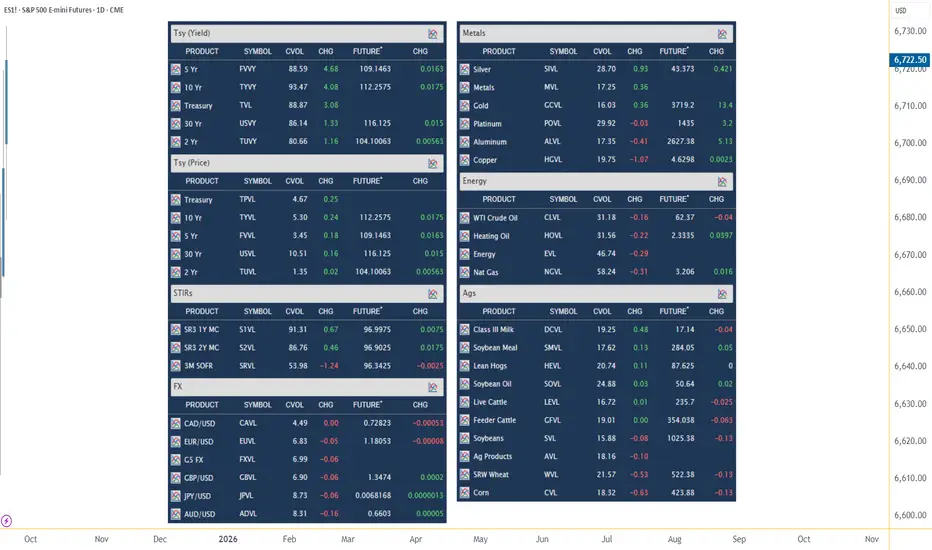
The main chart above — a table of major futures contracts across asset classes — makes one thing immediately clear: futures aren’t about trading just one market. They’re about trading them all. Whether you want exposure to equities (S&P 500, Nasdaq), commodities (crude oil, gold, corn), currencies (euro, yen, bitcoin), or interest rates (Treasuries, Eurodollars), futures provide a standardized, transparent, and centralized way to do so.
This breadth is why professionals rely on futures: they allow traders to balance risk across multiple sectors, hedge portfolios, and capture opportunities wherever they appear. For those looking to go beyond single-market thinking, futures open the door to true diversification.
What Are Futures?
At their core, futures are standardized agreements to buy or sell an asset at a specified price on a future date. While the concept sounds simple, the structure behind these contracts makes them unique among trading instruments.
Key Characteristics
Standardization: Each futures contract is standardized in terms of size, tick value, and expiration cycle. This standardization ensures transparency and liquidity.
Centralized Trading: Futures are traded on regulated exchanges, which reduces counterparty risk. Clearing houses guarantee that both sides of the trade meet their obligations.
Settlement: Some futures are physically settled (e.g., certain commodities), while others are cash-settled (e.g., equity index futures).
Standard vs. Micro Futures
Not all traders operate with the same account size. Recognizing this, exchanges introduced micro contracts.
Standard Contracts: Designed for institutional or larger retail traders, these carry higher notional values and margin requirements.
Micro Contracts: Smaller in size — often 1/10th of the standard — they allow traders to participate in the same markets with reduced exposure.
This tiered structure means that futures are accessible to traders of all levels. Whether someone wants to hedge a portfolio worth millions or test strategies with smaller risk, futures provide an efficient and scalable solution.
Futures are not just speculative instruments — they are risk-transfer mechanisms. Farmers, corporations, and investors all rely on them, which is why they remain at the heart of global finance.
The Mechanics of Futures Trading
Futures stand apart from other instruments because of how they embed leverage and daily settlement into every trade. These mechanics create both opportunity and responsibility for traders.
Leverage
Futures require only a fraction of the contract’s value — the margin — to open a position. This allows traders to control large notional values with relatively small capital. For example, a trader might only need a few thousand dollars in margin to manage exposure worth hundreds of thousands.
Advantage: Small price movements can translate into significant gains.
Risk: The same leverage can magnify losses just as quickly.
Margin and Daily Settlement
Unlike buying stocks outright, futures accounts are marked-to-market daily. This means:
Gains are credited to your account at the end of each session.
Losses are debited immediately.
If losses exceed available funds, a margin call requires the trader to deposit more capital or close the position.
Ticks and Point Values
Each futures contract has a minimum price movement called a tick, and each tick has a specific dollar value. Understanding tick value is essential for risk management — it tells you exactly how much you gain or lose with each price move.
Liquidity and Execution
Because contracts are standardized and exchange-traded, liquidity is often concentrated in a few active expirations (called “front months”). This ensures tight bid-ask spreads, but also means traders must roll positions forward as contracts near expiration.
Takeaway
The mechanics of futures amplify both efficiency and risk. Traders who respect leverage, understand margining, and monitor tick exposure can harness futures effectively. Those who overlook these mechanics, however, quickly discover how unforgiving futures can be.
Market Structure & Term Dynamics
One of the most fascinating — and misunderstood — aspects of futures trading is how contracts across different expirations reveal the market’s expectations. Unlike stocks, which represent a single price, futures unfold into a forward curve that tells a story about supply, demand, and sentiment.
Contango and Backwardation
Contango occurs when longer-dated contracts trade at higher prices than near-term ones. This often reflects storage costs, financing, or expectations of rising prices.
Backwardation happens when near-term contracts are more expensive than those further out, usually signaling scarcity or short-term demand pressure.
These structures aren’t static — they shift with economic conditions, inventory levels, and seasonal trends.
Seasonality
Many futures contracts display recurring patterns tied to the calendar. Agricultural futures respond to planting and harvest cycles, while energy markets often reflect seasonal consumption (e.g., heating oil demand in winter). Recognizing these cycles helps traders anticipate periods of heightened volatility.
Visualizing Structure and Seasonality
The below chart shows both a forward curve and seasonality patterns for a futures contract. Together, they highlight how futures pricing extends beyond the present moment:
• The forward curve reflects the market’s consensus outlook.
• Seasonality overlays historical tendencies, offering context for recurring patterns.
Why It Matters
Understanding term structure is vital for anyone holding positions across different expirations or engaging in spread trading. Futures aren’t just about today’s price — they’re about how markets evolve over time.
Applications of Futures
Futures are not just trading instruments; they are multipurpose tools that serve a wide spectrum of market participants. Their versatility explains why they sit at the center of global finance.
Directional Trading
Speculators use futures to express bullish or bearish views with efficiency. Leverage allows for significant exposure to price moves, making futures attractive for active traders seeking short-term opportunities.
Hedging Portfolios
Institutions, corporations, and even individual investors use futures to offset risks in other holdings.
An equity investor can hedge downside risk with stock index futures.
An airline can hedge rising fuel costs using energy futures.
A farmer can lock in prices for crops months before harvest.
Hedging is one of the foundational purposes of futures markets: transferring risk from those who wish to avoid it to those willing to accept it.
Spread Trading
Some traders don’t speculate on outright direction but instead on relationships between contracts. Examples include:
Calendar spreads: buying one expiration and selling another to trade the forward curve.
Intermarket spreads: trading related products, such as heating oil vs. crude oil, to capture relative value.
Diversification
The table shown earlier — featuring futures contracts across asset classes — demonstrates another application: diversification. Futures allow traders to move seamlessly between equities, commodities, currencies, and interest rates, building portfolios that respond to multiple market drivers instead of just one.
Takeaway
Whether for speculation, hedging, spreads, or diversification, futures adapt to the needs of a wide range of traders. Their applications extend well beyond simple directional bets, offering structured ways to manage both risk and opportunity.
Risk Management with Futures
The power of futures lies in their leverage and efficiency — but that same power can work against traders who fail to respect risk. Effective risk management is not optional; it is the foundation of survival in futures markets.
Position Sizing with Leverage
Every tick has a dollar value, and with leverage, even small moves can produce large swings in account equity. Proper position sizing ensures that a single move doesn’t exceed acceptable risk tolerance. A common approach is to size positions so that a stop-loss hit represents no more than 1–2% of account capital.
Margin Calls and Volatility Exposure
Because accounts are marked-to-market daily, losses are settled immediately. If losses exceed available funds, the trader faces a margin call — forcing them to either deposit additional capital or close positions. This mechanism protects the system but punishes overleveraged traders quickly.
Diversification as a Risk Tool
The futures contracts table highlighted at the top illustrates how diversification itself can be a form of risk management. A trader holding positions across equity, energy, and agricultural futures is likely less vulnerable to a single market shock than someone concentrated in one asset class.
Stop-Losses and Technical Reference Points
Using support, resistance, or UFO zones to anchor stop-loss levels ensures that exits are based on market structure rather than arbitrary distances. This provides logic to risk management instead of guesswork.
The Core Principle
Risk in futures is never eliminated — it is managed. By combining proper position sizing, diversification, and disciplined use of stops, traders can survive volatility long enough to let their edge play out.
Case Study: Applying Structure in Futures
To see how futures amplify both opportunity and risk, let’s walk through a structured trade in the 6E (Euro FX Futures) market.
Setup
Entry: 1.1468
Stop-Loss: 1.1376
Target: 1.17455
Confirmed by UFO support zone, SMA ribbon trend alignment, and candlestick reaction.
Risk and Reward in Price Terms
Risk per contract = Entry – Stop = 1.1468 – 1.1376 = 0.0092 (92 pips).
Reward per contract = Target – Entry = 1.17455 – 1.1468 = 0.02775 (277.5 pips).
Reward-to-Risk Ratio (R:R) = 277.5 ÷ 92 ≈ 3.0
This trade carries roughly a 3:1 reward-to-risk ratio, a structure many traders aim for.
P&L in Dollar Terms (6E Futures)
Each tick in 6E = 0.00005 = $6.25.
Risk (0.0092 ÷ 0.00005 = 184 ticks): Dollar risk = 184 × $6.25 = $1,150 per contract.
Reward (0.02775 ÷ 0.00005 = 555 ticks): Dollar reward = 555 × $6.25 = $3,468 per contract.
Margin and Return on Margin
Initial margin for 6E is typically in the range of a few thousand dollars (varies by broker and volatility).
Assuming margin is $2,500 per contract, this trade structure would imply a potential loss of $1,150 ≈ 46% of margin or a potential gain of $3,468 ≈ 139% of margin.
It’s critical to highlight that return on margin is not the same as return on account balance. A trader may have $50,000 in their account but only post $2,500 margin per contract. While the trade may show a 139% return on margin, the return on the entire account would be far smaller.
Takeaway
This example shows how futures transform price movements into significant dollar impacts. With leverage, a well-structured trade can deliver powerful gains, but the same leverage means poor risk control can erode capital quickly. Mastery comes from respecting this scale, not chasing it.
Practical Considerations
Even with a solid framework and strong risk management, futures trading has nuances that shape how trades play out in real life.
Trading Sessions and Liquidity
Futures trade nearly 24 hours a day, but liquidity isn’t evenly distributed. The most active periods typically align with the opening hours of major financial centers:
European session: Currency and interest rate futures see heavier flow.
U.S. session: Stock index and commodity futures dominate.
Asian session: Liquidity thins, often leading to sharper moves on lighter volume.
Knowing when your product is most active helps improve order execution and reduce slippage.
Volatility Cycles
Markets expand and contract in volatility. Equity index futures often see bursts of activity at the cash open and close, while energy and agricultural contracts may spike around scheduled reports. Adjusting stop distances and position sizes for these cycles is essential.
Event-Driven Moves
Futures are highly sensitive to macroeconomic and geopolitical events. Examples include:
Nonfarm payrolls shaking currency and index futures.
FOMC decisions moving rates and equity products.
Crop reports swinging agricultural markets.
OPEC meetings shifting energy futures.
For short-term traders, being aware of the calendar is as important as reading a chart. A well-structured trade can still fail if caught on the wrong side of an event-driven move.
Rolls and Expirations
Because futures expire, traders holding positions beyond front-month liquidity must roll contracts into later expirations. This roll process can impact pricing, particularly when term structure (contango or backwardation) is steep.
Bottom Line
Practical mastery comes from understanding not just the trade setup, but also the context in which it plays out. Futures reward preparation and punish oversight — especially around sessions, events, and expiration cycles.
Conclusion: Futures as a Path to Mastery
Futures can seem overwhelming at first glance — with leverage, margining, expiration dates, and shifting forward curves, they feel far more complex than simply buying or selling shares. But behind the layers of complexity lies a simple truth: futures are among the most versatile tools in finance.
In this guide, we’ve seen how futures:
Provide access to multiple asset classes, enabling true diversification.
Embed leverage that magnifies both opportunity and risk.
Reveal market expectations through forward curves and seasonality.
Support applications ranging from speculation to hedging and spread trading.
Demand structured risk management, since dollar impacts are amplified.
The case study showed how even one structured trade can transform when executed through futures. Defined entries, stops, and targets remain the same, but leverage changes the scale of both outcomes and responsibilities.
Futures trading is not about eliminating uncertainty. It is about engaging with markets in a disciplined way — using diversification, structure, and risk control to transform potential chaos into calculated opportunity.
This article is the second step in the From Mystery to Mastery series. Having laid the foundation in Trading Essentials and expanded into futures here, the journey continues next into the world of options, where versatility and complexity reach an even higher level.
From Mystery to Mastery trilogy:
When analyzing futures markets, keep in mind that some chart data may be delayed. The examples in this article highlight how futures can be applied across asset classes, from equities and currencies to commodities and interest rates — many of which are listed on CME Group exchanges. For traders who require real-time access to these products on TradingView, a dedicated CME Group real-time data plan is available here: www.tradingview.com . This is especially useful for shorter-term futures traders who rely on intraday precision, while longer-term participants may not find the same urgency in upgrading.
General Disclaimer:
The trade ideas presented herein are solely for illustrative purposes forming a part of a case study intended to demonstrate key principles in risk management within the context of the specific market scenarios discussed. These ideas are not to be interpreted as investment recommendations or financial advice. They do not endorse or promote any specific trading strategies, financial products, or services. The information provided is based on data believed to be reliable; however, its accuracy or completeness cannot be guaranteed. Trading in financial markets involves risks, including the potential loss of principal. Each individual should conduct their own research and consult with professional financial advisors before making any investment decisions. The author or publisher of this content bears no responsibility for any actions taken based on the information provided or for any resultant financial or other losses.
Margin
Leverage Your Way to Trading SuccessGood morning traders!
Today we're breaking down one of the most powerful yet misunderstood concepts in trading - leverage and margin. Think of this like the gym; leverage is your workout equipment, allowing you to lift more than you could with just your body weight. Margin, on the other hand, is like your gym membership fee; it's what you pay to access that equipment.
Understanding Leverage and Margin
-Leverage: In trading, leverage is about using a small amount of capital to control a much larger position. It's like using a barbell - it amplifies your strength, but if you're not careful, you can hurt yourself.
-Margin: This is the initial deposit required to borrow the "barbell." It's your skin in the game, ensuring you don't just run off with the equipment without working out.
The Power of Leverage
-Amplified Returns: Just like lifting weights can give you bigger muscles faster, leverage can significantly increase your returns if the market moves in your favor.
-Access to Bigger Plays: With leverage, you can dive into opportunities that would otherwise be out of your financial reach, like taking on a much heavier weight than you could lift solo.
The Risks You Must Navigate
-Magnified Losses: Here's where the gym analogy gets real - if you drop that heavy barbell, you're going to feel it. In trading, leverage can make small losses big ones if the market goes against you.
-Margin Calls: If your account balance dips below the required level, it's like the gym calling you to say, "Hey, you need more money for that membership!" You either add funds or have to stop using the equipment (close positions).
-The Temptation to Overdo It: Just like in the gym, where you might want to lift too much too soon, in trading, leverage can tempt you to overtrade, leading to exhaustion or injury (financial losses).
How to Lift with Leverage Smartly
-Set Stop-Loss Orders: This is like having a spotter in the gym. Decide beforehand how much weight (loss) you can handle before you need help (exit the trade).
-Only Use What You Can Afford to Lose: Never work out with weights that could crush you if they fall. Only use leverage on money you're prepared to part with.
-Know Your Limits: Understand how much margin you need to keep your positions open without getting a surprise bill from the gym.
-Position Sizing: Start small, like beginning with lighter weights before moving to the heavy stuff. Even with leverage, manage your trade sizes wisely.
-Keep Educating Yourself: Just as you'd learn new exercises or techniques in the gym, keep learning about markets and trading strategies.
A Gym Session Example
Imagine you've got $1,000 to invest, but with leverage, it's like you're trading with $10,000. If the market moves up by 5%, you're not just making a small profit; you're looking at a 50% return on your initial investment. But if it drops by 5%, you're facing a 50% loss, which could knock you out of the gym if you're not ready.
Wrapping Up
Leverage and margin are like your gym gear - they can make you stronger but only if used correctly.
If you're struggling to understand this concept, send me a DM - more than happy to help. If this article helped you, please boost, share, and comment; I truly appreciate it.
Kris/Mindbloome Exchange
Trade What You See
Understanding Trading Leverage and Margin.When you first dive into trading, you’ll often hear about leverage and margin . These two concepts are powerful tools that can amplify your profits, but they also come with significant risks. The image you've provided lays out the essentials of leverage and margin: Leverage allows traders to control larger positions, Margin acts as a security deposit, Profit Amplification boosts potential gains, and Risk Amplification warns of increased losses.
In this article, we’ll break down these terms and explore how leverage and margin work, their advantages and risks, and what to consider before using them in your trading strategy.
What is Leverage in Trading?
Leverage is essentially a loan provided by your broker that allows you to open larger trading positions than your actual account balance would otherwise allow. It’s a tool that can multiply the value of your capital, giving you the potential to make more money from market movements without needing to invest large sums of your own money.
Think of leverage as “financial assistance.” With leverage, even a small amount of capital can control a larger position in the market. This can lead to amplified profits if the trade goes your way. However, it’s a double-edged sword; leverage can also lead to amplified losses if the trade moves against you.
Example of Trading with Leverage
Suppose you have €100 in your trading account and your broker offers a leverage of 1:5. This means you can control a position worth €500 with your €100 investment. If the market moves in your favor, your profits will be calculated based on the €500 position, not just the €100 you originally invested. However, if the market moves against you, your losses will also be based on the larger amount.
What is Margin in Trading?
Margin is the amount of money you must set aside as collateral to open a leveraged trade. When you use leverage, the broker requires a deposit to cover potential losses—this is called margin. Margin essentially acts as a security deposit, ensuring that you can cover losses if the trade doesn’t go as planned.
Margin is usually expressed as a percentage of the total trade size. For example, if a broker requires a 5% margin to open a position, and you want to open a €1,000 trade, you would need to deposit €50 as margin.
How Does Margin Work?
Margin works together with leverage. The margin required depends on the leverage ratio offered by the broker. For instance, with a 1:10 leverage, you’d only need a 10% margin to open a position, while a 1:20 leverage would require a 5% margin.
If the market moves against your position significantly, your margin level can drop. If it falls too low, the broker may issue a **margin call**, requesting additional funds to maintain the trade. If you don’t add funds, the broker might close your position to prevent further losses, which could lead to a loss of the initial margin amount.
How Does Leveraged Trading Work?
Leveraged trading involves borrowing capital from the broker to increase the size of your trades. This allows you to open larger positions and potentially gain higher profits from favorable market movements.
Here’s a simplified process of how it works:
1. Deposit Margin: You set aside a portion of your own funds (margin) as a security deposit.
2. Leverage Ratio Applied: The broker provides you with additional capital based on the leverage ratio, increasing your trading power.
3. Open Larger Positions: You can now open larger trades than you could with just your capital.
4. Profit or Loss Magnified: Any profit or loss from the trade is amplified, as it’s based on the larger position rather than just your initial capital.
While leverage doesn’t change the direction of your trades, it affects how much you gain or lose on each trade. That’s why it’s essential to understand both the potential for profit amplification and the risk amplification that leverage brings.
The Benefits and Risks of Using Leverage
Benefits of Leverage
- Profit Amplification: With leverage, you can control larger trades, which means any favorable movement in the market can lead to greater profits.
- Capital Efficiency: Leverage allows you to gain exposure to the markets without needing to invest a large amount of your own money upfront.
- Flexibility in Trading: Leveraged trading gives traders more flexibility to diversify their positions and take advantage of multiple opportunities in the market.
Risks of Leverage
- Risk Amplification: Just as leverage can amplify profits, it also amplifies losses. If a trade moves against you, your losses can be substantial, even exceeding your initial investment.
- Margin Calls: If the market moves significantly against your leveraged position, you may face a margin call, requiring you to add more funds to your account to keep the position open.
- Rapid Account Depletion: High leverage means that small market moves can have a big impact on your account. Without careful management, you could deplete your account balance quickly.
Important Considerations for Leveraged Trading
1. Understand the Leverage Ratio: Different brokers offer various leverage ratios, such as 1:5, 1:10, or even 1:100. Choose a leverage ratio that aligns with your risk tolerance. Higher leverage ratios mean higher potential profits but also higher potential losses.
2. Know Your Margin Requirements: Always be aware of the margin requirements for your trades. Brokers may close your positions if your margin level drops too low, so it’s essential to monitor your margin balance regularly.
3. Risk Management is Key: Use risk management strategies like stop-loss orders to limit potential losses on each trade. Don’t risk more than a small percentage of your account balance on any single trade.
4. Avoid Overleveraging: One of the biggest mistakes new traders make is using too much leverage. Start with a lower leverage ratio until you’re more comfortable with the risks involved in leveraged trading.
5. Only Use Leverage if You Understand It: Leveraged trading is suitable primarily for experienced investors who understand the market and the risks involved. If you’re new to trading, practice with a demo account to learn how leverage works before applying it in a live account.
Final Considerations
Leverage and margin are powerful tools in trading that can amplify profits, but they come with considerable risk. Using leverage wisely and understanding margin requirements are essential to avoid unnecessary losses and protect your account. While the prospect of profit amplification is attractive, traders should always remember that leveraged trading is a double-edged sword—it can lead to significant gains, but it can also result in rapid account depletion if not managed carefully.
To summarize:
- Leverage allows you to control larger trades with a small investment, multiplying both potential profits and potential losses.
- Margin is the deposit required to open a leveraged trade and acts as a security against potential losses.
- Use leverage responsibly and only after understanding the risks involved.
Leverage can be a valuable tool in trading if used wisely, so make sure to educate yourself, practice with a demo account, and always approach leveraged trading with caution.
[EDU-Bite Sized Mini Series]Margin? Lots? Spread? What are they?Hello fellow traders , my regular and new friends!
Welcome and thanks for dropping by my post.
Today we are going to cover terms such as Margin, Lot size, Spread and What are they.
Forex trading is a dynamic and potentially lucrative endeavor, but it comes with its own set of terminology and jargon that can be intimidating for beginners. Understanding these terms is crucial for aspiring traders to navigate the forex market effectively and make informed decisions.
Margin
One of the fundamental concepts in forex trading is margin, which refers to the amount of money required to open and maintain a trading position. Margin allows traders to control larger positions with a relatively small amount of capital, amplifying both potential profits and losses. It's important for traders to understand margin requirements and manage their leverage carefully to avoid excessive risk.
Lot Size
Another key concept is lots, which represent the size of a trading position in forex. Standard lots typically consist of 100,000 units of the base currency, while mini lots and micro lots represent 10,000 and 1,000 units, respectively. Lot size determines the potential profit or loss of a trade, with larger lots leading to greater fluctuations in account equity. If you are more comfortable with smaller lot size, you can even go on to nano lots in 100 unit of currency.
Spread
Spread is another term commonly used in forex trading, referring to the difference between the bid and ask prices of a currency pair. The bid price is the price at which traders can sell a currency pair, while the ask price is the price at which they can buy it. The spread represents the cost of executing a trade and can vary depending on market conditions and liquidity.
There are different types of spreads encountered in forex trading, including fixed spreads and variable spreads. Fixed spreads remain constant regardless of market conditions, providing traders with certainty about trading costs. On the other hand, variable spreads fluctuate in response to market volatility, widening during times of high activity and narrowing during periods of low activity.
Understanding these trading terms and jargon is essential for beginners to develop a solid foundation in forex trading. By mastering concepts such as margin, lots, spread, and different types of spreads, aspiring traders can make more informed decisions and effectively manage their risk in the dynamic and fast-paced world of forex.
Do check out my recorded video (in trading ideas) for the week to have more explanation in place.
Do Like and Boost if you have learnt something and enjoyed the content, thank you!
-- Get the right tools and an experienced Guide, you WILL navigate your way out of this "Dangerous Jungle"! --
*********************************************************************
Disclaimers:
The analysis shared through this channel are purely for educational and entertainment purposes only. They are by no means professional advice for individual/s to enter trades for investment or trading purposes.
*********************************************************************
How Leverage Really Works | Margin Trading Explained
Leveraged trading allows even small retail traders to make money trading different financial markets.
With a borrowed capital from your broker, you can empower your trading positions.
The broker gives you a multiplier x10, x50, x100 (or other) referring to the number of times your trading positions are enhanced.
Brokers offer leverage at a cost based on the amount of borrowed funds you’re using and they charge you per each day that you maintain a leveraged position open.
For example, let's take EURUSD pair.
Let's buy Euro against the Dollar with the hope that the exchange rate will rise.
Buying that on spot with 1.195 ask price and selling that on 1.23 price we can make a profit by selling the same amount of EURUSD back to the broker.
With x50 leverage, our return will be 50 times scaled.
With the leverage, we can benefit even on small price fluctuations not having a huge margin.
❗️Remember that leverage will also multiply the potential downside risk in case if the trade does not play out.
In case of a bearish continuation on EURUSD , the leveraged loss will be paid from our margin to the broker.
For that reason, it is so important to set a stop loss and calculate the risks before the trading position is opened.
Let me know, traders, what do you want to learn in the next educational post?
Don't Blow Your Account | Learn How to Avoid Margin Call
Hey traders,
In this educational article, I will share with you 5 simple tips that will help you not to blow your trading.
1️⃣Always Use Stop Loss.
Let's start with the obvious - with the stop loss order.
Never ever trade without that. Before you open your trade, plan in advance its placement, stick to it once the position becomes active and never remove it.
2️⃣ Manage Your Position Sizes
I know that most of you are trading with a fixed lot. That is a bad habit. You should measure the lot size for each trading position you take. You should define in advance the risk percentage you are willing to lose per trade and calculate the lot sizes for your trades accordingly, then.
3️⃣Avoid Taking Too Many Positions
Remember that in trading, quantity does not imply quality. The more trades you take, the harder it is to manage each position individually. I would suggest opening maximum 5 trades per day and holding no more than 8 trades simultaneously.
4️⃣ Avoid Trading Too Many Markets
The wider is your watch list, the harder it is to focus on each individual element inside. Do not try to control as many markets as possible, instead, narrow your watch list and concentrate your attention on your favourite trading instruments.
5️⃣Remember About Volatility
The more volatile is the market that you trade, the harder it is to trade it and the bigger stop losses you need to keep your positions safe. Remember, that the volatility is the double-edged sword. It can bring substantial profits, but it can also blow your entire account in a blink of an eye.
Following these 5 simple rules, you will make your trading much safer. Study them and add them in your trading plan.
❤️Please, support my work with like, thank you!❤️
What Every Trader Should Know About Margin
Margin can be a powerful tool to leverage your investment returns or to finance purchases apart from your portfolio.
Margin is an extension of credit from a brokerage firm using your own eligible securities as collateral. Most traders typically use margin as a means to purchase additional securities, but there are other uses too. Interest is charged on the borrowed funds for the period of time that the loan is outstanding.
Benefits of a Margin Trading Account:
Use the cash or securities in your account as leverage to increase your buying power.
Get the lowest market margin loan interest rates of any broker.
Diversify trading strategies with short selling, options and futures contracts, or currency trading.
Borrow against a margin account at any time and repay the loan on your own schedule.
Margin borrowing is only for experienced investors with high risk tolerance. You may lose more than your initial investment.
Before trading on margin, understand the following risks:
Trading losses may be greater than the value of the initial investment
Leveraged investments create a greater potential risk of loss
Additional costs from margin interest charges
Potential margin calls or liquidation of securities
Hey traders, let me know what subject do you want to dive in in the next post?
QA WHAT is a Margin Call? QA: What is a Margin Call?
You don't want this.
It's an automatic instruction to close out your trade/s when you have insufficient funds in your portfolio.
This is a safety mechanism for both you and your broker.
It's also where either your trading platform, your broker or an automatic message via email will tell you to either deposit more funds into your account, close your trades or will warn you that your positions will be automatically closed.
*DO YOU HAVE ANY TRADING QUESTION?
Comment below or LIKE this post if you found it helpful.
I've been trading for the last 20 years and it's my hobby to help provide analyses and help traders get on the right foot.
I'm happy to have a platform like TradingView to do it :)
Trade well, live free.
Timon
MATI Trader
What is margin trading & How does it work?
Margin trading is when you pay only a certain percentage, or margin, of your investment cost, while borrowing the rest of the money you need from your broker.
Margin trading allows you to profit from the price fluctuations of assets that otherwise you wouldn’t be able to afford. Note that trading on margin can improve gains, but increases the risk and size of any potential losses.
But what is the margin in trading? There are two types of margins traders should be aware of. The money you need to open a position is your required margin. It’s defined by the amount of leverage you are using, which is represented in a leverage ratio.
There are also limits on keeping a margin trade running, which is based on your overall maintenance margin – the amount that needs to be covered by equity (overall account value).
Brokers require you to cover your margin by equity to mitigate risk. If you don’t have enough money to cover potential losses, you may be put on a margin call, where brokers would ask you to top up your account or close your loss-making trades. If your trading position continues to worsen you will face a margin closeout.
Hey traders, let me know what subject do you want to dive in in the next post?
Margin callWhen there are not enough available funds in your account to meet margin requirements, the broker issues you a warning, which is called a Margin Call.
Your broker automatically sends a margin call when your free margin reaches $0 and your margin level reaches 100%. From now on, it will be impossible to open new positions.
Thanks to leverage, traders get leverage that allows them to open positions that are several times larger than the size of their trading account. This helps to earn much more, but losses are also growing. It is at such moments, when you hold too large a position and the market goes against you, that you can get a margin call. This will trigger the automatic closing of all stop-out positions if the market continues to move against you.
An example of a margin call.
You open a forex trading deposit of $4000 and use a leverage of 1:100. As we know, the lot size on forex is equal to 100,000 units of the base currency ($ 100,000). When using the leverage of 1:100, you must deposit $ 1000 of your money as collateral for each open transaction in the amount of one lot.
After analyzing the EUR/USD currency pair, you decide that the price will rise. You open a long position for two standard lots at EUR/USD. This means that you are using $2,000 of your funds as collateral. At the same time, the free margin will also be $ 2000. The cost of one item when trading one lot of software will be equal to $ 10. This means that if the price drops by 200 points, the free margin will reach $ 0, the equity level will be equal to the margin used, and you get a margin call.
How can margin calls be avoided?
To avoid margin calls, you need to follow the rules of risk management. Before opening positions, you need to know where your stop loss will be and how much it will equal as a percentage of capital. The distance from your entry point to your stop loss should determine the size of your position and, accordingly, your risk level. Do not do the opposite: the size of your position should not determine the size of the stop loss.
You may have heard that it is not worth risking more than 5% of the capital in one transaction. Trading according to this rule is, of course, better than trading without rules, but an experienced trader will still say that it is too dangerous to risk 5%. Using the 5% rule, you can lose 20% of your capital in just 4 trades, which is too much.
The more money you lose, the more difficult it will be for you to return to the previous level of your trading capital. Serious drawdowns are also psychologically difficult for most novice traders. You may even start trading out of a desire to recoup and start opening even bigger positions to try to recoup your losses. But this will no longer be a trade, but a gambling game.
Never risk more than 2% of your trading account in any transaction. If you are just starting to trade forex, 1% risk will be even more appropriate. After you become confident in yourself and your trading strategy, you can slightly increase the size of your position. In any case, 5% is too much for most trading strategies. Even the best traders can make 4 or 5 losing trades in a row.
If you want to trade using large lots, you must have the appropriate amount of capital. This is the only safe way to trade for large amounts.
The number of positions you open at the same time determines your risk at any given time. If you risk only 2% of your trading account in one trade, do not think that you can open 10 positions at once — this is a sure way to get a margin call.
Even if you only open two positions, but you are trading correlated currencies, you are still risking 2% in one trade. An example of this could be a risk of 1% on a long EURUSD position and a simultaneous risk of 1% on a long GBPUSD position. If there is a sharp jump in the market due to the US dollar, you will receive a loss on two positions and lose 2%.
Therefore, try not to open multiple positions on correlating currency pairs, or at least be aware of the possible risks.
Traders, if you liked this idea or if you have your own opinion about it, write in the comments. I will be glad 👩💻
Why did I fail?How many traders do you think ask this question to themselves? Well, if we dig deeper into statistics, we’ll see that #1 reason differentiating successful traders from the rest 90%+ is proper use of margin and leverage. For every $50,000 in their account, most experienced forex traders and money managers trade one standard lot. If they traded a mini account, this indicates that for every $5,000 in their account, they trade one mini lot. Allow it to soak in for a couple of moments. Why do less experienced forex traders believe they can win by trading 100K standard lots with a $2,000 account or 10K micro lots with $250 if professionals trade like this? Never open a "regular account" with only $2,000 or a "micro account" with $250, no matter what the forex brokers tell you. Some even enable you to start an account for as little as $25! The number one reason rookie traders fail is because they are undercapitalized from the start and have a poor understanding of how leverage works.
However, this all also goes back to our previous lessons on figuring out what type of trader you are. For instance, we’re slightly more aggressive (and as our SL are usually extremely tight), we stick with 1% (which still allows us to open 2 lots for 50.000$). However, if you have hard time monitoring the trade or prefer to have more “breathing room” for a trade, consider 1 lot for 100.000$ of your trading capital.
All the best and stay safe, fam!
Spot Trading vs Margin Trading Pros and ConsSpot Trading is the most basic form of trading method and is the most suitable for beginners in trading. It's simply a BUY > HOLD > SELL mechanism.
On the Other Hand
Margin Trading is complicated and should only be done by experienced traders. There are various components to margin trading such as Maintenance margin, margin calls, leverage, and liquidation.
Pros and cons of Spot Trading
👉Spot trading is easy to learn and understand and is a good starting point for beginners in Trading.
👉It's an easy process to manage risk in spot trading not taking all the complications of liquidation or margin calls.
👉You can hold an asset for a much longer time and in the case of cryptocurrency can also transfer to any cold wallet.
👉No Trading happens during downtrends.
👉The potentials gains are not very good on a smaller investment amount.
Pros and cons of Margin Trading
👉Margin Trading needs some advanced knowledge of various things such as margin calls, liquidation, leverage, etc. Hence it's not recommended for new traders.
👉You can make profits on both uptrends(by going LONG) and downtrends(by going SHORT).
👉Gives an ability to trade much larger amounts with a relatively small initial investment by using leverage.
👉Margin Trading is risky, and if not done properly can blow your account in a very short time span.
👉Profits are higher when utilizing margin trading, and so are the losses. Every exchange has its own rules for margin trading, which need to be understood carefully before investing.
Thanks for reading and what kind of trading technique do you use and why? Share in the comments below.
For more similar educational ideas, scripts and trend analysis follow us.
Happy Trading.
📚 Leveraged & Margin Trading Guide + Examples ⚖️
Leveraged trading allows even small retail traders to make money trading different financial markets.
With a borrowed capital from your broker, you can empower your trading positions.
The broker gives you a multiplier x10, x50, x100 (or other) referring to the number of times your trading positions are enhanced.
Brokers offer leverage at a cost based on the amount of borrowed funds you’re using and they charge you per each day that you maintain a leveraged position open.
For example, let's take EURUSD pair.
Let's buy Euro against the Dollar with the hope that the exchange rate will rise.
Buying that on spot with 1.195 ask price and selling that on 1.23 price we can make a profit by selling the same amount of EURUSD back to the broker.
With x50 leverage, our return will be 50 times scaled.
With the leverage, we can benefit even on small price fluctuations not having a huge margin.
❗️Remember that leverage will also multiply the potential downside risk in case if the trade does not play out.
In case of a bearish continuation on EURUSD, the leveraged loss will be paid from our margin to the broker.
For that reason, it is so important to set a stop loss and calculate the risks before the trading position is opened.
❤️Please, support this idea with a like and comment!❤️
📚 Leveraged & Margin Trading Guide + Examples ⚖️
Leveraged trading allows even small retail traders to make money trading different financial markets.
With a borrowed capital from your broker, you can empower your trading positions.
The broker gives you a multiplier x10, x50, x100 (or other) referring to the number of times your trading positions are enhanced.
Brokers offer leverage at a cost based on the amount of borrowed funds you’re using and they charge you per each day that you maintain a leveraged position open.
For example, let's take EURUSD pair.
Let's buy Euro against the Dollar with the hope that the exchange rate will rise .
Buying that on spot with 1.195 ask price and selling that on 1.23 price we can make a profit by selling the same amount of EURUSD back to the broker.
With x50 leverage , our return will be 50 times scaled .
With the leverage, we can benefit even on small price fluctuations not having a huge margin.
❗️Remember that leverage will also multiply the potential downside risk in case if the trade does not play out.
In case of a bearish continuation on EURUSD, the leveraged loss will be paid from our margin to the broker.
For that reason, it is so important to set a stop loss and calculate the risks before the trading position is opened.
❤️Please, support this idea with a like and comment!❤️
Importance of Optimizing RSI Calibration with NINJASIGNALS V4This is a great example of why it is helpful to scan through multiple RSI Calibration values when calibrating Ninja Signals V4 to fit a given chart. Different currency pairs and candle sizes often require different RSI Calibration values to maximize trading success. Often times, different RSI Calibration values may result in a significantly higher net profit, win-ratio, or both. In this particular example, we found that using a small RSI Calibration value of 2 resulted in both a significantly higher net profit and win ratio. We typically use RSI Calibration values of 2-12 when fitting Ninja Signals V4 to a chart. Smaller RSI Calibration values result in a larger number and frequency of trades, whereas larger RSI Calibration values result in a smaller number and frequency of trades. We hope you find this helpful and informative. Feel free to send us a message on TradingView if you have any questions. Happy Trading!
Ninja Signals V4 (Script)
Ninja Signals V4 (Strategy)
Using Obscure Candle Sizes to Maximize Profit w/ NINJASIGNALS V4This is a great example of how effective a small change in candle size can be when using our Ninja Signals V4 trading script. By simply switching from 1h candles to 67m candles, we were able to achieve significantly better results. In theory, this will also help to minimize price slippage during live trading by avoiding popular candle sizes (e.g., 1h candles) when many traders attempt to open and close positions at the same bar close time.
A small adjustment in candle size can make a big difference when using various indicators. Sometimes standard candle sizes also result in less obvious trends, making it harder to find the best buy and sell points. If your target candle size is 1h candles, we recommend comparing all candle sizes from 40m through 100m in 1m increments (40m, 41m, 42m... ...98m, 99m, 100m, etc.). The small amount of time required often pays off with significantly better, more profitable results.
Ninja Signals V4 (Script)
Ninja Signals V4 (Strategy)
selby_exchange - Selby Margin Trading Rules v1.1Selby Margin Trading Rules 1.1
1.Trading Working Hours: 01:00UTC Monday thru 21:00UTC Friday take off all weekends and holidays. Only begin margin trading after 30 minutes of reviewing all instruments and timeframes.
2. Margin Forecasting: Charts are built on the 11/15min. using data from Heikin Ashi candle wicks. Identify entry/exit on the 1,2,3min. chart using moving average crossover intersections based on the Fibline Glance indicator set to: 100,100,0.1,40,0.1
3. Risk management: Maximum leverage on any position long or short is 70X. The position size should be based on weekly "working capital" and not total life savings. Formula for position size is a 5X position can use up to 95% and a 70X position can use up to 30%.
4. Enter limit order long/short and then set limit exit to take profit (TP) at the next short term Fibonacci level. Moving average crossovers in higher timeframes 14,21,33,48min. the 1-6hr. and 1day will confirm market direction for successful trade.
5. "THINGS TO AVOID" Greed - Bragging - FOMO
6. -2%-20% RULE: Always close negative positions. Look for a retrace opportunity to exit but if trade falls below (-2% on a 5X) or (-20% on a 70X) for more then 30min. set a stop loss limit order to prevent loss of time and a potential liquidation.
7. 60/40 Split: To maximize margin profit, stay out while awaiting confirmation of market direction, the entry must be caught at the Fib. Think/Chart 3-steps ahead, do not rush yourself into a position. Wait a few minutes between entry/exit. "3-Strikes" If you have three bad trades during the workday stop for 24hrs.
8. (TP) TAKE PROFIT: Cash-out at the end of the week into btc/fiat and pull 10% of net gains out of cyberspace forever. Work as long as you like on any day during the week, but remember not every day of the work week is always a good trading day.
Selby finding creative patterns in charts on Tradingview
Not advice for investing, but I am one to watch
Rebellion=Change=Future
Trading With MarginI’m Markus Heitkoetter and I’ve been an active trader for over 20 years.
I often see people who start trading and expect their accounts to explode, based on promises and hype they see in ads and e-mails.
They start trading and realize it doesn’t work this way.
The purpose of these articles is to show you the trading strategies and tools that I personally use to trade my own account so that you can grow your own account systematically.
Real money…real trades.
Let’s talk about trading with margin. What is margin? Who should trade with it? Should YOU be trading with it?
You see, when used correctly, margin can be your best friend, but when used incorrectly, it can be a disaster.
Leverage is a double-edged sword, and it can work for you as well as against you.
This is why I want to show you the responsible way to trade on margin. So let’s get.
What IS Margin?
So first off, what the heck is margin?
Well, when opening a trading account, you can open a cash account or a margin account, but what is the difference between the two?
With a cash account, if you put $10,000 into the cash account, it means that you have $10,000 in buying power, meaning that you can buy stocks and options for $10,000.
Now, when you have a margin account, the difference is when you’re putting $10,000 in cash in there, the broker will actually lend you another $10,000. So in total, you’re getting $20,000 in buying power.
How To Open A Margin Account
This is how you open a margin account, with tastyworks because this is the broker that I personally use, & I have four active accounts with them.
So when you go to tastyworks, it asks what kind of account do you want to open?
Is it an individual account, an entity/trust, or a joint account?
Then they will want to know what kind of account you want to open.
Do you want to open a margin, cash, or retirement account?
So with a cash and retirement account, this is where the broker does not lend you money.
So whatever cash you have in there, this is what you have in buying power.
However, when you use a margin account, you’re getting 2:1 buying power.
Buying Power: Stock vs Options
When it comes to buying power, there are two things that you need to know.
First is there is buying power for options, and buying power for options is always non-leveraged.
So if you put $10,000 in cash, even in a margin account, it means that you have $10,000 in buying power for options, and I’ll explain to you in a moment why that is.
And then we also have buying power for stocks, and here this is where margin kicks in.
So $10,000 in cash will give you $20,000 in buying power for buying stocks.
There’s also something called portfolio margin, and we will talk about this in just a moment, but I first want to show you exactly what it means here to have the buying power for options and to have the buying power for stocks.
How To Use Margin The Right Way
So I want to give you here a very specific example for Apple AAPL , and we first want to look at what happens if you want to sell, while trading The Wheel.
So let’s just say that you want to sell the 125 put for AAPL .
What does that mean?
It means that if you’re selling the put, you might be forced to buy AAPL at $125 a share, and for each put option that you’re selling, you would have to buy 100 shares of AAPL .
So this means that you would have to bring $12,500 to the table per contract, right?
Now here’s the deal. When you’re selling options, the broker is already giving you a discount.
So let’s see how much the broker is charging us if we want to sell a 125 put for AAPL .
So for AAPL I’m just choosing next week’s expiration because at this point the expiration and the price don’t matter right now, because all I want to show you is how much buying power is needed if I were to sell 1 put.
So the buying power that will be reduced from your options is $2,202.
So as you can see, if you are buying AAPL at 125, you would have to bring $12,500 to the table, but here the broker is only charging you $2,202.
Now again, we want to assume a $10,000 account because this is what many people are starting with.
So on a $10,000 account, theoretically, you could sell 4 of these options, and for this, if we are doing this, and edit our order to sell 4, we see that the broker will charge you $8,783.
So on a $10,000 account, at first it seems that you have enough margin for this. Wrong! Don’t do that!
So this is where we talk about the responsible way and the irresponsible way to do this.
So when you do this, this would be irresponsible. So here is what I think you should do.
Remember, on a $10,000 account, you’re actually getting $20,000 in buying power for buying stocks.
So you have $20,000 for buying stocks, so if you are selling one option, and you would get assigned, then you would have to buy stocks for $12,500 and you still have $7,500 left, right?
This is why you should only sell one option, even though your broker will only charge you $2,205 because if you’re assigned, you would have to bring $12,500 to the table.
The good news is you have that because the broker gave you $20,000 in buying power.
So this here is the right way to do this, and the right way means that you’re not over-leveraging yourself.
How To Use Margin The Wrong Way
So here’s what would have happened if you would have sold 4 options and got assigned.
Well, in this case, you would have to bring to the table 4 times $12,500, so this is $50,000, but you only have $20,000 in buying power.
So there’s a difference. So if you take the $50,000 minus the $20,000 that you have in buying power, you are $30,000 short, and these $30,000 become a so-called margin call, and these are the dreaded margin calls that you sometimes hear traders talk about.
A margin call means that right now you have to wire the broker $30,000, which you probably don’t have, right?
If you don’t do this, he will sell 300 of your shares.
So you’re still technically fine if you have less than the $20,000.
He probably sells a little bit less so because he wants to make sure that you are just overcoming this shortage.
Portfolio Margin
There's also portfolio margin. What the heck is the portfolio margin?
Well, the portfolio margin is for bigger accounts, and when I say bigger accounts, it really depends on the broker.
You see, some brokers request at least $100,000 in your account.
Others request that you have at least $150,000 in your account, and even others request that you have $175,000 in your account.
It really depends on your broker. Now, however, if you have the required minimum in the account, you can apply for portfolio margin.
Why would someone be interested in doing this?
Well, portfolio margin basically means, & again, it depends on the broker, that you are getting a 5:1 or a 6:1 leverage.
It means that if you have let’s say $200,000 in cash in an account, it becomes a million dollars in buying power, or depending on the broker, it could even become $1,250,000 in buying power.
So now you have a lot of buying power, and again, you have to use this responsibly. Just because the broker is giving it to you, you shouldn’t use all this.
So the same principles for me personally, apply like if I were using a 2:1 margin account.
I personally use this “excess buying power” when things go wrong when I need to save a trade that is in trouble.
So this is when I have to fly a rescue mission.
Summary
Well, first of all, it is super important that you understand what margin is, what buying power is, and then that you also understand that your broker is only charging you a small amount when you are selling options.
Don’t overleverage yourself, because when you do this you’re getting the dreaded margin call, and when you are getting the dreaded margin call you have to either wire money into the account, and this pretty much right away, the broker usually gives you 24 hours.
Some brokers might be generous and give you 48 hours, but usually, it is within 24 hours.
If you don’t wire the shortage to your broker, he will sell your shares until the margin requirement is met.
So you lose full control and you don’t want to do this.
Anyhow, I hope this has been helpful.
One hard truth about trading crypto: many 'clocks'Well, friends... Hello again!
After turn of day excitement and disillusionment, here a simple but important example of how key is to keep more than one exchange in check for key levels:
4.272 projection for 'wave 1', down at low 8000's, was hit on many, if not all (most relevant) crypto exchanges, except... Bitstamp. Now, not anymore.
It cost some folks the bad sensation of being trapped for who knows how long, or be point-blank stopped. Could they have avoided it? What do you think?
So, trading crypto is a bit like having many clocks. You never know which one is right at any given moment.
As such, the best you can do is, whenever you have a target, double-check it on multiple "clocks" / exchanges.
Those that I watch more frequently, here on TradingView, are:
BitMEX
Bitstamp
Bitfinex
Binance
Coinbase
HitBTC
(BTW, there was a second option to avoid this trap: as it usually happens in many trading situations, this latest rejection level is also related to 2 day TD Setup resistance line. Please check related idea for more information.)
Now, changing topics, briefly: another noticeable event, also highlighted on charts, are "off-the-book" margin operations on Bitfinex, which frequently lead to higher volatility, as exemplified. Such event preceded latest run up too.
To learn more about this topic, please check here .
So, what you think now? Price going down -- a bit a least -- or no chance, the way is up?
Cheers!
PHInkTrade
RSI Top sellingRSI is the easiest and the most simple to read indicator in lifetime.
When RSI is approaching a 70-80 zone, you have to be extremely aware of shorting opportunities.
If market was an electric water heater , you should understand, that it can't go higher of boiling temperature or it will explode.
Anyway outcome is a drop and if RSI reached 80 , drop will be significant.
When RSI drops to 30-40 levels it's perfect time to take profit , preferably by using deversified take profit stops.
This is the most safest trading opportunity for anyone just because it can't go wrong.
Try to practice by scrolling Top 100 stocks.
Keep in mind - Drop in SPX index means significant drop in stocks across the board. There have to be perfect opportunities
besides SPX top 20 list for sure.
Never Trade on Amount of Money That You Don't Feel Comfortable too Loose.
Take It As A "SAFE" gambling only. Always use EXTRA margin , just to sleep well :)
It should be for fun , other wise you should not trade ever.
Investing and Trading are different things. Please understand that fundamentally.
This is a technical lesson / mentorship , not a financial advice of any kind.
Trading Major Markets on Margin Part 2
Trading Major Markets on Margin: Part 2
...You need a game plan.
You need a system.
You need stops.
You need to understand true risk management and try to keep it as simple as possible at the same time .
You need discipline.
You need courage to buy when others are selling and to sell when others buying - if the correct signals are present to do so.
You need patience.
You need belief proven by evidence.
You need to test this by paper trading - or at least only trading the Dow for say $3 per point at outset.
If so and you were to decide on risking this amount per point and the stop you used on the Dow was 50 points away then the loss is $150 in this instance if wrong.
Look for trades that have risk/rewards of 3 to 10 times upside to 1 of downside whenever possible.
The upside on the Dow trade from Friday was from 24860 back to the highs and in near term it was back to 25000 - maybe 140 upside and 20 points of risk with a stop 20 lower. Or at 50 points of risk it just about qualifies as a 3 to 1 shot.
The low was 24852 on the futures.
Sometimes it works and sometimes not.
It really hurts to get stopped out and then the trade goes the way you originally thought it would.
Really hurts. More than being plain wrong usually.
But it will happen nevertheless.
On the other hand you could have got long around 24641 on Thursday and have closed out at 25000 yesterday for 360 points profit = $1080 profit before 2 points in costs.
The risk was between 20 to 50 points on the stop, so between $60 and $150 at $3 per point - so you know what you you stand to lose before the trade is initiated.
When you test it 20 times with small small numbers and see it works - or it doesn't - you can decide on whether you have a system of trading bigger numbers or not.
When you do, you can start to compound wins and losses and keep dividing total risk on ANY single trade to 5% of the total bank, 1/20th of the total bank.
If you did this with the Dow as above, (when tested to satisfaction first!) and you staked $1k with 50 points of stop it means $1000 divided by 50 points = $20 per point x 360 = $7200 profit.
For $1000 of risk.
The 20k is now worth $27,200.
Now you compound it and trade 5% of this on the next trade.
It takes less than a year to turn 10k into 1m if you can be bothered and disciplined enough.
You only need to be right half the time if the risk reward is right to begin with.
Go do the math...
There is no right way to trade. Just the one that suits your own profile and time considerations best.
This is just one way. It does work though, most of the time : )
Be lucky, whichever way you choose.