Explaining the Lower Timeframe Function and Its Role in Trading Introduction
Candlesticks on higher timeframes summarize long periods of trading activity, but they hide the internal balance of buying and selling. A daily candle, for instance, may show only a strong close, while in reality buyers and sellers may have fought much more evenly. To uncover this hidden structure, Pine Script offers the requestUpAndDownVolume() function, which retrieves up-volume, down-volume, and delta from a chosen lower timeframe (LTF).
Function in Practice
By applying this function, traders can measure how much of a move was supported by genuine buying pressure and how much came from selling pressure. The function works across timeframes: when analyzing a daily chart, one can select a one-minute or one-second LTF to see how the volume was distributed within each daily bar . This approach reveals details that are invisible on the higher timeframe alone.
Helper for Data Coverage
Lower-timeframe data comes with strict limitations. A one-second chart may only cover a few hours of history, while a one-minute chart can stretch much further back. To make this limitation transparent, a helper was implemented in our code: it shows explicitly how far the available LTF data extends . Instead of assuming full coverage, the trader knows the exact portion of the higher bar that is represented.
//══════════════
// Volume — Lower TF Up/Down
//══════════════
int global_volume_period = input.int(20, minval=1, title="Global Volume Period", tooltip="Shared lookback for ALL volume calculations (e.g., averages/sums).", group=grpVolume)
bool use_custom_tf_input = input.bool(true, "Use custom lower timeframe", tooltip="Override the automatically chosen lower timeframe for volume calculations.", group=grpVolume)
string custom_tf_input = input.timeframe("1", "Lower timeframe", tooltip="Lower timeframe used for up/down volume calculations.", group=grpVolume)
import TradingView/ta/10 as tvta
resolve_lower_tf(bool useCustom, string customTF) =>
useCustom ? customTF :
timeframe.isseconds ? "1S" :
timeframe.isintraday ? "1" :
timeframe.isdaily ? "5" : "60"
get_up_down_volume(string lowerTf) =>
= tvta.requestUpAndDownVolume(lowerTf)
var float upVolume = na
var float downVolume = na
var float deltaVolume = na
string lower_tf = resolve_lower_tf(use_custom_tf_input, custom_tf_input)
= get_up_down_volume(lower_tf)
upVolume := u_tmp
downVolume := d_tmp
deltaVolume := dl_tmp
//──── LTF coverage counter — counts chart bars with valid Up/Down (non-na) 〔Hazel-lite〕
var int ltf_total_bars = 0
var int last_valid_bar_index = na // new: remember the bar_index of the last valid LTF bar
if not na(deltaVolume)
ltf_total_bars += 1
last_valid_bar_index := bar_index
int ltf_safe_window = ltf_total_bars
var label ltf_cov_label = na // label handle for the “coverage” marker
Use in Strategy Development
Because both the main function and the helper for data coverage have been implemented in our work, we use the Hazel-nut BB Volume strategy here as a practical example to illustrate the subject. This strategy serves only as a framework to show how lower-timeframe volume analysis affects higher-timeframe charts. In the following sections, several charts will be presented and briefly explained to demonstrate these effects in practice.
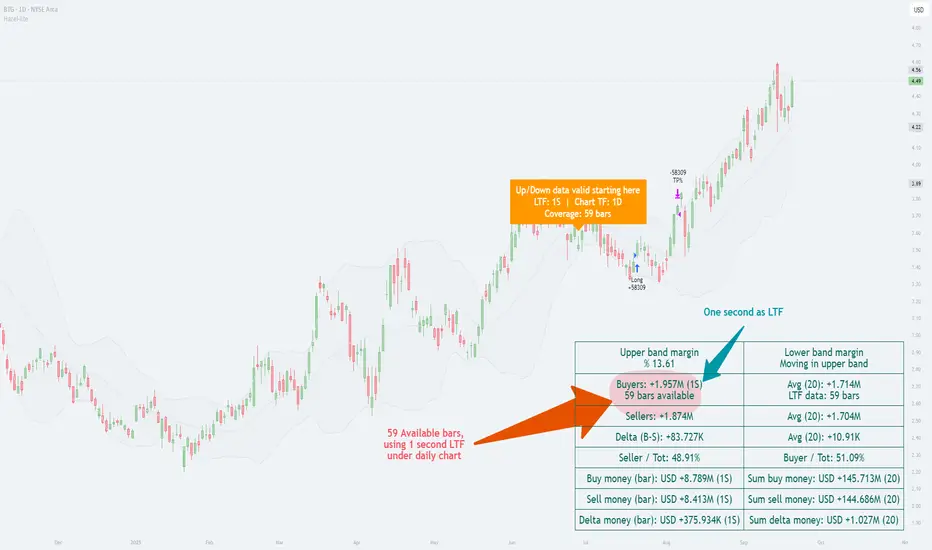
In this example, the daily chart is used as the main timeframe, while a one-second lower timeframe (LTF) has been applied to examine the internal volume distribution. The helper clearly indicates that only 59 one-second bars are available for this daily candle. This is critical, because it shows the analysis is based on a partial window of intraday data rather than a full day.
The up/down volume split reveals that buyers accounted for about 1.957 million units versus sellers with 1.874 million, producing a positive delta of roughly +83,727. In percentage terms, buyers held a slight edge (≈51%), while sellers were close behind (≈49%). This near balance demonstrates how the daily candle’s bullish appearance was built on only a modest dominance by buyers.
By presenting both the margin values (e.g., upper band margin 13.61%) and the absolute money flow, the chart connects higher-timeframe Bollinger Band context with the micro-timeframe order flow. The annotation “Up/Down data valid starting here” reinforces the importance of the helper: it alerts the user that valid LTF volume coverage begins from a specific point, preventing misinterpretation of missing data.
In short, this chart illustrates how choosing a very fine LTF (1 second) can reveal subtle buyer–seller dynamics, while at the same time highlighting the limitation of short data availability. It is a practical case of the principle described earlier—lower-timeframe insight enriches higher-timeframe context, but only within the boundary of available bars.
Analysis with One-Minute LTF
In this chart, the daily timeframe remains the base, but the lower timeframe (LTF) has been shifted to one minute. The helper indicates that data coverage extends across 353 daily bars, a much deeper historical window than in the one-second example. This means we can evaluate buyer/seller balance over nearly a full year of daily candles rather than just a short slice of history.
The up/down split shows buyers at ≈2.019M and sellers at ≈1.812M, producing a positive delta of +206,223. Here, buyers hold about 52.7%, compared to sellers at 47.3%. This stronger bias toward buyers contrasts with the previous chart, where the one-second LTF produced only a slim delta of +83,727 and ratios closer to 51%/49%.
Comparison with the One-Second LTF Chart
Data coverage: 1s gave 59 daily bars of usable history; 1m extends that to 353 bars.
Delta magnitude: 1s produced a modest delta (+83k), reflecting very fine-grained noise; 1m smooths those micro-fluctuations into a larger, clearer delta (+206k).
Interpretation: The 1s chart highlighted short-term balance, almost evenly split. The 1m chart, backed by longer history, paints a more decisive picture of buyer strength.
Key Takeaway
This comparison underscores the trade-off: the lower the LTF, the higher the detail but the shorter the history; the higher the LTF, the broader the historical coverage but at the cost of microscopic precision. The helper function bridges this gap by making the coverage explicit, ensuring traders know exactly what their analysis is built on.
Impact of TradingView Plan Levels
Another factor shaping the use of this function is the user’s access to data. TradingView accounts differ in how much intraday history they provide and which intervals are unlocked.
◉ On the free plan, the smallest available interval is one minute, with a few months of intraday history.
◉ Paid plans unlock second-based charts, but even then, history is measured in hours or days, not months.
◉ Higher tiers extend the number of bars that can be loaded per chart, which becomes relevant when pulling large volumes of lower-timeframe data into higher-timeframe studies
Conclusion
With requestUpAndDownVolume(), it becomes possible to see how each symbol behaves internally across different timeframes. The helper function makes clear where the data stops, preventing misinterpretation. By applying this setup within strategies like Hazel-nut BB Volume, one can demonstrate how changing the lower timeframe directly alters the picture seen on higher charts. In this way, the function is not just a technical option but a bridge between detail and context.
Scalptrading
World Market Scalping: Turning Small Moves into Big Opportunitie1. What is Scalping?
At its core, scalping is a trading style where traders aim to profit from tiny price changes in financial instruments. Instead of chasing large trends or waiting for news-driven swings, scalpers focus on small, predictable moves that happen frequently.
A scalper might enter and exit a trade within seconds or minutes.
Profits per trade are usually small—sometimes just a few cents, ticks, or pips.
Success depends on volume of trades and high win rates.
Example:
If a scalper trades EUR/USD in forex, they might aim to capture 3–5 pips per trade. If they make 100 trades a day, those small profits add up significantly.
This philosophy is what makes scalping so appealing: small edges, multiplied over time, equal big opportunities.
2. Why World Markets are Ideal for Scalping
Scalping thrives where there is:
High Liquidity – Global markets like forex, S&P 500 futures, or gold have massive trading volumes. Liquidity ensures tight spreads and quick order execution.
Constant Volatility – Even when major markets are calm, smaller fluctuations happen continuously.
24/5 Trading Access – The forex market and global indices run almost around the clock, giving scalpers endless opportunities.
Global Interconnections – Events in one country (like a Fed decision in the US) ripple across global markets, creating intraday opportunities.
For these reasons, scalping in world markets is a natural fit for traders seeking consistent activity and endless setups.
3. The Psychology of a Scalper
Scalping isn’t for everyone—it demands a particular mindset:
Patience with small gains – Scalpers accept that $20 here and $30 there will compound over time.
Quick decision-making – Hesitation kills scalpers; opportunities vanish in seconds.
Emotional discipline – Frequent trades can test patience; overtrading or revenge trading must be avoided.
Laser focus – Scalpers may spend hours glued to the screen, monitoring every tick.
In world markets, where volatility can spike suddenly, this discipline becomes even more critical.
4. Tools of the Scalping Trade
Scalpers rely heavily on advanced tools. Some essentials include:
High-speed trading platforms (like MetaTrader, NinjaTrader, or Thinkorswim).
Direct market access (DMA) brokers for fast execution.
Charts with one-minute or tick data to capture micro-movements.
Volume and order flow indicators to see real-time buying and selling pressure.
Algorithmic support (EAs or bots) for ultra-fast setups.
Without speed, scalping in world markets is like bringing a knife to a gunfight.
5. Scalping Techniques in World Markets
Scalpers use various methods depending on the asset:
a) Forex Scalping
Targets small pip movements.
Strategies include spread scalping, news scalping, and EMA crossovers.
b) Stock Scalping
Focuses on highly liquid stocks (e.g., Apple, Tesla, Microsoft).
Uses Level 2 data and time & sales for precision.
c) Index Scalping
Popular in instruments like S&P 500 futures (ES), Dow Jones, or Nikkei 225.
Scalpers often follow global sessions (Asian, European, US) for volatility bursts.
d) Commodity Scalping
Crude oil and gold are favorites due to global demand.
News-driven micro-volatility provides scalpers with rapid opportunities.
e) Bond Market Scalping
Though slower, bond futures and yields react instantly to economic data.
Scalpers exploit these quick yield/price adjustments.
Each market has its nuances, but the common theme is speed + volume = success.
6. The Power of Compounding Small Wins
Let’s look at how tiny wins add up:
Suppose a scalper makes $20 per trade.
They execute 50 trades a day, winning 70% of them.
Net daily profit = around $600–700.
Over 20 trading days a month, that’s $12,000–14,000.
This compounding effect demonstrates why scalpers don’t chase “home runs”—they rely on base hits that add up to a win streak.
7. Risks of Scalping in Global Markets
Scalping is not without risks:
Execution Risk – Delayed fills can turn profits into losses.
High Costs – Commissions and spreads eat into small gains.
Overtrading – Scalpers can burn out mentally or financially.
Market Noise – Small moves may be random, creating false signals.
Global Shocks – Sudden news (like central bank surprises) can wipe out hours of gains.
Risk management (tight stop-losses, trade size control) is the lifeline of world market scalping.
8. How Global Events Shape Scalping Opportunities
Scalpers thrive on volatility. World markets provide plenty of it:
Central Bank Decisions – Fed, ECB, BOJ, etc., move currencies, indices, and bonds.
Geopolitical Events – Wars, sanctions, or elections create sudden bursts.
Economic Data Releases – Jobs reports, inflation data, GDP, etc.
Commodity Supply Shocks – OPEC announcements, natural disasters, etc.
For scalpers, these are golden windows to catch lightning-fast trades.
Conclusion
Scalping is not just a trading method—it’s a mindset, discipline, and lifestyle. In the world’s largest markets, where trillions of dollars flow daily, scalpers carve out their share by seizing micro-opportunities others overlook.
It’s not about predicting the future. It’s about reacting faster, managing risk smarter, and compounding small profits into life-changing results.
For traders who crave action, thrive under pressure, and believe in the power of “small edges repeated often,” world market scalping offers a gateway to consistent success.
The opportunities are endless—the question is whether you have the speed, discipline, and mindset to capture them.
A guide to Profitable Scalping (why waste a price action)In the world of trading, many participants find themselves constantly waiting for the perfect confirmation for swing positions or entries, often missing out on the rapid movements that characterize financial markets. This is where the art of scalping comes into play, a strategy vastly different from swing trading, yet equally, if not more, compelling for those who master it because it offers way more opportunities to make money. In this blog post, I'll guide you through the essentials of becoming an effective scalper, focusing on market structure theory, the significance of Break of Structure (BOS), and the nuances that set scalping apart from swing trading.
Understanding Market Structure Theory
To excel in scalping, one must first be well-versed in market structure theory. This theory is the backbone of understanding how markets move and why they behave in certain patterns. It involves analyzing price highs and lows, trends, and ranges to predict future price movements. For a comprehensive understanding of market structure theory, this resource offers an in-depth explanation, it's not complete, but the best one freely available so I suggest you understand the content properly.
www.youtube.com
The Role of Break of Structure (BOS)
A critical concept in scalping is the Break of Structure (BOS). When we observe a confirmed BOS to the upside or downside, it indicates a significant shift in market sentiment. The order block that caused this break becomes a focal point of interest. This is because, in the realm of scalping, these points often act as magnets for price, offering high-probability entry points.
Capitalizing on Order Blocks
Once a BOS is identified, scalpers must pay close attention to the order block that instigated this shift. When the price returns to this order block, a reaction is typically expected. This reaction is the bread and butter of scalping. Unlike swing traders who seek to capture larger market moves over extended periods, scalpers thrive in these quick, precise moments.
Scalping vs. Swing Trading: A Different Focus
The primary difference between scalping and swing trading lies in their respective focuses and timeframes. Swing trading involves holding positions for several days to weeks, aiming to profit from substantial price moves. Traders in this domain often focus on potential targets for a trade, analyzing broader market trends and economic factors.
Conversely, scalping is a short-term strategy where trades last from a few minutes to hours. The focus here is not on the potential extent of a price move but, on the risk, -to-reward ratio. Scalpers typically aim for a 1 to 3 risk-reward ratio, meaning they risk one unit to gain three. This approach requires quick decision-making so it's much more involved than swing trading.
Before we go on to see some examples following are the key things to remember to be effective in scalping
To be an effective scalper, you need to:
1. Develop a proper Understanding of Market Structure
2. Identify High-Probability Order Blocks
3. Master Risk Management: Given the high-speed nature of scalping, managing risk is paramount. This involves setting strict stop-loss orders and having a clear risk-to-reward ratio for each trade.
4. Stay Disciplined and Agile: Scalping requires discipline to follow your trading plan and agility to adapt quickly to changing market conditions.
Examples: Scalable OBs with results.
This happened today: on SPX and NAS100
NAS100:
SPX:
How to pick an order block to trade for scalping:
Entry for Scalping should be between 0.25 to 0.5 level inside the Order Block, you can use FIB tool to get these levels, this is highlighted in the Images above.
1. Do not go above 4h TF for this strategy.
2. Make sure Order block is caused a BOS
3. Notice the time frame of BOS, Pick the Order block in relation to the BOS timeframe.
4. Makes sure Prior to BOS the Order block resulted in FVG
5. Make sure the Order Block is not too big as it will result in greater risk, which I do not prefer.
6. If price does not hit your entry do not chase price, move on to next one.
I want to emphasize here again , the goal of scalping is to capture the small move , not the whole move , so your focus should be one getting 2X or max 3X of your trade once , you do you get out and move on to next one , the good thing about this strategy is you can always find multiple assets where BOS is happening on anywhere from 1h to 4H TF.
Finally, nothing in the world of trading is 100% so it's possible this may not work sometimes, which you should be okay with as long as it works more than 50% of the time. I
n my experience it works more than 80% of the time.
Conclusion
Scalping is a dynamic and potentially lucrative trading strategy that requires a unique skill set, distinct from swing trading. By understanding market structure theory, focusing on order blocks following a BOS, and maintaining a disciplined approach to risk management, traders can exploit the rapid movements of the market for steady income. Remember, the key to successful scalping lies in quick, informed decisions and an unwavering commitment to your strategy.
Like and Leave comment to this post to seek further clarifications if needed.
Happy trading!
What is Scalping (How to Scalp the right way)To me scalping is a form of trading that's done when you're in between your moving averages or in between support and resistance levels like inside of those zones or when you are inside of consolidation and distribution areas. A lot of you claim to be scalpers on small time frames when the truth of the matter is you are simply impatient and you use 1 minute, 5 minute, 15 minute or less time frames on your charts.
With that being said one thing that you need to have a good grasp on is how to range trade and in this video I'm going to show you what you should be looking for when you arrange trading.
-------------
Scalping is a trading style that specializes in profiting off of small price changes and making a fast profit off reselling. In day trading, scalping is a term for a strategy to prioritize making high volumes off small profits.
Scalping requires a trader to have a strict exit strategy because one large loss could eliminate the many small gains the trader worked to obtain. Thus, having the right tools—such as a live feed, a direct-access broker, and the stamina to place many trades—is required for this strategy to be successful.
Scalping is a trading style that specializes in profiting off of small price changes and making a fast profit off reselling.
Scalping requires a trader to have a strict exit strategy because one large loss could eliminate the many small gains the trader worked to obtain.
Having the right tools—such as a live feed, a direct-access broker, and the stamina to place many trades—is required for this strategy to be successful.
A successful stock scalper will have a much higher ratio of winning trades versus losing ones, while keeping profits roughly equal or slightly bigger than losses.
A pure scalper will make a number of trades each day—perhaps in the hundreds.
What Is "Scalping" In ForexHello Traders,
We thought that we'd make a little guide to those of you who are looking at scalping as a possible trading strategy. This educational idea will give you a few things to consider and we hope that it will inform you of what you can expect from being a scalper.
Our Take:
Personally for us scalping isn’t our style and we wouldn’t recommend it to anyone but some people absolutely love it and are drawn into this type of trading because of the huge profit potential which is why we thought that we’d make this educational guide so that if you want to become a scalper then you know what you’re getting yourself into. Scalping can be a great way to trade but if you want to break out of that 9-5 job and not sit at a computer all day then scalping definitely isn’t your style. The reward you get from being a scalper comes with an equal risk and this is something a lot of people overlook.
A Message From Us:
We hope that you liked our guide and be sure to look out for our next educational guide where we’ll go over more lessons in regards to trading. If you have anything you want us to cover then please do contact us and we’ll see what we can do. We’d love it if you could show your appreciation if you liked this post and we wish you the best.
Stay Safe - The JPI Team
Disclaimer:
This does not constitute as financial advise. We are not responsible for any monetary loss that you endure. Trading is hard to be profitable with and we take losses just like everyone else does too. Our ideas won't always be correct which is why we urge you to always do your own analysis first before entering into the market but please feel free to use our analysis to assist you with yours.
Swing | Intraday | Scalp: pros and cons of three trading stylesAs we all know, the three most popular trading styles are the following: Swing trading, Day trading, and Scalping.
This educational post is concentrated on highlighting some of the pros and cons of all three techniques.
When it comes to Swing Trading (middle to long-term trading), some of the advantages are less screen time, less anxiety, less risk, and less candle noise. This style of trading is beneficial for those individuals that do not have enough time to sit in front of the charts and execute positions on a daily basis. However, some drawbacks should be mentioned as well. In order to be a swing trader, one needs to master the skill of remaining patient, disciplined and cold-blooded. Swing trades can run from one day up to a week, and hence, it is crucial to know how to sit on your hands and do nothing upon witnessing slow price action, indecision, drawdown and so forth.
Moving to intraday trading, no overnight and over-the-weekend risks can be associated with this style as executed positions are usually closed within a couple of hours when trading the H1 and lower-timeframe graphs. On the negative side, in order to make a living off day trading, a strong psychological temperament is needed along with a sufficient trading capital. If swing trading requires a minimum of a risk of 1-2% per trade, the number is lower for day trading. Hence, a bigger input (capital) is required in order to be able to make decent returns.
Last but not least: Scalping. The fans of this style of trading usually dedicate their focus on timeframes as low as the M5 and M1. Aiming towards capturing 5-10 pip movements, scalpers use smaller lot sizes in comparison to swing and day traders. Nevertheless, this trading style comprises of drawbacks such as indecision and a high degree of emotional state. Since the main purpose of scalping is capturing small price movements identified on lower-timeframe graphics, the noise and confusion is relatively high.
While all trading strategies have their own benefits and drawbacks, choosing a trading style that suits your goals and interests the most is highly linked with your personality. If you are a patient and, at the same time, a busy person, swing trading might be the best option for you. On the other hand, if you have enough time and patience to sit in front of the charts and execute trades on a daily and hourly bases, then either day trading or scalping might be the best variants to opt for.
Either way, it all narrows down to patience, long-term vision, discipline, persistence, and risk management. Choose one or two securities that you like trading the most, do not get discouraged while experiencing losses and moments of hardship, remain cold blooded and long-run oriented.
Investroy
15 Min. Scalping Strategy I HIGH WIN RATE15 Min. Scalping & Intraday Strategy I HIGH WIN RATE - Live Demonstration in the Asian Session - USDJPY
About KiSS 2.0 Market Structure Method Trading Strategy:
1. It is a market structure based trading strategy (uses a naked chart and indicators for confluence)
2. Effective strategy for scalping and intraday trading
3. 93% win rate and its recommended to demo and record a minimum of 100-300 trades in a trading journal to find your unique edge
4. Use a unique risk management method to increase probability of wins
Please support this idea with a LIKE and COMMENT if you find it useful and Click "Follow" on our profile if you'd like these trade ideas delivered straight to your email in the future.
Thanks for your continued support!
Brian & Kenya Horton, BK Trading Academy
Long Scalping a Bear MarketProbably one of the most difficult things you can do in a Bear Market is BUY. Especially when we are seeing aggressive selling like this. This is the type of market where every time you try and long, you lose money.
There's little point buying a falling knife UNLESS you are really good at it, because this current market is breaking every single type of support because of sentiment.
HOWEVER, using my strategy with the Price/Trend Indicator and Volume Indicator, you are able to see when momentum/ volume has shifted INSIDE of the Bear Flag . From this you can see that they are probably going to break out upwards to hit Stop Losses before continuing the fall.
If you take a look at the Orange Boxes, you can see a BUY signal, but Volume hasn't upthrusted enough - it hasn't strongly gone above the Blue and Grey trendlines, so it is invalid.
If you take a look at the White Boxes, you can see a BUY signal, with Volume upthrusting above the Blue and Grey trendlines. This is a valid LONG.
(Ignore the purple line, I'm just testing something at the moment)
There is an indicator called "Deviation Bands" - these are Standard Deviations from the baseline of current price. If you choose the option of "EMA", this will allow you to set Take Profit targets - like here, TP 1 and TP2. I will reupload it on my Scripts soon.
Stop Loss is usually quite tight in these scenarios - sometimes actually not as tight as this (sometimes you can get wicks) but other times below the last low.
3 Types of Traders: Which Are You?3 Types of Traders: Which Are you?
There are many different approaches of trading the financial markets that has provoked countless methods and strategies to be created over the decades.
One popular way to simplify & view this is to break it down into 3 types of traders which is categorised by two main factors which include the trading frequency & timeframes used by each one of the trading types.
1️⃣ Scalper
The large majority of beginner traders end up starting out with this type of trading because of numerous reasons. But mainly, this is due to the fast pace that the market moves, presenting many trading opportunities and giving off the perception of an opportunity to get rich quick.
Ironically, this trading style is then considered as one of the most easiest and successful ways of trading by beginner traders, while being stated by professional traders to be one of the most difficult.
Scalpers often have dozens of trading positions open at a time during multiple trading sessions and need to be in front of the charts at all times. Therefore, paying huge commissions to their broker due to spreads also making this type of trading have a high cost to it. Not to mention the chaos in lower timeframe analysis that eventually results in the majority to stop trading.
This is not to say that you cannot be successful with scalping. However, the main obstacle alongside many other with scalping, is the level of constant focus & rapid-decision making required which can have massive negative effects on your overall trading psychology if not kept in check.
2️⃣ Intraday
Intraday or day trading is the most popular type of trading amongst retail traders and is what I prefer the most myself.
Staying relatively active, the market gives some time for the trader to reflect & think upon their analysis on the pairs they are analysing. Opening and managing on average ~1-2 positions per trading session, the intraday approach offers a degree of freedom.
But does come at a cost due to the declining amount of volume and volatility, intraday traders may experience low risk:reward setups because of the average daily range of many pairs on the market.
3️⃣ Swing
Swing trading is the best choice for individuals who want to pursue trading while having a full-time occupation outside of trading. This is possible due to this type of trading primarily focusing on the higher timeframes such as daily/weekly for a large proportion of their analysis.
Thus, swing trading is not demanding when being combined with an individuals typical daily routine and trading psychology since they aim to catch mid/long-term market movements.
With an average trade holding length of 2 weeks and only 1-2 positions being placed per week. Swing trading is regarded to be one of the least emotional approaches and involves low cost of trading with great risk:reward setups.
Though, the main problem with swing trading is the degree of patience required when holding out for long period of times. Often resulting in the trader closing their positions too early and not having the ability to allow the positions to reach their final targets.
Which type of trading do you prefer?
What type of trader are you? Please comment belowHello friends,
Today I thought in helping you understand different Forex Trader Types and probably you can identify yourself in which category you fit in so you know how to approach the market each day.
There are 6 type of traders as far as I know:
1. News or Fundamental Traders
✅Fundamental traders focuses on Fundamental events that may potentially drive the market in a particular direction, causing spikes in a certain direction.
❇️This type of trading will be best for individual traders who likes to keep up with world events that can cause spikes in the market and seek to take advantage of these spikes that can last for a short period of time ranging from few seconds to 15 minutes.
✅This type of trading can be extremely risky as the market can change direction very fast which can cause a trader loosing his/her entire funds, but with good trading skills and experience this type of trading can be very rewarding and offers fast returns.
✅Fundamental Traders would seek to trade the Non-Farm Payroll data, employment figures, elections, CPI and GDP.
2. Scalpers
✅Scalpers are traders that focuses on holding positions for a short period of time from few seconds to a few minutes.
✅This type of trading requires a trader to sit on computer the whole day or during the time when the market is very volatile to take advantage of the small movements in the market to be able to make profit.
✅A trader may be inclined to take so many trades, making smaller profits each time to be able to make good return at the end of the day.
3. Day Trader
✅Day trader is more less like a scalper, taking short positions during the day and making sure that all positions are closed before the end of the day to stay away from negative news events, market gaps or widening of spread.
✅A day trader should be alert to changes in market direction and manage his positions swiftly and accordingly.
4. Swing Trader
✅Swing traders can hold positions for some couple of days and up to perhaps a couple of weeks.
✅Traders of this type analyses the market and take advantage of changes in trend direction and catch a trend while it is still fresh and ride this trend for a longer period of time before closing positions.
✅They would not be required to sit on computer the whole day. Rather, they would analyse, calculate the cost and take the position and they will only get back to computer after some couple of hours or another day to monitor the movement.
✅This type of trading is good for those that hold other businesses or jobs as they can make time for other activities to be done.
5. Position Traders
✅Positions traders hold trades for longer periods of time ranging from a several weeks to years.
✅For this type of trading patience is required to be able to hold trades for that long and a trader should have a very good knowledge about what moves currencies in a long term.
✅That also means that swap charges will be a lot and as a position trader he should put that into consideration before taking a long term position.
6. EA, Algorithmic Trader
✅These type of traders rely more or solely on computer algorithm programs to make buy and sell decisions for them. The EA also known as Expert Advisor may place trades on behalf of the trader and even closing trades when in profit.
✅Although the EA performs most of the work, a trader should also have basic knowledge of trading to be able to gain some measure of success from this type of trading.
Why is it important to trade in your local currency?
✅It can save you from a lot of calculations. When you trade in a currency which is not your local currency, your mind processes so much information to convert every number to your local currency. Your mind will be tired at the end of the day and you will begin making unplanned trades.
✅I watched a video on this topic recently and this fellow mentioned the same thing that I always thought, when you trade in a currency which is not your own, you wouldn't respect money. For example, $50 US dollar would look smaller if you are a trader living and using South African Rand. You may want to wait for more to be satisfied as the number 50 may look smaller in the eyes. But if we convert USD50 to South African Rand it would be R725.38 today and for many that would be a 4 days wage.
✅Many traders, especially new ones in the Forex industry, they really do not know what they want and how to go about making things work out consistently for them, they only think if they keep buying and selling eventually they can hit a million dollar and get away from the financial distress and poverty. Probably that is how the Forex Market is perceived, that giant casino that makes people rich and such way of thinking can destroy one's life and everything he acquired for years. The most important thing here is to respect money, knowing that it is very hard to obtain. As we respect it in our homes, hiding it from our siblings or relatives, we should respect it on the MT5 or MT4. Money is like Gold in our days, if you really want to know how important money is, get a spade and go dig for Gold.
I wish I could write more, but I feel like I have written more already and some people may find this boring to read. Please hit that like button if you learned something from here.
Feel free to comment below what you have learned or the type of trader you are.
Many Good wishes for you,
Forexintelligence AKA the Sniper:)
BITCOIN OR ANY MARGIN TRADED COIN - HOW TO SCALP TRADE Dear Traders and Hopeaholics alike,
HOW TO SCALP LIKE A PRO - NO BOTS, NO SCRIPTS, JUST UNDERSTANDING HOW THE INDICATORS CAN BE USED.
As the self-proclaimed President and Founder of HOPEAHOLICS ANONYMOUS (or HA for short) , you are NOT going to laugh at this strategy... BECAUSE USING THIS... YOU... YES YOU... will be laughing all the way to the crypto bank!!! HA HA HA... I hear you... this works!
And the strategy is FREE, no paid course, and simple to use!
WHAT YOU NEED
9 AND 21 EMA (EXPONENTIAL MOVING AVERAGE)
100 AND 200 MA (MOVNG AVERAGE)
A MARGIN/LEVERAGE TRADED ACCOUNT.
PAID TRADINGVIEW PREMIUM VERSION ALLOWS YOU TO SET AN ALERT ON THE CROSSING OF 9/21 EMAs - I HIGHLY RECOMMEND AS IT WILL PAY ITSELF OFF IN NO TIME!!!!!
These trades are best on 15min chart as it gives stronger confirmation on the direction.
They are also best when 100/200MAs are situated above or below the wave formation.
When MAs are tight to wave formation there is a high risk of entering a scalp as the direction is uncertain.
Always wait for confirmation of the 15min EMA indicator cross.
YOU MUST USE A STOP LOSS!!!!!
Scalp trades at any time are high risk as the market direction is not confirmed in correction zones. It is a way to make DOLLARS in an uncertain market, as you can see on the chart, trades are flipped LONG and SHORT as the EMAs cross. As explained and you can see in the example it is a higher risk when MAs are crowding the waves.
Be careful of over-margining/over-leveraging your trade, as the margin for any error can be affected with any wave move.
FOR BEGINNERS - I recommend commencing paper trading your entries and exits to gain confidence without risking your capital to commence with, we want you to be successful and making $$$
************************************************
When trading, always know you are in control 100% as you are pushing the buttons, and it is YOUR money/cryptocurrency you are trading.
BUT let me tell you this... at HOPEAHOLICS ANONYMOUS and in my world... ANYTHING IS POSSIBLE!!!
SHOOT FOR THE MOON - EVEN IF YOU MISS YOU'LL LAND AMONG THE STARS, BUT AT THIS STAGE I AGREE WITH ELON AND THINK WE ARE ALL HEADED TO MARS!!!
**********************************************
If you are unsure of direction or feel you are over trading I have a moto. IF IN DOUBT SIT IT OUT! There is no shame in not being in a trade. Stick to your game plan, wait for a set up to be confirmed, and ONLY take a trade if it all aligns.
So please I welcome your comments and CONSTRUCTIVE FEEDBACK - ALL HATERS WILL BE FLAGGED AND REPORTED!
And remember, there is NO RIGHT OR WRONG in trading - just money management!
REMEMBER IF YOU ARE PRACTICING SAFE... TRADING ALWAYS USE PROTECTION
(minimize your risk, use a stop loss. Especially in Margin Trades) ALWAYS!!!!!!!!!!!!!!!!!!!
<3 Lisa
DISCLAIMER:
The Legal stuff - I'm not a financial adviser. Just a few quick thoughts - remember you sit at your computer, you push the buttons...
PS make sure you give me a like, that way you get updates as I post them.... :) <3
THE ONLY WAY TO MAKE MONEY - IS TO MAKE YOUR OWN!!!
EDUCATION: Scalping 3-EMA StrategyHello, dear subscribers!
Today we are going to talk about the popular 3EMA scalping strategy which is usually used on the 1-min timeframe, but we can demonstrate it only on the 15-min chart because of restrictions.
Step 1
First of all we should define that the market is in short, medium and long term uptrend. The 200EMA shows the long, 100EMA - medium and 50EMA - short trend. Consequently all the three EMAs should follow in one direction, it's slope should be strictly positive for the uptrend identifying. The uptrend is an obligatory condition for the long position execution.
Step 2
If the step 1 condition is true the next step is to identify entry points. We should enter long position when the price crossed the 50EMA from up to down, but after couple of candles crossed it again from down to up
Step 3
Take profit and stop loss identifying. You should stop loss if the price crossed the 100EMA line from up to down. Take profit setup can be different: the fixed % growth, the price and 50EMA crossover and the price and 100EMA crossover
AUDUSD 15M SCALP SHORT TRADE US SESSIONStacey Burkes TSG Podcast Ep. #18 Forex Trading Strategy.
US SESSION 3 Hour Window
Starting at 8 am EDT
Ending at 11 am EDT
Step 1 Highest Bullish Candle Inside US 3 hr window.
Step 2 Bearish Pin Bar 2nd candle in US window.
Step 3 Enter Sell Trade when Price Engulfed the bottom of the High Bull Candle.
Step 4 Market Makers Stop Hunt Bullish Wick Confirmation for Short Entry Traders.
Step 5 SL above current swing high.
Step 6 EXIT - Close Short Trade after Price crossed Bullish Resistance.
EURAUD 15M SCALP LONG TRADE US SESSIONStacey Burkes TSG Podcast Ep. #18 Forex Trading Strategy.
US SESSION 3 Hour Window
Starting at 8 am EDT
Ending at 11 am EDT
Step 1 Lowest Bearish Candle Inside US 3 hr window
Step 2 Bullish Pin Bar 2nd candle in US window.
Step 3 Bullish Engulfing Candle Entered at Candle Close.
Step 4 Market Makers Stop Hunt Bearish Pin Bar Confirmation for Long Entry Traders.
Step 5 SL below Entry Candle
Step 6 EXIT - Close Long Trade after RailRoad Tracks Bearish Reversal Candle Pattern with 61 pip profit.
Bitcoin Price Action Open LONG Position XBT/USD
Leverage 7x - 20x (or Cross Leverage)
Position Size: 1% -3%
BUY Limit Order Entry Range 1: $10194 - $ 10155
BUY LIMIT Order Entry Range 2: $ 10070 - $10025
SL: BELOW $9945
TP1: $ 10450 - $ 10480
TP2: $10655 - $10690
***DYOR***
Gudd luck to Us ALL
Cheers,
bitATX