Bearish diververgence. Sell in May and go awayI think gold is going down below 1700 next week. Looks like bearish divergence on the hour chart, plus lower highs, lower lows and a doubletop. On top of that the end of the month sell off and May is typically not a good month for gold.
Fundamentals are confusing the technicals so I'm sitting on the sidelines next week or at most scalping.
Good luck!
Bearish-divergence
AI Stocks Weakness Could Spoil this Year’s Santa RallyAs December begins, traders worldwide are dusting off the same old question: Will we get a Santa Claus rally this year?
But 2025’s setup looks a little different. The market’s cheer seems to depend heavily on whether AI-related stocks can keep delivering miracles—and lately, the charts are suggesting they may be running out of steam.
When Tech Sneezes, the Market Catches a Cold
A quick look across U.S. equity futures shows a revealing pattern.
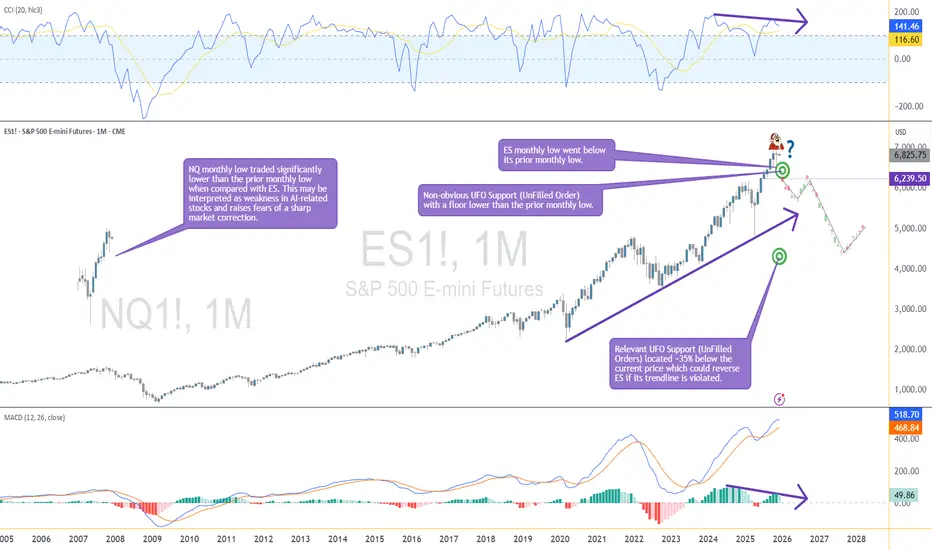
The E-mini NASDAQ 100 Futures (NQ), home to most AI and semiconductor giants, has posted a significantly lower monthly low compared to the prior month.
Meanwhile, the E-mini S&P 500 Futures (ES) declined much less, hinting at relative resilience, but also possible lagging weakness.
This divergence—NQ leading down while ES holds up—is a subtle warning. When the market’s growth engine (tech) loses traction, broader indices often follow with a delay. That’s the tension December traders are staring at: are we seeing the early signs of exhaustion before the holidays, or just a healthy pause?
Bearish Divergences Whisper “Caution”
The technicals are backing that cautious tone.
On the ES chart, the Commodity Channel Index (CCI) has been carving lower highs even as prices printed higher highs. This is a textbook bearish divergence, often an early sign that bullish momentum is fading.
The MACD histogram echoes the same message: momentum has been contracting through November despite new price highs, suggesting that underlying strength is eroding. Such divergences don’t predict direction on their own, but they do raise the probability of a short-term correction—or at least a choppy path into year-end.
The Price Map: Three Levels that Could Define December
Let’s outline the key technical zones traders are watching:
6,525.00: the prior monthly low—this is the first line of defense for the Santa Rally narrative. A break below this level would likely shift sentiment fast, especially if NQ continues under pressure.
6,239.50: the floor of a relevant UFO (UnFilled Orders) support zone. If ES dips below the prior low, this zone may become a “bear trap.” Many traders might short aggressively once 6,525.00 gives way, but those unfilled buy orders could absorb supply and trigger a sharp bounce. If the rally emerges from here, Santa might still make his visit.
4,430.50: a deeper UFO support cluster roughly 35% below current prices. If price were to cut through 6,239.50 and stay below it, the market would be entering a different regime altogether—likely accompanied by broken trendlines, volatility spikes, and a more defensive tone.
Reading Between the Lines: What the Divergence Means
Historically, the Santa Rally is powered by optimism, lighter volumes, and portfolio rebalancing. But this time, AI and semiconductor names—the champions of the current bull leg—are leading weakness.
That doesn’t mean doom; it means fragility.
The ES market may still rebound, but it’s doing so under reduced participation from the very sectors that drove prior gains.
Sizing the Trade Without Crossing the Line
For traders eyeing this setup through ES (E-mini S&P 500 futures) or MES (Micro E-mini S&P 500) futures, here’s a compliant, educational way to think about risk and position sizing:
Identify the Setup Zone: e.g., around 6,525.00 as potential demand, or below 6,239.50 as short-term breakdown.
Define Your Stop: the level where the technical picture is invalidated.
Set a Dollar Risk Limit: for instance, risking 1% of total account equity.
Derive Position Size: Divide your dollar risk by the price distance between entry and stop (converted into points). Then choose between the standard E-mini (ES) or Micro E-mini (MES) to match your risk tolerance and account size.
This framework lets traders adapt leverage responsibly—without needing the specific contract specs or margin figures, which vary by broker and time.
Risk Management: December Can Be a Trap
December is famous for emotional trading. The combination of holiday expectations, thinner liquidity, and year-end positioning can turn routine pullbacks into exaggerated moves.
That’s why focusing on risk before reward is critical.
The UFO support levels serve as reference zones where institutional activity might reappear, but they’re not guarantees. Managing stops, scaling out partial profits, and staying flexible matters more than trying to guess the market’s next headline.
ES and MES: Same Story, Different Scale
The Micro E-mini (MES) contract is a smaller version of the E-mini (ES), designed for traders who want the same price exposure but with lower notional size.
Both track the same index, tick for tick.
For traders exploring this December setup, the MES allows participation while controlling exposure more granularly—especially useful if volatility picks up and margin requirements shift.
Key Contracts Specs and Margins:
E-mini S&P 500 Futures (ES) with a point value = $50 per point.
Micro E-mini S&P 500 Futures (MES) with a point value = $5 per point.
As of the current date, the margin requirements for E-mini S&P 500 Futures and for the Micro E-mini S&P 500 Futures are approximately $22,400 and $2,240 per contract respectively.
Always verify the latest margin schedules and specifications directly with your broker or the exchange before entering trades, as those details update regularly and depend on market conditions.
Santa’s Setup: Scenarios to Watch
Scenario A — Santa Delivers: Price tests or slightly breaks the 6,525.00 low, finds support near 6,239.5, and rebounds into late December. Bearish divergences resolve sideways, and risk assets stabilize.
Scenario B — The Grinch Arrives: The 6,239.50 zone fails to hold, breaking trendline supports. The market slides toward 4,430.50, shaking off complacent longs and erasing part of the 2024-5 rally.
Both paths are technically valid. The difference will come from whether AI-heavy sectors regain strength—or confirm that this bull leg has indeed lost its engine.
Educational Takeaway
Divergences (CCI and MACD) highlight when momentum and price disagree—a sign of fatigue.
Intermarket analysis (ES vs. NQ) reveals where weakness may originate.
UFO levels identify potential institutional footprints—where traps or reversals often occur.
Discipline and risk control matter more than predicting whether Santa shows up.
Final Thought
Whether December brings gifts or grief may depend less on seasonal hope and more on how traders interpret these divergences.
If AI stocks can find footing again, the rally could revive. But if they keep sliding, this might be the year Santa takes a break.
When charting futures, the data provided could be delayed. Traders working with the ticker symbols discussed in this idea may prefer to use CME Group real-time data plan on TradingView: www.tradingview.com - This consideration is particularly important for shorter-term traders, whereas it may be less critical for those focused on longer-term trading strategies.
General Disclaimer:
The trade ideas presented herein are solely for illustrative purposes forming a part of a case study intended to demonstrate key principles in risk management within the context of the specific market scenarios discussed. These ideas are not to be interpreted as investment recommendations or financial advice. They do not endorse or promote any specific trading strategies, financial products, or services. The information provided is based on data believed to be reliable; however, its accuracy or completeness cannot be guaranteed. Trading in financial markets involves risks, including the potential loss of principal. Each individual should conduct their own research and consult with professional financial advisors before making any investment decisions. The author or publisher of this content bears no responsibility for any actions taken based on the information provided or for any resultant financial or other losses.
GOLD 1H Bearish Divergence Analysis:
Price Action (Top Section of Chart)
The price is making higher highs (shown with the upper trendline).
Relative Strength Index (RSI) (Bottom Section of Chart)
The RSI is making lower highs (shown with the downward trendline).
This is a bearish divergence, meaning that while the price is rising, the RSI is weakening, indicating that momentum is fading. This often suggests a potential reversal or pullback in price.
Confirmation:
The price has already started reacting to this divergence, showing some rejection from the highs.
The RSI dropping below 50 is an additional bearish signal.
If the price falls below support (around 2,864.95 EMA and 2,834.22 horizontal support), the bearish move could accelerate.
Catch Big Reversals Like a Pro Using the GOLDEN RSIHow to Catch Market Tops and Bottoms Using the GOLDEN RSI Indicator
Trading market reversals can feel like a daunting task. But what if you had a secret weapon to help you identify tops, bottoms, and potential reversals with ease? Enter the GOLDEN RSI Indicator—a custom-built tool designed to revolutionize your trading strategy. In this tutorial, I’ll show you how to leverage this powerful indicator to spot reversal trades like a seasoned pro.
What is the GOLDEN RSI Indicator?
The GOLDEN RSI builds on the traditional RSI (Relative Strength Index) by adding optimized zones and visual signals that highlight potential bullish and bearish reversals. Unlike the standard RSI, which requires subjective interpretation, this indicator provides precise entry and exit signals by visually marking key market conditions.
How to Use the GOLDEN RSI to Catch Market Reversals?
Understand the Key Zones:
Overbought Zone (Above 80): Signals a potential market top or reversal from bullish to bearish.
Oversold Zone (Below 20): Indicates a potential market bottom or reversal from bearish to bullish.
Neutral Zone (60-40): Consolidation phase where trends are less decisive.
Spotting Bullish Reversals
When the RSI dips into the oversold zone (below 20) and begins to reverse upward, the GOLDEN RSI will highlight a Bull signal. This suggests a potential upward move, ideal for long trades.
Pro Tip: Look for confirmation with price action, such as a bullish candlestick pattern or a break of resistance.
Spotting Bearish Reversals
When the RSI climbs into the overbought zone (above 80) and starts to turn down, the GOLDEN RSI will mark a Bear signal. This indicates a potential downward move, perfect for short trades.
Pro Tip: Combine with chart patterns like double tops or bearish engulfing candles to strengthen your confidence in the trade.
The Hidden Power of Divergences
Bullish Divergence: Price makes lower lows while the RSI makes higher lows. This signals potential bullish momentum.
Bearish Divergence: Price makes higher highs while the RSI makes lower highs. This signals potential bearish momentum.
The GOLDEN RSI visualizes divergences clearly, so you can spot them effortlessly.
Use Risk Management Tools
Set stop-loss levels below recent swing lows (for bullish trades) or above recent swing highs (for bearish trades).
Use risk-reward ratios of at least 1:2 to maximize your profit potential.
Real Trade Example Using GOLDEN RSI
In the SPX 15-minute chart above, the GOLDEN RSI accurately identified:
A Bearish Reversal near the market top, as the RSI entered overbought territory and started to fall.
A Bullish Reversal as the RSI dipped into the oversold zone and recovered upward.
These signals allowed for precise entry points, minimizing risk and maximizing rewards.
Why the GOLDEN RSI is a Game-Changer
Unlike generic RSI tools, the GOLDEN RSI is designed with traders in mind. It eliminates the guesswork by providing visual cues for market reversals. Whether you’re trading stocks, indices, or crypto, this indicator is a must-have in your toolkit.
How to Get the GOLDEN RSI Indicator?
Want to try it for yourself? Head over to TradingView and add the GOLDEN RSI Indicator to your chart. Use it alongside your favorite price action strategies to take your trading to the next level.
Conclusion
Reversals can make or break a trader’s portfolio. By mastering the GOLDEN RSI, you can confidently spot market tops, bottoms, and reversals with precision. Start using this custom indicator today and watch your trading results improve dramatically!
Don’t forget to like, share, and follow me on TradingView for more tutorials like this one. Let’s catch those reversals together!
US30 Short Idea based on monthly-minute breakdownAfter thorough breakdown i see US30 diverging in the weekly & hourly TF, after that I measured the daily-weekly moving average and concluded that it has finished the average pip movement before usual daily retracements. So after deciding it will be bearish I’m looking for a bullish retracement in the 1min-15 min TF to the 45100 area where I’ll be looking to place my SELLS. TP targets have been set from TP1-TP6 (Make sure to set to break even after TP1 hits if deciding to swing trade). Bulls usually control December so I did mark up the possible bullish scenarios from the 1st 4 TPs. Let’s see if US30 can FEED US !!
Polycab India Ltd. - Short Position SetupAnalysis for Short Position Condition:
1.Key Breakdown Level:
₹7,282 is a critical horizontal support level. A decisive breakdown below this level could trigger a bearish move.
2.Volume Profile Analysis:
Below ₹7,282, the volume profile shows limited buying interest until ₹6,997, suggesting a potential drop to this level.
Further weakness could see the stock test ₹6,746, where significant buying activity has previously occurred.
3.Trendline Breakdown:
The stock is trading within an ascending channel. A breakdown below ₹7,282 will confirm the failure of this channel, indicating a trend reversal.
4.Moving Averages:
The 20-day EMA is currently acting as dynamic support near ₹7,282. A breakdown will likely push the stock toward the 50-day EMA around ₹6,997.
The 200-day EMA near ₹6,746 is a long-term support level to monitor.
5.RSI (Relative Strength Index):
RSI is neutral but could head toward oversold levels if the breakdown occurs, strengthening the bearish view.
6.Volume Confirmation:
Watch for an increase in sell-side volume during the breakdown for confirmation.
Trade Plan for Short Positions:
Entry Trigger: Below ₹7,282.
Targets:
Target 1: ₹6,997
Target 2: ₹6,746
Stop Loss: Above ₹7,438 (previous high near resistance).
Risk-Reward Ratio: Ensure an ideal ratio of at least 1:2 for the trade.
Alternate Scenario:
If ₹7,282 holds and the stock bounces, the immediate upside resistance is ₹7,654, above which the stock may resume its bullish trend.
TURBO Bearish Divergence on 1Wk ChartTURBO Chart 1WK:
We have a negative divergence forming on the weekly time frame.
If the current candle remains as a bearish engulfing candle by the close of this week (3 days), then it's going down to test the bottom of the channel and those lower wicks. Falling to the bottom of this channel would result in a -31%. Correction. If it breaks the channel lower, then it's going down -80%
In a first ever "Utility Bull-Run," how will the meme coins hold up this time, with no utility?
This could be like the FTX or Luna Crash 👀
EURCADIs EURCAD exhausting at resistance zone?
As the price is been on high bull run but now it seems like price is lacking bullish momentum after printing double top pattern at resistance level and bearish divergence suggesting the sell pressure is about to start.
If the bears took control , the 1st target could be 1.4900 followed 1.4800
What you guys think of it?
NZD/CHF 4H Quick Take: Bearish Divergence AheadThe NZD/CHF pair is signaling a cautionary tale on its 4-hour chart. Despite posting higher highs, a bearish divergence with the RSI, which has been making lower highs, suggests weakening momentum. Notably, the RSI's recent peaks above 70 highlight overbought conditions, with the latest peak lower than its predecessor, hinting at diminishing buyer strength.
The pair's interaction with the weekly pivot point at 0.54257 early this week hints at a possible retest of this level soon. Traders should brace for potential shifts, as these indicators collectively suggest a looming correction.
Daily Wedge w/ Divergence Spotted!! - AJHere I have AUD/JPY on the 4Hr and Daily Charts!
Daily Chart-
-We see Price outlining a Rising Wedge and with this the First inclination that we could see Price push down further is the Bearish Divergence shown as the HIGHS on the RSI indicator suggesting Bulls could be losing Power!
-The High created on Feb. 23rd was followed by a STEEP decline in price!! Much of this caused by BOJ rumors of JPY possibly exiting "Deflation" and with the market doing well!
4Hr Chart-
Price had made a Low after the steep decline from the High giving me an opportunity to find a Fib'd Entry Zone and Price had tested it already at the end of last week. To start this week, price as began to work down validating my Bearish Bias on this pair!
Fundamentally this week:
AUD - GDP (Tue)
JPY - Tokyo Core CPI & BOJ Ueda Speaks (Mon)
*Currently in Active Trade
GBPCHF SHORT postionAfter reaching a supply zone for the GBP may be it is time for correction. There is bearish divergence on the RSI 1H timeframe which I am thinking is going to happen. The TP zone could be the eclipse which is on the resistance zone. The other important thing is that the 200MA could be support zone which is not sure that the price will break. Do your own reasearch and please share you thoughts.
Bearish RSI divergence on NasdaqHello everyone,
I just found a bearish RSI divergence on weekly chart of Nasdaq. RSI (14) on February 5 was at 73.05 and 72.91 on February 26. Close was 15990.66, now is 16274.94.
In addition there was a bull cycle of 18 bars on weekly chart from March 13 2023 with price increase of 31.54 %, current cycle from October 23 ended with 29.96 %.
And there is a high probability of a drop after reaching the ATH. See June 18 2015, just 4 days after a drop occured with a low on July 7, then another ATH was on July 15 August at 5231.94, this is just 1.01937 % above ATH from 10 March 2000 at 5132.52. Then signiffant drop occured with a low on August 24 at 4292.14, this is 82,03 % of ATH.
XAUUSD - 1h - Bearish Divergence - FibonaaciIn this chart I spot a Bearish Divergence in which RSI momentum going down and price go up.
it will be a sign of last bullish High and will go down and trend moves towards Distribution phase and then down trend/bearish.
In this zone we avoid trade until we spot a clear indication of trend
SO DONOT TRADE
CHFJPYIs CHFJPY exhausting at highs?
As the price is been on high bull run but now it seems like price is lacking bullish momentum after printing double top pattern at resistance level and bearish divergence suggesting the sell pressure is about to start.
If the bears took control , the 1st target could be 163.6 followed by 162.70
What you guys think of it
NASDAQ Moving Lower (1W)NASDAQ Weekly
Price Chart
After forming a double bottom in late 2022 the NASDAQ bounced and has melted up from its lows approximately 48% confirming that it was more than just a bear market rally. Most recently the NASDAQ has run into resistance (Light Red Box) and has descended roughly 3% past a minor trend line on the daily chart (not shown). Shorter term EMA's are beginning to even out (12-day / 26-day) indicting the beginning of a change in the direction of price action which will most likely move lower towards the target supports (Light Green Boxes). If the bottom support (Red Solid) is broken (pretty big "if" at the moment) then the possibility of breaking the long-term trend line (Yellow Solid) will come into play, however at this point it is premature to assume this comes to fruition.
Relative Strength Indicator
The major trend line (Yellow Solid) highlights the divergence from price action beginning in May 2022 and confirming the double bottom ending in December 2022. Most recently the RSI has remained elevated above the 70 line indicating a strong trend, however, the RSI has fallen back below the 70 signaling weakness. The RSI most likely moves down toward the major trend line and major support (Red Solid) from this point. Considering a cradle is in play with the resistance and trend line crossing, it will more than likely bounce with price action allowing the price to attempt one more move higher but will ultimately fail along with RSI failing to make a higher high and confirming price action. If the support and trend are broken it is most likely game over.
On Balance Volume
OBV bounced along with price and RSI in December 2022 and continued higher while making two consecutive bull flags confirming the movement. The OBV has failed to move higher after encountering resistance (Aquamarine Dotted) while retesting the major trend line (Yellow Solid) and seemingly has begun to move lower (emphasis on begun to). It is also notable to mention that a minor trend line (Yellow Dotted) has created a cradle that the OBV has so far failed to break. If the major resistance (Red Solid) is broken then it is basically game over, but we have two areas of support (Light Green Boxes) that will need to be broken first. The major resistance has had previous breaks which led to major downturns that can be seen in December 2000, February 2005, and September 2008 (all shown above).
TDLR;
Just want the meat and potatoes huh? Don't worry our entrees always Seem Legit. Price action recently hit resistance and has begun to move lower while EMA's begin to flatten. There's a 3% move down from a minor trend line on the 1D (not shown). The RSI is showing a bearish divergence after remaining elevated over the 70 line and beginning to move lower. The OBV looks to be forming a double top, and has run into resistance from a major and a minor trend line. Don't forget that this could take months to play out since this is the weekly chart.
What Seems Legit?
Possibly a bounce here from the support formed Jan - Mar 2022 in conjunction with the 12-day or 26-day EMA, retest the recent high, fail to break it and begin to move lower. It might just push lower due to the RSI on the 1D moving below the 50 line (analysis of the 1D has been posted).
"History doesnt repeat itself but often it rhymes" -
- Tap the 50-day EMA and carry on (2019)
- Crash to the major trend line and carry on (2020)
- Break the major support on the OBV and head lower (2000, 2005, 2008)
Chart Key
Yellow Solid = Major Trend Line
Red Solid = Major Support
Aquamarine Solid = Divergences
Red Box = Major Resistance
Green Boxes = Supports / Target Areas
Bearish Divergence Bearish Divergence on the monthly time frame indicating a big bearish morvment is about to happen.
RSI also showing market exhaustion where the bears are taking control
Stochastic showing the market is over bought.
and the candles on the chart is showing chop and wick to the top side.. indicating bulls loosing momentum and a reversal is imminent.
🔥 Bitcoin In Danger 🚨 Bearish Divergence Playing Out!Last week I made an analysis on BTC's bearish divergence on the 3-day chart. Seeing the bearish price action we got recently, it seems that this bearish divergence is playing out well.
In my eyes, it's very likely that BTC will go down from here onwards. Next target is the dotted purple support line.
Seeing there's another FOMC interest announcement tomorrow, Bitcoin is in danger of breaking through said support in case the market doesn't like tomorrow's meeting. In that case, my expectation would be that the top for 2023 is in.
All eyes on tomorrow.