Bitcoin Pullback to Resistance — Next Drop Loading?As I expected , Bitcoin( BINANCE:BTCUSDT ) has begun its decline from the resistance zone($94,850-$93,000) and has reached its target.
Currently, Bitcoin is moving near the resistance zone($90,900-$90,100), the Cumulative Short Liquidation Leverage($91,840-$90,110), and other resistance lines.
From an Elliott Wave perspective, it appears that Bitcoin has completed its five-wave downward sequence and is now in the process of forming the corrective waves upward, likely within the resistance zone($90,900-$90,100).
Moreover, since the USDT.D% ( CRYPTOCAP:USDT.D ) has successfully broken the upper line of its falling wedge pattern, we can anticipate further increases in USDT.D%, which could put additional downward pressure on Bitcoin.
Additionally, considering that the S&P 500 index( SP:SPX ) is likely to resume a bearish trend, and given Bitcoin’s correlation with the SPX, a further decline in Bitcoin is not unexpected.
In conclusion, based on the above analysis, I expect that Bitcoin will at least test the support lines and, if those are broken, it may continue to decline toward the Cumulative Long Liquidation Leverage($87,000-$85,663). If the momentum of breaking these support lines is strong, we can expect even more significant downward movement.
Do you think Bitcoin can go below $87,000?
First Target: Support lines
Second Target: Cumulative Long Liquidation Leverage($87,000-$85,663)
Stop Loss(SL): $92,000(Worst)
Points may shift as the market evolves
💡 Please respect each other's opinions and express agreement or disagreement politely.
📌Bitcoin Analysis (BTCUSDT), 1-hour time frame.
🛑 Always set a Stop Loss(SL) for every position you open.
✅ This is just my idea; I’d love to see your thoughts too!
🔥 If you find it helpful, please BOOST this post and share it with your friends.
Bitcoin (Cryptocurrency)
ADA – Downtrend Dominates, Risk of Deeper PullbackHello everyone,
On the chart, the downtrend remains clearly intact, with a persistent sequence of lower highs and lower lows extending from October to the present. Price is trading entirely below EMA34 and EMA89, both of which are sharply sloping downward. This confirms that sellers continue to control the market, with no meaningful signs of exhaustion so far.
Throughout November and December, all rebound attempts have been weak, short-lived, and repeatedly rejected around the EMA34 near the 0.45 USD area. This behavior suggests that buying pressure is purely technical in nature and insufficient to form a reversal structure. At the moment, ADA is hovering around the nearby support zone of 0.37–0.39 USD. However, the current D1 candle structure — small bodies, short lower wicks, and declining volume — indicates fading momentum, a pattern that often precedes a breakdown of support.
From an EMA perspective, the widening gap between price and EMA34 (0.452) as well as EMA89 (0.560) further confirms that the downtrend is expanding rather than contracting. To shift the market’s bias, ADA would need at least a daily close above 0.45 USD. At this stage, there are no early signals supporting such a scenario. Volume has continued to dry up over recent weeks and is concentrated mainly on bearish candles, implying a lack of fresh inflows, while sellers still require relatively little pressure to push prices lower.
Based on the current technical picture, the highest-probability scenario remains a breakdown below the 0.37–0.38 support zone, followed by an extension of the decline toward deeper support around 0.30–0.33 USD. This area represents a significant liquidity zone that previously acted as a major support, where price could eventually see a technical bounce or begin forming a new accumulation base. Until ADA approaches that region, there is still insufficient evidence to expect a genuine trend reversal.
Wishing you all a successful trading day!
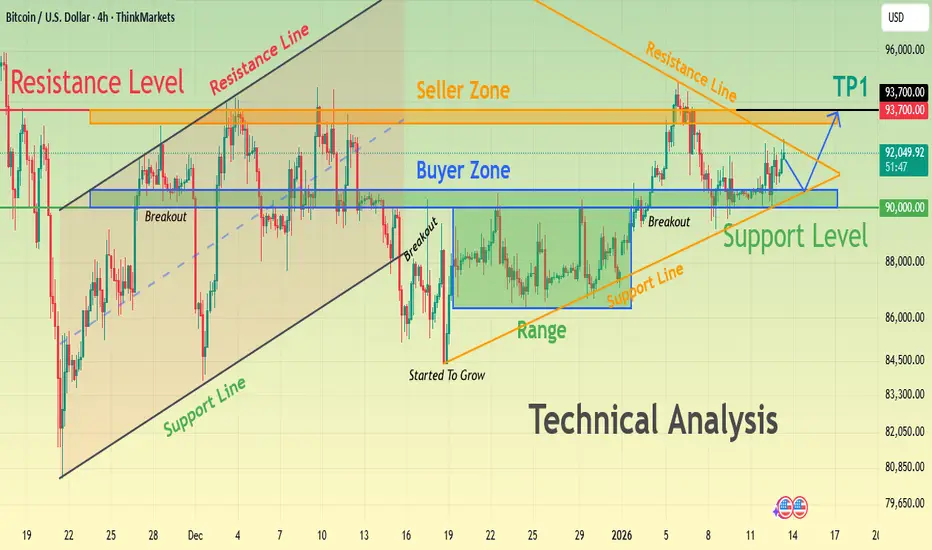
BTCUSD Holds Triangle Support - Bounce Toward 88,500 ExpectedHello traders! Here’s my technical outlook on BTC/USD based on the current chart structure. After a prolonged bearish move inside a downward channel, Bitcoin found a base near the lower boundary and reversed sharply, signaling seller exhaustion and a shift in momentum. This reversal was followed by a breakout above the descending resistance, confirming the end of the bearish phase. Price then entered a consolidation range, where accumulation took place before a confirmed breakout pushed BTC higher. Following the range breakout, the market formed a triangle structure, with price respecting the Triangle Support Line while facing pressure from the Triangle Resistance Line. Recently, BTC revisited the Buyer Zone around 86,300–85,500, which aligns with both horizontal support and the lower triangle boundary. Buyers stepped in at this level, defending the structure and keeping the recovery scenario intact. Currently, BTC is attempting a rebound from the Buyer Zone and is aiming toward the 88,500 Resistance Level (TP1). As long as price holds above the support zone, a move toward this resistance remains likely. A clean breakout above 88,500 would confirm further upside continuation, while rejection could lead to another consolidation or retest of support. For now, the structure favors buyers, with 86,300–85,500 as key support and 88,500 as the main upside target. Please share this idea with your friends and click Boost 🚀
BTC/USDT | Bears in control? (READ THE CAPTION)Good day folks, hope you're doing okay.
As you can see and I previously mentioned, BTC dropped to the demand zone and now it's being traded at 86,560 level.
However, it is yet to break out of the demand zone, if it fails to do so, a drop to the low of the demand zone at 83,860 is possible. If it goes up, it'll be met by the FVG at 88,350.
SOL – Support Broken, Favor Selling on Rallies into SupplyHello everyone, this is Domic,
On the 4H timeframe, SOL has decisively broken below the 130–132 support zone and dropped quickly toward 125–126 with long bearish candles accompanied by rising volume. This price action clearly shows active selling pressure taking control of the market. This is not a minor shakeout, but a confirmation that the downtrend is now dominant.
After the sell-off, price has only moved sideways briefly to rebalance liquidity, without any strong buying response or clear reversal pattern. This type of structure typically appears before the primary trend resumes.
The preferred scenario is a technical rebound back toward the 130–132 zone, followed by another leg down toward 123–125. If this area is breached, the decline could extend further toward 118–120. The bearish outlook would only be invalidated if SOL prints a clear 4H close above 136. Until then, all rebounds should be viewed as selling opportunities in line with the prevailing trend.
Wishing you successful trading!
BITCOIN - The downward trend may continue. Focus on 88KBINANCE:BTCUSDT.P failed to realize its bullish potential associated with positive news. Is crypto winter getting closer and closer?
Fundamentally, despite the rate cut and a relatively positive overall backdrop, the market continues to fall. Bears held the 95k resistance and the 90k zone. Bitcoin is breaking the consolidation support and entering a distribution phase. The decline has been temporarily halted by support at 85,500, and the market may correct to 87,000-88,000 (the break-even zone) before continuing its decline within the current trend. The target the market may strive for is 84K-80K.
Resistance levels: 87,000, 88,000, 90,000
Support levels: 85,560, 83,800, 80,000
If the market continues to lack support or no bullish driver emerges, the price may fall even lower. I expect a retest of the zone of interest (the support area of the trading range) and a further decline to key levels...
Best regards, R. Linda!
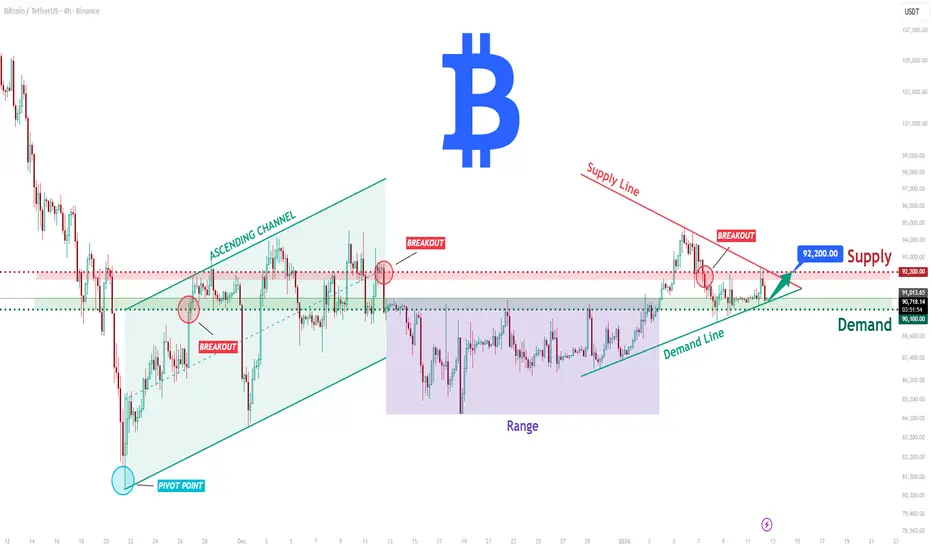
BTCUSDT Long: Demand Support Fuels Push Toward $92,500Hello, traders! BTCUSDT previously traded within a well-defined Descending Channel, confirming strong bearish pressure and controlled sell-side momentum. Price consistently respected the channel boundaries, producing lower highs and lower lows until a decisive breakdown occurred near the lower channel edge. After this breakdown, Bitcoin reached a clear Pivot Point, where sellers began to lose control and buyers stepped in aggressively. This reaction marked the end of the bearish impulse and initiated a structural shift. From this pivot low, price started forming higher lows, signaling the emergence of demand and the beginning of a recovery phase.
Currently, BTC broke above local resistance and entered a Range phase, where price consolidated between the 88,000 Demand Zone and the 92,500 Supply Zone. Multiple breakout attempts occurred inside this range, confirming active participation from both buyers and sellers. However, each dip toward the demand area was quickly absorbed, showing strong buyer interest and defense of the lower boundary. A rising Demand Line formed beneath price, reinforcing bullish pressure and supporting higher lows within the range. This structure indicates accumulation rather than distribution, suggesting preparation for a directional move.
My primary scenario is bullish as long as BTCUSDT holds above the 88,000 Demand Zone and continues respecting the ascending demand line. The recent pullback into demand appears corrective rather than impulsive, favoring continuation to the upside. I expect price to push back toward the 92,500 Resistance, which represents the upper boundary of the range and a key decision level. A clean breakout and acceptance above 92,500 would confirm bullish continuation and open the path for further upside expansion. Manage your risk!
Bitcoin Market Assessment - 110k or 80k incoming?Bitcoin Market Assessment – WhiteBit Chart & Exchange (Daily Time Frame)
Welcome back everyone.
Today we will be evaluating Bitcoin using the WhiteBit chart on the daily time frame.
Market Overview
Bitcoin recently surged to 126k, sweeping liquidity at the highs. Shortly after, the market sold off aggressively partly amplified by tariff news—which reinforced the upper resistance zone and caused price to break back below it.
Price continued to decline sharply, reaching 80.3k, where millions in positions were liquidated.
Current Technical Structure
1. Breached Bullish Golden Pocket
Price has broken below the bullish Golden Pocket (0.618–0.65).
Once breached, this zone typically flips into resistance, which is what we’re seeing now.
2. Rising Wedge on the 4H
On the 4-hour chart, price is forming a rising wedge, a pattern that often precedes continuation to the downside.
This wedge aligns directly with the breached Golden Pocket, forming a strong confluence of resistance.
3. Trend Context
Price action is still within a high-time-frame bearish trend, and the recent push upward appears to be a standard bearish pullback rather than a shift in structure.
These combined factors suggest the possibility of a deeper move down.
Downside Levels of Interest
0.786 Fibonacci Retracement (~85.6k)
Next discount zone and logical target if the bearish structure continues.
80k Psychological Level
A major high-volume and psychological area. If 85.6k breaks, a retest of 80k becomes probable.
Bears are clearly targeting this zone.
Volume Profile Insight
Using the anchored volume tool, a significant cluster of volume sits around 111k—just above the key 110k level and very near the bearish Golden Pocket (0.618–0.65).
This area has not yet been retested.
On higher time frames, the bearish Golden Pocket often acts as the ideal retracement zone before price continues lower. This creates a compelling upside target if the bearish scenario invalidates.
Market Tone
Momentum remains weak on the bullish side, with sellers maintaining control.
As long as price remains below the breached Golden Pocket, the market structure continues to favor the downside.
Scenario Summary
Bullish Scenario
Price breaks above and closes above the breached bullish Golden Pocket (0.618–0.65 zone).
Sustained strength above this level opens the door for:
- 110k retest, aligning with major volume at 111k
- Potential wick or extension into the bearish Golden Pocket
This would temporarily invalidate short-term bearish momentum.
Bearish Scenario (Primary)
Breached Golden Pocket continues acting as strong resistance.
Rising wedge breaks down.
Price targets:
- 0.786 Fib at 85.6k
- 80k psychological level if 85.6k fails
- Overall bearish trend remains intact, with bulls showing weakening momentum.
Thank you all so much for reading.
BTC has made a lot of reactions take place this year, from record breaking highs to record breaking liquidations of 19 Billion in just a few hours!
It is important to be cautious, risk only what you can afford to lose and ensure you take on proper risk management.
Make sure to follow and comment below what you think! If you would like any guides, or assessments of specific crypto currencies done, let me know!
Bearish Trap or Real Breakdown?Right now, we are sitting at $87,158, which puts us smack in the middle of equilibrium between the recent swing high at $94,555 and the swing low at $85,073. This isn’t just a random spot on the chart; it’s a critical decision point where the market structure is giving us distinct clues. The big development here is the CHoCH Bearish that just confirmed. For those tracking Smart Money Concepts, that is a Change of Character to the downside, meaning we have broken the sequence of higher lows. The bullish structure that held for weeks has flipped, and we need to adjust our playbook accordingly.
Let’s talk technical confluence, because when you layer the indicators, the story gets very specific. Price is trading below all three major EMAs (20, 50, and 200), creating a bearish alignment across the board. When you are below your moving average stack like this, the path of least resistance is typically down. The MACD confirms this with a deeply bearish reading of -1087, and the gap between the signal lines is widening—momentum is pointing south with conviction.
However, this is where the setup gets tricky and why you need to think two moves ahead. The RSI is hovering around 34, approaching oversold territory, and the most recent candle printed a massive 64.5% lower wick. That tells us someone stepped in to buy "fair value" with size. We are not quite at panic levels, but we are close enough that a relief bounce is absolutely on the table.
This creates a tension in the market: The structure says "sell," but the immediate momentum says "bounce." The tie-breaker here is the ADX, which is sitting at 62.7. This signals a powerful trending environment. This isn't choppy, directionless price action; when ADX is above 60, trends tend to persist. So, while the RSI warns of a bounce, the ADX says do not fight the trend without clear confirmation.
So, here is the roadmap.
The primary scenario favors a rejection at resistance. Any relief bounce from here likely runs straight into the Bearish Order Block (Supply Zone) between $89,429 and $90,617. This area is stacked with confluence: it contains unfilled sell orders, a bearish FVG, and sits just below the premium zone threshold. If we see price rally into that $89k–$90k region, it becomes a high-probability short opportunity. We would be looking for rejection signals there to target the swing low at $85,073. Break that level, and we are looking at the Bullish Order Block demand zone between $83,786 and $86,625, where I’d expect serious buying interest to finally emerge.
If you are looking to take a trade, patience is your edge here. Shorting into the hole at $87k with an oversold RSI is risky. The better risk-adjusted play is waiting for that bounce into the $88,500–$90,000 range. Your invalidation level (stop loss) is a 4H close above $90,617. If price closes above that level, it negates the bearish order block and invalidates the supply thesis.
On the flip side, if the bulls manage to reclaim $91,066 (the premium zone threshold), it triggers a CHoCH Bullish reversal. That would flip the entire structure back in favor of the bulls, targeting $94,185. But right now, with the volume running 2x the average and the internal bias sitting at neutral/bearish, that is the lower probability path.
Bottom line: The structure favors downside continuation, but only after a potential relief bounce. We have a confirmed trend shift, bearish EMA stacks, and strong volume on the decline. Don't get trapped shorting the bottom of the range, and don't get trapped longing a "dead cat" bounce. Wait for the test of supply at $90k, watch for the rejection, and trade the path of least resistance.
Confidence is sitting at roughly 75% on the bearish continuation due to the structural damage, but the oversold conditions demand we wait for better entry prices.
BTCUSD: Buyers in Control - Resistance Retest AheadHello everyone, here is my breakdown of the current BTCUSDT setup.
Market Analysis
BTCUSDT is currently trading within a broadly bullish structure, supported by a rising trend line that has been respected after the major sell-off and subsequent recovery. Following the strong decline, price formed a base near the lower levels and initiated a reversal, creating higher lows and shifting market control back to buyers. After the initial rebound, Bitcoin entered multiple Range phases, where price consolidated and built liquidity. Each range was followed by a breakout, confirming sustained buying interest. Some of these moves included fake breakouts, which briefly trapped participants before price continued to respect the broader bullish structure.
Currently, BTCUSDT is holding above the key Support Zone around 89,300, which has repeatedly acted as a demand area. Price is also compressing under a descending Triangle Resistance Line, while the rising trend line continues to support the market from below. This creates a tightening structure, suggesting that a decisive move is approaching. The 92,000 Resistance level remains the main barrier overhead, where sellers have previously stepped in and rejected higher prices.
My Scenario & Strategy
My scenario remains bullish as long as BTCUSDT holds above the 89,300 Support Zone and continues to respect the ascending trend line. I expect buyers to defend this area and gradually build pressure toward the upper resistance. A clean breakout above the 92,000 Resistance, especially with strong momentum, would confirm bullish continuation and open the path for a move toward higher levels, aligned with the broader trend.
However, if price fails to break the triangle resistance and loses the 89,300 Support, a deeper pullback toward the trend line could occur before buyers attempt another recovery. Until such a breakdown happens, the structure favors buyers. For now, the market remains constructive, with support holding and resistance at 92,000 as the key level to watch.
That’s the setup I’m tracking. Thank you for your attention, and always manage your risk.
GBP/USD | Testing Supply Zone and Setting Up for Possible Drop!By analyzing the #GBPUSD chart on the 4 hour timeframe, we can see that after the initial drop, price bounced and pushed back into the 1.344 supply zone. Once it hit that level, strong selling pressure kicked in and GBPUSD dropped to 1.334. Right now the pair is trading around 1.336.
If price can hold below 1.33790, we can expect a deeper decline. If it fails to stay below that level, we may first see a pullback toward 1.340 before any major drop happens.
Please support me with your likes and comments to motivate me to share more analysis with you and share your opinion about the possible trend of this chart with me !
Best Regards , Arman Shaban
BTCUSDT – Downtrend - The Market Enters a Critical TestBitcoin is losing bullish momentum and gradually shifting into a phase dominated by selling pressure. After multiple failed recovery attempts, BTCUSDT is showing clear signs of buyer fatigue as short-term capital pulls back and risk-off sentiment spreads across the market.
From a market context perspective, caution is prevailing as investors wait for key U.S. economic data. The U.S. dollar is showing signs of recovery, while Treasury yields stabilize, reducing the appeal of risk assets like Bitcoin in the short term. As a result, speculative flows have become more defensive.
On the price chart, the short-term bullish structure has been broken. Bitcoin continues to form lower highs, signaling that sellers are taking control of price action. Recent rebounds are weak and purely technical, quickly met with selling pressure—typical behavior during the early stages of a developing downtrend.
Notably, key support zones below are being gradually eroded. A clear break of these levels could trigger stop-loss cascades, accelerating the downside move. In this environment, attempting to catch the bottom carries significant risk.
From a trader’s perspective, selling on pullbacks remains the preferred strategy. Trading in alignment with the prevailing trend, maintaining strict risk management.
SOL/USDT | Solana Is Testing Buyers Right Now, Pump or Dump?CRYPTOCAP:SOL rallied all the way to $146 before pulling back again and right now price is trading near $132. The correction is completely normal and the main demand zone sits between $122 to $132 which is exactly where Solana is reacting at the moment. This is the zone that needs to hold because losing it would open the door for a deeper drop.
If buyers fail to defend the current range there is still a clean lower demand area around $105 where I expect stronger accumulation and a possible start of the next bullish leg. For now I am watching to see if SOL stabilizes inside the $122 to $132 zone because a proper hold there usually leads to another upward push.
Please support me with your likes and comments to motivate me to share more analysis with you and share your opinion about the possible trend of this chart with me !
Best Regards , Arman Shaban
BTC 4H Range Structure With Key Breakout Levels🔥 Welcome To FireHoseReel !
Let’s dive into Bitcoin (BTC) analysis.
👀 BTC 4H Overview
Bitcoin is currently trading inside a 4-hour range, with resistance at $93,663 and support at $84,563. A breakout from this box could trigger a major move. Keep in mind that December holiday conditions, especially Christmas, are keeping overall market volume relatively low.
📊 Volume Analysis
After breaking $88,082, Bitcoin’s volume shifted into strong selling pressure, printing a large 4H sell-off candle. A renewed volume expansion could lead to another significant move and potentially push price out of this range.
✍️ BTC Trading Scenarios
🟢 Long Scenario:
A breakout above $88,082 with rising buy volume could activate a low-risk long setup (~0.25% risk). If buying pressure expands into higher timeframes, the next resistance levels are $89,807, $93,663, and $96,412.
🔴 Short Scenario:
A breakdown below the current support near $84,563, confirmed by increasing sell volume, could provide a solid short opportunity.
🧠 Protect your capital first. No setup is worth blowing your account. If risk isn’t controlled, profit means nothing. Trade with rules, not emotions.
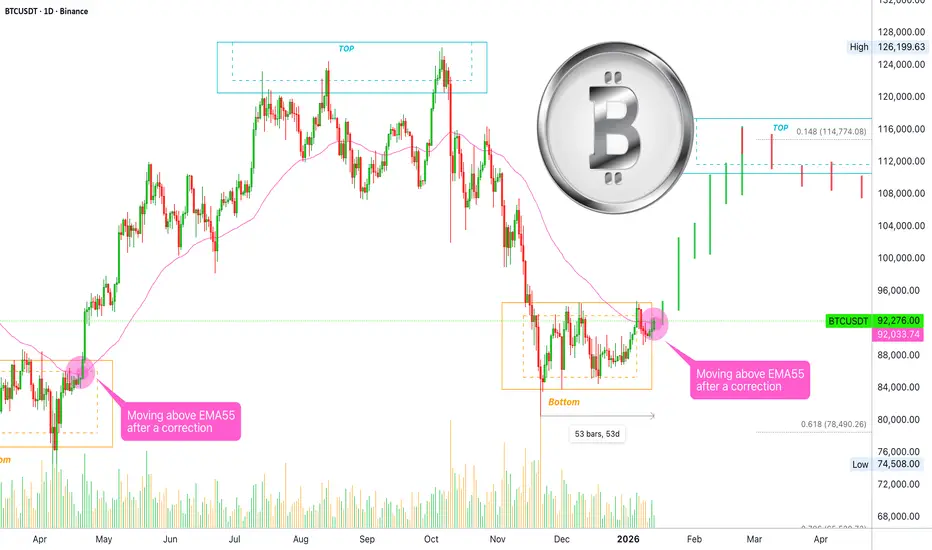
Bitcoin- Cyclical Bottom in the 80Ks leading to new ATH in 2026!I connected the major lows of the last two major corrections ever since BTC began its uptrend from the 37K swing low of January 2024. It appears BTC has completed the correction as per the cycle bottom to bottom half circles. Also, see how the price perfectly bounced off the diagonal support coming off from the January swing low! Next, I anticipate the price to make huge bullish pump to test the diagonal resistance! Next major cycle top I predict can happen in end of February to March 2026 time frame.
ADA/USDT | Cardano Pulls Back After the Rally! What's Next?CRYPTOCAP:ADA pushed all the way to $0.485 before getting hit with a sharp correction and right now price is trading near $0.40 which is roughly a sixteen percent drop from the recent high. Nothing major has changed in the broader structure because the key zone has always been the $0.32 to $0.36 demand range. If ADA drops into that area again I expect a fresh wave of buyers to step in just like the previous reactions.
For now I want to see if momentum cools down a bit more and whether ADA will revisit the deeper demand levels. That is still the zone where the next strong bullish leg can start building again.
Please support me with your likes and comments to motivate me to share more analysis with you and share your opinion about the possible trend of this chart with me !
Best Regards , Arman Shaban
Bitcoin Price History RhymesAs I look at the chart for CRYPTO:BTCUSD on the Weekly timeframe with Ichimoku overlayed the similarities to the 2021-2022 cycle top are eerie. Let's break down what I mean:
The key indicator of Ichimoku is price relative to the Kumo Cloud. A trend on the respective timeframe begins when price is above the cloud. I also use Chickou as momentum for confirmation. This means that the current Bull trend of Bitcoin began officially on the Weekly in November 2023.
The inverse to this rule is when price and momentum are on the opposite side of the cloud. The last Bear trend of Bitcoin began officially on the Weekly in May 2022.
So we can see how close Bitcoin is to true Bearish territory; getting below 80k and staying there for a prolonged time.
The other eerie similarity is the double false breakouts or "Spikes." If you learn ONE price action indicator remember the false breakout! There is no more reliable signal of reversal than when price makes a new high/low and then CLOSES back inside the prior range.
Once again this year as in 2021 there were two such signals weeks apart. It means that the market stopped buying at critical moments where breakouts should have occurred if price were to continue. These false breakouts are past being tradeable now but everyone should take note of just how frequent and reliable these instances are.
The Real Bitcoin Bottom: It’s in the Power BillThe Cost of Mining 1 BTC – Autumn 2025 Deep Dive
First of all, I want to say that I already made a similar publication in 2020 about the cost of Bitcoin, and we reached these levels (the chart is below).
Introduction: The Bitcoin mining industry in Autumn 2025 stands at a crossroads. Network difficulty has soared to all-time highs, squeezing miner profit margins as hashpower races ahead of price. The hashprice – the daily revenue per unit of hashing power – has slumped to record lows around $54 per PH/s-day (down from ~$70 a year ago). Analysts expect this metric to languish between $50 and $32 until the next halving in 2028, underscoring how challenging the economics have become. In this environment, understanding the cost to mine 1 Bitcoin is more crucial than ever. Below, we present a detailed comparison of popular ASIC miners and analyze which rigs remain profitable (or not) at current prices. We’ll also explore how the cost of production acts like a magnetic price level for BTC – often drawing the market down to this “floor” before a rebound – and what that means for investors now.
Cost to Mine 1 BTC by ASIC Miner Model (at $0.03–$0.10/kWh)
To quantify Bitcoin’s production cost, we compare leading ASIC miners from Bitmain, MicroBT, Canaan, Bitdeer, and Block. Table 1 below shows key specs and the estimated cost to mine one BTC under different electricity prices (from very cheap $0.03/kWh to pricey $0.10/kWh):
Key Takeaways:
Electricity price is the dominant factor in mining cost. At an ultra-cheap $0.03/kWh (possible in regions with subsidized power or stranded energy), even older-generation miners can produce BTC for well under $30k per coin. In our table, all models have a cost per BTC between ~$21k and $27k at $0.03/kWh – a fraction of Bitcoin’s current ~$90k–$95k market price.
At a mid-tier rate of $0.05/kWh (typical for industrial miners in energy-rich areas), the top machines still show healthy margins. Bitmain’s flagship S21 XP leads with roughly $36k cost per BTC, while other new-gen rigs fall in the ~$39k–$45k range. These figures imply profit margins of 50–60% for efficient miners at $0.05 power.
At a pricey $0.10/kWh (common for retail electricity or high-tariff regions), mining costs skyrocket. Only the very latest ASIC (S21 XP) stays comfortably below the current BTC price, at around $72k per coin. Most other models hover in the $78k–$90k range, meaning their operators are earning little to no profit at spot prices. In fact, at $0.10/kWh, a miner like the Avalon A15 Pro would spend about $89k to generate one BTC – essentially breakeven with Bitcoin at ~$90k. This illustrates why high-power-cost miners struggle or shut off during downturns.
Profitable vs. Unprofitable: Current Market Reality
Which miners are still profitable at today’s rates? Given Bitcoin’s price in the low $90,000s and typical industrial electricity around $0.05–$0.07/kWh, the newest generation ASICs remain comfortably profitable, while older, less efficient models are on the edge. For example:
Latest-gen winners: The Bitmain S21 XP – with industry-best ~13.5 J/TH efficiency – can mine a coin for roughly $36k at $0.05/kWh, leaving a huge cushion against price. Even at $0.07/kWh (a common hosting rate), its cost per BTC would be on the order of ~$50k, still well below market price. Other 2024–2025 flagship units (Whatsminer M60S++, Bitdeer A2 Pro, Block’s Proto) likewise have breakeven power costs around $0.12–0.13/kWh; they remain viable in most regions except the very expensive ones.
Older-gen on the brink: By contrast, an earlier-gen workhorse like the Antminer S19 XP ( ~21.5 J/TH) or similarly efficient rigs from 2021–2022 generation become marginal at moderate power rates. An S19 XP mining at $0.08/kWh sees its cost per BTC climb to roughly ~$94k (near current price), and at $0.10 it exceeds $110k (mining at a loss). Many such units are only profitable in locales with <$0.05 power. This is why we’ve seen miners with older fleets either upgrade or retire hardware as the margin for profitability narrows.
The efficiency gap: The spread between best-in-class and older miners translates directly into survivability. A miner burning 30–40 J/TH can only stay online if they have extremely cheap electricity or if BTC’s price is far above average production cost. As of Q4 2025, Bitcoin’s price is indeed high, but so is the network difficulty – meaning inefficient gear yields so little BTC that electricity costs outweigh revenue in many cases.
According to one industry report, the cost of mining 1 BTC varies widely across companies – from as low as ~$14.4k for those with exceptional power contracts (e.g. TeraWulf’s U.S. facilities) to as high as ~$65.9k for others like Riot Platforms, even before accounting for overhead. (Riot’s effective cost was brought down to ~$49.5k after cost-cutting measures.) This huge range shows how electricity pricing and efficiency determine which miners thrive. In early 2025, the situation became so extreme that CoinShares analysts found the average all-in production cost for public mining companies spiked to ~$82,000 per coin – nearly double the prior quarter (post-halving impact) – and up to $137,000 for smaller operators
ixbt.com
. At that time Bitcoin was trading around $94k, meaning many miners, especially smaller ones, were underwater and operating at a loss. In high-cost regions like Germany, the breakeven cost even hit an absurd ~$200k per BTC, making mining there utterly unviable.
Bottom line: At current prices, only miners with efficient rigs and reasonably cheap power are making money. Those with older equipment or expensive electricity have minimal margins or are already in the red. This dynamic naturally leads to miners shutting off machines that don’t profit, which in turn caps the network hashrate growth until either price rises or difficulty drops. It’s a self-correcting mechanism – one that ties directly into Bitcoin’s production cost acting as a market floor.
Production Cost as Bitcoin’s “Magnetic” Price Level
There’s a saying in the mining community: “Bitcoin’s price gravitates toward its cost of production.” In practice, the production cost often behaves like a magnet and a floor for the market. When the spot price climbs far above the cost to mine, it invites more hashing power (and new investment in miners) until rising difficulty pulls costs up. Conversely, if price falls below the average production cost, miners start to capitulate – selling coins and shutting rigs – until the difficulty eases and the market finds a bottom. This push-pull keeps price and cost loosely tethered over the long run.
Notably, JPMorgan’s research this cycle highlighted that Bitcoin’s all-in production cost (now around ~$94,000) has “empirically acted as a floor for Bitcoin” in past cycles. In other words, the market has rarely traded for long below the prevailing cost to mine, because at that point fundamental supply dynamics kick in. As of late 2025, they estimate the spot price is hovering just barely above 1.0 times the cost (~1.03x) – near the lowest end of its historical range. This implies miners’ operating margins are razor-thin right now, and any extended move significantly below ~$94k would likely trigger miner capitulation and supply contraction. In plainer terms: downside from here is naturally limited – not by hope or hype, but by the economics of mining. If BTC dropped well under the cost floor, many miners would simply turn off machines rather than mine at a loss, removing sell pressure and helping put in a price bottom.
History supports this magnetic pull. In previous bear markets, Bitcoin has tended to retest its production cost during the worst of capitulations. For example, during the late-2018 crash and again in the 2022 downturn, BTC prices plunged to levels that put numerous miners out of business. But those phases were short-lived. Prices found support once enough miners quit and difficulty adjusted downward, allowing the survivors to breathe. The market “wants” to stay near the cost of production, as that is a sustainable equilibrium where miners neither drop like flies nor earn excessive profits. Whenever price strays too high above cost, it usually invites a surge in competition (hashrate) that raises the cost floor; when price sinks too low, hashpower falls until cost drops to meet price. It’s an elegant economic dance built into Bitcoin’s design.
Why Price Often Meets Cost Before Rebounding
If Bitcoin production cost is a de facto floor, why do we often see price fall all the way down to it (or even briefly below it) before the next big rally? The answer lies in miner psychology and market cyclicality:
Miner Capitulation & Shakeouts: Markets are cruel to the over-leveraged and inefficient. During bull runs, miners expand operations, often taking on debt or high operating costs under the assumption of continually high prices. When the cycle turns, Bitcoin’s price can free-fall toward the cost of production, erasing margins. The weakest miners (highest costs or debt loads) capitulate first – selling off their BTC reserves and unplugging hardware. This wave of forced selling can push price right to (or slightly under) the cost floor, marking a final “shakeout” of excess. Only when the weakest hands are flushed does the market rebound. It’s no coincidence that major bottoms often align with news of miner bankruptcies or mass liquidations.
The Iron Law of Hashrate: Miners are competitive and will run at breakeven or even slight loss for some time, hoping for recovery, rather than quit immediately. This means the network can temporarily operate above sustainable difficulty levels. Eventually, however, reality sets in. When enough miners can’t pay the bills, hashrate plateaus or drops, halting difficulty growth or causing it to decline. At that inflection point, the cost of mining stabilizes (or falls), giving relief to the remaining miners. The stage is set for price to rebound off the now-lower equilibrium. In essence, Bitcoin often has to tag its production cost to force a network reset and purge imprudent operators. Only after that cleansing can a fresh uptrend begin with a healthier foundation.
Investor Sentiment at the Floor: From a contrarian market perspective, a convergence of price and production cost typically corresponds with maximum pessimism. If Bitcoin is trading at or below what it “should” cost to make, it signals extreme undervaluation to savvy investors. In late 2022, for instance, estimates of BTC’s cost basis in the $18k–$20k range coincided with the market trading in the mid-$15k’s – a level where miners were going bankrupt and sentiment was in the gutter. Yet those willing to be greedy when miners were fearful reaped the rewards when price recovered. The same pattern could be unfolding now in late 2025: the public is fearful of Bitcoin’s recent pullback, but its cost floor (~$94k) suggests fundamental value support. Smart money knows that when price meets cost, downside is limited and upside potential grows.
Conclusion – Steeling Ourselves at the Cost Floor
In EXCAVO’s signature fashion, let’s cut through the noise: Bitcoin’s production cost is the line in the sand – the magnetized level where price and reality meet. As of Autumn 2025, that line hovers in the mid-$90,000s, and Bitcoin has indeed been gravitating here. The data shows miners barely breaking even on average. This is a make-or-break moment. If you’re bullish because everyone else is, check your thesis – the real reason to be bullish is that BTC is scraping its cost floor, a level from which it has historically sprung back with vengeance. Conversely, if you’re panicking out of positions now, remember that you’re selling into the teeth of fundamental support. The market loves to punish latecomers who buy high and sell low.
Yes, the mining industry is under stress; yes, the headlines scream fear. But those very pressures are what forge the next bull run. Every miner that shuts off today is one less source of sell pressure tomorrow. Every uptick in efficiency raises the floor that much higher, like a coiled spring tightening. Bitcoin has been here before – when production cost and price locked jaws in late 2022, and again in early 2025 post-halving. Each time, the doom and gloom was followed by a dramatic recovery as the imbalances corrected.
Our contrarian take: The cost of mining 1 BTC isn’t just a number on a spreadsheet – it’s the secret pulse of the market. Right now it’s telling us that the bottom is in or very near. Prices might chop around this magnet a bit longer, even dip slightly below in a final fake-out, but odds of a deep crash under the ~$94k cost basis are slim. The longer Bitcoin grinds at or below miners’ breakeven, the more hashpower will fall off, quietly tightening supply. When the spring releases, the next upward leg could be explosive (as even mainstream analysts like JPMorgan are eyeing ~$170k targets).
In summary, Bitcoin tends to revisit its production cost for one last test – and when it holds, it launches. Autumn 2025 appears to be giving us that test. The savvy, data-driven operator will view this not with panic, but with patience and resolve. After all, if you can accumulate Bitcoin near its intrinsic mining value while the herd is fearful, you position yourself on the right side of the trade once the inevitable rebound kicks in. As the saying goes, bears win, bulls win, but miners (and hodlers) who understand the cost dynamics win big in the end. Brace yourself, stay analytical, and remember: Bitcoin’s true floor is built in watts and hashes, and it’s solid as steel.
Best regards EXCAVO
here's how bitcoin reaches 185k part 2.good morning,
in my last btc post i promised you my macro btc analysis if the post reached 5 likes,
so here you are.
---
the count is extremely simple;
from the 2022 bear market lows, btc has come up quite impulsively.
i label the entire leg from september 2023 -> october 2025 as a wave (3).
if you look closely, none of the waves overlap in this leg.
sure it might have an unconventional look, but it's not invalid by any technical standards.
---
if i'm correct with my analysis, wave (5) should see an equal appreciation as the length of wave (1) - could become slightly longer, too. usually in cases such as this, you can measure the distance of wave (1) and project it out from the bottom of wave (4);
> look for 100.00% - 123.60% - 161.80% extensions.
this puts the average upside target between 161k - 248k
---
we have had a sustained reading of extreme fear almost all month.
btc is at the bottom of the bullish pitchfork.
most people have given up hope. (bullish contrarian signal)
business cycle has yet to top.
fed man stopped quantitative tightening and has hinted at a balance sheet expansion.
aggressive rate cuts.
monthly hidden bullish divergence present between wave (2) and wave (4) pivot lows.
we are flipping previous cycle highs into support (horizontal support).
bitcoin capitulation metric has hit an all time high this cycle (each one has marked a major low).
---
all of this leads me to believe that we are not finished with the current bull trend.
---
🎯 = 185k
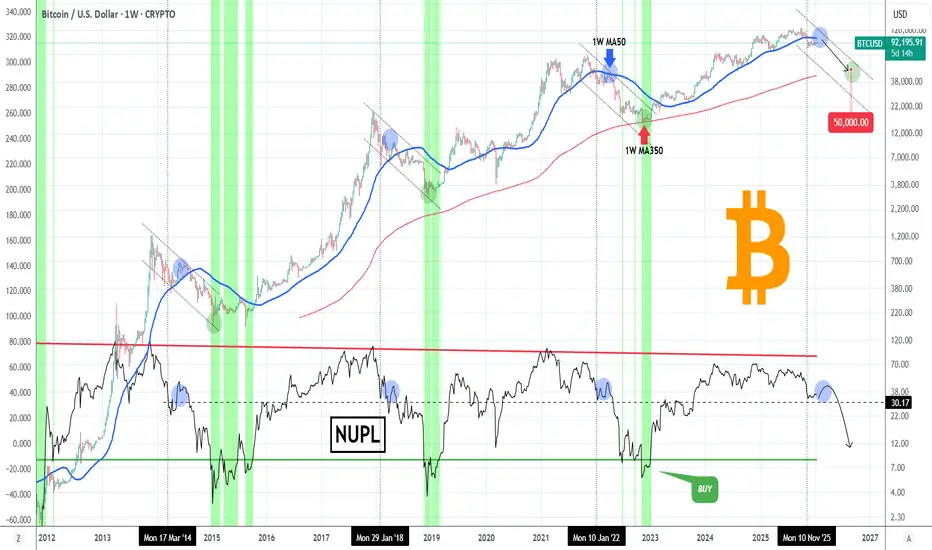
BITCOIN following the same blueprint as all previous Bear CyclesBitcoin (BTCUSD) has been falling non-stop since its October All Time High and all the signs continue to be there that we have already entered the new Bear Cycle.
We've been sharing extensive analyses with you since September on the markers of the Bear Cycle and the latest indicator that adds to the data set is the STOCH on the 3W time-frame.
As you can see, it has entered a level where all previous three Bear Cycles completed roughly their 1st Phase and rebounded on a dead-cat-bounce. On average it i roughly after every three 3W candles that this happens, this time it was after two, the previous two Bear Cycles after three and the one before (longest) after six.
Also this is the fastest it's reached the 1W MA100 (red trend-line) on a Bear Cycle correction and most likely it will be the same for its 3W MA50 (blue trend-line) and 3W MA100 (green trend-line).
This is another sign that shows how every Cycle gets less and less aggressive. The first Bear Cycle dropped by roughly -94%, the second by -87%, the third by -84% and the fourth (last) by 77%. This decelerating rate reveals BTC's asymptotic behavior as more and more mass adoption kicks in with every passing Cycle. As the market stabilizes, becomes larger and more widespread, the volatility becomes lower and lower. This is a sign of maturity.
So what does this potentially mean for us and this Bear Cycle? Well that the drop will most likely be contained at -70% maximum (-7% less than the previous Cycle), a rate that may be as low as -60% (just after contacting the 3W MA100) if ETF buying interest returns or other fundamental catalysts (bitcoin treasuries etc?) accelerate adoption. So this potential range translates into a possible buy zone of $50000 - $38000 towards the end of 2026 but that's a topic we've analyzed extensively on other studies.
So do you think the 3W STOCH puts another nail on Bitcoin's coffin or there are still hopes that the Bull Cycle will be resumed? Feel free to let us know in the comments section below!
---
** Please LIKE 👍, FOLLOW ✅, SHARE 🙌 and COMMENT ✍ if you enjoy this idea! Also share your ideas and charts in the comments section below! This is best way to keep it relevant, support us, keep the content here free and allow the idea to reach as many people as possible. **
---
💸💸💸💸💸💸
👇 👇 👇 👇 👇 👇
GBP/USD | Another try at supply zone? (READ THE CAPTION)As you can see, GBPUSD has managed to break free from the 1.3347-1.3367 supply zone. At the moment it is being traded at 1.33860 level and I expect it to challenge the 1.34300-1.34570 supply zone. It has been rejected once, now let's wait and see if it makes it up there and breaks through the supply zone. I expect a drop after reaching the supply zone.
ETH – Base Building After the PullbackHello everyone,
ETH has stabilized after a sharp correction from the 4,500–4,800 zone. In recent weeks, price has been moving slowly within the 3,000–3,200 range, forming a relatively solid accumulation base. On the weekly timeframe, the bearish structure has weakened significantly, and the market appears to be preparing for a potential trend shift as multiple supportive signals begin to emerge.
The most important highlight is that ETH has reclaimed the weekly EMA89 around the 3,050 level and has managed to hold above it . Staying above the EMA89 suggests that long-term selling pressure has eased and that dip-buying flows are returning. On the upside, the weekly EMA34 at 3,380–3,400 remains a key resistance zone — a level bulls must break to clearly confirm a new bullish leg.
The current price structure also supports a recovery scenario. The 2,800–2,900 zone has formed the first higher low after the prolonged decline, indicating strong absorption of selling pressure. Weekly candles continue to print long lower wicks with relatively small bodies, showing that sell-offs at lower levels are being aggressively absorbed. At the same time, volume has been gradually improving, reflecting accumulation by longer-term investors rather than speculative flows.
Given this context, ETH is likely to continue ranging between 3,000 and 3,400 to further build its base. A clear weekly close above 3,400 would serve as confirmation that the corrective structure has been broken, opening the door for a new upside phase. The next upside targets would be in the 3,750–3,900 area, and if capital inflows strengthen, an extended move toward 4,200–4,400 is possible — aligning with a major prior resistance cluster.
Wishing you all a successful trading day!