SOL 1D Update: Looking good here I was initially leaning toward SOL pushing lower within the broader descending channel, especially with price continuing to respect the downtrend structure and failing to reclaim prior resistance. The expectation was for another sweep toward lower channel support before any meaningful bounce.
However, price action is starting to shift. Instead of continuation lower, SOL is showing responsive buying around the $125 area and is now pushing higher, breaking the short-term pattern of lower highs. This move looks more impulsive than the prior bounces, which suggests demand is stepping in earlier than expected.
The $125–130 zone is acting as an important pivot. Holding above this area keeps the door open for a larger relief move. If this push sustains, the next area to watch is the mid-channel and then the $160–180 region, which lines up with prior consolidation and resistance.
While the higher timeframe downtrend has not been fully invalidated yet, this pump shifts the short-term bias from expecting downside continuation to respecting the possibility of a deeper corrective rally. I’m adjusting with price and watching to see if this move can build acceptance above support rather than fade immediately.
This is a good reminder that strong trends can end with a whimper, not a final flush, and price strength should be respected when it shows up.
Btc-e
BTC/Gold A Simple Signal That Has Worked Only 4 Times in HistoryThe BTC/XAU (monthly) chart has produced only four clear local bottom signals throughout its entire history.
This is a deliberately simple, noise-free setup. No indicators overload, no short-term speculation—just relative strength between Bitcoin and gold.
Each of these historical bottom zones marked periods where Bitcoin stopped underperforming gold and began a new phase of relative outperformance. In other words, these were moments when risk appetite slowly rotated back from a defensive asset (gold) into a risk asset (Bitcoin).
What makes this signal powerful is its rarity.
It doesn’t trigger often—but when it does, it tends to coincide with major regime shifts, not short-term trades.
The current level once again sits near a historically significant zone.
Whether this becomes another confirmed bottom will be decided by time and follow-through, but historically, this is where long-term investors start paying attention—not chasing price, but watching the ratio.
Bitcoin Buy/Long SignalIf you’ve been following us, you know that we’ve consistently been looking for buy/long opportunities on Bitcoin from lower prices.
Considering a bullish CH, a BOS, and the formation of higher lows, we are looking for buy/long positions around support zones. Overall, conditions for buying/going long on Bitcoin appear stable. If price reaches the entry area, we will enter the trade.
Entry range: 86954
Targets: 90547 _ 94094 _ 97540
Stop: 82787
Levrage: 6X _ 10X
Balance: 5% of capital
For risk management, please don't forget stop loss and capital management
When we reach the first target, save some profit and then change the stop to entry
Comment if you have any questions
Thank You
Wyckoff's Everywhere? Or Hallucinations?Is anyone else seeing Wyckoff distributions all over the place in stocks right now? I feel like I saw one and then started noticing them everywhere on major stocks
Bitcoin has one, started back in July and is straight out of a TA textbook. The prior cycles, Crypto peaked 1st being the most sensitive to liquidity changes.
Seems Bearish
Seems Bearish
However, TSM looks bullish!
It was forming a similar pattern but appears to be breaking out to the upside. If other stocks can follow this track things could keep going.
Happy New Year!
Hello, traders!
If you "Follow" us, you'll always get the latest information quickly.
Have a great day.
-------------------------------------
(BTCUSDT 12M Chart)
The pattern of a 3-year uptrend and a 1-year downtrend appears to have undergone a slight change, with the 2025 bearish candlestick closing.
The key areas to consider are the 69K-73K range and the 42K-44K range.
Prices below the 42K-44K range are expected to be unseen again.
Therefore, as the price approaches these levels, it's a good time to buy from a long-term perspective.
If the price declines near the Fibonacci level of 1.618 (89050.0), it could touch the 69K-73K range.
However, just as it failed to reach the expected target level of 2.618 (133889.92), the decline could also fall short of the 69K-73K range.
Therefore, if the price declines from 1.618 (89050.0), we need to check for support near 1.414 (79902.66).
Considering the previous pattern of three-year upswings and one-year downswings, 2026 is expected to be a challenging year, so caution is advised when trading.
The Fibonacci ratios currently displayed on the chart are based on the second wave.
Therefore, the Fibonacci level 3.618 (178729.84), which appears to be the end of the second wave, is expected to be the target area for the next bullish trend.
-
(1M chart)
Since the HA-High indicator on the 1M chart formed at 110105.69, a decline is likely until it meets the DOM (-60) or HA-Low indicators.
Currently, the price is positioned near the StochRSI 50 indicator and the M-Signal indicator on the 1M chart, and the StochRSI 20 indicator is showing signs of forming a new line.
Therefore, support near the Fibonacci level 1.618 (89050.0) is crucial.
If the price declines, the DOM (-60) indicator and the HA-Low indicator are expected to form a low soon. Therefore, we need to check for support near the previously mentioned levels:
1st: Fibonacci 1.414 (79902.66),
2nd: 69K ~ 73499.86.
For the price to rise at a key point or range and continue the uptrend, the StochRSI, TC, and OBV indicators must show upward trends.
Currently, the StochRSI indicator is showing signs of entering an oversold zone,
the TC indicator is showing a downward trend below 0,
and the OBV indicator is showing a downward trend between the Low Line and High Line.
-
(1W Chart)
Since this is currently a volatile week, we need to monitor the movements below this week.
The next volatile week is expected to occur around the week of January 26th.
Therefore, the key is whether the price can rise along the uptrend line and remain above the M-Signal indicator on the 1M chart.
If it fails to do so and falls, a downward trend is expected, as mentioned earlier.
My basic trading strategy is to buy in the DOM(-60) ~ HA-Low range and sell in the HA-High ~ DOM(60) range.
Therefore, a decline in the HA-High ~ DOM(60) range can be considered a normal decline, and it is difficult to determine a buy point at this time.
Therefore, I recommend waiting until the DOM(-60) or HA-Low indicators are met.
-
(1D Chart)
The HA-Low indicator on the 1D chart is forming at 87944.84, so the key question is whether it can find support near this level and rise.
However, since the M-Signal indicator on the 1M chart is passing, it's crucial to see if the price can rise above it and maintain its upward momentum.
Including these factors, a rise in the 84739.74 ~ 93.5K range is highly likely to trigger an uptrend.
The next period of volatility is expected to be around January 10th, so we should monitor whether the price rises along the rising trendline (1) after this period.
We should also monitor whether the price can break above the rising trendline (2).
The TC indicator is above zero,
and the OBV indicator is rising above the High Line to see if it can be sustained.
The StochRSI indicator is falling in the overbought zone.
Therefore, I believe that for the uptrend to continue, the StochRSI, TC, and OBV indicators must show upward trends.
If the price finds support in the 84739.74 to 87944.84 range (DOM(-60) to HA-Low range on the 1D chart) and rises, and the StochRSI, TC, and OBV indicators show upward trends, the uptrend is expected to continue.
As mentioned in the 12M chart explanation, this year is expected to be a difficult year. Therefore, when trading spot, it's important to increase the number of coins (tokens) corresponding to profits. When trading futures, it's important to minimize losses by trading short positions. This will prevent you from missing opportunities due to insufficient funds when the trend turns upward.
It's best to increase the number of coins (tokens) representing profit during a stepwise downtrend.
This is because a stepwise downtrend usually ends in an uptrend.
A stepwise downtrend occurs when the price falls between DOM (-60) and HA-Low.
However, because it's difficult to predict the end of a downtrend, you must carefully distribute your purchase amounts.
Furthermore, when profit is generated by each purchase price, you should sell the amount equal to the purchase price, leaving the coins (tokens) representing profit.
This will quickly convert to profit when the price rises.
-
Thank you for reading to the end.
We wish you successful trading.
--------------------------------------------------
BITCOIN - Flat holding back the market. Focus on 90K...BINANCE:BTCUSDT.P is forming a local uptrend, based on cascading support generated by the market during low (holiday) liquidity.
Fundamental support for Bitcoin and the cryptocurrency market is still absent, or not felt. Accordingly, it's too early to talk about a bullish reversal, rally, or pump. The daily chart shows a downtrend and consolidation in a flat/symmetrical triangle pattern. The zone of interest (liquidity area) is 89950 - 90600. A false breakout/short squeeze could shift the imbalance toward bears and trigger a reversal and decline within the current trading range, which in turn could trigger a decline in the altcoin market.
Resistance levels: 89950, 90600, 91900
Support levels: 88000, 86800, 85000
A localized upward movement amid a global downtrend, as long as this zone is not broken, can be considered a counter-trend correction. A short squeeze through the liquidity zone could trigger a bluer price move toward lower zones of interest, such as 88K - 85K.
Sincerely, R. Linda!
BTCUSDT – Chart Update. BTCUSDT – Chart Update
Price compressing inside an ascending triangle
Higher lows holding → bullish structure intact
Key resistance: 89.5K–90K
Break & hold above = momentum move toward 92K–95K
Support: 87K–86K zone
👉 Patience here. Expansion coming after the breakout.
Not financial advice
ETH — Price Slice. Capital Sector. 3134.34 BPC 2.5© Bolzen | The Architect | BPC Framework
Bolzen Market Institute
🏷 ETH — Price Slice. Capital Sector.
TradingView Publication Date: 01.01.2026
🏷 3134.34 — price not yet reached at time of publication.
🏷 BPC — The Bolzen Price Covenant — Strength Index: 2.5
Quantum structure of obligations and capital flow in price formation via energy blocks.
🏷 Vertical chart — Energy Grid Dashboard.
🏷 Static Stream 1: price published in energy-block production sequence.
🏷 The price energy block is already ordered—not by time, but by execution priority. Crucially: block priority dynamically reconfigures in response to hidden energetic impulses, whereas price execution order records their market manifestation. Every price in the dynamic stream is tied to proprietary energy-production metrics inaccessible to the general public. Those who perceive structure before its manifestation do not follow price—they anticipate it.
EΞ2Φ8Ψ45Θ·ζ⁻¹·106Λ732·Ω²
📎 Screenshot:
🏷 When trading from levels, use liquidity zones from BPC 10 and above.
🏷 Bolzen Liquidity Map — ETH (numerical equivalent):
🏷 I. Interactive Reference Guide: BPC — The Bolzen Price Covenant
🏷 P.S. English is not my native language — I offer no apologies for stylistic imperfections. What you see here is not a post. It is a demonstration of another level of preparation: the symbiosis of human intuition and algorithmic precision. Mathematics and aggressive market analysis — against the machine of liquidations.
— The Architect
BPC — The Bolzen Price Covenant
ETH — Price Slice. Capital Sector. 3120.34 BPC 5.1© Bolzen | The Architect | BPC Framework
Bolzen Market Institute
🏷 ETH — Price Slice. Capital Sector.
TradingView Publication Date: 01.01.2026
🏷 3120.34 — price not yet reached at time of publication.
🏷 BPC — The Bolzen Price Covenant — Strength Index: 5.1
Quantum structure of obligations and capital flow in price formation via energy blocks.
🏷 Vertical chart — Energy Grid Dashboard.
🏷 Static Stream 1: price published in energy-block production sequence.
🏷 The price energy block is already ordered—not by time, but by execution priority. Crucially: block priority dynamically reconfigures in response to hidden energetic impulses, whereas price execution order records their market manifestation. Every price in the dynamic stream is tied to proprietary energy-production metrics inaccessible to the general public. Those who perceive structure before its manifestation do not follow price—they anticipate it.
EΞ2Φ8Ψ45Θ·ζ⁻¹·106Λ732·Ω²
📎 Screenshot:
🏷 When trading from levels, use liquidity zones from BPC 10 and above.
🏷 Bolzen Liquidity Map — ETH (numerical equivalent):
🏷 I. Interactive Reference Guide: BPC — The Bolzen Price Covenant
🏷 P.S. English is not my native language — I offer no apologies for stylistic imperfections. What you see here is not a post. It is a demonstration of another level of preparation: the symbiosis of human intuition and algorithmic precision. Mathematics and aggressive market analysis — against the machine of liquidations.
— The Architect
BPC — The Bolzen Price Covenant
HYPE – At a Crossroads After a Small Weekly GainHYPE wrapped up the week in green with a modest +2% gain, but the broader picture remains cautious. Price action is still capped by the $26 resistance, a key level that needs to be broken for any real bullish momentum to emerge. Until then, upside moves may continue to stall.
🔻 Downtrend Still Dominates
Since late September, HYPE has been in a strong downtrend, losing over 60% of its value. That said, the asset found strong support at $22, which triggered a recent bounce. This support zone now serves as a critical level to hold if bulls hope to defend against further losses.
⚠️ Outlook: Weak Until Key Levels Break
Despite the bounce, the downtrend structure is still intact. Bulls need to reclaim $26, and ideally make a strong push above $30, to suggest a trend reversal and spark broader interest. Until that happens, rallies may remain short-lived and corrective in nature.
🕵️♂️ Keep an eye on price action around $26–$30 for confirmation of any shift in trend.
BTC 1D Update: The pump is starting... Looking good so far Bitcoin is starting to look constructive again on the daily. After the sharp selloff from the highs, price has spent time basing and stabilizing rather than continuing lower. The recent price action is showing tighter ranges, reduced downside momentum, and a gradual shift from impulsive selling to consolidation.
The $72k–73k region remains the major higher timeframe support and has held convincingly so far. Since bouncing from that area, BTC has been forming a short-term range with higher lows, suggesting sellers are losing control. This kind of behavior typically precedes expansion rather than continuation lower.
The $88k–90k zone is acting as the current pivot. Holding above this area keeps the short-term structure neutral to bullish. A clean reclaim and hold above $92k–95k would be an early signal that the market is ready to push back toward the $100k region and eventually challenge the prior range highs near $108k.
What stands out is the broader market context. We’re starting to see strength and momentum return across parts of the crypto market, with selective alts beginning to catch bids. That usually happens when Bitcoin stops trending down and transitions into accumulation or early expansion.
As long as BTC continues to hold above the mid-range and avoids another impulsive breakdown, I view this as a constructive reset rather than a topping structure. The bias shifts toward patience and looking for continuation setups, with invalidation on a loss of the recent range lows.
Overall, Bitcoin is starting to look better structurally, and the return of upside momentum across crypto supports the idea that this consolidation may resolve higher rather than lower.
Bitcoin 1MONTH vs Bitcoin 1WEEK vs Bitcoin 1DAY from 2023Here's a comparison that no one seems to see or be talking about. We could be on the precipice of the next major rally if Bitcoin's 1MONTH and 1DAY charts tell us what we could see next on the 1WEEK chart. This is the BULLISH scenario that would defy the 4 year cycle.
#BTC/USDT Let Bitcoin make a new ATH#BTC
The price is moving in a descending channel on the 1-hour timeframe. It has reached the lower boundary and is heading towards a breakout, with a retest of the upper boundary expected.
We are seeing a bearish bias in the Relative Strength Index (RSI), which has reached near the lower boundary, and an upward bounce is expected.
There is a key support zone in green at 87300, and the price has bounced from this level several times. Another bounce is expected.
We are seeing a trend towards stabilizing above the 100-period moving average, which we are approaching, supporting the upward trend.
Entry Price: 87988
First Target: 88350
Second Target: 88722
Third Target: 89287
Remember a simple principle: Money Management.
Place your stop-loss order below the green support zone.
For any questions, please leave a comment.
Thank you.
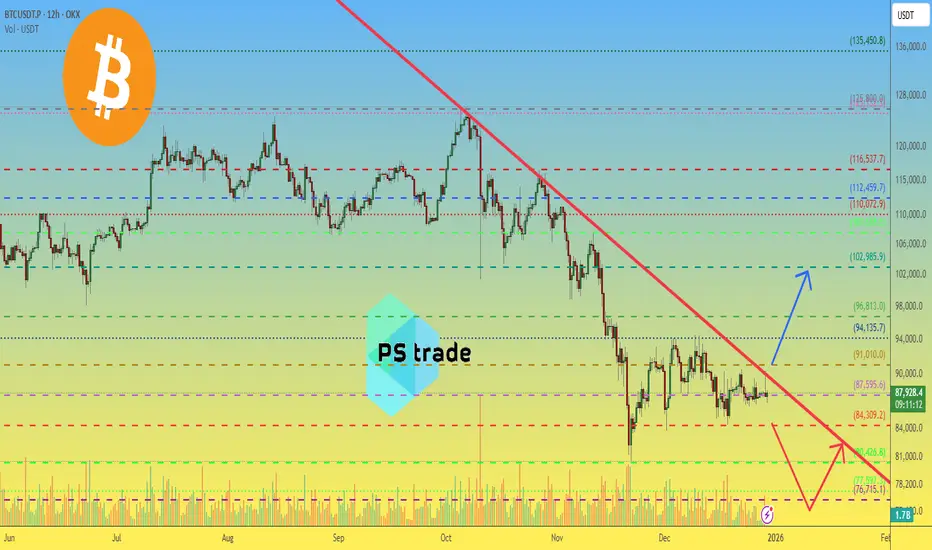
Bitcoin BTC price analysis#Bitcoin remains in a compression phase between key structural levels.
A failed attempt to break the descending trendline resulted in a bearish 12H pin bar, increasing the probability of a short-term move toward $84,500.
Key OKX:BTCUSDT levels:
• Resistance: $91,000 → $94,000–95,000
• Support: $84,000–84,500
• Major downside target if support fails: $75,000–77,000
On the monthly timeframe, a sweep into the $75–77K zone in early January aligns with historical market behavior observed in early 2025-type structures.
Bullish continuation requires a clean break and acceptance above $91K, followed by short liquidation fuel above $94K.
Question for traders:
Will CRYPTOCAP:BTC resolve this range to the downside first, or can buyers reclaim control before year-end?
______________
◆ Follow us ❤️ for daily crypto insights & updates!
🚀 Don’t miss out on important market moves
🧠 DYOR | This is not financial advice, just thinking out loud
$BTC 4h Time-based fractalsYou can interpret this fractal however you like, but structurally it still makes sense. We did get an extension at the highs, yet the current compression looks normal and not particularly concerning.
This type of pause often leads to a more controlled, slow grind higher. As long as price continues to hold the 88–87k area, a retest of the 97–100k zone remains reasonable before another breakdown.
Bitcoin Is Not Breaking Out Yet — This Is Classic Box Accumu....Hello everyone,
On the H1 timeframe, the key focus right now is not chasing an immediate breakout, but recognizing that Bitcoin is still consolidating inside a well-defined accumulation box. Despite several sharp intraday swings, price continues to respect clear boundaries, signaling balance rather than trend.
Structurally, BTC has been rotating between the 86,500 support zone and the 90,300–90,400 resistance zone. Multiple attempts to push higher have stalled below resistance, while every pullback into support has been absorbed quickly. This repeated back-and-forth price action is characteristic of box accumulation, where liquidity is being built before a directional expansion.
The recent impulsive rally toward the upper range was followed by an equally sharp rejection, but crucially, price did not break down. Instead, BTC stabilized above the mid-range and began forming higher short-term lows, suggesting that sellers are losing momentum near the bottom of the box while buyers remain active.
From a price action perspective, the market is printing overlapping candles and compressed swings, confirming that this is not a trending environment yet. The projected path on the chart reflects a typical accumulation outcome: continued rotation inside the box, potential liquidity sweeps, and only then a decisive move.
Key levels to watch:
Resistance zone: 90,300–90,400 — range high and breakout trigger.
Support zone: 86,500–86,800 — range low and structural defense.
Mid-range: ~88,500 — equilibrium area where noise dominates.
A clean breakout and acceptance above resistance would confirm bullish continuation and open the door for upside expansion. Conversely, a decisive breakdown below support would invalidate the accumulation structure and shift the bias lower. Until one of these conditions is met, Bitcoin remains range-bound and in preparation mode, not trending.
Wishing you all effective and disciplined trading.
Liquidity Builds Before the Real MoveOn the 1H timeframe, Bitcoin remains locked inside a clearly defined sideways range, bounded by a support zone around 86,700–87,000 and a resistance zone near 90,300–90,600. Price is currently trading around 88,500, which places it firmly in the middle of the range — a location that typically favors indecision rather than directional conviction.
From a market structure standpoint, Bitcoin has repeatedly failed to establish acceptance above the resistance zone. Each impulsive push into the 90K area has been met with swift rejection, signaling that sell-side liquidity remains active at the highs. These reactions confirm that the resistance is not yet weakened and continues to cap upside attempts.
On the lower boundary, the support zone has been respected multiple times, producing consistent rebounds. However, these reactions have become increasingly corrective rather than impulsive. This suggests absorption and balance, not aggressive accumulation. As long as price holds above this zone, downside continuation remains limited, but the lack of strong follow-through keeps the market range-bound.
The current price action shows compression and volatility contraction, a classic behavior ahead of expansion. Liquidity is being built on both sides of the range. A sustained break and acceptance above 90,600 would be required to confirm a bullish continuation scenario, while a clean loss of 86,700 support would expose lower liquidity pools and shift the bias decisively bearish.
From a broader macro perspective, Bitcoin remains sensitive to overall risk sentiment and liquidity conditions. With no clear macro catalyst or volume expansion visible at this stage, the market continues to favor range rotation rather than trend development.
In summary, Bitcoin is not trending it is consolidating. Until price decisively exits the 86,700–90,600 range, traders should prioritize reaction at key levels, patience, and disciplined risk management, rather than anticipating a breakout prematurely.
Bitcoin Builds a Base Below SupplyOn the 1H timeframe, Bitcoin is currently trading inside a well-defined range, capped by a clear resistance zone around 90,000–90,300 and supported by a key demand area near 87,700–88,000. Price has recently rebounded from the lower boundary of the range, indicating that buyers are still active at support, but the market has not yet transitioned into a trending environment.
From a structure perspective, the prior impulsive sell-off broke short-term bullish momentum and shifted BTC into a range-building phase. Since then, price action has been characterized by higher lows from support, but each upside attempt remains corrective and constrained beneath resistance. This behavior suggests balance and compression, not a confirmed breakout setup yet.
The 34 EMA and 89 EMA are beginning to flatten and converge, with price oscillating around them. This alignment typically reflects neutral momentum, reinforcing the idea that the market is waiting for new information or liquidity before committing to a directional move. As long as price remains below the resistance band, upside moves should be viewed as range rotations, not trend continuation.
The projected path toward resistance represents a mean-reversion move within the range, where liquidity is likely resting near the upper boundary. A clean breakout would require strong acceptance above 90,300, supported by increased volume and sustained closes above that level. Without those conditions, the probability of rejection and rotation back toward support remains elevated.
From a macro standpoint, Bitcoin is entering a period where expectations around monetary policy in the coming year are already partially priced in. This reduces the likelihood of an immediate, sentiment-driven breakout unless accompanied by a clear shift in liquidity conditions or risk appetite. As a result, the current structure favors patience and range awareness, rather than directional bias.
In summary, Bitcoin is constructively consolidating, but still structurally neutral. The market is preparing for expansion, yet direction remains unresolved. Until resistance is decisively reclaimed, Bitcoin should be treated as range-bound, with both upside and downside scenarios remaining technically valid.
Accumulation Continues — Expansion Needs a Breakout.BITSTAMP:BTCUSD is stuck in a clear accumulation range, with price rotating between the 86,000 support zone and the 90,200–90,800 resistance area. Repeated rejections near the top of the range show supply remains active, while buyers continue to defend dips, keeping structure balanced rather than trending.
The EMA cluster is flattening, reinforcing range conditions and liquidity rotation. Directional expansion will require a clean break from this box.
Key Levels
Resistance: 90,200 – 90,800
Support: 86,000 – 86,500
Range focus: 86,000 – 90,800
➡️ Primary: hold above 86k → range continuation → push back toward 89.5k–90.8k.
⚠️ Risk: loss of 86k → downside sweep into lower demand before reassessment.
BTC: The 15-Year Prophecy (Hosoda Time & The Diagonal)There is a ghost in the machine.
For the last few months, amidst the noise of breakouts and new highs, a specific signal has been flashing a warning that defies the rules of a standard Bull Market. It is a "glitch" in the data—a silence where there should be noise.
Most are ignoring it. Some are confused by it. Today, we are going to try solving it.
Below is the full evolution of the Bitcoin setup, from the Daily traps to the Macro truth, revealing why the "Silence" is actually the loudest signal we have ever seen.
Part 1: The Micro Trap (1D Chart)
Zooming into the daily timeframe, the structure of the decline is textbook. We are currently navigating Wave (4), but the context provided by the previous move is critical.
The "Extended" Wave 3: The drop we just witnessed wasn't a standard correction; it was an impulsive sell-off where Wave 3 was extended. when the third wave extends, it confirming strong momentum in the direction of the trend. The bears are in control.
Current Status (Wave 4): We seem to be in the middle of a Wave (4) relief rally, potentially unfolding as an ABC correction.
Sub-waves 'a' and 'b' appear complete, with 'b' potentially establishing a local higher low.
What's Next: We are likely waiting for Wave 'c' to expand upwards to potentially complete the structure.
The Potential Resistance ($99k): If this structure holds, Wave 'c' might push towards the resistance confluence around $99,323. This area could serve as a ceiling for this corrective phase.
The Downside Risk ($79k): Traders should remain cautious. If Wave (4) finds resistance near $99k, the Elliott Wave guidelines suggest a Wave (5) decline could follow. If that scenario plays out, the market might target the major support zone near $79,000.
Part 2: The Time Anomaly (1W Chart)
While the daily chart showed us the immediate price action, the Weekly chart reveals the true scale of the move. As discussed in previous updates, we are navigating a large-scale Irregular Flat Correction, and we are currently at the tail end of Wave (1) of the 5-wave impulse that makes up the larger C-Wave.
So, the entire impulsive structure we just analyzed on the Daily chart? That was just the first leg of this Weekly move.
☁️ The Ichimoku Signal: Testing "Senkou Span B" Price action has now entered the Ichimoku Cloud (Kumo), a critical zone of turbulence.
The Level: you can see candles trading inside the cloud. We have already tested the bottom support, specifically the Leading Span B (Senkou Span B).
The Forecast: Hitting this level signals that Wave (1) is either ending or has already ended. However, the market rarely makes it easy. I am expecting a potential "False Breakout" below the Cloud to trigger panic, followed by a sharp reclamation. That fake-out would likely mark the bottom of Wave (1) and start of Wave (2).
⏳ The Time Anomaly: Why so fast? There is a strange disconnect in the "Time" dimension of this cycle compared to history (see picture).
2021 Cycle: In the previous bull run, the correction for Wave 1 typically took 70 days to cool the RSI down to 37.
Current Cycle: We have smashed down to an RSI of 35.8 in just 42 days.
The Question: Why is the market correcting nearly twice as fast as before? This "Time Compression" indicates the cycle is moving faster and more violently than we are used to.
The "BBWP Mystery" Finally, look at the BBWP (Volatility) in the below picture. This presents a genuine anomaly. Throughout this cycle, we have seen contractions many times, yet the spectrum never reached the extreme 90% expansion levels. Now, at the very end of the cycle, we are seeing another massive BBWP Contractions.
Why is this happening? Is it just noise, or is this contraction actually telling us the truth?
Part 4: The Truth (6-Month Macro Chart)
Why is the market moving so fast? And what is the "BBWP Signal" we mentioned Before? Look at the 6-Month Logarithmic Chart below.
The Big Picture: Elliott Wave Supercycle on 6M Log Scale
On the logarithmic chart, Bitcoin appears to be wrapping up a massive impulse wave that started from its early days:
Wave (I): Peaked around 2013 (~$1,200 high).
Wave (II): Bottomed in 2015 (~$200 low).
Wave (III): Explosive rally to the 2021 all-time high (~$69,000).
Wave (IV): The 2022 bear market low (~$15,500).
Wave (V): Ongoing since late 2022, but here's the twist—it's unfolding as an ending diagonal (wedge pattern with overlapping subwaves: 1-2-3-4-5).
2.Applying Hosoda Time Theory (Ichimoku Time Theory indicate potential future market turning point).
The vertical lines in the chart are not Fibonacci; they are Hosoda Numbers (9, 13, 17, 21...),
9: Marked the 2023 Bull Run start.
13: Exactly Marked the Jan 2025 Top as end of wave 3, which matches the irregular flat analysis on Weekly chart which states that Cycle top was on Jan 2025.
17 (±1): Matches our projection for the next major pivot—the end of wave IV and the start of the final Wave V run on Jul-2026 or Jan-2027.
The "Mystery": The BBWP Anomaly
BBWP is contracting sharply now on weekly chart—at what feels like the end of the cycle, not the start. This flips the script on historical behavior. Why? I tie it back to the higher-degree Elliott count: The ending diagonal's converging nature naturally squeezes volatility, compressing Bollinger Bands as momentum fades. Instead of signaling a fresh bull, this late-cycle contraction could be foreshadowing a reversal—think trend exhaustion rather than accumulation.
A Possible Explanation: If the macro structure is indeed an Ending Diagonal, then this volatility crunch (BBWP contractions) and the market correcting nearly twice as fast as before makes perfect sense. We would be squeezing into the apex of a 15-year wedge. The market might be running out of "oxygen".
The Verdict: With the 6-Month structure potentially squeezing into a corrective Wave IV, the weight of evidence suggests that the path of least resistance is down. Until the market touches the lower boundary of this diagonal (or invalidates the structure), the only logical macro view is bearish.
How deep will the Bitcoin bear market retrace?We have already hit the 0.382 linear retrace level and the Bitcoin price is still bearishly consolidating.
So further downside is to be expected.
The question is how deep and do we have any confluent levels comparing the two fibonnaci's.
The answer is YES around the 50 thousand mark..
Which is an obvious key level to probe and ask questions of IMO
BTC Buy/Long Signal (2H)First of all, manage your risk and don’t trade as if this is the only opportunity in the market. It’s the end of the year, liquidity is low, and volatility can occur without clear reasons
Since price has reached an important demand zone on the 1-hour timeframe, we can consider taking a buy/long position with controlled risk.
Two entry points and two targets are marked on the chart.
Enter using a DCA approach at the entry points. At the first target, take partial profits and move the stop loss to break-even. Risk-averse traders can fully close the position at the first target
Do not enter the position without capital management and stop setting
Comment if you have any questions
thank you