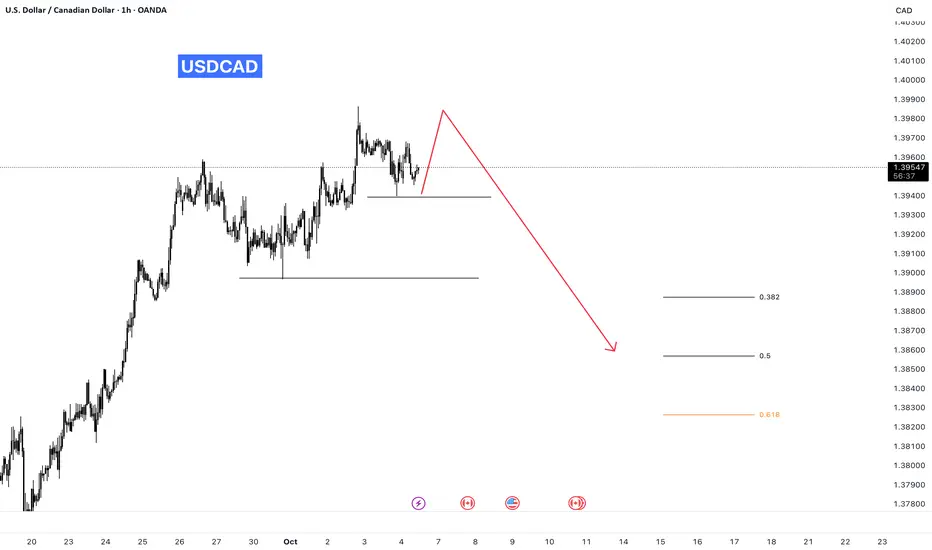
USD/CAD: Will the Great Divergence Break the Greenback?The financial world stands on the precipice of a defining moment for North American currency markets. The USD/CAD pair hovers near 1.3855, ticking nervously as traders count down to a rare double-header of central bank decisions. December 10, 2025, marks a pivotal divergence point where economic pathways between the United States and Canada split sharply. This is not merely a technical adjustment; it is a fundamental collision of monetary policy, geopolitical strategy, and industrial resilience. The outcome will likely dictate the Loonie’s trajectory for the coming year.
Macroeconomics: A Tale of Two Trajectories
The macroeconomic landscape reveals a stark contrast between the two nations. The Federal Reserve prepares to slash interest rates for the third consecutive time, targeting a range of 3.50%-3.75%. Markets price this move at nearly 88% probability. The US labor market displays clear signs of cooling, necessitating easier financing conditions to prevent a recession. Conversely, the Bank of Canada (BoC) stands firm. Canada’s economy defied expectations with a robust 2.6% annualized GDP growth in Q3, crushing earlier forecasts. This resilience compels the BoC to hold rates at 2.25% to prevent reigniting inflation, which remains sticky at 2.2%.
Geostrategy: The Fertilizer Chess Game
Beyond interest rates, a high-stakes geopolitical trade war complicates currency valuation. The US administration’s threat of severe tariffs on Canadian fertilizer imports paradoxically jeopardizes US food security. American farmers rely heavily on Canadian potash, importing over half of Canada’s production. Tariffs here act as a double-edged sword: they aim to punish Canada but simultaneously drive up input costs for the US agricultural sector. This strategic misstep weakens the US Dollar’s purchasing power domestically while forcing the administration to print subsidies, further diluting the currency.
Industry Trends: Agriculture Under Siege
The agricultural industry sits at the epicenter of this financial storm. The promise of $12 billion in aid to US farmers highlights the structural damage already inflicted by trade barriers. This subsidy model creates a vicious cycle of dependency rather than innovation. While Canadian fertilizer producers face tariff headwinds, their product remains essential, granting them significant pricing power. US farmers face a "margin squeeze" that ripples through the broader economy, softening the US economic outlook and diminishing the appeal of the Greenback relative to the resource-backed Loonie.
Management & Leadership: Powell vs. Macklem
Leadership styles at the central banks further amplify market volatility. Fed Chair Jerome Powell operates under intense political pressure and conflicting data, forcing a reactionary "data-dependent" approach. His leadership currently signals caution and retreat. In contrast, BoC Governor Tiff Macklem displays a steady hand, anchoring policy to tangible growth metrics like the recent 180.6K job surge. This stability in Canadian monetary leadership attracts foreign capital seeking predictable returns, creating a natural demand for the Canadian Dollar over the politically volatile USD.
Business Models: Supply Chain Resilience
The trade dispute forces companies to rethink business models. Canadian exporters are diversifying markets beyond the US, strengthening long-term resilience. Meanwhile, US importers face a supply chain crisis, unable to quickly source alternative fertilizer at competitive rates. This rigidity in the US supply chain exposes a critical weakness in the American business model for agriculture. Investors recognize this structural flaw, leading to capital flows that favor the adaptability of the Canadian export sector, thereby supporting the CAD against the USD.
Conclusion: The Loonie’s Rebellion
The confluence of diverging interest rates and self-inflicted US trade wounds creates a perfect storm for USD/CAD bears. The Federal Reserve’s dovish pivot contrasts sharply with the Bank of Canada’s confident hold, widening the yield spread in favor of Canadian assets. Combined with the strategic failure of fertilizer tariffs, fundamental drivers point toward a weaker US Dollar. Traders must watch the 1.3850 level closely; a break below likely signals the start of a prolonged downtrend for the pair. The divergence is real, and the Loonie is ready to rebel.
Canadian
SHORT ON CAD/JPYCAD/JPY has pulled back to a major supply area and is currently showing bearish pressure/momentum on the lower timeframe.
The Jpy index is also starting to rise from a demand are which will impact cad/jpy falling more.
I am looking to catch 300-400 pips this week selling cadjpy to the next demand zone.
BoC signals two-way USDCAD opportunities Bank of Canada Governor Tiff Macklem has commended US Federal Reserve Chair Jerome Powell's for managing of a difficult environment well, and pointed out that political attacks on the Fed from President Trump are a concern for the BoC too.
For USDCAD, this means traders might start viewing Canada’s central bank as acting more independently, instead of just following the Fed. This could create more two-way trading opportunities.
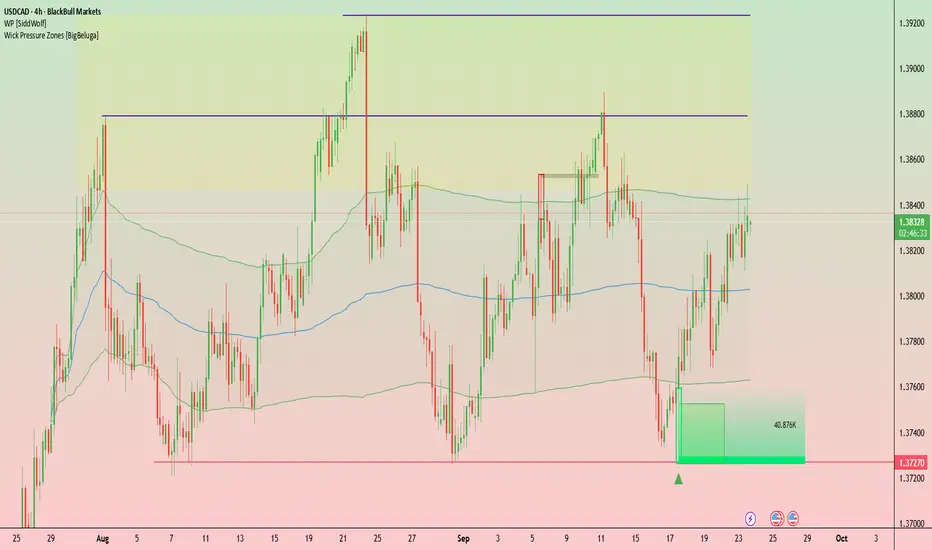
On the 4-hour chart, USDCAD has shown clear range dynamics: immediate resistance sits near 1.3845–1.3880, a zone repeatedly rejecting advances through September, while the 1.3720 area has acted as strong demand. The higher lows since mid-September could suggest buyers are building strength though.
SHORT ON EUR/CADEUR/CAD has a nice rising channel at a major resistance area.
There is a lot of Liquidity to the downside.
I have a sell limit set at the top of the channel to activate me after the possible sweep of liquidity behind the resistance line of the channel.
Looking to catcu 300-400 pips on this play.
Market Analysis: USD/CAD DipsMarket Analysis: USD/CAD Dips
USD/CAD declined and now consolidates below the 1.4350 level.
Important Takeaways for USD/CAD Analysis Today
- USD/CAD started a fresh decline after it failed to clear the 1.4415 resistance.
- There was a break below a major bullish trend line
USD/CAD Technical Analysis
On the hourly chart of USD/CAD at FXOpen, the pair climbed toward the 1.4420 resistance zone before the bears appeared. The US Dollar formed a swing high near 1.4415 and recently declined below the 1.4350 support against the Canadian Dollar.
There was also a close below the 50-hour simple moving average and 1.4310. There was a break below a major bullish trend line with support at 1.4310.
The bulls are now active near the 1.4300 level. The pair is now consolidating losses below the 23.6% Fib retracement level of the downward move from the 1.4415 swing high to the 1.4288 low. If there is a fresh increase, the pair could face resistance near the 1.4330 level.
The next key resistance on the USD/CAD chart is near the 1.4350 level and the 50% Fib retracement level of the downward move from the 1.4415 swing high to the 1.4288 low.
If there is an upside break above 1.4350, the pair could rise toward the 1.4400 resistance. The next major resistance is near the 1.4415 zone, above which it could rise steadily toward the 1.4450 resistance zone.
Immediate support is near the 1.4290 level. The first major support is near 1.4260. A close below the 1.4260 level might trigger a strong decline. In the stated case, USD/CAD might test 1.4240. Any more losses may possibly open the doors for a drop toward the 1.4400 support.
This article represents the opinion of the Companies operating under the FXOpen brand only. It is not to be construed as an offer, solicitation, or recommendation with respect to products and services provided by the Companies operating under the FXOpen brand, nor is it to be considered financial advice.
SHORT ON GBP/CADGBP/CAD is rejecting a key supply area on the 15min after continuing to make (Lower Highs) on the Higher Time Frames.
There has been a change in market structure from Up to down on the lower timeframe signaling a possible drop.
GBP/CAD is highly over brought and I believe its ready to fall.
I will be selling GBP/CAD to the next swing low for about 100-150 pips. OANDA:GBPCAD
Trump reshaping Canada’s election and Loonie Six weeks ago, a Conservative victory in the next Canadian election seemed inevitable.
Now, that certainty is fading. Conservative leader Pierre Poilievre's support from the American right, including Elon Musk, is becoming a potential liability as Canada faces an unprecedented challenge: the U.S. president openly questioning its viability as a nation, threatening tariffs, and even suggesting annexation.
A recent Nanos poll shows 39.6% of Canadians see new Liberal leader Mark Carney as the most qualified to negotiate with Trump, compared to 26% for Poilievre.
This uncertainty may be weighing on the Canadian dollar. USDCAD broke lower last week, falling below key support (1.4260 - 1.4466), signaling a shift toward sellers. However, the 1-hour chart shows a minor upward trendline defining the current pullback.
CAD/USD 15-Minute Analysis: Head & Shoulders BreakoutCAD/USD 15-Minute Analysis: Head & Shoulders Breakout
On the 15-minute time frame, CAD/USD has formed a Head and Shoulders pattern, and the price has broken below the neckline trendline, signaling potential bearish momentum. Here's my idea:
Entry:AT 0.4146$
Target: The next significant support level, marked in the green zone.
This pattern suggests further downside, but as always, manage your risk carefully and monitor price action as we approach the target zone.
Let me know your thoughts and share your analysis below! 👍
Why is the Canadian Dollar Outperforming Expectations?A Deep Dive into the Unexpected Resilience of the CAD
In a landscape marked by economic uncertainty, the Canadian dollar has defied the odds, exhibiting remarkable resilience. This unexpected strength is a result of a complex interplay of factors, including the Federal Reserve's monetary policy, market dynamics, and global commodity trends.
The Federal Reserve's Pivotal Role
The Federal Reserve's shift towards a more accommodative monetary policy has been a key driver of the CAD's rally. The Fed's hints at potential rate cuts, especially in response to a weakening labor market, have weakened the U.S. dollar, boosting the appeal of other G10 currencies, including the CAD. This has created a favorable environment for the Canadian dollar, as investors seek higher-yielding alternatives to the U.S. dollar.
Short Covering and Positioning Dynamics
Another significant factor contributing to the CAD's strength is a wave of short covering. Traders had previously bet against the CAD, anticipating a divergence between the easing cycles of the Federal Reserve and the Bank of Canada. However, as the U.S. dollar weakened and the CAD began to rise, these short positions became increasingly unsustainable. Traders were forced to unwind their bets, adding momentum to the CAD's rally.
The Impact of Rising Oil Prices
Canada's significant oil exports make it particularly sensitive to fluctuations in oil prices. The recent increase in crude oil prices, driven by geopolitical tensions and potential supply disruptions, has provided a further boost to the CAD. As a major oil producer, Canada benefits from higher oil prices, which can lead to increased exports and a stronger currency.
Assessing the Risks and Challenges
While the CAD's rally has been impressive, it is important to acknowledge the potential risks and challenges that could undermine its momentum. The Bank of Canada's rate cuts, although expected, could narrow yield differentials and put pressure on the CAD. Additionally, ongoing global uncertainties and subdued risk appetite could limit the loonie's upside potential.
Key Data to Watch
Several key data releases will be closely monitored in the coming weeks. Canada's GDP data will provide insights into the health of the Canadian economy and could influence the Bank of Canada's policy trajectory. Meanwhile, U.S. economic reports, such as PCE, will be watched for potential shifts that could affect the USD/CAD exchange rate.
Conclusion
The Canadian dollar's unexpected resilience is a testament to its strength in a challenging economic environment. While the current momentum is positive, investors should remain cautious and closely monitor key economic indicators. By understanding the underlying factors driving the CAD's rally and assessing the potential risks, investors can make informed decisions about their currency exposure.
GBPCAD: Strong start for GBP fading out?GBP has been the strongest performing currency so far this year - I keep asking myself why??
Country in a recession
Stagnant economy
Limp Central Bank
With today's unemployment reading I'm expecting this to be the start of bearish involvement in sterling, I'm starting with this pair.
Think oil has dropped a lot and could be ready to bounce up which is good for CAD.
Seem to have broken the ascending trendline and retesting it now, failure to break back in will signify a change in direction.
My first target is 1.708, around the MA50 (daily) and clear support.
CADUSD: Looking very bearish to meI'm expecting to see USD strength through March with a Hawkish Fed that has strength ibn their economy, compared to all other crosses.
Looking at the 4hr chart I'm seeing a couple of bearish engulfing candles and therefor looking for a short in an LTF.
There is very choppy water between 0.735 and 0.7366 so we may see a lot of indecision here but I'm overall bearish and expect the drop down to major support.
GBPCAD SHORTSGBPCAD since the beginning of the week have been moving bearish and in respect to this, I plan to stick to the trend, the daily and the weekly also shows the bearish trend, and to follow this I expect this pair to retrace to the 50 Exponential moving average and we short to the 800 Exponential moving average.
Ummmm.... Hey as you can see, I don't know diddly about charting but hopefully the fancy bullseye got your attention. This ETF appears to be in distress!! The only reason I'm reviewing is that a friend said it has been a MF recommendation. Sometimes they seem to have good timing but this one and my advice to my friend was, even if you believe in the fundamentals of the ETF, the economy is still in a world of pain and Cnd banks are still under mad pressure. The Div looks nice...maybe after it closes the gap I'll take a look again after that but right now the chart is ugly and I'd stay eagle eyes and not involved.