Sentiment cycle. Two sentiments and FUD.Based on Livermores "opposite day trading", Qullamaggies 10/20/50.
Livermores emotion cycle doesn't fully explain price dynamic. In practice markets or crowd have a clear sentiment of "safety" and trust. and "danger" and distrust.
You can have a strong market... that breaks and starts crashing --> You know the sentiment wont be the same. You see some risk taking fomo.. but it doesnt end nowhere. Because the core of every strong market is strong momentum technicals or setup. Odds in your favor etc.
It's very clear where the SENTIMENT (cycle) shifts to crashing and "it wont be the same anymore". towards risk on (setup).
Categorizing all market on RISK-ON, RISK-OFF (at near term) wouldnt explain the dynamic either... because like most of the time (maybe 80%) market is on a FUD mode.
Livermore was good at explaining crowd temperature.
Something could be bullish, but still on FUD mode -> and you get these tiny sell offs, losing due to SL or selling on fear.
clear "RISK ON" is where, based on Qullamaggie, there are strong upsloping quick MAs (10/20/50). --> best explanation would be that people trust in the market. It's hard to lose, when everyone throws money at market.
eventually it leads to FUD channels etc. or corrections.
Even today --> there do always be some chance, that market just crashes. No guarantees. Strong technicals but FUD sentiment.
//April, May, June were all FUD.. fear uncertainty doubt.
Livermore said there was only two emotions, Fear and Greed.
Fear
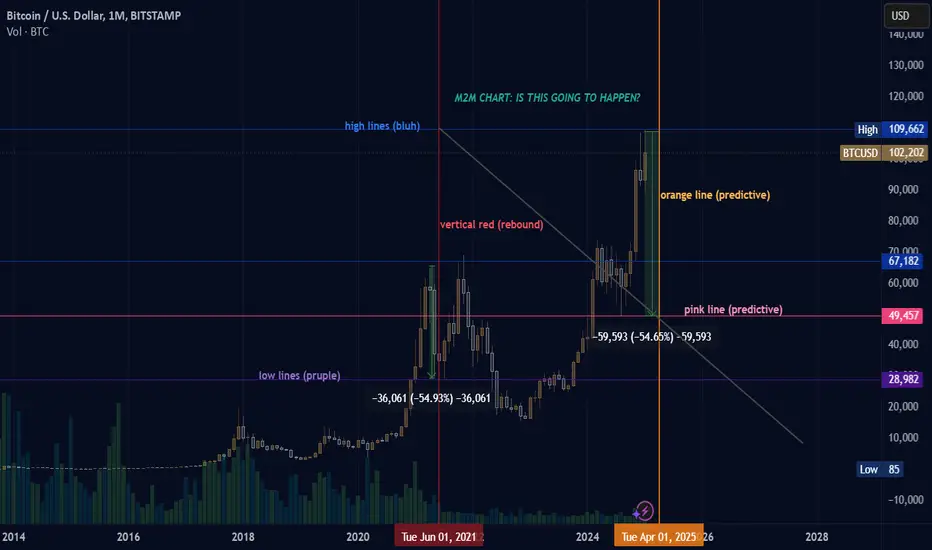
Bitcoin Daily Analysis #13 – November 17, 2025Welcome to another Bitcoin analysis — and apologies for the delay.
As we can see, our bearish scenario has strengthened, and on the daily timeframe, BTC has officially turned downward 📉.
It’s still unclear whether this move is just a correction wave or a full trend reversal, but based on the candle volume, there’s potential for deeper pullbacks ahead.
If Bitcoin reclaims the 106,000 zone and holds strongly above it, the bullish outlook can return 🔄📈.
But if we get rejected from this level once more, we can safely say the trend has shifted into a clear downtrend.
There’s solid buying orders around the 90,000 zone, and we need to see how price reacts there.
A break below this level would make the bullish scenario much harder to achieve 🚨.
Additionally, after building a consolidation box in this region — or waiting for clearer structure — there may be an opportunity to take a short position 📉🟥.
Disclaimer:
This content is for informational purposes only and does not constitute financial or investment advice. © DIBAPRISM
Larry D.Kohn
$VIX: ALLIGNED FOR FURTHER EQUITY MARKET WEAKNESS We can observe the following on the weekly chart:
1. MACD buy signal since September 29th
2. RSI 14 above the 50 line at 53
3. From October 27th onwards, higher weekly lows and higher weekly closing highs.
4. Despite new all-time highs for benchmark stock indices, there is a divergence with the TVC:VIX (negative divergence for equities)
If this pattern persists, the risk to the stock market remains.
BTC - Fear & GreedAs Bitcoin falls below $100,000, now is a good time to check the Fear & Greed index to map out the sentiment around the move, and to compare similar scores at other places in this bull run move.
As painful as it may be, buying the fear and selling the green is an effective strategy. Every local bottom since the start of 2023 has had a F&G score below 50:
Jan 26th 2023 - 26
March 10th 2023 - 34
June 14th 2023 - 46
Sept 11th 2023 - 40
July 7th 2024 - 29
Aug 5th 2024 - 26
Sept 6th 2024 - 22
Feb 26th 2025 - 21
March 10th 2025 - 20
April 8th 2025 - 24
Today - 16
As of writing the current fear and greed score is lower than it has been for nearly three years!
What is important to note is that bullish momentum has faded but structure remains (higher lows + higher highs). IF the pattern continues then this is a good place to buy historically, obviously that does not guarantee the same pattern will continue to play out but if the bull market is still alive then this level usually gets a bullish reaction.
The timing also adds another layer of complexity as the US Government shutdown is ending. Bitcoin is super reactive to liquidity, once the shut down began it is clear liquidity did drop resulting in price falling. This correlation implies an expected rise in liquidity and Bitcoins price along with it.
For the bears the target area is $89,000-$92,000. In my opinion this will cap the downside at least temporarily.
Halloween Special: The Risk “Treats” That Keep You Alive!🧠 If October has a lesson, it’s this: fear is useful, panic is fatal. Great traders don’t fight the monsters; they contain them.
Here’s my Halloween mindset & risk playbook:
🧪 Keep your “lifeline” small: Risk a fixed 1% per trade until your balance moves ±10%, then recalibrate. This makes loss streaks survivable and hot streaks meaningful.
⏰ Set a nightly curfew: a max daily loss (e.g., 3R or 3%). Hit it? Close the platform. No “one last trade.” Curfews save accounts.
🛑 Define your invalidation before you enter: If that level prints, you’re out, no arguments, no “maybe it comes back.” Plans beat feelings.
🎯 Hunt asymmetry: If you can’t see at least 2R cleanly (preferably 3R), pass. You don’t need more trades; you need better trades.
🧟 Kill the zombie trade: the one you’re babysitting, nudging stops, praying. If you’re managing hope more than risk, exit and reset.
🧘 Protect your mind equity: Two back-to-back losses? Take a 20-minute break. After a big win? Journal before you click again. Calmness compounds.
📜 Make a ritual: pre-trade checklist → position size → entry → stop → targets → log. Rituals turn uncertainty into routine, and routine into consistency.
What’s your #1 rule that keeps the “revenge-trading demon” out of your account❓
⚠️ Disclaimer: This is not financial advice. Always do your own research and manage risk properly.
📚 Stick to your trading plan regarding entries, risk, and management.
Good luck!
All Strategies Are Good; If Managed Properly!
~Richard Nasr
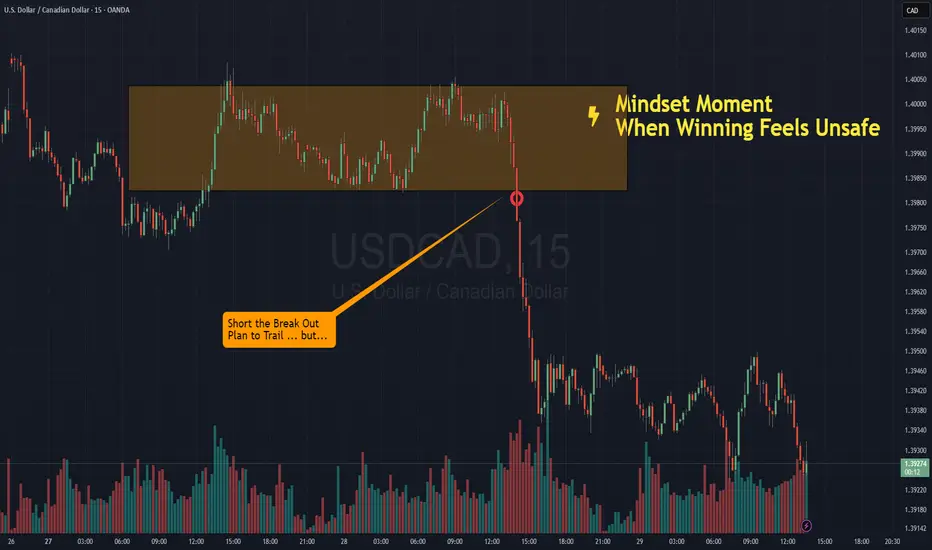
When Winning Feels UnsafeNOTE – This is a post on mindset and emotion. It is not a trade idea or strategy designed to make you money. My intention is to help you preserve your capital, focus, and composure so you can trade your own system with calm and confidence.
You’re in profit.
The trade’s working.
Your system’s doing exactly what it should.
But instead of ease, something tightens.
A flicker of doubt.
You can hear that inner voice: “Don’t mess this up. You wouldn’t want to give this back now would you? How much is enough anyway?”
You scan the chart again.
Check your unrealized PnL.
Move the stop closer.
Start managing… what doesn’t need managing.
Here’s what’s really happening:
Your subconscious is remembering what happened the last time you saw success…
The time you relaxed and it reversed.
The time you felt proud and someone cut you down.
The time you won and it didn’t last.
So even when the market moves in your favour, part of you braces.
Waiting for the other shoe to drop.
So that voice saying, don’t mess this up - is actually a memory trying to protect you.
And in so doing, never really lets you feel safe
The point here is that your work as a trader is to be in the here and now. Not in the past.
Be cognisant to the cues of your memory and body that don’t work in your favour.
So when you notice tension rising,
Take one slow breath. Feel your feet on the floor. And repeat. ‘Right here, right now’.
And then …
Follow your trade plan.
Stay true to your trading plan.
Manage your risk
And let the market do what it does.
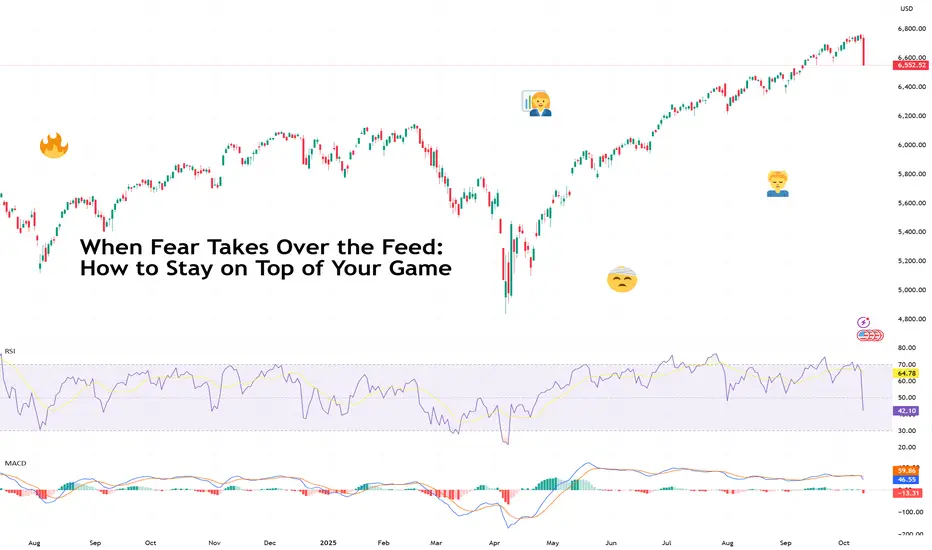
When Fear Takes Over the Feed: How to Stay on Top of Your GameFriday wasn’t just a red day — it was the kind of red that makes traders question their life choices.
The Nasdaq Composite NASDAQ:IXIC plunged 3.6% , its worst day since the April tariff-fueled meltdown.
The S&P 500 SP:SPX dropped 2.7%, the Dow Jones TVC:DJI tumbled nearly 900 points, and $1.6 trillion in market value simply evaporated.
Hello tariffs, my old friend.
President Trump announced he’s canceling a planned meeting with China’s Xi Jinping and slapping 100% tariffs on Chinese goods. Just when investors thought the trade wars were over.
It was China this time that triggered the mayhem. President Xi unveiled plans to tighten controls on rare-earth exports, materials critical for EVs and high-tech hardware.
The widespread selling was especially brutal over at the crypto corner with a record $19 billion in liquidations. Bitcoin BITSTAMP:BTCUSD face-planted 7.2% for the day, sliding below $111,000.
So, what’s a trader supposed to do when markets melt faster than your enthusiasm to study the Elliott wave?
Here’s a step-by-step guide that breaks down the psychology of panic and how smart traders stay cool when the feed turns into a fear factory.
🧠 Step One: Understand the “Fear Reflex”
When bad news breaks, the first instinct for most traders is to actually do something. Anything. Sell, short, hedge, pray — anything to make the pain stop. That’s your amygdala (the brain’s alarm system) talking.
When headlines hit, ask yourself:
• Is this new information, a re-spin of old fears, or a projection?
• Does it change the fundamentals of my positions?
• What’s the time frame of this impact — minutes, months, or meme-cycle?
If you can’t answer those calmly, and instead rush to offload your positions, you’re in panic mode and you risk making impulse decisions.
📊 Step Two: Zoom Out (Literally and Mentally)
When fear takes over the feed, the chart shrinks. Traders start staring at 1-minute candles and wonder if they should dump their stocks right now .
That’s the moment to zoom out. Pull up the 4-hour, daily, or weekly chart. You’ll likely notice that Friday’s epic collapse looks less like the apocalypse and more like a blip in an ongoing uptrend.
Case in point: The Nasdaq may have tanked 3.6%, but it’s still sitting near record territory after months of AI-fueled gains. The broader trend — higher highs, higher lows — is intact.
Volatility doesn’t mean reversal. It means emotion acting out. And markets love testing conviction.
💬 Step Three: Tune Out the Noise
When every post in your feed screams “MARKET MELTDOWN!” it’s tempting to join the panic chorus. But that doesn’t mean it’s going to be like that tomorrow.
Take for example the April crash. Stocks were rising and rising , and not too long after, they started hitting record after record .
You don’t need to read 20 opinions — you need one solid plan (and, of course, to be a daily reader of our Top Stories ).
A simple checklist helps:
• Position size: Are you overexposed?
• Stop-loss: Is it placed logically, not emotionally?
• Cash buffer: Do you have dry powder for the dip?
Don’t scramble mid-freefall. Prepare for volatility before it happens.
🧩 Step Four: Identify the Difference Between Noise and Narrative
Every market drop has two layers — the market-shaking news story and how investors perceive it.
• The headline on Friday: “Trump reignites trade war with China.”
• The perception: Markets pricing growth halt, rake hikes, gloom and doom, and apocalypse.
In the short term, that’s fear-inducing. In the medium term? It could actually mean looser monetary policy — which is generally bullish for risk assets like stocks, gold, and even crypto.
In other words, what feels like the end of the world on Friday might look like a buying opportunity by Tuesday.
🧭 Step Five: Play Offense When Others Play Defense
There’s a reason Buffett’s “be fearful when others are greedy” quote is overused — because it’s true.
When the market wipes out $1.6 trillion in a day, it’s a reminder that liquidity and emotion drive short-term moves. If your thesis is intact and you’re not that up high on leverage, you may consider this drop as a time to look for opportunities.
Instead of selling in fear, study which sectors overreacted.
• Tech led the plunge — but if (or when) there’s a rebound, these stocks will most likely be the leaders. Especially now when the third-quarter earnings season is here (check when it’s big tech’s turn to report by browsing the Earnings calendar ).
• Gold and bonds saw inflows — typical defensive plays.
• Energy and industrials may catch bids if tariffs stick.
🪙 A Note to Crypto Bros
Bitcoin’s 7% slide shows that once-independent assets have spent too much time with traditional risk assets.
And now they’re almost impossible to tell apart. As institutional capital grows in crypto, it behaves more like a growth play where risk is embraced during good times, but dumped during bad.
The lesson? Don’t buy the “decoupling” narrative so easily. Bitcoin may hedge against long-term fiat decay, but in a short-term panic, it’s still part of the same risk ecosystem. The smart move is to trade correlations , not beliefs.
If Bitcoin drops with stocks during a tariff tantrum, that’s confirmation that institutional traders are playing both arenas.
🧡 Final Takeaway
Let’s acknowledge that Friday’s bloodbath was catastrophic to many . It wiped out traders that were holding both stocks and crypto. If that happened to you, as painful as it is, keep your head up, take a breath (or a break), and come back another day.
And when you do, widen your chart, trim that leverage and keep your bets nimble so you’d survive the next inevitable meltdown.
Finally, we can't not address the elephant in the room. It was likely another Trump-led market rinse-and-repeat cycle: tweet, panic, rebound. Futures are recovering after Trump waved away tariff fears , saying “Don’t worry about China, it will all be fine!”
Off to you : How did you fare Friday? And what's your way of weathering the market storms? Share your experience in the comments!
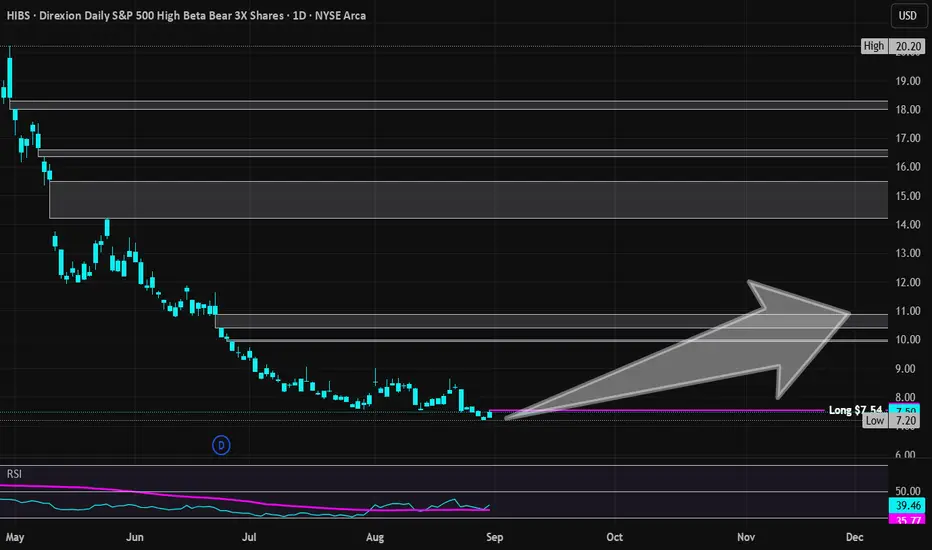
High Beta Bear | HIBS | Long at $7.54 (Primarily September)Historically, September is one of the worst performing months in the stock market. A hedge against my bets for this month is to buy shares of Direxion Daily S&P 500 High Beta Bear 3X AMEX:HIBS as a volatility play. The index provider selects 100 securities from the S&P 500 Index that have exhibited the highest sensitivity to market movements, or “beta,” over the past 12 months based on the securities’ daily price changes.
This isn't "buy and hold" play, whatsoever - you'll lose. It's a short duration hedge using seasonality odds that *may* be in my favor.
Targets:
$8.50 (+12.7%)
$9.50 (+26.0%)
$10.50 (+39.3%, if a market scare...)
Potential Gold LongWith Volatile Markets and constant War Developments
XAU/USD has experienced higher than NORMAL volatility.
Given price can RESPECT this short term trendline, we may have a Target of 3,500 in sight.
2 weeks of Bullish Momentum now followed by a beautiful retracement & Strong Wicks below.
SL - 3,355
TP 1 - 3,440
TP 2 - 3,470
TP 3 - 3,496
VIX | Nov 19, 2025 Call Options | Strike $21TVC:VIX , the great "fear" index, has two looming price gaps on the daily chart. Every gap has always been filled in the history of the $TVC:VIX. Given the 90-day tariff pauses and forever world turmoil, there will (undoubtedly), be a spike in the TVC:VIX to close these open gaps. It's just a matter of timing... I've chosen to go 6 months out on the option date (November 19, 2025) as a hedge to my portfolio ($3.45 per contract). I plan to add more contracts if the TVC:VIX dips into the 13-14 area, too.
I truly dislike timing the market, but such a position could be a nice 3x gainer of the TVC:VIX spikes to $36 in short time. Or... totally worthless if we are in a constant bullish market for the next 6 months.
Time will tell.
The last 4 previous Stockmarket Fear spikes were great buys...for Bitcoin, allowing investors to enhance their long-term holdings.
Purchasing risk assets when the #VIX exceeds 50 and over 20% of stocks fall below their 200-day moving average has consistently yielded positive returns, with a success rate of one hundred percent when evaluated one week, one month, and three months later.
This particular scenario has only happened 11 times in the history of the S&P 500, and the reading from Monday, April 7th, marked one of those rare instances.
#BTFD
Why this strategy works so well (Ticker Pulse Meter + Fear EKG) Disclaimer: This is for educational purposes only. I am not a financial advisor, and this is not financial advice. Consult a professional before investing real money. I strongly encourage paper trading to test any strategy.
The Ticker Pulse + Fear EKG Strategy is a long-term, dip-buying investment approach that balances market momentum with emotional sentiment. It integrates two key components:
Ticker Pulse: Tracks momentum using dual-range metrics to pinpoint precise entry and exit points.
Fear EKG: Identifies spikes in market fear to highlight potential reversal opportunities.
Optimized for the daily timeframe, this strategy also performs well on weekly or monthly charts, making it ideal for dollar-cost averaging or trend-following with confidence. Visual cues—such as green and orange dots, heatmap backgrounds, and SMA/Bollinger Bands—provide clear signals and context. The strategy’s default settings are user-friendly, requiring minimal adjustments.
Green dots indicate high-confidence entry signals and do not repaint.
Orange dots (Fear EKG entries), paired with a red “fear” heatmap background, signal opportunities to accumulate shares during peak fear and market sell-offs.
Now on the the educational part that is most fascinating.
Load XLK on your chart and add a secondary line by plotting the following on a secondary axis:
INDEX:SKFI + INDEX:SKTH / 2
Now, you should see something like this:
Focus on the INDEX:SKFI + INDEX:SKTH / 2 line, noting its dips and spikes. Compare these movements to XLK’s price action and the corresponding dot signals:
Green and Orange Dots: Opportunities to scale into long positions.
Red Dots: Opportunities to start scaling out of positions.
This concept applies not only to XLK but also to major stocks within a sector, such as AAPL, a significant component of XLK. Chart AAPL against INDEX:SKFI + INDEX:SKTH / 2 to observe how stock and sector indices influence each other.
Now, you should see something like this:
Long-Term Investing Considerations
By default, the strategy suggests exiting 50% of open positions at each red dot. However, as long-term investors, there’s no need to follow this rule strictly. Instead, consider holding positions until they are profitable, especially when dollar-cost averaging for future retirement.
In prolonged bear markets, such as 2022, stocks like META experienced significant declines. Selling 50% of positions on early red dots may have locked in losses. For disciplined long-term investors, holding all open positions through market recoveries can lead to profitable outcomes.
The Importance of Context
Successful trading hinges on context. For example, using a long-term Linear Regression Channel (LRC) and buying green or orange dots below the channel’s point-of-control (red line) significantly improves the likelihood of success. Compare this to buying dots above the point-of-control, where outcomes are less favorable.
Why This Strategy Works
The Ticker Pulse + Fear EKG Strategy excels at identifying market dips and tops by combining momentum and sentiment analysis. I hope this explanation clarifies its value and empowers you to explore its potential through paper trading.
Anyway, I thought I would make a post to help explain why the strategy is so good at identifying the dips and the tops. Hope you found this write up as educational.
The strategy:
The Companion Indicator:
Buying The Dip / Dollar Cost AveragingI recently published my first script and felt now would be a good time to share something I feel could help some people out. I have been trading since 2021 and it has been an amazing journey. Anyhow, I would consider myself a value based investor and in it for the long term.
So as the market takes a dip - now is certainly the time to be buying the dip or dollar cost averaging. The way I see it, if you are going to DCA/Buy The Dip, it might be handy to have access to a tool that is slightly better than just regularly timed investments.
Take a look at my indicator and let me know your thoughts.
Comment, Like and Follow if you enjoy the strategy and companion indicator.
A Practical Framework for Overcoming Fear in Trading“Fear is not real. The only place that fear can exist is in our thoughts of the future. It is a product of our imagination, causing us to fear things that do not at present and may not ever exist. Do not misunderstand me, danger is very real, but fear is a choice.” - Will Smith, After Earth
Although I firmly agree with this statement, I also have to acknowledge that while fear is a choice, it’s also a biological response to perceived threats like uncertainty, lack of control, and experience.
When faced with these threats the brain activates the amygdala which triggers the fight or flight response releasing hormones like cortisol and adrenaline, preparing the body to respond quickly and instinctively.
If left alone, traders consumed with fear will either seek to take vengeance against the markets, typically referred to as “Revenge Trading” or they’ll hesitate when taking the next position fearing that it would be a repeat of the last. Either way, it never ends well.
In today’s article we’re going to be breaking down fear both figuratively and literally, by gaining a deeper understanding on how it works and what steps we should take to overcome it.
Three Types of Fears in Trading:
Now I’m sure most of you reading this article are familiar with the three types of fears related to trading, so I’ll go through these quite briefly but for those of you who might not be that familiar I’ll leave a short explanation for each of the fears highlighted.
Fear of Missing Out (FOMO):
The apprehension of missing profitable opportunities leads traders to enter trades impulsively without proper analysis, often resulting in poor outcomes. Traders experiencing FOMO generally find themselves in trading signal groups or rely on social media for direction, see my previous article on Trading Vs. Social Media
Fear of Losing Money:
The anxiety associated with potential financial loss can cause traders to exit positions prematurely or avoid taking necessary risks. This fear is closely linked to loss aversion, where the pain of losing is felt more intensely than the pleasure of equivalent gains.
Fear of Being Wrong:
The discomfort of making incorrect decisions can deter traders from executing trades or cause them to hold onto losing positions in an attempt to prove their initial decision was right.
In many respects, traders try to deal with these fears directly but usually without much success. This is because they’re treating the symptom but not the cause.
In order to deal with any of these fears either independently or collectively you’d need to first learn to become comfortable in three very specific areas.
Uncertainty - At its core, trading is a game of probabilities, not certainties. Certainty in trading comes only when you’re able to shift your focus from the outcome of any one trade to your ability to take any one trade regardless of the outcome. Remember, it's not your job to predict the future, rather you should prepare for it.
Past Losses - The outcome of one trade has absolutely no impact on the outcome of the next, and the best way to deal with past losses is to embrace the lessons that came with it.
Lack of Control - Although we cannot control the outcome of a trade, we do control the type of trade we take. We can control when we enter, exit, and how much we risk, which when examined closely carries far more significance than merely seeking to control the outcome.
Debunking The Biggest Myth In Trading
If you won then you were right, if you lost then you were wrong. This is the biggest myth in trading today and one of the main reasons why so many traders chose being right over being profitable.
Instead of accepting a loss, they’ll remove whatever stop loss they had in place in the hope that the market will eventually turn in their favor, refusing to accept that they may have been wrong.
There are very good reasons for this type of behaviour which is tied directly to our identity, social belonging and self-worth. When we’re faced with the possibility of being wrong our intellect, competency and self-image is challenged.
In order to protect ourselves from this challenge, we begin to resist any new information that could conflict or even threaten our existing belief, creating discomfort even when the evidence is clear.
This can trigger emotions like anxiety and avoidance behaviour which can show up in the form of hesitation, overthinking, or avoiding placing trades altogether. However, I’m about to share a framework with you that will help you overcome the fear of being wrong and instead of avoiding it, if you follow this framework, you’ll begin to embrace it.
3 Step Process To Profit From Being Wrong
In trading Losses are inevitable. In fact, some of the most successful traders lose far more times than they actually win, and yet they’re still able to make money. This is because you don’t need to be a winning trader in order to be a profitable one.
It’s under this principle that you’ll apply the 3 step process to profit from being wrong.
1. Reframe “Wrong” as “Feedback”
Generally being wrong comes with consequences, in trading those consequences comes in the form of losses. However, you determine how much you’re willing to lose on any given trade. This means that because you control how much you’re willing to lose, you ultimately control the consequences.
The market is a nearly endless pool of trade opportunities and no one trade can determine the outcome of the next. Therefore, a losing trade cannot mean you were wrong, because as long as you still have capital to trade there is another opportunity lining up.
Instead, what the losing trade does uncover is the market conditions in relation to your plan. It’s at this point where you review your initial analysis and see if anything has changed. If nothing changed, then it's likely you may have gotten in a bit too early and you’d just have to wait for the next setup.
However, upon your review, you discover the market conditions have changed, and you now have to re-evaluate your approach, then this is the feedback the market is giving you. This is what it means to take feedback from the markets and this is what it takes to be profitable instead of being right.
2. Separate Identity From Outcome
The mistake many trades tend to make is measuring their success on the outcome of a trade. This is a recipe for disaster because in order for them to feel successful they’d have to win every single time.
This of course is impossible, instead I’d encourage you to separate yourself from the outcome of the trade and focus on just trading. There are only one of three outcomes you can experience in a trade. 1. Loss, 2. Win, 3. Breakeven. When you’re able to accept 1. Loss then you don’t have to worry about numbers 2,3.
Because you control how much you’re willing to lose you should be able to accept what you’re willing to lose, and by accepting what you're willing to lose you’ve then separated yourself from the outcome of the trade and you can now focus on just trading.
To keep you in check with this step here is a very simple but highly effective practice:
✅ Practice saying: “This was a good trade with a bad outcome — and that’s okay.”
3. Celebrate The Process, Not Perfection
“That which gets rewarded gets repeated” If you’re only rewarding yourself when you close a winning trade then you’re simply reinforcing the notion of viewing the markets through the lens of right and wrong.
As we’ve already discovered this view is detrimental to your longevity as a trader and so I would argue that instead of celebrating a winning trade, celebrate your process. Reward yourself every time you follow your plan regardless if the trade resulted in a win, loss or breakeven.
This approach will help you improve your process which in turn will improve your overall returns and performance.
Conclusion
📣 You are not here to be perfect. You’re here to grow, to learn, and to keep showing up — fear and all.
The market rewards the trader who is calm under pressure, humble in defeat and focused on the long game.
Go into this week knowing that fear may still show up — but you’re more prepared than ever to handle it.
Let fear be a signal, not a stop sign.
You've got this. 🚀
Fighting Emotions: Overcoming Greed and Fear in the MarketThere are moments in life that remain etched in memory forever, dividing it into "before" and "after." For me, that pivotal moment was the fateful day I lost an enormous sum of money—enough to live comfortably for 3–5 years. This loss was not just a financial blow but a deep personal crisis, through which I found the true meaning of trading and life.
When I first embarked on the trading path, success came quickly. My initial trades were profitable, charts followed my forecasts, and my account grew at an incredible pace. Greed subtly crept into my heart, whispering, "Raise the stakes, take more risks—the world is yours." I succumbed to these temptations, ignoring risks and warnings. It felt as if this success would last forever.
But the market is a force of nature that doesn’t tolerate overconfidence. On what seemed like an ordinary day, everything changed. Unexpected news rocked the market, and my positions quickly went into the red. Panic consumed me, and instead of stopping and accepting the losses, I decided to recover them. That mistake cost me everything.
In just a few hours, I lost an amount that could have secured my life for years. I stared at the screen, unable to believe my eyes. My heart was crushed with pain and despair. In that moment, I realized that greed had brought me to the brink of ruin.
After that crash, I was left in an emotional void. Fear became my constant companion. I was afraid to open new positions, afraid even to look at the charts. Every thought about trading filled me with anxiety and regret. I began doubting myself, my abilities, and my chosen path.
But it was in that silence that I started asking myself important questions: How did I end up here? What was driving me? I realized that greed and a lack of discipline were the reasons for my downfall.
Understanding my mistakes, I decided not to give up. I knew I had to change my approach not just to trading but to life as well. I began studying risk management, trading psychology, reading books, and talking to experienced traders.
Key Lessons I Learned:
Acceptance of Responsibility : I stopped blaming the market or external circumstances and took full responsibility for my decisions.
Establishing Clear Rules : I developed a strict trading plan with clear entry and exit criteria.
Emotional Control : I began practicing meditation and relaxation techniques to manage my emotions.
Gradually, I returned to the market, but with a new mindset. Trading was no longer a gambling game for me. I learned to accept losses as part of the process, focusing on long-term stability rather than quick profits.
Risk Diversification : I spread my capital across different instruments and strategies.
Continuous Learning : I invested time in improving my skills and studying new analytical methods.
Community and Support : I found like-minded people with whom I could share experiences and get advice.
That day when I lost everything became the most valuable lesson of my life. I realized that true value lies not in the amount of money in your account but in the wisdom and experience you gain. Greed and fear will always be with us, but we can manage them if we stay mindful and disciplined.
Takeaways for Traders :
Don’t Let Greed Cloud You r Judgment: Set realistic goals and celebrate every step forward.
Fear is a Signal : Use it as an opportunity to reassess your actions and strengthen your strategy.
Risk Management is Your Best Friend : Always control risks and protect your capital.
My journey was filled with pain and suffering, but it was these hardships that made me stronger and wiser. If you are going through difficult times or standing at a crossroads, remember: every failure is an opportunity to start over, armed with experience and knowledge.
Don’t give up. Invest in yourself, learn from your mistakes, and move forward with confidence. Let your path be challenging, for it is through overcoming obstacles that we achieve true success and inner harmony.
Your success begins with you.
If you enjoyed this story, send it a rocket 🚀 and follow to help us build our trading community together.
FEAR: Your Biggest Trading EnemyFear is a natural emotion that affects all traders, whether beginners or experienced professionals. In trading, fear often stems from uncertainty, the potential for losses, and the volatility of financial markets. Left unchecked, fear can lead to poor decision-making, impulsive actions, and even significant financial losses. However, by understanding fear and learning how to manage it effectively, traders can improve their performance and build confidence over time.
Steps to Overcome Fear in Trading
Develop a Trading Plan
Having a well-structured trading plan provides clarity and reduces fear. A plan should include specific rules for entry and exit, risk management strategies, and profit targets. When you follow a plan, you take emotions out of decision-making and rely on data-driven strategies.
Stick to your plan: Trusting your trading strategy can reduce emotional decision-making, especially during times of market volatility or uncertainty.
Use Risk Management
Effective risk management can alleviate fear because it limits the potential downside of any trade. Traders should:
Set a stop-loss: Predetermine the maximum amount you are willing to lose on any trade. This not only limits losses but also takes the emotional pressure off monitoring trades.
Control position sizing: By using small position sizes relative to your account balance, you minimize the impact of any one trade, which can reduce fear and emotional stress.
Focus on Process, Not Outcomes
Instead of focusing on whether an individual trade is profitable, concentrate on executing trades according to your plan. Understand that losses are part of trading and that a single trade doesn't define your overall success.
Avoid emotional attachment to trades: Treat trading as a probabilistic game where losses and gains balance out over time if your strategy is sound.
Build Confidence with Knowledge
Fear often stems from uncertainty. The more knowledge and experience you gain, the more confident you’ll feel in your trading decisions. Spend time improving your understanding of:
Technical analysis: Learn to read charts, patterns, and indicators to make informed decisions.
Fundamental analysis: Understand the economic factors that drive market movements.
Regularly review your past trades, both successful and unsuccessful, to learn from mistakes and build confidence in your abilities.
Practice Patience and Discipline
Patience is crucial to avoid overtrading or jumping into trades impulsively. Fear can push you into making quick decisions, but staying disciplined ensures you wait for the right setups.
Discipline in following your trading plan and sticking to risk management rules can help control the emotional swings that come with fear. Staying patient allows trades to develop fully and increases the chances of success.
Accept Losses as Part of the Process
No trader wins 100% of the time, and understanding that losses are a natural part of trading can help reduce the fear of losing. Treat each loss as a learning experience rather than a failure.
Reframe your mindset from avoiding losses to managing losses. When you accept that losses will happen but you can limit their impact, fear becomes easier to handle.
Control Emotional Reactions
Mindfulness techniques: Practices like deep breathing, meditation, or taking regular breaks can help traders stay calm during high-pressure situations.
Avoid overreacting: If you experience a significant loss, avoid the temptation to enter a "revenge trade" to recover quickly. Emotional decisions can compound losses. Take a step back, review your plan, and re-enter the market with a clear mind.
Use a Trading Journal
Keeping a trading journal helps track your emotions, thought processes, and decision-making patterns. Over time, this can help identify fear-based behaviors and allow you to adjust accordingly. By reviewing your journal regularly, you can improve self-awareness and make better decisions.
Fear is a natural part of trading, but it doesn't have to control your actions. By developing a solid trading plan, practicing effective risk management, and building knowledge and discipline, traders can overcome fear and make more rational decisions. Over time, learning to accept losses and focusing on long-term strategies will help you manage fear and improve your overall trading success. Remember, the key to overcoming fear is consistent practice, self-awareness, and developing confidence in your abilities as a trader.
#VIX fear index and what it means with all its dates#VIX 1M chart;
The VIX (Volatility Index) is an indicator that measures the expected volatility of the market and is often referred to as the " fear index ".
In short, low values indicate a calm market, while high values indicate a tense market with higher stress levels.
By the way, this chart is mainly used by those who trade in the options market.
So what's it going to do for us? Let's see.
The VIX is usually inversely correlated with the S&P 500 index. In other words, it is negatively correlated.
When is the VIX chart triggered?
* Financial crises and economic uncertainty.
* Major corporate bankruptcies or scandals.
* Geopolitical tensions and war threats.
* Large-scale events such as natural disasters or pandemics.
* Major central bank decisions and interest rate changes.
The dates and events I have indicated in the chart;
* October 1998 : Russian debt crisis and the collapse of the Long-Term Capital Management (LTCM) hedge fund.
* July 2002 : Dot-com bubble burst and accounting scandals (Enron, WorldCom).
* October 2008 : Global financial crisis, bankruptcy of Lehman Brothers.
* May 2010 : Flash Crash - a sudden and massive drop in the US stock market.
* August 2011 : US credit rating downgraded.
* August 2015 : China's economic slowdown and market volatility.
* February 2018 : Inflation fears in the US and a sudden drop in stocks.
* March 2020 : The shock of the COVID-19 pandemic on global markets.
* August 2024 : Bank of Japan's first rate hike in many years.
Here are the details of what two of the above terms mean and why they may have an impact on the markets;
What is a Flash Crash?
On May 6, 2010, an extraordinary event occurred on the US stock markets that lasted only minutes, but caused severe price fluctuations and sudden drops in market values. During this event, the Dow Jones Index fell by about 1000 points in a few minutes and recovered shortly afterwards. It became clear how unprepared the markets were for such an extraordinary event. This continued the domino effect.
Who is Lehman Brothers? Why would its bankruptcy have an impact on the markets?
Lehman Brothers was considered one of the most prestigious investment banks on Wall Street, with a huge influence around the world. Therefore, we can say that such a bankruptcy during the 2008 real estate crisis had the effect of throwing fire on the global markets.
If you have read this far, you can like and share to support us.
The Fear Index and Geopolitical TensionsIn an era marked by geopolitical tensions and economic volatility, the fear index emerges as a crucial tool for traders seeking to navigate turbulent markets. This article delves into the historical significance of the fear index, exploring pivotal moments like the Cuban Missile Crisis, the 1973 Oil Crisis, and the 2008 Financial Crisis. By understanding how investor psychology and market sentiment intertwine with the fear index, traders can gain a competitive edge.
In today's world, marked by unprecedented geopolitical tensions, understanding the fear index has never been more crucial. As global conflicts escalate, the fear index provides essential insights into market sentiment and helps risk managers navigate through these turbulent times.
A Geopolitical Powder Keg
We are witnessing a convergence of significant geopolitical events:
Russo-Ukrainian Conflict: Ongoing hostilities have far-reaching implications for global stability.
Middle Eastern Volatility: Potential for a full-scale war involving major powers like Israel, the U.S., and Iran.
Sino-Taiwanese Tensions: Threats of a Chinese invasion of Taiwan with severe repercussions for the semiconductor industry and global economy.
Pro-Palestinian Protests: These could escalate into widespread violence, further destabilizing the political and economic landscape.
The Role of the Fear Index
The fear index, often measured by market volatility, acts as a barometer of investor sentiment in the face of these geopolitical risks. By closely monitoring the fear index, risk managers can gain early warnings of market disruptions and develop strategies to mitigate potential crises.
Historical Context
Historical precedents show how the fear index responds to geopolitical tensions:
Cuban Missile Crisis (1962): Stock markets plummeted due to heightened anxiety, underscoring the impact of geopolitical events on market sentiment.
1973 Oil Crisis: The Arab-Israeli War and subsequent oil embargo led to global economic downturns, reflecting the fear index's potential spike during such crises.
9/11 Attacks: The fear index surged as markets reacted to the unprecedented nature of the terrorist attacks.
2008 Financial Crisis: Global financial instability caused a dramatic increase in the fear index, providing early warnings of the impending market collapse.
COVID-19 Pandemic: The pandemic's economic halt saw the fear index spike, signaling early disruptions.
Methodologies for Calculation
Understanding how the fear index is calculated enhances its utility:
Volatility Indexes (e.g., VIX): Measure implied market volatility.
Sentiment Analysis: Assess sentiment through news and social media.
Investor Behavior Metrics: Analyze options trading and margin debt levels.
Combining these approaches offers a comprehensive view of market fear in response to geopolitical tensions.
The Psychological Impact
Investor behavior during geopolitical crises is influenced by:
Loss Aversion: Heightened sensitivity to potential losses.
Herd Mentality: Following the crowd amplifies reactions.
Availability Heuristic: Overestimating the probability of easily recalled events.
Strategic Applications
Risk managers must adopt a holistic approach, integrating the fear index with geopolitical and economic data to develop robust contingency plans. While the fear index can't predict crises' exact timing or magnitude, it provides valuable early warnings to prepare for potential disruptions.
Conclusion
The fear index is indispensable for navigating today's geopolitically charged environment. By monitoring market sentiment and identifying emerging trends, you can protect your investments from unforeseen events and build resilience. Embrace the insights offered by the fear index to stay ahead in these volatile times.
Psychology: Trade Smart - Focus on Facts, Not wishes!See the Truth: Trading Without Bias
Discover the critical importance of objective analysis in trading.
Learn how to avoid emotional biases, stay neutral, and focus on what the market truly shows you. This guide will help you improve your trading strategies and achieve more consistent results.
VIX Remains Rangebound ....for nowThe VIX remains rangebound and in very good territory all things considering geopolitically and globally. No one can predict the future with 100% certainty but as long as there isn’t any earth-shattering news, fear will probably remain low, given the exception of U.S. election shenanigans coming up. Be aware here that my prediction is that at the last second (and really when it is far too late) they will pull Biden out of the race. Many will not be expecting this (though, I am astounded at how they will not) and it will cause massive volatility in our markets again before settling down. But we have all summer and into the fall before we begin to see some of this occur.
VIX Has Broken This TL for the First Time in a Year and a Half!VIX has broken to the upside of this descending trend line as the world holds their breath over the Israel/Iran conflict. This is the first time fear has broken above this trend line since September of 2022. Pair this observation with the current dollar strength and you know which way the markets will go, down.
Dollar, VIX, Gold & Silver are Spiking! What Could This IndicateTraders,
In this video I'll cover the spikes we are witnessing in the dollar, fear, and precious metals (specifically gold). We'll discuss what this might indicate to us from a geo-political/macro-economic perspective. Inflation continues to tick up. The SEC continues to attack big players (tokens/coins) in the crypto space without providing rules for how to play fairly. We'll track the current progress on stocks pulling back. Bitcoin dominance had done something it has never done before. Meanwhile, Bitcoin continues to track sideways while altcoins continue their deeper pullback. Plus, I'll analyze Ethereum Classic and at the end of the video I have some news from my followers.
P.S. - Minutes after producing the video, I read that Iran plans to attack Israel. The charts were telling us something. Is this it?