JSW Infrastrture - Daily/Weekly - JSW - Weekly / Daily levels, post upside termination at 350 backing off down to the cluster zone, watching to see if it could clear declining symmetry ? by Stlns3
GBPUSD Daily CLS Model 1 - 50% TPHi friends, new range created. As always we are looking for the manipulation in to the key level around the range. Don't forget confirmation switch from manipulation phase to the distribution phase to make the setup valid. Stay patient and enter only after change in order flow. If price reaches 50% of the range take partial or full close. 📌 HTF - Higher Timeframe view 🧩 Complete proces and Strategy explained 👇 Click Below 🧠 Core of mindset problems If you don't know your statistics on large enough data sample. You don't know your probabilities of win rate once the losing streak happen and it happens to every strategy. You will start doubting, hesitating to take next trade because you don't know statistics of your losses. In the end you will be doubting strategy and then jump to different one. You will be in the endless loop for years, looking for new better strategy. 👊 Your ultimate goal as a trader is not to be a generalist who knows 10 000 patterns. But rather create one system with narrowed criteria of each element of the trade to remove subjective and emotional decisions as much as possible and stick to this system no matter what. Practice it 10 000 times become a MASTER. ✨ Trading Mastery is reflection of your life Have a longterm plan, No Alcohol & Drugs, Ignore others, Focus on your journey , Backtest regularly, Review your weeks, Journal mistakes, Exercise, Sleep well, Read books, Walks in nature (no phone) , Meditate, Reduce social media time, Spend time with family, Live Life. Trading is hard, but not impossible. I believe in you 💪 David Perk aka Dave Fx HunterShortby David_PerkUpdated 191957
Elise | USDJPY 12H — Weak High Targeted Before ReversalFX:USDJPY Price filled the recent gap and aggressively pushed upward, signaling continuation during the short term. However, the major rejection zone from previous market structure aligns with exhaustion levels, suggesting a potential reversal once liquidity above current highs is taken. Key Scenarios 🚀 Bullish Sweep → Rejection Scenario (Primary) Price may break above 158.76, take liquidity, form weakness, then reverse: ❗️ Sell After Liquidity Sweep Confirmation 🎯 Downside Target: 153.50 🛑 Invalidation: Sustained breakout and close above 159.90 📉 Immediate Drop (Less Likely But Possible) If price fails to break the weak high and forms rejection candle patterns, a correction may begin earlier. Current Levels to Watch Weak High Expectation: 158.76 Reversal Zone: 158.30–159.00 Target Support: 153.50 Invalidation: >159.90 candle close ⚠️ Disclaimer: This analysis is for educational purposes only — not financial advice.Shortby Elise-Golden-Sparks0
gold sell updatedTVC:GOLD Gold just tapped the premium supply zone and over-extended out of the rising wedge. Momentum is exhausted — once price slips back below 4200, a clean correction toward lower imbalance levels is expected. averaged at 4221 Trailing - its Friday Shortby Wall_Street_Jr0
Gold SELL SetupGold has tapped a major supply zone while forming a rising wedge, showing clear bullish exhaustion. Rejection from this zone signals a potential reversal. If price fails to break above the resistance, a sharp downside move is expected once the wedge breaks. selling at 4205 level with reversal confirmation TVC:GOLD Shortby Wall_Street_Jr1
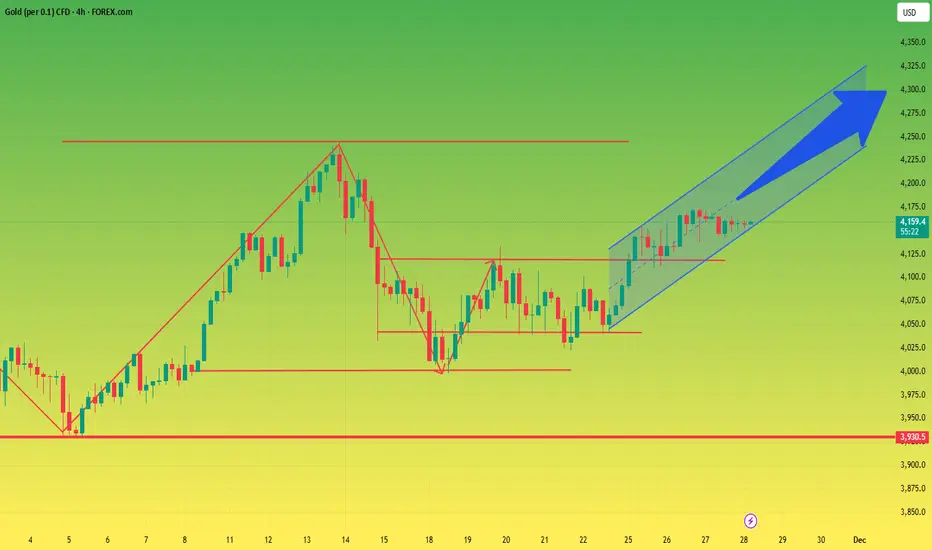
Continue to buy gold after the market opens!After a steady rise this week, gold prices have been consolidating near resistance levels, with trading range narrowing. As market expectations rise for another Fed rate cut in December, coupled with increased anticipation of regional peace negotiations, global market sentiment has become more optimistic, prompting some funds to flow from gold into risk assets. The US economic data released this week were mixed, but overall did not change the market's judgment on the Fed's policy path. The cross-cutting performance of economic data reinforced market expectations of further Fed rate cuts in December, causing the dollar index to fall to a one-week low and continuing to be a significant supporting factor for gold. From the combined perspective of interest rate expectations, dollar performance, and technical structure, this round of gains is very healthy. If subsequent economic data continues to support rate cut expectations, gold still has the potential to resume its upward trend after a pullback to key support. However, it should be noted that repeated fluctuations in the expected peace negotiations could bring additional volatility. In terms of strategy, we can continue to maintain a buy-on-dips approach! After the market opens, you can buy in batches in the 4125-4150 range, with the first target at 4165. If it successfully breaks through 4170, the upside potential will be further opened up, and it is expected that the stalemate will be broken on Friday. The above represents only my personal thoughts. If you find it helpful, please like and follow to show your support! Please note that any strategy is time-sensitive, and strategies will change as market conditions evolve. I will notify you in the channel based on the actual market situation!Longby Market_Trading_GuideUpdated 4
CopperXCUUSD - Bullish Channel as an corrective pattern in Short Time Frame - Resistance Level - RSI - Divergence - Completed " 1234 " Impulsive Waves - BSLby ForexDetective224
GOLD Consolidation Starts (Correction zone) Buyers Slow ExitNow after the all time high of 3482. GOLD enters into a Consolidation zone Starts or (Correction zone) Buyers Slow Exit. So at current market price 4180 Sell and again buy at 4000 and again sell at 4170 range and again buy at 3890 and again sell at 4050 and again buy at 3890 and again sell at 4160 and again buy at 3737. This is for Education Purpose only, am still testing WD Gann theory!by Arunvfx083
Defining Sustainable Finance and Its Importance in the Economy Introduction In the twenty-first century, finance is no longer viewed solely as a mechanism to generate profits; it is increasingly recognized as a tool for shaping sustainable development. Sustainable finance has emerged as a critical concept that integrates environmental, social, and governance (ESG) considerations into financial decision-making. The growing awareness of climate change, social inequalities, and corporate governance failures has compelled governments, investors, and financial institutions to rethink traditional finance models. Sustainable finance represents the convergence of economic performance with social responsibility and environmental stewardship, seeking to ensure long-term value creation while safeguarding planetary and societal well-being. Defining Sustainable Finance Sustainable finance can be broadly defined as the process of making investment decisions, lending, and financial activities that consider environmental, social, and governance factors alongside traditional financial analysis. Unlike conventional finance, which primarily focuses on risk-adjusted returns, sustainable finance emphasizes aligning financial flows with sustainable development objectives. These objectives are often guided by international frameworks such as the United Nations Sustainable Development Goals (SDGs) and the Paris Agreement on climate change. At its core, sustainable finance encompasses a wide range of practices, including green finance, social finance, responsible investing, and impact investing: Green Finance: Financial activities aimed at supporting environmentally sustainable projects, such as renewable energy, energy efficiency, and low-carbon infrastructure. Social Finance: Investments that address social challenges, including education, healthcare, affordable housing, and community development. Responsible Investing: Integrating ESG factors into investment decisions to mitigate risks and create long-term value. Impact Investing: Targeting measurable social and environmental impacts alongside financial returns. By combining financial and non-financial criteria, sustainable finance seeks to redirect capital flows towards projects that contribute positively to society and the environment. The Evolution of Sustainable Finance Sustainable finance is not an entirely new concept but has evolved significantly over the past few decades. Initially, financial markets were primarily concerned with short-term profits, often neglecting the broader consequences of investment decisions. However, increasing global environmental crises, social inequalities, and corporate scandals highlighted the limitations of a profit-centric model. The 2008 financial crisis further underscored the need for more resilient and responsible financial systems. In response, international organizations, regulators, and investors began promoting sustainability-oriented frameworks. The Principles for Responsible Investment (PRI), established in 2006, encouraged asset owners to integrate ESG considerations into their investment practices. Similarly, the Task Force on Climate-related Financial Disclosures (TCFD), created in 2015, aimed to improve transparency around climate risks in financial reporting. Over time, these initiatives have evolved into a broader movement that seeks to embed sustainability into the very fabric of financial markets. Key Components of Sustainable Finance Sustainable finance involves several interconnected components that ensure financial activities contribute to sustainable development: Environmental Considerations: Addressing climate change, pollution, biodiversity loss, and resource depletion. Financial institutions assess how their investments impact the environment and prioritize projects that promote ecological balance. Social Considerations: Promoting social equity, human rights, labor standards, and community well-being. Investments in social infrastructure, healthcare, education, and inclusive growth are examples of socially responsible finance. Governance Considerations: Ensuring transparency, accountability, ethical conduct, and robust risk management. Good governance minimizes financial and reputational risks while fostering trust in financial institutions. Risk Management and Long-Term Value Creation: By integrating ESG factors, sustainable finance enables investors and institutions to anticipate and mitigate long-term risks, including regulatory changes, environmental liabilities, and social unrest. This approach enhances the resilience of financial portfolios and promotes sustainable economic growth. Importance of Sustainable Finance in the Modern Economy Promoting Environmental Sustainability: Climate change poses a significant threat to global economies, with natural disasters, resource scarcity, and rising temperatures affecting industries and communities. Sustainable finance channels investments into renewable energy, green infrastructure, and low-carbon technologies, facilitating the transition to a sustainable economy. By doing so, it reduces environmental risks and supports global efforts to combat climate change. Fostering Social Development: Sustainable finance emphasizes the social dimension of investments, ensuring that capital allocation addresses societal challenges. Investments in healthcare, education, affordable housing, and inclusive growth improve living standards and reduce inequalities. By promoting social development, sustainable finance strengthens communities and enhances economic stability. Enhancing Corporate Responsibility and Governance: Incorporating ESG criteria encourages corporations to adopt responsible business practices. Companies with strong governance and ethical practices are less prone to scandals, regulatory penalties, and reputational damage. Sustainable finance incentivizes accountability and transparency, contributing to more stable and trustworthy financial markets. Reducing Systemic Financial Risks: Environmental and social risks are increasingly recognized as material financial risks. Climate-related disasters, resource depletion, and social unrest can disrupt markets and lead to financial losses. Sustainable finance provides a framework for assessing and managing these risks, reducing the likelihood of systemic crises and ensuring long-term financial stability. Aligning with Global Development Goals: Sustainable finance aligns financial flows with the SDGs, promoting inclusive and equitable growth. By supporting projects that address poverty, inequality, clean energy, and responsible consumption, it fosters sustainable economic development and contributes to a more equitable global economy. Driving Innovation and Economic Competitiveness: Sustainable finance encourages investment in innovative technologies and sustainable business models. Companies focusing on renewable energy, circular economy solutions, and green technologies gain a competitive advantage. This drives economic growth, creates jobs, and fosters innovation, making economies more resilient to future challenges. Attracting Responsible Investors: Investors increasingly seek ESG-compliant opportunities as awareness of sustainability risks grows. Sustainable finance attracts institutional investors, pension funds, and socially conscious individuals, enhancing capital availability for sustainable projects and reducing the cost of capital for responsible enterprises. Challenges and Future Prospects Despite its importance, sustainable finance faces several challenges. Standardization of ESG metrics remains a significant issue, as inconsistent reporting makes it difficult to assess sustainability performance. Additionally, greenwashing—misrepresenting investments as environmentally or socially responsible—undermines trust. Regulatory frameworks vary across countries, creating barriers to cross-border sustainable investments. Nevertheless, the future of sustainable finance looks promising. Governments and regulators are increasingly mandating ESG disclosures, while technological advancements in data analytics and blockchain improve transparency. As awareness grows, sustainable finance is expected to become a mainstream component of financial markets, reshaping investment strategies and corporate behavior. Conclusion Sustainable finance represents a paradigm shift in the modern economy, where financial decisions are no longer isolated from social and environmental considerations. By integrating ESG factors into investment and lending practices, sustainable finance addresses pressing global challenges, including climate change, inequality, and corporate governance failures. It promotes long-term economic resilience, attracts responsible investment, and aligns financial markets with global development objectives. In an era marked by uncertainty and complex global challenges, sustainable finance is not merely a moral imperative—it is an economic necessity. Its growth signals a future where finance serves as a catalyst for sustainable development, ensuring that economic prosperity goes hand in hand with social well-being and environmental stewardship. The adoption of sustainable finance principles will ultimately determine the capacity of economies to thrive in a rapidly changing world, making it a cornerstone of modern economic policy and practice.Educationby GlobalWolfStreet111
Countdown Begins — Nifty Setting Up a Precise Time Blast🔥 Time & Price Analysis — The Market Has Spoken 🔥 Strategy: Buy on Dips CMP: 26,338 Target 1: 26,405 Target 2: 26,490 Stop Loss: Below 26,290 Time Window: Move expected by 10.50 am on 28th November When Time and Price come together, doubt disappears. Nifty is aligning perfectly with my cycle window. Demand zones are holding with remarkable strength, and the Time Vibration is indicating a decisive upward push before 23:30 on 28th Nov. I’m positioned. I’m prepared. And I’m trusting my analysis with full conviction. Buy on dips. Protect the levels. Respect the time. This move isn’t random— It’s calculated. It’s timed. It’s coming. If this analysis resonates with you, Like, Share, Boost, and Comment — Your engagement brings more deep Time & Price studies to this community.Longby RaviRoushanSrivastavaUpdated 141424
end of 2025: looking like the start: what i seethe trend has decided to remain bearish so 86k to 79k are my reversal points for a $139k target in price however if it does break those lows it has made a significant break of structre that could push bitcoin to very concerning lows in this case one would have to hedge to save themselvesLongby Bekiumuzi_DubeUpdated 2
Gold broke through trendline resistance. Bullish.Due to Thanksgiving, overall price fluctuations were limited, mainly range-bound, oscillating within the 4140-70 range, although the daily chart closed higher. Currently, the downtrend line has been temporarily broken, and aggressive buying at higher levels is not recommended until it is firmly established above this level. Looking at the four-hour chart, the gold triangle consolidation pattern remains unchanged, with the downward trendline resistance around 4175. Only a decisive break above this trendline resistance can lead to further upward movement, presenting a new buying opportunity! On the one-hour chart, the price is repeatedly testing the resistance zone, showing short-term spikes. After the one-hour candlestick firmly establishes itself above 4175, watch for short-term corrections, which could present buying opportunities. Today, continue to monitor the price reaction at the upper trendline of the triangle at 4175, which is also the key level for today's bullish/bearish trend. If it holds above this level, further gains to 4200-4220 are possible. Key Levels: First Support: 4152, Second Support: 4140, Third Support: 4122 First Resistance: 4190, Second Resistance: 4208, Third Resistance: 4222 Gold Trading Strategy: BUY: 4145-4150, SL: 4130, TP: 4170-4180; SELL: 4200-4205, SL: 4220, TP: 4180-4170; More Analysis →Longby Wall_street_junUpdated 1
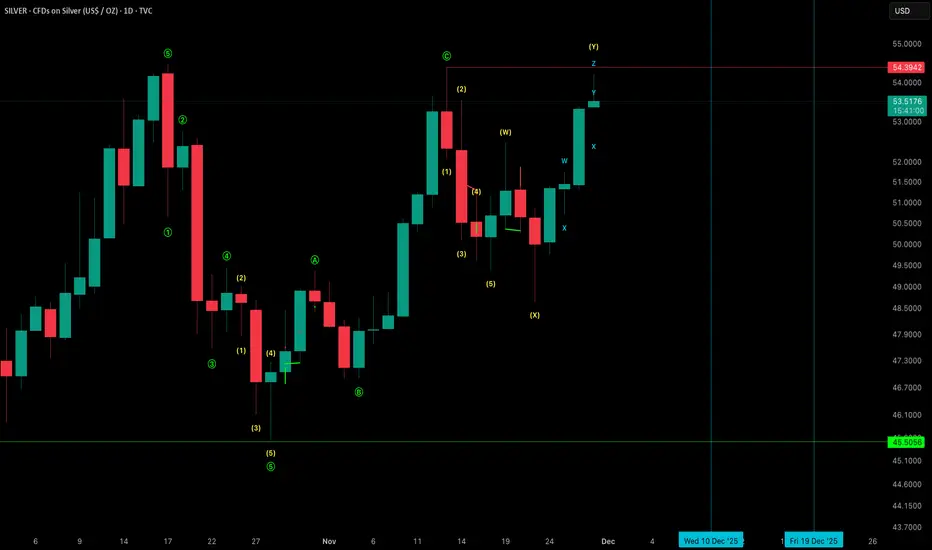
Gold & Silver Forecast: Topping Pattern + Gann Dates AlignWe continue to lean towards the view that both markets are forming — or have already formed — a top, with a strong reversal to the downside still favoured. Our potential bottom dates remain as follows: 10th December 19th December 29th December Could both precious metals continue higher? Yes — if Gold breaks above 4245 and Silver breaks above 54 on a daily breakout basis, then both instruments could accelerate sharply to the upside. In that scenario, the dates listed above would likely flip from potential bottoms to potential tops. However, for now, our Elliott Wave count, Gann timing, and statistical work continue to point more towards a reversal and a downside move. We acknowledge that the current trend, with all these strong green candles, looks powerful and convincingly bullish — but this does not change our bearish bias unless the market proves otherwise. In all cases, stay safe and always apply strict risk management.by VitalDirection0
THANKS GIVING TRADE BREAKDOWN 11/27/2025Green week for us USDCZK, USDCNH, CTT EURGBP AND CHFJPY. Decent week 12:04by nicholo310
I will go long on gold at $4125-$4150.With the week drawing to a close, let's review our trading performance. Overall, we've maintained a profitable trend. Since the market opened on Monday, we bought at the low point and the price of gold rose all the way up. We continued to buy on dips and the price continued to fluctuate upwards. Our trading strategy remained to buy on dips until the price approached the key resistance area and then entered a consolidation phase. After a period of steady rise, gold prices have been fluctuating narrowly around previous highs recently, with the range of fluctuation gradually narrowing. Market expectations for a further rate cut by the Federal Reserve in December continue to rise, coupled with a positive outlook for geopolitical peace negotiations, which has boosted global risk appetite. Some funds have shifted from safe-haven assets to risk assets, putting some downward pressure on gold prices in the short term. Although the US economic data released this week showed a mixed picture, it did not significantly change the market's overall assessment of the monetary policy path. The structural discrepancies in the data reinforced expectations that the Federal Reserve would maintain its accommodative stance, causing the dollar index to fall to a one-week low and providing strong support for gold. Considering the interplay of interest rate expectations, the US dollar exchange rate, and technical patterns, this round of price increases has strong fundamental support and a healthy structure. If subsequent economic data continues to indicate a slowdown in growth momentum, reinforcing expectations of interest rate cuts, gold prices may resume their upward trend after a pullback to test key support levels. However, we must be wary that uncertainties in geopolitical developments could trigger fluctuating market sentiment, thereby exacerbating short-term volatility. Strategically, it is recommended to continue the approach of buying on dips. After the market opens, positions can be established in batches within the 4125-4150 range, with the first target at 4165; if the 4170 level is effectively broken, further upside potential will open up. The market is expected to break out of its current consolidation pattern on Friday and make a directional choice. The above are my personal thoughts! If they are helpful to you or you agree with my ideas, please like and follow to support me! All strategies have a limited lifespan. While referring to them, it's also important to closely monitor market changes. I will respond flexibly based on actual market fluctuations, and I will provide specific updates in the channel! Longby Martin_Trading_Guide3
I'm planning to go long on gold in the 4150-4160 range!Gold prices performed strongly this week. After opening, the price dipped to around 4040 before rebounding. I promptly issued a buy signal at the low point, and as I predicted, the price successfully broke through $4100 and continued to climb. During the rise, I issued multiple buy signals, constantly setting new highs, which validated the correctness of the long strategy. So far, gold prices have been steadily rising without significant pullbacks, which I believe is a healthy trend. Technically, on the hourly and 4-hour charts, prices are trading above major moving averages and the Bollinger Band's middle line, indicating that the bulls are in control. Therefore, my strategy remains to buy gold. Aggressive traders may consider buying gold at 4150-4160, with 4135-4145 as a potential entry point for additional positions. Strict position sizing and buying in stages are crucial. The above represents only my personal thoughts. If you find it helpful, please like and follow to show your support! Please note that any strategy is time-sensitive, and strategies will change as market conditions evolve. I will notify you in the channel based on the actual market situation!Longby Market_Trading_GuideUpdated 1
BTC and FibI'm to lazy to type description I'm to lazy to type description I'm to lazy to type description I'm to lazy to type description I'm to lazy to type description I'm to lazy to type description I'm to lazy to type description I'm to lazy to type description I'm to lazy to type description I'm to lazy to type description I'm to lazy to type descriptionby Crypto_105650
Im selling gold CFDs#GOLD downfall starts very soon. Becareful buying at the top range, we are lokely to visit 3,700.00$ hashtag#XAU Downchannel formed around 4 Hours time frame plus symetrical triangle im very bearish now.Shortby RickAndTrading2
XAUUSD: Market Analysis and Strategy for November 27Gold Technical Analysis: Daily Resistance: 4210, Support: 4000 4-Hour Resistance: 4180, Support: 4110 1-Hour Resistance: 4170, Support: 4130 The weekly chart continues its bullish trend. Tomorrow's monthly/weekly chart closes, directly impacting the December technical outlook. The daily chart continues its upward trend. The newly formed "rounded bottom" needs to be monitored for its sustainability. Bollinger Bands are widening upwards, and the middle band and moving average support are gradually moving upwards. As mentioned in recent analyses, the main strategy is to follow the trend and be bullish. The next key level to watch is 4200. Long-term holders can wait for the Fed's interest rate decision before buying. The ideal long-term entry point for gold remains below 4000; however, short-term traders can buy low and sell high. Based on the 1-hour chart, gold continued its upward trend during the European session, with the candlestick pattern indicating an upward channel. The next resistance level to watch is around 4180, followed by the psychological resistance at 4200. Support levels are around 4150/4140. Trading Strategy: BUY: 4150~4140 Selling strategies should be determined based on the real-time candlestick pattern. More Analysis →Longby ActuaryJUpdated 4
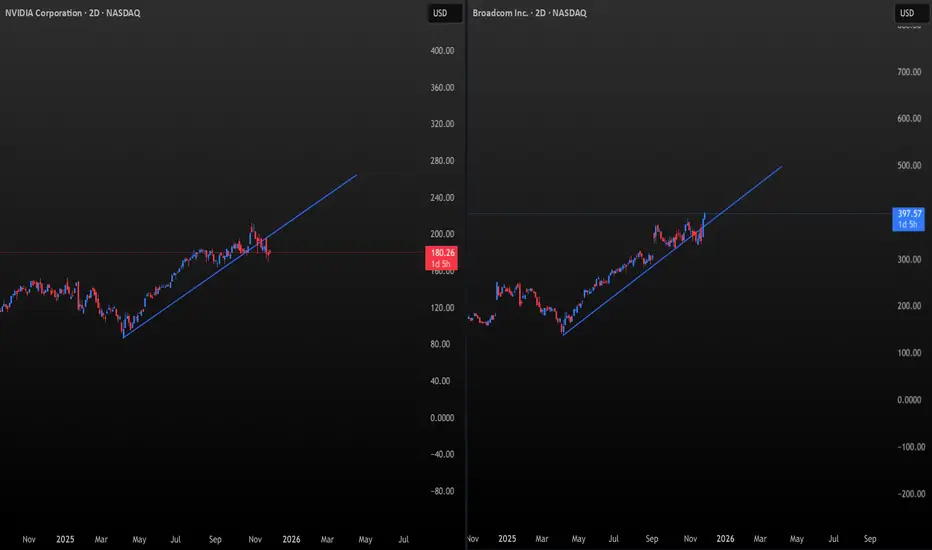
NVDA vs AVGO: The Battle for the AI Throne Has Begun⚡A New Leader Emerges in the Semiconductors For years, NVDA was the undisputed titan — the gravitational center of the semiconductor universe. But now, the geometry tells a different story. THE CHARTS 📐 Both charts use the same natural scaling: 1° of time = $1 of price per unit. And here’s the critical observation: NVDA has broken beneath its 1° angle. AVGO has recaptured and accelerated above its 1° angle. AVGO has already made new all-time highs. During a semiconductor correction. While SMH was down. While the S&P 500 retraced. The real question still remains however, are we still in the early innings of the AI Boom? SMH — The Semiconductor Supercycle Update The Structure That Defines the AI Era🏛️ The 2023–2027 channel is the master structure for this entire semiconductor cycle. SMH bounced precisely where the primary and secondary angles intersect. 🚀 Market Knots — Speed & Acceleration Confirm the Turn Speed found support precisely at the median line around 126 Market Knots — the natural mid-energy band where major long-term advances restart. Acceleration appears to have: 🔻spiked, 📉bottomed, and is now curling upward. Poised to turn positive The measurements point to a weekly bottom and another wave higher in this semiconductor cycle fueled by AI growth. The Leadership Rotation🏅 (The Baton Moment) AVGO is emerging as the structural leader of the AI supercycle. It has already demonstrated exceptional strength: holding its 1° angle, breaking into new all-time highs, and accelerating while the rest of the semiconductor sector underperformed. This behavior is not random. It reflects Broadcom’s unique position at the infrastructure core of AI — the networking, switching, optical, and custom ASIC layer that becomes the bottleneck after GPUs. As the semiconductor supercycle builds, AVGO steps forward as the defining leader of the AI boom by Nana-Hermes8866
GBPJPYGBPJPY - Demand Zone - Fibonacci Level - 50.00% / 61.80% - Break of Structure - Completed " 12345 " Impulsive Waves - Sell Side Liquidityby ForexDetective226
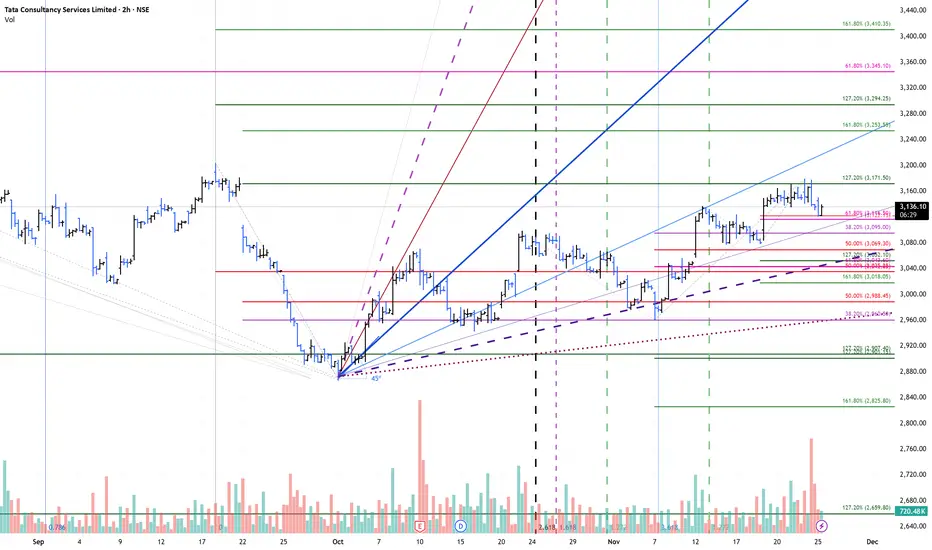
TCS - 2hour Chart with Price Cluster levels to watch .TCS - 2 hour chart price cluster level along with GANN Fans, initial reaction back down from extension. by StlnsUpdated 118
BTC: Wait for 120KI've repeatedly suggested buying BTC consistently below 90K, and the market has validated my view once again. Our current positions are profitable – keep holding and wait for the high to hit. Today's BTC Trading Strategy: BTCUSDT buy@88000-90000 TP:93000-95000 I'll send out accurate signals right at the opening every day, don't miss out. Longby AntonioWatt2