Gold in Global Trade: An Analysis of SafetyHistorical Stability of Gold
Historically, gold has been valued for its scarcity, durability, and universal acceptance. Unlike fiat currencies, which can be printed and devalued by governments, the supply of gold is limited. This scarcity ensures that gold retains intrinsic value, making it a reliable store of wealth. During periods of economic crisis, wars, or geopolitical instability, investors have consistently turned to gold as a safeguard against currency depreciation and inflation.
For example, during the 2008 global financial crisis, while stock markets plunged worldwide, the price of gold surged as investors sought a safe store of value. Similarly, countries with unstable economies often rely on gold reserves to stabilize their currencies and trade imbalances. This historical consistency has cemented gold’s reputation as a safe and liquid asset in global trade.
Gold as a Hedge Against Currency Fluctuations
One of the primary reasons gold is considered safe in global trade is its role as a hedge against currency fluctuations. In international trade, currency values are volatile and can be affected by inflation, monetary policy, and political instability. Gold, priced in major currencies like the US dollar, provides a buffer against these risks. When the dollar weakens, gold prices often rise, maintaining purchasing power for traders and investors.
Central banks around the world also hold substantial gold reserves as a part of their foreign exchange strategy. By diversifying their reserves between currencies and gold, they can mitigate risks associated with sudden currency devaluation. This demonstrates the critical role gold plays not only for individual investors but also in stabilizing global trade systems.
Liquidity and Global Acceptability
Another factor contributing to gold’s perceived safety is its universal acceptability and liquidity. Unlike other commodities, gold can be traded easily in almost any market globally, from New York to Dubai, Singapore, or London. This ease of transaction ensures that gold can be converted into cash quickly in times of need, which is particularly important during trade disruptions or financial crises.
Gold is also highly standardized, with global markets adhering to consistent purity standards (typically 24-karat or 99.99% pure). This standardization reduces transaction friction, making gold a reliable medium in global trade, especially in situations where other financial instruments or fiat currencies may lose value due to instability.
Risks Associated with Gold in Global Trade
Despite its historical reliability, gold is not entirely risk-free. Investors and traders should consider several factors before assuming that gold is “completely safe.”
1. Price Volatility: Although gold is less volatile than stocks or cryptocurrencies, it still experiences significant price fluctuations. Global demand, interest rates, inflation expectations, and geopolitical events can all cause sharp swings in gold prices. For example, during periods of rising interest rates, gold often underperforms because it does not generate income like bonds or equities.
2. Storage and Security Costs: Physical gold requires secure storage, insurance, and sometimes transportation logistics, which can add costs and reduce liquidity. In international trade, shipping large quantities of gold is expensive and risky, particularly in politically unstable regions.
3. Regulatory Risks: Governments may impose taxes, tariffs, or restrictions on gold trading and export, especially during periods of economic crisis. For instance, India historically imposed restrictions on gold imports to manage trade deficits, which affected international trade dynamics.
4. Opportunity Cost: Holding gold exclusively, without diversifying into other assets, carries an opportunity cost. In bullish equity markets or high-growth sectors, gold may underperform relative to other investment vehicles. Traders relying solely on gold may miss opportunities for higher returns elsewhere.
Gold in Modern Financial Systems
In today’s financial ecosystem, gold remains an essential instrument in global trade and investment, albeit with a more nuanced role. Beyond physical gold, financial derivatives such as gold futures, options, and exchange-traded funds (ETFs) have expanded its accessibility. These instruments allow investors and corporations to hedge against currency risk, inflation, and commodity price fluctuations without physically holding gold.
Gold ETFs, for example, have made gold trading more liquid and efficient, allowing smaller investors to participate in global gold markets. Central banks and large corporations also use gold swaps and forward contracts to stabilize their balance sheets and hedge risks in international trade. However, these financial instruments introduce counterparty risk, which is a new dimension compared to physical gold.
Gold and Global Trade Policy
Gold’s role in global trade is also influenced by geopolitical factors. Nations with substantial gold reserves are better positioned to weather economic sanctions, currency crises, or trade disruptions. Conversely, countries with limited access to gold may face vulnerabilities in international trade.
Additionally, the global pricing of gold is heavily influenced by the US dollar, as most gold transactions are denominated in dollars. This dependence means that shifts in US monetary policy or currency valuation can impact the global perception of gold’s safety. Thus, while gold remains a reliable hedge, its safety is not absolute; it is contingent on global economic and geopolitical dynamics.
Conclusion: Safe, But Not Risk-Free
In conclusion, gold is widely regarded as one of the safest assets in the global trade market due to its historical stability, scarcity, liquidity, and role as a hedge against currency fluctuations. It has consistently provided a buffer during financial crises, inflationary periods, and geopolitical instability. Its universal acceptability and standardization make it a reliable medium in international transactions.
However, gold is not entirely free from risks. Price volatility, storage and security costs, regulatory constraints, and opportunity costs mean that relying solely on gold is not a guaranteed safeguard. Modern financial instruments linked to gold, while increasing accessibility, also introduce new dimensions of risk.
Therefore, gold can be considered a relatively safe asset in global trade, but its safety is contextual. Investors, traders, and policymakers should treat it as a critical component of a diversified portfolio, rather than a standalone guarantee of security. In a complex and interconnected global economy, the “safest” strategy is one that balances gold with other financial instruments, currencies, and commodities to mitigate risk and maximize stability.
Globalstar
How International Finance Has Transformed1. From Gold Standard to Fiat and Floating Exchange Rates
One of the most significant transformations occurred in the 20th century when countries moved away from the gold standard, where currencies were directly linked to gold reserves. This system promoted stability but limited monetary flexibility. The shift began after the Great Depression and was finalized when the Bretton Woods system collapsed in 1971, allowing currencies to float freely.
This change reshaped international finance in several ways:
Exchange rate volatility increased, creating new risks and opportunities for global trade.
Central banks gained more power, using interest rates and monetary tools to manage inflation, growth, and currency values.
Currency markets expanded, eventually becoming the world’s largest financial market.
The transition to floating exchange rates allowed greater economic independence but also made global finance more complex and sensitive to geopolitical events, speculation, and macroeconomic trends.
2. Globalization and the Surge of Cross-Border Capital Flows
After World War II and especially since the 1980s, globalization accelerated dramatically. Countries reduced trade barriers, opened financial markets, and encouraged foreign investment. As a result:
Foreign direct investment (FDI) surged as multinational corporations expanded production worldwide.
Portfolio investments grew rapidly, with investors buying stocks, bonds, and derivatives across borders.
Developing economies gained access to global capital, enabling faster growth but also exposing them to external shocks.
Globalization made capital mobile and interconnected but also increased financial contagion risk, as seen in the Asian Financial Crisis (1997), Global Financial Crisis (2008), and the market turmoil during the COVID-19 pandemic.
3. The Rise of International Financial Institutions
International finance today is heavily shaped by global institutions such as:
International Monetary Fund (IMF) – monitors global stability, provides financial assistance, and stabilizes exchange rates.
World Bank – funds development and infrastructure projects.
Bank for International Settlements (BIS) – coordinates central bank policies.
World Trade Organization (WTO) – facilitates trade rules and dispute resolutions.
These institutions did not exist or had limited roles in earlier eras. Their expansion reflects the growing interdependence of nations and the need for coordinated financial governance.
4. Technological Revolution: Digital Payments, Trading, and Banking
Perhaps the most revolutionary transformation has come from technology.
a. Digital Banking and Payments
The rise of online banking, mobile wallets, payment gateways, and instant settlement systems (like UPI, SWIFT gpi, SEPA, and FedNow) has changed how money moves globally. Cross-border transactions that took days now occur within minutes.
Key changes include:
E-payments replacing cash
Fintech companies disrupting traditional banking
Blockchain and cryptocurrency innovations introducing decentralized finance (DeFi)
b. Algorithmic and High-Frequency Trading (HFT)
Financial markets today rely heavily on:
Algorithmic trading
Machine learning-based decision systems
Microsecond-level execution speeds
This has transformed global foreign exchange, commodity futures, and stock markets, increasing liquidity but also raising concerns about flash crashes and systemic risk.
c. Cryptocurrencies and Digital Assets
Bitcoin, Ethereum, stablecoins, and central bank digital currencies (CBDCs) have altered the landscape by introducing:
Decentralized value transfer
Smart contracts
New investment vehicles
Alternatives to traditional banking systems
Countries like China have advanced digital currency initiatives (e-CNY), while many central banks are exploring or piloting CBDCs.
5. The Emergence of Global Financial Hubs
Cities such as New York, London, Singapore, Hong Kong, Dubai, and Tokyo have evolved into major financial centers. Their growth is driven by:
Attractive regulatory environments
Large capital pools
Expertise in asset management, banking, and trading
Connectivity to international markets
These hubs influence currency flows, investment trends, and global economic policies.
6. Transformation of Trade Finance and Global Supply Chains
Modern international finance supports complex global supply chains that operate through:
Letters of credit
Trade credit insurance
Supply chain finance
Blockchain-based trade settlement
Supply chains now stretch across continents, linking producers, distributors, and consumers worldwide. As a result, disruptions like the pandemic, geopolitical tensions, or shipping bottlenecks significantly impact international finance.
7. Regulatory Evolution and Risk Management
After major global crises, regulations have become stricter and more sophisticated.
Major reforms include:
Basel I, II, and III – strengthening banking capital requirements.
Dodd-Frank Act (2010) – increasing transparency and oversight of derivatives.
IFRS standards – aligning international accounting practices.
Anti-money laundering (AML) and KYC rules – reducing illegal finance.
These regulations aim to prevent systemic failures while promoting stable and transparent financial markets.
8. Geopolitics and International Finance
International finance today is heavily shaped by geopolitical dynamics:
Key developments:
US-China trade war reshaped supply chains and investment flows.
Sanctions on countries (Russia, Iran, etc.) influence global energy and commodity markets.
Rise of bilateral currency trade (like yuan settlements) reduces reliance on the dollar.
Regional trade blocs (EU, ASEAN, USMCA) shape economic cooperation.
Finance has become an instrument of geopolitical influence, with currencies, sanctions, and capital controls used strategically.
9. The Dominance of the US Dollar and Challenges Ahead
The US dollar remains the world's primary reserve and trade currency, giving the U.S. significant financial influence. However:
China’s yuan
Euro
Cryptocurrencies
CBDCs
are emerging as competitors. The future may see a more multipolar currency system.
10. The Future of International Finance
International finance continues to evolve. Key trends include:
Wider adoption of CBDCs and blockchain-based settlements
Green finance and ESG investments
AI-driven financial analysis and risk management
More regional and local currency trade
Reorganization of supply chains for resilience
The next decade will likely bring a more digital, decentralized, and multipolar global financial architecture.
Is Apple's $1.5B Satellite Deal the Future?In the rapidly evolving world of satellite communications, a transformative partnership has emerged between tech giant Apple and satellite operator Globalstar. This landmark $1.5 billion agreement has the potential to reshape the way we connect in remote and underserved regions, inspiring questions about the future of global connectivity.
At the heart of this deal lies Globalstar's commitment to develop and operate a state-of-the-art mobile satellite services (MSS) network. Backed by Apple's substantial infrastructure prepayment of up to $1.1 billion and a $400 million equity investment, Globalstar is poised to enhance the reliability and coverage of emergency satellite communications for iPhone users worldwide. This strategic alliance not only demonstrates Apple's long-term vision for satellite-based connectivity but also positions Globalstar as a dominant player in an industry that is expected to witness a surge in activity in the coming decade.
As the satellite communications sector braces for the launch of an estimated 50,000 satellites into low-Earth orbit, this Globalstar-Apple partnership stands out as a game-changer. By dedicating up to 85% of its network capacity to Apple, Globalstar is solidifying its role as a critical infrastructure provider, catering to the growing demand for seamless connectivity in remote and underserved regions. This move, coupled with Globalstar's plans to expand its satellite constellation and ground infrastructure, suggests a future where satellite-based services become increasingly integrated into our everyday lives.
The financial implications of this deal are equally compelling. Globalstar projects that its annual revenue will more than double in the year following the launch of the expanded satellite services, marking a significant improvement from its recent financial performance. Furthermore, the company's ability to retire its outstanding senior notes and secure favorable adjustments to its funding agreement highlights the transformative nature of this partnership, positioning Globalstar for long-term growth and stability in the evolving satellite communications landscape.
GSAT may form Bearish Flag pattern. 6/Oct/21GSAT ( Globalstar ) may form a bearish flag pattern where price might stalled at around 6.34 which are 1) Supply Zone 2) Upper Line of bearish flag pattern ..
Globalstar seeking to descend. GSATRegression to the mean is what we are seeing wit GSAT. This one shows no evidence of pivoting or impulsing upwards once again. That last impulse was stellar, however.
This is a reflection using technical analysis + only and we do not consider valuation and macro factors at this stage.
The Fibonacci targets going down are highlighted in purples with invalidation in red. Fibonacci goals, it is prudent to suggest, are nothing more than mere fractally evident and therefore statistically likely levels that the market will go to. Having said that, the market will always do what it wants and always has a mind of its own. Therefore, none of this is financial advice, so do your own research and rely only on your own analysis. Trading is a true one man sport. Good luck out there and stay safe!
#stocks #penny #GSAT, #GlobalstarINC, BullishIn this video, the discussion is about the #GSAT, Price Action analysis, resistance, and support, risk to reward ratio.
Note: The discussion on the video is not financial advice and is purely for training and educational purpose.
$GSAT Follow Up Breakdown 3/2$GSAT Video breakdown on todays choppy action and what to watch for tomorrow!
A Good ONEAfter AT&T Buys Straight Path, Globalstar Could Be The Next Telecom Takeover Target
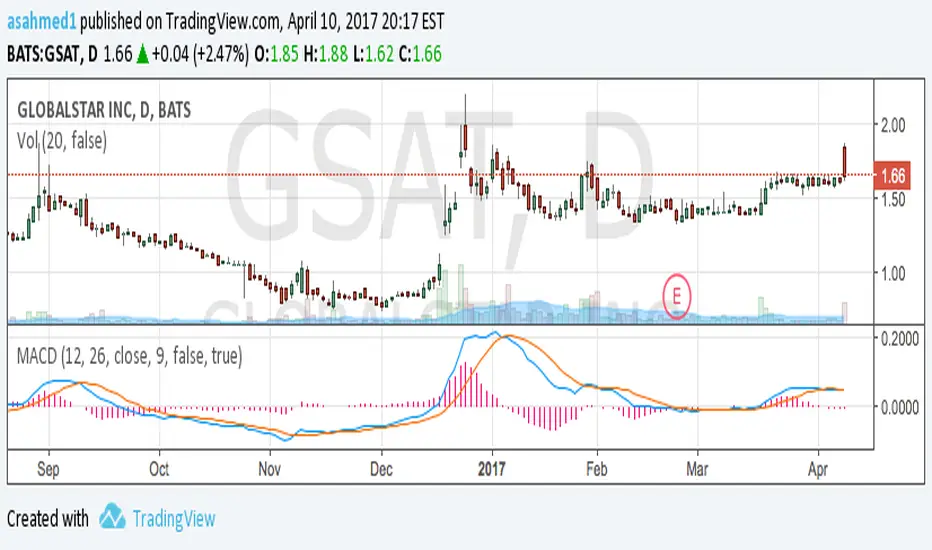
Chart does show an uptrend is starting
Entry: tomorrows open
S/L: $0.73