GOOGL low resistance liquidity run to ATHI think this GOOGL 24 hour chart has a great set up to take us back to All-time high.
We got the formation of a bullish fair value gap today.
We have relative highs sitting at 321.31.
Most definitely a low resistance run on liquidity at 332.98.
There was a gap on the weekly timeframe that got filled, and we got a bounce out of it two weeks in a row, and this would be the third week of a bounce .
The only thing that could disrupt this move up, is that there is a bearish weekly Fair value gap that needs to get broken through.
We clear that and it could be smooth sailing.
Imbalance
BTC — Trendline Rejection or Breakout? BTC is approaching a key structural decision point, and the next move will determine whether we see continuation upward or a corrective sweep to lower liquidity levels. This idea outlines both scenarios with clear targets and educational structure analysis.
Key Structural Areas
1️⃣ Rising Trendline Support
BTC continues to respect a clean ascending trendline. This line has been a major pivot for the past several days.
Price is currently hovering just above it, and the yellow circle marks the confluence of:
Rising trendline support
A local demand block
Prior liquidity sweep zone
This is the most important area to watch for reaction.
2️⃣ Short-Term Rejection Scenario (White Path)
Before breaking upward, BTC may show short-term downside rejection, targeting:
➡️ Short-Term Target:
$88,180
This level aligns with:
Demand block retest
Trendline kiss
Local inefficiencies needing fill
A rejection into 88,180 would be normal and healthy before a potential bullish continuation.
3️⃣ Bullish Reclaim Scenario
If price taps the rejection zone and reclaims the trendline, upside targets remain:
$95,800 – $96,500 → Half-filled FVG + structural supply
$99,500 – $100,200 → Major FVG + macro resistance zone
These zones are where we expect strong reaction and profit-taking.
4️⃣ Breakdown Scenario
If BTC fails the trendline with a full candle close below, expect:
Breakdown of structure
Full sweep of demand
Deeper correction into mid-range levels
Not my primary bias, but it's critical to acknowledge the possibility.
Summary
BTC is sitting on an important trendline.
A quick rejection into 88,180 could be the liquidity grab needed before upside continuation.
Reclaiming the trendline = bullish continuation toward FVGs.
Breaking below = deeper corrective move.
📘 Disclaimer
This analysis is for educational purposes only. It represents personal opinion and not financial advice. Always do your own research and manage your own risk.
EURUSD: Liquidity Grab @ 1.15000EURUSD has experienced a liquidity grab as price closed below the previous low and is heading towards 1.15. CRT suggest price could go lower and wick below the previous candle or even drop further.
Alongside 1.15, there is an imbalance, which price could tap into and possibly fill, both EURUSD and GBPUSD has some divergence so it will be interesting to see how it plays out
Rare Global Long Liquidity Imbalance (Order Book Signal)Over the last few days, the Long Zigg indicator has printed a rare extreme reading of 100 at the 10% order book depth — and this level appeared twice in just three days . Other monitored depths are also trading near their recent highs.
The last time we saw similar readings was around March 7, 2025 . After a brief correction, the market moved into a strong growth phase:
• BTC ≈ +70%
• ETH ≈ +225%
• SOL ≈ +166%
Many altcoins extended even further over the following months.
Long Zigg tracks the liquidity imbalance toward longs across the entire market using aggregated order books rather than price alone. It highlights moments when buy-side interest clearly dominates available sell liquidity.
Right now, this signal again shows a notable skew in liquidity to the buy side. I’m watching to see whether the market will react in a similar way to the previous extreme, or if this time will be different.
This is not financial advice and not a trade recommendation — just an observation based on my order book analytics.
BTC — Original Distribution Still UnfinishedBTC continues to move inside unfinished structure. Risk tone is neutral and overnight flows were thin, leaving the market waiting for direction from today’s U.S. releases. The only event with enough weight to shift risk appetite is the FOMC Minutes later today.
On the chart, BTC has rejected the original bullish distribution gap at 88,804.64 for several sessions. That gap remains unclosed, which signals unfinished architecture rather than trend continuation. Price is still confined within Monday’s range between 91,158 and 95,950, forming a clean mid-range compression. Nothing in this structure confirms resolution yet.
Market Structure Mapping views this compression as a neutral regime: the market is balancing, not trending. The failure to close the distribution zone shows the prior move left imbalance behind, and markets generally rebalance before committing to a new leg. Retail sees “sideways.” Professionals see preparation.
The non-obvious point: this isn’t hesitation; it’s the market restoring balance before revealing intent.
For operators, the approach is straightforward. Let New York volatility clear the noise. Structural clarity only appears once price resolves above 95,950 or below 91,158. Anything before that is positioning, not direction.
— CORE5DAN
Institutional Logic. Modern Technology. Real Freedom.
DXY, US DOLAAR UPDATEDXY — Structure & Flow Brief
DXY | Bullish Bias | Daily Frame | CORE5 View:
Dollar remains in short-term pullback mode inside a broader bullish structure, holding between 97.67 and 99.98 while traders watch this week’s macro lineup.
The key data hits Thursday and Friday — Jobless Claims, followed by PPI and Retail Sales.
Those reports will show if the economy is cooling or still running hot, shaping the next leg for the dollar.
Yields stay firm, keeping the tone quietly bullish, but most desks are flat until the data drops.
MSM — Market Structure Mapping (The Framework)
We’re trading inside a daily bearish candle, sliding into the imbalance near 98.964.
A close back above that cap would keep the broader trend context bullish.
If price doesn’t reclaim that level, the structure favors a move toward lower zones before the next leg.
VFA — Volume Flow Analytics (The Participation Map)
A main POC sits at 98.562, right inside the discount area of the range.
That’s a heavy-volume zone — price action can drive into it if downside momentum develops.
On news days, markets often run through these areas to clear liquidity before direction returns.
OFD — Order Flow Dynamics (The Behavior)
Price is currently parked inside an order-flow imbalance, filling single-print orders around 98.964.
It’s an absorption phase — volume is active, but larger players are keeping it balanced until catalysts arrive.
We’re seeing divergences across EURUSD, gold, and yields heading into Friday’s PPI and Retail Sales.
When the data hits, volatility often increases, and these imbalance zones tend to resolve.
PEM — Precision Execution Modeling (The Engagement Rules)
Trading the middle of the range is a low-edge play unless you’re scalping.
We’ve already had strong moves today, so there’s no reason to force new triggers here.
Within the CORE5 framework, we avoid engaging at the 50/50 range midpoint and wait for direction, confirmation, and flow alignment.
For now, it’s about risk control and patience until tomorrow’s data gives a clean framework signal.
CORE5 Rule of the Day:
Mid-range moves feed ego, not equity.
— CORE5DAN
Institutional Logic. Modern Technology. Real Freedom.
GAL Head & Shoulders Breakdown Ahead? | Smart Money Targeting FAThe Ghandhara Automobiles Limited (PSX: GAL) chart is showing a clear Head and Shoulders reversal pattern at the top of a long-term ascending channel — hinting at potential bearish movement before any new bullish cycle begins.
📊 Technical Insights:
🧩 Head & Shoulders Pattern signaling trend exhaustion.
🟪 IMB Zone (Imbalance) yet to be fully mitigated — price likely to rebalance before continuation.
🔻 Fundamental Area around 400–420 PKR could act as a major demand zone for Smart Money accumulation.
🟢 Long-term channel still intact, suggesting possible rebound after discount pricing.
💡 Outlook:
Expect short-term bearish pressure targeting the IMB and Fundamental Zone before the next potential bullish leg. Patience and confirmation at the lower levels will be key for investors and SMC traders.
BTCUSD Pre NY SessionThe key target sits at 98.225, marking the next visible liquidiBTCUSD | 7 Nov 2025
Bitcoin traded through the buy-side imbalance on the daily chart and flipped that zone into resistance.
This confirms a Buy-Side Imbalance Flip.
Clear liquidity targets remain below current price.
The key target sits at 98.225, marking the next visible liquidity objective.
Dollar tone stays firm, and risk sentiment remains cautious.
Crypto markets continue to mirror liquidity behavior, not headlines.
Flows remain defensive as participants manage exposure into key levels.
Professionals wait for confirmation when structure shifts.
They don’t react to the first move — they study how price behaves around it.
Patience at structural turns defines consistency.
— CORE5DAN
Institutional Logic. Modern Technology. Real Freedom.ty objective.
BTCUSD — Pre-New York Session🧭 Context
Bitcoin is pulling back on the hourly without delta following — a clear Delta Divergence.
Key bearish structure: 104 584.
Imbalance: 104 268.
If price closes below these within the next 15 minutes, retracement higher into the NY session becomes likely.
📊 Technical Frame
Volume delta remains ultra-low while price presses higher — signaling a potential fake move.
The U.S. Dollar hovers sideways in its 4-hour structure, holding range highs.
Confluence is light; precision is required.
🌍 Macro Overview
Crypto sentiment is cautious. Short-term flows favor defensive positioning.
Dollar holds firm but lacks expansion — macro tone remains indecisive ahead of U.S. session liquidity.
🎯 Takeaway
Delta Divergence marks exhaustion, not opportunity.
Let confirmation form at 104 584 / 104 268 before engagement.
— CORE5DAN
Institutional Logic. Modern Technology. Real Freedom.
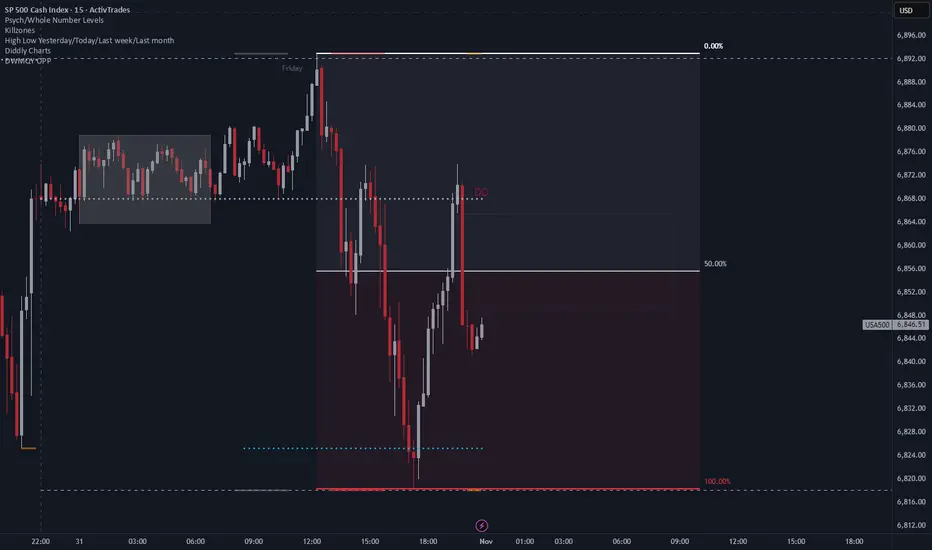
Intraday Range Expansion and Potential Repricing on the SPXFollowing a clean sweep of Friday’s high, price delivered a strong displacement to the downside, breaking short-term structure and rebalancing inefficiencies left behind. The subsequent rebound towards the daily open suggests a retracement into a premium area, potentially setting up for continuation lower if rejection holds around that zone.
If buyers fail to sustain price above the daily open, the market could aim for a full range fill back toward the previous low or discount zones below, maintaining the current bearish intraday order flow.
BTCUSD — Bearish range meets imbalance capBTCUSD - patience before momentum
Date: Sunday, October 19
Timeframe: Daily
Context
Bitcoin remains inside a bearish range — with high of116.080 and low of 103.492.
Price currently sits near the range low, trading into a discount zone the Fibonacci 50% retracement.
The big question: Does price reject from the imbalance cap, or reclaim it and squeeze higher?
Technical Map
• Structure: Daily range remains intact. A daily imbalance cap sits above price in the premium area. If rejected, we confirm bearish continuation; if pierced, it signals structural weakness in sellers and possible momentum shift.
• Momentum: Recent candles show mild bullish recovery. Wait for daily lows to start breaking before short continuation — patience here pays.
• Volume: Heavy bearish volume node clusters near the 111.000 psychological level — expect reaction.
Fundamental Pulse (Week Ahead)
• Macro Drivers: Traders watch US GDP advance data, PCE inflation, and Fed speakers for cues on policy tone.
• Yields: Rising yields could strengthen the Dollar — pressuring risk assets like Bitcoin.
• Liquidity Context: Stablecoin flows and ETF net inflows have slowed; liquidity rotation favors defensive positioning.
Plan
Bias stays bearish unless structure proves otherwise.
The ideal path: rejection from the imbalance cap and midrange confirmation lower.
However, if Dollar strength eases or yields drop, that may unwind shorts — watch structure, not emotion.
Remember: you trade your system, not your feelings.
Mindset Pulse
“You’re never lost when you know your map.”
Structure is the map. Emotions are the fog.
Wait for clarity — not excitement.
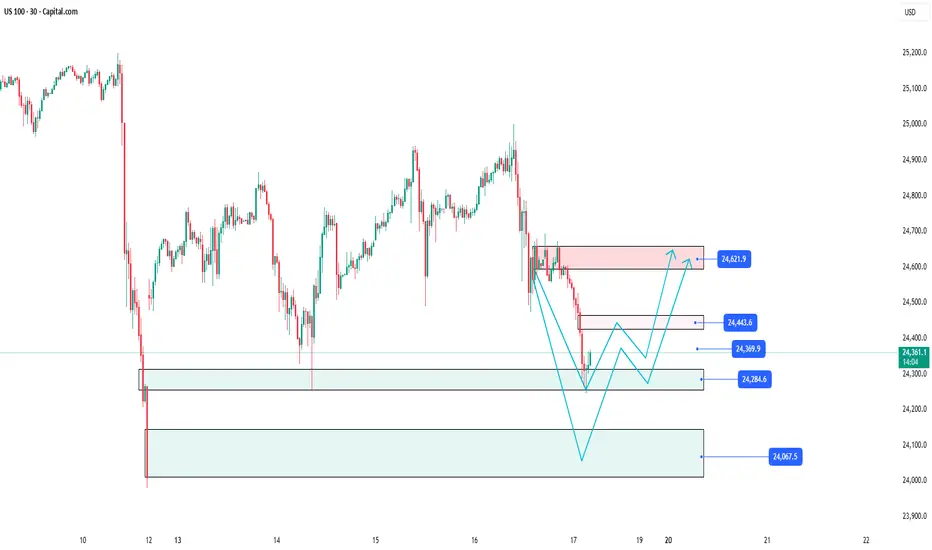
US100: Price action around important imbalance📊 SKILLING:US100 Analysis: Detailed trading scenario at key price level 24,443.6 🚀
The US 100 30-minute chart is currently illustrating a clear picture of price movements with significant support and resistance zones. At the moment, the price is undergoing a strong correction after a deep decline and is approaching crucial price areas, creating multiple potential trading opportunities for investors.
________________________________________
Support Zone 24,284.6 – The starting point for a potential bounce 💥
Currently, the price is nearing the technical support level around 24,284.6 – a key support area that is expected to hold considerable buying interest, potentially triggering a short-term bounce. Buyers may step in here to prevent further declines and initiate a recovery trend.
Careful observation of price action around this zone is essential as it will determine the market’s next momentum: whether the price will rebound or break lower.
________________________________________
Immediate Resistance Levels and the Imbalance Zone at 24,443.6 🔍
Following a bounce from the 24,284.6 support, the expected scenario is a gradual move upwards to test important resistance levels:
• First at 24,369.9, where initial selling pressure may emerge, challenging the upward momentum.
• Next at 24,443.6, identified as a significant imbalance zone on the chart — a price level where price previously moved rapidly, creating a notable supply-demand gap.
• This zone acts as a technical “wall,” a crucial checkpoint before the price can continue its upward trend or get pushed back down.
________________________________________
Detailed Price Movement Scenario 🔄
1. Price bounces from the support at 24,284.6, setting the stage for a recovery leg.
2. Price moves up to test the first resistance at 24,369.9; the reaction here indicates the buyers’ strength.
3. Price then challenges the imbalance zone at 24,443.6 — where significant selling pressure may occur.
4. At this level, two scenarios may unfold:
• Price breaks above 24,443.6, confirming the uptrend and targeting the next resistance at 24,621.9.
• Price rejects this zone, leading to selling pressure that pushes price back to retest the 24,284.6 support or even lower.
________________________________________
Downside scenario if support at 24,284.6 fails 🛡️
In the worst case, if price breaks below the crucial support at 24,284.6, further declines toward a broader support zone at 24,067.5 are likely. This level may act as the next key area for price stabilization and buyer interest before any potential rebound.
Please like and comment below to support our traders. Your reactions will motivate us to do more analysis in the future 🙏✨
Harry Andrew @ ZuperView
Trading GBPUSD | Judas Swing Strategy 15/10/2025This week’s FX:GBPUSD setup was another textbook example of how patience and discipline can turn a high-probability setup into gains. We marked out our range highs and lows, the key zones we monitor for potential manipulation going into New York open.
As Judas Swing session kicked off, price swept below the low of the zone, taking out resting liquidity. This was our first major clue. The Judas Swing strategy looks for these liquidity sweeps before positioning in the opposite direction of the trap.
Once that downside sweep occurred at 9:25EST, our focus shifted to potential long opportunities. We patiently waited for confirmation, specifically a break of structure to the upside before considering any entry. When that break came, all that was left was a retracement into the fair value gap (FVG) formed during the impulsive move up. Price retraced and filled the imbalance, and that’s where we executed our long after the candle closed. Risk was set at 1%, targeting a 2% return.
This entry could be considered a sniper entry because price barely moved against us. Within minutes, price began to rally, confirming the Judas reversal and validating our entry. Price continued climbing and reached our take-profit in less than an hour. The result was a +2R winner while maintaining disciplined risk management.
The Judas Swing strategy thrives on patience and structure. Wait for liquidity sweeps, confirm the break, and execute only when price revisits your FVG. You won’t catch every move, but you’ll catch the right ones and that’s what leads to consistency.
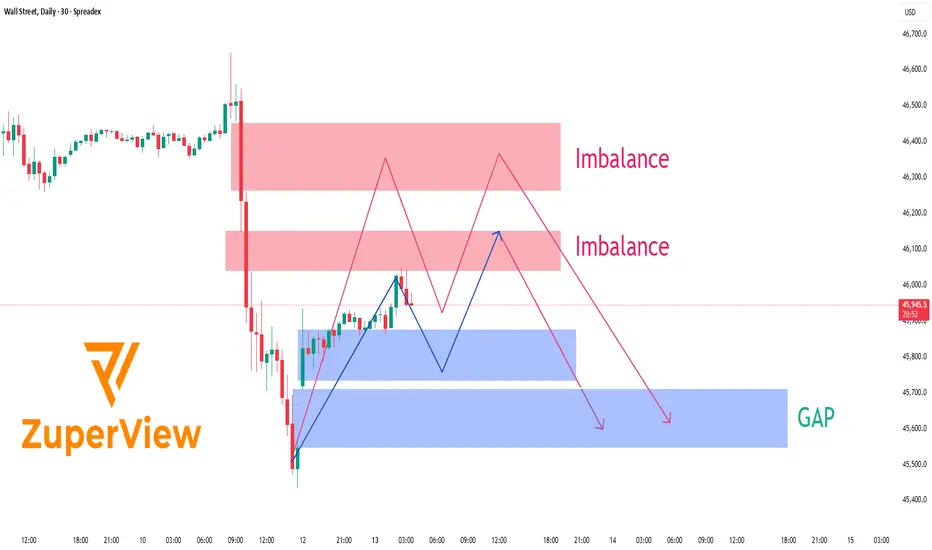
US30: Rebound before the stormTechnical Outlook – Wall Street Index (30-Minute Chart)
After the announcement that the U.S. will impose a 100 % tariff on Chinese imports, Wall Street ⚡ plunged sharply, leaving behind distinct Imbalance zones and an unfilled GAP lurking below current price levels.
At present, price is hovering around 45,950 💵, showing a modest rebound after tapping into a short-term demand zone. Above, two notable Imbalance areas stand out — around 46,000-46,150 and 46,250-46,450 - both formed as aggressive sell orders flooded the market following the latest wave of trade-war headlines 🌍.
The likely scenario 🎯:
Price could continue to retrace upward ↗️ to test one of these supply/imbalance zones before sellers re-enter the market. If selling pressure remains dominant, the index may resume its decline toward the GAP area around 45,500 - 45,650 📉, where liquidity is still unfilled and buyers may look to step back in.
Current price action indicates a corrective pullback rather than a full reversal. Trading volume is thinning 📉, candlestick patterns show signs of exhaustion 🕯️, and the upper imbalance zones remain untouched — all signaling that sellers still hold the upper hand.
________________________________________
🌍 Fundamental Context – U.S. vs. China Tensions Heating Up
On October 10, President Trump officially declared a 100 % additional tariff on Chinese goods, effective November 1, 2025 — the most aggressive move since the 2018-2019 trade war.
Beijing immediately condemned the plan, warning of “corresponding countermeasures”, including restrictions on rare-earth exports and higher port fees on U.S. vessels. While strong in tone, China has so far stopped short of announcing a direct tariff retaliation, signaling a cautious approach while keeping the door open for talks.
Washington, meanwhile, insists the measure aims to “protect American interests and reduce over-reliance on China’s supply chains,” but officials also noted that negotiations remain possible if China shows “substantive goodwill.”
Financial markets reacted swiftly 💥:
• U.S. and Asian equities dropped 2–3 % on average.
• USD strengthened, while gold and JPY rallied as safe-haven flows increased.
• Tech and industrial stocks with strong China exposure saw the largest losses.
Overall, risk sentiment remains fragile as investors brace for a prolonged phase of trade uncertainty.
________________________________________
💡 Trading Summary
Short-term structure favors a sell-the-rally approach. The market may retest upper imbalance zones before resuming its downtrend toward the 45,500 USD GAP area.
If U.S.–China tensions intensify further, downside momentum could accelerate. Conversely, any sign of renewed dialogue or tariff delay could trigger a short-term rebound — but bias remains bearish until the market reclaims 46,300 USD convincingly.
In short: patience, risk control, and reaction to headlines are key this week. ⚖️
Please like and comment below to support our traders. Your reactions motivate us to do more analysis in the future 🙏✨
Harry Andrew @ ZuperView
US30: Consecutive breakouts signal an emerging downtrend
SPREADEX:DJI – When price rejects the high, the market begins to shift
On the 30-minute chart, price action is clearly signaling a loss of bullish momentum and a transition toward a bearish structure.
________________________________________
🧠 Price Action Analysis
1. First Failed Breakout
Price initially broke above the ascending trendline that had held since early October — but failed to hold the breakout.
➤ A classic early warning of buyer exhaustion, often seen during distribution phases.
2. Multi-Layered Resistance Zone
The 46,725 – 46,779 region has become a clustered resistance zone, rejecting price repeatedly.
➤ Multiple rejections here suggest dominant selling pressure, with strong supply overhead.
3. Second False Breakout
A more subtle second breakout attempt followed — but again, price was swiftly rejected.
➤ Consecutive failed breakouts typically indicate a lack of conviction and precede sharp reversals.
________________________________________
📉 Trend Structure Has Shifted Bearish
• Lower highs and lower lows now visible
• Price broke below the previous trendline
• Pullback attempts failed to reclaim broken support
• Market is respecting resistance instead of support
➡ These are clear signs of a short-term downtrend emerging.
________________________________________
🔻 Trading Strategy: Favoring Sell Setups in the New Bearish Context
✴️ Scenario 1: Sell at Retest of Proven Resistance Zone
• Optimal Sell Zone: 46,700 – 46,750
• This area has already triggered two failed breakouts — a third touch could be the ideal trap for late buyers
• Watch for bearish rejection candles (pin bars, bearish engulfing, etc.)
Suggested Sell Limit Order:
→ Entry: 46,730
→ Stop Loss: 46,830 (above prior swing high)
→ TP1: 46,500
→ TP2: 46,300
→ Risk-Reward: At least 1:2
_______________________________________
✴️ Scenario 2: Momentum Sell on Breakdown of Local Support
• Trigger Level: 46,580 — if price breaks below with strong momentum (long red candle, increased volume)
• Confirms trend continuation after consolidation
Suggested Sell Breakout Order:
→ Entry: 46,580
→ Stop Loss: 46,680
→ Target: 46,350 – 46,200
→ Tip: Use smaller position size if breakout appears weak to avoid getting trapped in a fakeout
________________________________________
🎯 Trade Management
• Only enter trades with clear price rejection or momentum confirmation
• Move SL to breakeven after TP1 is hit to lock in safety
• Exit the trade if price closes above 46,830 — that would invalidate the bearish thesis
________________________________________
False breakouts leave a trail — for those who know how to read it. It's not a failure. It’s the market whispering that direction has changed.
Please like and comment below to support our traders. Your reactions will motivate us to do more analysis in the future 🙏✨
Harry Andrew @ ZuperView
Trading GBPUSD EURUSD | Judas Swing Strategy 29/09/2025This week, the Judas Swing strategy delivered another set of textbook lessons on patience, execution, and discipline. We had two clear setups unfold on FX:GBPUSD and FX:EURUSD and both gave us valuable insight into how the market manipulates liquidity before revealing its true direction.
On Monday FX:GBPUSD initially consolidated during the Judas Swing period, giving us the perfect framework to anticipate manipulation. As the session started, we saw liquidity taken above the high of the Judas Swing zone.
From there, we immediately shifted our focus to potential selling opportunities. Once structure broke to the downside, all eyes were on the retrace into the imbalance left behind. We knew from experience that patience is key here, sometimes price runs away without giving the pullback, and forcing an entry in those situations usually leads to regret.
This time, we got the perfect retrace. Once price tapped back into the FVG and the candle closed, our short was executed with a clean 1% risk. The market briefly hovered near our entry, but the setup held strong. Soon after price dropped decisively, reaching our target and securing a solid 2% gain.
On Tuesday FX:EURUSD gave us a slightly different picture but the same Judas Swing principles applied. Price first ran the zone lows, grabbing liquidity before reversing sharply. Once we spotted that break of structure to the upside, our game plan was straightforward: wait for the retrace into imbalance, and execute.
The market made it easy this time, with zero to no drawdown, price quickly reversed in our favor, running straight to our target for another +2R trade.
Both FX:GBPUSD and FX:EURUSD reminded us why the Judas Swing strategy works, the markets lure traders into chasing breakouts before reversing into the true move of the day. By waiting for the sweep, confirmation, and retrace, we put ourselves on the right side of the move with defined risk. Two trades, two wins, and another week of staying disciplined to the plan. Consistency doesn’t come from predicting every market move, it comes from following a strategy that stacks the odds in your favor.
USD/CHF - Multi Timeframe Analysis (Trade setup)📉 USD/CHF – Forecast Breakdown 📉
Time to dissect this one across the charts 👇
🕰 Weekly View
The weekly chart is still in a bearish trend. Price rejected from the monthly/weekly trendline and printed a clean lower-high setup. Structure suggests continuation down unless buyers can flip resistance near 0.83. For now → bias leans bearish, with space to revisit 0.76–0.75 demand.
📅 Daily Structure
Daily shows a swing range with:
BOS south ✅
Liquidity sweep below SSL (sell-side liquidity)
Market retracing toward 0.805–0.81 (daily + 71% zone)
This looks like a setup for a liquidity grab into premium pricing before sellers potentially take control again. The daily zone at 0.805–0.81 is the hot spot to watch for bearish reactions.
⏱ 4H Breakdown
On the 4H:
Price already made a BOS down, confirming short-term bearishness.
Currently pushing back into a 4H + daily supply overlap (0.805–0.81).
Ideal scenario → a sweep of that zone before the next bearish leg, targeting 0.79 → 0.785.
🎯 Summary
Weekly : Bearish, trend pointing lower 📉
Daily : Retrace likely into 0.805–0.81 before rejection ⚔️
4H : Watching for liquidity sweep + reversal confirmation 👀
Bias → Bearish, unless bulls flip above 0.815. Short opportunities favored around the supply zone, targeting 0.79 → 0.785, with deeper extension possible toward 0.76 if momentum holds.
⚠️ Risk note: USD/CHF can grind slowly — patience is key; avoid chasing entries.
Possible Pre-Skyrocket ManipulationSince every soul on this earth knows that we will see huge bull-moves with given and upcoming rate cuts + october price action, its not unlikely that we COULD manipulate even lower after the Billion Dollar liquidation move overnight.
IF we do so, we would do it pretty fast and continue the displacement from the bearish head and shoulders pattern that broke the daily 50 EMA%SMA in the next few weeks.
On a technical site, there is still a huge amount of liquidity on CRYPTO:ETHUSD left (around 20B$), most accumulated at around 3.450$.
Strangely enough, that area matches the current ranges equilibrium, standard deviation levels of prior bearish manipulation moves, KEY SR Levels of 3400 and 3200, monthly and daily imbalances (which will get filled sooner or later), the 200D EMA and 50W EMA, AND the current htf bullish trendline and broken triangle resistance...
If we hit this before mid-October, these will be free longs, and I will DCA into my position, which sits at 1.794$ currently.
Trading EURUSD | Judas Swing Strategy 15/09/2025The Judas Swing strategy is all about discipline, patience, and trusting the process, and this FX:EURUSD setup from Monday’s session was a perfect reminder of why sticking to the rules matters more than chasing results.
As the Judas Swing session started, FX:EURUSD gave us the first clue we look for: a liquidity sweep above the zones high. Breakout buyers jumped in, only to find themselves trapped as price quickly reversed. This was our signal to get ready. But, as always, one signal isn’t enough. We needed the next confirmation: a break of structure to the downside. Once that shift in order flow printed, the setup was officially on our radar.
Next came the waiting game. The strategy demands patience until price retraces back into a Fair Value Gap (FVG) created on the price leg that broke structure. It didn’t take long FX:EURUSD pulled back neatly, tapped into the FVG, and our entry candle closed. That was the green light.
Risk per trade: 1%
Target: 2%
Risk-to-Reward: 1:2
Checklist complete. Trade executed.
Unlike some trades where price rockets instantly, this one tested our patience. FX:EURUSD moved in our favor but reversed and even pulled against us. Momentum returned, but instead of pushing toward our 2% target, price lost steam mid-way and reversed. The result: a 1% loss
The important lesson here is that a losing trade executed according to plan is still a successful trade. We didn’t chase the liquidity sweep. We didn’t anticipate the break of structure. We didn’t force an early entry. Every box was ticked, and the trade simply didn’t play out. That’s trading. The Judas Swing isn’t about winning every setup, it’s about trusting the process over the long run. By managing risk and staying consistent, we position ourselves for sustainable growth, even when individual trades don’t hit target.
Trading Imbalances: How to Use Fair Value GapsDifficulty: 🐳🐳🐋🐋🐋 (Novice+)
This article is designed for traders who want to understand Fair Value Gaps (FVGs) in a simple, practical way — without drowning in complex Smart Money Concepts terminology.
🔵 INTRODUCTION
If you’ve studied Smart Money Concepts (SMC), you’ve likely come across Fair Value Gaps (FVGs). For many, the concept feels overcomplicated. In reality, an FVG is just an imbalance in price — a spot where the market moved so fast that it didn’t fully trade both sides.
🔑When price leaves a gap behind, it often comes back later to “rebalance.” This gives traders powerful zones for entries, exits, and target setting.
🔵 WHAT IS A FAIR VALUE GAP?
A Fair Value Gap is formed over three candles :
Candle 1: The first move (anchor).
Candle 2: The big impulsive candle (the imbalance).
Candle 3: The follow-up candle.
The gap exists when the high of Candle 1 is below the low of Candle 3 (in a bullish case). This leaves an “untraded zone” inside Candle 2.
Think of it as a skipped step. Price rushed through so quickly, there wasn’t enough time to trade at fair value.
🔵 WHY DOES PRICE RETURN TO FVGs?
Markets seek balance. When an imbalance forms, algorithms and institutional flows often revisit the gap to collect liquidity and rebalance orders.
This doesn’t mean every FVG gets filled instantly — some remain open for days or even weeks. But many serve as magnets for price.
🔑Key point: An FVG is not a magic level. It’s a clue about where inefficiency sits.
🔵 HOW TO TRADE FVGS SIMPLY
1️⃣ Mark the Zone
Identify the three-candle imbalance. Highlight the gap inside Candle 2.
2️⃣ Wait for Return
Don’t chase the impulsive candle. Instead, wait for price to retrace into the FVG zone.
3️⃣ Trade the Reaction
Bullish FVG → wait for price to dip into the zone and show bullish reaction
Bearish FVG → wait for price to retest zone and reject downward
Stops are usually placed beyond the gap, targets set toward the next liquidity pool or swing level.
🔵 EXAMPLE SCENARIO
A strong bullish candle leaves an imbalance.
Price continues higher, but a day later revisits the gap.
At bullish rejection candles form with increasing volume.
Entry taken, stop below gap, target at next swing high.
🔵 TIPS FOR ADVANCED TRADERS
Higher timeframe FVGs are stronger and attract price longer.
Not every gap fills — filter with trend direction.
Combine with OBs (Order Blocks) or liquidity zones for more precision.
Ignore small random gaps in low-volume markets.
🔵 CONCLUSION
Fair Value Gaps don’t need to be mysterious. They’re simply imbalances in the auction process. By waiting for price to return and react, traders can build structured entries with defined risk.
🔑Instead of overcomplicating SMC concepts, think of FVGs as footprints of urgency — and opportunities for balance.
Do you already trade FVGs, or is this your first time hearing about them? Share your setups below!
How to use Order Flow / Delta Volume Indicator for IntradayWhat you’re seeing
This idea visualizes an intraday session with my Order Flow / Delta Volume study applied. The chart overlays three things that matter for short-term context:
• Cumulative delta (blue line) : running sum of delta, rescaled so it’s easy to compare to price swings.
• VWAP (grey line) : session anchor for bias and mean-reversion context.
Signal logic (kept simple & rule-based)
A bar is considered imbalanced when one side’s volume dominates the bar’s total volume.
• Imbalance: upVol / totalVol > 0.60 → buy-side imbalance; downVol / totalVol > 0.60 → sell-side imbalance.
• Trend/strength filters (optional but enabled here):
• VWAP filter → longs only when price > VWAP; shorts only when price < VWAP.
• RSI(14) filter → longs only if RSI > 50; shorts only if RSI < 50.
• Noise throttle: minimum 5 bars between signals + price must exceed the prior close by ±ATR(14) to avoid tiny wiggles.
These rules try to capture moments when flow (delta) and context (VWAP/RSI) line up, while the ATR and cooldown help skip low-quality, back-to-back prints.
How to read the chart
• Rising blue cumulative-delta with price above VWAP → constructive backdrop for longs; fading/ranging delta warns to de-risk or wait.
• Green “ BUY ” labels plot when a buy-side imbalance clears the filters; red “ SELL ” labels mark sell-side imbalances with bearish context.
• Background tints briefly highlight where the raw imbalance occurred (light green/red), even when a trade filter blocks a signal.
Walk-through of the attached example
• Trend leg after a base: cumulative delta turns up first and price reclaims VWAP → several filtered BUY signals print into the push; ATR gate avoids chasing the very first small upticks.
• Mid-session chop: delta flips around the zero line and price hovers near VWAP → far fewer signals; most imbalances are filtered out by RSI/VWAP or fail the ATR move requirement.
• Late expansion: a swift VWAP reclaim with strong positive delta → clustered BUY signals that track the follow-through, while opposing sell imbalances near VWAP are rejected by filters.
Inputs used on this chart
• Imbalance threshold: 0.60
• VWAP filter: On
• RSI filter: On, threshold 50
• Cooldown: 5 bars
• ATR length: 14
Notes
• This is not a trade recommendation. Signals highlight where participation leans, not certainty of direction.
• Best paired with your execution plan (risk unit, stop location, partials near prior S/R or VWAP).
• In fast spikes, delta can be extreme—ATR and the cooldown help, but slippage and whipsaws are always possible.
• For instruments with very low volume or during illiquid hours, consider raising the imbalance threshold or disabling signals altogether.
Takeaway
Order-flow imbalance by itself fires often; layering VWAP, RSI, and an ATR-based movement check concentrates signals to moments when both flow and context align. The attached session shows that behavior clearly: fewer prints in chop, more conviction when cumulative delta trends and price holds its side of VWAP.
Educational post for discussion only. No financial advice.