CADJPY Potential Sell Setup – Liquidity Gap Reversal IdeaI hope everyone is having a productive day. CADJPY is presenting a potential selling opportunity as price action is gradually moving toward a visible liquidity imbalance. There is a high probability that the market may fill this gap before showing a corrective move or possible reversal. The projected target zone is near 110, however traders are encouraged to manage their own take-profit levels based on personal strategy and disciplined risk management.
Trade responsibly, stay patient, and always protect your capital. If this analysis adds value to your trading, feel free to like, comment, and follow for future market insights.
Community ideas
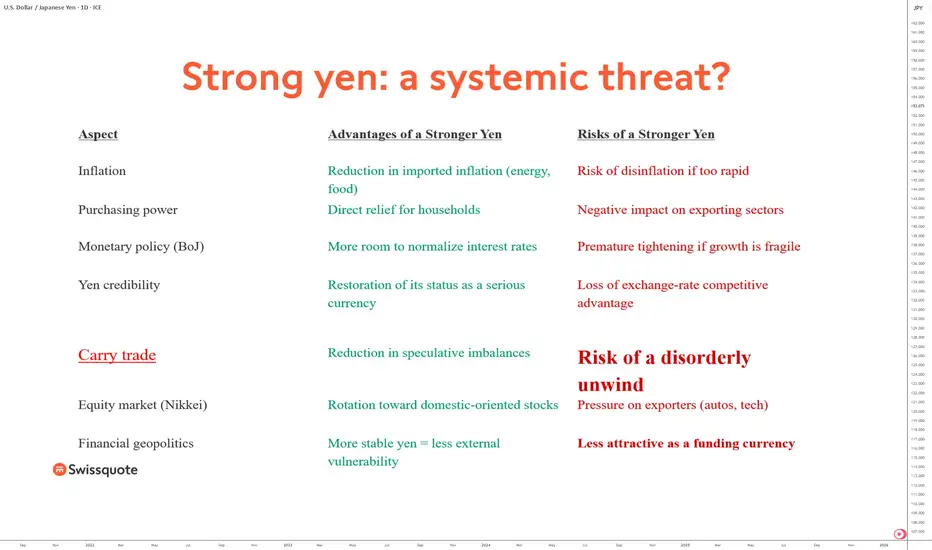
Yen rebound (JPY): a systemic threat?The Japanese yen is close to its lowest level in 40 years and has been the weakest currency in the FX market for several years. However, since the end of January 2026, it has shown a bullish impulse that could mark the beginning of a longer-term upward phase. Could such a regime shift in the yen’s trend represent a threat to Japan, the foreign exchange market, and global finance in general?
First, it is important to keep in mind that the recent rebound in the yen (JPY)—that is, the decline in USD/JPY since last Friday—does not yet change the yen’s underlying trend. The yen remains in a broader downtrend. However, if this underlying trend were to reverse from bearish to a new long-term bullish trend, then significant risks for global finance could indeed emerge. These risks are not driven by the yen rebounding per se, but rather by the speed and momentum of any potential appreciation of the Japanese currency.
The main systemic risk would stem from the unwinding of yen carry trade positions that are still outstanding. At the same time, it should not be overlooked that a yen rebound can also have positive effects, particularly for the Japanese economy, which is seeking to combat inflation.
Here is where the systemic risk to global finance could arise:
• If the yen rebounds too quickly (speed is the key factor), there could be a full unwinding of the approximately USD 200 billion in remaining yen carry trade positions, potentially triggering a global market sell-off
• If the yen rebounds sharply while Japanese interest rates continue to rise, a major source of global funding would disappear
• If the yen rebounds too strongly and too quickly, Japanese institutional investors may
repatriate capital invested abroad into domestic assets, triggering selling pressure on global equity markets
• From a technical perspective, USD/JPY must not fall below the 140 JPY support level
These risks must nevertheless be nuanced and placed within a broader macroeconomic context. A persistently weak yen has certainly supported the competitiveness of Japanese exports and boosted the profits of large listed companies, but it has also imported significant inflation, particularly in energy and food. In this context, a controlled rebound in the yen could instead be viewed as a factor of macroeconomic stabilization for Japan.
A stronger yen would help reduce imported inflation, improve the purchasing power of Japanese households, and restore some credibility to the Bank of Japan’s (BoJ) monetary policy, which has long been perceived as ultra-accommodative and isolated compared with other major central banks. It would also give the BoJ greater room to gradually normalize its interest rate policy without triggering an inflationary shock.
In summary, a yen rebound is not, in itself, a systemic threat. It only becomes potentially dangerous if it is too rapid, too violent, and leads to a sudden end of the yen carry trade. Under a central scenario of gradual normalization, a stronger yen could instead help reduce some of the imbalances accumulated over recent years, both in Japan and globally.
DISCLAIMER:
This content is intended for individuals who are familiar with financial markets and instruments and is for information purposes only. The presented idea (including market commentary, market data and observations) is not a work product of any research department of Swissquote or its affiliates. This material is intended to highlight market action and does not constitute investment, legal or tax advice. If you are a retail investor or lack experience in trading complex financial products, it is advisable to seek professional advice from licensed advisor before making any financial decisions.
This content is not intended to manipulate the market or encourage any specific financial behavior.
Swissquote makes no representation or warranty as to the quality, completeness, accuracy, comprehensiveness or non-infringement of such content. The views expressed are those of the consultant and are provided for educational purposes only. Any information provided relating to a product or market should not be construed as recommending an investment strategy or transaction. Past performance is not a guarantee of future results.
Swissquote and its employees and representatives shall in no event be held liable for any damages or losses arising directly or indirectly from decisions made on the basis of this content.
The use of any third-party brands or trademarks is for information only and does not imply endorsement by Swissquote, or that the trademark owner has authorised Swissquote to promote its products or services.
Swissquote is the marketing brand for the activities of Swissquote Bank Ltd (Switzerland) regulated by FINMA, Swissquote Capital Markets Limited regulated by CySEC (Cyprus), Swissquote Bank Europe SA (Luxembourg) regulated by the CSSF, Swissquote Ltd (UK) regulated by the FCA, Swissquote Financial Services (Malta) Ltd regulated by the Malta Financial Services Authority, Swissquote MEA Ltd. (UAE) regulated by the Dubai Financial Services Authority, Swissquote Pte Ltd (Singapore) regulated by the Monetary Authority of Singapore, Swissquote Asia Limited (Hong Kong) licensed by the Hong Kong Securities and Futures Commission (SFC) and Swissquote South Africa (Pty) Ltd supervised by the FSCA.
Products and services of Swissquote are only intended for those permitted to receive them under local law.
All investments carry a degree of risk. The risk of loss in trading or holding financial instruments can be substantial. The value of financial instruments, including but not limited to stocks, bonds, cryptocurrencies, and other assets, can fluctuate both upwards and downwards. There is a significant risk of financial loss when buying, selling, holding, staking, or investing in these instruments. SQBE makes no recommendations regarding any specific investment, transaction, or the use of any particular investment strategy.
CFDs are complex instruments and come with a high risk of losing money rapidly due to leverage. The vast majority of retail client accounts suffer capital losses when trading in CFDs. You should consider whether you understand how CFDs work and whether you can afford to take the high risk of losing your money.
Digital Assets are unregulated in most countries and consumer protection rules may not apply. As highly volatile speculative investments, Digital Assets are not suitable for investors without a high-risk tolerance. Make sure you understand each Digital Asset before you trade.
Cryptocurrencies are not considered legal tender in some jurisdictions and are subject to regulatory uncertainties.
The use of Internet-based systems can involve high risks, including, but not limited to, fraud, cyber-attacks, network and communication failures, as well as identity theft and phishing attacks related to crypto-assets.
TSM: The Silicon Shield (Long Term Investment Thesis)Goal: Maximize share count over time using DCA into weakness
1. The "Accumulation Zones"
Instead of looking for a "trade entry," you are dividing capital into Tranches. Not going "All In" at the top, but you also don't want to sit on the sidelines waiting for a crash that might never come.
Zone 1: The "Foothold" (Current Level: $340 - $350)
Deploy 10-15% of capital here.
TSM is in "Blue Sky" discovery. If it pulls a "NVIDIA 2024" move and rockets to $450 without dipping, you will hate yourself for having zero exposure. Buying a small "starter position" just to get skin in the game. Just accept that this portion might go underwater temporarily.
Zone 2: The "Aggressive Value" (The Red Line: $300)
Deploy 30% of capital here.
This is the 0.236 Fib. In strong bull markets, high-quality stocks often bounce here and never look back. This is where the traders will be trying to enter.
Zone 3: The "Generational Gift" (The Orange/Green Lines: $242 - $268)
Deploy the remaining 55% of capital here.
The 0.382 ($268) and 0.5 ($242) are the "Fair Value" zones. If the market gives you a 30% discount on the world's most important company (due to a broad market panic or tariff scare), you back the truck up, and it's where you aggressively lower your average cost.
2. The Long-Term "Moat" Thesis (Why we hold)
The "Toll Booth" of the Future: TSM isn't just a tech stock; it is the toll booth for the AI era. Whether NVIDIA, AMD, Apple, or Meta wins the AI war, they all have to pay TSM. You own the casino, not the gambler.
The "Silicon Shield": The geopolitical risk (China/Taiwan) is actually a moat. The entire Western world is incentivized to protect TSM's output. TSM is currently building "Sovereign Fabs" in the US (Arizona) and Japan/Germany, effectively franchising its monopoly globally to reduce risk.
The Dividend Bonus: Unlike Tesla or early-stage tech, TSM pays a dividend. While you wait for the stock to compound, you get paid. Reinvest those dividends to accelerate the compounding.
3. The Revised Plan
Step 1: The "No-Regret" Buy
Buy a small position tomorrow. Do not worry about the price (purely psychological to stop you from FOMO)
Step 2: Set the "GTC" (Good Til Cancelled) Trap
Set a Limit Buy order for a larger chunk of shares at $301.50.
Leave it there forever. If a "Flash Crash" happens while you are sleeping (due to bad news), you will wake up owning cheap shares.
Step 3: Ignore the Noise
If TSM drops to $300, the news headlines will be terrible ("AI Bubble Bursting," "Tariff Wars").
Your Job: Ignore the headlines. Trust the Fib levels. That fear is what gives you the $300 entry.
The chart tells a Trader to "Run away."
The chart tells an Investor: "This is the strongest horse in the race. Ride it, but keep some powder dry for the dips."
____________________________________________
Here is the in-depth breakdown of their Q4 2025 performance and their massive forward guidance for 2026.
1. Headline Numbers: The New Kingmaker
TSMC delivered a "beat and raise" quarter that reflects the insatiable demand for AI silicon.
Revenue: $33.73 billion for Q4 (up 25.5% YoY).
Net Income: $16.31 billion (up 35% YoY).
Gross Margin: 62.3%. This is an incredibly high margin for a hardware manufacturer, signaling they have immense pricing power as the sole provider of the world's most advanced chips.
The Narrative Shift: For the first time, reports indicate that Nvidia has overtaken Apple as TSMC’s largest customer by revenue, contributing approximately 13% of annual income. This marks the official transition from the "Smartphone Era" to the "AI Era."
2. The "Capex Supercycle": 2026 Guidance
The most shocking number from the report was the forward capital expenditure guidance. TSMC is preparing for a massive scale-up to meet the demand from the "hyperscalers" (Meta, MSFT) and automakers (Tesla).
2025 Capex (Actual): ~$41 billion.
2026 Capex (Guidance): $52 billion – $56 billion.
This represents a ~35% increase in spending year-over-year.
Where is the money going? roughly 70-80% is allocated to Advanced Process Technologies (2nm and A16), and notably, 10-20% is now dedicated to Advanced Packaging (CoWoS), which has been the main bottleneck for Nvidia's GPUs.
3. The Technology Roadmap: 2nm is Here
While Tesla and Microsoft talk about "future" capabilities, TSMC is executing on the physics today.
2nm Mass Production (N2): TSMC officially commenced mass production of its 2nm chips in January 2026.
The Specs: These chips use "GAAFET" (Gate-All-Around) transistors (nanosheets), which allow for higher power efficiency—critical for the energy-hungry AI data centers e.g. Microsoft.
Capacity Status: The initial capacity is reportedly already "sold out," with Apple and Nvidia securing the vast majority of the first run.
CoWoS Expansion: This is the specific packaging technology required to glue high-bandwidth memory (HBM) to the GPU. TSMC plans to quadruple capacity to ~150,000 wafers per month by the end of 2026 to support Nvidia's "Rubin" chips.
4. Forward Predictions: 2026 & Beyond
Q1 2026 Outlook: Revenue is expected to grow to $34.6B – $35.8B, implying the "slow season" usually seen in Q1 (post-iPhone launch) is being completely offset by relentless AI demand.
The "Silicon Shield" Deepens: With "Foundry 2.0," TSMC is moving beyond just making chips to handling the complex packaging that makes AI clusters work. By the end of 2026, advanced packaging alone is projected to account for over 10% of total revenue.
Summary Verdict
TSMC's earnings confirm that the "AI Spending Spree" is not slowing down.
For Tesla: TSMC's 2nm ramp is what will likely power the future "A15" inference chips Tesla mentioned in their investor deck in today's earnings call.
For Microsoft/Meta: The $56B Capex plan from TSMC is the direct result of the $37B+ quarterly checks these hyperscalers are writing.
BTC | 4HCRYPTOCAP:BTC — 4H Zoom-In
Transitional Phase | Leading Diagonal Int. (1)
Based on this Quantum Model projection, Q-Structure λᵣ2 drove a sharp retracement in Minute Wave ii (circled).
An impulsive advance in Minute Wave iii (circled), within Minor Wave 5, is expected to follow.
🔖 This outlook is derived from insights within the Quantum Models framework. Within my methodology, Quantum Structures represent high-probability targets generated by the confluence of equivalence lines. These Q-Structures also serve as structural anchors, shaping the model's internal geometry and guiding the evolution of alternative paths as price action unfolds.
#Crypto #MarketStructure #TrendAnalysis #QuantumModels
Buy CAD/CHF on retest of broken trendline.On November last year CAD/CHF broke a descending trendline going back to June last year and 2 days ago it retested it with a strong rejection. I am hoping for a retest of this trendline to an upside target just before another descending trendline around 0.5740
Buy Limit : 0.5620 retest broken trendline
Stop : 0.5570 under recent low
Profit : 0.5720 before descending trendline
Risk 1 : 2 / stop 50 pips
PRECISION WIRESPrecision Wires India Ltd is a mid‑cap electricals company incorporated in 1989. It is India’s largest manufacturer of winding wires and conductors, catering to power, automotive, and industrial sectors.
Promoter: The founding family continues to lead the company, building it into a recognized specialty wire manufacturer with global reach.
FY22–FY25 Snapshot
Sales – ₹3,033 Cr → ₹3,302 Cr → ₹4,015 Cr → ₹4,355 Cr
Net Profit – ₹118 Cr → ₹142 Cr → ₹176 Cr → ₹205 Cr
Operating Performance – Moderate → Strong → Very Strong → Excellent
Dividend Yield – 0.8% → 1.0% → 1.2% → 1.4%
Equity Capital – ₹12 Cr (constant)
Total Debt – ₹420 Cr → ₹390 Cr → ₹365 Cr → ₹340 Cr (steady deleveraging)
Fixed Assets – ₹1,120 Cr → ₹1,180 Cr → ₹1,240 Cr → ₹1,310 Cr
EPS – ₹9.8 → ₹11.8 → ₹14.6 → ₹17.0
Institutional Interest & Ownership Trends
Promoter holding: ~58%, reflecting strong family control.
FIIs/DIIs: Limited but gradually rising exposure as earnings scale.
Public float: ~42%, with delivery volumes showing accumulation by long‑term investors.
Strategic Moves & Innovations
Expansion in specialty winding wires for EVs, renewable energy, and industrial motors.
Investment in capacity upgrades and backward integration for cost efficiency.
Diversification into export markets, strengthening global presence.
Focus on quality certifications to serve premium clients in automotive and power sectors.
Cash Flow & Balance Sheet Strength
Operating cash flows strengthened in FY25, supported by margin expansion.
Free cash flow positive, reinvested into modernization and R&D.
Debt reduced steadily, improving balance sheet resilience.
Strong asset base with manufacturing facilities in Silvassa and other industrial hubs.
Risk Factors
Dependence on copper prices, which affect margins.
Competition from global and domestic wire manufacturers.
Cyclical demand linked to industrial and power sector investments.
Export exposure sensitive to global economic cycles.
Investor Takeaway
Precision Wires India Ltd. demonstrates steady revenue growth, margin expansion, and deleveraging, supported by demand from EVs, renewables, and industrial sectors. With strong fundamentals and rising institutional interest, it is well‑positioned for sustained growth, though investors should monitor copper price volatility and sector cyclicality.
Impulse wave PRICE over 1020ema over 60sma #001 GBPUSDI just typed a whole lot and copied it several times but it didnt get copied wtfff.
This is duck hunting but we are riding the short term impulse wave.
We are taking profit at 1R instead of the usual 3R whenever possible is because we are trading into bull trap.
bull trap aka major resistance zone on the 4H time frame.
0840SGT 29012026
Beautifully printing HH on Bigger tf.AVGO Analysis
CMP 333.24 (28-01-2026)
Bearish Divergence playing well after
Beautifully printing HH on Bigger tf.
Immediate Resistance seems to be around 350 - 351
Crossing this level with Good Volumes may lead it
towards 360 - 365 initially.
On the flip side, 309 - 310 is the immediate Support.
Breaking this Level, will bring more selling pressure.
ETH — Price Slice. Capital Sector. 3162.75 BPC 6.9© Bolzen | The Architect | BPC Framework
Bolzen Market Institute
🏷 ETH — Price Slice. Capital Sector.
TradingView Publication Date: 29.01.2026
🏷 3162.75 — price not yet reached at time of publication.
🏷 BPC — The Bolzen Price Covenant — Strength Index: 6.9
Quantum structure of obligations and capital flow in price formation via energy blocks.
🏷 Vertical chart — Energy Grid Dashboard.
🏷 Static Stream 1: price published in energy-block production sequence.
🏷 The price energy block is already ordered—not by time, but by execution priority. Crucially: block priority dynamically reconfigures in response to hidden energetic impulses, whereas price execution order records their market manifestation. Every price in the dynamic stream is tied to proprietary energy-production metrics inaccessible to the general public. Those who perceive structure before its manifestation do not follow price—they anticipate it.
EΞ2Φ8Ψ45Θ·ζ⁻¹·106Λ732·Ω²
📎 Screenshot:
🏷 When trading from levels, use liquidity zones from BPC 10 and above.
🏷 Bolzen Liquidity Map — ETH (numerical equivalent):
🏷 I. Interactive Reference Guide: BPC — The Bolzen Price Covenant
🏷 P.S. English is not my native language — I offer no apologies for stylistic imperfections. What you see here is not a post. It is a demonstration of another level of preparation: the symbiosis of human intuition and algorithmic precision. Mathematics and aggressive market analysis — against the machine of liquidations.
The persistent ETH and BTC Energy Grid Dashboard remains publicly accessible and is intended for international institutional review.
Dear international community,
I extend my gratitude to the TradingView moderation team for their impartiality and support of analytical work at the global level, as well as to all who follow my research. This platform serves as a space to demonstrate contributions to the advancement of market analytics.
Attention and time are your most valuable resources. ATH is emotion; timeframes are your truest allies. Thank you.
— The Architect
BPC — The Bolzen Price Covenant
TESLA FREE SIGNAL|
✅TESLA reacts strongly from discounted demand after liquidity sweep, forming bullish displacement. Expect continuation toward premium as imbalance fills and buy-side strength holds.
—————————
Entry: $431.55
Stop Loss: $417.14
Take Profit: $451.76
Time Frame: 4H
—————————
LONG🚀
✅Like and subscribe to never miss a new idea!✅
ASML watch $956-971: Double Golden fibs may give a DIP to buyASML has been growing in spurts along with the semi's.
It has just hit a Double-Goldden fib zone $956.18-971.28
Looking for a Dip-to-Fib or Break-n-Retest for long entries.
.
Previoius Analysis that nailed the EXACT BOTTOM:
Hit BOOST and FOLLOW for more such PRECISE and TIMELY charts.
========================================================
.
XAU / USD 1 Hour Chart ( Buy in progress )Hello traders. Not sure who saw my last post, but my analysis played out perfectly. I marked where I bought in, and where I closed most of the trade's profit. One trade so far this week, and it was a good one. All done for the day. My stop loss is now above my entry point, so zero loss. Let's see how the NY open goes. Big news later today here in the US. Big G gets a shout out. Be well and trade the trend.
Ivanhoe Electric (IE) — Typhoon-Powered U.S. Copper DiscoveryCompany Overview
Ivanhoe Electric AMEX:IE is a technology-driven copper explorer focused on the U.S., leveraging its proprietary Typhoon™ geophysical system and advanced analytics to uncover high-quality, electrification-ready copper assets. The Santa Cruz Copper Project (AZ) anchors the story amid growing U.S. policy support for domestic critical minerals.
Key Catalysts
De-Risked Path at Santa Cruz: Recent land acquisitions plus a $200M credit facility strengthen development readiness and optionality.
Tech Edge = Faster Discoveries: Typhoon™ + data analytics accelerating targets at Tintic (UT) and other districts, improving hit-rates and timelines.
Strategic Partnerships: Collaboration with Ma’aden (Saudi Arabia) adds international upside while maintaining a secure U.S. asset base.
Structural Demand Tailwind: Electrification, grid build-out, EVs, and defense keep copper front-and-center in long-cycle capex.
Investment Outlook
Bullish above: $15–$16
Target: $27–$28 — supported by Typhoon™-enabled discovery efficiency, funding de-risk, and policy-backed U.S. copper supply.
📌 IE — marrying proprietary geophysics with tier-one U.S. copper optionality.
WIPRO | Gann Square of 9 – 45° Support Case Study | 28 Mar 2022This idea presents a historical intraday example of how the Gann Square of 9 can be used to identify logical support levels based on price–degree relationships.
On 28 March 2022, WIPRO Ltd initiated a downward move after forming its 0° reference point near ₹609.
📐 Gann Degree Structure
0° level: 609
45° level: 597
Using the Square of 9 calculations, ₹597 emerged as the next geometric downside level.
⏱️ Price–Time Alignment (Gann Guideline)
According to classical Gann intraday observations:
Support reactions often appear when
45° is reached before 2:30 PM, or
90° is reached before 2:45 PM
In this session, price completed the 45° move within the valid time window, and a clear upward reaction followed from the ₹597 zone.
🧠 Key Learning
This case study demonstrates that:
Degree completion helps define objective support
Reversals occur from measured levels, not guesswork
Gann geometry converts price action into structured behavior
📌 Conclusion
The Gann Square of 9 offers a rule-based method to identify intraday support and resistance.
When price respects degree levels within time, reactions often become clearer and more reliable.
Disclaimer:
This chart is shared strictly for educational and analytical purposes only. It does not constitute trading or investment advice.
EUR/GBP BULLISH BIAS RIGHT NOW| LONG
Hello, Friends!
EUR/GBP pair is trading in a local downtrend which we know by looking at the previous 1W candle which is red. On the 3H timeframe the pair is going down too. The pair is oversold because the price is close to the lower band of the BB indicator. So we are looking to buy the pair with the lower BB line acting as support. The next target is 0.869 area.
Disclosure: I am part of Trade Nation's Influencer program and receive a monthly fee for using their TradingView charts in my analysis.
✅LIKE AND COMMENT MY IDEAS✅