BEARFlAG Aussie Against the Pound Hey Guys,
The Aussie seems to have broken the Bear flag against the British pound providing a good short entry with a .90 stoploss and a over 10% take profit target great risk to reward. that stop loss is supported by the confluence of the trendline becoming resistance, the 100sma and the previous high. This is also a continuation of the larger decline against the pound that broke out December last year
see picture below
Do your own research
Pound
GBP/USD What’s changed in the last 24–48h
What’s changed in the last 24–48h
IMF & BoE warnings: The IMF’s October Global Financial Stability Report flags stretched equity valuations—especially the AI-led tech cohort—and rising odds of a disorderly correction.
The BoE has voiced a similar risk: if optimism about AI fades, markets could lurch lower. That mix has supported the USD via risk-off flows.
UK data softens: Fresh ONS labour data show unemployment up to 4.8% (3m to August) and wage growth cooling—nudging markets to price earlier BoE easing at the margin and weighing on GBP.
Price action: Into today, GBP/USD has remained heavy, trading around the low-1.33s and briefly probing the 1.33–1.325 support area cited by several desks. Sellers faded bounces below ~1.336/1.340 resistance.
Counterweight from the Fed: A softer USD blip followed coverage of Powell hinting at scope to cut and slow QT, but it hasn’t flipped the broader risk tone yet.
How the IMF “AI bubble” angle feeds through to GBP/USD
Risk sentiment channel: AI-froth concerns raise correction risk in U.S. megacap tech. When equities wobble, USD tends to catch a haven bid, pushing GBP/USD lower—that’s what we’re seeing.
Rates/term-premium channel: The IMF also highlights fiscal and bond-market vulnerabilities. Any jump in U.S. yields on risk stress can be USD-supportive unless the Fed leans clearly dovish.
Relative growth narrative: The IMF’s WEO/GFSR portray the U.S. as still relatively resilient (AI investment) while the UK grows ~1.3% and faces stickier inflation—tilting differentials toward the USD unless UK data surprise.
Levels & Bias (tactical)
Resistance: 1.336–1.340 (break/close above would ease pressure); then 1.348.
Support: 1.330/1.325 first; loss of 1.325 risks a run toward the low-1.32s.
Bias: Still mildly bearish while below ~1.340 given risk-off impulse + soft UK labour prints. A durable USD dip would need clearer Fed easing signals or stronger UK data.
Near-term catalysts to watch (this week)
UK August GDP/production (Thu 16 Oct): A miss likely reinforces GBP selling; an upside surprise could spark a squeeze toward 1.34–1.348.
U.S. data/Fed speak: Any firm dovish steer could cap the dollar and stabilise cable; renewed equity stress on AI-bubble headlines would do the opposite.
Bottom line
Including the IMF’s AI-bubble warnings, the story so far is risk-off supportive of the USD, UK data are not helping sterling, and GBP/USD remains under pressure while sub-1.340.
For hedging: favour sell-the-rally flow below 1.340 with eyes on 1.330/1.325 support; flip more neutral only on a daily close above 1.340 or if UK data positively surprise.
GBP/USD Outlook for 13–17 October 2025
Technical Analysis
GBP/USD 1-hour chart as of 13 Oct 2025. The pair has been trending lower in early October, making lower highs and testing support near the mid-1.32s.
On the 1-hour and 4-hour charts, GBP/USD exhibits a clear short-term downtrend. After peaking around 1.3730 in September, the pair pulled back sharply to a multi-month low of 1.3263 by early October.
This drop has pushed price below key moving averages across timeframes – for instance, on the daily chart it fell under the 50-day EMA, a bearish technical signal
On H4 and H1, shorter period MAs are similarly sloping downward, acting as dynamic resistance. The trend structure shows a series of lower highs and lower lows. In the 1-hour chart (above), the latest bounce to the 1.3370–1.3380 area was rejected, confirming that prior support as a newfound resistance zone. The market’s inability to break the descending trendline (visible on intraday charts) has kept the momentum bearish.
Price patterns suggest the pair is consolidating after the recent sell-off, possibly forming a triangle or descending channel on the 4-hour chart. In fact, by the end of last week the pound was “forming a ‘Triangle’ pattern near 1.3442”.
This pattern reflects indecision – a compression that could precede a breakout. A bearish triangle interpretation aligns with the downtrend: a break below the triangle’s lower boundary (around 1.3080–1.3100) would signal a fresh leg down, whereas breaking above 1.3440–1.3480 would invalidate the pattern and hint at recovery.
Until one of these edges gives way, the pair may gyrate within this contracting range. Notably, volume spiked during the early October sell-off (as seen by large volume bars on the chart), indicating heavy selling interest when GBP/USD broke under mid-1.33. This suggests strong resistance on bounces – rallies have been on lighter volume, while declines saw higher participation, consistent with a market biased to the downside.
Support and resistance zones are well-defined. Immediate support lies at 1.3260 (the recent swing low) – the area where buyers defended prices last week. Below that, analysts highlight 1.3185 as an “ultimate support” target for this pullback.
This level is significant as it marks the next major floor (around the June/July lows) and a potential take-profit zone for short positions. If 1.3185 were to fail, it could trigger a steeper drop; the next supports would be around 1.3125–1.3130 (an earlier structural low) and the 1.3080 region (the base of the triangle pattern).
On the upside, 1.3370–1.3400 has turned into the first key resistance. This zone, which roughly corresponds to the broken support from late September and the 23.6% Fibonacci retracement of the Sep–Oct slide, now caps intraday rebounds. It also aligns with the Ichimoku kijun and Senkou Span B (~1.3390–1.3430) on H4 charts, reinforcing its importance as a pivot area
A sustained break above 1.3400 would neutralize the immediate bearish bias. Above, 1.3485 is the next focal level – technical forecasts indicate this as a likely corrective rally target if the pound strengthens..
Indeed, one weekly outlook suggests an attempt to test 1.3485 before sellers reassert control.
Beyond 1.3485, additional resistance lies around 1.3535–1.3550 (prior congestion zone) and then 1.3680–1.3730 (the September high). However, such levels may only come into play on a significant sentiment shift. For now, traders will be watching 1.3370 and 1.3260 as inflection points – a breakout or breakdown beyond these could set the tone for short-term direction.
In summary, the technical picture skews bearish going into the week. Trend indicators and moving averages point downward, and the pound’s failure to hold support indicates sellers remain in control. Key levels identified for short-term trading include: 1.3370 (near-term resistance/pivot), 1.3420 (strong resistance, near the 50-day MA and trendline confluence), 1.3260 (minor support), and 1.3185 (major support).
Scalpers may look to sell rallies near resistance and buy dips at support, but should do so cautiously given the potential for a volatile breakout from the consolidative pattern. The volume profile suggests any breakout should be watched for volume confirmation – e.g. a high-volume push above 1.3400 could signal a real reversal, whereas a low-volume pop might fade quickly. Likewise, a spike in volume on a drop through 1.3260 would confirm fresh selling pressure. These technical cues, combined with the broader context, will guide intraday and swing positioning as we move through the week.
Macroeconomic Fundamentals
Central Bank Policy Outlook (BoE vs Fed): The policy stances of the Bank of England and U.S. Federal Reserve are central to GBP/USD’s medium-term direction. The Bank of England (BoE) has shifted to a more dovish footing in late 2025, as the UK economy shows signs of cooling. In August, the BoE cut its benchmark rate by 25 bps to 4.0%, the first cut since 2023
This decision was contentious – inflation was still ~3.8% (nearly double the 2% target) at that time, and nearly half of the BoE’s MPC members opposed the cut on inflation concerns.
However, a couple of policymakers continued to vote for further cuts at the latest meeting, citing weakening growth.
The BoE’s dilemma is clear: inflation remains above target, but economic momentum is fading. The bank’s current guidance leans toward staying on hold in the very near term, yet markets are beginning to price in the possibility of additional rate cuts in coming months if the downturn deepens. In short, the BoE’s policy outlook has turned cautious – rate cuts are on the table if data continue to deteriorate, though the bank is treading carefully given inflation’s persistence.
The U.S. Federal Reserve likewise appears to have ended its rate-hiking cycle and is eyeing potential rate reductions ahead. U.S. inflation has moderated closer to the Fed’s target (headline CPI was last about 2.9% YoY in August), and the Fed adopted a pause in hikes since late 2024. Now, amid signs of slowing economic activity, the futures market is assigning ~75% probability that the Fed will cut rates twice more by end-2025.
Fed officials have maintained a cautious tone, balancing lingering inflation risks against emerging growth and employment risks. Notably, Fed Chair Jerome Powell has warned of “dual risk” – that inflation could tick up again even as unemployment rises – which justifies a data-dependent approach.
But if incoming data (once fully available) confirm cooling price pressures and softer growth, the bias will tilt toward monetary easing. In sum, both central banks are shifting from tightening to easing bias, but timing differs: the BoE has already made a cut (with some hesitation), whereas the Fed has paused but not cut yet. This relative stance will influence yield differentials – any hint of the Fed cutting sooner or more aggressively than the BoE tends to weaken the USD against GBP (and vice versa).
Economic Indicators (Inflation, Growth, Employment): Recent data underscore the divergence in economic conditions. Inflation: UK price growth, while down from its 2022 peaks, is still elevated at 3.8% as of the last reading (August).
In the U.S., inflation is lower (~3.1% core, 2.9% headline in Aug), much closer to the Fed’s 2% goal. Thus, real interest rates in the UK are more negative, which erodes consumer purchasing power and complicates BoE policy (they must support growth without letting inflation stay too high). Growth: The UK economy appears to be flatlining. July GDP was 0.0% (no growth), and forecasts for Q3 are modest. The upcoming UK monthly GDP for August (due 16 Oct) is a crucial data point – if it shows another month of stagnation or contraction, it will reinforce the narrative of a slowing UK economy. (Recent forecasts suggest 2025 UK GDP around 1.2–1.3% for the full year, aided by a better first half,, but momentum in H2 is weak.).
The U.S. by contrast had a solid first half of 2025 and is still growing, though potentially at a slowing pace due to higher rates and external headwinds. With a U.S. government shutdown (more on that below) delaying data, markets have less visibility on current U.S. growth – but industrial output and other proxies will be watched for clues. Employment: The UK labor market is visibly cooling. The unemployment rate has climbed to 4.7%, its highest in nearly four years, as of the three months to July. Joblessness has risen steadily from ~4.2% a year ago to 4.7% now, indicating slack is building. Wage growth has also come off the boil (regular pay ex-bonus grew 4.8% in that period, slowing from 5% prior).
These trends point to less pressure from the labor side – something the BoE will take into account if unemployment continues to tick up. In the U.S., the labor market (last known unemployment ~3.8%) has softened only mildly from ultra-tight conditions, and weekly jobless claims – when reported – have been relatively low (though this week’s claims release is in doubt due to the shutdown)..
Overall, macro fundamentals favor the dollar slightly: the U.S. has lower inflation and a stronger growth profile, whereas the UK faces higher inflation and stagnation. However, the flip side is that the Fed has more room to cut rates (since inflation is near target), while the BoE is constrained by still-high inflation. This tug-of-war in fundamentals is a key part of the GBP/USD equation.
KEY EVENTS THIS WEEK (13–17 Oct 2025):
A number of scheduled releases and events in the coming week could be catalysts for GBP/USD volatility:
• UK Employment Report (Tue 14 Oct): The August labor market report from the ONS will be “scrutinised for signs of continued employment weakness”. Markets expect the unemployment rate to remain at 4.7%, but attention will also be on job gains/losses and wage figures. Given recent PMI surveys showed ongoing job cuts , any downside surprise (e.g. a rise in unemployment above 4.7% or poor employment change) could weaken GBP by bolstering expectations of BoE rate cuts.
Conversely, an unexpectedly robust labor report (e.g. stable unemployment with strong wage growth) might lend support to sterling by suggesting the economy isn’t deteriorating as fast as feared.
• China Trade & Inflation Data (Mon 13 and Wed 15 Oct): While not UK/US data, these will set the global risk tone. China’s September trade figures (exports/imports) out on Monday will be scoured for the impact of U.S. tariffs.
Weak Chinese export numbers could heighten global growth fears – a negative for risk-sensitive currencies like GBP – whereas resilient data might improve sentiment. Similarly, China’s inflation (CPI) on Wednesday could influence commodities and risk appetite globally.
• Eurozone Industrial Production (Wed 15 Oct): Another external factor, but relevant as a gauge of European economic health. A weaker eurozone output number could indirectly pressure GBP (since it often trades in tandem with EUR when broad USD moves occur), and it might reinforce the narrative of global slowdown. Strong output, on the other hand, could slightly ease recession fears in Europe.
• UK Monthly GDP & Output (Thu 16 Oct): The UK GDP monthly estimate for August is due Thursday. Alongside, we expect industrial and manufacturing production figures for August (these are often released in the same report). This is one of the “week’s most significant releases for sterling traders”.
The prior data showed zero GDP growth in July, so the question is whether August stayed flat, expanded modestly (perhaps a rebound of ~0.2%?), or contracted. Given “ongoing steep job losses” and other headwinds,, analysts worry the data could disappoint. A weak GDP or production reading would likely hit the pound, as it “could strengthen expectations for BoE rate cuts, weighing on sterling”.
On the flip side, if the GDP/production numbers surprise to the upside (indicating the UK avoided a summer contraction), the pound may get a relief bounce as markets reassess the urgency of BoE easing. This data also comes just ahead of the UK government’s November Budget, potentially influencing fiscal considerations.
• U.S. Data (All Week, subject to shutdown): The U.S. is in a unique situation with an ongoing federal government shutdown (now in its third year, per scenario) that is preventing the release of many official economic reports.
Typically, this week would have seen September CPI (which was expected ~0.3% MoM) and retail sales, but those reports may not occur on schedule.
The absence of U.S. data creates an “information vacuum” – ironically, this uncertainty has been supporting the dollar in recent sessions (as traders shy away from risk and default to USD)
However, a few U.S. releases are still slated: Fed’s Industrial Production (Fri 17 Oct) should be published since the Fed compiles it, and it will be closely watched as a proxy for economic health. Forecasts had penciled in a +0.2–0.3% MoM rise after a slight fall previously. A weak industrial output number could undermine the dollar by upping Fed rate cut bets, while a stronger number might have the opposite effect. Additionally, weekly jobless claims (Thu) and retail sales (Wed) are at risk of delay due to the shutdown – if they are indeed not released, markets will lack those usual signals. Finally, the University of Michigan Consumer Sentiment Index (Fri 17 Oct) is due; under normal conditions this is a second-tier report, but “given the current irrationality of the market, even a neutral reading may fuel further dollar strength” in these unusual times.
Overall, the U.S. macro picture this week is murky – traders must “look to alternative data sources and international releases to gauge the health of the global economy”, which means UK data, China data, and any Fed speakers will take on added significance in guiding USD direction.
• Federal Reserve and BoE Speakers: Both central banks have officials speaking at various forums (not explicitly listed in sources, but typically likely). Notably, any Fed official comments will be parsed for hints on how the shutdown/data gap is affecting policy plans.
If Fed speakers strike a dovish tone (emphasizing downside risks or readiness to cut if needed), that could weaken the USD. If they sound hawkish (concerned about inflation despite lack of data), the dollar might firm up. For the BoE, any commentary about the impact of recent data (or hints ahead of the November meeting) could jolt GBP – e.g. if a BoE MPC member suggests that weak data could justify a cut soon, sterling would likely slip.
IN SUMMARY, macroeconomic fundamentals present a mixed picture: the UK’s slowing growth and still-elevated inflation put the BoE in a tough spot, slightly skewing policy dovish, while the U.S. has steadier growth with cooling inflation, allowing the Fed room to ease – ordinarily a dollar-negative mix. However, the immediate focus is on this week’s data and events: UK jobs and GDP numbers will directly impact sterling, and the broader risk environment (influenced by the U.S. fiscal standoff and trade tensions) will drive the dollar side of the equation. Weak UK data coupled with ongoing U.S. risks would likely bolster the bearish case for GBP/USD, whereas any positive surprises from the UK or de-escalation of U.S. risks could spur a short-term rebound in the pound.
Market Sentiment and Positioning
Risk Sentiment:
The overall market mood as we enter the week is one of cautious risk aversion, which has so far benefited the safe-haven U.S. dollar. A confluence of geopolitical and macro risks has rattled investors. Chief among them is the prolonged U.S. government shutdown (an unprecedented scenario where the shutdown has dragged on, creating significant uncertainty.
This has led to worries about U.S. fiscal stability and has deprived markets of key economic data, increasing volatility.
Another major overhang is the escalation in U.S.–China trade tensions: the U.S. administration (under President Trump) has threatened new 130% tariffs on Chinese goods by November, to which China may retaliate. Fears of a “renewed trade war” have dampened global growth sentiment.
In Europe, political uncertainty (such as the French political crisis mentioned in analyses) has also contributed to a risk-off tone.
This swirl of uncertainties has driven investors toward the safety of the U.S. dollar, pushing the Dollar Index (DXY) to a multi-week high around the 99 level (its strongest in about two months.
It’s telling that despite expectations of U.S. rate cuts, the dollar has risen – “paradoxically… strengthening despite the lack of major data releases,” as traders flock to USD whenever a new risk emerges.
Another barometer, the VIX volatility index, has been elevated in recent weeks; it remains near the high-teens (around 18–20),, reflecting heightened investor nervousness. Elevated VIX typically correlates with a stronger USD and weaker risk-sensitive currencies like GBP, as traders reduce exposure to perceived risk.
For the pound, general market sentiment has been bearish, independent of UK-specific factors. One forex analyst noted that the pound “continues falling and the dollar continues to rise” largely due to global factors, observing that the market at times “doesn’t seem to care about fundamentals or substance – it simply needs an excuse to buy dollars”.
This underscores how sentiment-driven the recent moves have been. In fact, GBP’s decline has been partly sympathetic to the euro’s slide; with the euro hit by European growth and political worries, the pound (often correlated) is “being pulled down alongside the euro, regardless of whether there’s a U.K.-specific rationale”.
Such herd behavior implies that until the global backdrop calms, sterling may have trouble finding its footing even if UK data aren’t terrible.
However, sentiment can turn on a dime. If we see any resolution or improvement in these risk factors – for example, hints of a U.S. fiscal deal to end the shutdown, or a dial-back of tariff threats – then the safe-haven bid for dollars could quickly unwind, boosting GBP/USD. Additionally, equity market performance will be influential: a continued sell-off in global stocks would likely keep USD bid (since USD often gains when investors liquidate risky assets), whereas a stock rebound would signal risk appetite returning, which could help the pound recover some ground. Traders should therefore monitor headlines on the U.S. budget negotiations, trade talks, and even other geopolitical flashpoints throughout the week for shifts in risk sentiment.
COT and Positioning: The latest Commitments of Traders (COT) data (as of late September) indicates that large speculative traders are not extremely positioned on GBP – their long vs short positions are nearly balanced.
Unlike some past episodes where speculators were heavily short the pound, currently the net position of non-commercials is around neutral. In fact, in the most recent COT report, speculators added about 4,600 net long contracts on GBP (via adding longs and closing shorts).
This suggests that institutional players had turned modestly bullish on the pound’s prospects going into October. Notably, this shift occurred as GBP/USD was rising earlier in 2025 (the pound had “risen sharply in 2025” largely due to one driver – U.S. policy under Trump – that weakened the dollar).
Now, with the dollar’s rebound, those net longs might be underwater, but the key takeaway is that positioning is not maxed out in either direction. There isn’t a massive short overhang on GBP that would fuel a short squeeze, nor an extreme long position that would exacerbate a sell-off. This balanced positioning could mean the pair is freer to move on fresh fundamental impulses rather than positional unwinding. It also implies that if a strong trend does develop (up or down), there is room for traders to build positions in that direction.
On the USD side, positioning has been shifting against the dollar in the bigger picture. Market commentary notes that the “dollar’s net positioning continues to deteriorate” in relative terms
– many traders have been positioning for a weaker dollar over the medium term, anticipating Fed rate cuts and an end to USD’s yield advantage.
This undercurrent could become important if the immediate risk-off mood eases: with so many expecting a dollar downtrend to resume, the turn in sentiment could see a wave of USD selling (and hence GBP buying). But in the very short term, as we’ve seen, those expectations are taking a back seat to fear-driven moves.
Market Internals and Other Indicators:
The US Dollar Index breaking above its 100-day MA last week shows short-term momentum is with the dollar. Yet analysts caution that this might not herald a long-term trend reversal – it “remains uncertain amid emerging expectations for further U.S. rate cuts”.
In other words, the dollar’s recent strength could be a counter-trend rally in an otherwise bearish 2025 trajectory. If we zoom out, 2025 as a whole had seen a significant dollar decline (the DXY hit a 3-year low in June before rebounding).
The pound’s broader trend this year was up until this recent pullback. Many investment houses (e.g. Cambridge Currencies analysis) still forecast the USD to weaken again by late 2025 unless major global risk events persist Investor sentiment gauges like the S&P 500 VIX (near 19) and safe-haven flows into assets like U.S. Treasuries will be watched closely.
If the VIX spikes above 20, it’s a sign of rising fear – typically bearish for GBP/USD. Conversely, if VIX subsides and equity markets stabilize or rally, risk appetite is improving, likely helping GBP.
Also of note is the performance of commodities and emerging market currencies (sensitive to China news); a stabilization there could indicate that the market is absorbing the tariff risk better than feared.
IN SUMMARY, market sentiment and positioning heading into the week favor the U.S. dollar, but the situation is fluid. The pound is weighed down by a general risk-off environment and lacks a bullish narrative of its own right now. Large traders are not aggressively shorting it (positions are roughly balanced), which means any shift in sentiment (good news or data) could allow for a rebound as dollars are unwound.
Conversely, without a positive catalyst, sentiment-driven dollar demand could continue to pressure GBP/USD. It’s a market that “doesn’t care why it’s buying dollars” at the moment – any trigger is fueling USD strength – so sterling bulls will need a clear spark (such as upbeat UK data or easing of U.S. risks) to turn the tide.
Until then, caution is warranted, as the environment has been described as “chaotic and unpredictable… not the most favorable for traders”
Integrated Forecast and Scenarios (13–17 Oct 2025)
Bringing together the technical, macro, and sentiment factors, our outlook for GBP/USD over the coming week leans cautiously bearish, with room for brief recoveries. The directional bias is bearish on a multi-day swing basis, while intraday trading may see two-way volatility (neutral-to-slightly bearish intraday bias). In practical terms, this suggests we expect the pound to remain under pressure overall, but with choppy ups and downs in the day-to-day sessions.
Below we outline likely scenarios and key technical targets under different outcomes, along with important caveats:
Baseline Scenario – Bearish Bias:
The most likely scenario is that GBP/USD sees further downside drift, consistent with its prevailing downtrend. Weak UK data and persistent risk-off sentiment could be the catalysts. For instance, if Tuesday’s UK jobs report shows rising unemployment or soft wage growth, and Thursday’s GDP figures confirm stagnation, markets would increasingly price in BoE rate cuts, weighing on the pound
Simultaneously, if the U.S. shutdown standoff and tariff threats remain unresolved, the safe-haven demand for USD should persist. Under this baseline, GBP/USD would probably test the 1.3260 support early in the week and could break below it. A daily close under 1.3260 would likely invite momentum sellers. The next downside target is around 1.3185, which analysts have identified as a strong support level (and take-profit area for shorts).
Indeed, one strategy recommends short positions with 1.3185 as the goal. Should 1.3185 be reached (possibly on a significant news trigger), we would expect some profit-taking and a bounce attempt from the bulls. If the bearish forces are overwhelming, a decisive breach below 1.3185 would be very bearish – it could open the door toward 1.3080–1.3100 (the lower boundary of the triangle pattern on higher timeframes).
Note that a drop to those levels would likely confirm a breakdown from the consolidation pattern, potentially accelerating losses. However, a fall that deep in one week may require an outsized shock or extremely poor UK outcomes. Our baseline sees 1.3185 holding (at least initially), with GBP/USD perhaps closing the week in the mid-1.32s after probing lower. The bias would remain bearish unless we get a clear upside breakout signal.
Bullish/Relief Scenario – Short-Term Rebound:
While not the central expectation, there is a plausible scenario where GBP/USD bounces higher this week. This could happen if the news flow flips sentiment – for example, suppose UK data come in better than expected (steady unemployment, and a positive surprise in GDP or manufacturing output). That would alleviate some concerns about the UK economy and reduce immediate BoE easing bets, helping GBP. Additionally, if U.S. political leaders make progress toward ending the shutdown or if the rhetoric on tariffs cools, risk sentiment would improve, likely weakening the USD safe-haven bid.
Technically, any rally would first face the 1.3370–1.3400 resistance zone. A move above 1.3400 (especially a daily close above) would “invalidate the bearish outlook” in the short term, signaling that a larger rebound is underway. In that case, short-covering could quickly carry the pair to the next resistance at 1.3480–1.3485. Analysts cite 1.3485 as a probable target for a bullish correction – this level is near the upper trendline of the recent triangle and also roughly the 38.2% Fib retracement of the Sep–Oct drop. We would expect sellers to defend 1.3485 aggressively on first test. If, however, 1.3485 is conquered (in an extreme risk-on or USD-negative scenario), the door opens to 1.3530+ (the next supply zone, where the 50-day MA and prior highs converge).
A “strong rally and breakout of the 1.3865 area” is considered highly unlikely this week, but if it occurred, it would “cancel out the GBP/USD decline… signaling continued growth above 1.4205” in a much broader bull scenario.
To be clear, that is beyond any reasonable 1-week forecast – mentioned here only as the ultimate bullish invalidation level (i.e. the point beyond which the entire bearish trend of 2025 would be reversed). In summary, in a relief scenario we see GBP/USD potentially climbing into the mid-1.34s; our upside bias for the week would turn neutral/bullish only on a firm break of 1.3400, with 1.3485 as a best-case objective before renewed range trading.
Range/Volatile Neutral Scenario:
Given the conflicting forces, it’s also possible the pair will whipsaw within a rough range (say 1.33–1.34) without a clear trend, as traders await bigger catalysts. This could happen if data and news come in mixed – e.g. UK employment is slightly weak (pushing GBP down) but GDP is slightly above forecast (pushing it up), while on the U.S. side the lack of data continues to cloud direction. In such a case, neither bulls nor bears gain full control, and the market could see choppy range trading. Intraday volatility might be high (with 30-50 pip swings on headlines), but the week’s end could see GBP/USD not far from where it started (around mid-1.33s). Important levels for range-bound action would be the same support/resistance noted (1.3260 floor, 1.3400 ceiling). Traders might then focus on short-term scalping: buying near support and selling near resistance, albeit with tight stops given headline risk.
Caveats and Risks:
This forecast carries several caveats given the unusual market conditions.
Firstly, event risk is exceptionally high – unexpected political breakthroughs or breakdowns (for instance, a sudden resolution of the U.S. funding impasse, or conversely an abrupt escalation like China retaliating on trade) can spur outsized moves that override technical levels. Traders should be prepared for potentially elevated volatility in this “information vacuum” environment, including possible wider spreads and whipsaw price action. As one market insight noted, “market conditions remain chaotic and unpredictable… I mean... This is not the most favorable environment for traders. Caution is advised. ” . Use of stop-loss orders and disciplined position sizing is crucial.
Secondly, the reliability of technical patterns may be lower when fundamental news shocks hit – a level like 1.3185 could break temporarily on a spike only for the price to revert, for example.
Therefore, one should not rely solely on static levels; confirmation signals (such as sustaining a break for some hours, or high volume on the breakout) add confidence before acting.
Thirdly, keep an eye on correlated markets: if equity indices or commodities make big moves, FX often reacts. A rally in stock markets (signaling risk-on) could boost GBP/USD beyond what the UK-specific factors would suggest, whereas a stock sell-off could sink it further. Lastly, the scenario of continued missing U.S. data means Fed communication becomes critical – any ad hoc comments or guidance changes from the Fed in light of missing CPI/retail data would be market-moving.
IN CONCLUSION, our integrated analysis suggests a mildly bearish trajectory for GBP/USD this week , with an expectation that the pair gravitates lower unless counteracted by positive news. The intraday bias is for volatile, range-bound trading (many small swings with no strong trend, until a catalyst arrives), whereas the swing bias (over the 5-day horizon) leans bearish – we anticipate the week’s developments are more likely to favor USD strength/GBP weakness than the opposite. Key technical price targets are 1.3185 on the downside and 1.3485 on the upside, with interim levels (1.3260 and 1.3370) guiding the near-term moves.
We foresee two main scenarios: either a continuation lower towards the low-1.32s if data and sentiment disappoint (our base case), or a bounce to mid-1.34s if the pound gets a fundamental or sentimental reprieve. Traders should be ready for both, mapping out their tactics (stop-loss placements, take-profit levels) around the breakout/breakdown zones identified.
Above all, remain nimble – this week demands close attention to news flashes and an adaptive approach.
As the saying goes, “ trade what you see, not what you expect ,” especially in an environment where a single headline can tip the balance.
By blending the technical signals with macro and sentiment context, one can navigate the likely scenarios, but also be prepared to quickly adjust if the market narrative shifts unexpectedly.
Ultimately, caution and careful analysis of incoming information will be the key to successfully trading GBP/USD in the week ahead.
Sources:
• Technical analysis of GBP/USD price action and key levels
• Macroeconomic background on BoE/Fed policy and UK/US economic data
• Market sentiment drivers and positioning insights
Scenario forecasts for GBP/USD October 13–17, 2025
GBPUSD (15M) – Reaction Setup at Key ZonesFX:GBPUSD
📊 ⚖️
Structure | Trend | Key Reaction Zones
Price recently rebounded from the pink demand zone, confirming short-term bullish momentum.
Currently approaching a strong yellow supply zone (1.3360–1.3380), which has previously rejected price.
Trendline compression indicates a possible fakeout-to-reversal scenario forming.
Market Overview
GBPUSD is trading between a defined supply-demand structure. After recovering from the pink zone, bulls are driving price back into upper liquidity areas. A rejection from the yellow zone may trigger bearish continuation back toward the demand area, while a clean breakout above 1.3380 could fuel a stronger bullish run. Patience for confirmation is key — market could flip either way with London volatility.
Key Scenarios
✅ Bullish Case 🚀 → 🎯 Target 1: 1.3380 → 🎯 Target 2: 1.3400
❌ Bearish Case 📉 → 🎯 Target 1: 1.3310 → 🎯 Target 2: 1.3280 (Revisit to pink demand zone)
Current Levels to Watch
Resistance 🔴: 1.3360 – 1.3380
Support 🟢: 1.3280 – 1.3250
⚠️ Disclaimer: This analysis is for educational purposes only. Not financial advice
Will GBPUSD Remain Pressured Amid Upcoming US data next week?Fundamental approach:
- The pound-dollar weakened this week amid a firmer US dollar as risk sentiment deteriorated and markets braced for delayed but imminent US inflation data during a federal shutdown.
- A risk-off tone, tied to the US government shutdown, lifted the US dollar, pressuring risk-sensitive currencies and pushing the Cable lower as safe-haven demand persisted.
- Meanwhile, the Bureau of Labor Statistics recalled staff to ensure the Sep CPI is published, keeping Fed policy uncertainty in play and supporting the USD into the week’s end. On the UK side, prior data signaled a flat July GDP after a rebound in Jun, tempering optimism ahead of the next monthly print.
- The pound-dollar could remain pressured if US CPI and Fed communications reinforce expectations for restrictive policy, although any UK activity surprise may provide a near-term lift.
Technical approach:
- GBPUSD retested both EMAs before closing below, indicating a bearish momentum. The EMAs are having a dead-cross, signalling a shift in the market structure.
- If the GBPUSD remains below the resistance level at 1.3400, the price may continue to move toward the support level at 1.3175.
- On the contrary, closing above 1.3400 and both EMAs may prompt the GBPUSD to retest the following resistance at 1.3580.
Analysis by: Dat Tong, Senior Financial Markets Strategist at Exness
GBPUSD – 30M | Testing Support Zone, Bullish Bounce ExpectedFX:GBPUSD
Market Overview
GBPUSD is consolidating within a tight structure after a strong sell-off.
The pair is currently testing a major support base where buyers previously defended aggressively.
If price maintains above this zone, we may see a bullish recovery leg toward mid and upper ranges.
Key Scenarios
✅ Bullish Case 🚀 →
🎯 Target 1: 1.3451 (mid-range)
🎯 Target 2: 1.3485 (rejection zone retest)
🎯 Target 3: 1.3510 (extended liquidity reach)
❌ Bearish Case 📉 →
Invalidation below 1.3390 (if support fails to hold).
Current Levels to Watch
Resistance 🔴: 1.3451 / 1.3485
Support 🟢: 1.3400 / 1.3410
⚠️ Disclaimer: This analysis is for educational purposes only. Not financial advice.
GBP/JPY Outlook and Elliott Wave AnalysisThe GBP/JPY currency pair is currently trading near critical levels. The Bank of England (BoE) keeps its policy rate steady at 4.00%, providing limited near-term support for the Pound. In contrast, the Bank of Japan (BoJ) maintains rates at 0.50%, but signals of potential future tightening could strengthen the Japanese Yen. This divergence creates downside pressure on GBP/JPY.
From a technical standpoint, according to the Elliott Wave Theory, the GBP/JPY pair has likely completed the final wave C of an ABC corrective structure in a diagonal pattern. This pattern suggests the Japanese Yen could gain short-term strength against the Pound, with the pair potentially pulling back towards 198.00 by 1 October.
In the short term, GBP/JPY may continue to show choppy but downward-biased moves. However, the upcoming 1 October data releases and the BoJ’s policy stance will be crucial. If the Bank of Japan refrains from action, the Pound could regain momentum and drive GBP/JPY higher towards the 201.00 resistance area.
GBPUSD: Cable slides under 1.35 handle after triple blow!Cable faces a crucial test at 1.3500 following yesterday's triple blow from disappointing UK PMI data, hawkish comments from Powell, and concerning UK public sector borrowing figures ahead of November's Budget.
In this ThinkMarkets analysis, we break down the key technical levels as GBPUSD loses the round 1.3500 support but remains within its upward channel.
Key focus areas :
Immediate Risk : Break below channel support targeting 1.3372 double bottom
Critical Level : 1.3335 - invalidation of inverse head & shoulders pattern
Fibonacci Support : 61.8% retracement cluster around 1.3340
Trading Strategies : Three approaches for the potential breakdown
Key Levels to Watch :
Support : 1.3500 (breaking), 1.3450, 1.3372, 1.3340
Resistance : 1.3550 bounce target
Bias : Cautiously bearish while below channel support
The pound continues to face domestic headwinds with stalling economic data and fiscal concerns, making any recovery challenging despite potential Fed dovishness.
Cable traders, watch this critical technical juncture closely.
Trade responsibly with ThinkMarkets - your trusted forex partner.
This content is not directed to residents of the EU or UK. Any opinions, news, research, analyses, prices or other information contained on this website is provided as general market commentary and does not constitute investment advice. ThinkMarkets will not accept liability for any loss or damage including, without limitation, to any loss of profit which may arise directly or indirectly from use of or reliance on such information.
Fundamental Market Analysis for September 22, 2025 GBPUSDThe latest public finance data showed that net borrowing by the public sector reached £18 billion, the highest monthly figure in five years. Economists had expected public borrowing to be significantly lower, at £12.8 billion. Analysts believe that this move threatens to exacerbate the debt burden and increase fiscal risks, which could put some pressure on the pound sterling.
On Thursday, the Bank of England voted to keep interest rates at 4.0% amid uncertain growth prospects and a weakening labor market. This decision was made after the UK central bank last cut its key interest rate by 25 basis points (bps) in August. The Bank of England reiterated that “a gradual and cautious further easing of monetary policy constraints remains appropriate.”
As for the US dollar, last week the US Federal Reserve (Fed) approved a widely expected rate cut and signaled that there would be two more cuts before the end of the year.
Traders will be focusing more on the Fed's statements later on Monday. Comments from Fed officials may provide some clues about the outlook for US interest rates.
Trading recommendation: SELL 1.3430, SL 1.3460, TP 1.3380
GBPUSD🔸The pound has bounced back from near the demand area last week, preventing us from entering a long trade
🔹The 4-hour chart trend is bearish and has recently hit the first supply area, giving us a sell entry opportunity
🔸As long as the 4-hour candlestick does not close above 1.35953, it is still possible to enter the trade in the red areas
🔹The first target is the blue area
Fundamental Market Analysis for September 04, 2025 GBPUSDOn Thursday, during the Asian trading session, the GBP/USD pair fell to around 1.3430. The pound sterling (GBP) is weakening against the US dollar (USD) amid concerns about the UK's financial situation.
UK Finance Minister Rachel Reeves said on Wednesday that she would present the annual budget on November 26, insisting that the economy is not “broken” and that she would control spending to help reduce inflation and borrowing costs. However, concerns about the UK's ability to control its finances are weighing on sentiment and dragging the pound down against the US dollar.
According to the US Bureau of Labor Statistics (BLS), the number of job openings on the last working day of July was 7.181 million. This figure followed 7.357 million (revised from 7.437 million) job openings recorded in June and was below the market consensus of 7.4 million.
The weakening of the UK labor market, announced on Wednesday, reinforced expectations that the Federal Reserve (Fed) will cut rates this month. This, in turn, could undermine the dollar and help limit losses for the major currency pair.
Trading recommendation: SELL 1.3400, SL 1.3450, TP 1.3300
Fundamental Market Analysis for September 01, 2025 GBPUSDThe Bank of England's (BoE) cautious rate cut last month marks a significant divergence from the growing consensus that the Federal Reserve (Fed) will cut borrowing costs at least twice before the end of this year. This, in turn, has been a key factor in the relative strength of the British pound (GBP) against the US dollar and confirms the short-term positive outlook for the GBP/USD pair.
However, the moderate rise in the US dollar (USD) could be an obstacle for the currency pair. Traders are also showing indecision and prefer to wait for important US macroeconomic data, which will be released at the beginning of the new week, to confirm the next stage of the directional movement. Therefore, it would be wise to wait for the continuation of purchases before making new bets on the rise of the GBP/USD pair and positioning for further strengthening.
Market participants are now awaiting the release of the final UK manufacturing PMI to gain some momentum amid low liquidity due to the US Labor Day holiday. Meanwhile, attention will remain focused on the closely watched US employment data to be released on Friday. The popular non-farm payrolls (NFP) report will play a key role in influencing the US dollar's price dynamics and the movement of the GBP/USD pair.
Trading recommendation: BUY 1.3555, SL 1.3485, TP 1.3665
GBPUSD🔸Last week, the pound price reacted to the specified demand range and a good profit was received if the trade was entered
🔹But the long-term trend is still down and the specified red ranges are suitable for entering a sell trade
🔸The 4-hour candle close above 1.35886 invalidates this analysis
🔹The 1.3330 range could be a good target for a sell trade
GBPUSD Technical Analysis & Trading Strategy Forecast# GBPUSD Technical Analysis & Trading Strategy Forecast - August 2025
Comprehensive Multi-Timeframe Analysis for Intraday and Swing Trading
Current Price: 1.35033 USD (as of August 30, 2025, 12:54 AM UTC+4)
24H Change: -0.08%
Market Sentiment: Bullish Bias with Cautious Optimism
---
Executive Summary
The GBPUSD pair is currently trading above the critical 1.3500 psychological level, showing resilience after the Bank of England's recent rate cut to 4% in August 2025. The GBP/USD pair gradually crawled back above the 1.3500 barrier on the renewed upside, indicating potential for continued upward momentum despite monetary policy headwinds.
Key Technical Levels:
Immediate Support: 1.3450 - 1.3485
Key Resistance: 1.3585 - 1.3620
Psychological Level: 1.3500 (currently above)
---
Market Context & Fundamental Backdrop
Recent Central Bank Actions
At its meeting ending on 6 August 2025, the MPC voted by a majority of 5–4 to reduce Bank Rate by 0.25 percentage points, to 4%. This dovish move has created mixed signals for GBP, with the median profile in the August MaPS implied a cumulative 50 basis point reduction in Bank Rate by the end of this year.
Interest Rate Differential Impact
UK Base Rate: 4.00% (recently cut from 4.25%)
Fed Funds Rate: 4.25-4.50% (unchanged)
Rate Differential: Narrowing in favor of USD
---
Multi-Methodology Technical Analysis
1. Candlestick Pattern Analysis
Current Formation: Doji reversal patterns observed on 4H timeframe
Pattern: Indecision candles near 1.3500 support
Implication: Potential for directional breakout
Confirmation Required: Volume increase on next significant move
2. Elliott Wave Theory Analysis
Wave Structure: Currently in Wave 4 corrective phase
Primary Trend: Bullish impulse from 1.2300 lows
Current Position: Corrective Wave 4 consolidation
Target Wave 5: Projected range 1.3650-1.3750
Invalidation Level: Break below 1.3380
3. Harmonic Pattern Recognition
Active Pattern: Bullish Gartley formation completing
D Point: Target zone 1.3480-1.3520
Fibonacci Levels: 0.786 retracement at 1.3485
Bullish Reversal Zone: 1.3450-1.3500
Target Extensions: 1.3585 (1.27), 1.3650 (1.618)
4. Wyckoff Market Cycle Analysis
Current Phase: Accumulation Phase C (Spring Test)
Background: Institutional accumulation near support
Volume Profile: Decreasing on declines, increasing on rallies
Smart Money: Likely accumulating between 1.3450-1.3520
Next Phase: Markup anticipated above 1.3585
5. W.D. Gann Analysis
Square of 9 Analysis:
Current Position: 1.35033 sits at 144° (important Gann angle)
Support Levels: 1.3472 (135°), 1.3434 (128°)
Resistance Levels: 1.3542 (152°), 1.3580 (160°)
Time Cycles: September 15-20 represents significant time window
Price Squaring: Next major target 1.3689 (169°)
Gann Angles from August Low:
- 1x1 Angle: 1.3520 (primary support)
- 2x1 Angle: 1.3485 (secondary support)
- 1x2 Angle: 1.3585 (resistance)
6. Ichimoku Kinko Hyo Analysis
Cloud Status: Price above Kumo on daily chart
Tenkan-Sen (9): 1.3515 (bullish above)
Kijun-Sen (26): 1.3498 (consolidating)
Senkou Span A: 1.3505 (cloud support)
Senkou Span B: 1.3480 (strong support)
Chikou Span: Above price action (bullish confirmation)
Signal: Bullish bias maintained while above cloud
---
Technical Indicators Analysis
Momentum Indicators
RSI (14-period):
- 4H: 52.3 (neutral, room to rise)
- Daily: 48.7 (approaching oversold relief)
- Weekly: 55.2 (bullish momentum intact)
MACD Analysis:
The Moving Average Convergence Divergence (MACD) for GBPUSD turned positive on August 27, 2025, suggesting renewed bullish momentum with the stock continued to rise in of 116 cases over the following month based on historical patterns.
Volatility & Price Action
Bollinger Bands (20, 2):
- Current Position: Middle band test (1.3515)
- Band Width: Contracting (low volatility environment)
- Squeeze Setup: Potential expansion coming
- Direction Bias: Bullish above middle band
VWAP Analysis:
- Daily VWAP: 1.3520 (key pivotal level)
- Weekly VWAP: 1.3485 (major support)
- Volume Profile: High volume node at 1.3500-1.3520
Moving Average Configuration
Short-term (Intraday):
- EMA 21: 1.3518 (immediate resistance)
- SMA 50: 1.3505 (support)
- WMA 13: 1.3525 (dynamic resistance)
Medium-term (Swing):
- EMA 50: 1.3490 (key support)
- SMA 100: 1.3465 (major support)
- EMA 200: 1.3420 (trend support)
---
Multi-Timeframe Trading Strategy
Intraday Trading Strategy (5M - 4H)
# Bullish Scenario (Primary - 65% Probability)
Entry Strategy:
Long Entry 1: 1.3485-1.3500 (Harmonic D-point)
Long Entry 2: 1.3520-1.3530 (breakout above VWAP)
Stop Loss: 1.3465 (below Wyckoff support)
Take Profit 1: 1.3585 (Gann resistance)
Take Profit 2: 1.3620 (Harmonic target)
Risk-Reward Ratio: 1:2.8 (Excellent)
Timeframe Specific Targets:
5M/15M: Quick scalps 1.3500 → 1.3530
30M/1H: Swing to 1.3585
4H: Extended move to 1.3620
# Bearish Scenario (Secondary - 35% Probability)
Entry Strategy:
Short Entry: 1.3465 break (Ichimoku cloud breach)
Stop Loss: 1.3510 (above VWAP)
Take Profit 1: 1.3420 (EMA 200)
Take Profit 2: 1.3380 (Elliott Wave invalidation)
Swing Trading Strategy (4H - Monthly)
# Primary Bullish Wave Count
Long-term Setup (1-3 weeks):
Entry Zone: 1.3480-1.3520 (current accumulation)
Stop Loss: 1.3420 (trend support)
Target 1: 1.3650 (Elliott Wave 5 minimum)
Target 2: 1.3750 (Wave 5 extension)
Target 3: 1.3850 (major resistance confluence)
Monthly Outlook:
- September: Consolidation 1.3450-1.3650
- October: Breakout attempt above 1.3650
- November: Potential test of 1.3750-1.3850
---
Risk Management & Trade Management
Position Sizing Guidelines
Intraday: Maximum 2% risk per trade
Swing: Maximum 3% risk per position
Portfolio Allocation: 5-8% maximum GBPUSD exposure
Dynamic Stop Loss Strategy
1. Initial Stop: Below key support levels
2. Breakeven: Move to entry after 50% target hit
3. Trailing Stop: Use ATR(14) x 2 for swing trades
4. Time Stop: Exit if no progress within 48 hours (intraday)
Bull Trap / Bear Trap Analysis
Potential Bull Trap Warning:
- Watch for fake breakout above 1.3585 with weak volume
- Confirmation needed: Volume > 20-day average
- Invalidation: Immediate reversal below 1.3550
Bear Trap Opportunity:
- Break below 1.3480 with quick recovery above 1.3500
- Entry on reclaim of 1.3500 with strong volume
- Target: 1.3585-1.3620
---
Weekly Trading Calendar & Key Events
Upcoming Market Movers (September 2-6, 2025)
High Impact Events:
Tuesday: UK PMI Final, GDP Monthly
Wednesday: US ADP Employment
Thursday: BoE Officials Speeches
Friday: US Non-Farm Payrolls
Trading Approach:
- Reduce position size 2 hours before high-impact news
- Consider flat positions during NFP release
- Re-enter on confirmed direction post-news
---
Alternative Scenarios & Contingency Plans
Scenario 1: Dovish BoE Surprise (20% Probability)
Trigger: Additional rate cut signals
Expected Move: 1.3500 → 1.3350
Strategy: Short on break of 1.3465, target 1.3380-1.3350
Scenario 2: USD Weakness Theme (25% Probability)
Trigger: Fed dovish pivot or data weakness
Expected Move: 1.3500 → 1.3750
Strategy: Aggressive long on any dip to 1.3480
Scenario 3: Risk-Off Environment (15% Probability)
Trigger: Geopolitical tensions or market crash
Expected Move: Sharp decline to 1.3200-1.3300
Strategy: Full hedging, await oversold bounce
---
Technical Rating Summary
Overall Rating: BULLISH BIAS
1-Week Outlook: BUY (Confirmed by MACD turn positive)
1-Month Outlook: BUY (Elliott Wave structure intact)
Confidence Level: 7/10
Key Catalysts for Bullish Breakout:
1. Sustained break above 1.3585 with volume
2. US economic data disappointment
3. Risk-on sentiment return
4. Technical pattern completion
Bearish Invalidation Levels:
Short-term: 1.3465
Medium-term: 1.3420
Long-term: 1.3380
---
Conclusion & Trading Recommendations
The GBPUSD pair presents a compelling bullish setup despite recent BoE dovishness. Our technical rating for GBPUSD stock is buy today with multiple technical methodologies aligning for potential upside. The convergence of Harmonic patterns, Elliott Wave projections, and Gann analysis suggests a high-probability move toward 1.3585-1.3650 over the coming weeks.
Priority Actions:
1. Immediate: Monitor for entry opportunities in 1.3485-1.3520 zone
2. Short-term: Prepare for breakout above 1.3585
3. Medium-term: Position for Elliott Wave 5 completion at 1.3650-1.3750
Risk Disclaimer: This analysis is for educational purposes only. Past performance does not guarantee future results. Always implement proper risk management and consider your risk tolerance before trading.
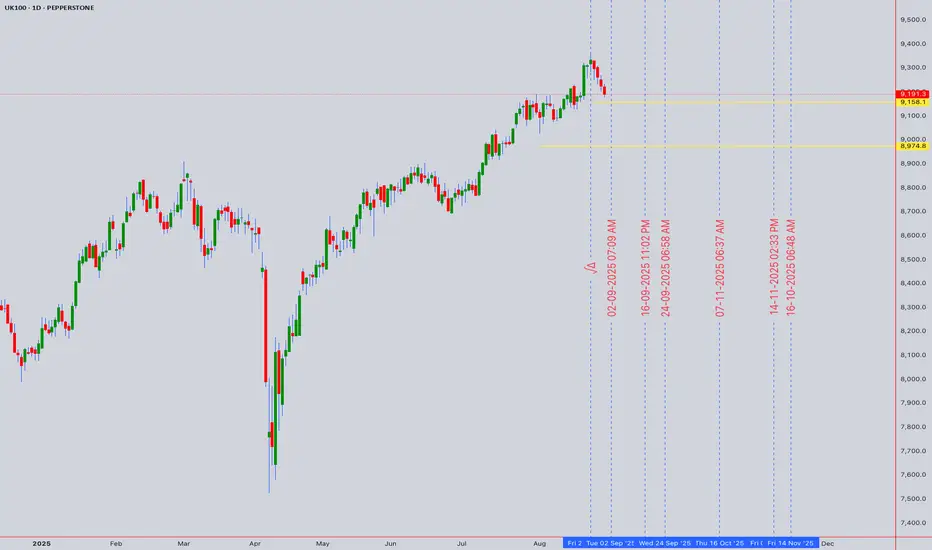
FTSE 100 UK100 Technical Analysis: Weekly Forecast# FTSE 100 UK100 Technical Analysis: Advanced Multi-Timeframe Trading Strategy & Weekly Forecast
Current Price: 9,191.30 (As of August 30, 2025, 11:54 AM UTC+4)
Asset Class: UK100 / FTSE 100 Index
Analysis Date: August 30, 2025
---
Executive Summary
The FTSE 100 Index (UK100) continues to demonstrate resilient performance, trading at 9,191.30 points with solid fundamental support from recent Bank of England policy accommodation. Recent market data shows the GB100 reached 9,199 points on August 29, 2025, maintaining a monthly gain of 0.68% and an impressive 9.82% year-over-year advance. Our comprehensive technical analysis reveals the index is positioned for potential continuation toward the 9,525.47 analytical target by year-end 2025, supported by dovish monetary policy and improving technical confluence across multiple timeframes.
---
Multi-Timeframe Technical Analysis
Elliott Wave Analysis
The FTSE 100 exhibits a complex corrective structure within a larger degree impulse sequence:
Primary Count: Completing Wave 5 of (3) within an extended bull market cycle
Alternative Count: ABC corrective completion transitioning to new impulse
Immediate Target: 9,300-9,400 (Wave 5 extension)
Extended Target: 9,525-9,600 (Major wave completion zone)
Invalidation Level: Break below 8,950 (Wave 4 low)
Long-term Projection: 10,200-10,500 potential by mid-2026
Wyckoff Market Structure Analysis
Current price action demonstrates characteristics of a Wyckoff Re-accumulation Phase:
Phase: Late Stage Re-accumulation with signs of Markup beginning
Volume Analysis: Institutional absorption evident on declines below 9,100
Price Action: Narrowing consolidation ranges with higher low formation
Composite Operator Activity: Smart money accumulation at support levels
Market Structure: Building energy for next major upward movement
W.D. Gann Comprehensive Analysis
Square of 9 Analysis:
- Current price 9,191.30 positioned near significant Gann resistance level
- Next major Gann square: 9,409 (180-degree rotation from recent low)
- Time and price convergence: September 15-22, 2025 (Autumn Equinox influence)
- Critical Gann levels: 9,216, 9,409, 9,604 (geometric progressions)
Angle Theory Application:
- 1x1 Rising Angle Support: 9,050-9,100 (primary trend support)
- 2x1 Accelerated Angle: 9,300-9,400 (next resistance cluster)
- 1x2 Support Angle: 8,850-8,950 (major correction boundary)
- 1x4 Long-term Support: 8,500-8,600 (secular bull market support)
Time Cycle Analysis:
- 84-day cycle completion anticipated: Mid-September 2025
- Seasonal Gann Pattern: September-October historically bullish for UK markets
- Major time window: October 8-18, 2025 (next significant turning point)
- Annual cycle: Year-end strength typically supports FTSE performance
Price Forecasting & Time Harmonics:
- Immediate resistance: 9,240-9,280
- Primary target: 9,350-9,400
- Extended projection: 9,525-9,600
- Time harmony suggests acceleration after September 18, 2025
---
Japanese Candlestick & Harmonic Pattern Analysis
Recent Candlestick Formations (Daily Chart)
Bullish Engulfing: August 26-27 showing strong buying pressure
Piercing Pattern: August 28-29 confirming support at 9,150 level
Long Lower Shadows: Multiple occurrences indicating accumulation
Volume Validation: Increasing volume on up days, declining on down days
Harmonic Pattern Recognition
Bullish Gartley Completion: 9,050-9,150 zone (recent successful test)
ABCD Pattern Active: Targeting 9,375-9,425 completion zone
Potential Butterfly Formation: Monitoring for completion at 9,500-9,600
Fibonacci Confluence: 1.618 extension projects to 9,387 from August low
Advanced Harmonic Analysis
Three Drives Pattern: Currently developing third drive toward 9,400+
Cypher Pattern Potential: Reversal consideration at 9,550-9,650
Deep Crab Formation: Long-term pattern suggesting 9,800+ targets
AB=CD Equality: Multiple time and price relationships converging
---
Ichimoku Kinko Hyo Analysis
Current Cloud Structure (Daily Chart)
Price Position: Above Kumo cloud indicating bullish trend continuation
Tenkan-sen (9-period): 9,167 (short-term dynamic support)
Kijun-sen (26-period): 9,124 (medium-term trend baseline)
Senkou Span A: 9,146 (leading span A - immediate support)
Senkou Span B: 9,087 (leading span B - key cloud support)
Chikou Span: Positioned above historical price action (bullish confirmation)
Future Kumo Analysis (26 periods ahead):
- Ascending cloud formation supporting continued bullish bias
- Future support zone: 9,200-9,300 (forward-looking cloud support)
- Kumo thickness increasing, suggesting strengthening trend
Ichimoku Trading Signals
TK Cross: Tenkan above Kijun (active bullish signal)
Price vs Cloud: Sustained positioning above cloud
Chikou Span Clear: No interference with historical price levels
Cloud Breakout: Recent bullish breakthrough confirmed
---
Technical Indicators Comprehensive Analysis
RSI (Relative Strength Index) Multi-Timeframe
Daily RSI: 62.4 (healthy bullish momentum, room for expansion)
Weekly RSI: 58.7 (positive trend with upside potential)
4H RSI: 65.8 (approaching but not yet overbought)
RSI Divergence Analysis: No bearish divergence detected, momentum intact
Bollinger Bands Analysis
Current Position: Price approaching upper band (9,220 level)
Band Width: Contracting after recent expansion (consolidation phase)
%B Indicator: 0.72 (strong positioning without extreme reading)
Squeeze Indicator: Preparing for next volatility expansion
VWAP Analysis (Volume Weighted Average Price)
Daily VWAP: 9,154 (key dynamic support level)
Weekly VWAP: 9,089 (intermediate support zone)
Monthly VWAP: 9,067 (major trend support)
Volume Profile: Significant acceptance above 9,100 level
Moving Average Structure Analysis
10 EMA: 9,158 (immediate dynamic support)
20 EMA: 9,136 (short-term trend support)
50 SMA: 9,087 (intermediate trend support)
100 SMA: 9,023 (key trend support)
200 SMA: 8,934 (major secular support)
Moving Average Alignment:
- Perfect bullish alignment across all timeframes
- Golden Cross pattern firmly established (50/200 SMA)
- Price trading above all major moving averages
---
Support & Resistance Analysis
Primary Resistance Levels
1. R1: 9,240-9,280 (immediate Gann resistance cluster)
2. R2: 9,350-9,400 (2x1 Gann angle and harmonic completion)
3. R3: 9,525-9,600 (Major Elliott Wave target and analytical forecast)
4. R4: 9,750-9,800 (Long-term harmonic projection)
5. R5: 10,000-10,200 (Psychological and secular targets)
Primary Support Levels
1. S1: 9,124 (Kijun-sen and recent swing support)
2. S2: 9,050-9,100 (1x1 Gann angle and harmonic support)
3. S3: 8,950-9,000 (Elliott Wave invalidation boundary)
4. S4: 8,850-8,900 (1x2 Gann angle and 100 SMA confluence)
5. S5: 8,750-8,800 (Major correction target zone)
Volume-Based Price Levels
High Volume Node: 9,050-9,150 (institutional accumulation zone)
Low Volume Gap: 9,200-9,300 (potential rapid movement area)
Volume Resistance: 9,400+ (historical distribution levels)
POC (Point of Control): 9,125 (maximum volume acceptance)
---
Multi-Timeframe Trading Strategy Framework
Scalping Strategy (5M & 15M Charts)
5-Minute Timeframe Methodology:
Entry Criteria: Pullbacks to 20 EMA with RSI <30 oversold
Profit Targets: 25-40 points per scalping trade
Stop Loss Parameters: 15-20 points maximum risk exposure
Volume Confirmation: Above-average volume required on breakouts
Optimal Time Windows: 8:00-10:00 AM and 2:00-4:00 PM GMT
15-Minute Scalping Framework:
Range Identification: Current consolidation 9,150-9,220
Breakout Methodology: Volume spike confirmation above 9,220
Mean Reversion: Fade extreme moves beyond 2 standard deviations
Risk Management: Maximum 3 positions simultaneously, 1:1.5 minimum R:R
Intraday Trading Strategies (30M, 1H, 4H)
30-Minute Chart Approach:
Trend Following: Long positions above EMA confluence (9,140)
Pattern Recognition: Flag and pennant completions near resistance
Target Methodology: Initial 9,280, extended 9,350-9,400
Risk Parameters: 50-70 point stops, 2:1 reward-to-risk minimum
1-Hour Chart Strategy:
Momentum Confirmation: MACD histogram expansion on bullish crossovers
Support Trading: Long entries from 9,100-9,150 support zone
Breakout Management: Monitor 9,240 level for continuation signals
Session Focus: London session volatility (8:00 AM - 4:30 PM GMT)
4-Hour Swing Framework:
Cloud Strategy: Long positions on successful Ichimoku cloud bounces
Elliott Wave Guidance: Ride Wave 5 extensions toward major targets
Fibonacci Utilization: 38.2% and 61.8% retracements for optimal entries
Position Duration: 2-7 days typical holding period for swing trades
Swing Trading Strategy (Daily, Weekly, Monthly)
Daily Chart Methodology:
Breakout Strategy: Long on sustained breaks above 9,240 with volume
Accumulation Zones: Build positions on tests of 9,050-9,150
Target Sequence: 9,350 → 9,525 → 9,750 progressive profit-taking
Position Management: Scale entries across multiple time frame confirmations
Weekly Chart Perspective:
Primary Trend: Strongly bullish above 8,950 weekly support
Swing Objectives: 9,525-9,600 zone for major profit realization
Risk Assessment: Weekly closes below 8,850 signal trend reversal
Monthly Chart Analysis:
Secular Trend: Multi-year bull market structure intact
Long-term Targets: 10,500-11,000 by 2026-2027 projections
Major Support: 8,200-8,500 (unlikely to test in current cycle)
---
Daily Trading Plan: September 2-6, 2025
Monday, September 2, 2025
Market Status: Full UK trading session
Technical Setup:
Resistance Levels: 9,240, 9,280, 9,320
Support Levels: 9,150, 9,100, 9,050
Expected Range: 9,120-9,260
Trading Strategy:
Morning Session (8:00-12:00 GMT): Monitor for overnight gap analysis
Afternoon Session (12:00-16:30 GMT): Focus on US market correlation
Primary Setup: Long 9,140-9,170 targeting 9,240-9,280
Alternative Setup: Fade any move above 9,280 without volume confirmation
Risk Considerations:
- Bank of England policy speculation impact
- End-of-month institutional flows
- Brexit-related news sensitivity
Tuesday, September 3, 2025
Market Outlook: Post-Labor Day momentum with full global participation
Key Events & Strategy:
UK Economic Data: Manufacturing PMI and construction data releases
Technical Focus: 9,240 breakout attempt with volume validation
Entry Strategy: Long 9,180-9,220 on consolidation completion
Target Areas: 9,300-9,350 on successful breakout scenarios
Risk Management:
- Reduced position sizes due to data event risk
- Monitor GBP/USD correlation for confirmation signals
- Prepare for potential volatility around PMI releases
Wednesday, September 4, 2025
Market Outlook: Mid-week consolidation with building momentum
Strategic Framework:
Technical Pattern: Monitor for bull flag or pennant completion
Volume Analysis: Require institutional participation for sustained moves
Support Testing: Strength of 9,150-9,180 zone crucial for continuation
Momentum Signals: MACD and RSI alignment for directional bias
Trading Approach:
Range Strategy: Buy support, sell resistance until breakout
Breakout Preparation: Position for 9,240+ level clearance
Risk Assessment: Political developments and central bank communications
Thursday, September 5, 2025
Market Outlook: Pre-weekly close positioning dynamics
Key Considerations:
Technical Levels: 9,300-9,350 resistance cluster testing
Institutional Activity: Pension fund rebalancing flows
Pattern Development: Harmonic pattern completion monitoring
Global Correlation: Monitor S&P 500 and DAX for confirmation
Execution Strategy:
Momentum Continuation: Above 9,280 favors 9,400 target
Profit-Taking Zones: Scale out at 9,320, 9,380, 9,425
Risk Management: Tighten stops as resistance approaches
Friday, September 6, 2025
Market Outlook: Weekly close significance and weekend positioning
Final Session Strategy:
Weekly Close Target: Above 9,200 maintains bullish structure
Profit Preservation: Secure gains from successful breakout trades
Gap Risk Management: Prepare for weekend news flow impact
Position Review: Maintain swing positions with appropriate stops
Critical Levels:
Weekly Bullish: Close above 9,220
Weekly Neutral: 9,150-9,220 range
Weekly Bearish: Close below 9,150
---
Macroeconomic & Policy Analysis
Bank of England Policy Impact
The Bank of England's recent monetary policy decisions significantly influence FTSE 100 performance. The Committee voted to reduce Bank Rate to 4% in August 2025, representing continued accommodation that supports equity valuations and corporate profitability across the index.
Interest Rate Environment
The next Bank Rate decision is due on September 18, 2025, with economists and markets expecting at least one more rate cut in 2025. This dovish policy trajectory provides fundamental support for equity market performance.
Economic Growth Outlook
The UK economic environment presents improving conditions with downside domestic and geopolitical risks around economic activity remaining, although trade policy uncertainty has diminished somewhat. This stabilization supports continued FTSE 100 outperformance.
Inflation Dynamics
The Bank of England predicted that inflation would follow a bumpy path and expects it to rise to around 4% in September, but this increase should be only temporary, and inflation should fall back to 2%.
Key Risk Factors
1. Monetary Policy Uncertainty: Timing and magnitude of future rate cuts
2. Global Trade Relations: Post-Brexit trade relationship developments
3. Currency Impact: GBP strength/weakness affecting multinational earnings
4. Energy Sector Exposure: Oil price volatility impacting major components
5. Political Stability: Government policy consistency and business confidence
---
Sector Analysis & FTSE 100 Component Review
Sector Performance Dynamics
Financial Services: Benefiting from interest rate normalization process
Energy Sector: Oil majors providing dividend yield attraction
Consumer Goods: Defensive characteristics supporting index stability
Technology: Limited exposure compared to global peers, potential upside
Healthcare: Pharmaceutical giants providing stability and growth
Dividend Yield Analysis
The FTSE 100's attractive dividend yield continues to support international investor interest, with share buybacks remaining a significant component of shareholder returns supported by robust cash generation of these companies.
Valuation Assessment
There's little doubt that the UK's blue-chip index is undervalued compared with overseas peers, providing fundamental support for continued outperformance and multiple expansion potential.
---
Multi-Asset Correlation Analysis
Currency Relationships
GBP/USD Impact: Inverse correlation with multinational earnings (0.65 negative)
EUR/GBP Influence: European trade relationship effects (0.45 positive)
USD Strength: Dollar appreciation pressures on international revenues
Global Index Correlations
S&P 500 Relationship: Moderate positive correlation (0.58)
DAX Connection: Strong European correlation (0.74)
Nikkei Influence: Asian market sentiment transmission (0.42)
Commodity Exposure
Oil Price Sensitivity: Energy sector weighting creates positive correlation
Gold Relationship: Limited direct exposure, inverse correlation during risk-off
Base Metals: Industrial exposure through mining components
---
Risk Management Comprehensive Framework
Position Sizing Methodology
Scalping Operations: 0.5-1% account risk per individual trade
Intraday Positions: 1-2% maximum account risk exposure
Swing Positions: 2-3% account risk per established position
Maximum Portfolio Exposure: 7% total UK100-related risk allocation
Stop-Loss Implementation
Scalping Stops: 15-25 points maximum loss per trade
Intraday Stops: 50-75 points based on volatility conditions
Swing Trading Stops: Below key support levels (9,050 for current longs)
Technical Invalidation: Elliott Wave and pattern breakdown levels
Profit-Taking Strategy
Scaling Method: Take 30% at first target, 40% at second target, hold 30%
Trailing Stops: Implement after achieving 2:1 favorable risk-reward
Time-Based Exits: Close before major BoE announcements and data releases
Pattern-Based Exits: Honor harmonic and Elliott Wave completion zones
Risk Monitoring Systems
Daily Risk Assessment: Maximum drawdown tolerance 3%
Weekly Risk Review: Position correlation and concentration analysis
Monthly Performance Evaluation: Strategy effectiveness and adjustment needs
Stress Testing: Scenario analysis for major market disruptions
---
Weekly Outlook Probability Matrix
Bullish Scenario (Probability: 70%)
Primary Catalysts:
- Bank of England maintains accommodative policy stance
- UK economic data shows continued stability/improvement
- Technical breakout above 9,240 with volume confirmation
- Global risk-on sentiment supporting equity markets
Price Objectives:
- Initial Target: 9,300-9,350
- Extended Target: 9,400-9,525
- Optimistic Scenario: 9,600+
Supporting Factors:
- Dividend yield attraction for international investors
- Undervaluation relative to global peers
- Technical momentum building across timeframes
Neutral/Consolidation Scenario (Probability: 20%)
Characteristics:
- Range-bound trading between 9,100-9,280
- Mixed economic signals and policy uncertainty
- Technical indecision at key resistance levels
- Reduced trading volumes and institutional activity
Trading Parameters:
- Upper Range: 9,250-9,280
- Lower Range: 9,100-9,150
- Strategy Focus: Range trading and volatility contraction plays
Bearish Scenario (Probability: 10%)
Risk Catalysts:
- Unexpected hawkish shift from Bank of England
- Significant deterioration in UK economic indicators
- Major geopolitical shock or financial system stress
- Technical breakdown below critical support at 9,050
Downside Objectives:
- Initial Target: 8,950-9,000
- Extended Target: 8,800-8,850
- Stress Scenario: 8,600-8,750
---
Advanced Trading Techniques & Market Microstructure
Order Flow Analysis
Institutional Activity: Large block trades above 9,150 indicate accumulation
Retail Sentiment: Contrarian indicator showing excessive bearishness
Options Market: Put/call ratio neutral, no extreme positioning detected
ETF Flows: Consistent inflows into UK equity ETFs supporting demand
High-Frequency Trading Considerations
Algorithmic Support: 9,150-9,180 zone shows HFT buying interest
Liquidity Zones: Deep liquidity above 9,200 and below 9,100
Speed of Execution: Critical during London market open and close
Spread Dynamics: Tightening spreads indicating improving liquidity
Options Market Intelligence
Gamma Exposure: Positive gamma above 9,180, negative below 9,100
Key Strike Concentrations: 9,200 calls and 9,100 puts high open interest
Implied Volatility: Currently underpriced relative to realized volatility
Options Skew: Slight put premium indicating modest hedging activity
---
Seasonal & Cyclical Analysis
Historical Seasonal Patterns
September Performance: Historically mixed, average +0.8% monthly return
Q4 Seasonality: Strong fourth quarter performance, average +4.2%
Year-End Effects: Portfolio rebalancing typically supports FTSE 100
Dividend Calendar: Major distributions in Q1 and Q3 affecting flows
Economic Cycle Positioning
Current Phase: Late cycle expansion with monetary accommodation
Sector Rotation: Value sectors outperforming growth in current environment
Interest Rate Cycle: Declining rate environment supporting equity multiples
Credit Cycle: Stable credit conditions supporting corporate expansion
---
Technology & Innovation Impact
Fintech Integration
Digital Banking: Major FTSE components adapting to digital transformation
Payment Systems: Evolution affecting traditional banking models
Regulatory Technology: Compliance costs and operational efficiency factors
Cryptocurrency Influence: Limited direct exposure, regulatory developments
ESG Considerations
Environmental Standards: Increasing focus on sustainability metrics
Social Governance: Stakeholder capitalism trends affecting valuations
Regulatory Compliance: ESG reporting requirements and investment flows
Transition Risks: Energy transition affecting traditional sector weights
---
Conclusion & Strategic Outlook
The FTSE 100 Index (UK100) presents a compelling technical and fundamental investment case with multiple confluences supporting continued upside momentum toward the analytical forecast target of £9,525.47 by the end of 2025. The combination of accommodative Bank of England policy, attractive dividend yields, and constructive technical patterns creates a favorable risk-reward environment.
Critical Success Factors:
1. Monetary Policy Support: Continued BoE accommodation through 2025
2. Technical Breakout Confirmation: Sustained move above 9,240 with volume
3. Economic Stability: UK data showing resilience and gradual improvement
4. Global Risk Environment: Maintained risk-on sentiment supporting equities
Key Monitoring Priorities:
1. September 18 BoE Decision: Next policy rate announcement impact
2. Technical Level Behavior: Price action at 9,240-9,280 resistance cluster
3. Volume Patterns: Institutional participation in breakout attempts
4. Global Correlation Changes: Relationship dynamics with major indices
Strategic Recommendation:
Maintain constructive bias with tactical flexibility, emphasizing disciplined risk management while positioning for probable continuation of the multi-year bull market in UK equities. The September 15-22 Gann time window represents a critical juncture for intermediate-term directional confirmation.
The confluence of technical, fundamental, and policy factors suggests high probability for achieving the 9,400-9,525 target zone within the forecast timeframe, while downside risk appears well-contained above the 9,050 support complex.
---
*This comprehensive analysis is provided for educational and informational purposes only. It does not constitute investment advice, and readers should conduct their own research and consult with qualified financial professionals before making investment decisions. Always implement appropriate risk management strategies and position sizing methodologies.*
---
For individuals seeking to enhance their trading abilities based on the analyses provided, I recommend exploring the mentoring program offered by Shunya Trade. (Website: shunya dot trade)
I would appreciate your feedback on this analysis, as it will serve as a valuable resource for future endeavors.
Sincerely,
Shunya.Trade
Website: shunya dot trade
Disclaimer: This post is intended solely for educational purposes and does not constitute investment advice, financial advice, or trading recommendations. The views expressed herein are derived from technical analysis and are shared for informational purposes only. The stock market inherently carries risks, including the potential for capital loss. Therefore, readers are strongly advised to exercise prudent judgment before making any investment decisions. We assume no liability for any actions taken based on this content. For personalized guidance, it is recommended to consult a certified financial advisor.
GBPUSD Bearish Setup – Rejection at Key Resistance (6H Chart)🧨 OANDA:GBPUSD Bearish Setup – Rejection at Key Resistance (6H Chart)
GBPUSD is showing signs of exhaustion near the 1.36000 resistance zone. A lower high and bearish engulfing candle suggest sellers are stepping in.
🔹 Trade Setup:
Sell Entry: 1.35050
Stop Loss: 1.36000
Take Profit 1: 1.34000
Take Profit 2: 1.33100
Take Profit 3: 1.31500
Risk-reward is favorable, especially if price breaks below 1.33500 with momentum. Watch for confirmation on lower timeframes.
📌 Scaling out at TP1/TP2 is advised. Invalidate the setup if price closes above 1.36000 with strength.
#GBPUSD #ForexTrading #PriceAction #FXSetup #BearishReversal #TradingView #TechnicalAnalysis #SwingTrade #6HChart #ForexStrategy
Psychology Always Matters: