Single-Family Home Prices Priced in Gold (1971–2026)📊 Single-Family Home Prices Priced in Gold (1971–2026)
This chart shows the price of a U.S. single-family home measured in ounces of gold, not dollars, going back to the early 1970s.
Why this matters:
Tight Credit is not good for markets! Bad JUJU!
Gold acts as a long-term monetary benchmark. Pricing homes in gold strips out currency effects and helps reveal real cycles, not nominal noise. It gives us insight into how the market is looking at credit going forward.
🔎 What the chart shows (facts)
Home prices in gold move in long, multi-decade cycles
Peaks tend to occur during periods of:
easy credit
suppressed interest rates
strong belief in “housing always goes up”
Troughs tend to follow:
monetary tightening
credit contraction
stress resets in the financial system
Historically, these cycles are not random and not short-term.
Bottom line
This chart is about relative value, monetary regimes, and long-term structure.
For new traders:
Learn to separate nominal prices from real purchasing power, "VALUE" and you’ll start seeing markets more clearly.
Structure first. Emotion later.
The home didn't change
The Currency did.
I strongly encourage traders and investors to understand the operational mechanics of the monetary system. There is a meaningful distinction between money and currency, and this chart highlights that difference clearly.
Understanding that distinction changes how you interpret cycles, value, and risk.
If you enjoy the work:
👉 Drop a solid comment
Let’s push it to 6,000 and keep building a community grounded in raw truth, not hype.
Realestate
COMP | Real Estate Services on the Rise | LONGCompass, Inc. engages in the provision of an online real estate platform. Its platform provides an integrated suite of software for customer relationship management, marketing, client service, operations and other critical functionality, as well as brokerage services and adjacent services. The company was founded by Ori Allon and Robert Reffkin in 2012 and is headquartered in New York, NY.
Opendoor Technologies Big Correction coming ?In this video I explore the recent explosion in the price of Opendoor Technologies .
Still along way off its All time highs but up some 2000% from the past few months alone
I analyse what could be a very key zone to build upon .
Tools used Fibs, VPR, VWAP, TPO Chart
Sunteck Realty - Uber and Premium Luxury Real Estate Projects Record Pre-Sales:
Sunteck achieved its highest-ever Q1 pre-sales bookings at Rs. 657 crores, marking a robust 31% YoY growth over Rs. 502 crores in Q1 FY25. Management reaffirmed its guidance for similar or better growth for the full year FY26.
Segmental Mix and Margin Outlook:
The Uber Luxury and Premium Luxury segments are contributing a larger share to pre-sales. Management expects “further margin expansion contributing to our overall profitability” as these segments scale.
Luxury Segment Momentum:
Sales are being driven by luxury projects, notably BKC and Nepean Sea Road. Management emphasized a strategic focus on the “uber luxury and premium luxury” segments, with upcoming launches in Bandra Bandstand and Western Suburbs (ODC, Andheri).
Collections Guidance:
While specific collection guidance is not provided, management expects “substantially more than what we have collected last year,” with collection growth likely in the 20% range (vs. 30-35% pre-sales growth) due to the ramp-up cycle of new launches.
Optimism and Confidence:
Management exuded strong optimism, citing robust sales momentum, a healthy balance sheet, and an aggressive pipeline. The company is “accelerating BD activity,” “gearing up for new launches,” and believes its “strong financial foundation enables us to pursue strategic initiatives and be more agile and responsive to changing market condition.”
No Major Headwinds Noted:
The only caveat mentioned was the “world of uncertainty” around regulatory approvals, which is an industry-wide issue.
Summary
Sunteck Realty is pursuing an aggressive growth trajectory in FY26, underpinned by record pre-sales, a robust launch pipeline (Rs. 110 billion GDV in next three quarters), and a strong balance sheet. The company’s focus on the luxury and premium segment is driving margin expansion. While regulatory approval timelines remain a generic risk, management’s tone is confident, and guidance is for continued strong operating and financial performance. The Dubai project remains on track for a late FY26/early FY27 launch. No material headwinds were flagged.
OPEN 1D - Flag Ready for Takeoff?On the daily chart, Opendoor Technologies (OPEN) is forming a clean bullish flag - a consolidation phase following a massive +400% rally since spring 2025. Price action remains tightly contained within the pattern, with strong support from the MA50 and the 6.3–7.4 buy zone, aligning with the 0.618 Fibonacci retracement.
Technically , the setup looks mature: MA50 is trending upward, MA200 sits far below, and volume contraction hints at a breakout ahead. The first target sits at $16.50 (1.618 extension), while the second target lies at $25.60 (2.618 extension) - a potential +200% move from current levels.
Fundamentally, Opendoor is finally emerging from its downturn:
– +37% YoY growth in property transactions;
– operating costs reduced by ~25%;
– positive operating cash flow for the first time in three years;
– partnerships with Zillow and Redfin driving stronger customer acquisition.
With the U.S. housing market showing signs of recovery and potential Fed rate cuts on the horizon, OPEN stands out as a high-upside play in the proptech sector.
Tactical plan: watch for accumulation near 6.3–7.4, add on breakout confirmation. Profit targets: 16.5 → 25.6.
After all, in both trading and real estate - it’s all about timing and location.
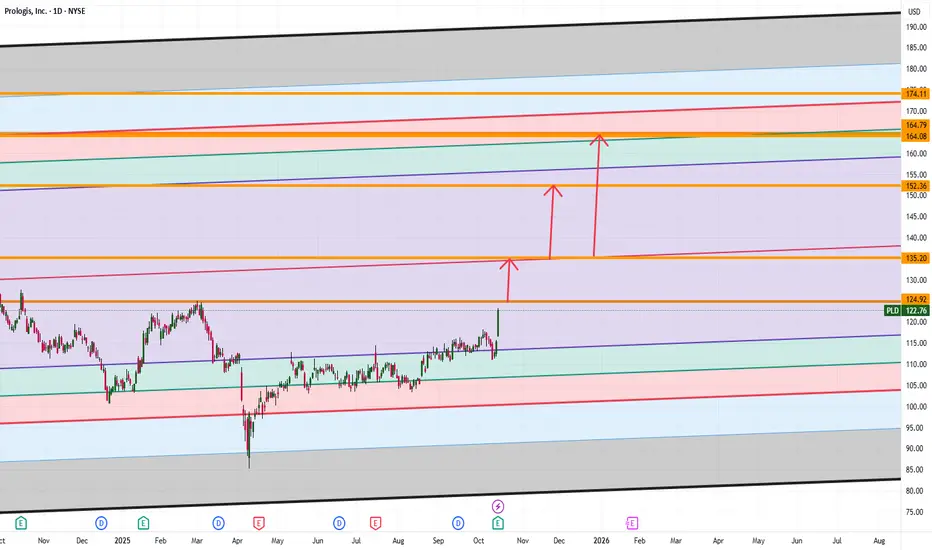
Prologis (PLD) Simple Market Breakdown!PLD’s been showing solid momentum lately 📈 and here’s the key zone I’m watching:
✅ If we break and hold above 124.92, the next target zone is around 135.20.
⚠️ At that level, we could see some correction or sideways movement (a bit of rest before the next move).
🚀 But if PLD breaks above 135.20 and holds, that could set up the next big leg toward 152, and possibly 164.
💡 So short-term; watch for a small pause. Long-term; momentum still looks strong if we keep closing higher.
Want to see how I’m mapping out the next levels and what signals I’m tracking for confirmation?
💬 DM me “PLD” and I’ll send you the full chart breakdown directly.
Mindbloome Exchange
Trader Smarter Live Better
$hmcall Hmcall Haldane Mccall Plc price at -40% DiscountNSENG:HMCALL Hmcall Haldane McCall operates in Nigerian real estate development and hospitality via subsidiaries Suru Homes and Suru Express Hotels.
Current price: 4.05 naira per share
hmcall Current price is -40% discount of previous all time high of 6.8naira per share. There is a likelihood that prices will stabilize around here as there is a double bottom formation in price action and Moneywave indication just turned upward from negative territory,
My buy zone: 4.05 - 4.72 (Not financial Advice)
Assuming a reversal in price.
Tp1 = 6.50naira per share and
Tp2 = 8.35naira per share (assuming bullish momentum is sustained)
#Hmcall Idea is invalidated under 4naira per share
Farmers Have Been Losing Money for Years Grain is planted in the Spring and harvested in Autumn.
As shown farmers have been losing money for the past several years, buying grain in the spring and selling at a loss.
The entire ag industry is (was) propped up by land inflation, driven by the fantasy of "Yellowstone" cosplay.
Well, this sort of thing can only go on for so long before we run out of buyers.
Best of luck to all the John Duttons out there. "Soft Commodities" showing you are underwater.
$CY6U: CapitaLand India Trust – Bangalore Boom or Borrowing Bust(1/9)
Good afternoon, Tradingview! ☀️ SGX:CY6U : CapitaLand India Trust – Bangalore Boom or Borrowing Bust?
At 1.02 SGD, is this Indian office play a hidden gem or a debt-laden mirage? Revenue’s up, insiders are buying—let’s unpack the curry! 🔍
(2/9) – PRICE PERFORMANCE 📊
• Current Price: 1.02 SGD 💰
• Recent Moves: Modest gains in 2025, per trends 📏
• Sector Buzz: India’s office market heating up 🌟
It’s a slow simmer, but spice is brewing! 🔥
(3/9) – MARKET POSITION 📈
• Market Cap: Around 1.36B SGD (1,333.5M shares) 🏆
• Operations: Office projects, Bangalore expansion ⏰
• Trend: Revenue hit S$278M, up from S$234M 🎯
Rooted in India’s growth soil! 🌱
(4/9) – KEY DEVELOPMENTS 🔑
• Expansion: Bangalore office buy locked in 🔄
• Insider Buying: Confidence despite earnings dip ahead 🌏
• Sentiment: Cautious cheers, per market vibes 📋
Scaling up, but debt’s the side dish! 🍛
(5/9) – RISKS IN FOCUS ⚠️
• Earnings Drop: 39% decline forecast over 3 years 🔍
• Borrowing: Heavy reliance raises eyebrows 📉
• Global Noise: China stimulus, trade jitters ❄️
Spicy risks on the horizon! 🌩️
(6/9) – SWOT: STRENGTHS 💪
• Revenue Jump: S$278M from S$234M last year 🥇
• India Play: Bangalore’s office boom 📊
• Insider Faith: Buying signals grit 🔧
A curry with some kick! 🍲
(7/9) – SWOT: WEAKNESSES & OPPORTUNITIES ⚖️
• Weaknesses: Debt load, earnings slide ahead 📉
• Opportunities: India’s resilience, market gaps 📈
Can it spice up profits or just heat debt? 🤔
(8/9) – 📢At 1.02 SGD, revenue up, insiders in—your vibe? 🗳️
• Bullish: 1.20 SGD soon, India shines 🐂
• Neutral: Flat, risks weigh ⚖️
• Bearish: 0.90 SGD, debt bites 🐻
Drop your take below! 👇
(9/9) – FINAL TAKEAWAY 🎯
CapitaLand’s Bangalore bet and S$278M revenue pop tasty 📈, but debt and a 39% earnings dip loom 🌫️. Volatility’s our mate—dips are DCA spice 💰. Scoop low, rise steady! Gold or ghee?
The Bursting House Bubble- Like usual, all details are marked simply on the chart :
- Notice that after the 2007 crash, the trend was halted by a major resistance.
- Also note that during the Covid crash, the rebound occurred at the same zone, where resistance had transformed into support.
- The housing market is inflating beyond fundamentals. Prices are being pushed by speculation and unsustainable leverage. History shows that no bubble lasts forever.
- Between 2027 and 2030, the real estate market faces a high probability of a major crash.
- Don’t forget, since Covid-19 they haven’t printed money, but sooner or later, they’ll need an excuse to restart the printing machine… and it’s coming.
Be careful, protect your capital now and diversify, buy when fear floods the streets, that’s how new wealth is created.
Happy Tr4Ding !
JELD-WEN Holdings | JELD | Long at $4.02JELD-WEN Holdings NYSE:JELD designs, manufactures, and sells wood, metal, and composite materials doors, windows, and related building products in North America and Europe. The stock has taken quite a beating since the rise in interest rates, and I think a reversal *may* be in sight in the next year as rates are slowly lowered - even if the market is forward-thinking and purely anticipating a new housing boom (which I highly doubt given the current home prices). Regardless, there is risk with this stock since it has relatively high debt (debt-to-equity of 2.61x). A Quick Ratio of 1.1 and Altman's Z Score of 1.9 puts NYSE:JELD near a medium level of bankruptcy risk. The company has pretty good cash reserves and a forward P/E of 10x (current is negative), so growth is anticipated. Book value of $5.31.
A bear case here is a terrible earnings call in August 2025 due to the housing market slowing (i.e. people pausing home purchases/builds/repairs expecting interest rates to drop soon). That may plummet the stock near $1.00 or below, which would be a tremendous deal, *unless* the company fundamentals change (like bankruptcy).
Without a crystal ball, yet understanding the forward-thinking aspects of the market, NYSE:JELD is in a personal buy-zone at $4.02 with some risks.
Targets into 2027:
$5.40 (+34.3%)
$8.50 (+111.4%)
Parcl - PRCL-USD - 30 Million Market Cap (100x Potential)www.tradingview.com
CHATGPT Research Summary:
Parcl: Unlocking Real Estate Exposure on the Blockchain
Introduction:Parcl is a groundbreaking decentralized platform that enables traders and investors to speculate on real estate market price movements much like they trade crypto or equities. By combining real-time housing data with blockchain technology, Parcl offers around-the-clock, borderless, and highly liquid exposure to global residential real estate markets. In this comprehensive blog post, we’ll explore what Parcl is, how it works, what it means to own the EGX:PRCL token, the unique opportunities it provides for investors (including AI-driven strategies), its core strengths, and the risks and challenges it faces. The tone is professional, investment-focused, and designed for the TradingView audience.
What is Parcl and How Does It Work?
Parcl allows users to trade real estate price indices for global cities without ever owning or transacting physical property. Each index represents the aggregated median price per square foot/meter for residential properties in a specific city. Users can go long or short on these indices using perpetual contracts with up to 10x leverage, entirely on-chain and settled in USDC.
Built on Solana, Parcl leverages the blockchain's high speed and low fees to offer a seamless and cost-efficient trading experience. Users only need a Solana-compatible wallet (e.g., Phantom) to deposit USDC, select a city index, and place a trade. There are no barriers such as down payments, brokers, or escrow delays — just rapid, decentralized access to global housing markets.
Data integrity is ensured through Parcl Labs, which aggregates millions of housing data points daily to generate real-time city indices. These feeds are streamed on-chain via oracles like Pyth Network, ensuring transparency and reliability.
What Does It Mean to Own EGX:PRCL ?
The EGX:PRCL token is the governance and utility token of the Parcl ecosystem. Holders of PRCL can:
Participate in protocol governance by voting on changes to platform parameters, fee structures, and market expansions.
Access premium real estate data and analytics through Parcl Labs.
Receive airdrops, rewards, or staking incentives as part of community growth and loyalty initiatives.
While PRCL doesn’t currently offer revenue sharing, it grants holders influence over protocol decisions and potential future economic alignment as the ecosystem matures.
A New Asset Class for Investors and AI Agents
Parcl opens up a completely new asset class: blockchain-native, synthetic real estate exposure. This has major implications:
For retail investors, it democratizes access to real estate, which was previously limited by geography, capital requirements, and illiquidity.
For sophisticated traders, it enables granular bets (e.g., short New York, long Miami) and high-frequency strategies previously impossible in traditional real estate.
For AI agents and algorithmic investors, Parcl provides composable, on-chain access to a diversified asset class that can be rebalanced and traded programmatically.
In short, Parcl makes real estate a liquid, programmable, and globally accessible financial primitive.
Core Strengths: Why Parcl Stands Out
Solana-native speed & cost-efficiency: Enables fast execution and micro-investments ($1+), ideal for retail users and automated agents.
Unique data infrastructure: Parcl Labs’ real-time indices provide unparalleled accuracy and granularity.
Sophisticated perpetual AMM model: Handles liquidity and market balancing with dynamic funding rates and cross-margining.
Growing community and product-market fit: With 80,000+ users and over $1.3B in cumulative volume, Parcl is becoming the most liquid real estate trading venue in the world.
Risks and Threats to Consider
Regulatory uncertainty: Synthetic real estate products may eventually face classification as securities or derivatives in some jurisdictions.
Liquidity dependencies: The AMM model depends on sufficient USDC liquidity pools; low liquidity could cause slippage or insolvency risk.
Smart contract vulnerabilities: As with all DeFi platforms, there is non-zero risk of exploits or oracle manipulation.
Platform dependency: Parcl is tightly coupled to Solana — if the chain experiences downtime or congestion, the protocol may be impacted.
Investors should also be aware of token unlocks and potential dilution from early backers and treasury allocations.
Future Outlook and 100x Potential
With a current market cap near $30 million, Parcl represents a high-upside, early-stage bet on tokenized real estate. If the project gains traction and achieves broader adoption, it’s feasible to imagine a future market cap of $2.5 to $3 billion, representing a 100x potential from current levels.
Factors that could drive this include:
Expansion to more global cities
Increased PRCL utility and staking incentives
Growing demand for real-world assets (RWAs) on-chain
Enhanced support for automated and AI-driven strategies
Final Thoughts
Parcl is redefining what it means to invest in real estate. By transforming local, illiquid property markets into a global, composable, and liquid asset class, Parcl enables both human and AI investors to access and trade the housing market like never before.
Whether you’re a trader looking for uncorrelated exposure, a long-term investor seeking innovation, or a technologist building AI agents — Parcl offers a compelling opportunity.
⚠️ Disclaimer: This is not financial advice. Always do your own research and make investment decisions based on your individual risk profile.
$Meta and U.S equity Bull Run Almost Finished? Was just having a little fun before bed and brainstorming on the NASDAQ:META chart. Our darling as of late. I love trying to find similarities and patterns between macro swings and cycles. Human psychology and business cycles have a way of repeating themselves pretty often. As they say, history doesn't repeat, but it rhymes.
This recent melt up reminds a lot of the price action NASDAQ:META saw in 2021-2022. RSI overbought both times, currently approaching the 2.618 fib when connecting them to major high and low points. Decreasing volume on the moves up.
There's a lot of other data to support a bear market may be on the horizon:
Weak housing data/stocks (I do see some outlier stocks in the housing sector).
The yield curve un-inversion which typically precedes major bear markets 6-12 months after un-inversion.
The dollar seems to want to keep going higher. However it has shown a lot of weakness here lately which could help fuel the rest of the bull market.
The unwinding of the Japanese Yen carry trade has seemed to play a big factor in U.S equities as of late. Every time the BOJ hikes interest rates, a lot of U.S. equities see pretty sizable bearish volatility shortly after.
Being the darling that NASDAQ:META has become, once this trend line breaks it will be a signal that everyone should be taking note of in my opinion. I think the risk of a bear market increases dramatically. Maybe we get a shallow or 2022 style bear market next year and continue to make one last lag into new highs in 2027.
Here are some ideas that could support that theory:
China seems to be coming out of a depression-style bear market and is beginning to inject liquidity into their economy. This could help give U.S. equities a little more juice to run higher for longer
chips could make a major comeback and fuel SPY/QQQ higher for longer.
Names like Google, Tesla and Amazon can continue to show strength and we could see a rotation into them.
Maybe we get some more significant quantum breakthroughs with the help of AI.
These are things to keep in mind, but I think the probabilities of this this bull market we've enjoyed since 2008 is A LOT closer to the end than the beginning.
I base most of my sentiment off the 18.6 year real estate/land cycle theory that I have been following since 2022. I also give a lot of credibility to U.S. yield curve un-inversions sending shockwaves through the global economic system.
What do you guys and gals think?
$BEKE Inverse head and shouldersKE Holdings Inc. is a publicly traded Chinese real estate holding firm that offers a comprehensive online and offline platform for housing transactions and related services through its subsidiaries. It stands as the largest online real estate transaction platform in China.
Investors commonly refer to the entire operation as "Beike."
The company has garnered financial support from major players like Tencent, SoftBank Group, and Hillhouse Investment.
In August 2020, KE made its debut on the New York Stock Exchange (NYSE), successfully raising $2.12 billion during its initial public offering. On its first trading day, the stock soared by 87%, bringing the company's valuation to nearly $40 billion.
By May 2022, KE expanded its reach by becoming a dual-listed entity, adding its shares to the Hong Kong Stock Exchange.
KE operates two primary businesses: Lianjia and Beike. Lianjia functions as a real estate agency, while Beike serves as an online platform that connects customers with estate agents, including Lianjia. Lianjia is often likened to Redfin, whereas Beike is compared to Zillow.
The company is divided into four key business segments:
1. Existing home transaction services
2. New home transaction services
3. Home renovation and furnishing
4. Emerging and other services
La Rosa Holdings Corp. (LRHC) Surge Over 20% in Extended TradingLa Rosa Holdings Corp. (NASDAQ: NASDAQ:LRHC ), a cloud-based real estate conglomerate, has witnessed an impressive price surge, climbing nearly 30% in Wednesday’s extended trading session. This rally follows a series of strategic corporate developments, including leadership appointments, warrant cancellations, and growing investor confidence, fueling bullish momentum in the stock.
Catalysts Driving LRHC’s Momentum
Zack Morris-Backed AMA and Market Sentiment Boost
A pivotal factor in LRHC’s recent rally was a Twitter AMA featuring influential trader Zack Morris and La Rosa’s CEO, Joe La Rosa. During the session, Morris expressed strong conviction in the stock, boosting investor sentiment and sparking heightened trading activity. Such endorsements from influential figures often play a significant role in price movements, as retail traders respond to perceived credibility and confidence in a company’s future growth.
Strategic Leadership Expansion
In a significant corporate move, La Rosa Holdings announced the appointment of industry veteran Jose Miguel “JM” Padron to spearhead the national expansion of its commercial real estate division. Padron, known for his expertise in commercial real estate, is expected to drive revenue growth and market penetration, adding long-term value to La Rosa’s business model.
Cancellation of $2.4 Million in Warrants
Another fundamental catalyst was La Rosa’s decision to redeem and cancel $2.4 million worth of outstanding warrants. These warrants, previously issued to institutional investors, were exercisable for 2,446,634 shares of common stock. The cancellation reduces potential dilution and signals financial strength, a move generally perceived as bullish by investors anticipating share price appreciation.
Technical Outlook
From a technical perspective, NASDAQ:LRHC has shown a strong uptrend, surging approximately 25% from its prior alert levels. The stock’s Relative Strength Index (RSI) currently sits at 39, indicating that it is approaching a key technical zone. A breakout above the critical resistance level of $1.18 could trigger a 100% surge, reinforcing bullish sentiment and confirming an upward trend.
Key Support & Resistance Levels
- Support Levels: $0.50 (recent breakout level), $0.45 (previous consolidation zone)
- Resistance Levels: $1.00 (psychological level), $1.18 (breakout confirmation)
A sustained move above $1.18 could open the doors for a significant uptrend, with technical indicators suggesting a bullish reversal pattern forming. Investors are closely watching for volume confirmations and follow-through buying pressure to validate the breakout.
The Future of La Rosa Holdings Corp.
Founded in 2004 and headquartered in Celebration, Florida, La Rosa Holdings operates a diversified business model spanning Residential Real Estate Brokerage, Franchising Services, Coaching, Property Management, and Commercial Real Estate Brokerage. The company’s technology-integrated approach positions it competitively in the evolving real estate market.
With strong fundamental catalysts, increasing investor interest, and a favorable technical setup, NASDAQ:LRHC is emerging as a compelling stock to watch. If momentum continues to build, the stock could see further upside, making it a key player in the real estate and investment landscape.
La Rosa Holdings Corp. (NASDAQ: LRHC): A Gem In The Real EstateOverview
La Rosa Holdings Corp. (NASDAQ: LRHC) is making waves in the real estate sector, standing out as a resilient and innovative company poised for significant growth. With a current alert price of $0.409 per share, a market cap of $8.25 million, and an average trading volume of $3.3 million, LRHC presents an intriguing opportunity for both short-term traders and long-term investors.
Technical Analysis
LRHC's stock is currently in a consolidation phase, forming a bullish symmetrical triangle pattern. This technical setup often precedes a breakout, with gains potentially reaching 100% or more. Supporting this bullish outlook are several key indicators:
- Relative Strength Index (RSI): At an oversold level of 28.55, signaling a likely reversal.
- Moving Averages (MAs): Key MAs have positioned above the candlesticks, further indicating a bullish trend.
- Pattern Analysis: The stock has established a strong base following retracements from its peaks in February, June, and October 2024. The setup suggests a significant upward rally is imminent.
For traders, this combination of technical indicators provides a rare opportunity to enter at a pivotal moment.
Company Highlights
Founded in 2004 and headquartered in Celebration, Florida, La Rosa Holdings operates through five key segments:
1. Residential Real Estate Brokerage
2. Franchising Services
3. Coaching Services
4. Property Management
5. Commercial Real Estate Brokerage
This multi-faceted approach has enabled the company to create a robust ecosystem, empowering agents and franchisees to thrive in a competitive market.
Recent Achievements
- Revenue Growth: Reported unaudited preliminary revenue of $65 million for FY 2024, marking a 104% year-over-year increase.
- Expansion: Opened its first office in North Carolina, with plans to enter new markets and acquire additional brokerage firms.
- Innovation: Introduced cryptocurrency payment options, allowing agents to receive commissions in digital assets—a pioneering move in the real estate industry.
CEO Insights
Joe La Rosa, the visionary CEO, has emphasized the company’s commitment to innovation and growth:
"Achieving over 100% year-over-year revenue growth underscores the strength of our business model. With ambitious plans for 2025, including strategic acquisitions and technology enhancements, we are on track to achieve profitability while empowering our agents with cutting-edge solutions."
Why LRHC Stands Out
1. Agent-Centric Model: Offering a 100% commission plan and robust support for agents.
2. Tech-Driven Solutions: Proprietary tools like My Agent Account and kvCORE CRM streamline operations and boost productivity.
3. Sustainability: Proven resilience during economic downturns, including the Great Recession.
The Opportunity
With its bullish technical indicators, strong fundamentals, and forward-looking strategy, La Rosa Holdings Corp. (NASDAQ: LRHC) is a compelling pick for those looking to capitalize on a high-growth opportunity.
As always, do your own research and consider consulting a financial advisor before making investment decisions. Stay tuned for updates on LRHC and other market movers.
Alexandria Real Estate | ARE | Long at $97.41Alexandria Real Estate NYSE:ARE
Pros:
Pays a high and reliable dividend of 5.56%
Earnings are forecast to grow 18.52% per year
Revenue rose from $1.5 billion to $3 billion by Q3 2024
Insiders recently awarded a large amount of options in January 2025
Historically cyclical and bottom cycle may be ending soon
Cons:
Debt is not well covered by operating cash flow
P/E of 57.93x
May see further near-term declines in share price with poor earnings ($60s-$70s, bottom is unconfirmed)
Targets (into 2027)
$120.00
$140.00
$149.00
$199.00
$220.00 (long-term outlook)
LRHC Possibilities and Areas of InterestGood afternoon everyone, hope yah had a great New Years. In this 2025 we are looking at LRHC possible move to the upside with POSSIBLE targets at $1.13 & $2.08. There is a major gap to the downside in which we might not fill just yet until $1.13 gets filled (higher probability).
$2.08 seems like also a possibility, but that is more long-term and another analysis would be required once further data makes its way into the charts.
Nonetheless, Happy New Years everyone and have a blessed day!
Preserving Wealth: Essential Investment StrategiesHave you realized that your dollars or euros don't buy what they used to? Inflation, the quiet thief of purchasing power, has become a pressing issue for both individuals and investors. In November 2024, the annual inflation rate in the United States increased to 2.7%, marking its second consecutive rise, while inflation in the eurozone reached 2.2%. Though these figures may appear modest, even slight upticks in inflation can significantly reduce the value of your savings and investments over the long haul.
United States Inflation Rate YoY (ECONOMICS:USIRYY)
The Basics of Inflation and Its Effects
Inflation transpires when the overall price level of goods and services rises, diminishing the purchasing power of money. If left unchecked, it can undermine the real value of your assets and complicate your financial aspirations. In such a climate, cultivating strategies to hedge against inflation becomes vital. Effective inflation hedging allows individuals to safeguard their assets, maintain their value, and even potentially grow their wealth during times of rising prices.
This article delves into several of the most potent inflation hedges, such as equities, global diversification, real estate, precious metals. Each approach carries distinct advantages for protecting your portfolio from the pressures of inflation.
Equities: A Reliable Defense Against Inflation
Historically, stocks have emerged as one of the most effective long-term instruments for mitigating inflation. Companies often adapt to increasing costs by raising prices, allowing them to sustain profitability. By investing in shares of these companies, individuals can benefit from their ability to pass on costs, which helps preserve and potentially grow their investments during inflationary stretches.
Certain sectors are particularly adept at thriving in inflationary climates. Consumer staples—essential goods such as food, beverages, and household products—tend to perform consistently because demand remains steady regardless of price hikes. Similarly, energy stocks often benefit from inflation, as rising oil and gas prices can directly enhance profits for firms in that sector.
However, not every stock is an ideal candidate. It is essential to select high-quality companies with solid fundamentals, such as stable earnings, healthy balance sheets, and notable pricing power. Firms operating in industries with limited competition or significant barriers to entry often demonstrate stronger pricing capabilities, making them attractive choices during inflationary periods.
By integrating thoughtfully chosen equities into your portfolio, you can protect your wealth while positioning yourself for long-term success. Stocks remain a foundational element of effective inflation-hedging strategies, offering both growth potential and a buffer against the dwindling purchasing power of money.
Equity Growth Potential: Stocks tend to grow in value over the long term, often outpacing inflation. When inflation rises, companies can increase prices to maintain profit margins, which can lead to higher earnings and, eventually, stock prices. Investing in indices that reflect a broad range of companies, like the S&P 500, can provide exposure to this growth potential.
Indices, such as the S&P 500, are statistical measures that track the performance of a specific group of stocks, representing a particular segment of the financial market. The S&P 500, for instance, comprises 500 of the largest publicly traded companies in the United States, covering various industries. This index serves as a benchmark for the overall performance of the U.S. stock market and provides investors with insights into market trends, economic health, and the performance of large-cap stocks.
Indices are commonly used by investors to gauge market movements, assess investment strategies, and create diversified portfolios. They can be passive investment vehicles, such as index funds or exchange-traded funds (ETFs), which aim to replicate the performance of these indices, allowing investors to benefit from broad market exposure without needing to buy individual stocks directly.
S&P500 Weekly chart From 2009 till today
Read also:
Global Diversification: Mitigating Risks Across Borders
Inflation does not affect all economies with the same intensity; thus, diversifying investments internationally can serve as a powerful buffer against rising prices. By tapping into global markets, investors can shield their assets from localized inflation while gaining exposure to regions with robust economic prospects or consistently stable inflation rates—enhancing the overall performance of their portfolios.
Emerging markets, in particular, present compelling opportunities during inflationary periods. Characterized by expanding sectors and rising middle classes, these economies often offer higher returns than developed nations, especially when inflation diminishes the purchasing power of domestic assets. Resource-rich countries generally benefit as commodity prices climb, propelling economic growth and creating appealing investment opportunities.
International diversification also affords the benefit of currency diversification. By holding investments in multiple currencies, you gain exposure to exchange rate fluctuations that can mitigate the adverse effects of inflation. For example, if your home currency depreciates due to rising inflation, foreign assets denominated in stronger currencies may increase in value, acting as a natural hedge. Furthermore, currencies from economies with stable monetary policies can provide additional protection against inflationary pressures.
By spreading investments across diverse global markets, sectors, and currencies, you not only reduce inflation risks but also position yourself to capitalize on a range of economic dynamics. Global diversification stands out as one of the most effective defenses against inflation in today’s interconnected economy.
Real Estate: A Tangible Investment with Upside Potential
Real estate is widely recognized as one of the most effective assets during inflationary times. As a physical investment, real estate not only preserves value but often appreciates over time, frequently outpacing inflation rates. This makes it a potent hedge against inflation for both preserving and expanding wealth.
One key advantage of real estate lies in its capacity to generate rental income. In times of inflation, landlords can often increase rents to keep pace with rising costs, ensuring that their income grows along with inflation. This reliable cash flow becomes especially resilient during economic uncertainty.
Additionally, property values typically increase in correlation with inflation, driven by higher costs of construction materials, labor, and land. Investors who retain real estate during inflationary periods frequently observe a rise in asset values, granting both protection against inflation and opportunities for long-term gains.
For those preferring a hands-off investment experience, Real Estate Investment Trusts (REITs) present an excellent alternative. REITs allow individuals to invest in a diversified array of real estate assets—such as commercial buildings, residential properties, and infrastructure projects—without the need for active management. These trusts generally perform well during inflation as they benefit from both rising property values and increasing rental income.
Moreover, real estate provides the added benefit of leveraging investments. By using borrowed funds to acquire property, investors can amplify their returns during inflation, as the value of their assets appreciates while the real costs of debt are diminished by inflation.
Precious Metals: A Time-Honored Financial Shield
Gold and other precious metals have stood the test of time as reliable hedges against inflation. During economic uncertainty and rising prices, these assets frequently prove their worth as safe havens. Unlike fiat currencies, which may depreciate during inflation, precious metals tend to maintain or appreciate in value, making them essential components of a diversified portfolio.
Gold's longstanding appeal stems from its ability to preserve purchasing power. When inflation erodes the value of paper money, gold often rises in price, acting as a shield against financial instability. Its widespread recognition as a store of value further enhances its reliability during periods of economic fluctuation.
Investors can obtain exposure to gold in various forms, including physical assets like bullion and coins, which provide tangible ownership, as well as Gold ETFs (Exchange-Traded Funds) that allow trading without logistical concerns of storage. Furthermore, gold mining stocks can offer leveraged exposure to the metal; as gold prices rise, mining companies typically see their profit margins expand, making their stocks potentially lucrative investments.
Emerging alongside these traditional forms is digital gold, allowing investors to purchase fractional amounts of gold online. This modern strategy combines the ease of ETFs with the security of owning physical gold, appealing to those looking to diversify with smaller investments.
Gold also plays a unique role in market psychology. Its historical significance and status as a "crisis commodity" render it a go-to asset during geopolitical tensions or economic downturns. Incorporating precious metals into your investment approach—whether through physical assets, ETFs, mining stocks, or digital gold—enables effective shielding of your wealth from inflation while providing the flexibility to adapt to market shifts.
Gold Futures Weekly chart from 2010 till now.
Conclusion
Inflation, while often gradual and subtle, can have a profound effect on your financial stability. By adopting astute investment strategies that hedge against inflation—such as investing in stocks, diversifying internationally, acquiring real estate, holding precious metals. As economic conditions change, staying informed and proactive will empower you to navigate and thrive in challenging environments. With the right strategies, you can not only keep pace with inflation but also secure a brighter financial future.
✅ Please share your thoughts about this article in the comments section below and HIT LIKE if you appreciate my post. Don't forget to FOLLOW ME; you will help us a lot with this small contribution.
$PRO God Candle Incoming After breaking out of a brutal 116D descending channel, NYSE:PRO looks like it’s about to unleash a god candle on us all 💯
Next Targets:
150% to local high ~$4
235% to previous ATH ~$5.80
415% to new ATH ~$8.90
With @PropyInc sitting at a measly $100m MC, this micro-cap will absolutely rip when the RWA / Real Estate narrative catches fire with Onchain Summer (Base).