LHX Analysis: $1B Space Deal Signals GrowthThe Strategic Pivot
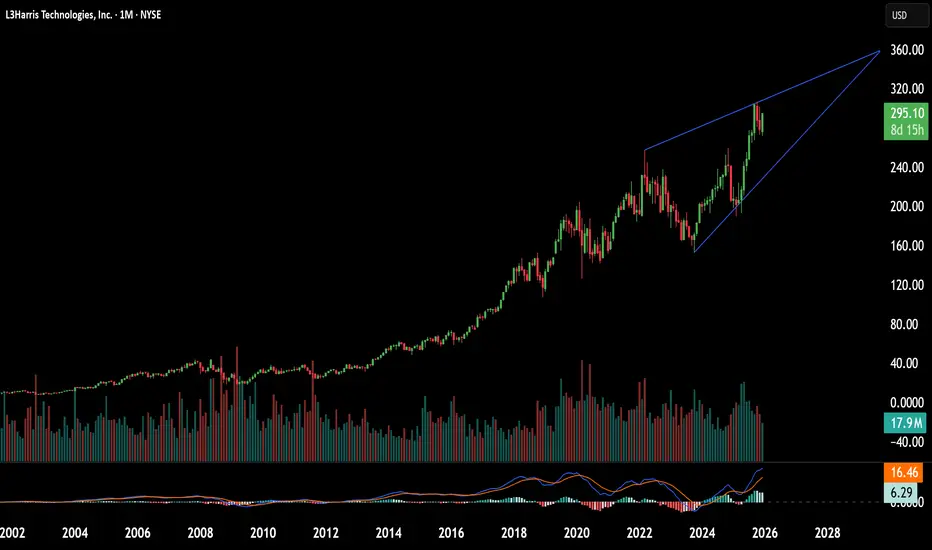
L3Harris Technologies (NYSE: LHX) is redefining the defense landscape. While the stock has climbed 38.6% year-to-date, recent developments suggest the rally is just beginning. The catalyst is a massive $843 million contract with the Space Development Agency (SDA). This deal confirms L3Harris as a primary player in modern warfare infrastructure. With projected revenues hitting $22 billion and free cash flow nearing $2.7 billion, the fundamentals are robust. This analysis dissects the strategic drivers behind this growth.
Geopolitics & Geostrategy: The High Ground
Modern conflict has shifted to orbit. Major powers are actively militarizing space to secure communications and surveillance advantages. The SDA contract for infrared satellites places L3Harris at the center of this geopolitical contest. Governments demand persistent missile warning capabilities to counter hypersonic threats from rivals. L3Harris provides the "eyes in the sky" necessary for national survival. This geostrategic necessity ensures long-term demand for their orbital assets.
Industry Trends: From Armor to Dat
The defense industry is moving away from heavy manufacturing toward intelligence and connectivity. Tanks and ships are vulnerable without secure data links. L3Harris specializes in this exact niche: avionics, electronic warfare, and sensing. They are not building the metal shell; they are building the brain. This trend favors agile tech integrators over traditional heavy metal defense contractors. The market values high-margin electronics over low-margin hardware.
Technology & Science: Infrared Precision
The science behind the new SDA contract is critical. These satellites utilize advanced infrared sensors to track heat signatures from missile launches. Developing these sensors requires elite engineering and physics capabilities. L3Harris has mastered the suppression of "background noise" in space to detect small targets. This scientific edge creates a high barrier to entry for competitors. Few companies possess the technical heritage to execute this level of precision engineering.
Business Models & Economics: Cash Flow Efficiency
L3Harris operates on a highly efficient financial model. The company generated nearly $2.7 billion in free cash flow (FCF) recently. This liquidity allows them to fund internal Research and Development (R&D) without relying on expensive debt. In a high-interest-rate macroeconomic environment, cash is king. Their ability to self-fund innovation while paying dividends makes them attractive to institutional investors. The economic engine here is stability combined with growth.
Cyber & High-Tech: Hardened Systems
Space assets are prime targets for cyberattacks. L3Harris integrates "cyber-resilience" directly into its satellite architecture. They do not just build communication radios; they build encrypted networks that withstand jamming and spoofing. This convergence of hardware and cybersecurity is a key selling point. Defense clients pay a premium for systems that operate reliably in contested electronic environments.
Management & Leadership: Organic Discipline
The leadership team at L3Harris is executing a disciplined strategy. Instead of relying solely on expensive acquisitions, they are driving "organic growth." The recent financial report highlights this internal efficiency. Management focuses on operational excellence and clearing supply chain bottlenecks. This focus has improved margins and delivery times. Investors trust leadership that delivers on promises without overleveraging the balance sheet.
Patent Analysis: Protecting Intellectual Property
A review of the sector suggests L3Harris holds a "moat" of intellectual property. Their patent portfolio likely covers proprietary sensor integration and waveform technologies. These patents legally protect their market share in tactical communications. Competitors cannot easily replicate their avionics suites without infringing on protected tech. This IP fortress secures future revenue streams and keeps margins high.
Forecast: The Trajectory
L3Harris is currently undervalued relative to its potential. The $843 million contract is a signal, not an anomaly. As global tensions rise, the premium on space-based intelligence will increase. The company’s focus on high-tech sensors, strong cash flow, and strategic positioning makes it a formidable stock. Traders should view the current price as an entry point before the full value of these space contracts materializes in 2026 earnings.
Space
FJET - From Private Skies to Public Markets!!Most retail investors never had access to the biggest space winners.🌌
SpaceX went from a private valuation near $46B to over $800B without ever giving the public a chance to participate.
This time, the door is open❗️
Starfighters Space, Inc. AMEX:FJET has officially entered the public markets, giving everyday investors exposure to a real aerospace company… Not a concept, not a slide deck; but one already flying missions out of NASA’s Kennedy Space Center.
📊 Technical Analysis
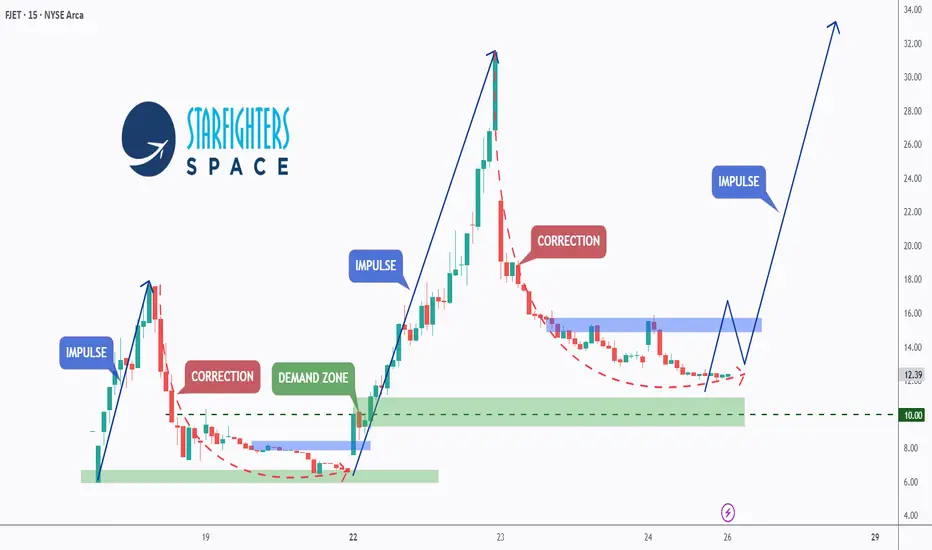
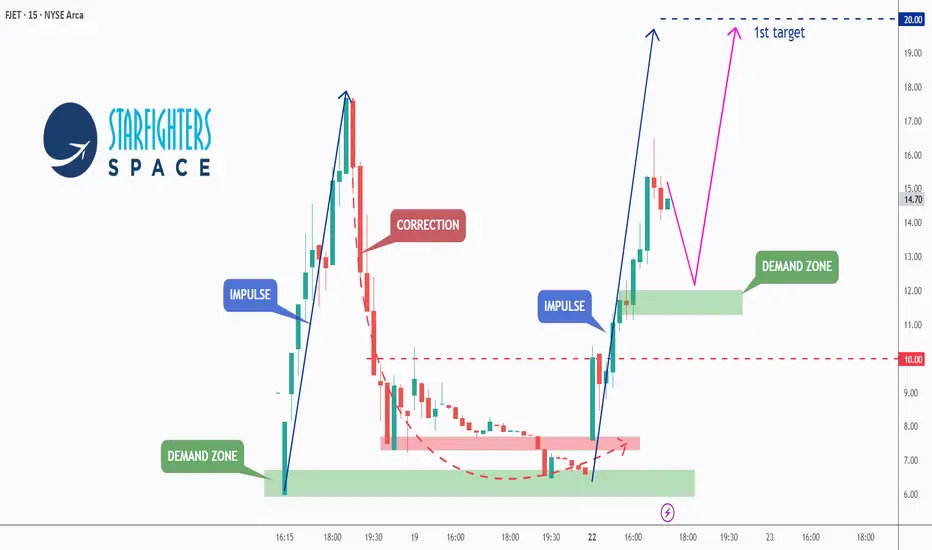
Following its public debut, FJET delivered a strong impulsive move 📈, confirming aggressive buyer interest.
After a healthy correction into demand, buyers stepped in again, keeping the structure intact.
Price has now broken and held above the $10 area , confirming bullish continuation and validating the higher-timeframe structure.
🔁 From here, the expectation is a shallow pullback / consolidation , followed by continuation in line with the scenario marked in purple.
🏹 The $20 zone represents the first target , and upon reaching it, I will be watching for further upside , at which point I’ll post an updated outlook.
💡 Bigger Picture
This isn’t a speculative space idea, it’s an operating aerospace company 💼with rare credentials:
- World’s only commercial Mach 2-capable fleet of Lockheed F-104 Starfighters.
- Operating directly out of NASA’s Kennedy Space Center.
- Strategic validation from NASA, Lockheed Martin, GE, and the U.S. Air Force.🛩
- Pioneering a hypersonic air-launch platform designed to dramatically reduce the cost and timeline of microsatellite deployment.
- Successfully completed a $40M Regulation A+ raise , transitioning from private capital into the public markets.
Recent history shows that real aerospace IPOs tend to move early:
Voyager, Firefly, Karman, and AIRO all saw sharp post-listing expansions.
In this sector, the first phase after going public often matters the most.
📘 Bottom line
FJET offers something rare:
💎Early exposure to a credible aerospace company right after it entered the public markets, before full institutional positioning and before the story became widely crowded.
📡Whether you approach it as a technical setup, a newly public aerospace play, or a longer-term space infrastructure narrative, this is a name worth keeping on the radar.
⚠️ Always do your own research and speak with your financial advisor before investing.
📚 Stick to your trading plan, entry, risk management, and execution.
All strategies are good; if managed properly.
~ Richard Nasr
Disclaimer: I have been paid $800 by CDMG, funded by Starfighters Space, to disseminate this message.
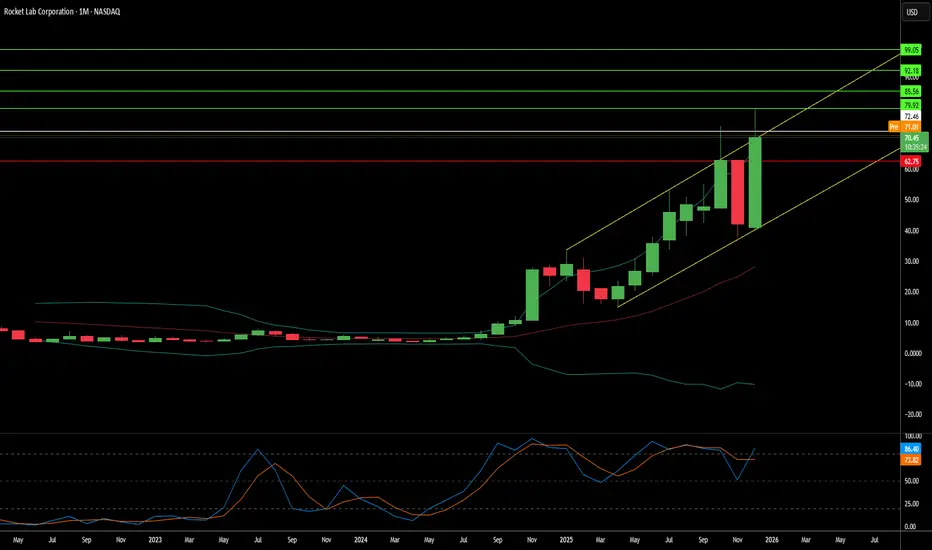
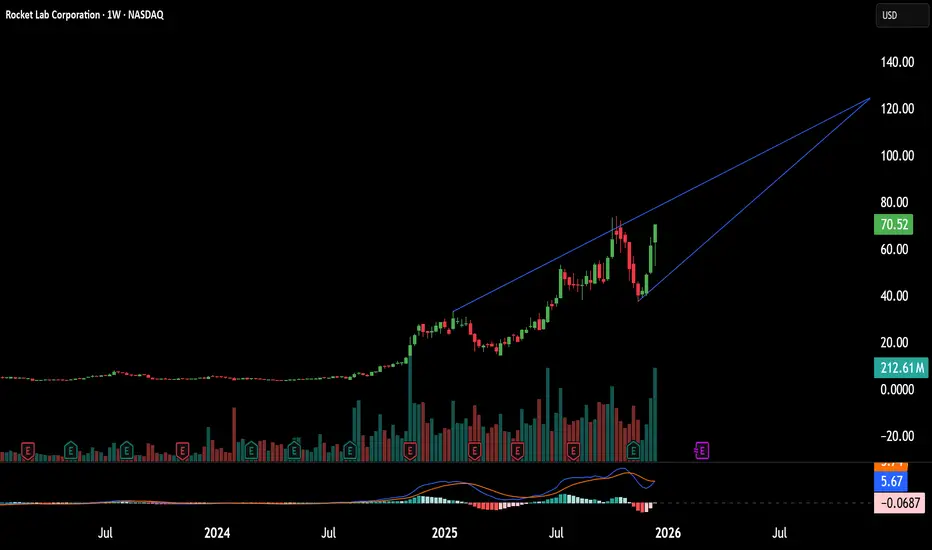
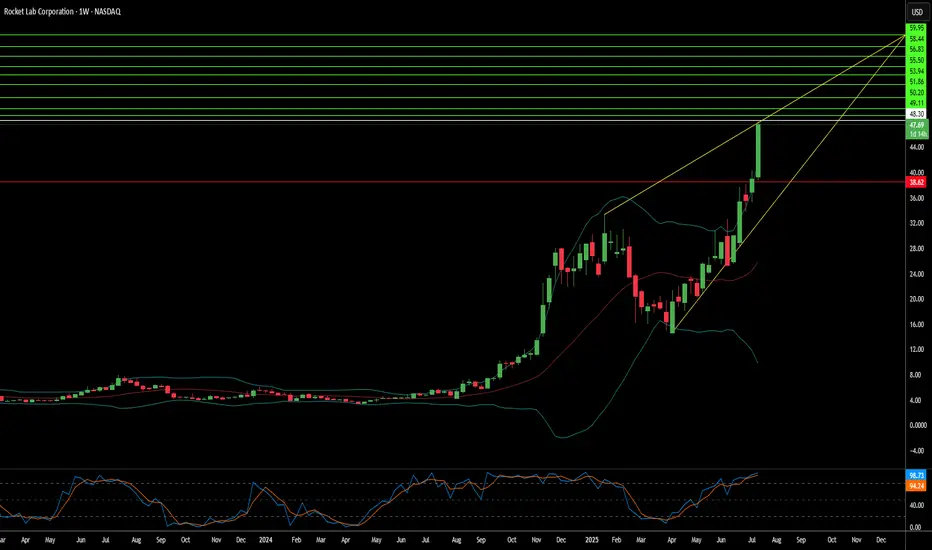
Rocket Lab’s Strategic Ascent: Beyond the NumbersRocket Lab (NASDAQ: RKLB) has solidified its status as a cornerstone of the modern space economy. Following a turbulent period that saw shares retrace nearly 50%, the stock has staged a commanding recovery, rallying roughly 111% year-to-date. This resurgence is not merely a product of market speculation; it reflects a convergence of geopolitical necessity, operational maturity, and favorable macroeconomic shifts.
Geostrategy and Defense Dynamics
The company’s recent momentum is deeply rooted in shifting geopolitical realities. The successful STP-S30 mission for the U.S. Space Force, launched five months ahead of schedule, underscores Rocket Lab’s critical role in national security. In an era where orbital assets are vulnerable to kinetic and cyber threats, the ability to rapidly replace satellites is a strategic deterrent. Rocket Lab provides the "responsive space" capability that Western defense planners demand.
Furthermore, the dedicated launch for the Japan Aerospace Exploration Agency (JAXA) highlights a strengthening of allied aerospace integration. As nations like Japan seek to diversify launch providers away from domestic bottlenecks, Rocket Lab has emerged as the preferred neutral partner. This expands its total addressable market beyond U.S. borders, insulating it from single-market risks.
Industry Trends and Valuation Benchmarks
A massive sector-wide repricing is underway, catalyzed by reports of a potential SpaceX IPO in 2026 at a $1.5 trillion valuation. This news has fundamentally altered how investors assess the space industry’s long-term economics. SpaceX’s valuation serves as a powerful anchor, validating the orbital economy’s scale.
As the only other publicly traded, vertically integrated launch provider with a proven track record, Rocket Lab is the primary beneficiary of this sentiment shift. Capital that once flowed into speculative pre-revenue SPACs is consolidating into proven operators. Rocket Lab’s business model, which combines launch services with high-margin space systems, offers investors a tangible hedge against the capital-intensive nature of pure launch plays.
Operational Excellence and Culture
Corporate culture remains Rocket Lab’s hidden alpha. While the broader aerospace sector struggles with chronic delays, Rocket Lab’s delivery of the STP-S30 mission ahead of schedule speaks to a unique internal ethos. This "execution-first" culture sharply contrasts with competitors who rely on PowerPoint engineering.
Management’s ability to navigate high-tech manufacturing challenges while maintaining launch cadence has built a reservoir of institutional trust. This reliability is a defensive moat. In the launch business, reputation is currency; Rocket Lab’s consistency allows it to command pricing power and secure long-term government contracts that competitors cannot access.
Technology and the Neutron Horizon
The upcoming Neutron rocket represents a technological inflection point. Scheduled for its maiden flight in the first half of 2026, Neutron moves the company from a small-lift niche to medium-lift dominance. This vehicle targets the lucrative constellation deployment market, currently a SpaceX monopoly.
From a patent and science perspective, Neutron’s design—featuring unique carbon composite structures and reusable fairings—signals a leap in material science application. These proprietary engineering solutions create high barriers to entry. By securing intellectual property around rapid reusability and automated manufacturing, Rocket Lab protects its margins against commoditization.
Conclusion
Rocket Lab’s recovery is structural, not accidental. It is driven by a unique intersection of defense utility, superior execution, and a repricing of the space sector’s potential. As the company prepares for the Neutron era, it is shedding its label as a "small launch" provider and emerging as a diversified aerospace prime.
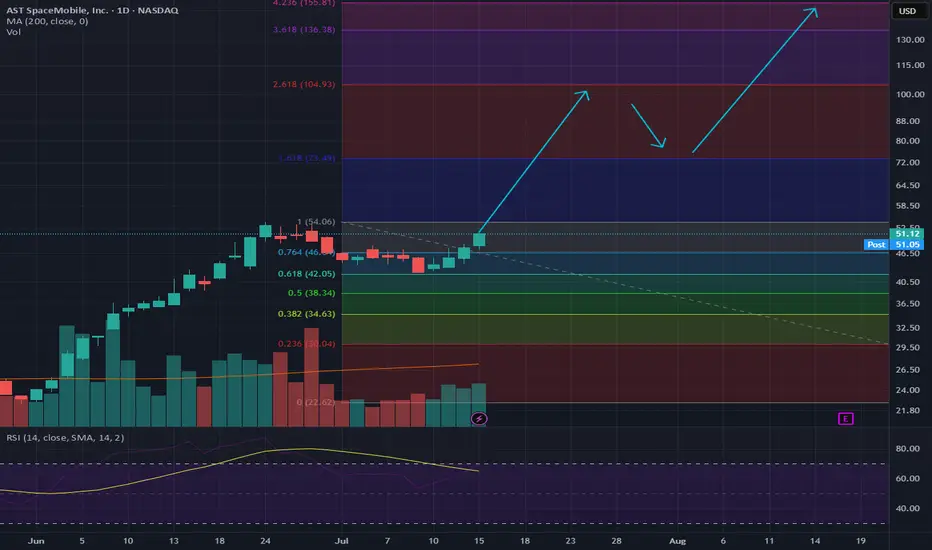
ASTS 4H: space internet or orbital dream?AST SpaceMobile (ASTS) is consolidating above the $61–69 zone, right near the 0.618 Fibonacci level of its last major rally. On the 4H chart, momentum shows early reversal signs: falling volume on pullbacks, stochastic turning up, and buyers defending local lows. The bullish setup holds as long as price stays above $61, with upside targets at $100 and $135 where the extension projection aligns.
Fundamentally , as of November 2025, ASTS stands out as one of the most promising yet capital-intensive players in the satellite telecom industry. The company completed deployment of its BlueWalker test constellation and is preparing for commercial rollout of direct-to-cell satellite connectivity. Successful phone-to-satellite calls using standard smartphones - validated with AT&T and Vodafone - mark a true technological milestone, positioning ASTS as a potential first-mover in global space-based mobile internet.
Revenue for the first nine months of 2025 reached roughly $55M, almost double last year’s level, but operating losses still exceed $300M due to high manufacturing and launch costs. The company holds about $180M in cash versus ~$260M in debt, continuing to rely on strategic partnerships and funding programs to maintain liquidity. The key upcoming catalyst is the commercial network activation in 2026 in cooperation with AT&T, Vodafone, and Rakuten, which could dramatically change valuation if successful.
With investor attention shifting back to space communications, competition with Starlink and Lynk Global is heating up, but ASTS’s advantage lies in using standard smartphones without extra hardware. Risks remain - high capital needs, launch delays, and dependency on partner timelines - yet the reward potential is extraordinary if execution holds.
Tactically, staying above $61 keeps the bullish structure alive with $100 and $135 as primary targets. A breakdown below $60 would negate the setup.
They’ve already connected phones to space - now let’s see if they can connect revenue to profit.
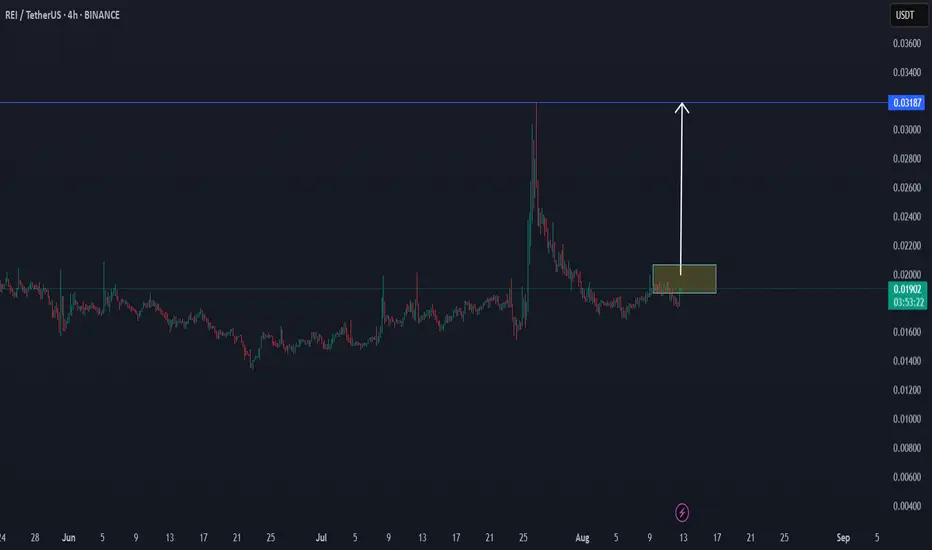
THE RETURN BREAK OF REI TO $0,032There is a good chance we are going to see a new break on REI as we saw before.
We will follow the coin for new volume.
Rocket Lab to new all time highs as more things go to spaceRocket Lab build rockets. CEO has an extremely bright aura. Hard to find a better story-driven pure space play with SpaceX being private. I like Rocket Lab and invested because as more and more things fly and go to space, it has the wind at its back.
Is Rocket Lab the Future of Space Commerce?Rocket Lab (RKLB) is rapidly ascending as a pivotal force in the burgeoning commercial space industry. The company's vertically integrated model, spanning launch services, spacecraft manufacturing, and component production, distinguishes it as a comprehensive solutions provider. With key operations and launch sites in both the U.S. and New Zealand, Rocket Lab leverages a strategic geographic presence, particularly its strong U.S. footprint. This dual-nation capability is crucial for securing sensitive U.S. government and national security contracts, aligning perfectly with the U.S. imperative for resilient, domestic space supply chains in an era of heightened geopolitical competition. This positions Rocket Lab as a trusted partner for Western allies, mitigating supply chain risks for critical missions and bolstering its competitive edge.
The company's growth is inextricably linked to significant global shifts. The space economy is projected to surge from $630 billion in 2023 to $1.8 trillion by 2035, driven by decreasing launch costs and increasing demand for satellite data. Space is now a critical domain for national security, compelling governments to rely on commercial entities for responsive and reliable access to orbit. Rocket Lab's Electron rocket, with over 40 launches and a 91% success rate, is ideally suited for the burgeoning small satellite market, vital for Earth observation and global communications. Its ongoing development of Neutron, a reusable medium-lift rocket, promises to further reduce costs and increase launch cadence, targeting the expansive market for mega-constellations and human spaceflight.
Rocket Lab's strategic acquisitions, such as SolAero and Sinclair Interplanetary, enhance its in-house manufacturing capabilities, allowing greater control over the entire space value chain. This vertical integration not only streamlines operations and reduces lead times but also establishes a significant barrier to entry for competitors. While facing stiff competition from industry giants like SpaceX and emerging players, Rocket Lab's diversified approach into higher-margin space systems and its proven reliability position it strongly. Its strategic partnerships further validate its technological prowess and operational excellence, ensuring a robust position in an increasingly competitive landscape. As the company explores new frontiers like on-orbit servicing and in-space manufacturing, Rocket Lab continues to demonstrate the strategic foresight necessary to thrive in the dynamic new space race.
GE Aerospace: How to go to the moon!GE's stock is soaring due to strong earnings and optimistic future guidance from its aerospace division.
1. Blowout Earnings: GE Aerospace reported earnings per share of $1.75, far exceeding analysts' expectations of $1.10.
2. Surging Orders: The company saw a 46% increase in orders last quarter, signaling strong demand for its products.
3. Revenue Growth: GE generated $10.8 billion in revenue, beating forecasts of $10 billion.
4. Wall Street Optimism: Analysts are raising price targets, with some predicting the stock could climb even higher.
5. Industry Momentum: The aerospace sector is experiencing a boom, with GE positioned as a key player.
I'm betting we are close to a pullback and then catapult to New ATH!
To the Moon: Space Isn't Just for Billionaires. It's for You TooTo your parents, getting involved in space meant joining NASA, becoming an astronaut, or — more realistically — building a scale model of the Saturn V and telling them you wanted to be "just like Neil Armstrong."
Today? You don’t need a PhD, perfect vision, or the ability to survive on dehydrated ice cream. The economics of orbit is accessible from your screen through the shares of publicly listed companies.
While billionaires are busy trying to out-flex each other in orbit, there’s a rapidly growing group of public companies that you can use as a launchpad to space exposure.
Let's explore (pun intended) how space is no longer science fiction only — it's an economic sector you can trade.
🚀 SpaceX: The Giant with a Gravitational Field
First, let’s get this out of the way: SpaceX is still private. Elon Musk’s rocket-powered unicorn dominates the headlines — and deservedly so. The company is launching Starlink satellites by the hundreds, winning NASA contracts, and discussing building cities on Mars where we can move and grow space potatoes.
But unless you have deep VC connections or you run a private equity fund, you can’t buy SpaceX stock yet. (Cue the tiny violin.) According to private-market estimates, SpaceX boasts a valuation of $350 billion, making it the world’s most expensive private company.
What you can do is invest in companies that supply, compete with, or benefit from the SpaceX era. Here are a few ideas.
🛸 Rocket Lab NASDAQ:RKLB : The Mini-SpaceX
If SpaceX is the Goliath of orbital launches, Rocket Lab is the David — except instead of a slingshot, it's using the Electron rocket and prepping the bigger Neutron.
Rocket Lab specializes in small satellite launches — think communications, Earth observation, climate monitoring. The company is cheaper, faster, and more frequent than the heavy-lifters like Falcon 9 by SpaceX. If you’re bullish on the boom in low-Earth orbit activity, Rocket Lab could be the small-cap rocket you can strap your portfolio to.
Bonus points — it’s not just a launch company. Rocket Lab, valued at around $10 billion, is expanding into satellite manufacturing, in-orbit services, and deep space missions.
👽 Intuitive Machines NASDAQ:LUNR : Houston, We Have a Moonshot
With a ticker symbol NASDAQ:LUNR — obviously leaning into the Moon theme — Intuitive is all about lunar landers and space infrastructure. The company is part of NASA’s Commercial Lunar Payload Services (CLPS) program, helping deliver payloads (science experiments, rovers, tech gizmos) to the Moon.
In the absence of crypto moons, these guys are aiming for the real thing.
But be warned: Intuitive is a true moonshot investment. As recently as March, the company's moon lander, Athena, couldn't pull off a stellar touchdown and its shares nosedived roughly 60%. Year to date, the stock is down 55%.
The startup is pioneering in a market that doesn’t quite exist yet at scale. Revenues are coming in phases, tied to contracts, with success as lumpy as a Moon crater. In a nutshell? It's a high-risk, high-reward kind of ride.
Still — if you're looking for an early, pure-play exposure to the Moon economy, Intuitive Machines, valued at just $1.5 billion, is basically as close as you can get.
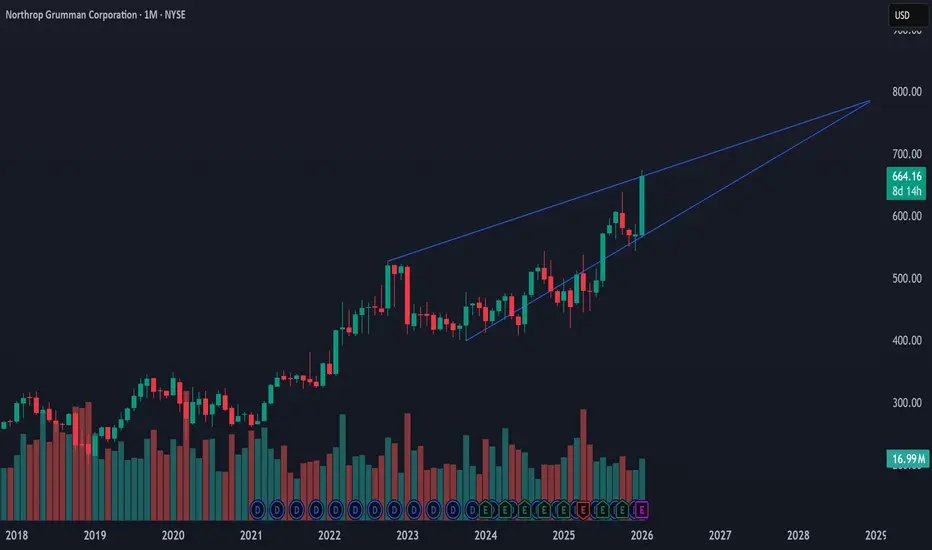
🌟 Northrop Grumman NYSE:NOC : The Silent Space Titan
While Rocket Lab and Intuitive Machines get the Reddit buzz, Northrop Grumman keeps a low profile, winning contracts and building stuff that actually gets yeeted into space.
The company is deeply involved in NASA’s Artemis program, manufacturing boosters for the Space Launch System (SLS) — the rocket that’s supposed to return humans to the Moon. It also makes satellite systems, missile defense tech, and stealthy aerospace goodies for the US government.
Northrop isn’t going to quadruple overnight on a meme rally — it’s worth just under $70 billion. But it provides serious, steady exposure to the high-stakes space game — with dividends. It’s the choice for traders who like their moonshots with a side of mature risk management.
✨ Lockheed Martin NYSE:LMT : Space Cowboys in Business Suits
Lockheed Martin isn’t just the F-35 fighter jet company. It also builds the Orion spacecraft — NASA’s chosen ride for deep space missions, including Mars (if Elon doesn’t get there first).
Lockheed’s space division covers everything from weather satellites to missile warning systems. The company, worth around $111 billion, has been in the space race before Jeff Bezos came up with Blue Origin and way before Musk founded SpaceX.
Think of Lockheed like the expert-level astronaut: calm, collected, and still racking up mission hours while everyone else is learning which button not to press.
💫 Boeing NYSE:BA : Sometimes Up, Sometimes… Not So Much
Boeing’s Starliner capsule is supposed to ferry astronauts to the International Space Station. Supposed to. It’s been delayed more times than your average budget airline flight.
The astronauts that were stuck in space for nine months? Riding a Starliner that failed during docking (the mission was supposed to be a ten-day roundtrip). So Musk’s SpaceX had to intervene and bring those two space explorers back to earth in March.
Still, despite technical hiccups and PR headaches, Boeing remains heavily involved in the space economy. It builds rockets, satellites, and space station modules. Even when it trips, it trips forward — thanks to government contracts and industrial clout.
If you can stomach some turbulence, Boeing, worth $134 billion, offers another angle on the space trade.
🌙 RTX NYSE:RTX : Watching the Skies
You may not think "space" when you hear RTX (formerly Raytheon), but you should. The company builds sensors, satellites, and missile tracking systems — vital components of the US space and defense apparatus.
Space isn’t just about launching astronauts and rovers; it's about surveillance, communications, and security. RTX, valued at a whopping $168 billion, plays behind the scenes, helping make space a battlefield for signals, not soldiers.
Steady, profitable, and sneakily important, RTX is the stealth bomber of space stocks.
🪐 Other Orbit-Worthy Notables
Outside of the headliners, there’s a growing constellation of companies playing critical roles in space commerce:
Redwire NYSE:RDW : In-space manufacturing and tech solutions.
Blacksky Technology NYSE:BKSY : Real-time satellite imagery and analytics.
Virgin Galactic NYSE:SPCE : Richard Branson’s waning dream of space tourism, working to make suborbital flights a regular experience (careful, though, the stock is down 99.9% from peak).
☄️ Your Portfolio Doesn't Have to Stay on Earth
Space is no longer just a billionaire’s playground or a sci-fi dream. It's an investable theme — one that covers exploration, infrastructure, defense, data, and connectivity.
Sure, the sector is volatile. There will be delays, explosions (hopefully unmanned), stock swings, and moments where it all seems like an expensive science experiment. But there’s also real innovation, massive contracts, and a trillion-dollar economy forming right above our heads.
The thing is, while the biggest names in tech make the headlines and get daily coverage , you won’t see those space companies featured on the front page of big financial journals or covered in the weekly take of your financial podcast.
Traders who are serious about catching the big moves before they blast off should keep one tool close: the earnings calendar . These companies’ quarterly reports highlight progress, revenue, profit or loss figures, and present forward-looking guidance to act as a compass to traders and investors.
The economics of space isn’t just exciting because it’s shiny and futuristic — it’s exciting because the groundwork is being laid quietly, deal by deal, launch by launch. And the traders who are paying attention before the crowd shows up? They’re the ones best positioned for lift-off.
Your turn : Are you already investing in the space economy? Did we miss any names in there? Tell us — what’s your favorite way to reach for the stars? ✨🚀🌔
Breaking: Intuitive Machines ($LUNR) Up 2% In Mondays Premarket The shares of Intuitive Machines, Inc. (NASDAQ: NASDAQ:LUNR ) are up 2.35% in Monday's premarket session. A company that designs, manufactures, and operates space products and services in the United States.
Its space systems and space infrastructure enable scientific and human exploration and utilization of lunar resources to support sustainable human presence on the moon. The company offers lunar access services, such µNova, lunar surface rover services, fixed lunar surface services, lunar orbit delivery services, rideshare delivery services to lunar orbit, as well as content sales and marketing sponsorships.
Technical Outlook
As of the time of writing, shares of Intuitive Machines, Inc. (NASDAQ: NASDAQ:LUNR ) are up 3% in premarket session. Trading in tandem with the 1-month low pivot albeit close to the support point, NASDAQ:LUNR is gaining momentum with a break above the 38.2% Fibonacci retracement point set to be the catalyst to spark a bullish renaissance for NASDAQ:LUNR shares.
Though the Relative Strength Index (RSI) is oversold at 30, NASDAQ:LUNR is looking poised to break the psychological 38.2% Fib level. Intuitive Machines, Inc. earnings is coming up Tuesday, May 13, 2025, before market open.
Analyst Forecast
According to 6 analysts, the average rating for LUNR stock is "Strong Buy." The 12-month stock price forecast is $15.5, which is an increase of 118.62% from the latest price.
Can Satellites Redefine Military Power?The strategic chessboard of military technology is undergoing a profound transformation, where Lockheed Martin plays a pivotal role with its advancements in satellite communication systems. The company has recently marked a significant milestone with the successful Early Design Review (EDR) of the MUOS Service Life Extension program, aimed at enhancing secure military communications. This leap forward is not just about maintaining current capabilities but about reimagining how military power can be projected and managed through space.
Lockheed Martin's collaboration with SEAKR Engineering introduces a groundbreaking feature: a reprogrammable payload processor for satellites, which could revolutionize operational flexibility in space. This technology allows for in-orbit adjustments, ensuring satellites can evolve with changing mission requirements without the need for costly replacements. This innovation challenges us to consider the future of warfare, where adaptability and real-time changes could dictate the outcome of conflicts, far beyond the traditional battlefield.
The implications of such technological advancements extend beyond military strategy; they invite a broader conversation about the role of private-sector innovation in national defense. With commercial giants like Starlink reshaping satellite communication, the military must now decide whether to continue investing in proprietary technologies or integrate commercial solutions. This dilemma poses a fascinating question: In an era where technology evolves at breakneck speed, how will traditional military assets adapt to maintain relevance and superiority?
Eternal PainWill Virgin Galactic ever provide share holders with anything but pain?
The board is no help as they continue to issue more shares. However; there is a potential bright future.
Currently the equity value of the company is lower than the liquidation value of the firm. The enormous cash burn is slowing as most of the capex necessary for flights is ready to go. Given their booking backlog, once they start a solid rhythm a lot of cash is going to be generated.
Look at their most recent investor presentation. With conservative estimates when (if) regular flights begin one spaceport will generate $500m per annum in EBIT [ ] With profits and any sort of multiple on earnings the future could be galactic.
My hopium induced reason for owning this since $5.90 is one day in the next 3-5 years this could be a legitimate 100+ bagger. Space is the ultimate growth arena and with SpaceX focused on mars and industrial matters, Blue Origin no where to be found, the moat is large and the industry is wide open.
Could BA be a wrinkle in the market?BA seems to be facing challenges. However, advancements in technology, along with opportunities in space and defense spending, present a gap that could benefit the company. While I don't have a specific time horizon, I see an opportunity to profit by going against the grain. It's a difficult path, but the potential is there.
MNTS short cover rally preparing to resumesell cycle appears to have been completed. short vol ratio data suggesting we will resume higher soon.
expecting recovery of 2.10 level by q1 2025, at which point the first portion of profits will be secured.. the rest would be held speculatively to 5$-10$ ranges.
lots of bullish macro-economic narrative developments as well to fuel the rally higher.
LUNR IM-2 Launch upcoming in January 2025The privately held Intuitive Machines, LLC, became a public company after merging with a special-purpose acquisition company, Inflection Point Acquisition Corp., in February 2023. The company is listed on the Nasdaq, incorporated in Delaware. On February 22, 2024, the Odysseus IM-1 spacecraft landed on the Moon. It was the first privately built craft to land on the Moon, and the first American spacecraft to do so since 1972. The Odysseus lander fell on its side when landing, but its instruments remained partially functional (albeit with a reduced downlink capacity), so the mission was judged successful. ( WIKIPEDIA )
This company is picking up momentum and creating higher support while enjoying increased volume for the past three months. It looks like this stock seems to climb during the period when they have a space mission or achieve a new contract. Recently they achieved a Contract worth 4.8 Billion Dollars USD with NASA which is a serious contract and not something to be taken lightly. This contract opens up additional revenue opportunities with other companies. Intuitive Machines is increasing REVENUE YOY at a compounding rate, and has seasoned experienced executives in almost every position of leadership. The company is very motivated and explanatory with their products, and you can access user manuals on their technology. It looks like a very legit company that plans on being around for the next space age and further. They have technology in space communications that could possibly be adapted for satellites that transmit signals to earth as various companies are switching to satellites for cellular tech. Inutitive machines market cap is roughly 915.29 Million USD. Their contract is worth 4.8 billion dollars.
www.reuters.com
Following the launch of IM-1, Intuitive Machines' stock surged 35% in one trading day, rising 75% total by Friday, February 16.
Intuitive Machines’ stock sank 32% after the Odysseus moon lander fell on its side on 23 February 2024.
This stock is a great buy for stability while also offering potential for break outs to scalp shares and sell to play short term trends, while going up in the long term. The stock offers consistent news and they are very motivated to become a Space power house for the USA.
BlackSky | BKSY | Long at $1.09BlackSky Technology NYSE:BKSY is a small company focused on satellite imagery tech. It's another name from the SPAC-boom era that suffered a massive price drop - reaching a high of $17.41 in 2021 and a low of $0.86 in 2024. However, based on my selected simple moving averages (SMAs), there may be a price "influx" soon as it merges with its primary SMA (white line) and consolidates further or rises. Fundamentally, the company needs more time to prove itself as a growth/earnings generator, but in the near"er"-term, there may be some price movement in its future. It's currently in a personal buy zone at $1.09.
Target #1 = $1.50
Target #2 = $1.75
Target #3 = $2.00