AI's Insight from News Cross-Checked with Pattern Recognition 👁Dear Investors, I believe that PLTR might fall to $13.2 in the coming months. Here, I made a short idea from the insights of the different AI algorithms I use for speculative analytics.
News Analytics - Natural Language Processing
1 Palantir's revenue growth has slowed in recent quarters. The company's revenue grew by 31% year-over-year in the first quarter of 2023, but this was down from 54% growth in the fourth quarter of 2022. This slowdown in revenue growth could be a sign that Palantir is facing challenges in the market.
2 Palantir's gross margin has been declining. The company's gross margin was 74% in the first quarter of 2023, down from 77% in the fourth quarter of 2022. This decline in gross margin could be a sign that Palantir is having to invest more in sales and marketing to drive revenue growth.
3 Palantir has been losing market share. The company's market share in the data analytics market is estimated to be around 1%, according to Gartner. This is a very small market share, and it has been shrinking in recent years. This could be a sign that Palantir is not as competitive as its rivals.
4 Palantir's stock price has been volatile in recent months. The stock price has fallen by more than 50% from its all-time high in August 2021. This volatility could be a sign that investors are uncertain about Palantir's future.
Cross-Checking Logic
Of course, there are also some positive news about Palantir that could suggest that the stock price will not fall to $13.2. For example, the company has a strong pipeline of new business opportunities. Palantir is also investing heavily in research and development, which could lead to new products and services that could boost the company's growth.
Chart Pattern Recognition - Deep Neural Networks
Between the two red trendlines, my neural networks believe to be a bearish channel. Your human eyes can see how Palantir rejected the upper trendline on 11 October and 21 November. I marked these price points with red ellipses. The channel had some bullish aspects when the bottom trendline acted as a support on 02 November and possibly today. Look at the left green arrow. Palantir's last rally related to this point. Today, the stock is near the same trendline again, and there's a chance that it can reignite a similar rally. The white arrow shows this possible scenario. I, however, feel skeptical that history would repeat itself.
Ensembling Technical Indicators
I asked different AIs to weigh technical indicators to represent their opinions. I ensembled the results of these AI opinions and selected MACD, RSI, and volume to simulate AI's insights in a way you can reproduce on your chart without AI. From declining volume bars I suspect the continuation of the bearish trend. The price action has been bearish over the last week, and I can't see the volume to reverse it. I can see extreme sell volumes every now and then, but they seemed to escalate the bearish trend. I don't see where the orders are that could absorb the end of the bearish trend. RSI tried to make a bullish cross below the volume indicator, but it happened to be a failed cross. RSI reversed as it crossed the SMA, which suggests a lack of bullish momentum. The potential bullish signal turned out to be an indication of how weak bulls are. At the same time, MACD has been going on the bearish side with a strong momentum, and periodically pulsing bearish momentum without signs of weakening. Overall, these indicators simulate what my AI bots believe about the market. Their ensembled opinion seems to be a bearish continuation.
Chart Explanation
I already explained the red bearish channel, the channel contacts, the indicators, and a potential bullish scenario, but I think bears enjoy a better risk-reward ratio. Theoretically, channel breakdown could pull the price into the support level of 13.2. I've got a green line at this level. Thus, the target price of a short could be within the green box around this level where the bearish trajectory's red arrow shows. The stock might reverse or not at this level. I'll have to reassess if I see the playout of my bearish expectation.
Conclusion
Ultimately, the direction of Palantir's stock price will depend on a variety of factors, including the company's financial performance, the overall market conditions, and investor sentiment. It is always important to do your own research and consult with a financial advisor before making any trading decisions.
Kind regards,
Ely
Speculation

Swing Trade Patterns: $NKE ExampleNYSE:NKE stock has a 2-day resting pattern and then a candlestick buy entry signal that is slightly longer than its average price gains in a single day.
Most Volume Oscillators are not at the top of the chart yet. Flow of funds indicators indicates money flowing into this stock.
The higher line is the bottom completion level for this short-term bottom. The resistance is moderate for a swing trade, but the stock could break through if momentum to speculative buying continues.


Nobody is talking about Voyager.OTC:VYGVQ took a one way ticket to Goblin Town after the fall of Voyager Digital. For the past year the sock has been trading sideways with little action.
Maybe it's the copium talking, but I have suspicion that OTC:VYGVQ is not dead just yet.
Here are a few points to back up my hypothesis:
-There is a massive butterfly harmonic that just completed on the 3D chart
-U.S. regulators have charged Ex-CEO Steve Ehrlich for fraud and deliberately lying about customer asset protection. Funny things always happen with law suits and bankruptcy claim.
-The stock recently broke out of descending wedge with a massive wick up to 0.2, which makes me think some bigger money is entering. Could it be the Composite Operator? Ehrlich? An activist investor? Who knows. 0.2 and 0.5 are key levels to watch historically; straight up and straight down between these areas.
-Lastly, and maybe the most far reaching point yet, there is a prominent gap on the daily @ 1.92 meaning there is some trapped liquidity up there.
The gap occurred during a weekly transition which increases the odds of it being filled from my experience. Now it could take months, even years (potentially) for OTC:VYGVQ to reach that level again (if the stock doesn't die and get delisted, which could definitely happen).
Only time will tell.
I'm letting it ride for now.


GBPUSD SELL SETUPThis Video will explain why the speculated trade is possible according to the strategy I use.
Note: This is not likely to happen. Trade wisely


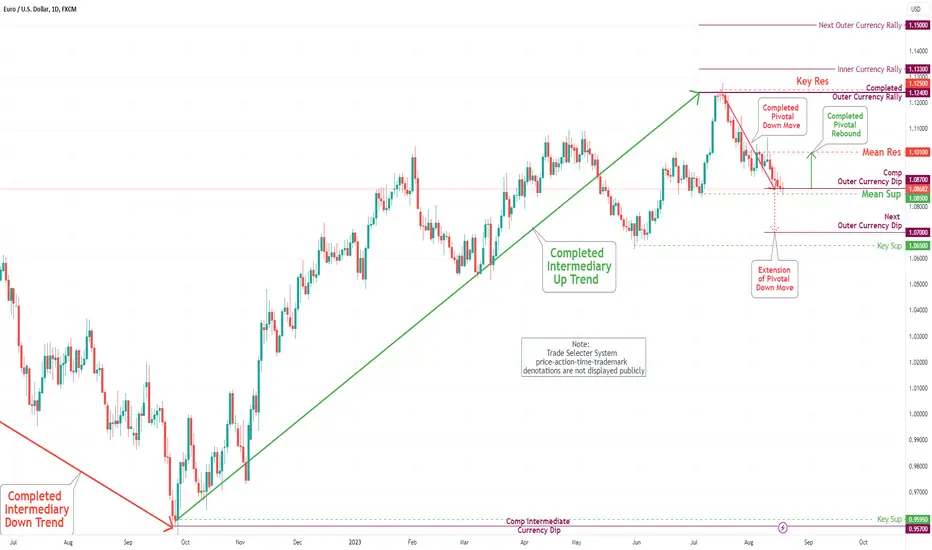
EUR/USD Daily Chart Analysis For Week of August 18, 2023Technical Analysis and Outlook:
The price action of the Eurodollar remained downwards as projected by Trade Selecter by completing our major target Outer Currency Dip 1.087. However, a strong rebound is possible with Mean Res 1.101 as a target. On the downside, price action might take us to the Next Outer Currency Dip of 1.070.

📈Investing vs. Speculating: Understanding the Key Differences📉Navigating the Financial Landscape: Investing vs. Speculating for Smart Financial Growth
In the intricate world of stock trading, distinguishing between an investor and a speculator is vital, despite their mutual interest in market analysis. Each follows distinct approaches and objectives, and understanding these differences is paramount before venturing into the stock market. With diverse individuals seeking to capitalize on opportunities and make profits, this article delves into the contrasting methods and goals of investors and speculators, shedding light on their unique strategies.
Understanding the Distinction: Investor vs. Speculator
At first glance, differentiating between an investor and a speculator might seem challenging. After all, both activities involve buying and selling stocks and require initial market analysis. However, the nature of these two approaches varies significantly.
Before delving into the world of stock markets, grasping the difference between investing and speculation is essential. Each day, the stock exchange witnesses countless transactions, leading to continuous price fluctuations. Behind each trade lies an individual with their own motivations, strategies, and rules, all driven by the common desire to make money. However, their approaches diverge; some choose to invest, while others opt for speculation.
Let's explore the dissimilarities. Who exactly is an investor?
Investing involves purchasing stocks of companies at their intrinsic value, with the expectation of long-term growth and subsequent profitability. As the definition suggests, patience is required, as companies do not experience substantial growth within mere weeks. Investors build portfolios of stocks with a focus on the years ahead. Moreover, investors can generate income through means other than price appreciation alone. By becoming shareholders, stock buyers become co-owners of the company. They can participate in general meetings organized by the company and receive dividends, which are a portion of the company's profits shared with its investors. This way, investors receive periodic returns.
Investing necessitates comprehensive analysis of the company whose stock one intends to acquire. The objective is to enhance the value of the acquired assets over the long term. Evaluating the prospects of a specific sector and the company itself entails reading recommendations, staying informed about market trends, and skillfully combining relevant information. Proficient investors are capable of constructing portfolios that yield consistent profits year after year.
On the other hand, a speculator approaches the stock market differently. Speculation involves buying and selling stocks with the anticipation of profiting from short-term price fluctuations. Speculators typically focus on quick gains and may not be concerned about the company's long-term prospects. Their decisions are often driven by technical analysis and market trends, aiming to capitalize on short-term price movements.
While both investors and speculators participate in the stock market, understanding their differing approaches and objectives is critical for making informed choices and achieving financial growth.
Meet the Speculator: Focused on Profits and Market Swings
Speculators are individuals whose primary focus is on making profits in the stock market. Unlike investors who carefully analyze the specific stocks they buy and the performance of the underlying companies, speculators are more concerned with the high volatility of prices that offers potential for quick gains. They may not be as concerned about the long-term prospects of a company; what matters most to them is the opportunity to capitalize on price movements, whether upward or downward.
Unlike investors who prefer to hold stocks for the long term, speculators aim to quickly buy and resell stocks to profit from short-term price fluctuations. They may even utilize financial instruments such as contracts to benefit from falling prices. For speculators, the direction of price movement becomes inconsequential; they can make gains regardless of whether stock prices rise or fall.
One instance of speculation occurred during the aftermath of the Brexit referendum when stock prices plummeted. Speculators saw an opportunity to acquire stocks at low prices, and many stocks rebounded in the following days. By investing in undervalued companies and taking advantage of people's tendency to overreact, speculators made significant profits within a short period.
Unlike investors who focus on a company's financial performance and long-term growth prospects, speculators rely more on charts and market sentiment. They are sensitive to emotions in the market, such as fear during potential financial crises or uncertainties surrounding elections, which can significantly influence price swings. Speculators thrive on exploiting these rapid price movements, finding ample opportunities for their trading activities.
However, it's important to note that speculating in the stock market involves heightened stress and risks due to the significant price fluctuations. As prices can change rapidly, speculators need to be prepared for the potential downsides and be well-versed in managing risks effectively.
Timing Matters: The Distinct Approach of Traders and Speculators
Distinguishing between traders and speculators becomes evident when considering the time factor in the world of stock trading. Investing in stocks requires patience, relying on a company's future growth, financial results, and potential dividends. Successful investing often involves waiting for several years to achieve substantial growth, surpassing the performance of other instruments like funds.
On the other hand, speculation hinges on understanding short-term market sentiment and making quick decisions. Swift reactions to market changes are necessary as the stock market is prone to significant sell-offs followed by potential reversals. Speculators closely monitor the market and wait patiently for opportune moments to capitalize on rapid price movements.
The paradox of speculation lies in the contrasting time frames involved: speculation itself is brief, but speculators invest considerable time observing charts compared to traders who simply maintain open positions.
Combining Investment and Speculation
In principle, one doesn't have to exclusively choose between investing and speculating. However, effectively combining an equity portfolio with a speculative portfolio demands substantial experience and time. It's essential to bear in mind that speculation carries significantly higher risks compared to investing.
A seasoned investor can gradually construct a small speculative portfolio while allocating the majority of funds to long-term investments in stocks. The stock portfolio consistently builds capital, while the speculative portion can potentially yield an additional "bonus" when favorable market opportunities arise.
Investor Sleeps Well: The Patient Approach of Investors
While speculators engage in the challenging pursuit of profiting from daily price fluctuations, investors adopt a different approach. Investors carefully select stocks for their portfolios and patiently wait, exercising risk control. This approach enables them to focus on their professions or businesses while allowing their savings to grow through capital appreciation.
One notable example of this investment strategy is Warren Buffett. Buffett has dedicated years to constructing portfolios by choosing shares of reliable companies that consistently share profits with their shareholders through dividend payments. This straightforward strategy, employed for decades, surpasses the performance of speculators and aggressive mutual funds.
Success in investing relies on an investor's knowledge and understanding of prevailing market conditions. While the latter remains beyond anyone's control, the former depends solely on the experience gained with each subsequent trade. Investing is a gradual process, and as experience accumulates, positive results are more likely to emerge. Patience, discipline, and a long-term perspective are key traits of successful investors.
The Best Approach: Investment or Speculation?
The question of whether to invest or speculate ultimately depends on your individual goals, risk tolerance, and time horizon. Both strategies have their merits and cater to different types of traders.
Investing is a long-term strategy that involves buying stocks of companies at their intrinsic value with the expectation of long-term growth and profits. Patient investors hold onto their stocks for years, conducting thorough analyses of company prospects and making informed decisions based on research and market information. They can also benefit from dividends as co-owners of the company, providing a steady income stream. Investing requires a disciplined approach to constructing portfolios that generate systematic profits over time.
On the other hand, speculation is a short-term strategy driven by the desire for quick profits. Speculators are primarily motivated by profit and take advantage of high volatility in stock prices. They may not necessarily focus on a company's financial performance or the overall state of the economy. Speculators need to react swiftly to market changes, capitalizing on price swings. However, this approach involves higher stress and risk. Speculators can profit from both rising and falling prices, and their success relies heavily on understanding short-term market sentiment.
While both investment and speculation have their merits, it's essential to note that speculation is generally riskier and requires a deep understanding of market dynamics. Combining an equity portfolio with speculative positions can be challenging and time-consuming. Most investors prioritize investing in stocks for long-term growth and stability while allocating a smaller portion for speculative opportunities.
Ultimately, investors tend to have a more relaxed approach as they carefully choose stocks for their portfolio and patiently wait for their investments to appreciate over time. This approach allows investors to focus on their other commitments while still profiting from capital appreciation. Warren Buffett, a renowned investor, exemplifies this strategy by building portfolios of reliable companies that consistently share profits with shareholders. Investing is a continual learning process, and success depends on the investor's knowledge, experience, and ability to adapt to market conditions. So, the best approach boils down to aligning your trading style with your financial goals and risk tolerance.
In the dynamic world of financial markets, the choice between investing and speculating is deeply personal, guided by individual goals, risk tolerance, and time horizon. Investors embrace a patient, long-term strategy, seeking gradual growth and sustained profits through careful analysis and informed decisions. On the other hand, speculators chase short-term gains, leveraging market volatility to capitalize on rapid price swings. While a combination of both approaches is possible, it demands expertise, time, and experience.
It is crucial to recognize that speculation involves higher risks, making it essential for traders to approach it with caution and a deep understanding of market dynamics. For most investors, allocating a smaller portion of funds to speculative opportunities while predominantly focusing on long-term stock investments offers a balanced approach.
In the end, regardless of the chosen path, success in financial markets requires a thoughtful and disciplined approach. Armed with knowledge, experience, and a clear strategy, traders can navigate the complexities of the market and work towards achieving long-term financial prosperity.


Let's Talk About "Perspectives"Let's talk about the perspectives people often bring up in trading
.
.
.
Under various conditions, such as different market trends, timeframes, strategy logics, and technical analyses, everyone's view and perspective on the market varies.
TV is filled with people's opinions and perspectives on market trends. Some people seek validation from others, while some wish to share what they believe to be profitable opportunities and be appreciated for it.
Sharing perspectives sometimes tie down traders as well, limiting them to their own published analysis articles and ego, causing some people to be unwilling to admit their mistakes and seize the next trading opportunity.
Regardless of the validation of these opinions and perspectives, we must admit that every profitable trade has an element of "Luck" involved. "NO ONE WINS EVERYTRADE".
.
"And what's more interesting Is that if you find two long-term, consistently profitable traders, they are very likely to have completely opposite views on the same trading product at the same time, but both of them still stay profit."
.
.
.
I believe that when a mature trader being asked about their opinions or perspectives, they should be able to clearly differentiate between their views and their trading plans.
Possible question and responses include:
1. "Asked about the upcoming market trend"
I currently have a positive outlook for a specific period of time, believing that the market may rise (or fall). However, I'm not certain if I'm correct. If things go wrong, I will cut my losses according to my trading plan. Admitting mistakes and respecting the market. Search for the next trading opportunity.
2. "Asked about positions and trading opportunities"
I am temporarily trading "Target" in the direction of a rise (or fall), but I do not recommend anyone to follow my trade because I have no idea if my next trade will be profitable. What I do know is that I can achieve my deserved expected return through long-term trading.
3. "Asked about specific trading methods"
I cannot give you specific advice, as I don't know how much capital you have or how much risk you're willing to take. Everyone's pursuit of returns and tolerance for losses are different, which will be reflected in the trading strategies they use.
4. "Asked about medium to long-term future trends"
I am a trader, not a financial expert, and definitely not an economist. Predicting the future is too difficult, even for Nobel Prize-winning economists, who may not be able to forecast market trends right as well. So, what I can do is play the role of a good observer, watch price trends for potential trading opportunities, and make the most cost-effective trades or positive expected value trades.
5. "Asked about making money in short-term trading"
In the short term, there is a high probability that my trades will incur losses, and speculative trading can also result in terrible consecutive losses. However, I am fully aware of the expected win rate and returns for each trade. Through each trade, I accumulate expected value and manage my funds with proper risk control. I believe that time and a large number of trades will realize this expected value.
.
.
.
This is also why I am not very willing to share trading opportunities directly.
.
.
.
I am very clear that my trading pattern has a win rate of less than 45%, and I am quite certain that following my trades is more likely to lead you to stop-loss. More scenario below:
A. If I share an opportunity and make money by being right, there might still be people who lose money because they set different trading plan and can't tolerate fluctuations.
B. If I share an opportunity and lose money by being wrong, you could find me to blame. However, everyone needs to take responsibility for their own profits and losses because it's your money and your decisions.
C. If you follow my trading plan and gain profit. You learn nothing about it. Also one trade's win/loss most likely depands on "Luck". Not so much different from "Gamble".
Of course, occasionally drawing some charts to remind everyone of the current general trend direction is not a problem!
In the short term, "Luck" is essential for speculation, and I hope everyone can have good fortune.
.
.
.
I am Beta,
If my articles are helpful, please leave a "like" or "comment", and "follow me" for more good stuff.


The Fact. Traders Worth Nothing ?Sharing My Idea About Professional Traders.
A trader who makes profit "Should not be respected or admired". Because they don't contribute anything to society.
Traders make money by exploiting price differences and engaging in arbitrage, that sounds good doesn't it ?
But let's face it, that don't help anyone in the world except themselves, and It's not noble than any other job out there.
I want to build a community with traders who can make a positive influence to the world.
The simplest way is to help those in need by donating.
There are way more people need money or resources than you do.
If you agree with my ideal, welcome follow me.
I'm Beta. Let's do some effort to the world.

Let's Talk About Bad Luck and Downtimes In TradingAbout bad luck and downtimes in trading.
Let's discuss the downtimes that traders may face. While everyone experiences them, some traders can maintain a calm mindset, while others may collapse under the pressure. What sets them apart?
As I mentioned in my previous articles, trading involves risks, much like gambling. If you're seeking a risk-free investment, consider options like bonds or long-term investments.
Even with a positive expected value, trading can encounter terrible consecutive losses. For instance, my index swing trading strategy has a win rate of around 40% and a profit-to-loss ratio of 5 or higher, which sounds promising. However, the reality is that consecutive wins and losses are inevitable. A 40% win rate implies the following chances:
- Around an 8% chance of experiencing five consecutive losses.
- Around a 5% chance of experiencing six consecutive losses.
- Around a 3% chance of experiencing seven consecutive losses.
- Around a 2% chance of experiencing eight consecutive losses.
How many consecutive losses can you handle? Can you keep your emotions in check? Can you survive the phase of self-doubt and questioning the strategy's correctness? These are all crucial factors. The most critical aspect is always capital management, ensuring that you retain profits and avoid being eliminated by the market.
When feeling down, it's essential to accept your emotions and not avoid them. Embrace yourself and the imperfections of your trading. Take a break and improve your mood. Only trade when you can maintain a rational mindset. Go for a walk, chat with your family and friends, enjoy good food, and appreciate the beauty of the world beyond trading.
Although it's against human nature, keeping an open mind and discussing your loss situation with others can be helpful. This helps you face yourself honestly, rather than trading for self-esteem or self-display. Trading goals should focus on making money, self-realization, improving life, and helping those in need. Always remind yourself.
Evaluate the feasibility of the strategy, the ability to withstand consecutive losses, and manage your money well. Be aware that downtimes may occur at any time, but long-term positive expected value trading will lead you in the right direction.
I hope this article can be helpful to you. I'm trader Beta, and you can also find me if you need a psychological coach.
Wish you all the best of Luck while trading.


(For beginners) Investing/Speculation -Developing Trading PlansInvesting/Speculating for Beginners
First, let me talk about my views on the difference between investing and speculating, as well as some trading plans and ideas I have compiled from reading books. I hope that after reading this article, you can save some time on reading other books XD.
The purpose of investing should be to achieve "stable asset growth", and good investments should accumulate assets in almost risk-free situations, bringing stable returns of 10% or less per year. "As the recent bond investment return rate is considerable, wealthy people are all doing it."
The purpose of speculation is to seek higher returns in the short term based on specific events, market conditions, and analysis. However, it also requires bearing corresponding risks, with returns and risks ranging from 10% to any percentage. (The so-called almost risk-free depends on the individual, and having insider information is also risk-free. The above definition is my own. I believe that over 90% of my trades are speculation, not investment.)
Since I have said that investing is almost risk-free, the main topic of discussion will be speculation. I will consider some details before, during, and after trading.
-----------------------------------------------------------------
"Before Speculative Trading"
Some details I will consider:
1.Risk assessment of the trade. In extreme cases, how much money will be lost? Good fund management ensures that you will never fail.
2. Assessment of expected returns and the maximum percentage of potential losses. Make cost-effective trades and trade when there is a good chance of winning.
3. Analysis of the entry price. If there is no good position, abandon the trade and look for the next opportunity.
4. Planning for the start of trading, the basis for the target price and stop-loss price, whether to move the stop-profit and stop-loss in specific circumstances, and whether to exit directly if the original trading basis is lost.
5. The impact on life. Will the psychological pressure after the trade affect life and work? Is there time to cope with unexpected situations during trading?
-----------------------------------------------------------------
"Start Trading"
Prepare well before trading and execute according to the original plan.
-----------------------------------------------------------------
"After Trading"
1. Reflect on where the trade went wrong, whether the plan was not followed, and whether the pre-trade assessment was misjudged.
2. Do not be overly pleased or upset because of the result of a single trade. With a 50% chance of success even when tossing a coin with closed eyes, what needs to be done is to accumulate a trading strategy with a long-term positive expected value. With the logic of making big profits and small losses, one can have the Holy Grail of trading. If you can't win, review your strategy and conduct backtesting.
3. Speculation requires accumulating long-term trading records to determine whether the trading strategy is successful. At least 1,000 trades are needed to have some reference value, and short-term success or failure does not necessarily represent right or wrong.
4. When making money, take it out and feel its weight to avoid getting lost in the world of money and decreasing the quality of risk management.

QG IdeaI am considering this natural gas idea for Q2 2023. Purely speculative based on the discount rate, seasonality, and that mild winters are followed by brutal ones. News released regarding supply glut has occurred, which I suspect will drive price to accumulate near 2020 lows. Cheers!

DIS Pre-Earnings RunDisney is in the retail news a lot these days but the chart has a pre-earnings run in anticipation that Year over Year financials will look a lot better than it did most of 2022. This stock has been as high as $200 a share so it has plenty of room to continue upward.
HOWEVER, it is over-speculated right now so profit-taking on the earnings release, good or bad, and probably a gap, are highly likely.
This is WHY earnings strategies for swing traders require that you prepare 2-4 weeks in advance so that you're already in the stock ahead of the earnings report. There are smaller funds and retail groups in the mix at this point.


$JWN Nordstrom Ryan Cohen Really did Buy the Turtle Necks. Seems A good area to keep eyes on.
Try see if finds support on POC (Point of Control) in Volume Profile
Looks primed to move up.
Possible Targets Described in Video
Not Financial Advice.
If Ryan Cohen Has bought in, I suspect this is worth a entry.
NYSE:JWN

QQQ speculative range until FOMC in FebruaryDead cat bounce in the last 2 weeks from a bullish speculation that bottom is in and fed will pivot. China reopening to spike inflation, prolong the time of terminal rate and turn a soft landing into a hard landing. Fed will remain hawkish into 2024 and market will trade sideways until further evidence of the scale of recession. No technical data to support this claim just a speculative opinion.


EURUSD Smart Money ConceptsWelcome, fellow speculators.
Here I have EURUSD which I have assessed as being bullish due to evidence of the market structure forming higher highs and higher lows via my 15M-4H timeframes. I want to see price give a pullback to my deepest order block which I have refined with my Fibonacci retracement tool. I have set an alert above my speculated entry level so I can properly assess the price action before aiming to enter. I want to see positions become liquidated before even pondering entering into my long position.
Trust & Patience
-KWH

MARKET BOTTOM PREDICTION!!! DXY & ES1! (MACRO ANALYSIS)DESCRIPTION: In the chart above I have provided a MACRO ANALYSIS of DXY. And what should only be taken as SPECULATION & as a POSSIBILITY since patterns tend to repeat themselves. The chart above includes an overlap of DXY & ES1! in an effort to observe their inverse & parallel relationship.
POINTS:
1. DXY shows a COMMON DEVIATION of 10 POINTS justifying the placement for SUPPLY & DEMAND POCKETS.
2. A VERTICAL YELLOW LINE is indicative of a MARKET PEAK.
3. A VERTICAL GREEN LINE was placed after a VERTICAL YELLOW LINE to signify when MARKET BOTTOMED.
*IMPORTANT:Between every MARKET TOP & every MARKET BOTTOM DXY FLUCTUATES a total of 20 POINTS BEFORE THE MARKET
5. PAY CLOSE ATTENTION to the recession of 2007 - 2009. After DXY saw its first 20 POINT FLUCTUATION DXY hit 80 and bounced back to 90 POINTS.
6. Moving onto RSI we can see that DXY COMMITS to its RSI TREND throughout a RECESSION which does in fact lead me to believe that current RSI levels for DXY will follow a Down Trend similar to what was seen from 2000 to 2003.
SCENARIO:
- With all this in mind we can speculate that DXY will CAPITULATE to 95 POINTS before seeing a bounce allowing current UPTREND CHANNEL for DXY to find some CONSOLIDATION. This will also allow RSI too COMPLETE a DOWNTREND SIMULTANEOUSLY.
*PREDICTION: If DXY is to fall to 95 POINTS that would be the equivalent of ES1! falling too 3,600 OR SPY to 360*
TVC:DXY
CME_MINI:ES1!
AMEX:SPY


XRP VOLATILITY EXPECTATIONXRP is one of the most controversial cryptos out there, soon to be 2 years since SEC opened a case against Ripple Labs. for distribution of unregistered securities. There are many rumors out there that a settlement might happen later today on the 15th of December 2022. This calls for volatility on the asset either way, if there is a settlement and if there is no settlement. Many retail investors will wait for a fat green or red candle and many orders are expected to be placed based on sentiment and speculation. Might be a good run for intraday trading. 3 major central banks will also hold Interest rate sessions on the 15th, which based on historical data might be shaking the markets all day as well.
Risk Disclosure: Trading Foreign Exchange (Forex) and Contracts of Difference (CFD's) carries a high level of risk. By registering and signing up, any client affirms their understanding of their own personal accountability for all transactions performed within their account and recognizes the risks associated with trading on such markets and on such sites. Furthermore, one understands that the company carries zero influence over transactions, markets, and trading signals, therefore, cannot be held liable nor guarantee any profits or losses.


Is Volatility the New Normal? Hi I'm Goose and I'm apparently obsessed with the VIX this week. I would say I've reached a point of borderline stalker, going through historical data, working up average all time range theories, and ultimately writing a script that will give me a bar count inside and outside of a date and price range and the percentage of time during that period that the VIX has gone wild. I used this script compare these statistics across the daily chart in different sections of time. Now, I did this because I am anticipating a return to mean with the VIX any moment now. I'm tapping my fingers and getting impatient. And not because I'm waiting for a rally, I mean, a rally would be cool, but because this has gone on long enough really.
So I decided to compare the 2008 Crash historical data with the more recent Covid data. If you haven't read the in's and out's, the timeline and the reasons why, go do that right now. Or just watch The Big Short a couple of times for the cliff notes. But for the sake of this chart, I marked up some of the important moments during what is now known as the Housing Crisis/Great Recession. Theoretically I could have made arguments to drag this period out to 2014, but comparably it makes little sense and frankly, even further drives my theory, so I ended the period when the market had recovered its 50% losses from pre crash peaks. Keep in mind, current markets recovered and S&P Futures made a new high in just under 6 months from the Covid Crash. So this is already an unfair comparison. And that is kind of my point. Comparable factors like unemployment and U.S. Homeownership are actually contradictory for the most part if you omit the summer of 2020. And if you're in the group, as I am, that believes low unemployment numbers promote higher inflation numbers, then we could argue inflation begun, albeit transitory, in May and July of 2018 when unemployment dropped below 4% and really got a foothold in 2019. All it needed was a supply chain interruption. And I know Covid takes the blame for that, but that had started also. China trade, pine beetles, metal shortages, coffee , etc... So when Covid whooped the employment numbers 10 points from March at 4.4%, to April at 14.7%, it basically created a sling shot effect with equities. Come August of 2020 when those numbers rapidly dropped to 8.4% we made brand new highs. And within a year we had dropped back to where we started in the upper 4% range. I know I'm on a tangent, but why is this important? Because in the Covid Market, we turned those numbers around in 1 year, as opposed to the 5 years it took to recover AFTER the end of the Recession and its 5 year recovery. Soooo... That's why I'm not counting that period, and why I'm calling out VIX on is behavior.
So lets get to my point. Is the new normal volatile AF ? As it currently stands, and based on a range of $10-$20 dollars which I determined to be fair visually for the initial part of this work up, the VIX has spent 5% more days above the standard range. Now 5% isn't a deal breaker. We can find dramatic headlines that will excuse random volatility but I will argue we are at a crossroads. If we continue to stay above $20, we risk having to work hard and longer to get that figure back down. Remember calculating your GPA , but in reverse. Eventually the shock and awe of a +$30 VIX won't induce the same FOMO reaction and things may get really weird. When VIX goes into the new year, the powers that be will need to reign her in to avoid decoupling on any given Wednesday instead of just low liquidity holidays. My theory actually goes further down the rabbit hole when I narrowed down a true 50% average range, wait for it.... $10 - $16.75! YES! The overall, from inception, average high of range sits at $16.75. And pop on the tin foil hat because with that range, both the Housing Crisis/Great Recession AND the Covid Market are sitting at 91% above range. I checked that 3 times to be sure and I did not include that in the frame of this chart as it already had enough scribbling all over it, but if you explore to the bottom of the chart you will see a smashed up mess of it. So if your listening Market Makers, shut it down, shut it down now. And if that is what you are setting up to do as I have already speculated in a previous work up, well done! Keep it up. I know for a fact that the VIX is heavily relied upon by many successful traders in many different products for directional bias, let's not ruin it shall we...
On this chart you will see the table bar counts for inside and outside of price range for the specified period as well as the total bar count and the percentage of bars outside of that range.
That means up OR down so the period between the Recession and Covid has 12% outside of range, but you will notice that it goes below the range as well. When the price range was moved down
beneath the lows to $8, it lowered the percentage by 3 points.
I have also labeled some fun facts that occurred during the historical period to show a bit about why I choose the dates that I did.
Leave a comment for a heated debate, or to tell me how cool I am, or that I'm just a silly Goose.
en.wikipedia.org
www.statista.com
data.bls.gov

$TOST for the bulls!(1) We’ve got a golden cross (2) there was a more than 50% surprise in earnings and a decent surprise in revenue (we know earnings is more important though) (3) the stochastic indicates that price is undervalued as well as that downwards momentum is low, (4) and looks like a double bottom of support! We’ll see what happens.


5 LESSONS from the Bear MarketHi Traders, Investors and Speculators 📈📉
Ev here. Been trading crypto since 2017 and later got into stocks. I have 3 board exams on financial markets and studied economics from a top tier university for a year. Daytime job - Math Teacher. 👩🏫
Bearish markets are a normal part of the economic cycle, but even after years and years of repeating processes and patterns, it can still be hard to embrace.
The real value of a bear market may be that it gives investors the opportunity to gear up for the next cycle, in other words to accumulate and buy in cheap. It also helps you see the importance of managing your risk and diversification. For example - let's say you've invested 100% of your free cash into Bitcoin. IF Bitcoin were to trade sideways or lower for a longer period, lets say months, you have no capital left to invest in other potential opportunities. You are also missing out on rallies that may be happening across other markets. Your portion of diversification is definitely dependent on your initial capital investment, but try to diversify as far as your capital allows.
For savvy investors, a bear market also creates a period for looking beyond emotional headlines and studying the hard facts — facts that can ultimately place them in a position to take advantage of coming opportunities. Periods of falling prices are a natural part of investing in the stock market. Bear markets follow bull markets, and vice versa. They are considered the “ebb and flow” of wealth accumulation.
Now, let's take a look at 5 Things YOU should remember during the Bear Market :
❗ Periods of falling prices are a common part of investing / speculating
❗ An investment’s value will be greatly influenced by fundamental factors, and sometimes fundamental factors is enough to create a bullish or bearish market for that assets and related assets
❗ Diversification , (even though it does not protect anyone against losses), often provides the safest haven against the ebb and flow of fluctuating markets
❗ Invest over time, rather than make single lump-sum purchases. In other words, falling prices are the friends of dollar cost averaging investors
❗ Take a long-term view when investing in the stock market. Short-term fluctuations are natural. Try to invest in projects that are undervalued , rather than jumping in whilst a coin is in the middle of a parabolic rally.
Check out this idea on ETH that covers dollar-cost-averaging:
Remember that you’ll be bombarded with all kinds of economic information during both bear and bull markets. There will be reports, for example, about inflation, interest rates, and unemployment figures that may encourage you to either give up on the market or invest in it. To avoid being lured to either extreme, develop a financial strategy that accounts for risks you find comfortable. Then trust yourself and stick with the plan.
_______________________
📢Follow us here on TradingView for daily updates and trade ideas on crypto , stocks and commodities 💎Hit like & Follow 👍
We thank you for your support !
CryptoCheck


📖 Jesse Livermore famouse Quotes 📖Jesse Livermore famous quotes:
“Don’t take action with a trade until the market, itself, confirms your opinion. Being a little late in a trade is insurance that your opinion is correct. In other words, don’t be an impatient trader.”
- Jesse Lauriston Livermore.
“There is nothing new in Wall Street. There can’t be because speculation is as old as the hills. Whatever happens in the stock market today has happened before and will happen again.”
- Jesse Lauriston Livermore.
“He will risk half his fortune in the stock market with less reflection than he devotes to the selection of a medium-priced automobile.”
- Jesse Lauriston Livermore.
“Losing money is the least of my troubles. A loss never troubles me after I take it. I forget it overnight...”
- Jesse Lauriston Livermore.
“Profits always take care of themselves but losses never do.”
- Jesse Lauriston Livermore.
“Go long when stocks reach a new high. Sell short when they reach a new low.”
- Jesse Lauriston Livermore.
“It is not good to be too curious about all the reasons behind price movements.”
- Jesse Lauriston Livermore.
🚀 Follow profile for more! 🚀

Elon musk effect in DOGE on SNLJust a quick throwback to when DOGE dropped after Elon Musk SNL. I remember going short before the show, it was a super risky and speculative move but it ended up paying off. At the time, I had an 1000 megabytes internet speed (totally insane in Latin America), and I was watching the show on youtube. Either with that, the price dropped 2 seconds before I even heard Elon say the word “hustle”. This made me think about how someone could react that fast, or how is it possible to develop a program that only with recognizing the word “hustle” in a video, will execute a short position.

