Spy!
ES (SPX, SPY) Analysis, Levels, Setups for Tue (Dec 2nd)The market structure remains optimistic on the higher timeframes, bolstered by a significant rebound from the 6,520 levels. Currently, prices are fluctuating in the upper range of this move, consolidating between the intraday support and the previous weekly high. Although momentum indicators are stretched, they have yet to indicate a reversal, suggesting a potential continuation toward resistance levels R1 and possibly R2, provided that buyers can uphold the nearest support zones. Conversely, a failure to maintain support at S1 and S2 could pave the way for a deeper corrective phase targeting S3.
The levels are remain the same from yesterday analysis.
A++ SETUP 1 - LONG FROM S2 RELOAD BAND (6,790-6,805)
look for an overnight or early NY flush into 6,800 ± 10 points, followed by a strong rejection: wick below S2 on 15m, close back inside the band, plus a higher low on 5m.
Entry zone: 6,800-6,795 (inside S2 once rejection shows).
Hard stop: 6,780 (below the lower edge of S2 and recent wick structure).
TP1: 6,845-6,855 (back through S1 into the middle of the current range).
TP2: 6,870-6,885 (R1 test).
A++ SETUP 2 - SHORT LIQUIDITY SWEEP INTO R1 (6,870-6,885)
during London or NY AM, price spikes through 6,870 into the 6,870-6,885 band, takes out prior highs, but then prints a rejection: 15m candle with an upper wick and close back below about 6,875, plus a lower high on 5m.
Entry zone: 6,875-6,880 after the rejection is confirmed, not on the first blind touch.
Hard stop: 6,895 (above the top of R1; acceptance above there suggests a push toward R2).
TP1: 6,835-6,840 (back into S1).
TP2: 6,800-6,795 (retest of S2).
Key Events and Data to Watch on Tuesday
Tomorrow's U.S. session will be pivotal, focusing on key indicators of manufacturing and construction. The final S&P Global U.S. Manufacturing PMI will be released at 9:45 a.m. ET, followed closely by the ISM Manufacturing Index at 10:00 a.m. ET—both crucial for assessing factory activity and the momentum of economic growth. Concurrently, the Commerce Department will unveil October Construction Spending figures, a vital metric for understanding demand in infrastructure and housing sectors. Additionally, domestic vehicle sales data will be published, providing further insight into consumer strength.
Moreover, the OECD's latest Economic Outlook will present updated global growth projections, which could significantly influence market risk appetite. As markets remain attuned to indicators of decelerating economic activity, any surprises in these reports could lead to notable shifts between support levels (S2) and resistance levels (R1/R2), potentially reinforcing expectations for a rate cut from the Fed in December.
$SPY & $SPX Scenarios — Tuesday, Dec 2, 2025 🔮 AMEX:SPY & SP:SPX Scenarios — Tuesday, Dec 2, 2025 🔮
🌍 Market-Moving Headlines
🎤 Bowman testimony hits at 10 AM — this is the only fixed macro event of the day, and her tone on regulation and economic conditions can nudge yields.
🚗 Auto Sales (Nov) TBA — release time unclear, but this report can move cyclicals if it prints far from expectations. Previous level was 16.4 million annualized.
📊 Key Data and Events (ET)
10 00 AM
• Fed Vice Chair for Supervision Michelle Bowman — Testimony
TBA
• Auto Sales (Nov)
Previous: 16.4 million
Note: Release time is not announced
⚠️ Disclaimer: For educational use only, not financial advice.
📌 #SPY #SPX #stocks #macro #fed #autosales #markets #trading #investing
S&P 500 (ES1!): Bullish! Look For Valid Buys!Welcome back to the Weekly Forex Forecast or the week of Dec. 1-5th.
In this video, we will analyze the following FX market: S&P 500 (ES1!)
The S&P500 rallied last week, closing strong! Look for follow through going into this week.
Go with the overall bullish trend until there is a bearish market structure break.
Enjoy!
May profits be upon you.
Leave any questions or comments in the comment section.
I appreciate any feedback from my viewers!
Like and/or subscribe if you want more accurate analysis.
Thank you so much.
Disclaimer:
I do not provide personal investment advice and I am not a qualified licensed investment advisor.
All information found here, including any ideas, opinions, views, predictions, forecasts, commentaries, suggestions, expressed or implied herein, are for informational, entertainment or educational purposes only and should not be construed as personal investment advice. While the information provided is believed to be accurate, it may include errors or inaccuracies.
I will not and cannot be held liable for any actions you take as a result of anything you read here.
Conduct your own due diligence, or consult a licensed financial advisor or broker before making any and all investment decisions. Any investments, trades, speculations, or decisions made on the basis of any information found on this channel, expressed or implied herein, are committed at your own risk, financial or otherwise.
Bulls Hang Tough - US Data and Holiday Trading Make or BreakThanksgiving week delivered a nice rally to help November finish higher than October
It's now December and we have a myriad of US News hitting the headlines before Christmas and New Year's bring us into 2026
ADP Non-Farm
US PMI
US Core PCE
Non-Farm
CPI / PPI
FOMC (December Rate Cut Likely)
Price action is truly key. November ended with a nice stable rally with broad market pumps encouraging an equal weight comeback trade for now (nearly 60% of S&P stocks > 50 period moving average, and 60% of S&P stocks > 200 period moving average)
If the markets avoid a major slip or disruption to end the year, animal spirits may remain optimistic enough to keep the party going in 2026 and continue to climb the wall of worry as sentiment remains pessimistic
US Market Key Levels
1) Oct 10 and Nov 20 candle lows
2) 200 period moving average
3) February 2025 all-time highs area
Sector rotation is pretty clear. Broader market rotation is pretty clear, but overall the markets need to continue to show stable and steady earnings growth and trends and keep the AI narrative glowing with a positive outlook
SPY & Macro HistoricalToday FED ended QN (Quantitative Normalizing NOT "T" = tightening. 1st, you normalize, then you tighten. Right??)
The Fed is continuing to let mortgage-backed securities roll off its balance sheet, while the U.S. Treasury increases T-bill issuance (cash-like instruments). That combination means more gov securities are hitting the market even as the Fed’s balance sheet stays roughly unchanged.
More Treasury supply + no Fed buying = higher yields and tighter liquidity. More MBS roll-off = higher mortgage rates and pressure on housing. Treasury bills soak up cash, while longer bonds suffer.
🔥 REALMACRO summary:
The Fed is doing this to:
Get out of the mortgage market.
Strengthen the Treasury bill market (the foundation of dollar liquidity).
Keep bank reserves “ample” without restarting QE.
This combo lets them tighten just enough to cool asset prices, without breaking the plumbing again like in 2019.
The success of this experiment will largely determine how long the Fed can avoid returning to QE. If liquidity tightens too far as the economy continues to weaken, they’ll be forced back into some form of balance sheet expansion sooner rather than later.
Lastly, let's check how right I was when I posted "MMT Everything."
As of April 2020, US debt was $ 24T. Today, it is $38T, representing a total increase of $14T in 5 years.
✅ CAGR ≈ 9.6% per year
✅ S&P 500 CAGR (Apr 2020 → Today): ~18.6% per year
Both are completely unsustainable growth rates.
I nailed that back in April 2020. Trump & MMT "print and play" will be the death of us! SIGH!
Lastly, the DOGE gimmick was a complete and total failure as expected. No reduction in deficit and no fraud found. Imagine that!
As I keep saying, " NEVER INVEST IN TOXIC PEOPLE! THEY WILL ALWAYS BURN YOU IN THE END!" It's not political it's a FACT!
THANK YOU for getting me to 5,000 followers! 🙏🔥
Let’s keep climbing.
If you enjoy the work:
👉 Drop a solid comment
Let’s push it to 6,000 and keep building a community grounded in truth, not hype.
ES (SPX, SPY) Deep Analyses for Upcoming Week (Dec 1st - 5th)Multi-Timeframe Market Structure Analysis
Weekly Trend Overview
The E-mini S&P 500 (ES) continues to reflect a robust bullish trend on the weekly chart, characterized by a series of higher highs and higher lows. The most recent swing low is situated in the mid-6,500s, while prices are currently testing the previous weekly high zone around the high-6,800s, accompanied by a labeled weak high band overhead.
In terms of market positioning, prices reside firmly in the upper half of the annual range, trading within a premium supply band rather than at a discount. Momentum indicators are showing signs of a slowdown, with the weekly oscillator retreating from overbought conditions and gently sloping downward, even as prices hold near their highs. This situation exemplifies early-stage negative momentum divergence, suggesting that while the overarching trend remains intact, any upside progress is now slower and increasingly susceptible to pullbacks.
The structural bull market on the weekly timeframe is still valid, but the current price action falls into a costly zone, placing the onus on buyers to maintain upward momentum.
Daily Trend Analysis
Following a notable decline in November from the all-time high, ES established a higher low around the mid-6,500s, coinciding with a key extension bundle. Subsequently, it rebounded through the mid-6,700s, successfully reclaiming the essential daily midrange. The latest price action reflects a sequence of lower lows (LL), higher lows (HL), and a higher high, signaling a short-term bullish trend within a broader sideways pattern just beneath the recent highs.
The active daily range is delineated between 6,650 and 6,900, with current trading situated in the upper third. The daily momentum oscillator has sharply ascended from oversold territory and sits comfortably in the 60s—nearing overbought conditions but not quite there yet.
The daily trend indicates an uptrend initiated from a higher low, now testing resistance levels. Trend-following participants are positioned long, though late entrants may find themselves crowded near the upper edge of the trading range.
Four-Hour Structural Insights
The 4-hour chart reveals a strong reversal from a low around 6,525, where price structure has formed a clean stair-step of higher highs and higher lows. The latest 4-hour higher low rests in the high-6,700s. The recent impulse leg from this higher low has driven prices into the prior week's high and supply band near the high-6,800s. Observations indicate that candles are narrowing while wicks are extending, typically signaling an impending maturation of the current price leg.
While this remains largely an impulse move rather than a complete correction, the risk-to-reward ratio for entering fresh long positions at these levels appears unfavorable without a corrective pullback.
The 4-hour trend is decidedly bullish, yet this leg is maturing. A retracement toward the last observed higher low band in the high-6,700s would be both typical and healthy for the ongoing progression.
One-Hour Intraday Context
The 1-hour chart indicates a prolonged consolidation phase in the low-to-mid-6,800s, succeeded by a breakout thrust toward the prior week’s high. Recent micro-structural developments show small higher highs with diminished follow-through into the resistance zone. The emergence of upper wicks on the 1-hour candles suggests we're in the later stages of this move which originated from Friday’s New York low.
For intraday traders, entering new positions at this stage carries poor asymmetry. Strategies may involve either capitalizing on a potential exhaustion spike higher or considering buys only after a reset lower.
The intraday price leg is nearing maturity; anticipate either a minor mean reversion back into the breakout base or a final overshoot into the overhead extension band, followed by a more substantial pause.
Oscillator Insights on Weekly and Daily Timeframes
On the weekly front, the oscillator is rolling over from overbought levels, keeping prices near previous highs. While this in itself does not constitute a sell signal, it does imply that any additional advances will likely become increasingly challenging and volatile. Conversely, the daily oscillator remains robust, exhibiting positive momentum and trending upwards, although already sitting at mid-to-high levels. While there remains potential for one more uptick toward resistance, the risk of a sharp downturn looms larger should market news or flows fail to meet expectations.
Bottom Line: The primary timeframe indicators (weekly/daily) maintain a bullish outlook, while the active swings on the 4-hour and 1-hour charts are showing maturity and extension into resistance. The upcoming trading week will likely focus on navigating this late-stage upswing, either through fading exhaustion at the range's peak or by purchasing on controlled dips into well-defined demand zones.
Market Overview: Key Levels and Dynamics
Trend Boundary Analysis: 6,780 Area
The pivotal threshold for discerning between a healthy pullback and a significant trend reversal lies around the 6,780 mark. A sustained daily close below this level—specifically under S2 and near the last daily higher low—would signal a transition from what appears to be a “healthy pullback in an uptrend” to a more pronounced “daily correction.” In contrast, remaining above 6,780 allows for the interpretation of pullbacks as buyable dips into existing demand. However, should the market close below this threshold with consistent acceptance evidenced by multiple 4-hour closes and significant volume, the prevailing sentiment would shift towards anticipating a larger trading range or an early trend change.
Volatility Metrics Overview
The volatility index (VIX) closed at approximately 16.35 on Friday, a considerable drop from the mid-20s earlier in the month, indicating a low-to-moderate equity volatility regime. The options market appears relaxed rather than panicked. The VIX term structure has returned to contango, with the front month trading cheaper than the back month, supporting a risk-on environment without veering into euphoria. On the treasury front, the MOVE index remains elevated at around 69, having retreated from mid-80s spikes earlier in November, signaling that rate volatility has cooled yet remains high compared to pre-2022 standards.
The recent readings suggest that the fear that overshadowed the mid-month selloff has largely been priced out. Both equity and rate volatility have begun to mean-revert, typically favoring range trading and a more orderly trend rather than severe sell-offs. However, it’s important to note that the current state makes protective measures inexpensive, hinting that abrupt corrections could emerge unexpectedly.
Options Positioning Dynamics
The total put/call ratio is hovering around 0.70 for the latest session, suggesting a slight tilt towards puts relative to longer-term averages. The equity put/call ratio stands at about 0.44, indicating a bullish, call-heavy sentiment among traders, predominantly in single-name options. The 10-day moving average of the put/call ratio is roughly 0.92, slightly below neutral, indicating some short-term complacency, although not excessively stretched.
The SKEW index has stabilized around 143, down from the 160s a year ago but still above the traditional baseline of 120-130. This points to an inclination for tail hedging that is present but not extreme. Given the mid-teen VIX levels and a neutral total put/call ratio combined with a low equity put/call ratio, it is reasonable to deduce that dealers are likely not heavily short gamma at current spots. They may be positioned closer to long or flat gamma within the 6,750-6,900 range, which generally dampens intraday volatility and suggests a tendency toward mean-reversion. Conversely, movement outside this band—specifically above 6,950 or below 6,730—could alter the gamma positioning and pave the way for more significant directional shifts.
Market Breadth and Internal Strength
The S&P 500 concluded the week with a modest 0.5% gain on Friday, reflecting small gains throughout the month, while the Nasdaq faced a 1.5% decline, primarily driven by weakness in large technology stocks. The S&P 500 remains above both its 50-day and 200-day moving averages, having reclaimed the 50-day line last week after an earlier dip, suggesting renewed market participation beyond just a few mega-cap stocks.
Sector performance varied notably, with technology facing headwinds throughout November—most notably from AI-linked companies—while sectors such as energy, consumer cyclicals, and certain areas of healthcare and financials saw positive movements towards month-end. Despite an earlier warning from indicators like the McClellan Oscillator suggesting internal weaknesses, the recent rebound has begun to improve breadth. However, concerns linger that this rally might be more fragile than typical broad-based advances, given its rotational and choppy nature.
Credit and Funding Landscape
The high-yield index (HYG) hovers around 81, near recent highs, indicating generally favorable credit conditions as it has progressively climbed through November. High-yield spreads are tightening relative to recent standards, reinforcing a “risk-on” attitude within credit markets. There are no apparent signs of acute funding stress; previous operational disruptions in futures markets were not indicative of systemic issues.
Currently, credit markets are not signaling alarms. As long as HYG remains above approximately 79, equity dips are more likely to be viewed as buying opportunities rather than triggers for widespread liquidation.
Sentiment and Investor Positioning
In the latest AAII survey, the bull-bear spread stands at around -11%, indicating a modest bearish sentiment, with bears outnumbering bulls by approximately 11 percentage points—below the historical mean of +6%. Conversely, the low equity put/call ratio suggests that traders are actively pursuing upside positions in individual equities.
In summary, while survey data points to cautious investor sentiment, options markets illustrate a preference for call buying and a diminishment of fear. This dichotomy often results in uneven uptrends with the potential for sudden pullbacks when complacency is inevitably challenged.
Global Risk Sentiment and Cross-Asset Overview
In the cryptocurrency sector, Bitcoin has stabilized around 90-91k following a significant correction earlier in the month, with modest recovery observed in the past week. This development underscores a risk-on atmosphere among investors.
Macro and data-calendar context
• The coming week (Dec 1–5) is busy but not as pivotal as the mid-December CPI/Payrolls
• Key events:
• Monday: ISM Manufacturing and construction spending.
• Tuesday: JOLTS job openings.
• Wednesday: ADP employment and ISM Services, plus several PMI and industrial-production figures.
• Thursday: Challenger job cuts, weekly jobless claims, and trade balance.
• Friday: Critically, the delayed PCE and core PCE inflation data for September, pushed back by the recent government shutdown.
• Fed communication: The Fed is effectively entering its pre-meeting quiet period; Powell’s upcoming speech is one of the last major remarks before the December meeting.
Macro narrative: Markets are leaning heavily toward another Fed rate cut in December and a benign inflation path.  Given that, negative surprises in PCE or labor data could trigger a sharp repricing.
The late-November rally appears to be a recalibration of positioning and sentiment following a mid-month scare within the tech sector, rather than a direct response to any significant data shock. This week's major macroeconomic event is Friday's PCE report; other data releases are expected to influence intraday fluctuations rather than alter the overarching trend.
Scenario Analysis and Probabilities
These scenarios represent probabilistic outcomes rather than certainties.
Primary Path — “Controlled Grind with Dip-Buying” (Approximately 50%)
As we enter Monday, expect a modest pullback from Friday's late gains, with overnight Globex trading projected to fluctuate between 6,820 and 6,880. Early in the week, the market may test support levels S1 (6,830–6,840) or potentially S2 (6,790–6,805), ultimately leading to renewed attempts to breach resistance at R1 and possibly R2. By the week’s end, prices are anticipated to oscillate within a broad range of 6,790–6,930 ahead of Friday's PCE announcement, with only temporary moves outside this zone.
Confirmation Criteria: This path will be validated if we observe rejections below the 6,780 level holding firm on a closing basis, accompanied by repeated failures of sellers to maintain downward pressure beneath S2.
Bear-Extension Path — “Deeper Reset Before Year-End” (Approximately 30%)
This scenario is triggered by a failed breakout above R1/R2 early in the week, coupled with a significant intraday reversal and a decisive 4-hour close beneath S2 and potentially S3. Initial price action may feature a spike into the 6,910–6,930 range followed by swift sell-offs, leading to a rapid retreat back through S1 and S2, particularly if the PCE data comes in above expectations or labor statistics surprise on the upside, prompting a re-assessment of potential Fed rate cuts.
Target Area: The initial aim would be the 6,650–6,700 region (near S4), with the possibility of a complete reversal down toward the more robust 6,620–6,650 band.
Confirmation Criteria: Continuous acceptance below approximately 6,730 on a 4-hour basis, combined with a daily close under the 6,780 threshold, would indicate a return to the narrative of a higher low for November.
Bull-Surprise Path — “Breakaway Into New Highs” (Approximately 20%)
This scenario is set in motion by a clear 4-hour and subsequent daily close above R2 and R3, driven by exceptionally benign PCE numbers and a supportive stance from the Federal Reserve. Initial price action should reflect minimal pullback in the early part of the week, steadily climbing past R1 and R2, ultimately resulting in a trend day that aggressively squeezes shorts above the 6,950 mark.
Target Area: The market will likely gravitate toward the extension zone of 7,050–7,100.
Confirmation Criteria: Sustained trading above 6,930 without significant reversals, robust market breadth, and a VIX that remains comfortably anchored in the mid-teens or lower will serve as key indicators for this bullish outlook.
Two A++ setups for the week
A++ Setup 1: Rejection short from R2
Fade spike into 6,910-6,930; Entries, SL, TPs
Entry zone: 6,890–6,900 on the first clean 1-minute pullback after the 5-minute lower high.
Initial stop: Above the rejection high plus a small buffer; planning number ~6,935. That is about 35-45 points of risk if filled near 6,895-6,900; refine to the actual 15-minute wick when it forms.
TP1: 6,830-6,840 (S1 / breakout base). From a 6,895 entry, that is roughly 55–65 points, giving at least 1.3-1.5R with the conservative stop and significantly more if the wick is tighter.
TP2: 6,790-6,805 (S2 demand pocket).
TP3 (runner): 6,730-6,750 (S3), only if tape is heavy (e.g., PCE or data shock).
A++ Setup 2: Continuation long from S2
ES Long (A++) - Buy reclaim of 6,790–6,805; Entries, SL, TPs
Entry zone: 6,805-6,815 on the first 1-minute higher-low after the 5-minute confirmation.
Initial stop: A few points below the spike low; planning number ~6,780, which gives about 25–35 points of risk.
TP1: 6,870-6,885 (R1 / prior week high band). From a 6,810 entry, that is roughly 60–75 points, delivering comfortably more than 2R with the planned stop.
TP2: 6,910-6,930 (R2 extension band).
TP3 (runner): 6,950-6,980 (R3 / upper weekly supply) if PCE and flows are supportive.
Good Luck !!!
$SPY & $SPX Scenarios — Week of Dec 1 to Dec 5, 2025🔮 AMEX:SPY & SP:SPX Scenarios — Week of Dec 1 to Dec 5, 2025 🔮
🌍 Market-Moving Headlines
🏭 PMI and ISM reset the growth story: Monday and Wednesday bring manufacturing and services surveys that will steer the “soft landing versus slowdown” debate into year end.
🎤 Powell in prime time: Monday night remarks from the Fed Chair are the key policy event of the week and can move yields and risk right into the Asia open.
🧾 Backlog inflation and income data: Friday’s delayed September PCE, income, and spending finally land, giving a cleaner read on the Fed’s preferred inflation gauge.
📉 Jobs and ADP midweek: ADP and weekly claims keep traders focused on labor cooling versus resilience ahead of the next full employment report.
📊 Key Data & Events (ET)
MONDAY, DEC 1
⏰ 9 45 AM
• S and P Final United States Manufacturing PMI (Nov) — prior 51.9
⏰ 10 00 AM
• ISM Manufacturing (Nov)
⏰ 8 00 PM
• Fed Chair Jerome Powell speaks
TUESDAY, DEC 2
⏰ 10 00 AM
• Fed Vice Chair for Supervision Michelle Bowman testifies
⏰ TBA
• Auto Sales (Nov) — around 16.4 million expected
WEDNESDAY, DEC 3
⏰ 8 15 AM
• ADP Employment (Nov) — expected around 42,000
⏰ 8 30 AM
• Import Price Index (Sept, delayed)
• Import Price Index excluding fuel (Sept, delayed)
⏰ 9 45 AM
• S and P Final United States Services PMI (Nov)
⏰ 10 00 AM
• ISM Services (Nov)
THURSDAY, DEC 4
⏰ 8 30 AM
• Initial Jobless Claims (week of Nov 29)
• United States Trade Deficit (Oct)
⏰ 12 00 PM
• Fed Vice Chair for Supervision Michelle Bowman speaks
FRIDAY, DEC 5 — PCE Backlog Day
⏰ 8 30 AM
• Personal Income (Sept, delayed report)
• Personal Spending (Sept, delayed report)
• PCE Price Index (Sept, delayed report)
• Core PCE Price Index (Sept, delayed report)
• PCE and Core PCE year over year (Fed’s preferred inflation gauges)
⏰ 10 00 AM
• University of Michigan Consumer Sentiment, preliminary (Dec) — around 51.0
⏰ 3 00 PM
• Consumer Credit (Oct) — prior roughly 13.1 billion
⚠️ Disclaimer: Educational and informational only — not financial advice.
📌 #SPY #SPX #trading #stocks #macro #Powell #PCE #ISM #ADP #inflation #economy #markets #investing
Is $SOFI gunning for $37?Is NASDAQ:SOFI gunning for $37?
After a few months consolidating between the $25 and $32 levels, Sofi appears to be ready to have upward momentum as the MACD is showing a bull cross. Assuming the market selloff in high beta is taking a prolonged pause, I see this name gradually climbing based on their future growth prospects as a platform based financial innovation and banking company.
Idea would invalidate on a weekly close below $28.
I would put a stop at $27.5 if tailing.
Best of luck of tailing.
SPY Buyers In Panic! SELL!
My dear followers,
This is my opinion on the SPY next move:
The asset is approaching an important pivot point 683.34
Bias - Bearish
Safe Stop Loss - 688.64
Technical Indicators: Supper Trend generates a clear short signal while Pivot Point HL is currently determining the overall Bearish trend of the market.
Goal - 674.67
About Used Indicators:
For more efficient signals, super-trend is used in combination with other indicators like Pivot Points.
Disclosure: I am part of Trade Nation's Influencer program and receive a monthly fee for using their TradingView charts in my analysis.
———————————
WISH YOU ALL LUCK
SPX to Money Supply WARNING!If the charts aren’t showing bubble setups, I’m not going to invent them. I post what the data shows. So please don’t shoot the messenger when I say GTFO & STFO.
And just to keep the facts straight:
Brokerage, stock, and crypto accounts are not part of M2.
Why does M2 matter?
It’s the actual spendable money in the economy.
When M2 grows faster than real output (as it did in 2021), price pressure builds.
The economy runs on liquidity.
Retail, goods, services all of it requires money you can actually spend, not paper gains in a trading account.
When the S&P 500 disconnects massively from M2 — like during the dot-com bubble — revenue and profit growth can’t keep pace. Valuations expand purely on speculation, not on real, organic fundamentals. That’s how multiples stretch and bubbles form.
The problem? Most retail traders have no idea this is happening. They’re trading with their hair on fire, following cute social-media stories dressed up as “analysis,” using strategies that have never been tested in real markets.
And that’s exactly how bubbles are fed:
big players sell into retail euphoria, and retail ends up holding the bag of schitt!
Buy when stocks are cheap, not at all-time highs in euphoria land.
"Price is what you payt, VALUE is what you get!"
THANK YOU for getting me to 5,000 followers! 🙏🔥
Let’s keep climbing.
If you enjoy the work:
👉 Drop a solid comment
Let’s push it to 6,000 and keep building a community grounded in truth, not hype.
SPY: Will Keep Falling! Here is Why:
Balance of buyers and sellers on the SPY pair, that is best felt when all the timeframes are analyzed properly is shifting in favor of the sellers, therefore is it only natural that we go short on the pair.
Disclosure: I am part of Trade Nation's Influencer program and receive a monthly fee for using their TradingView charts in my analysis.
❤️ Please, support our work with like & comment! ❤️
Novo Nordisk $NVO – Undercut and Reverse Setup AnalysisTrade Setup Overview
Novo Nordisk (NVO) is currently exhibiting characteristics of a classic undercut and reverse chart pattern. On November 24th, there was a distinct sign of lower price rejection, indicating that institutional buyers were active in the market. This activity was marked by a significant increase in trading volume, resulting in a pocket pivot, which is often considered a bullish signal.
Technical Developments
As of today, NVO has reclaimed its position above the 21-day exponential moving average (EMA). The stock now appears poised to break out above its established flat base. In response to these technical indicators, I have decided to take a full position in the stock, anticipating a potential breakout.
Risk Management
To manage downside risk, I have set my stop loss at a close below the low reached on November 25th. This stop placement represents approximately a 6.5% loss from my entry point. While this stop-loss is somewhat larger than my usual preference, it remains within my acceptable risk management range.
Investment Considerations
It is important for readers to conduct their own analysis and adhere to their personal trading strategies. All investments inherently involve risk, and making informed decisions is essential when allocating capital in the financial markets.
WAVE 5 TOPPING EXIT ANY LONGS IN SPY Today I moved back to a 50% long in the money PUTS at sp cash 6840 /6845 zone if we can breakout to above 6870 on a close I will move to 75% long in the money 2027 puts Timing in my call for the BULL market to end within 9 to 15 TD is now day 6.5 The market is setting up for a decline of 10% out of nowhere . Silver is confirming the BUBBLE I am looking for 64 plus or minus 2 $ before the Start of the reversal in ALL ASSETS
PUT CALL BUY SIGNAL IS NOW GIVEN AGAIN The chart is my work in put/call model I use to take positions . We are now into a level of heavy put buying once again which in MOST not All cases have lead to rally phase . I have taken a 25 % long again after missing the rally on monday but the rally in rsp means they are shifting away from leverage to late stage . I still have 6950 in sp cash min and in qqq a 643 . We could see one more drop in Bitcoin to a minor new low and this would setup a much bigger counter trend rally in BITCOIN to 96/106 targets for the right shoulder into 12/15 date best of trades WAVETIMER The longs are mid 2027 calls ONLY
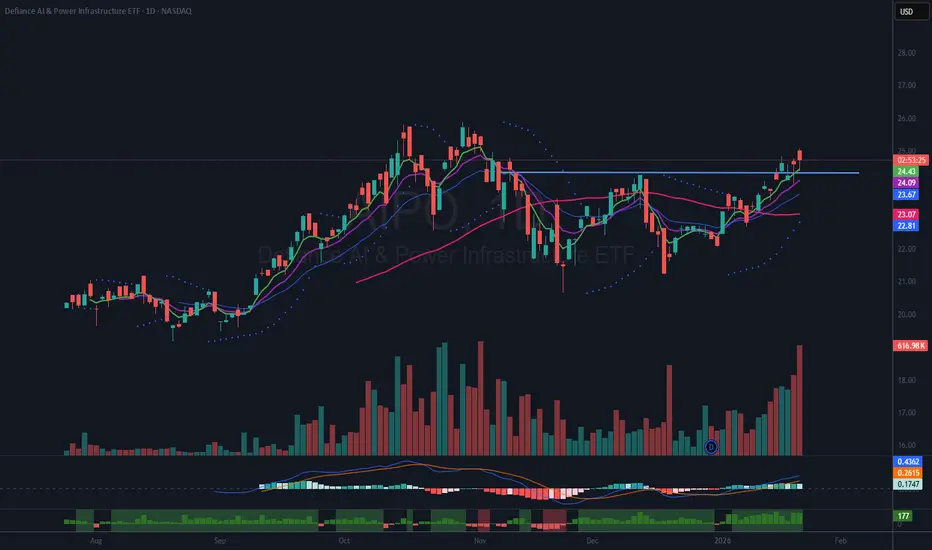
$AIQ ETF: Resuming the Uptrend?Recent Performance of AIQ ETF
The AIQ ETF, which focuses on Artificial Intelligence and Technology, recently experienced a 12% pullback from its all-time high reached on November 3rd. This downward movement culminated in a closing low on November 20th.
Institutional Activity and Volume
On November 21st, institutional traders intervened, rejecting a further decline. This action was accompanied by some of the highest buying volume ever recorded for the ETF, signaling renewed interest and potential strength in the market.
Technical Indicators
Today, the ETF has made a clear move above the short-term downtrend line. Alongside this, it has also reclaimed its 21-day Exponential Moving Average (EMA), which can be seen as a positive technical signal for potential upward momentum.
Trading Approach and Risk Management
Based on these signals, I have initiated a half-size position in the AIQ ETF. My stop-loss is set just below today's low, maintaining a tight risk profile. This cautious approach is because the uptrend has not yet been confirmed by the establishment of a higher low and a higher high.
Important Considerations for Readers
Readers are encouraged to perform their own analysis and follow their personal trading strategies. It is important to recognize that all investments carry inherent risks. Making informed decisions is essential when allocating capital in the financial markets.
$IWM-The lagger will be the leaderZoom out here and see this giant cup and handle.
OBV has broken out, preceding price.
Decreased rates influence small businesses the most. The impact has lagged, but it is now ready to run.
The breakout target is 330
Strong monthly candle. May see a slow start to the month after the run up we had over the last week, but by mid next month into Q2 2026 you will see this run 40%.
AMEX:SPY NASDAQ:QQQ AMEX:IWM
$UPST- A Black Friday SpecialUpstart chart is simple.
Channel held. Interest rates will continue to fall and will increase Upstart revenue. The effects of the interest rates will lag so it will take 3-6 months for the stock to reflect in price.
Targets:55,87, and 112
Time to final target: end of Q1 2026/ early Q2 2026
#SPY #QQQ #interestrates #financial
WARNING! 22 States Already In Recession.What the map is actually saying
This map claims that as of October 2025, 22 states are either:
Already in recession (red)
At high risk of recession (also red)
“Treading water” (yellow — basically flat growth)
Only the green states are shown as still expanding.
What this really means
This is a state-level business cycle indicator. States can slip into recession long before the national data officially confirms a U.S. recession.
Why? Because:
State economies depend heavily on specific industries (energy, tech, manufacturing, tourism).
Those sectors can crash regionally without the whole country being in recession—yet.
So a cluster of red states = early warning signal.
The big takeaway
When half or more of the states show contraction, historically, the national recession follows within months.
It means:
Job growth is stalling.
Local tax revenues are falling.
Credit conditions are tightening.
Businesses are cutting spending.
Consumers are slowing down.
In simple terms:
When enough states catch pneumonia, the U.S. national economy gets sick. You have been WARNED!
GTFO and STFO!
THANK YOU for getting me to 5,000 followers! 🙏🔥
Let’s keep climbing.
If you enjoy the work:
👉 Boost
👉 Follow
👉 Drop a solid comment
Let’s push it to 6,000 and keep building a community grounded in truth, not hype.
$INTC Classic 20% Pullback AnalysisOverview of Recent INTC Performance
Intel Corporation (INTC) experienced significant positive momentum following its gap-up breakout on September 18th. From the closing high on September 17th to the closing high on October 28th, the stock delivered an impressive gain of 67%.
Subsequent Pullback and Technical Retracement
After reaching its peak, INTC underwent a pullback of just over 19%. This decline represented a 50% retracement of the prior advance, a common technical milestone. During this period, the stock briefly dipped below its 50-day moving average (DMA), a level often regarded as a key support by technical analysts.
Recovery and Position Initiation
Today INTC reclaimed both the 50-day moving average and the 20-day exponential moving average (EMA). Additionally, the stock broke above its downtrend line, signaling renewed strength. In response to these technical developments, I initiated a half-size position in INTC, setting a stop-loss just below the day’s low to manage risk.
Risk Management and Investment Disclaimer
Readers need to conduct their own analysis and adhere to their personal trading strategies. Please remember that all investments involve inherent risks. Making informed decisions is crucial when allocating capital in the financial markets.
SPX Overbought In Real Terms WARNING!SPX Overbought In Real Terms (Inflation-adjusted) Stripping away inflation shows you the "real" value of SPX.
This is not something you will likely see again in your lifetime. We have only been this overbought twice before since 1947! Both times, what followed was a bear market. You are far more likely to see the price hit the bottom of the channel in your lifetime.
As is always the case, no one will want to touch stocks then. Rest assured, I, for one, will be buying up a storm then.
You have all been WARNED!
GTFO and STFO!
Risk Management is paramount!
THANK YOU for getting me to 5,000 followers! 🙏🔥
Let’s keep climbing.
If you enjoy the work:
👉 Boost
👉 Follow
👉 Drop a solid comment
Let’s push it to 6,000 and keep building a community grounded in truth, not hype.