Few lessons from losing positions.GBPUSD long: FOMO, Big Fib less than 50, middle 50, small - none - consolidation around 29.2, tight SL, low confidence, rejection from middle fib 50.
USDCAD short: Stop loss placement, tight SL,late second entry on the wrong side of pedulum.
GBPUSD short: wishful trading, calling the top, impatience, fail to read market structure,narrow focus.
USDJPY short: vibe trading, calling the top, tight stop loss, cutting the winner short.
GBPAUD long: counter trend, fib as a catch, fail to read market structure,
Trading-strategy
The Trade That Changed Me ForeverThere was a trade years ago that worked perfectly.
Not because it was lucky.
Not because the market was easy.
But because I didn’t think.
Everything was already decided.
Structure was clear. Risk was defined.
I just executed.
And that moment stayed with me.
Think about driving.
The road changes.
Traffic changes.
Conditions are never the same.
Yet you don’t overthink every move.
You don’t debate the steering or the brakes.
You just drive.
Because repetition turned chaos into instinct.
That’s exactly what happened with my trading.
Flawless Execution Is the Turning Point
That trade taught me something simple:
Trading becomes profitable when execution becomes automatic.
When price reaches your level, there’s no conversation.
No hesitation... No emotion... No noise...
YOU. JUST. ACT.
I didn’t feel excitement.
I didn’t feel fear.
I felt calm.
When execution becomes second nature, trading stops being heavy, and starts flowing... Just like driving.
Question for you:
When did trading start to feel natural for you? or are you still forcing every decision?
⚠️ Disclaimer: This is not financial advice. Always do your own research and manage risk properly.
📚 Stick to your trading plan regarding entries, risk, and management.
Good luck! 🍀
All Strategies Are Good; If Managed Properly!
~ Richard Nasr
Mastering MACDTurning a Popular Indicator Into a Structured Decision Tool
Many traders use MACD as a simple signal generator. They see a crossover, enter a trade, and later realise the result does not match the expectation. MACD becomes useful only when it is applied inside a clear framework built on trend, momentum, and timing. Its real value lies in reading shifts in participation rather than delivering standalone entry signals.
Understanding what the indicator represents is the first step. MACD measures the relationship between two moving averages and reveals how fast price is accelerating or slowing down. The histogram shows the rate of change. When used with intent, MACD helps you read the strength behind a move instead of trying to predict direction. Momentum confirms structure and brings clarity to the decision process.
Define the market environment before looking at MACD. Trending markets and ranging markets produce different behaviours. In a trend, a rising histogram often supports continuation and helps you judge whether a pullback is healthy or the start of a deeper rotation. In a range, the histogram moves around the zero line and highlights areas where momentum is fading. Without this context, MACD signals tend to mislead more than they help.
The next step is aligning MACD with the locations your system already relies on. Use it as part of the confluence, not as a trigger. When price reaches a higher-timeframe level, a liquidity area, or a clear structural pivot, the histogram can show whether momentum is shifting in your favour. You are not asking MACD to discover the trade. You are using it to confirm the logic you have prepared.
With structure and location in place, create specific decision rules for MACD behaviour. Examples include shrinking momentum when price approaches a level, expansion that supports a breakout, crossovers that match the higher-timeframe direction, or divergences that signal exhaustion at important zones. Every rule needs to serve a practical purpose. Reacting to every crossover removes discipline and weakens the system. Well-defined conditions make MACD a reliable filter.
Risk management remains outside the indicator. MACD does not define stops, invalidation, or how much to risk. Those rules come from structure. Stops should respect swing highs or lows, well-defined invalidation areas, or volatility-based distances. Combining this approach with MACD’s momentum read protects you from chasing trades that lack strength and reduces over-engagement during slow conditions.
Validation closes the loop. Backtest the exact behaviours you rely on, not the indicator as a whole. Study how histogram shifts behave at your chosen levels. Compare momentum against structure. Track how timing improves when MACD is used to refine execution instead of generate entries. When the data confirms the rules across different market conditions, the system gains stability.
MACD becomes a valuable asset when integrated into a disciplined process. On its own, it produces too much noise. Inside a structured system, it sharpens momentum reading, filters out weak trades, and builds cleaner execution. Traders who use MACD to support their framework instead of driving it achieve far greater consistency over time.
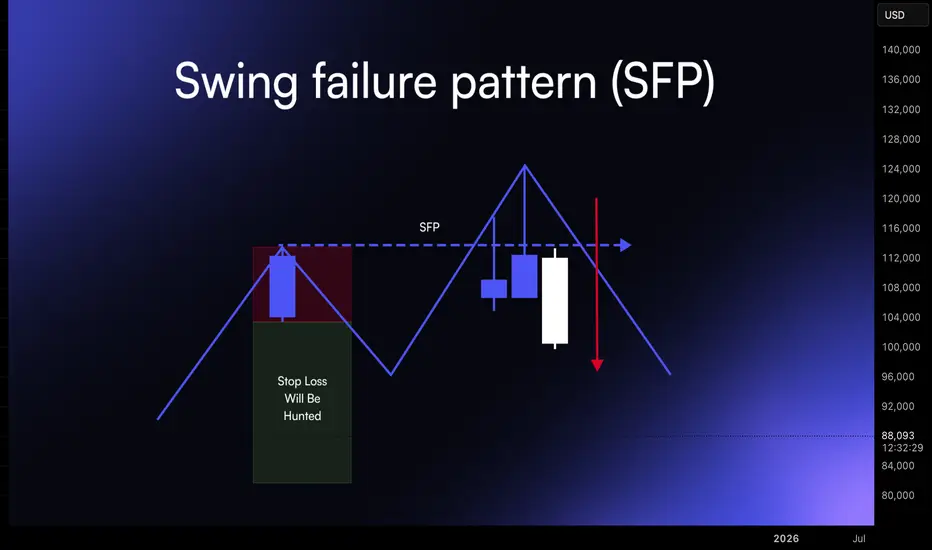
Swing Failure Pattern (SFP): When Price ReversesThe swing failure pattern is a liquidity event, not a candle pattern. It marks the moment when the market reaches for obvious stops, absorbs them, and reveals true intent.
An SFP forms when price trades beyond a well-defined swing high or low and then fails to hold acceptance outside that level. The extension triggers breakout entries and stop losses. The immediate rejection back inside the range confirms that the move was used to collect liquidity rather than to continue.
What the structure tells you
The key information is not the wick itself, but the context around it. The prior high or low must be obvious and widely watched. Equal highs, range extremes, or clean swing points carry the most liquidity. When price briefly breaks that level and closes back inside, the market signals that opposing orders have been filled.
This failure traps late participants. Breakout traders are positioned in the wrong direction, while stop losses from earlier positions have already been taken. That imbalance becomes fuel for the next move.
Why SFPs matter
SFPs often appear at major range boundaries or after extended directional moves. In ranges, they define the edges where reversals are most likely. In trends, they frequently mark local distribution or accumulation before a deeper retracement or full reversal.
The move after the SFP is usually cleaner than the move into it. Once liquidity is taken, price no longer needs to revisit the level. Structure shifts, momentum changes, and expansion follows away from the failed breakout.
How to use SFPs correctly
An SFP is not a signal by itself. It requires confirmation through acceptance back inside the range and alignment with higher-timeframe context. When combined with structure, it provides precise locations where risk can be defined tightly and intent is clear.
The market does not reverse because price touched a level. It reverses because liquidity was collected and the objective at that level was completed. The swing failure pattern is the footprint of that process.
Mastering the Morning Breakout: The New York 15m/30m ORB SetupThe first 15-30 minutes of the market are often pure chaos for novices, but for professionals, it is where the day's structure is built.
The **Opening Range Breakout (ORB)** works because it defines the "Initial Balance"—the battleground where buyers and sellers fight for control. Once price breaks this zone with conviction, it often signals the true trend for the rest of the session.
**The Problem:**
Most traders fail at the open because they chase volatility. They enter on wicks, get trapped by fake-outs, or miscalculate their levels manually.
**The Solution (Chart Breakdown):**
In this NQ example, we strip away the noise and focus on pure structure:
1. **Define the Battlefield:** We let the first 15 minutes pass, or 30 minutes if you wish to wait for more confirmation.
2. **Wait for range to form** Notice the breakout. We don't guess. We wait for a **Candle CLOSE** outside the box.
3. **The Trigger:** The "BULL/BEAR" label only appears when buyers have proven they can hold price above or below the range. This filters out the "wicks" that stop out early shorts.
4. **Precision Targets:** Instead of guessing where to take profit, we use the 1x and 2x measured moves based on the range's own volatility.
**Why this approach saves accounts:**
It forces objectivity. By automating the levels and waiting for the confirmed break, you remove the emotional "FOMO" that ruins morning sessions. You aren't predicting the move; you are executing on confirmed momentum.
*This setup is running on a free community tool. You can add it to your chart using the link below to automate your own morning levels.*
The One Pattern Every Trader Misses!Most traders focus on flags, wedges, double tops, fibs…
But there’s a pattern far more powerful, and almost no one talks about it:
-- The Behavior Pattern. --
📈It’s not drawn on your chart. You can’t code it into an indicator.
But it determines your success more than any formation.
Here’s the pattern professionals watch, and beginners ignore:
1️⃣ Impulsive Behavior
When price moves fast, traders move even faster.
FOMO kicks in. Chasing begins. Risk is forgotten.
Professional interpretation:
➡️ If emotions are impulsive, structure won’t be respected.
Avoid trading in emotional markets unless you already have a plan.
2️⃣ Hesitation Behavior
Price reaches your level. Your alert triggers.
Everything lines up… and you still don’t enter.
Why?
Because hesitation is a sign your risk is unclear.
Professional interpretation:
➡️ If hesitation appears, your plan isn’t ready.
The chart is never the problem, the plan is.
3️⃣ Revenge Behavior
One loss turns into five.
You stop trading the chart and start trading your frustration.
Professional interpretation:
➡️ If frustration is present, you’re trading without structure.
Step away. Market will be here tomorrow.
Why This Matters ⁉️
The market doesn’t punish bad trades. It punishes bad behavior.
Your biggest losing streaks didn’t come from your strategy.
They came from emotional patterns you didn’t recognize in real time.
Once you learn to see these behavior patterns, your charts become clearer, your decisions simpler, and your risk finally makes sense.
🧠Final Thought
Chart patterns tell you where the market might go.
Behavior patterns tell you whether you’ll survive long enough to get there.
Master both; and you’ll trade with the clarity most people never reach.
⚠️ Disclaimer: This is not financial advice. Always do your own research and manage risk properly.
📚 Stick to your trading plan regarding entries, risk, and management.
Good luck! 🍀
All Strategies Are Good; If Managed Properly!
~Richard Nasr
BTC 1H: Selling pressure remains dominant.1. Trend Context
The short-term structure remains bearish, with the price trading below the EMA.
After breaking through the 111,200 – 112,000 zone, the market is forming a small correction.
2. Key Levels
Nearest Resistance: 110,700 – 111,800. Important zone to watch during this correction.
Main Support (Demand Zone): 108,000 – 108,500. Next target if the downtrend continues.
3. Scenario
Key Scenario : Currently, an uptrend line has been formed, indicating a slight recovery after the previous sharp decline. Wait for the EMA to move closer to the price and form a momentum accumulation zone, after which a first breakout through the uptrend line will appear.
Alternative scenario : If BTC sustains recovery to 110,700, sell-off at this level could be considered.
Please like and comment to support our traders. Your feedback motivates us to produce more analysis in the future 🙏✨
BTCUSD on the 30m timeframe1. Trend Context
BTCUSD on the 30m timeframe remains in a clear downtrend, forming consistent Lower Highs and Lower Lows.
2. Key Zones
SZ (Supply Zone): 114,250 – 114,750. Origin of the strong selloff, major resistance if price retraces upward.
SR (Structure Reversal): 113,000 – 113,250. Previously marked a short-term structural shift, now likely to act as dynamic resistance.
DZ (Demand Zone): 111,200 – 111,750. Price is currently testing this zone, which serves as short-term support.
3. Trading Scenarios
If DZ holds, a short-term bounce toward SR is possible.
If price rejects at SR, it offers a favorable short setup in line with the prevailing downtrend.
If DZ breaks, the downtrend may extend with a target around 110,000 or lower.
Please like and comment below to support our traders. Your reactions will motivate us to do more analysis in the future 🙏✨
Emotional Reactivity: The Silent Killer of Trading PerformanceEven with the best strategy, traders often fall short — not because the system fails, but because they do. One of the most common culprits? Emotional reactivity.
Fear and greed are the twin saboteurs.
Fear leads to hesitation, premature exits, or failure to take action.
Greed tempts us to oversize, chase trades, or hold too long.
These emotional spikes don’t just “feel bad” — they disrupt the brain’s decision-making systems. Under pressure, the amygdala takes over, bypassing the prefrontal cortex (where rational thinking happens)—this results in reactive behaviour: impulse entries, revenge trades, panic exits.
🔧 How to Defeat Emotional Reactivity
Here are proven strategies that work — not just in theory, but in the trenches of real-world trading.
✅ 1. Use Pre-Defined Rules & Checklists
The more rules you build into your system, the less room there is for emotion to interfere.
Think: “If X and Y are true, then I enter — no debate.”
🎯 2. Risk in Terms of ‘R’
Instead of thinking “I’m risking $5,000,” say “I’m risking 1R.”
This reframing normalises risk, reduces attachment, and keeps you focused on process over outcome.
📓 3. Track Emotional States in Your Journal
Don’t just log trades. Record your mental state before and after.
Over time, patterns emerge: when you’re most reactive, most hesitant, most aggressive.
🧘 4. Control Your Environment & Physiology
Fatigue, caffeine overload, or noise can heighten emotional spikes.
A calm workspace and healthy habits reduce the likelihood of hijacked decision-making.
🌬️ 5. Use Breathing to Regulate State
Even 60 seconds of box breathing can short-circuit fear.
Try this: inhale 4 sec → hold 4 sec → exhale 4 sec → hold 4 sec.
🕵️♂️ 6. Trade Fewer, Higher-Conviction Setups
Most overtrading is emotional.
By filtering out B-grade trades, you reduce stress and decision fatigue.
Final Word
You can’t eliminate emotion — but you can contain it.
The goal is to become emotionally aware and systematically anchored.
Master this, and you stop trading your feelings — and start trading your edge.
👍 If this resonated, drop a like or comment below.
🔁 Repost to help other traders cut through the noise.
📌 Follow for more mindset and execution tips grounded in real-world trading.
What Happens If I Am Late? (Trading Strategy For Beginners)It can happen that for whatever reason you couldn't buy when the market was trading at bottom prices. What then? Am I too late?
It is unwise to buy at any random price and even less with 10X cross leverage. I've seen people doing just that and buying at the top of the range. While it is never too late in relation to the overall market cycle, it can be late for a certain pair.
The time to buy is near support. If bottom prices are not possible, the best option is to wait. Say you miss Bitcoin at $78,800 and prices start to advance. When prices are moving up at $84,000 and rising you can just wait. But if prices peak at $88,000 and then retrace to $84,000, consolidate as a higher low this becomes a second entry. The same when Bitcoin retraced from $95,000 and moved to the $91,000 - $93,000 range. This range becomes a second entry.
Rather than rushing and buying when prices trade, say at $106,000, at the top of the move, we wait for a retrace. If this isn't possible we simply look for another pair.
It is never too late because it depends on what strategy we are using, our Cryptocurrency Trading Plan, and trading style. If you are doing leverage it will depend on the chart setup and the amount of leverage you are using. If you are doing spot, it depends on your goals more than anything because buying can be done at any given time based on the long-term.
It is unwise to rush into Ethereum at $2,500 because you missed $1,600. And you say, "I didn't have any money and I didn't want to miss out." With 10X? What if you lose everything on a flash crash, are you missing out now?
The thing is, that all the pairs are the same when it comes to profits potential. We are looking for a win. So if a pair has a low probability of producing a successful trade, it is no good regardless of the name.
Patience is key.
You can use the comments section to ask questions.
It is not about "breaking the trading rules," it is about your money.
Have you considered what would happen if the market flash crashes just to liquidate you and those in a similar position to yours and then moves up?
You didn't want to miss out, but this not missing out can result in a major loss. It is better to plan and take action based on a strategy rather than rushing, the market is not going away.
Opportunities are endless, and every single day I will be sharing new charts. Some pairs are trading near support and at bottom prices, those are always the best because of the lower risk.
Low risk vs a high potential for reward.
Plan ahead.
Namaste.
Altcoins Trading Strategy (Tips)There are many ways to approach the market, many ways to approach Crypto. There are strategies focused on the long-term while others will focus on the short-term. Know this, the market is set to grow very strongly.
Now, you might be conditioned to take certain actions or have a reaction when something happens due to past history. Say you went through the strong 2022 bear market and then within the transition years, 2023 and 2024 and all the way through mid-2025, each time there was some bullish action it invariably ended in a strong correction. So you might be thinking, "Hey, after some growth it is all going to crash!" But no, that is not what is going to happen.
You see, the market moves in cycles and these cycles are four years long. Regardless of the transition period, now is not the time to be taking profits after a 20%-30% bullish jump, which is minimum for Crypto.
Yes, you can approach the market short-term but short-term with the conditions we have present now means 200-300%. That would be short-term. After this much growth, close a trade and move to the next pair.
If you are thinking long-term; less dealing, less clicking, easy profits no stress, then buy and hold. The top will be very clear once it comes. If not clear, you will see your profits grow some 500% to 800% and in some cases even more. When your capital is up by that much, you can consider taking some profits.
Remember another one, keep this one in mind. You don't have to be 100% right.
If you are uncertain if you should secure profits in the coming months, you can always sell just a portion, can be 10% or 20% and wait to see what the market does next. It is not necessary to close a position by 100% thinking "I got the top."
Another one, "near the top," is something to keep in mind. Not the exact top just as we don't need to catch the exact bottom. This can result in stress, anxiety and losses. Just be happy and grateful with whatever you receive.
To close this one, never use a stop-loss when trading spot, never. It is a recipe for disaster, just buy and hold and the market will bless you with money, peace of mind, financial success and love.
If you set a stop-loss order, the whales and trading bots will fill your order and you will secure a losing trade. Rather than putting a sell order below your entry price, put it above, always high up, the higher the better, because the exchanges bots are programmed based on the sell orders that people place. If everybody places their orders really high up, this creates pressure on the programs to buy more and more and more. The higher the resistance zone (your sell orders), the more the market will grow.
When the time for shakeouts and corrections comes, do nothing. Either sell BEFORE the correction happens or be prepared to wait long-term. You have to plan BEFORE, not out of an impulse, because the impulse will push you to make mistakes.
I am wishing you success and profits.
If you enjoy the content, consider giving a follow and leaving a comment.
Namaste.
Potential Bullish Cypher on GBPUSD Daily Chart
Hello guys, hope you guys are doing great.
I see a potential bullish cypher on GBPUSD daily chart. All the measurements are checked.
Price is reacting from a Weekly and Daily Key Level with multiple touches and Rejection showing bullish momentum.
Considering the date and period price is reacting from this Key level is very important to me based on my strategy and how I swing trade.
The potential downside to this setup is that, we might continue to see the pound going lower and testing key levels below. then we review and look out for another trading opportunity.
Till that happens. the above setup still holds to at atleast 0.382 TP1 (___ Price Level).
I will keep you guys updated going forward on this pair into the month of January 2025.
All the best guys
NSTR - Technical Analysis of Key Bullish and Bearish LevelsKey Observations:
Expanded Volume Profile:
The volume profile on the left indicates significant trading activity (support/resistance zones).
The high-volume node around 360–380 suggests a key area of interest where the price might consolidate or face resistance/support.
Bullish Levels:
Bullish Week (376): A breakout above this level could trigger upward momentum toward 400 and potentially higher.
Close Week Swing (363): Currently being tested. Sustained strength above this level would be a sign of bullish continuation.
Key Target at 400: Bullish swing level acting as a psychological and technical resistance point.
Bearish Levels:
Bear Swing (348): A breakdown below this level could lead to further downside, with the next support at Bear Week (325).
Week ATR (328): If the price approaches this level, it signals a deeper bearish sentiment.
Price Action:
The yellow line shows a recovery attempt after a sharp drop. The price appears to be testing resistance at Close Week Swing (363).
The upward trend from lower levels near 325 suggests some buying interest at lower prices.
Annotations and Targets:
Close Week Swing (363) is pivotal; crossing this level with volume might lead to a test of higher resistance levels.
The area around 325–328 has shown strong support previously, and a retest might attract buyers.
Analysis:
Bullish Scenario:
The price needs to decisively close above 363 to gain bullish momentum. If this happens, look for targets at 376 and then 400.
Volume supporting an upward move would confirm bullish sentiment.
The Bullish Week (376) level is critical for mid-term trend confirmation.
Bearish Scenario:
Failure to hold above 363 could lead to a retest of 348 (Bear Swing) and possibly further downward moves toward 325–328.
Increased volume at lower levels might indicate bearish control.
Neutral Scenario:
Consolidation between 348 and 363 could signal indecision, with a breakout or breakdown likely depending on market sentiment.
Recommendations:
For Bullish Traders:
Look for strong volume above 363 and consider targets at 376 and 400.
Watch for consolidation near 360–363 as a possible entry point.
For Bearish Traders:
A rejection at 363 or a breakdown below 348 would signal opportunities to target 325–328.
Use volume and candlestick patterns to confirm breakdowns.
Risk Management:
Stops should be placed slightly beyond key levels (e.g., above 376 for shorts or below 348 for longs).
This setup emphasizes the importance of the 363 level as a tipping point for direction. Let me know if you'd like further insights!
Kava Heavy Bearmarket- This analysis is presented as a tutorial. Some of you may already be familiar with MACD, but for those who aren’t, I’m happy to guide you through it.
- Today, I’d like to share some insights on how to determine whether a token is still in a bear market or if it's on the verge of changing direction.
- As always everything is noted in the graphic, so lets go :
1 . First, focus on the orange line, which is the most crucial one, sitting around $1.20. Did you notice that in 2020, Kava bounced off this line? Back then, it served as strong support. Now, take note that Kava was rejected twice in 2023 and 2024 at this exact same price level, this support just turned as a strong resistance.
2. Take a look at the MACD indicator Lines. During Kava's bull market in 2020, the MACD was consistently moving in the positive zone (bullmarket green area). After Kava's crash, observe how Kava have been repeatedly rejected at this exact middle line and continued to evolve in a negative zone (bearmarket red area).
3. Finally, take a closer look at the "hammer Emoji" and the bearish trendline. You will observe that everything is interconnected. At times, Kava gets "hammered" at the $1.20 level along the middle line, while at other times, it encounters resistance on its bearish trendline. None of this is coincidental.
Conclusion :
- Kava remains is still in a heavy bear market. As a relatively young token, it's difficult to analyze long-term historical data. However, with time, extending the timeframe to 1 or 3 months can help reduce noise and potentially detect a bullish reversal.
- Kava's key level is $1.20. When it stays below this, it's better to step back, touch some grass, and wait for a breakout before considering any long positions.
- If you’re looking to trade profitably, always go with the flow. Don’t try to long something that’s trending downward or short something that's rising. It’s simply a matter of logic.
Happy Tr4Ding !
EURUSD Daily Analysis - A downward movement is expected towards Throughout the first day of the new week EURUSD remained consolidated at the levels of 1.0960/85.
Today at 6 o'clock GMT we expect data on Industrial Production for the month of August in Germany, with expectations for a growth of 0.8% compared to the previous month, where we had a drop of -2.4%.
The Eurogroup Meeting is another key event of the day that is likely to have an impact on currency markets.
A little later in the day, however, the Bank of New Zealand is expected to cut interest rates more aggressively by 0.5% following the new trend of interest rate cuts around the world.
From World-Signals.com, we expect a slight strengthening of the Euro, but it is very likely that the downward trend will continue towards the end of the week. Bet on a strategy to sell on slight bounces up to 1.1010+ with daily gains of 20-35 pips or short positions with bigger gains towards the end of the week.
Daily analyzes of EURUSD - Dollar regains lost positionsAmong the important fundamentals from Monday is Factory Orders for the month of August in Germany from 8am GMT. It is very likely that we will see another contraction that will negatively affect the Euro. In general, the industry in Germany has started to shrink and there are no chances for growth.
The other important news is related to retail sales in the Eurozone at 11am GMT. Although we expect levels around zero or very little growth in retail sales.
Among the world events that affect the currency markets are the escalation of the conflict in the Middle East, where mainly the Euro may suffer due to disrupted supplies of both goods and fuels.
Overall, the Dollar will be in a stronger position this week and we at World-Signals.com expect the Dollar to strengthen against the Euro.
In the last week, the Dollar has taken about 200 pips on the Euro. In retrospect, the Dollar had 3 losing weeks, and only in the last one did it regain some of the lost positions.
Use the 1.1010 levels to open short positions with a 6-8 business day closing target.
UBISOFT REKT- What happens when you're one of the biggest video game companies in the world and you rest on your laurels? You sink.
- That said, as traders, we can always attempt to capitalize on a dead cat bounce.
- Right now, nothing to buy, if Ubisoft not down more and bounce before, just forget it.
------------------------------------------------------------------------------------------
Trading Parts :
------------------------------------------------------------------------------------------
- Buy around 10€ ( 30% invest )
- DCA Rebuy to 8.5€ ( 70% invest )
------------------------------------------------------------------------------------------
- TP1 : 17.9€
- TP2 : 29.9€
------------------------------------------------------------------------------------------
SL : 5.9€
------------------------------------------------------------------------------------------
Stay S4fe
Happy Tr4Ding !
Exxon Mobile (XOM): Awaiting Long Term Entry at $65Our group has recently revisited Exxon Mobil Corporation (XOM), and while there hasn't been much change, it's worth reassessing. The stock has entered the zone between 100% and 138%, which we identify as the level for Wave A and has respected this level.
Long-Term Outlook:
We anticipate a significant downward movement over the long term, potentially reaching the $65 level. This is where we plan to make substantial long-term purchases. The range between $65.50 and $64.40 has been consistently respected, reinforcing our strategy to wait for these levels before entering the market heavily.
Short-Term Outlook:
In the short term, Exxon has been trading within a range for nearly a year and a half. It briefly broke below this range to complete the larger Wave (A)and then broke above it to finish the sub-wave A. We are now entering a potential Wave B zone.
Current Strategy:
- Long-Term: We are waiting for the price to drop to the $65 range before making significant purchases.
- Short-Term: We are monitoring the $104 to $100 zone, which looks attractive for a potential reversal. However, given the risk, we are not placing any entries yet and will wait to observe the market's reaction.
JD.com (JD): Key Levels to Watch Amid Potential BreakoutFor the Chinese stock JD.com listed on the Nasdaq, we observe a significant pattern. Initially, we had a prolonged sideways movement that concluded with an initial surge, establishing the current resistance zone. This zone held twice before the price fell through.
Starting from point X in our Elliott Wave count in November 2018, we saw a rapid increase of approximately 470% in a short period. However, this was followed by a steep sell-off, leading to the formation of Wave (2) within a trend channel.
The correction's time horizon places it in the perfect zone, typically between 2 and 2.618 on the higher time frame, which is a good indicator that this could indeed be Wave (2). To continue the upward movement, it is crucial for JD.com to flip this resistance zone.
The current question is whether the price will first return to the High-Volume Node Point of Control (POC) or break out upwards directly. Flipping the support-resistance zone will be key for any significant upward momentum.
We'll be closely monitoring these levels to determine the next move.
Zooming in on the 12-hour timeframe, we can observe the scenario at the end of the assumed Wave (2). This pattern is characteristic of what we like to see at the conclusion of Wave 2. Initially, we experienced an accumulation phase, which transitioned into a manipulation phase, followed by an expansion phase. This sequence is generally a positive sign.
Currently, we are witnessing a pullback after touching the resistance level. Despite this, we maintain our outlook that the price should continue to rise and not retest the $20 mark.
There's a breakout gap that partially filled but remains open near the bottom. This gap formed just before we entered the expansion phase, and it's a critical point to consider.
Given the ongoing volatility in the Chinese market and the uncertainty among investors, we remain cautious. We are closely watching how JD.com behaves within the $24.50 to $26.80 range. With a drop towards the gap close near $21, we will consider making significant buys.
If the price breaks out upwards, we will look for opportunities to enter positions.
GOLD Bulls targetPrice has bounced off the 50% fib level on the daily chart and has also broken out of the triangle pattern previously created.
Price currently sits at resistance so there are no clear long entries to play here that would be safe to take, but if price drops to previously lows, or creates a new higher high, then we can be waiting for the next leg towards the highs.
Looking to short under zoneLooking to short price for 120 pts if candle closes ONLY below my zone under 2040.43. The candle has to close before i consider it as my first confirmation. My second sell Limit or executed market price trade will be at the upper end of my zone at 2043.62.
I will only execute my second trade once price reverses before hitting my target area for 120 pts after new candle closes below the zone