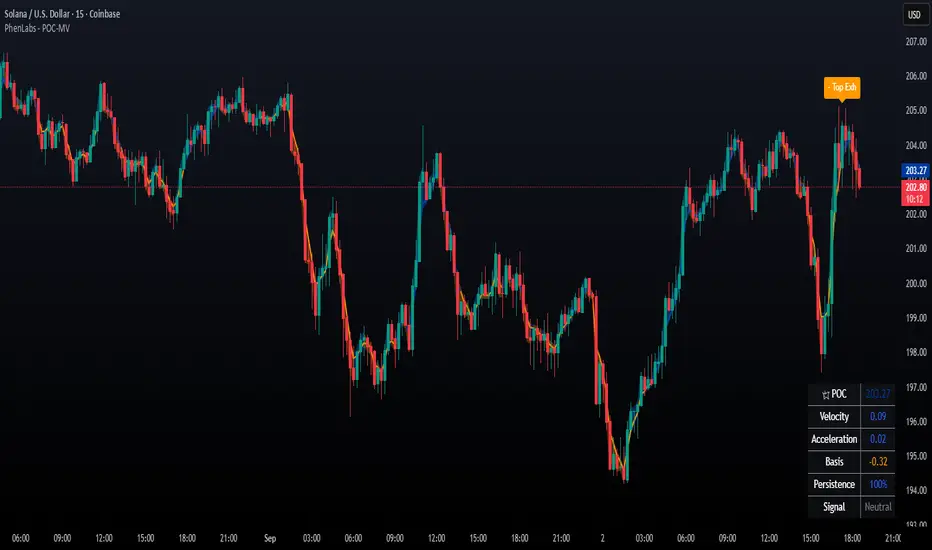
Volume Footprint Anomaly Scanner [PhenLabs]๐ PhenLabs - Volume Footprint Anomaly Scanner (VFAS)
Version: PineScriptโข v6
๐ Description
The PhenLabs Volume Footprint Anomaly Scanner (VFAS) is an advanced Pine Script indicator designed to detect and highlight significant imbalances in buying and selling pressure within individual price bars. By analyzing a calculated "Delta" โ the net difference between estimated buy and sell volume โ and employing statistical Z-score analysis, VFAS pinpoints moments when buying or selling activity becomes unusually dominant. This script was created not in hopes of creating a "Buy and Sell" indicator but rather providing the user with a more in-depth insight into the intrabar volume delta and how it can fluctuate in unusual ways, leading to anomalies that can be capitalized on.
This indicator helps traders identify high-conviction points where strong market participants are active, signaling potential shifts in momentum or continuation of a trend. It aims to provide a clearer understanding of underlying market dynamics, allowing for more informed decision-making in various trading strategies, from identifying entry points to confirming trend strength.
๐ Points of Innovation
โโ Z-Score for Delta Analysis : Utilizes statistical Z-scores to objectively identify statistically significant anomalies in buying/selling pressure, moving beyond simple, arbitrary thresholds.
โโ Dynamic Confidence Scoring : Assigns a multi-star confidence rating (1-4 stars) to each signal, factoring in high volume, trend alignment, and specific confirmation criteria, providing a nuanced view of signal strength.
โโ Integrated Trend Filtering : Offers an optional Exponential Moving Average (EMA)-based trend filter to ensure signals align with the broader market direction, reducing false positives in ranging markets.
โโ Strict Confirmation Logic : Implements specific confirmation criteria for higher-confidence signals, including price action and a time-based gap from previous signals, enhancing reliability.
โโ Intuitive Info Dashboard : Provides a real-time summary of market trend and the latest signal's direction and confidence directly on the chart, streamlining information access.
๐ง Core Components
โโ Core Delta Engine : Estimates the net buying/selling pressure (bar Delta) by analyzing price movement within each bar relative to volume. It also calculates average volume to identify bars with unusually high activity.
โโ Anomaly Detection (Z-Score) : Computes the Z-score for the current bar's Delta, indicating how many standard deviations it is from its recent average. This statistical measure is central to identifying significant anomalies.
โโ Trend Filter : Utilizes a dual Exponential Moving Average (EMA) cross-over system to define the prevailing market trend (uptrend, downtrend, or range), providing contextual awareness.
โโ Signal Processing & Confidence Algorithm : Evaluates anomaly conditions against trend filters and confirmation rules, then calculates a dynamic confidence score to produce actionable, contextualized signal information.
๐ฅ Key Features
โโ Advanced Delta Anomaly Detection : Pinpoints bars with exceptionally high buying or selling pressure, indicating potential institutional activity or strong market conviction.
โโ Multi-Factor Confidence Scoring : Each signal comes with a 1-4 star rating, clearly communicating its reliability based on high volume, trend alignment, and specific confirmation criteria.
โโ Optional Trend Alignment : Users can choose to filter signals, so only those aligned with the prevailing EMA-defined trend are displayed, enhancing signal quality.
โโ Interactive Signal Labels : Displays compact labels on the chart at anomaly points, offering detailed tooltips upon hover, including signal type, direction, confidence, and contextual information.
โโ Customizable Bar Colors : Visually highlights bars with Delta anomalies, providing an immediate visual cue for strong buying or selling activity.
โโ Real-time Info Dashboard : A clean, customizable dashboard shows the current market trend and details of the latest detected signal, keeping key information accessible at a glance.
โโ Configurable Alerts : Set up alerts for bullish or bearish Delta anomalies to receive real-time notifications when significant market pressure shifts occur.
๐จ Visualization
Signal Labels :
* Placed at the top/bottom of anomaly bars, showing a "๐" (bullish) or "๐" (bearish) icon.
* Tooltip: Hovering over a label reveals detailed information: Signal Type (e.g., "Delta Anomaly"), Direction, Confidence (e.g., "โ
โ
โ
โ"), and a descriptive explanation of the anomaly.
* Interpretation: Clearly marks actionable signals and provides deep insights without cluttering the chart, enabling quick assessment of signal strength and context.
โโ Info Dashboard :
* Located at the top-right of the chart, providing a clean summary.
* Displays: "PhenLabs - VFAS" header, "Market Trend" (Uptrend/Downtrend/Range with color-coded status), and "Direction | Conf." (showing the last signal's direction and star confidence).
* Optional "๐ก Hover over signals for details" reminder.
* Interpretation: A concise, real-time summary of the market's pulse and the most recent high-conviction event, helping traders stay informed at a glance.
๐ Usage Guidelines
Setting Categories
โ๏ธ Core Delta & Volume Engine
โโ Minimum Volume Lookback (Bars)
โโ Default: 9
โโ Range: Integer (e.g., 5-50)
โโ Description: Defines the number of preceding bars used to calculate the average volume and delta. Bars with volume below this average won't be considered for high-volume signals. A shorter lookback is more reactive to recent changes, while a longer one provides a smoother average.
๐ Anomaly Detection Settings
Delta Z-Score Anomaly Threshold
โโ Default: 2.5
โโ Range: Float (e.g., 1.0-5.0+)
โโ Description: The number of standard deviations from the mean that a bar's delta must exceed to be considered a significant anomaly. A higher threshold means fewer, but potentially stronger, signals. A lower threshold will generate more signals, which might include less significant events. Experiment to find the optimal balance for your trading style.
๐ฌ Context Filters
Enable Trend Filter
โโ Default: False
โโ Range: Boolean (True/False)
โโ Description: When enabled, signals will only be generated if they align with the current market trend as determined by the EMAs (e.g., only bullish signals in an uptrend, bearish in a downtrend). This helps to filter out counter-trend noise.
โโ Trend EMA Fast
โโ Default: 50
โโ Range: Integer (e.g., 10-100)
โโ Description: The period for the faster Exponential Moving Average used in the trend filter. In combination with the slow EMA, it defines the trend direction.
โโ Trend EMA Slow
โโ Default: 200
โโ Range: Integer (e.g., 100-400)
โโ Description: The period for the slower Exponential Moving Average used in the trend filter. The relationship between the fast and slow EMA determines if the market is in an uptrend (fast > slow) or downtrend (fast < slow).
๐จ Visual & UI Settings
โโ Show Info Dashboard
โโ Default: True
โโ Range: Boolean (True/False)
โโ Description: Toggles the visibility of the dashboard on the chart, which provides a summary of market trend and the last detected signal.
โโ Show Dashboard Tooltip
โโ Default: True
โโ Range: Boolean (True/False)
โโ Description: Toggles a reminder message in the dashboard to hover over signal labels for more detailed information.
โโ Show Delta Anomaly Bar Colors
โโ Default: True
โโ Range: Boolean (True/False)
โโ Description: Enables or disables the coloring of bars based on their delta direction and whether they represent a significant anomaly.
โโ Show Signal Labels
โโ Default: True
โโ Range: Boolean (True/False)
โโ Description: Controls the visibility of the โ๐โ or โ๐โ labels that appear on the chart when a delta anomaly signal is generated.
๐ Alert Settings
โ Alert on Delta Anomaly
โโ Default: True
โโ Range: Boolean (True/False)
โโ Description: When enabled, this setting allows you to set up alerts in TradingView that will trigger whenever a new bullish or bearish delta anomaly is detected.
โ
Best Use Cases
โ Early Trend Reversal / Continuation Detection: Identify strong surges of buying/selling pressure at key support/resistance levels that could indicate a reversal or the continuation of a strong move.
โโ Confirmation of Breakouts: Use high-confidence delta anomalies to confirm the validity of price breakouts, indicating strong conviction behind the move.
โโ Entry and Exit Points: Pinpoint precise entry opportunities when anomalies align with your trading strategy, or identify potential exhaustion signals for exiting trades.
โโ Scalping and Day Trading: The indicatorโs sensitivity to intraday buying/selling imbalances makes it highly effective for short-term trading strategies.
โโ Market Sentiment Analysis: Gain a real-time understanding of underlying market sentiment by observing the prevalence and strength of bullish vs. bearish anomalies.
โ ๏ธ Limitations
Estimated Delta: The script uses a simplified method to estimate delta based on bar close relative to its range, not actual order book or footprint data. While effective, itโs an approximation.
โโ Sensitivity to Z-Score Threshold: The effectiveness heavily relies on the `Delta Z-Score Anomaly Threshold`. Too low, and youโll get many false positives; too high, and you might miss valid signals.
โโ Confirmation Criteria: The 4-star confidence levelโs โconfirmationโ relies on specific subsequent bar conditions and previous confirmed signals, which might be too strict or specific for all contexts.
โโ Requires Context: While powerful, VFAS is best used in conjunction with other technical analysis tools and price action to form a comprehensive trading strategy. It is not a standalone โbuy/sellโ signal.
๐ก What Makes This Unique
Statistical Rigor: The application of Z-score analysis to bar delta provides an objective, statistically-driven way to identify true anomalies, moving beyond arbitrary thresholds.
โโ Multi-Factor Confidence Scoring: The unique 1-4 star confidence system integrates multiple market dynamics (volume, trend alignment, specific follow-through) into a single, easy-to-interpret rating.
โโ User-Friendly Design: From the intuitive dashboard to the detailed signal tooltips, the indicator prioritizes clear and accessible information for traders of all experience levels.
๐ฌ How It Works
1. Bar Delta Calculation:
โโ The script first estimates the โbuy volumeโ and โsell volumeโ for each bar. This is done by assuming that volume proportional to the distance from the low to the close represents buying, and volume proportional to the distance from the high to the close represents selling.
โโ How this contributes: This provides a proxy for the net buying or selling pressure (delta) within that specific price bar, even without access to actual footprint data.
2. Volume & Delta Z-Score Analysis:
โโ The average volume over a user-defined lookback period is calculated. Bars with volume less than twice this average are generally considered of lower interest.
โโ The Z-score for the calculated bar delta is computed. The Z-score measures how many standard deviations the current barโs delta is from its average delta over the `Minimum Volume Lookback` period.
โโ How this contributes: A high positive Z-score indicates a bullish delta anomaly (significantly more buying than usual), while a high negative Z-score indicates a bearish delta anomaly (significantly more selling than usual). This identifies statistically unusual levels of pressure.
3. Trend Filtering (Optional):
โโ Two Exponential Moving Averages (Fast and Slow EMA) are used to determine the prevailing market trend. An uptrend is identified when the Fast EMA is above the Slow EMA, and a downtrend when the Fast EMA is below the Slow EMA.
โโ How this contributes: If enabled, the indicator will only display bullish delta anomalies during an uptrend and bearish delta anomalies during a downtrend, helping to confirm signals within the broader market context and avoid counter-trend signals.
4. Signal Generation & Confidence Scoring:
โโ When a delta Z-score exceeds the user-defined anomaly threshold, a signal is generated.
โโ This signal is then passed through a multi-factor confidence algorithm (`f_calculateConfidence`). It awards stars based on: high volume presence, alignment with the overall trend (if enabled), and a fourth star for very strong Z-scores (above 3.0) combined with specific follow-through candle patterns after a cooling-off period from a previous confirmed signal.
โโ How this contributes: Provides a qualitative rating (1-4 stars) for each anomaly, allowing traders to quickly assess the potential significance and reliability of the signal.
๐ก Note:
The PhenLabs Volume Footprint Anomaly Scanner is a powerful analytical tool, but itโs crucial to understand that no indicator guarantees profit. Always backtest and forward-test the indicator settings on your chosen assets and timeframes. Consider integrating VFAS with your existing trading strategy, using its signals as confirmation for entries, exits, or trend bias. The Z-score threshold is highly customizable; lower values will yield more signals (including potential noise), while higher values will provide fewer but potentially higher-conviction signals. Adjust this parameter based on market volatility and your risk tolerance. Remember to combine statistical insights from VFAS with price action, support/resistance levels, and your overall market outlook for optimal results.
Trend
BTC PL Trend + Floor - Log PilotBTC Power Law Trend + Floor with forward projection.
Sky blue for the trend. Neon orange for the floor. Both project forward in dotted green.
Tracks Bitcoinโs long-term arc and structural support through time since Genesis.
SwingTrade ADX Strategy v6This is a swing trading strategy that combines VWAP (Volume Weighted Average Price), ADX (Average Directional Index) for trend strength, and volume ratios to generate long/short entry and exit signals. It's designed for daily charts but can be adapted.
#### Key Features:
- **Entries**: Based on VWAP crossovers, rising/falling delta (price deviation from VWAP), ADX trend confirmation, and volume ratios.
- **Exits**: Dynamic exits when VWAP delta reverses after a peak.
- **Filters**: Optional toggles for VWAP signals, ADX, and volume. Backtest date range for custom periods.
- **Visuals**: VWAP line, signal shapes/labels, and an info panel showing key metrics (VWAP Delta %, ADX, Volume Ratio).
- **Alerts**: Built-in alerts for buy/sell entries and exits.
#### How to Use:
1. Apply to your chart (e.g., stocks, forex, crypto).
2. Adjust parameters in the settings (e.g., ADX threshold, volume period).
3. Enable/disable indicators as needed.
4. Backtest using the date filters and review equity curve.
**Disclaimer**: This is for educational purposes only. Past performance is not indicative of future results. Not financial adviceโtrade at your own risk. Backtest thoroughly and use with proper risk management.
Feedback welcome! If you find it useful, give it a like.
GBPJPY Trendflow forexsebiPsychological Levels Indicator for GBP/JPY
This indicator marks key psychological price levels on the GBP/JPY chart. These are round-number price levels (such as 190.00, 191.00, 192.00, etc.) that often act as significant support and resistance due to their psychological impact on traders. These levels attract attention from both institutional and retail traders, leading to increased order flow and potential market reactions.
The indicator automatically draws major psychological levels (typically every 100 pips) and can optionally show minor levels (e.g., every 50 or 25 pips), helping traders identify key zones of interest with greater clarity.
Key Features:
Plots major psychological levels (e.g., 190.00, 191.00, 192.00)
Optional minor levels (e.g., 190.50, 190.25, etc.)
Compatible with all timeframes
Helps identify areas of support, resistance, and price reaction
Suitable for all trading styles: scalping, intraday, and swing trading
These levels serve as a visual guide for anticipating potential reversals, breakouts, or consolidations around high-probability zones.
The Visualized Trader (Fractal Timeframe)The **The Visualized Trader (Fractal Timeframe)** indicator for TradingView is a tool designed to help traders identify strong bullish or bearish trends by analyzing multiple technical indicators across two timeframes: the current chart timeframe and a user-selected higher timeframe. It visually displays trend alignment through arrows on the chart and a condition table in the top-right corner, making it easy to see when conditions align for potential trade opportunities.
### Key Features
1. **Multi-Indicator Analysis**: Combines five technical conditions to confirm trend direction:
- **Trend**: Based on the slope of the 50-period Simple Moving Average (SMA). Upward slope indicates bullish, downward indicates bearish.
- **Stochastic (Stoch)**: Uses Stochastic Oscillator (5, 3, 2) to measure momentum. Rising values suggest bullish momentum, falling values suggest bearish.
- **Momentum (Mom)**: Derived from the MACD fast line (5, 20, 30). Rising MACD line indicates bullish momentum, falling indicates bearish.
- **Dad**: Uses the MACD signal line. Rising signal line is bullish, falling is bearish.
- **Price Change (PC)**: Compares the current close to the previous close. Higher close is bullish, lower is bearish.
2. **Dual Timeframe Comparison**:
- Calculates the same five conditions on both the current timeframe and a user-selected higher timeframe (e.g., daily).
- Helps traders see if the trend on the higher timeframe aligns with the current chart, providing context for stronger trade decisions.
3. **Visual Signals**:
- **Arrows on Chart**:
- **Current Timeframe**: Blue upward arrows below bars for bullish alignment, red downward arrows above bars for bearish alignment.
- **Higher Timeframe**: Green upward triangles below bars for bullish alignment, orange downward triangles above bars for bearish alignment.
- Arrows appear only when all five conditions align (all bullish or all bearish), indicating strong trend potential.
4. **Condition Table**:
- Displays a table in the top-right corner with two rows:
- **Top Row**: Current timeframe conditions (Trend, Stoch, Mom, Dad, PC).
- **Bottom Row**: Higher timeframe conditions (labeled with "HTF").
- Each cell is color-coded: green for bullish, red for bearish.
- The table can be toggled on/off via input settings.
5. **User Input**:
- **Show Condition Boxes**: Toggle the table display (default: on).
- **Comparison Timeframe**: Choose the higher timeframe (e.g., "D" for daily, default setting).
### How It Works
- The indicator evaluates the five conditions on both timeframes.
- When all conditions are bullish (or bearish) on a given timeframe, it plots an arrow/triangle to signal a strong trend.
- The condition table provides a quick visual summary, allowing traders to compare the current and higher timeframe trends at a glance.
### Use Case
- **Purpose**: Helps traders confirm strong trend entries by ensuring multiple indicators align across two timeframes.
- **Example**: If you're trading on a 1-hour chart and see blue arrows with all green cells in the current timeframe row, plus green cells in the higher timeframe (e.g., daily) row, it suggests a strong bullish trend supported by both timeframes.
- **Benefit**: Reduces noise by focusing on aligned signals, helping traders avoid weak or conflicting setups.
### Settings
- Access the indicator settings in TradingView to:
- Enable/disable the condition table.
- Select a higher timeframe (e.g., 4H, D, W) for comparison.
### Notes
- Best used in trending markets; may produce fewer signals in choppy conditions.
- Combine with other analysis (e.g., support/resistance) for better decision-making.
- The higher timeframe signals (triangles) provide context, so prioritize trades where both timeframes align.
This indicator simplifies complex trend analysis into clear visual cues, making it ideal for traders seeking confirmation of strong momentum moves.
MA Table [RanaAlgo]The "MA Table " indicator is a comprehensive and visually appealing tool for tracking moving average signals in TradingView. Here's a short summary of its usefulness:
Key Features:
Dual MA Support:
Tracks both EMA (Exponential Moving Average) and SMA (Simple Moving Average) signals (10, 20, 30, 50, 100 periods).
Users can toggle visibility for EMA/SMA separately.
Clear Signal Visualization:
Displays Buy (โฒ) or Sell (โผ) signals based on price position relative to each MA.
Color-coded (green for buy, red for sell) for quick interpretation.
Customizable Table Design:
Adjustable position (9 placement options), colors, text size, and border styling.
Alternating row colors improve readability.
Optional MA Plots:
Can display the actual MA lines on the chart for visual confirmation (with distinct colors/styles).
Usefulness:
Quick Overview: The table consolidates multiple MA signals in one place, saving time compared to checking each MA individually.
Trend Confirmation: Helps confirm trend strength when multiple MAs align (e.g., price above all MAs โ strong uptrend).
Flexible: Suitable for both short-term (10-20 period) and long-term (50-100 period) traders.
Aesthetic: Professional design enhances chart clarity without clutter.
Ideal For:
Traders who rely on moving average crossovers or price-MA relationships.
Multi-timeframe analysis when combined with other tools.
Beginners learning MA strategies (clear visual feedback).
Multi-Timeframe Resonance v2.0๐ Multi-Timeframe Resonance System โ Identify trend, range, and turning points at a glance
โจ Core Advantages:
๐น Multi-timeframe resonance analysis: Detects trend direction and range across timeframes. Helps identify M tops, W bottoms, consolidation turning points, and trend switches.
๐น Clear phase visualization: Highlights trend momentum (green) and consolidation zones (red).
๐น Universally compatible: Works on stocks/ETFs, futures/commodities, forex, gold, crypto โ parameter tuning is the only requirement.
๐ฏ Target Users:
โ
Traders needing fast structure analysis
โ
Trend-followers, swing traders, or range-arbitrageurs
โ
Multi-timeframe analysts & volume researchers
โ
Quant teams seeking stable signal output
๐ Market Structure Evolution Sequence:
**Same-Bear โ Small Box Bull โ Medium Box Bull โ Large Box Bull โ Same-Bull โ Small Box Bear โ Medium Box Bear โ Large Box Bear โ Same-Bear**
- โSame-Bearโ/โSame-Bullโ: full agreement among timeframes๏ผstrongest trend stages.
- โSmall/Medium/Large Boxโ: represent increasing-level consolidations indicating trend emergence or turn.
๐ By identifying the current structure phase, traders can determine if:
- The market is in the **early trend stage** (Same-Bull/Same-Bear)
- Or in a **trend shift period** (BearโBull or BullโBear)
- Or still **oscillating** (structures switching)
โ ๏ธ **Practical Note:**
Although structure usually follows the sequence above, in strong or volatile moves it may:
- **Skip steps** (e.g., Same-Bear โ Large Box Bull)
- **Switch rapidly** within a few candles
Traders should use volume, candle patterns, and higher-timeframe trends to confirm valid structure changes or avoid false breakouts.
๐ Execution Logic:
This indicator applies **multi-timeframe resonance** to capture **trend pullbacks**:
- Identifies trend direction via higher timeframes
- Uses pullback in shorter timeframe to signal entry
- Executes trend-following trades at pullback points
- Protects with structured stop-loss based on higher timeframe structure
๐ This is a protected script. For access details, please see the Authorโs Instructions.
๐ ๅคๅจๆๅ
ฑๆฏ่ฏๅซ็ณป็ป โ ่ถๅฟใ้่กไธๆ็น๏ผไธ็ฎไบ็ถ
โจ ๆ ธๅฟไผๅฟ๏ผ
๐น ๅคๅจๆๅ
ฑๆฏๅๆ๏ผๅๆถๆฃๆตๅคไธชๅจๆ็่ถๅฟๆนๅไธ้่ก็ปๆ๏ผ่พ
ๅฉ่ฏๅซ M ้กถ / W ๅบ / ้่กๆ็น / ่ถๅฟ่ฝฌๆข็ญๅ
ณ้ฎไฟกๅทใ
๐น ่ถๅฟไธ้่กๆธ
ๆฐๅฏ่ง๏ผ่ชๅจ้ซไบฎ่ถๅฟๆจ่ฟ๏ผ็ปฟ่ฒ๏ผไธ้่ก็ๆด๏ผ็บข่ฒ๏ผๅบๅ๏ผไธ็ผ็ๆธ
ๅธๅบ่ๅฅใ
๐น ๅ
จๅ็ง้็จ๏ผ้้
่ก็ฅจ / ETFใๆ่ดง / ๅๅใๅคๆฑ / ้ป้ใๅ ๅฏ่ดงๅธ็ญๅธๅบ๏ผไป
้่ฝปๅพฎๅๆฐๅพฎ่ฐใ
๐ฏ ้็จไบบ็พค๏ผ
โ
้่ฆๅฟซ้่ฏๅซๅพ่กจ็ปๆ็ไบคๆ่
โ
่ถๅฟ่ท้่
ใๆณขๆฎตๆๆ่
ใ้่กๅฅๅฉ่
โ
็ญ่กทไบๅคๅจๆๅๆไธ้่ฝ่กไธบ็ ็ฉถ็ไบคๆ่
โ
่ฟฝๆฑ็จณๅฎไฟกๅท่พๅบ็้ๅ็ญ็ฅๅข้
๐ ๅธๅบ็ปๆๆผๅ่ทฏๅพ๏ผ
ๅ็ฉบ โ ๅฐ็ฎฑๅค โ ไธญ็ฎฑๅค โ ๅคง็ฎฑๅค โ ๅๅค โ ๅฐ็ฎฑ็ฉบ โ ไธญ็ฎฑ็ฉบ โ ๅคง็ฎฑ็ฉบ โ ๅ็ฉบ
โๅ็ฉบโ / โๅๅคโ๏ผ่กจ็คบๅคๅจๆ่ถๅฟๅฎๅ
จไธ่ด๏ผไปฃ่กจ่ถๅฟๆๅผบ้ถๆฎต
โๅฐ็ฎฑ / ไธญ็ฎฑ / ๅคง็ฎฑโ๏ผไปฃ่กจไธๅ็บงๅซ็้่ก็ปๆ๏ผ็ปๆ้ๆญฅ้่ฟ๏ผ่กจ็คบ่ถๅฟๆญฃๅจ้
้
ฟๆ่ฝฌๅ
๐ ้่ฟ่ฏๅซๅฝๅๆๅค็็ปๆ้ถๆฎต๏ผไบคๆ่
ๅฏไปฅๅคๆญ๏ผ
ๅฝๅๆฏๅฆๅคไบ่ถๅฟๅๆ้ถๆฎต๏ผๅฆๅ็ฉบ / ๅๅค๏ผ
ๆฏๅฆๅคไบ่ถๅฟ่ฝฌๆขๅบ้ด๏ผๅฆ็ฑ็ฉบ่ฝฌๅคๆ็ฑๅค่ฝฌ็ฉบ๏ผ
ๆไปๅคไบ้่กๅๅคๅบ้ด๏ผ็ปๆ้ข็นๅๆข๏ผ
โ ๏ธ ๅฎๆๆ้๏ผ
่ฝ็ถๅธๅบ็ปๆ้ๅธธ้ตๅพชไธ่ฟฐ้กบๅบๆผๅ๏ผไฝๅจๅผบ่ถๅฟๆๅง็ๆณขๅจ่กๆ
ไธ๏ผๅฏ่ฝๅบ็ฐไปฅไธๆ
ๅต๏ผ
่ทณ่ทๆผๅ๏ผๅฆไปโๅ็ฉบโ็ดๆฅ่ฟๅ
ฅโๅคง็ฎฑๅคโ้ถๆฎต๏ผ
ๅฟซ้ๅๆข๏ผๅ ๆ นK็บฟๅ
่ฟ็ปญ่ทณ่ฟๅคไธช็ปๆ๏ผ
ๅ ๆญค๏ผไบคๆ่
ๅบ็ปๅ้่ฝใK็บฟๅฝขๆๅๆด้ซๅจๆ่ถๅฟ๏ผๅคๆญ็ปๆๅๅๆฏๅฆโๆๆโๆไธบโๅ็ช็ ดโใ
๐ ๆง่ก้ป่พ๏ผ
ๆฌๆๆ ้่ฟๅคๅจๆ่ถๅฟๅ
ฑๆฏ็กฎ่ฎค๏ผๆๆ่ถๅฟไธญ็ๅ่ธฉๆบไผ๏ผ
ๅฉ็จ้ซ้ถๅจๆๅคๆญ่ถๅฟๆนๅ
ๅจไฝ้ถๅจๆ็ๅ่ธฉไฝ็ฝฎไฝไธบ่ฟๅบไฟกๅท
้กบๅฟไบคๆ๏ผๆๆไธป่ถๅฟไธญ็ไฝๅธ / ้ซๆๆบไผ
ๆญขๆไฝ็ฝฎไพๆฎไธไฝๅจๆ็ปๆ็กฎ่ฎค๏ผๆ็กฎๆธ
ๆฐ
๐ ๆฌ่ๆฌไธบๅๆงๆๆ็ๆฌ๏ผๅฆ้่ทๅไฝฟ็จๆ้๏ผ่ฏทๅ้
โไฝ่
่ฏดๆโใ
RSI Shift Zone [ChartPrime]OVERVIEW
RSI Shift Zone is a sentiment-shift detection tool that bridges momentum and price action. It plots dynamic channel zones directly on the price chart whenever the RSI crosses above or below critical thresholds (default: 70 for overbought, 30 for oversold). These plotted zones reveal where market sentiment likely flipped, helping traders pinpoint powerful support/resistance clusters and breakout opportunities in real time.
โฏ HOW IT WORKS
When the RSI crosses either the upper or lower level:
A new Shift Zone channel is instantly formed.
The channelโs boundaries anchor to the high and low of the candle at the moment of crossing.
A mid-line (average of high and low) is plotted for easy visual reference.
The channel remains visible on the chart for at least a user-defined minimum number of bars (default: 15) to ensure only meaningful shifts are highlighted.
The channel is color-coded to reflect bullish or bearish sentiment, adapting dynamically based on whether the RSI breached the upper or lower level. Labels with actual RSI values can also be shown inside the zone for added context.
โฏ KEY TECHNICAL DETAILS
Uses a standard RSI calculation (default length: 14).
Detects crossovers above the upper level (trend strength) and crossunders below the lower level (oversold exhaustion).
Applies the channel visually on the main chart , rather than only in the indicator pane โ giving traders a precise map of where sentiment shifts have historically triggered price reactions.
Auto-clears the zone when the minimum bar length is satisfied and a new shift is detected.
โฏ USAGE
Traders can use these RSI Shift Zones as powerful tactical levels:
Treat the channelโs high/low boundaries as dynamic breakout lines โ watch for candles closing beyond them to confirm fresh trend continuation.
Use the midline as an equilibrium reference for pullbacks within the zone.
Visual RSI value labels offer quick checks on whether the zone formed due to extreme overbought or oversold conditions.
CONCLUSION
RSI Shift Zone transforms a simple RSI threshold crossing into a meaningful structural tool by projecting sentiment flips directly onto the price chart. This empowers traders to see where momentum-based turning points occur and leverage those levels for breakout plays, reversals, or high-confidence support/resistance zones โ all in one glance.
Fibonacci Sequence Moving Average [BackQuant]Fibonacci Sequence Moving Average with Adaptive Oscillator
1. Overview
The Fibonacci Sequence Moving Average indicator is a twoโpart trading framework that combines a custom moving average built from the famous Fibonacci number set with a fully featured oscillator, normalisation engine and divergence suite. The moving average half delivers an adaptive trend line that respects natural market rhythms, while the oscillator half translates that trend information into a bounded momentum stream that is easy to read, easy to compare across assets and rich in confluence signals. Everything from weighting logic to colour palettes can be customised, so the tool comfortably fits scalpers zooming into oneโminute candles as well as position traders running multiโmonth trend following campaigns.
2. Core Calculation
Fibonacci periods โ The default length array is 5, 8, 13, 21, 34. A single multiplier input lets you scale the whole family up or down without breaking the goldenโratio spacing. For example a multiplier of 3 yields 15, 24, 39, 63, 102.
Component averages โ Each period is passed through Simple Moving Average logic to produce five baseline curves (ma1 through ma5).
Weighting methods โ You decide how those five values are blended:
โข Equal weighting treats every curve the same.
โข Linear weighting applies factors 1โtoโ5 so the slowest curve counts five times as much as the fastest.
โข Exponential weighting doubles each step for a fastโreacting yet still smooth line.
โข Fibonacci weighting multiplies each curve by its own period value, honouring the spirit of ratio mathematics.
Smoothing engine โ The blended average is then smoothed a second time with your choice of SMA, EMA, DEMA, TEMA, RMA, WMA or HMA. A short smoothing length keeps the result lively, while longer lengths create institutionโgrade glide paths that act like dynamic support and resistance.
3. Oscillator Construction
Once the smoothed Fib MA is in place, the script generates a raw oscillator value in one of three flavours:
โข Distance โ Percentage distance between price and the average. Great for meanโreversion.
โข Momentum โ Percentage change of the average itself. Ideal for trend acceleration studies.
โข Relative โ Distance divided by Average True Range for volatilityโaware scaling.
That raw series is pushed through a lookโback normaliser that rescales every reading into a fixed โ100 to +100 window. The normalisation window defaults to 100 bars but can be tightened for fast markets or expanded to capture long regimes.
4. Visual Layer
The oscillator line is gradientโcoloured from deep red through sky blue into bright green, so you can spot subtle momentum shifts with peripheral vision alone. There are four horizontal guide lines: Extreme Bear at โ50, Bear Threshold at โ20, Bull Threshold at +20 and Extreme Bull at +50. Soft fills above and below the thresholds reinforce the zones without cluttering the chart.
The smoothed Fib MA can be plotted directly on price for immediate trend context, and each of the five component averages can be revealed for educational or research purposes. Optional barโpainting mirrors oscillator polarity, tinting candles green when momentum is bullish and red when momentum is bearish.
5. Divergence Detection
The script automatically looks for four classes of divergences between price pivots and oscillator pivots:
Regular Bullish, signalling a possible bottom when price prints a lower low but the oscillator prints a higher low.
Hidden Bullish, often a trendโcontinuation cue when price makes a higher low while the oscillator slips to a lower low.
Regular Bearish, marking potential tops when price carves a higher high yet the oscillator steps down.
Hidden Bearish, hinting at ongoing downside when price posts a lower high while the oscillator pushes to a higher high.
Each event is tagged with an โ or โ label at the oscillator pivot, colourโcoded for clarity. Lookโback distances for left and right pivots are fully adjustable so you can fineโtune sensitivity.
6. Alerts
Five readyโtoโuse alert conditions are included:
โข Bullish when the oscillator crosses above +20.
โข Bearish when it crosses below โ20.
โข Extreme Bullish when it pops above +50.
โข Extreme Bearish when it dives below โ50.
โข Zero Cross for momentum inflection.
Attach any of these to TradingView notifications and stay updated without staring at charts.
7. Practical Applications
Swing trading trend filter โ Plot the smoothed Fib MA on daily candles and only trade in its direction. Enter on oscillator retracements to the 0 line.
Intraday reversal scouting โ On shortโterm charts let Distance mode highlight overshoots beyond ยฑ40, then fade those moves back to mean.
Volatility breakout timing โ Use Relative mode during earnings season or crypto news cycles to spot momentum surges that adjust for changing ATR.
Divergence confirmation โ Layer the oscillator beneath price structure to validate double bottoms, double tops and headโandโshoulders patterns.
8. Input Summary
โข Source, Fibonacci multiplier, weighting method, smoothing length and type
โข Oscillator calculation mode and normalisation lookโback
โข Divergence lookโback settings and signal length
โข Show or hide options for every visual element
โข Full colour and line width customisation
9. Best Practices
Avoid using tiny multipliers on illiquid assets where the shortest Fibonacci window may drop under three bars. In strong trends reduce divergence sensitivity or you may see false counterโtrend flags. For portfolio scanning set oscillator to Momentum mode, hide thresholds and colour bars only, which turns the indicator into a heatโmap that quickly highlights leaders and laggards.
10. Final Notes
The Fibonacci Sequence Moving Average indicator seeks to fuse the mathematical elegance of the golden ratio with modern signalโprocessing techniques. It is not a standalone trading system, rather a multiโpurpose information layer that shines when combined with market structure, volume analysis and disciplined risk management. Always test parameters on historical data, be mindful of slippage and remember that past performance is never a guarantee of future results. Trade wisely and enjoy the harmony of Fibonacci mathematics in your technical toolkit.
Weighted Multi-Mode Oscillator [BackQuant]WeightedโฏMultiโMode Oscillator
1.โฏWhatโฏIsโฏIt?
The Weighted MultiโMode Oscillator (WMMO) is a nextโgeneration momentum tool that turns a dynamicallyโweighted moving average into a 0โ100 bounded oscillator.
It lets you decide how each bar is weighted (by volume, volatility, momentum or a hybrid blend) and how the result is normalised (Percentile, ZโScore or MinโMax).
The outcome is a selfโadapting gauge that delivers crystalโclear overbought / oversold zones, divergence clues and regime shifts on any market or timeframe.
2.โฏHowโฏItโฏWorks
โข Dynamic Weight Engine
โโโชโฏ Volume โ emphasises bars with exceptional participation.
โโโชโฏ Volatility โ inverse ATR weighting filters noisy spikes.
โโโชโฏ Momentum โ amplifies strong directional ROC bursts.
โโโชโฏ Hybrid โ equalโweight blend of the three dimensions.
โข MultiโMode Smoothing
โโChoose from 8 MA types (EMA, DEMA, HMA, LINREG, TEMA, RMA, SMA, WMA) plus a secondary smoothing factor to fineโtune lag vs. responsiveness.
โข Normalization Suite
โโโชโฏ Percentile โ rank vs. recent history (context aware).
โโโชโฏ ZโScore โ standard deviations from mean (statistical extremes).
โโโชโฏ MinโMax โ scale between rolling high/low (trend friendly).
3.โฏReadingโฏtheโฏOscillator
Zone Default Level Interpretation
Bull >โฏ80 Acceleration; momentum buyers in control
Neutral 20โฏโโฏ80 Consolidation / no edge
Bear <โฏ20 Exhaustion; sellers dominate
Gradient line/area automatically shades from bright green (strong bull) to deep red (strong bear).
Optional barโpainting colours price bars the same way for rapid chart scanning.
4.โฏTypicalโฏUseโCases
Trend Confirmation โ Set Weightโฏ=โฏHybrid, Smoothingโฏ=โฏEMA. Enter pullbacks only when WMMO >โฏ50 and rising.
Mean Reversion โ Weightโฏ=โฏVolatility, reduce upper / lower bands to 70 / 30 and fade extremes.
Volume Pulse โ Intraday futures: Weightโฏ=โฏVolume to catch participation surges before breakout candles.
Divergence Spotting โ Compare price highs/lows to WMMO peaks for early reversal clues.
5.โฏInputsโฏ&โฏStyling
Calculation: Source, MAโฏLength, MAโฏType, Smoothing
Weighting: Volume period & factor, Volatility length, Momentum period
Normalisation: Method, Lookโback, Upper / Lower thresholds
Display: Gradient fills, Threshold lines, Barโcolouring toggle, Line width & colours
All thresholds, colours and fills are fully customisable inside the settings panel.
6.โฏBuiltโInโฏAlerts
WMMOโฏLong โ oscillator crosses up through upper threshold.
WMMOโฏShort โ oscillator crosses down through lower threshold.
Attach them once and receive push / eโmail notifications the moment momentum flips.
7.โฏBestโฏPractices
Percentile mode is selfโadaptive and works well across assets; ZโScore excels in ranges; MinโMax shines in persistent trends.
Very short MA lengths (<โฏ10) may produce jitter; compensate with higher โSmoothingโ or longer lookโbacks.
Pair WMMO with structureโbased tools (S/R, trend lines) for higherโprobability trade confluence.
Disclaimer
This script is provided for educational purposes only. It is not financial advice. Always backโtest thoroughly and manage risk before trading live capital.
52SIGNAL RECIPE AMA Momentum Vectorโโโ52SIGNAL RECIPE AMA Momentum Vectorโโโ
โ Overview
52SIGNAL RECIPE AMA Momentum Vector is an advanced technical indicator based on Adaptive Moving Average (AMA), integrating volume filtering and gradient zone visualization to provide comprehensive analysis of price trends and momentum.
It automatically adjusts to market conditions by calculating efficiency ratios, reducing noise while clearly capturing significant trends. The volume confirmation system helps traders identify high-probability entry and exit points with precision.
โโโโโโโโโโโโโโโโโโโโโโโโโโโโโโโโโโโโโ
โ Key Features
โข Adaptive Moving Average: Smart moving average that automatically adjusts based on market conditions
โข Volume Filter Integration: Double-confirmation of important price movements through volume analysis
โข Momentum Gradient Zones: Intuitive visualization of trend strength through color gradation
โข Signal Confirmation System: Generation of high-reliability buy/sell signals by combining multiple factors
โข Trend Direction Identification: Clear color distinction between bullish and bearish market conditions
โข Automatic Adaptation: Intelligent design that self-adjusts to various market situations
โโโโโโโโโโโโโโโโโโโโโโโโโโโโโโโโโโโโโ
โ Technical Foundation
โ AMA Calculation Principles
โข Efficiency Ratio (ER): Measures how efficiently price moves in one direction
โข Dynamic Smoothing Coefficient: Automatically adjusts faster or slower based on market conditions
โข Adaptive Algorithm: Less sensitive during sideways markets, more responsive during trending markets
โข Noise Reduction Function: Filters out meaningless price movements while capturing important signals
โ Momentum Vector Implementation
โข Trend-Price Distance Calculation: Measures trend strength by the distance between AMA and current price
โข Color Gradation: Visual system where color intensity changes proportionally to trend strength
โข ATR-Based Adjustment: Automatically adjusts gradient zone width according to market volatility
โข Directional Color Distinction: Intuitive display with blue/cyan for uptrends and red for downtrends
โโโโโโโโโโโโโโโโโโโโโโโโโโโโโโโโโโโโโ
โ Practical Applications
โ Price Trend Interpretation
โข Trend Direction Assessment:
โถ Price above AMA with blue gradation indicates ongoing bullish momentum
โถ Price below AMA with red gradation indicates ongoing bearish momentum
โข Momentum Strength Verification:
โถ Deeper gradient colors mean stronger momentum and healthier trends
โถ Lighter gradient colors suggest weakening momentum and potential reversal
โ Trading Strategy Utilization
โข Trend Following Strategy:
โถ Buy signal when price crosses above AMA with increased volume
โถ Sell signal when price crosses below AMA with increased volume
โข Momentum Confirmation Trading:
โถ Deep gradation increases confidence in trend continuation for entry decisions
โถ Multiple consecutive candles staying on one side of AMA increases trend reliability
โโโโโโโโโโโโโโโโโโโโโโโโโโโโโโโโโโโโโ
โ Advanced Configuration Options
โ Input Parameter Guide
โข Fast Period (Default: 2)
โถ 1-2: Responds very quickly to price changes. Suitable for short-term trading.
โถ 3-5: Moderate response that reduces frequent signals.
โถ 6-10: Slower response but captures only more definitive trends.
โข Slow Period (Default: 30)
โถ 20-25: AMA moves faster. Good for shorter timeframe trading.
โถ 26-35: Balanced speed suitable for most market conditions.
โถ 36-50: AMA moves slowly, smoothly following long-term trends.
โข Efficiency Ratio Period (Default: 10)
โถ 5-8: Focuses more on recent price movements. Responds quickly to changes.
โถ 9-12: Balanced period suitable for most situations.
โถ 13-20: Considers longer-term price movements, ignoring temporary fluctuations.
โข Volume Average Period (Default: 20)
โถ 10-15: Compares with the average volume of the last 10-15 days. More sensitive to changes.
โถ 16-25: Compares with the average volume of approximately the last month. Balanced setting.
โถ 26-50: Compares with long-term average volume, capturing only truly significant volume changes.
โข Volume Threshold Multiplier (Default: 1.2)
โถ 1.0-1.1: Recognizes volume just 10% above average as valid.
โถ 1.2-1.5: Requires volume 20-50% higher than average (e.g., 1.2 means 120% of average).
โถ 1.6-2.0: Recognizes only very high volume at least 1.6 times (160%) above average.
โ Timeframe-Specific Recommended Settings
โข Short Timeframes (5min-1hr):
Fast Period 2, Slow Period 20, Efficiency Ratio Period 8
โ Responds quickly to price changes, suitable for day trading.
โข Medium Timeframes (4hr-daily):
Fast Period 2, Slow Period 30, Efficiency Ratio Period 10
โ Most balanced setting for general swing trading.
โข Long Timeframes (daily-weekly):
Fast Period 2, Slow Period 40, Efficiency Ratio Period 14
โ Optimized for smoothly tracking longer trends.
โ Market-Specific Recommended Settings
โข Stock Market:
Volume Threshold 1.2, Volume Average Period 20
โ Signal is valid when volume is 20% above average.
โข Forex Market:
Volume Threshold 1.5, Efficiency Ratio Period 12
โ Forex requires higher volume to be meaningful and slightly longer efficiency measurement.
โข Cryptocurrency Market:
Volume Threshold 1.3, Fast Period 2, Slow Period 25
โ Settings optimized for highly volatile cryptocurrencies.
โโโโโโโโโโโโโโโโโโโโโโโโโโโโโโโโโโโโโ
โ Synergy with Other Indicators
โข Moving Averages: Trend reliability increases when AMA and key moving averages point in the same direction
โข RSI/Stochastic: Powerful reversal signals when AMA crossovers occur in overbought/oversold zones
โข MACD: Signal probability greatly increases when MACD histogram direction changes coincide with AMA crossovers
โข Bollinger Bands: Trend strength can be determined by AMA's position within Bollinger Bands
โข Support/Resistance Levels: Success probability dramatically increases when AMA breakouts occur at key price levels
โโโโโโโโโโโโโโโโโโโโโโโโโโโโโโโโโโโโโ
โ Conclusion
AMA Momentum Vector provides accurate price trend analysis by combining the advanced features of adaptive moving averages with momentum visualization technology.
It perfectly adapts to constantly changing market environments through its self-adjusting algorithm and generates highly reliable trading signals through its volume confirmation system.
Users can optimize the indicator for their trading style and market conditions with simple parameter adjustments, enabling effective trading decisions that comprehensively consider price direction, momentum strength, and volume confirmation.
โโโโโโโโโโโโโโโโโโโโโโโโโโโโโโโโโโโโโ
โป Disclaimer: Past performance does not guarantee future results. Always use appropriate risk management strategies.
โโโ52SIGNAL RECIPE AMA Momentum Vectorโโโ
โ ๊ฐ์
52SIGNAL RECIPE AMA Momentum Vector๋ ์ ์ํ ์ด๋ํ๊ท (AMA)์ ๊ธฐ๋ฐ์ผ๋ก ํ ๊ณ ๊ธ ๊ธฐ์ ์ ์งํ๋ก, ๋ณผ๋ฅจ ํํฐ๋ง๊ณผ ๊ทธ๋ผ๋ฐ์ด์
์กด ์๊ฐํ๋ฅผ ํตํฉํ์ฌ ๊ฐ๊ฒฉ ์ถ์ธ์ ๋ชจ๋ฉํ
์ ์ข
ํฉ์ ์ผ๋ก ๋ถ์ํฉ๋๋ค.
์์ฅ ํจ์จ์ฑ ๋น์จ์ ์๋์ผ๋ก ๊ณ์ฐํ์ฌ ์์ฅ ์ํฉ์ ๋ง๊ฒ ์ค์ค๋ก ์กฐ์ ๋๋ฉฐ, ๋
ธ์ด์ฆ๋ ์ค์ด๊ณ ์ค์ํ ์ถ์ธ๋ ์ ๋ช
ํ๊ฒ ํฌ์ฐฉํฉ๋๋ค. ๋ํ ๋ณผ๋ฅจ ํ์ธ ์์คํ
์ ํตํด ๋์ ํ๋ฅ ์ ๋งค๋งค ์์ ์ ์ ํํ๊ฒ ์๋ณํ ์ ์๋๋ก ๋์์ค๋๋ค.
โโโโโโโโโโโโโโโโโโโโโโโโโโโโโโโโโโโโโ
โ ์ฃผ์ ํน์ง
โข ์ ์ํ ์ด๋ํ๊ท : ์์ฅ ์ํฉ์ ๋ฐ๋ผ ์๋์ผ๋ก ์กฐ์ ๋๋ ์ค๋งํธํ ์ด๋ํ๊ท ์
โข ๋ณผ๋ฅจ ํํฐ ํตํฉ: ์ค์ํ ๊ฐ๊ฒฉ ์์ง์์ ๋ณผ๋ฅจ์ผ๋ก ํ๋ฒ ๋ ํ์ธ
โข ๋ชจ๋ฉํ
๊ทธ๋ผ๋ฐ์ด์
์กด: ์์ ๊ทธ๋ผ๋ฐ์ด์
์ผ๋ก ์ถ์ธ์ ๊ฐ๋๋ฅผ ์ง๊ด์ ์ผ๋ก ์๊ฐํ
โข ์ ํธ ํ์ธ ์์คํ
: ์ฌ๋ฌ ์์๋ฅผ ์ข
ํฉํ์ฌ ์ ๋ขฐ๋ ๋์ ๋งค์/๋งค๋ ์ ํธ ์์ฑ
โข ์ถ์ธ ๋ฐฉํฅ ์๋ณ: ์์น์ธ์ ํ๋ฝ์ธ๋ฅผ ์์์ผ๋ก ๋ช
ํํ๊ฒ ๊ตฌ๋ถ
โข ์๋ ์ ์ ๊ธฐ๋ฅ: ๋ค์ํ ์์ฅ ์ํฉ์ ์์์ ๋ง์ถฐ์ง๋ ์ง๋ฅํ ์ค๊ณ
โโโโโโโโโโโโโโโโโโโโโโโโโโโโโโโโโโโโโ
โ ๊ธฐ์ ์ ๊ธฐ๋ฐ
โ AMA ๊ณ์ฐ ์๋ฆฌ
โข ํจ์จ์ฑ ๋น์จ (ER): ๊ฐ๊ฒฉ์ด ์ผ๋ง๋ ํจ์จ์ ์ผ๋ก ํ ๋ฐฉํฅ์ผ๋ก ์์ง์ด๋์ง ์ธก์
โข ๋์ ํํํ ๊ณ์: ์์ฅ ์ํฉ์ ๋ฐ๋ผ ๋น ๋ฅด๊ฑฐ๋ ๋๋ฆฌ๊ฒ ์๋ ์กฐ์ ๋๋ ๊ณ์
โข ์ ์ํ ์๊ณ ๋ฆฌ์ฆ: ํก๋ณด์ฅ์์๋ ๋๊ฐํ๊ฒ, ์ถ์ธ์ฅ์์๋ ๋ฏผ๊ฐํ๊ฒ ๋ฐ์
โข ๋
ธ์ด์ฆ ๊ฐ์ ๊ธฐ๋ฅ: ๋ฌด์๋ฏธํ ๊ฐ๊ฒฉ ์์ง์์ ๊ฑธ๋ฌ๋ด๊ณ ์ค์ํ ์ ํธ๋ง ํฌ์ฐฉ
โ ๋ชจ๋ฉํ
๋ฒกํฐ ๊ตฌํ
โข ์ถ์ธ-๊ฐ๊ฒฉ ๊ฑฐ๋ฆฌ ๊ณ์ฐ: AMA์ ํ์ฌ ๊ฐ๊ฒฉ ์ฌ์ด์ ๊ฑฐ๋ฆฌ๋ก ์ถ์ธ ๊ฐ๋ ์ธก์
โข ์์ ๊ทธ๋ผ๋ฐ์ด์
: ์ถ์ธ ๊ฐ๋์ ๋น๋กํ์ฌ ์์ ๋๋๊ฐ ๋ณํ๋ ์๊ฐํ ์์คํ
โข ATR ๊ธฐ๋ฐ ์กฐ์ : ์์ฅ ๋ณ๋์ฑ์ ๋ง์ถฐ ๊ทธ๋ผ๋ฐ์ด์
์์ญ ๋๋น ์๋ ์กฐ์
โข ๋ฐฉํฅ์ฑ ์์ ๊ตฌ๋ถ: ์์น์ธ๋ ํ๋์/์ฒญ๋ก์, ํ๋ฝ์ธ๋ ๋นจ๊ฐ์์ผ๋ก ์ง๊ด์ ํ์
โโโโโโโโโโโโโโโโโโโโโโโโโโโโโโโโโโโโโ
โ ์ค์ฉ์ ์์ฉ
โ ๊ฐ๊ฒฉ ์ถ์ธ ํด์
โข ์ถ์ธ ๋ฐฉํฅ ํ๋จ:
โถ ๊ฐ๊ฒฉ์ด AMA ์์ ์๊ณ ํ๋์ ๊ทธ๋ผ๋ฐ์ด์
์ด ๋ณด์ด๋ฉด ์์น ๋ชจ๋ฉํ
์งํ ์ค
โถ ๊ฐ๊ฒฉ์ด AMA ์๋์ ์๊ณ ๋นจ๊ฐ์ ๊ทธ๋ผ๋ฐ์ด์
์ด ๋ณด์ด๋ฉด ํ๋ฝ ๋ชจ๋ฉํ
์งํ ์ค
โข ๋ชจ๋ฉํ
๊ฐ๋ ํ์ธ:
โถ ๊ทธ๋ผ๋ฐ์ด์
์์์ด ์งํ ์๋ก ๋ชจ๋ฉํ
์ด ๊ฐํ๊ณ ์ถ์ธ๊ฐ ๊ฑด๊ฐํจ์ ์๋ฏธ
โถ ๊ทธ๋ผ๋ฐ์ด์
์์์ด ์
์์๋ก ๋ชจ๋ฉํ
์ด ์ฝํด์ง๊ณ ์์ผ๋ฉฐ ๋ฐ์ ๊ฐ๋ฅ์ฑ ์์ฌ
โ ํธ๋ ์ด๋ฉ ์ ๋ต ํ์ฉ
โข ์ถ์ธ ์ถ์ข
์ ๋ต:
โถ ๊ฐ๊ฒฉ์ด AMA๋ฅผ ์ํฅ ๋ํํ๊ณ ๋ณผ๋ฅจ์ด ์ฆ๊ฐํ๋ฉด ๋งค์ ์ ํธ
โถ ๊ฐ๊ฒฉ์ด AMA๋ฅผ ํํฅ ๋ํํ๊ณ ๋ณผ๋ฅจ์ด ์ฆ๊ฐํ๋ฉด ๋งค๋ ์ ํธ
โข ๋ชจ๋ฉํ
ํ์ธ ํธ๋ ์ด๋ฉ:
โถ ์งํ ๊ทธ๋ผ๋ฐ์ด์
์ ์ถ์ธ ์ง์ ๊ฐ๋ฅ์ฑ์ด ๋์์ ์๋ฏธํ๋ฏ๋ก ์ง์
ํ์ ๊ฐํ
โถ ์ฌ๋ฌ ์บ๋ค์ด ์ฐ์ํด์ AMA ํ์ชฝ์ ๋จธ๋ฌผ๋ฉด ์ถ์ธ์ ์ ๋ขฐ๋๊ฐ ๋์์ง
โโโโโโโโโโโโโโโโโโโโโโโโโโโโโโโโโโโโโ
โ ๊ณ ๊ธ ์ค์ ์ต์
โ ์ธํ ํ๋ผ๋ฏธํฐ ๊ฐ์ด๋
โข ๋น ๋ฅธ ๊ธฐ๊ฐ (Fast Period) (๊ธฐ๋ณธ๊ฐ: 2)
โถ 1-2: ๊ฐ๊ฒฉ ๋ณํ์ ๋งค์ฐ ๋น ๋ฅด๊ฒ ๋ฐ์ํฉ๋๋ค. ๋จ๊ธฐ ๊ฑฐ๋์ ์ ํฉํฉ๋๋ค.
โถ 3-5: ์ ๋นํ ๋ฐ์ํ์ฌ ์ฆ์ ์ ํธ๋ฅผ ์ค์ฌ์ค๋๋ค.
โถ 6-10: ๋ฐ์์ด ๋๋ฆฌ์ง๋ง ๋ ํ์คํ ์ถ์ธ๋ง ํฌ์ฐฉํฉ๋๋ค.
โข ๋๋ฆฐ ๊ธฐ๊ฐ (Slow Period) (๊ธฐ๋ณธ๊ฐ: 30)
โถ 20-25: AMA๊ฐ ๋ ๋น ๋ฅด๊ฒ ์์ง์
๋๋ค. ์งง์ ์๊ฐ ๊ฑฐ๋์ ์ข์ต๋๋ค.
โถ 26-35: ๊ท ํ ์กํ ์๋๋ก ๋๋ถ๋ถ์ ์์ฅ ์ํฉ์ ์ ํฉํฉ๋๋ค.
โถ 36-50: AMA๊ฐ ์ฒ์ฒํ ์์ง์ฌ ์ฅ๊ธฐ ์ถ์ธ๋ฅผ ๋ถ๋๋ฝ๊ฒ ๋ฐ๋ผ๊ฐ๋๋ค.
โข ํจ์จ์ฑ ๋น์จ ๊ธฐ๊ฐ (Efficiency Ratio Period) (๊ธฐ๋ณธ๊ฐ: 10)
โถ 5-8: ์ต๊ทผ ๊ฐ๊ฒฉ ์์ง์์ ๋ ์ง์คํฉ๋๋ค. ๋ณํ์ ๋น ๋ฅด๊ฒ ๋ฐ์ํฉ๋๋ค.
โถ 9-12: ๊ท ํ ์กํ ๊ธฐ๊ฐ์ผ๋ก ๋๋ถ๋ถ์ ์ํฉ์ ์ ํฉํฉ๋๋ค.
โถ 13-20: ๋ ๊ธด ๊ธฐ๊ฐ์ ๊ฐ๊ฒฉ ์์ง์์ ๊ณ ๋ คํ์ฌ ์ผ์์ ์ธ ๋ณ๋์ ๋ฌด์ํฉ๋๋ค.
โข ๋ณผ๋ฅจ ํ๊ท ๊ธฐ๊ฐ (Volume Average Period) (๊ธฐ๋ณธ๊ฐ: 20)
โถ 10-15: ์ต๊ทผ 10-15์ผ์ ํ๊ท ๋ณผ๋ฅจ๊ณผ ๋น๊ตํฉ๋๋ค. ๋ณํ์ ๋ฏผ๊ฐํฉ๋๋ค.
โถ 16-25: ์ง๋ ์ฝ ํ ๋ฌ๊ฐ์ ํ๊ท ๋ณผ๋ฅจ๊ณผ ๋น๊ตํฉ๋๋ค. ๊ท ํ ์กํ ์ค์ ์
๋๋ค.
โถ 26-50: ์ฅ๊ธฐ ํ๊ท ๋ณผ๋ฅจ๊ณผ ๋น๊ตํ์ฌ ์ ๋ง ํฐ ๋ณผ๋ฅจ ๋ณํ๋ง ํฌ์ฐฉํฉ๋๋ค.
โข ๋ณผ๋ฅจ ์๊ณ๊ฐ ์น์ (Volume Threshold Multiplier) (๊ธฐ๋ณธ๊ฐ: 1.2)
โถ 1.0-1.1: ํ๊ท ๋ณด๋ค ์ฝ 10% ์ ๋๋ง ๋์๋ ์ ํจํ ๋ณผ๋ฅจ์ผ๋ก ์ธ์ ํฉ๋๋ค.
โถ 1.2-1.5: ํ๊ท ๋ณด๋ค 20~50% ๋์ ๋ณผ๋ฅจ์ ์๊ตฌํฉ๋๋ค(์: 1.2๋ ํ๊ท ์ 120%).
โถ 1.6-2.0: ํ๊ท ์ ์ต์ 1.6๋ฐฐ(160%) ์ด์ ๋๋ ๋งค์ฐ ๋์ ๋ณผ๋ฅจ๋ง ์ธ์ ํฉ๋๋ค.
โ ํ์ํ๋ ์๋ณ ์ถ์ฒ ์ค์
โข ์งง์ ์๊ฐ ์ฐจํธ (5๋ถ-1์๊ฐ):
๋น ๋ฅธ ๊ธฐ๊ฐ 2, ๋๋ฆฐ ๊ธฐ๊ฐ 20, ํจ์จ์ฑ ๋น์จ ๊ธฐ๊ฐ 8
โ ๊ฐ๊ฒฉ ๋ณํ์ ๋น ๋ฅด๊ฒ ๋ฐ์ํ๋ฉฐ ๋จํ์ ์ ํฉํฉ๋๋ค.
โข ์ค๊ธฐ ์ฐจํธ (4์๊ฐ-์ผ๋ด):
๋น ๋ฅธ ๊ธฐ๊ฐ 2, ๋๋ฆฐ ๊ธฐ๊ฐ 30, ํจ์จ์ฑ ๋น์จ ๊ธฐ๊ฐ 10
โ ์ผ๋ฐ์ ์ธ ์ค์ ํธ๋ ์ด๋ฉ์ ๊ฐ์ฅ ๊ท ํ ์กํ ์ค์ ์
๋๋ค.
โข ์ฅ๊ธฐ ์ฐจํธ (์ผ๋ด-์ฃผ๋ด):
๋น ๋ฅธ ๊ธฐ๊ฐ 2, ๋๋ฆฐ ๊ธฐ๊ฐ 40, ํจ์จ์ฑ ๋น์จ ๊ธฐ๊ฐ 14
โ ๋ ๊ธด ์ถ์ธ๋ฅผ ๋งค๋๋ฝ๊ฒ ์ถ์ ํ๋ ๋ฐ ์ต์ ํ๋์์ต๋๋ค.
โ ์์ฅ๋ณ ์ถ์ฒ ์ค์
โข ์ฃผ์ ์์ฅ:
๋ณผ๋ฅจ ์๊ณ๊ฐ 1.2, ๋ณผ๋ฅจ ํ๊ท ๊ธฐ๊ฐ 20
โ ํ๊ท ๋ณด๋ค 20% ๋ง์ ๋ณผ๋ฅจ์ด ์์ ๋ ์ ํธ๊ฐ ์ ํจํฉ๋๋ค.
โข ์ธํ ์์ฅ:
๋ณผ๋ฅจ ์๊ณ๊ฐ 1.5, ํจ์จ์ฑ ๋น์จ ๊ธฐ๊ฐ 12
โ ์ธํ์ ๋ณผ๋ฅจ์ด ๋ ๋์์ผ ์๋ฏธ๊ฐ ์์ผ๋ฉฐ, ์ฝ๊ฐ ๋ ๊ธด ํจ์จ์ฑ ์ธก์ ์ด ํ์ํฉ๋๋ค.
โข ์ํธํํ ์์ฅ:
๋ณผ๋ฅจ ์๊ณ๊ฐ 1.3, ๋น ๋ฅธ ๊ธฐ๊ฐ 2, ๋๋ฆฐ ๊ธฐ๊ฐ 25
โ ๋ณ๋์ฑ์ด ํฐ ์ํธํํ์ ์ต์ ํ๋ ์ค์ ์
๋๋ค.
โโโโโโโโโโโโโโโโโโโโโโโโโโโโโโโโโโโโโ
โ ๋ค๋ฅธ ์งํ์์ ์๋์ง
โข ์ด๋ํ๊ท ์ : AMA์ ์ฃผ์ ์ด๋ํ๊ท ์ ์ด ๊ฐ์ ๋ฐฉํฅ์ ๊ฐ๋ฆฌํฌ ๋ ์ถ์ธ ์ ๋ขฐ๋ ์์น
โข RSI/์คํ ์บ์คํฑ: ๊ณผ๋งค์/๊ณผ๋งค๋ ๊ตฌ๊ฐ์์ AMA ๊ต์ฐจ ๋ฐ์ ์ ๊ฐ๋ ฅํ ๋ฐ์ ์ ํธ
โข MACD: MACD ํ์คํ ๊ทธ๋จ ๋ฐฉํฅ ๋ณํ์ AMA ๊ต์ฐจ๊ฐ ์ผ์นํ๋ฉด ์ ํธ ํ๋ฅ ๋ํญ ์ฆ๊ฐ
โข ๋ณผ๋ฆฐ์ ๋ฐด๋: AMA๊ฐ ๋ณผ๋ฆฐ์ ๋ฐด๋ ๋ด์์ ์ด๋ค ์์น์ ์๋์ง๋ก ์ถ์ธ ๊ฐ๋ ํ๋จ
โข ์ง์ง/์ ํญ ๋ ๋ฒจ: ์ค์ ๊ฐ๊ฒฉ๋์์ AMA ๋ํ ์ ์ฑ๊ณต ํ๋ฅ ์ด ํฌ๊ฒ ์ฆ๊ฐ
โโโโโโโโโโโโโโโโโโโโโโโโโโโโโโโโโโโโโ
โ ๊ฒฐ๋ก
AMA Momentum Vector๋ ์ ์ํ ์ด๋ํ๊ท ์ ๊ณ ๊ธ ๊ธฐ๋ฅ๊ณผ ๋ชจ๋ฉํ
์๊ฐํ ๊ธฐ์ ์ ๊ฒฐํฉํ์ฌ ์ ํํ ๊ฐ๊ฒฉ ์ถ์ธ ๋ถ์์ ์ ๊ณตํฉ๋๋ค.
์์ฒด ์กฐ์ ์๊ณ ๋ฆฌ์ฆ์ผ๋ก ์์๊ฐ๊ฐ ๋ณํ๋ ์์ฅ ํ๊ฒฝ์ ์๋ฒฝํ๊ฒ ์ ์ํ๋ฉฐ, ๋ณผ๋ฅจ ํ์ธ ์์คํ
์ ํตํด ์ ๋ขฐ๋ ๋์ ๋งค๋งค ์ ํธ๋ฅผ ์์ฑํฉ๋๋ค.
์ฌ์ฉ์๋ ๊ฐ๋จํ ํ๋ผ๋ฏธํฐ ์กฐ์ ์ผ๋ก ์์ ์ ๊ฑฐ๋ ์คํ์ผ๊ณผ ์์ฅ ์ํฉ์ ๋ง๊ฒ ์งํ๋ฅผ ์ต์ ํํ ์ ์์ด, ๊ฐ๊ฒฉ ๋ฐฉํฅ, ๋ชจ๋ฉํ
๊ฐ๋, ๋ณผ๋ฅจ ํ์ธ์ ์ข
ํฉ์ ์ผ๋ก ๊ณ ๋ คํ ํจ๊ณผ์ ์ธ ๊ฑฐ๋ ๊ฒฐ์ ์ ๋ด๋ฆด ์ ์์ต๋๋ค.
โโโโโโโโโโโโโโโโโโโโโโโโโโโโโโโโโโโโโ
โป ๋ฉด์ฑ
์กฐํญ: ๊ณผ๊ฑฐ ์ฑ๊ณผ๊ฐ ๋ฏธ๋ ๊ฒฐ๊ณผ๋ฅผ ๋ณด์ฅํ์ง ์์ต๋๋ค. ํญ์ ์ ์ ํ ๋ฆฌ์คํฌ ๊ด๋ฆฌ ์ ๋ต์ ์ฌ์ฉํ์ธ์.
Directional Market Efficiency [QuantAlgo]๐ข Overview
The Directional Market Efficiency indicator is an advanced trend analysis tool that measures how efficiently price moves in a given direction relative to the total price movement over a specified period. Unlike traditional momentum oscillators that only measure price change magnitude, this indicator combines efficiency measurement with directional bias to provide a comprehensive view of market behavior ranging from -1 (perfectly efficient downward movement) to +1 (perfectly efficient upward movement).
The indicator transforms the classic Efficiency Ratio concept by incorporating directional bias, creating a normalized oscillator that simultaneously reveals trend strength, direction, and market regime (trending vs. ranging). This dual-purpose functionality helps traders and investors identify high-probability trend continuation opportunities while filtering out choppy, inefficient price movements that often lead to false signals and whipsaws.
๐ข How It Works
The indicator employs a sophisticated two-step calculation process that first measures pure efficiency, then applies directional weighting to create the final signal. The efficiency calculation compares the absolute net price change over a lookback period to the sum of all individual bar-to-bar price movements during that same period. This ratio reveals how much of the total price movement contributed to actual progress in a specific direction.
The directional component applies the mathematical sign of the net price change (positive for upward movement, negative for downward movement) to the efficiency ratio, creating values between -1 and +1. The resulting Directional Efficiency is then smoothed using an Exponential Moving Average to reduce noise while maintaining responsiveness. Additionally, the system incorporates a configurable threshold level that distinguishes between trending markets (high efficiency) and ranging markets (low efficiency), enabling regime-based analysis and strategy adaptation.
๐ข How to Use
1. Signal Interpretation and Market Regime Analysis
Positive Territory (Above Zero): Indicates efficient upward price movement with bullish directional bias and favorable conditions for long positions
Negative Territory (Below Zero): Signals efficient downward price movement with bearish directional bias and favorable conditions for short positions
High Absolute Values (ยฑ0.4 to ยฑ1.0): Represent highly efficient trending conditions with strong directional conviction and reduced noise
Low Absolute Values (ยฑ0.1 to ยฑ0.3): Suggest ranging or consolidating markets with inefficient price movement and increased whipsaw risk
Zero Line Crosses: Mark critical directional shifts and provide primary entry/exit signals for trend-following strategies
2. Threshold-Based Market Regime Classification
Above Threshold (Trending Markets): When efficiency exceeds the threshold level, markets are classified as trending, favoring momentum strategies
Below Threshold (Ranging Markets): When efficiency falls below the threshold, markets are classified as ranging, favoring mean reversion approaches
3. Preset Configurations for Different Trading Styles
Default
Universally applicable configuration optimized for medium-term analysis across multiple timeframes and asset classes, providing balanced sensitivity and noise filtering.
Scalping
Highly responsive setup for ultra-short-term trades with increased sensitivity to quick efficiency changes. Best suited for 1-15 minute charts and rapid-fire trading approaches.
Swing Trading
Designed for multi-day position holding with enhanced noise filtering and focus on sustained efficiency trends. Optimal for 1-4 hour and daily timeframe analysis.
๐ข Pro Tips for Trading and Investing
โ Trend Continuation Filter: Enter long positions when Directional Efficiency crosses above zero in trending markets (above threshold) and short positions when crossing below zero, ensuring alignment with efficient price movement.
โ Range Trading Optimization: In ranging markets (below threshold), take profits on extreme readings and enter mean reversion trades when efficiency approaches zero from either direction.
โ Multi-Timeframe Confluence: Combine higher timeframe trend direction with lower timeframe efficiency signals for optimal entry timing.
โ Risk Management Enhancement: Reduce position sizes or avoid new entries when efficiency readings are weak (near zero), as these conditions indicate higher probability of choppy, unpredictable price movement.
โ Signal Strength Assessment: Prioritize trades with high absolute efficiency values (ยฑ0.4 or higher) as these represent the most reliable directional moves with reduced likelihood of immediate reversal.
โ Regime Transition Trading: Watch for efficiency threshold breaks combined with directional changes as these often mark significant trend initiation or termination points requiring strategic position adjustments.
โ Alert Integration: Utilize the built-in alert system for real time notifications of zero-line crosses, threshold breaks, and regime changes to maintain constant market awareness without continuous chart monitoring.
Candle close on high time frameOVERVIEW
This indicator plots persistent closing levels of higher time frame candles (H1, H4, and Daily) on the active intraday chart in real time. Unlike similar tools, it offers granular control over line projection length, fully independent toggles per timeframe, and a built-in mechanism that automatically limits the total number of historical levels to avoid chart clutter and performance issues.
CONCEPTS
Key levels from higher time frames often act as areas where price reacts or consolidates. By projecting each candle's exact closing price forward as a horizontal reference, traders can quickly identify dynamic support and resistance zones relevant to the current price action. This indicator enables seamless multi-timeframe analysis without the need to manually switch chart intervals or re-draw lines.
FEATURES
Independent Time Frame Selection: Enable or disable H1, H4, and Daily levels individually to tailor the analysis.
Custom Extension Length: Each timeframe's closing level can be projected forward for a user-defined number of bars.
Performance Optimization: The script maintains an internal limit (default: 100) on the number of active lines. When this threshold is exceeded, the oldest lines are removed automatically.
Visual Differentiation: Colors for each timeframe are fully customizable, enabling immediate recognition of level origin.
Immediate Update: New levels appear as soon as a higher timeframe candle closes, ensuring real-time reference.
USAGE
From the indicator inputs, select which timeframes you want to track.
Adjust the extension lengths to fit your trading style and time horizon.
Customize the line colors for clarity and personal preference.
Use these projected levels as part of your confluence criteria for entries, exits, or stop placement.
Combine with trend indicators or price action tools to enhance your multi-timeframe strategy.
ORIGINALITY AND ADDED VALUE
While similar scripts exist that plot higher timeframe levels, this implementation differs in:
Its efficient automatic cleanup of old lines to preserve chart performance.
The independent extension and color settings per timeframe.
Immediate reaction to new candle closes without repainting.
Simplicity of use combined with precise customization.
This combination makes it a practical and flexible tool for traders who rely on clear HTF level visualization without manual drawing or the limitations of built-in TradingView tools.
LICENSE
This script is published open-source under the Mozilla Public License 2.0.
Kase Convergence Divergence [BackQuant]Kase Convergence Divergence
The Kase Convergence Divergence is a sophisticated oscillator designed to measure directional market strength through the lens of volatility-adjusted log return structures. Inspired by Cynthia Kaseโs work on statistical momentum and price projection ranges, this unique indicator offers a hybrid framework that merges signal processing, multi-length sweep logic, and adaptive smoothing techniques.
Unlike traditional momentum oscillators like MACD or RSI, which rely on static moving average differences, KCD introduces a dual-process system combining:
Kase-style statistical range projection (via log returns and volatility),
A sweeping loop of lookback lengths for robustness,
First and second derivative modes to capture both velocity and acceleration of price movement.
Core Logic & Computation
The KCD calculation is centered on two volatility-normalized transforms:
KSDI Up: Measures how far the current high has moved relative to a past low, normalized by return volatility.
KSDI Down: Measures how far the current low has moved relative to a past high, also normalized.
For every length in a user-defined sweep range (e.g., 25โ35), both KSDI_up and KSDI_dn are computed, and their maximum values across the loop are retained. The difference between these two max values produces the raw signal:
KPO (Kase Projection Oscillator): Measures directional skew.
KCD (Kase Convergence Divergence): Defined as KPO โ MA(KPO) โ similar in spirit to MACD but structurally different.
Users can choose to visualize either the first derivative (KPO) , or the second derivative (KCD) , depending on market conditions or strategy style.
Key Features
โ
Multi-Length Sweep Logic: Improves signal reliability by aggregating statistical range projections across a set of lookbacks.
โ
Advanced Smoothing Modes: Supports DEMA, HMA, TEMA, LINREG, WMA and more for dynamic adaptation.
โ
Dual Derivative Modes: Choose between speed (first derivative) or smoothness (second derivative) to fit your trading regime.
โ
Color-Encoded Signal Bands: Heatmap-style oscillator coloring enhances visual feedback on trend strength.
โ
Candlestick Painting: Optional bar coloring makes it easy to spot trend shifts on the main chart.
โ
Adaptive Fill Zones: Green and red fills between the oscillator and zero line help distinguish bullish and bearish regimes at a glance.
Practical Applications
๐ Trend Confirmation: Use KCD as a secondary confirmation layer after breakout or pullback entries.
๐ Momentum Shifts: Crossover and crossunder of the zero line highlight potential regime changes.
๐ Strategy Filters: Incorporate into algos to avoid trendless or mean-reverting environments.
๐งช Derivative Switching: Flip between KPO and KCD modes depending on whether you want to measure acceleration or deceleration of price flow.
Alerts & Signals
Two built-in alerts help you catch regime shifts in real time:
Long Signal: Triggered when the selected oscillator crosses above zero.
Short Signal: Triggered when it crosses below zero.
These events can be used to generate entries, exits, or trend validation cues in multi-layer systems.
Conclusion
The Kase Convergence Divergence goes beyond traditional oscillators by offering a volatility-normalized, derivative-aware signal engine with enhanced visual dynamics. Its sweeping architecture and dynamic fill logic make it especially powerful for identifying trending environments, filtering chop, and adding statistical rigor to your trading toolkit.
Whether youโre a discretionary trader seeking precision, or a quant looking to model more robust return structures, KCD offers a creative yet analytically grounded solution.
Golden Ratio Trend Persistence [EWT]Golden Ratio Trend Persistence
~~~~~~~~~~~~~~~~~~~~~~~~~~~~~~~~~~~~~~~~~~~~
Overview
The Golden Ratio Trend Persistence is a dynamic tool designed to identify the strength and persistence of market trends. It operates on a simple yet powerful premise: a trend is likely to continue as long as it doesn't retrace beyond the key Fibonacci golden ratio of 61.8%.
This indicator automatically identifies the most significant swing high or low and plots a single, dynamic line representing the 61.8% retracement level of the current move. This line acts as a "line in the sand" for the prevailing trend. The background color also changes to provide an immediate visual cue of the current market direction.
~~~~~~~~~~~~~~~~~~~~~~~~~~~~~~~~~~~~~~~~~~~~
The Power of the Golden Ratio (61.8%)
The golden ratio (ฯโ1.618) and its inverse (0.618, or 61.8%) are fundamental mathematical constants that appear throughout nature, art, and science, often representing harmony and structure. In financial markets, this ratio is a cornerstone of Fibonacci analysis and is considered one of the most critical levels for price retracements.
Market movements are not linear; they progress in waves of impulse and correction. The 61.8% level often acts as the ultimate point of support or resistance. A trend that can hold this level demonstrates underlying strength and is likely to persist. A breach of this level, however, suggests a fundamental shift in market sentiment and a potential reversal.
~~~~~~~~~~~~~~~~~~~~~~~~~~~~~~~~~~~~~~~~~~~~
How to Use This Indicator
This indicator is designed for clarity and ease of use.
Identifying the Trend : The visual cues make the current trend instantly recognizable.
A teal line with a teal background signifies a bullish trend. The line acts as dynamic support.
A maroon line with a maroon background signifies a bearish trend. The line acts as dynamic resistance.
Confirming Trend Persistence : As long as the price respects the plotted level, the trend is considered intact.
In an uptrend, prices should remain above the teal line. The indicator will automatically adjust its anchor to new, higher lows, causing the support line to trail the price.
In a downtrend, prices should remain below the maroon line.
Spotting Trend Reversals : The primary signal is a trend reversal, which occurs when the price closes decisively beyond the plotted level.
Potential Sell Signal : When the price closes below the teal support line, it indicates that buying pressure has failed, and the uptrend is likely over.
Potential Buy Signal : When the price closes above the maroon resistance line, it indicates that selling pressure has subsided, and a new uptrend may be starting.
Think of this tool as an intelligent, adaptive trailing stop that is based on market structure and the time-tested principles of Fibonacci analysis.
~~~~~~~~~~~~~~~~~~~~~~~~~~~~~~~~~~~~~~~~~~~~
Input Parameters
You can customize the indicator's sensitivity through the following inputs in the settings menu:
Pivot Lookback Left : This number defines how many bars to the left of a candle must be lower (for a pivot high) or higher (for a pivot low) to identify a potential swing point. A higher value will result in fewer, but more significant, pivots being detected.
Pivot Lookback Right : This defines the number of bars that must close to the right before a swing point is confirmed. This parameter prevents the indicator from repainting. A higher value increases confirmation strength but also adds a slight lag.
Fibonacci Ratio : While the default is the golden ratio (0.618), you can adjust this to other key Fibonacci levels, such as 0.5 (50%) or 0.382 (38.2%), to test for different levels of trend persistence.
Adjusting these parameters allows you to fine-tune the indicator for different assets, timeframes, and trading styles, from short-term scalping to long-term trend following.
Trend Lines (only lines)[matteovesperi]Indicator Overview
The indicator, developed by matteovesperi, is an overlay tool that plots trend lines on price charts. It is designed to identify and connect pivot highs and lows over short-term, intermediate-term, and long-term periods, providing a visual representation of trends and potential support/resistance levels. The indicator is customizable, with options to adjust periods, toggle visibility, and manage performance for efficient use.
Key Points
The indicator plots trend lines based on pivot points for short-term, intermediate-term, and long-term periods.
It seems likely that it helps visualize trends and support/resistance levels across different time frames.
Research suggests users can customize periods and toggle line/label visibility for analysis.
Overview
This indicator overlays on price charts to show trend lines connecting pivot highs and lows, identified over customizable short, intermediate, and long-term periods. It uses color-coded lines for each period and allows toggling visibility.
Functionality
It detects pivots using lookback periods (e.g., default 3 for short-term, 15 for intermediate, 40 for long-term), draws lines between consecutive pivots, and can display prioritized labels. Lines are managed for performance, removing oldest when exceeding limits.
Usage
The indicator is particularly useful for traders and technical analysts seeking to understand trends across different time frames. By observing the direction and slope of the trend lines, users can gauge the strength and direction of trends. The pivot points and connecting lines can act as dynamic support and resistance levels, aiding in decision-making for entry and exit points.
The multi-timeframe capability allows for a comprehensive analysis, combining short-term price movements with longer-term trends. For example, a trader might use short-term lines for day trading signals while referring to long-term lines for overall market direction. The customizable periods enable adaptation to various trading styles and asset characteristics, enhancing flexibility.
Customization and User Experience
Users can adjust the lookback periods to suit their trading strategy, with ranges ensuring practical sensitivity (e.g., short-term minimum of 1, long-term maximum of 100). The ability to toggle line and label visibility provides control over chart clutter, allowing focus on specific periods. Color settings, while defaulted, can be adjusted for better visualization, though the provided RGB values suggest a grayscale theme for consistency.
52SIGNAL RECIPE Directional Consistency Indexโโโ 52SIGNAL RECIPE Directional Consistency Index (DCI) โโโ
โ Overview
52SIGNAL Directional Consistency Index (DCI) is a technical indicator that measures the directional consistency of market movements. This indicator focuses on the consistency of direction rather than the magnitude of price changes, analyzing the strength of market trends and providing more reliable trend analysis by filtering out noise to reflect only meaningful price movements.
โโโโโโโโโโโโโโโโโโโโโโโโโโโโโโโโโโโโโ
โ Key Features
โข Direction-Focused Analysis: Concentrates solely on directional consistency rather than magnitude of price changes
โข Noise Filtering: Ignores insignificant price movements through minimum percentage change settings
โข Trend Exhaustion Detection: Identifies potential trend reversals as values approach ยฑ0.5 levels
โข Intuitive Visualization: Instant recognition of trend direction through color changes based on rising/falling zones
โข Multi-Market Application: Adaptable to various financial markets including stocks, cryptocurrencies, and forex
โโโโโโโโโโโโโโโโโโโโโโโโโโโโโโโโโโโโโ
โ Technical Foundation
โ Directional Calculation
โข Basic Principle: Counts only the up/down movement of each candle to measure directional consistency
โข Calculation Method: Determines direction based on percentage change between current close and previous close
โข Direction Values: Simplified into Rising (+1), Falling (-1), or Insignificant Change (0)
โข Averaging: DCI calculated as the moving average of direction values over the specified period
โ Noise Filtering Mechanism
โข Minimum Percentage Change: The minimum percent change required to consider a price movement significant
โข Filtering Effect: Movements smaller than the minimum change are excluded from direction calculation (treated as 0)
โข Enhanced Reliability: Adjustable filtering strength for optimization across different market environments
โโโโโโโโโโโโโโโโโโโโโโโโโโโโโโโโโโโโโ
โ Practical Applications
โ Trend Identification & Reversal Prediction
โข Early Uptrend Detection:
โถ When DCI enters the 0 to +0.3 range
โถ When recent directional consistency begins to consistently rise
โข Early Downtrend Detection:
โถ When DCI enters the 0 to -0.3 range
โถ When recent directional consistency begins to consistently fall
โข Trend Reversal Signals:
โถ When DCI approaches +0.5 (uptrend exhaustion, potential downward reversal)
โถ When DCI approaches -0.5 (downtrend exhaustion, potential upward reversal)
โ Trading Strategy Implementation
โข Trend Following Strategies:
โถ Consider buying when DCI crosses above the 0 line
โถ Consider selling when DCI crosses below the 0 line
โข Reversal Trading:
โถ Consider taking profits or short positions when DCI approaches +0.5
โถ Consider long positions when DCI approaches -0.5
โข Divergence Confirmation:
โถ Weakening uptrend signal when price rises but DCI weakens
โถ Weakening downtrend signal when price falls but DCI strengthens
โโโโโโโโโโโโโโโโโโโโโโโโโโโโโโโโโโโโโ
โ Advanced Setting Options
โ Period (Length) Settings
โข Short-term Analysis: 5-10 days (faster signals, more sensitive responses)
โข Medium-term Analysis: 10-20 days (balanced signals, recommended default)
โข Long-term Analysis: 20-30 days (slower signals, long-term trend identification)
โ Minimum Percentage Change Settings
โข Low Volatility Markets: 0.05-0.2% (suitable for forex markets)
โข Medium Volatility Markets: 0.3-0.5% (suitable for stock markets)
โข High Volatility Markets: 0.5-1.0% (suitable for cryptocurrency markets)
โ Settings by Trading Style
โข Scalping: Lower period (5-10), lower minimum change (0.05-0.1%)
โข Day Trading: Medium period (10-15), medium minimum change (0.2-0.3%)
โข Swing Trading: Higher period (15-25), higher minimum change (0.3-0.5%)
โโโโโโโโโโโโโโโโโโโโโโโโโโโโโโโโโโโโโ
โ Synergy with Other Indicators
โข Moving Averages: Strengthen signals by confirming moving average crossovers when DCI crosses the 0 line
โข RSI: Combine DCI trend direction with RSI overbought/oversold levels to confirm entry points
โข MACD: Enhance reliability by pairing DCI directional signals with MACD momentum confirmation
โข Bollinger Bands: Analyze volatility by checking Bollinger Band expansion/contraction when DCI approaches ยฑ0.5
โโโโโโโโโโโโโโโโโโโโโโโโโโโโโโโโโโโโโ
โ Conclusion
52SIGNAL Directional Consistency Index (DCI) is a powerful tool for objectively measuring market directionality and visualizing trend strength. The noise filtering through minimum percentage change settings can be adjusted to match your trading style and market characteristics for optimal results. Its ability to identify early trend stages and detect overextended zones provides traders with important entry and exit points. When used in conjunction with other technical indicators, it can significantly enhance the reliability of trading decisions.
โโโโโโโโโโโโโโโโโโโโโโโโโโโโโโโโโโโโโ
โป Disclaimer: Past performance does not guarantee future results. Always use appropriate risk management strategies.
โโโ 52SIGNAL ๋ฐฉํฅ์ฑ ์ผ๊ด์ฑ ์ง์ (DCI) โโโ
โ ๊ฐ์
52SIGNAL ๋ฐฉํฅ์ฑ ์ผ๊ด์ฑ ์ง์(DCI)๋ ์์ฅ์ ๋ฐฉํฅ์ฑ ์ผ๊ด์ฑ์ ์ธก์ ํ๋ ๊ธฐ์ ์ ์งํ์
๋๋ค. ์ด ์งํ๋ ๊ฐ๊ฒฉ ๋ณํ์ ํฌ๊ธฐ๊ฐ ์๋ ๋ฐฉํฅ์ ์ผ๊ด์ฑ์ ์ค์ ์ ๋์ด ์์ฅ์ ์ถ์ธ ๊ฐ๋๋ฅผ ๋ถ์ํ๊ณ , ๋
ธ์ด์ฆ ํํฐ๋ง ๊ธฐ๋ฅ์ ํตํด ์๋ฏธ ์๋ ๊ฐ๊ฒฉ ๋ณ๋๋ง์ ๋ฐ์ํ์ฌ ๋ ์ ๋ขฐํ ์ ์๋ ์ถ์ธ ๋ถ์์ ์ ๊ณตํฉ๋๋ค.
โโโโโโโโโโโโโโโโโโโโโโโโโโโโโโโโโโโโโ
โ ์ฃผ์ ํน์ง
โข ๋ฐฉํฅ์ฑ ์ค์ฌ ๋ถ์: ๊ฐ๊ฒฉ ๋ณํ์ ํฌ๊ธฐ๊ฐ ์๋ ๋ฐฉํฅ์ฑ์๋ง ์ง์คํ์ฌ ์ถ์ธ์ ์ผ๊ด์ฑ ์ธก์
โข ๋
ธ์ด์ฆ ํํฐ๋ง: ์ต์ ๋ณํ์จ ์ค์ ์ ํตํด ์๋ฏธ ์๋ ์์ ๊ฐ๊ฒฉ ๋ณ๋์ ๋ฌด์
โข ์ถ์ธ ๊ณผ์ด ๊ฐ์ง: ยฑ0.5 ์์ค์ ์ ๊ทผํ ๋ ์ถ์ธ ์ ํ ๊ฐ๋ฅ์ฑ ์๋ณ
โข ์ง๊ด์ ์ธ ์๊ฐํ: ์์น/ํ๋ฝ ๊ตฌ๊ฐ์ ๋ฐ๋ฅธ ์์ ๋ณํ๋ก ์ถ์ธ ๋ฐฉํฅ ์ฆ๊ฐ ์ธ์
โข ๋ค์ํ ์์ฅ ์ ์ฉ: ์ฃผ์, ์ํธํํ, ์ธํ ๋ฑ ๋ค์ํ ๊ธ์ต ์์ฅ์ ์ ์ฉ ๊ฐ๋ฅ
โโโโโโโโโโโโโโโโโโโโโโโโโโโโโโโโโโโโโ
โ ๊ธฐ์ ์ ๊ธฐ๋ฐ
โ ๋ฐฉํฅ์ฑ ๊ณ์ฐ
โข ๊ธฐ๋ณธ ์๋ฆฌ: ๊ฐ ์บ๋ค์ ์์น/ํ๋ฝ ์ฌ๋ถ๋ง ์นด์ดํธํ์ฌ ๋ฐฉํฅ์ ์ผ๊ด์ฑ ์ธก์
โข ๊ณ์ฐ ๋ฐฉ๋ฒ: ํ์ฌ ์ข
๊ฐ์ ์ด์ ์ข
๊ฐ์ ํผ์ผํธ ๋ณํ๋ฅผ ๊ธฐ์ค์ผ๋ก ๋ฐฉํฅ ํ๋จ
โข ๋ฐฉํฅ ๊ฐ: ์์น(+1), ํ๋ฝ(-1), ์๋ฏธ ์๋ ๋ณํ(0)๋ก ๋จ์ํ
โข ํ๊ท ํ: ์ค์ ๋ ๊ธฐ๊ฐ ๋์์ ๋ฐฉํฅ ๊ฐ์ ์ด๋ํ๊ท ์ผ๋ก DCI ์ฐ์ถ
โ ๋
ธ์ด์ฆ ํํฐ๋ง ๋ฉ์ปค๋์ฆ
โข ์ต์ ๋ณํ์จ: ์๋ฏธ ์๋ ๊ฐ๊ฒฉ ๋ณ๋์ผ๋ก ์ธ์ ํ ์ต์ ํผ์ผํธ ๋ณํ
โข ํํฐ๋ง ํจ๊ณผ: ์ต์ ๋ณํ์จ๋ณด๋ค ์์ ๋ณ๋์ ๋ฐฉํฅ ๊ณ์ฐ์์ ์ ์ธ(0์ผ๋ก ์ฒ๋ฆฌ)
โข ์ ๋ขฐ๋ ํฅ์: ํํฐ๋ง ๊ฐ๋ ์กฐ์ ์ ํตํด ๋ค์ํ ์์ฅ ํ๊ฒฝ์ ์ต์ ํ ๊ฐ๋ฅ
โโโโโโโโโโโโโโโโโโโโโโโโโโโโโโโโโโโโโ
โ ์ค์ฉ์ ์์ฉ
โ ์ถ์ธ ์๋ณ ๋ฐ ์ ํ์ ์์ธก
โข ์์น ์ถ์ธ ์ด์
:
โถ DCI๊ฐ 0์์ +0.3 ์ฌ์ด๋ก ์ง์
ํ ๋
โถ ์ต๊ทผ ๋ฐฉํฅ์ฑ์ด ์ผ๊ด๋๊ฒ ์์นํ๊ธฐ ์์ํ ๋
โข ํ๋ฝ ์ถ์ธ ์ด์
:
โถ DCI๊ฐ 0์์ -0.3 ์ฌ์ด๋ก ์ง์
ํ ๋
โถ ์ต๊ทผ ๋ฐฉํฅ์ฑ์ด ์ผ๊ด๋๊ฒ ํ๋ฝํ๊ธฐ ์์ํ ๋
โข ์ถ์ธ ์ ํ ์ ํธ:
โถ DCI๊ฐ +0.5์ ๊ฐ๊น์์ง ๋ (์์น ์ถ์ธ ๊ณผ์ด, ํ๋ฝ ์ ํ ๊ฐ๋ฅ์ฑ)
โถ DCI๊ฐ -0.5์ ๊ฐ๊น์์ง ๋ (ํ๋ฝ ์ถ์ธ ๊ณผ์ด, ์์น ์ ํ ๊ฐ๋ฅ์ฑ)
โ ํธ๋ ์ด๋ฉ ์ ๋ต ์ ์ฉ
โข ์ถ์ธ ์ถ์ข
์ ๋ต:
โถ DCI๊ฐ 0์ ์ ์๋ก ๋ํํ ๋ ๋งค์ ๊ณ ๋ ค
โถ DCI๊ฐ 0์ ์ ์๋๋ก ๋ํํ ๋ ๋งค๋ ๊ณ ๋ ค
โข ๋ฐ์ ํธ๋ ์ด๋ฉ:
โถ DCI๊ฐ +0.5์ ๊ทผ์ ํ ๋ ์ด์ต์คํ ๋๋ ๋งค๋ ํฌ์ง์
๊ณ ๋ ค
โถ DCI๊ฐ -0.5์ ๊ทผ์ ํ ๋ ๋งค์ ํฌ์ง์
๊ณ ๋ ค
โข ๋ค์ด๋ฒ์ ์ค ํ์ธ:
โถ ๊ฐ๊ฒฉ์ ์์นํ๋ DCI๊ฐ ์ฝํ๋ ๋ ์์น ์ถ์ธ ์ฝํ ์ ํธ
โถ ๊ฐ๊ฒฉ์ ํ๋ฝํ๋ DCI๊ฐ ๊ฐํ๋ ๋ ํ๋ฝ ์ถ์ธ ์ฝํ ์ ํธ
โโโโโโโโโโโโโโโโโโโโโโโโโโโโโโโโโโโโโ
โ ๊ณ ๊ธ ์ค์ ์ต์
โ ๊ธฐ๊ฐ(Length) ์ค์
โข ๋จ๊ธฐ ๋ถ์: 5-10์ผ (๋น ๋ฅธ ์ ํธ, ๋ฏผ๊ฐํ ๋ฐ์)
โข ์ค๊ธฐ ๋ถ์: 10-20์ผ (๊ท ํ ์กํ ์ ํธ, ๊ธฐ๋ณธ ๊ถ์ฅ)
โข ์ฅ๊ธฐ ๋ถ์: 20-30์ผ (๋๋ฆฐ ์ ํธ, ์ฅ๊ธฐ ์ถ์ธ ์๋ณ)
โ ์ต์ ๋ณํ์จ(Minimum % Change) ์ค์
โข ์ ๋ณ๋์ฑ ์์ฅ: 0.05-0.2% (์ธํ ์์ฅ์ ์ ํฉ)
โข ์ค๋ณ๋์ฑ ์์ฅ: 0.3-0.5% (์ฃผ์ ์์ฅ์ ์ ํฉ)
โข ๊ณ ๋ณ๋์ฑ ์์ฅ: 0.5-1.0% (์ํธํํ ์์ฅ์ ์ ํฉ)
โ ํธ๋ ์ด๋ฉ ์คํ์ผ๋ณ ์ค์
โข ์ค์บํ: ๋ฎ์ ๊ธฐ๊ฐ(5-10), ๋ฎ์ ์ต์ ๋ณํ์จ(0.05-0.1%)
โข ๋ฐ์ด ํธ๋ ์ด๋ฉ: ์ค๊ฐ ๊ธฐ๊ฐ(10-15), ์ค๊ฐ ์ต์ ๋ณํ์จ(0.2-0.3%)
โข ์ค์ ํธ๋ ์ด๋ฉ: ๋์ ๊ธฐ๊ฐ(15-25), ๋์ ์ต์ ๋ณํ์จ(0.3-0.5%)
โโโโโโโโโโโโโโโโโโโโโโโโโโโโโโโโโโโโโ
โ ๋ค๋ฅธ ์งํ์์ ์๋์ง
โข ์ด๋ํ๊ท ์ : DCI๊ฐ 0์ ์ ๋ํํ ๋ ์ด๋ํ๊ท ๊ต์ฐจ ํ์ธ์ผ๋ก ์ ํธ ๊ฐํ
โข RSI: DCI์ ์ถ์ธ ๋ฐฉํฅ๊ณผ RSI์ ๊ณผ๋งค์/๊ณผ๋งค๋ ์์ค์ ๊ฒฐํฉํ์ฌ ์ง์
์ ํ์ธ
โข MACD: DCI์ ๋ฐฉํฅ์ฑ ์ ํธ์ MACD์ ๋ชจ๋ฉํ
ํ์ธ์ ๊ฒฐํฉํ์ฌ ์ ๋ขฐ๋ ํฅ์
โข ๋ณผ๋ฆฐ์ ๋ฐด๋: DCI๊ฐ ยฑ0.5์ ๊ทผ์ ํ ๋ ๋ณผ๋ฆฐ์ ๋ฐด๋ ํ์ฅ/์์ถ ํ์ธ์ผ๋ก ๋ณ๋์ฑ ๋ถ์
โโโโโโโโโโโโโโโโโโโโโโโโโโโโโโโโโโโโโ
โ ๊ฒฐ๋ก
52SIGNAL ๋ฐฉํฅ์ฑ ์ผ๊ด์ฑ ์ง์(DCI)๋ ์์ฅ์ ๋ฐฉํฅ์ฑ์ ๊ฐ๊ด์ ์ผ๋ก ์ธก์ ํ๊ณ ์ถ์ธ์ ๊ฐ๋๋ฅผ ์๊ฐํํ๋ ๊ฐ๋ ฅํ ๋๊ตฌ์
๋๋ค. ์ต์ ๋ณํ์จ ์ค์ ์ ํตํ ๋
ธ์ด์ฆ ํํฐ๋ง์ ๊ฐ์์ ํธ๋ ์ด๋ฉ ์ฑํฅ๊ณผ ์์ฅ ํน์ฑ์ ๋ง๊ฒ ์กฐ์ ํ ์ ์์ด ์ต์ ์ ํจ๊ณผ๋ฅผ ๋๋ฆด ์ ์์ต๋๋ค. ์ถ์ธ์ ์ด๊ธฐ ๋จ๊ณ๋ฅผ ์๋ณํ๊ณ ๊ณผ์ด ๊ตฌ๊ฐ์ ๊ฐ์งํ๋ ๋ฅ๋ ฅ์ ํธ๋ ์ด๋์๊ฒ ์ค์ํ ์ง์
๋ฐ ํด์ถ ํฌ์ธํธ๋ฅผ ์ ๊ณตํฉ๋๋ค. ๋ค๋ฅธ ๊ธฐ์ ์ ์งํ์ ํจ๊ป ์ฌ์ฉํ๋ฉด ํธ๋ ์ด๋ฉ ๊ฒฐ์ ์ ์ ๋ขฐ๋๋ฅผ ํฌ๊ฒ ํฅ์์ํฌ ์ ์์ต๋๋ค.
โโโโโโโโโโโโโโโโโโโโโโโโโโโโโโโโโโโโโ
โป ๋ฉด์ฑ
์กฐํญ: ๊ณผ๊ฑฐ ์ฑ๊ณผ๊ฐ ๋ฏธ๋ ๊ฒฐ๊ณผ๋ฅผ ๋ณด์ฅํ์ง ์์ต๋๋ค. ํญ์ ์ ์ ํ ๋ฆฌ์คํฌ ๊ด๋ฆฌ ์ ๋ต์ ์ฌ์ฉํ์ธ์.
52SIGNAL RECIPE EMA Trend โโโ 52SIGNAL RECIPE EMA Trend โโโ
โ Overview
52SIGNAL RECIPE EMA Trend is a powerful visual tool that allows you to instantly grasp market trends without complex chart analysis. It represents the direction and strength of trends through an intuitive color-coding system based on the relative positions of three Exponential Moving Averages (EMAs).
โโโโโโโโโโโโโโโโโโโโโโโโโโโโโโโโโโโโโ
โ Key Features
โข Trend Direction and Strength Visualization: Instantly identify trend direction and strength through an intuitive color-coding system
โข EMA Relationship Analysis: Analyze the relative positions of short-term, medium-term, and long-term EMAs to determine trend status
โข Clean Separate Window Display: Provides clear visual representation in a window separate from the price chart
โโโโโโโโโโโโโโโโโโโโโโโโโโโโโโโโโโโโโ
โ Technical Foundation
52SIGNAL RECIPE EMA Trend utilizes the following three EMAs:
โข Short-term EMA (default: 9)
โข Medium-term EMA (default: 20)
โข Long-term EMA (default: 50)
By analyzing the relative positions of these three EMAs, it determines the following trend states:
โ Intuitive Color-Coding System
โข Bullish Trend (Blue Zones)
โถ Bright Blue: Strong bullish trend - Short-term EMA > Medium-term EMA and Short-term EMA > Long-term EMA
โถ Dark Blue: Weak bullish trend - Short-term EMA > Medium-term EMA but Short-term EMA < Long-term EMA
โข Bearish Trend (Red Zones)
โถ Bright Red: Strong bearish trend - Short-term EMA < Medium-term EMA and Short-term EMA < Long-term EMA
โถ Dark Red: Weak bearish trend - Short-term EMA < Medium-term EMA but Short-term EMA > Long-term EMA
โโโโโโโโโโโโโโโโโโโโโโโโโโโโโโโโโโโโโ
โ Practical Applications
โ Trend Identification
โข Bullish Trend: Blue zones indicate an ongoing bullish trend. Particularly, bright blue zones represent a strong bullish trend with all EMAs aligned.
โข Bearish Trend: Red zones indicate an ongoing bearish trend. Bright red zones suggest strong bearish momentum.
โข Trend Reversal: When the color changes from blue to red (or vice versa), it indicates that a trend reversal has occurred.
โ Trading Strategy Applications
โข Consider Long Positions: When transitioning to blue zones, especially when changing from dark blue to bright blue, consider long positions.
โข Consider Short Positions: When transitioning to red zones, especially when changing from dark red to bright red, consider short positions.
โข Position Maintenance/Management: Maintain existing positions while the same color persists, and reassess risk management when color intensity changes.
โ Synergy with Other Indicators
52SIGNAL RECIPE EMA Trend is more effective when used alongside these indicators:
โข RSI: Verify overbought/oversold conditions to optimize entry points within trends
โข Volume Indicators: Validate trend strength through volume confirmation
โข Support/Resistance Levels: Analyze with key price levels to determine entry/exit points
โข Bollinger Bands: Identify volatility within trends and potential reversal points
โโโโโโโโโโโโโโโโโโโโโโโโโโโโโโโโโโโโโ
โ Customization
You can adjust the following parameters as needed:
โข Short-term EMA Length: Decrease for more sensitive reactions, increase for smoother signals
โข Medium-term EMA Length: Adjust for medium-term trend perspective
โข Long-term EMA Length: Adjust for long-term trend filtering strength
โโโโโโโโโโโโโโโโโโโโโโโโโโโโโโโโโโโโโ
โ Conclusion
52SIGNAL RECIPE EMA Trend is a powerful visualization tool that enables intuitive understanding of market trends. It allows for immediate recognition of trend direction and strength without complex analysis, making it applicable to various trading styles from short-term traders to long-term investors.
This indicator is most effective when used as a tool to visualize trend conditions rather than as an independent trading signal generator. Always use it in conjunction with other technical/fundamental analysis tools to make more robust trading decisions.
โโโโโโโโโโโโโโโโโโโโโโโโโโโโโโโโโโโโโ
โป Disclaimer: Past performance does not guarantee future results. Always use appropriate risk management strategies.
โโโ 52SIGNAL RECIPE EMA ํธ๋ ๋ โโโ
โ ๊ฐ์
52SIGNAL RECIPE EMA ํธ๋ ๋๋ ๋ณต์กํ ์ฐจํธ ๋ถ์ ์์ด๋ ์์ฅ ํธ๋ ๋๋ฅผ ์ฆ์ ํ์
ํ ์ ์๋ ๊ฐ๋ ฅํ ์๊ฐ์ ๋๊ตฌ์
๋๋ค. ์ธ ๊ฐ์ง ์ง์ ์ด๋ ํ๊ท ์ (EMA)์ ์๋์ ์์น๋ฅผ ๊ธฐ๋ฐ์ผ๋ก ํ ์ง๊ด์ ์ธ ์์ ์ฝ๋ฉ ์์คํ
์ ํตํด ํธ๋ ๋์ ๋ฐฉํฅ๊ณผ ๊ฐ๋๋ฅผ ํํํฉ๋๋ค.
โโโโโโโโโโโโโโโโโโโโโโโโโโโโโโโโโโโโโ
โ ์ฃผ์ ํน์ง
โข ํธ๋ ๋ ๋ฐฉํฅ ๋ฐ ๊ฐ๋ ์๊ฐํ: ์ง๊ด์ ์ธ ์์ ์ฝ๋ฉ ์์คํ
์ ํตํด ํธ๋ ๋ ๋ฐฉํฅ๊ณผ ๊ฐ๋๋ฅผ ์ฆ์ ์๋ณ
โข EMA ๊ด๊ณ ๋ถ์: ๋จ๊ธฐ, ์ค๊ธฐ, ์ฅ๊ธฐ EMA์ ์๋์ ์์น๋ฅผ ๋ถ์ํ์ฌ ํธ๋ ๋ ์ํ ํ๋จ
โข ๊น๋ํ ๋ณ๋ ์ฐฝ ํ์: ๊ฐ๊ฒฉ ์ฐจํธ์ ๋ณ๋์ ์ฐฝ์์ ๋ช
ํํ ์๊ฐ์ ํํ ์ ๊ณต
โโโโโโโโโโโโโโโโโโโโโโโโโโโโโโโโโโโโโ
โ ๊ธฐ์ ์ ๊ธฐ๋ฐ
52SIGNAL RECIPE EMA ํธ๋ ๋๋ ๋ค์ ์ธ ๊ฐ์ง EMA๋ฅผ ํ์ฉํฉ๋๋ค:
โข ๋จ๊ธฐ EMA (๊ธฐ๋ณธ๊ฐ: 9)
โข ์ค๊ธฐ EMA (๊ธฐ๋ณธ๊ฐ: 20)
โข ์ฅ๊ธฐ EMA (๊ธฐ๋ณธ๊ฐ: 50)
์ด ์ธ ๊ฐ์ง EMA์ ์๋์ ์์น๋ฅผ ๋ถ์ํ์ฌ ๋ค์๊ณผ ๊ฐ์ ํธ๋ ๋ ์ํ๋ฅผ ๊ฒฐ์ ํฉ๋๋ค:
โ ์ง๊ด์ ์ธ ์์ ์ฝ๋ฉ ์์คํ
โข ๊ฐ์ธ ํธ๋ ๋ (ํ๋์ ์์ญ)
โถ ๋ฐ์ ํ๋์: ๊ฐํ ๊ฐ์ธ ํธ๋ ๋ - ๋จ๊ธฐ EMA > ์ค๊ธฐ EMA ๊ทธ๋ฆฌ๊ณ ๋จ๊ธฐ EMA > ์ฅ๊ธฐ EMA
โถ ์ด๋์ด ํ๋์: ์ฝํ ๊ฐ์ธ ํธ๋ ๋ - ๋จ๊ธฐ EMA > ์ค๊ธฐ EMA ํ์ง๋ง ๋จ๊ธฐ EMA < ์ฅ๊ธฐ EMA
โข ์ฝ์ธ ํธ๋ ๋ (๋นจ๊ฐ์ ์์ญ)
โถ ๋ฐ์ ๋นจ๊ฐ์: ๊ฐํ ์ฝ์ธ ํธ๋ ๋ - ๋จ๊ธฐ EMA < ์ค๊ธฐ EMA ๊ทธ๋ฆฌ๊ณ ๋จ๊ธฐ EMA < ์ฅ๊ธฐ EMA
โถ ์ด๋์ด ๋นจ๊ฐ์: ์ฝํ ์ฝ์ธ ํธ๋ ๋ - ๋จ๊ธฐ EMA < ์ค๊ธฐ EMA ํ์ง๋ง ๋จ๊ธฐ EMA > ์ฅ๊ธฐ EMA
โโโโโโโโโโโโโโโโโโโโโโโโโโโโโโโโโโโโโ
โ ์ค์ฉ์ ์์ฉ
โ ํธ๋ ๋ ์๋ณ
โข ๊ฐ์ธ ํธ๋ ๋: ํ๋์ ์์ญ์ ์งํ ์ค์ธ ๊ฐ์ธ ํธ๋ ๋๋ฅผ ๋ํ๋
๋๋ค. ํนํ ๋ฐ์ ํ๋์ ์์ญ์ ๋ชจ๋ EMA๊ฐ ์ ๋ ฌ๋ ๊ฐํ ๊ฐ์ธ ํธ๋ ๋๋ฅผ ๋ํ๋
๋๋ค.
โข ์ฝ์ธ ํธ๋ ๋: ๋นจ๊ฐ์ ์์ญ์ ์งํ ์ค์ธ ์ฝ์ธ ํธ๋ ๋๋ฅผ ๋ํ๋
๋๋ค. ๋ฐ์ ๋นจ๊ฐ์ ์์ญ์ ๊ฐํ ์ฝ์ธ ๋ชจ๋ฉํ
์ ์์ฌํฉ๋๋ค.
โข ํธ๋ ๋ ๋ฐ์ : ์์์ด ํ๋์์์ ๋นจ๊ฐ์์ผ๋ก(๋๋ ๊ทธ ๋ฐ๋๋ก) ๋ณ๊ฒฝ๋๋ฉด ํธ๋ ๋ ๋ฐ์ ์ด ๋ฐ์ํ์์ ๋ํ๋
๋๋ค.
โ ํธ๋ ์ด๋ฉ ์ ๋ต ์์ฉ
โข ๋กฑ ํฌ์ง์
๊ณ ๋ ค: ํ๋์ ์์ญ์ผ๋ก ์ ํ๋ ๋, ํนํ ์ด๋์ด ํ๋์์์ ๋ฐ์ ํ๋์์ผ๋ก ๋ณ๊ฒฝ๋ ๋ ๋กฑ ํฌ์ง์
์ ๊ณ ๋ คํ์ธ์.
โข ์ ํฌ์ง์
๊ณ ๋ ค: ๋นจ๊ฐ์ ์์ญ์ผ๋ก ์ ํ๋ ๋, ํนํ ์ด๋์ด ๋นจ๊ฐ์์์ ๋ฐ์ ๋นจ๊ฐ์์ผ๋ก ๋ณ๊ฒฝ๋ ๋ ์ ํฌ์ง์
์ ๊ณ ๋ คํ์ธ์.
โข ํฌ์ง์
์ ์ง/๊ด๋ฆฌ: ๊ฐ์ ์์์ด ์ง์๋๋ ๋์ ๊ธฐ์กด ํฌ์ง์
์ ์ ์งํ๊ณ , ์์ ๊ฐ๋๊ฐ ๋ณ๊ฒฝ๋ ๋ ๋ฆฌ์คํฌ ๊ด๋ฆฌ๋ฅผ ์ฌํ๊ฐํ์ธ์.
โ ๋ค๋ฅธ ์งํ์์ ์๋์ง
52SIGNAL RECIPE EMA ํธ๋ ๋๋ ๋ค์ ์งํ๋ค๊ณผ ํจ๊ป ์ฌ์ฉํ ๋ ๋ ํจ๊ณผ์ ์
๋๋ค:
โข RSI: ๊ณผ๋งค์/๊ณผ๋งค๋ ์ํ๋ฅผ ํ์ธํ์ฌ ํธ๋ ๋ ๋ด ์ง์
์์ ์ต์ ํ
โข ๊ฑฐ๋๋ ์งํ: ๊ฑฐ๋๋ ํ์ธ์ ํตํ ํธ๋ ๋ ๊ฐ๋ ๊ฒ์ฆ
โข ์ง์ง/์ ํญ ๋ ๋ฒจ: ์ฃผ์ ๊ฐ๊ฒฉ ๋ ๋ฒจ๊ณผ ํจ๊ป ๋ถ์ํ์ฌ ์ง์
/ํด์ถ ์์ ๊ฒฐ์
โข ๋ณผ๋ฆฐ์ ๋ฐด๋: ํธ๋ ๋ ๋ด ๋ณ๋์ฑ๊ณผ ์ ์ฌ์ ๋ฐ์ ์ง์ ์๋ณ
โโโโโโโโโโโโโโโโโโโโโโโโโโโโโโโโโโโโโ
โ ์ปค์คํฐ๋ง์ด์ง
ํ์์ ๋ฐ๋ผ ๋ค์ ๋งค๊ฐ๋ณ์๋ฅผ ์กฐ์ ํ ์ ์์ต๋๋ค:
โข ๋จ๊ธฐ EMA ๊ธธ์ด: ๋ ๋ฏผ๊ฐํ ๋ฐ์์ ์ํด ๊ฐ์, ๋ ๋ถ๋๋ฌ์ด ์ ํธ๋ฅผ ์ํด ์ฆ๊ฐ
โข ์ค๊ธฐ EMA ๊ธธ์ด: ์ค๊ธฐ ํธ๋ ๋ ๊ด์ ์ ๋ง๊ฒ ์กฐ์
โข ์ฅ๊ธฐ EMA ๊ธธ์ด: ์ฅ๊ธฐ ํธ๋ ๋ ํํฐ๋ง ๊ฐ๋ ์กฐ์
โโโโโโโโโโโโโโโโโโโโโโโโโโโโโโโโโโโโโ
โ ๊ฒฐ๋ก
52SIGNAL RECIPE EMA ํธ๋ ๋๋ ์์ฅ ํธ๋ ๋๋ฅผ ์ง๊ด์ ์ผ๋ก ์ดํดํ ์ ์๊ฒ ํด์ฃผ๋ ๊ฐ๋ ฅํ ์๊ฐํ ๋๊ตฌ์
๋๋ค. ๋ณต์กํ ๋ถ์ ์์ด ํธ๋ ๋ ๋ฐฉํฅ๊ณผ ๊ฐ๋๋ฅผ ์ฆ์ ์ธ์ํ ์ ์์ด, ๋จ๊ธฐ ํธ๋ ์ด๋๋ถํฐ ์ฅ๊ธฐ ํฌ์์๊น์ง ๋ค์ํ ํธ๋ ์ด๋ฉ ์คํ์ผ์ ์ ์ฉํ ์ ์์ต๋๋ค.
์ด ์งํ๋ ๋
๋ฆฝ์ ์ธ ํธ๋ ์ด๋ฉ ์ ํธ ์์ฑ๊ธฐ๋ณด๋ค๋ ํธ๋ ๋ ์ํ๋ฅผ ์๊ฐํํ๋ ๋๊ตฌ๋ก ์ฌ์ฉํ ๋ ๊ฐ์ฅ ํจ๊ณผ์ ์
๋๋ค. ํญ์ ๋ค๋ฅธ ๊ธฐ์ ์ /๊ธฐ๋ณธ์ ๋ถ์ ๋๊ตฌ์ ํจ๊ป ์ฌ์ฉํ์ฌ ๋ ๊ฒฌ๊ณ ํ ํธ๋ ์ด๋ฉ ๊ฒฐ์ ์ ๋ด๋ฆฌ์ธ์.
โโโโโโโโโโโโโโโโโโโโโโโโโโโโโโโโโโโโโ
โป ๋ฉด์ฑ
์กฐํญ: ๊ณผ๊ฑฐ ์ฑ๊ณผ๊ฐ ๋ฏธ๋ ๊ฒฐ๊ณผ๋ฅผ ๋ณด์ฅํ์ง ์์ต๋๋ค. ํญ์ ์ ์ ํ ๋ฆฌ์คํฌ ๊ด๋ฆฌ ์ ๋ต์ ์ฌ์ฉํ์ธ์.
[CRTT] Dragon TrendModified Sonic R system based on Wyckoff logic to indicate current trend phase and strength based on the Dragon (EMA34) color.
1. Red : downtrend but the trend strength is weak and can be consider as phase |B| or |D|. Open positions in this color is risk, we should wait more.
2. Green : uptrend but the trend strength is weak and can be consider as phase |B| or |D|. Open positions in this color is risk, we should wait more.
3. Purple : uptrend and the strength of trend is strongly bullish that can be considered as phase |D| or |E| in accumulation phase. This is where we place our Long positions because the trend is strongly bullish and price could continue to run upward.
4. Blue : downtrend and the strength of trend is strongly bearish that can be considered as phase |D| or |E| in distribution phase. This is where we place our Short positions because the trend is strongly bearish and price could continue to run downward.
Adaptive Causal Wavelet Trend FilterThe Adaptive Causal Wavelet Trend Filter is a technical indicator implementing causal approximations of wavelet transform properties for better trend detection with adaptive volatility response.
The Adaptive Causal Wavelet Trend Filter (ACWTF) applies mathematical principles derived from wavelet analysis to financial time series, providing robust trend identification with minimal lag. Unlike conventional moving averages, it preserves significant price movements while filtering market noise through signal processing that i describe below.
I was inspired to build this indicator after reading " Wavelet-Based Trend Identification in Financial Time Series " by In, F., & Kim, S. 2013 and reading about Mexican Hat wavelet filters.
The ACWTF maintains optimal performance across varying market regimes without requiring parameter adjustments by adapting filter characteristics to current volatility conditions.
Mathematical Foundation
Inspired by the Mexican Hat wavelet (Ricker wavelet), this indicator implements causal approximations of wavelet filters optimized for real-time financial analysis. The multi-resolution approach identifies features at different scales and the adaptive component dynamically adjusts filtering characteristics based on local volatility measurements.
Key mathematical properties include:
Non-linear frequency response adaptation
Edge-preserving signal extraction
Scale-space analysis through dual filter implementation
Volatility-dependent coefficient adjustment, which I love
Filter Methods
Adaptive: Implements a volatility-weighted combination of multiple filter types to optimize the time-frequency resolution trade-off
Hull: Provides a causal approximation of wavelet edge detection properties with forward-projection characteristics
VWMA: Incorporates volume information into the filtering process for enhanced signal detection
EMA Cascade: Creates a multi-pole filter structure that approximates certain wavelet scaling properties
Suggestion: try all as they will provide slightly different signals. Try also different time-frames.
Practical Applications
Trend Direction Identification: Clear visual trend direction with reduced noise and lag
Regime Change Detection: Early identification of significant trend reversals
Market Condition Analysis: Integrated volatility metrics provide context for current market behavior
Multi-timeframe Confirmation: Alignment between primary and secondary filters offers additional confirmation
Entry/Exit Timing: Filter crossovers and trend changes provide potential trading signals
The comprehensive information panel provides:
Current filter method and trend state
Trend alignment between timeframes
Real-time volatility assessment
Price position relative to filter
Overall trading bias based on multiple factors
Implementation Notes
Log returns option provides improved statistical properties for financial time series
Primary and secondary filter lengths can be adjusted to optimize for specific instruments and timeframes
The indicator performs particularly well during trend transitions and regime changes
The indicator reduces the need for using additional indicators to check trend reversion
Volume MAs Oscillator | Lyro RSVolume MAs Oscillator | Lyro RS
Overview
The Volume MAs Oscillator is a powerful volumeโadjusted momentum tool that combines customโweighted moving averages on volumeโweighted price with smoothed deviation bands. It offers dynamic insights into trend direction, overbought/oversold conditions, and relative valuation โ all within a single indicator
Key Features
VolumeโAdjusted Moving Averages: Moving averages can be volumeโweighted using the following formula: a moving average of (Price ร Volume) divided by a moving average of Volume. This formula is applied across more than 14 different moving averages; however, it is not used with the VWMA, as VWMA is inherently a volume-weighted moving average.
Percentage Oscillator: Displays the normalized difference: (source โ MA) / MA *โฏ100, centered around zero for easy interpretation of strength and direction.
Deviation Bands: Builds upper and lower bands from standard deviation of the oscillator over a selected lookback, with distinct positive/negative multipliers and optional smoothing to reduce noise.
Inputs: Band Length, Band Smoothing, Positive Band Multiplier, Negative Band Multiplier.
MultiโMode Signal System:
1. Trend Mode โ Colors oscillator according to breaks above (bullish) or below (bearish) respective bands.
2. Reversion Mode โ Inverses color logic: signals overextensions beyond bands as reversion opportunities, greys inside the bands.
3. Valuation Mode โ Applies a gradient color scale (UpC โ DnC) to reflect relative valuation strength.
Customizable Visuals: Select from 5 preโset palettesโClassic, Mystic, Major Themes, Accented, Royalโor define your own custom bullish/bearish colors.
Chart enhancements include colorโcoded oscillator line, deviation bands, glowโeffect midline at zero, background shading and candlestick/bar coloring aligned to signal mode.
BuiltโIn Signals: Automatically plots โฒ oversold and โผ overbought markers upon crosses of lower/upper bands (in trend or reversion modes), enhancing signal clarity.
How It Works
MA Calculation โ Applies the selected MA type to price ร volume (normalized by MA of volume) or direct VWMA.
Oscillator Output โ Calculates the % difference of source vs. derived MA.
Band Construction โ Computes rolling standard deviation; applies userโdefined multipliers; smooths bands with exponential blending.
Mode-Dependent Coloring & Signals โ
โข Trend: Highlights strength trends via band cross coloring.
โข Reversion: Flags extremes beyond bands as potential pullbacks.
โข Valuation: Uses gradient to reflect oscillatorโs position relative to recent range.
Signal Markers โ Deploys arrows and color rules to flag overbought (โผ) or oversold (โฒ) conditions when bands are breached.
Practical Use
Trend Confirmation โ In Trend Mode, use upward price_diff cross above upper band as bullish; downward cross below lower band as bearish.
Mean Reversion โ In Reversion Mode, fading extremes beyond bands may precede a retracement.
Relative Valuation โ Valuation Mode shines when assessing how extended price_diff is, with gradient colors indicating valuation zones.
Bars/candles colorโcoded to oscillator state boosts clarity of market tone and allows for rapid visual scanning.
Customization
Adjust MA type/length to tune responsiveness vs. smoothing.
Configure band settings for volatility sensitivity.
Toggle between signal modes for trend-following or reversion strategies.
Stylish visuals: pick or customize color schemes to match your chart setup.
โ ๏ธDisclaimer
This indicator is a tool for technical analysis and does not provide guaranteed results. It should be used in conjunction with other analysis methods and proper risk management practices. The creators of this indicator are not responsible for any financial decisions made based on its signals.
TradersAID - Adaptive Smoothing Velocity ColoringTradersAID โ Adaptive Smoothing Velocity Coloring
1. Overview
TradersAID โ Adaptive Smoothing Velocity Coloring is a momentum visualization tool designed to highlight bullish or bearish pressure directly on price bars โ helping you intuitively read directional strength and velocity shifts in any market or timeframe.
Using a Kalman-inspired estimation framework originally developed for aerospace and autonomous navigation, this tool analyzes the velocity of price movement and assigns a contextual candle color โ offering a clean and readable way to interpret short-term flow.
Whether youโre navigating ranges or watching for trend continuation, this visualization simplifies complex data into actionable visual rhythm.
2. What It Does
Instead of measuring only price, the script focuses on price velocity โ the rate of change over time. It computes this through a proprietary estimator that continuously adapts to volatility and momentum shifts.
The output is color-coded candles that reflect velocity dynamics:
โข Green shades represent bullish acceleration
โข Red shades reflect bearish velocity
โข Neutral tones indicate fading momentum or transition phases
This allows you to quickly assess market tone:
โข In strong trends: Watch for fading momentum (weaker colors)
โข In ranges: Spot subtle shifts that hint at upcoming breakout direction
โข Near potential reversals: Diverging velocity and price can stand out at a glance
3. How to Use It
โข Momentum Insight:
Use color intensity to judge whether the current move is gaining or losing strength.
โข Breakout Anticipation:
In sideways markets, shifting colors within the range can help anticipate which side may take control next.
โข Divergence Reading:
Look for double tops or bottoms where price holds but velocity changes โ often a hint that the move is maturing.
โข Visual Confirmation Layer:
Combine with structural tools (like TradersAID Warning Dots or Trend Bands) to add a layer of momentum awareness.
4. Key Features
โข Adaptive Velocity Model: Kalman-filter-like algorithm continuously tracks price velocity
โข Gradient Candle Coloring: Smooth scale from deep red (strong bearish) to deep green (strong bullish)
โข Flexible Sensitivity Modes:
o Slow โ smoothest interpretation
o Regular โ balanced tone
o Fast โ more responsive
โข RSI Normalization: Translates raw velocity into a familiar oscillator scale
โข Full Overlay Integration: Candle coloring works seamlessly with other studies on the same chart
5. Technical Basis (Why Itโs Closed Source)
The tool is built on a proprietary Unscented Kalman Filter implementation that estimates both price and its velocity simultaneously.
This advanced approach is rare in retail tools, drawing from real-time estimation techniques used in robotics and aerospace applications.
While the source remains closed to protect the performance logic and smoothing implementation, the core concepts โ adaptive filtering, velocity-based analysis, and visual gradient output โ are fully explained here for transparency and compliant understanding.
6. Settings
โข Sensitivity Modes: Fast / Regular / Slow
โข RSI Length: Adjustable to control the smoothness of velocity normalization
โข Color Theme: Intuitive gradient from red (bearish) to green (bullish)
โข Compatible Timeframes: Designed to work across all timeframes โ no restriction
7. Disclaimer
This tool is for educational and informational purposes only. It does not offer financial advice, predict outcomes, or generate trading signals. Always use in conjunction with your own analysis and supporting systems.
Traders AID / Adaptive Smoothing Line (use on 1-week TF)TradersAID โ Adaptive Smoothing Line (use on 1-week TF)
1. Overview
TradersAID โ Adaptive Smoothing Line is a trend-following overlay designed to bring structure to noisy markets โ especially on the 1-week chart, where clarity is crucial.
Instead of using conventional moving averages, this tool applies a Kalman-inspired smoothing method that adapts to changing price behavior.
Originally used in fields like robotics and autonomous driving, this filtering concept helps track directional flow without overreacting to minor fluctuations โ making it easier to identify sustained moves or exhaustion patterns.
2. What It Does
The line continuously adapts to current market conditions by filtering volatility and directional flow through an internal estimator logic.
Unlike laggy moving averages, it does not simply average past prices โ it adjusts dynamically based on how price behaves.
Key behaviors include:
โข Directional slope that reflects trend strength
โข Increased sensitivity during acceleration phases
โข Stabilized flattening during sideways periods
This makes the trend easier to follow without being distracted by short-term chop.
3. How to Use It
โข Trend Interpretation:
Use the lineโs angle to judge momentum. Steep slopes show conviction, while flattening may signal transition or fading strength.
โข Support & Resistance Context:
During trending phases, the line often acts as dynamic support or resistance โ especially when combined with other tools.
โข Volatility Filtering:
In consolidation, the line becomes smoother, helping reduce noise and simplify your view of structure.
โข Layering Tool:
Use it as a visual foundation beneath more reactive tools like TradersAID Warning Dots or Velocity Coloring to stay grounded in context.
4. Key Features
โข Adaptive Behavior: Responds to both price and volatility
โข Three Modes:
o Slow for structure clarity
o Regular for balanced responsiveness
o Fast for shorter-term context
โข Overlay Design: Plots directly on price for seamless interpretation
โข Minimalist Output: Clean, unobtrusive line โ no clutter
5. Technical Basis (Why Itโs Closed Source)
This tool uses a custom smoothing technique based on Kalman-inspired logic, tuned specifically for longer-term trend structure.
While not a full Kalman implementation, the core idea is drawn from systems that track state under uncertainty โ offering stability without lagging behind price.
The algorithm adapts continuously to live market input, producing a smooth yet responsive curve that reflects trend direction and change in a visually intuitive way.
As this smoothing mechanism is not available in open-source scripts and is part of a broader proprietary system, the code remains closed to protect its originality and performance edge.
6. Settings
โข Mode Selection: Fast / Regular / Slow
โข Styling Controls: Color, line width, smoothing curve
โข Frame Lock:
โ
This tool is designed to work exclusively on the 1-week timeframe.
7. Disclaimer
This script is for educational and informational purposes only. It does not provide financial advice or generate trading signals. Use with your own judgment and supporting tools.