Target shownI think we have a great target here before bulls step in. Wallstreet may be telegraphing what it thinks about bitcoin. Risk is letting out air bigtime today.Shortby DollarCostAverage0
Forward and Future Forex Trading1. Understanding Forex Derivatives A derivative is a financial contract whose value is derived from the performance of an underlying asset—in this case, a currency pair. In forex trading, derivatives such as forwards, futures, options, and swaps are used to hedge currency risks or to speculate on currency price movements. The purpose is to manage exchange rate volatility that can impact trade, investment returns, or the cost of imported and exported goods. 2. What is a Forward Forex Contract? A forward contract in forex is a customized agreement between two parties to exchange a specific amount of one currency for another at a predetermined rate (known as the forward rate) on a specified future date. For example, suppose an Indian importer expects to pay $1 million to a U.S. supplier in three months. If the current USD/INR rate is ₹83, and the importer fears that the rupee may depreciate to ₹85, they can enter into a forward contract with a bank to buy $1 million at ₹83.50 after three months. Regardless of the market rate at that time, the importer will pay ₹83.50 per dollar, thus avoiding potential losses from exchange rate volatility. Key Characteristics of Forward Contracts: Customization: The contract size, maturity date, and exchange rate are negotiated between the buyer and seller. No Exchange Trading: Forwards are traded over-the-counter (OTC), typically between banks, corporations, or financial institutions. Settlement: The exchange of currencies occurs on the agreed future date. No Initial Margin: Usually, no upfront margin is required; settlement happens only at maturity. 3. What is a Forex Futures Contract? A forex futures contract is a standardized agreement to buy or sell a specific amount of currency at a future date and a predetermined rate. Unlike forwards, futures are traded on regulated exchanges such as the Chicago Mercantile Exchange (CME) or Intercontinental Exchange (ICE). For instance, a trader may buy a Euro FX Futures contract to purchase euros and sell U.S. dollars at a fixed exchange rate three months from now. These contracts are marked to market daily, meaning profits and losses are settled at the end of each trading day. Key Characteristics of Futures Contracts: Standardization: Futures have fixed contract sizes, maturity dates, and settlement procedures. Exchange-Traded: Traded on organized exchanges under regulatory supervision. Daily Settlement: Open positions are marked to market daily, and margin adjustments are made accordingly. Margins and Clearing Houses: Traders deposit an initial margin and maintain a variation margin to cover potential losses. Clearing houses guarantee the trade, reducing counterparty risk. 4. Forward vs. Future Forex Contracts – Key Differences Feature Forward Contract Futures Contract Trading Venue Over-the-counter (OTC) Organized exchanges (e.g., CME) Customization Fully customizable Standardized Counterparty Risk Higher (no clearing house) Lower (clearing house guarantees) Liquidity Lower Higher Margin Requirement Usually none Required (initial and variation) Settlement At maturity Daily mark-to-market Flexibility High Limited due to standardization Use Case Hedging by corporations Speculation and hedging by traders In essence, forwards are tailored instruments suited for businesses with specific needs, while futures cater more to traders and investors who prefer liquidity, transparency, and regulatory oversight. 5. Purpose and Applications A. Hedging Corporations use forwards and futures to hedge foreign exchange exposure from imports, exports, loans, or investments. Example: An Indian IT firm expecting USD inflows may sell dollars forward to lock in the current exchange rate and protect against rupee appreciation. B. Speculation Traders and investors use futures to profit from expected currency movements. Example: A trader expecting the euro to strengthen may buy euro futures contracts. C. Arbitrage Arbitrageurs exploit differences in currency prices between spot, forward, and futures markets to earn risk-free profits. Example: Covered interest arbitrage ensures alignment between interest rates and forward premiums. D. Portfolio Diversification Forex futures allow institutional investors to gain exposure to foreign currencies, balancing risk in their investment portfolios. 6. Advantages of Forward and Future Forex Contracts Forwards: Tailored contracts that meet exact needs. Useful for long-term hedging. No upfront margin or daily cash flow requirement. Futures: Highly liquid and easily tradable. Reduced counterparty risk due to clearing houses. Transparent pricing and regulated environment. Ideal for short-term trading or speculation. 7. Disadvantages and Risks Forwards: High counterparty risk. Illiquid—difficult to exit before maturity. No daily marking to market; losses can accumulate unnoticed. Futures: Less flexibility due to standardization. Requires margin deposits, tying up capital. Daily settlement can create cash flow challenges. Speculative positions can amplify losses. 8. Market Participants The key participants in forward and future forex trading include: Commercial Banks – act as counterparties in forward contracts. Corporations – hedge foreign exchange risk. Hedge Funds & Institutional Investors – speculate using futures. Central Banks – use forwards/futures for currency stabilization. Retail Traders – participate in exchange-traded futures for short-term gains. 9. Real-World Examples Forward Example: A Japanese exporter expecting $5 million from a U.S. buyer in six months locks in the JPY/USD forward rate to avoid yen appreciation losses. Futures Example: A currency trader on CME buys British Pound futures anticipating a rise in GBP against USD. If GBP strengthens, the trader profits as the futures contract gains value. 10. Global Forex Forward and Futures Markets The forward market is vast, largely dominated by interbank transactions. According to the Bank for International Settlements (BIS), forwards account for over $1 trillion in daily turnover globally. The futures market, while smaller, is growing rapidly due to transparency and accessibility. Leading exchanges like CME, Euronext, and SGX offer a wide range of currency futures, including EUR/USD, GBP/USD, USD/JPY, and emerging market pairs such as USD/INR. Conclusion Both forward and future forex trading play critical roles in the international financial system. Forwards provide flexibility and customization, making them ideal for corporations seeking to hedge long-term currency risks. Futures, on the other hand, offer liquidity, transparency, and regulatory safety, making them attractive for traders and investors. In today’s volatile global economy, where exchange rates can fluctuate due to geopolitical tensions, monetary policies, or economic shocks, these instruments are indispensable tools for managing currency exposure and optimizing financial strategies. The choice between forwards and futures ultimately depends on the trader’s objectives, risk appetite, and the nature of their exposure. Together, they ensure that global trade and investment can proceed with reduced uncertainty and enhanced financial stability.Educationby GlobalWolfStreet2
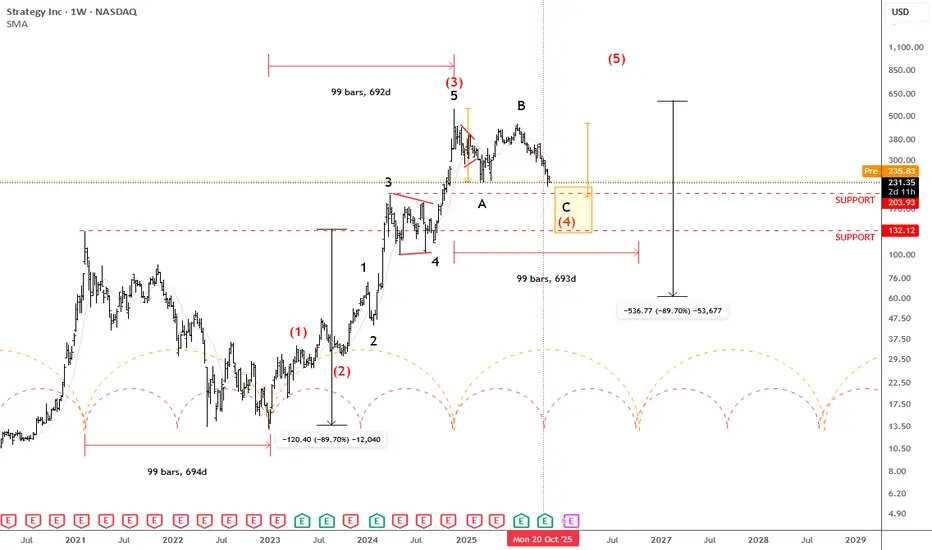
MSTR Trading Close To Support Based on Elliott wave and CyclesMicroStrategy has seen a strong uptrend since the December 2022 lows, but over the last year the market has been in a retracement phase. It appears that this could be another A-B-C setback within a higher-degree wave four, where subwave C could potentially retest the 200 area, or even extend toward the deeper 132 support. That level also aligns with the February 2021 high, making it an important zone to watch. Cycle-wise, it looks like we’re currently in the middle of a full cycle, suggesting that the correction could be moving into second half of this retracement, and may come to an end within the next few months. Ideally, we could then see a new turn higher in 2026, continuing the broader bullish trend. Highlights: Trend: Corrective pullback in wave four Support: 200 / 132 Cycle View: Mid-cylce; possible new rebound early 2026 Note: Structure fits within a broader five-wave bullish sequence, with strong long-term trend intact GHby ew-forecast11
(micro)StrategyThe red submarine has started to descend again and it presents us a buy opportunity as rarely seen in stocks.Shortby szorenn1
$MSTR bounce above $300 before falling further?Ever since Early October, MSTR has been falling. We've now reached the bottom of a flag structure and I'd expect a bounce here before we fall further. I think the most likely path from here is that we see a rally into the $300 zone, however, it's possible that we can go up to the top of the flag before falling further. That said, if we get a rally, it'll be a rally you want to sell because eventually I think we're heading down to the $100 level before you want to become a long term buyer. I've marked off key resistances on the path up to take profits on a long, should the rally play out from here.by benjihyam4
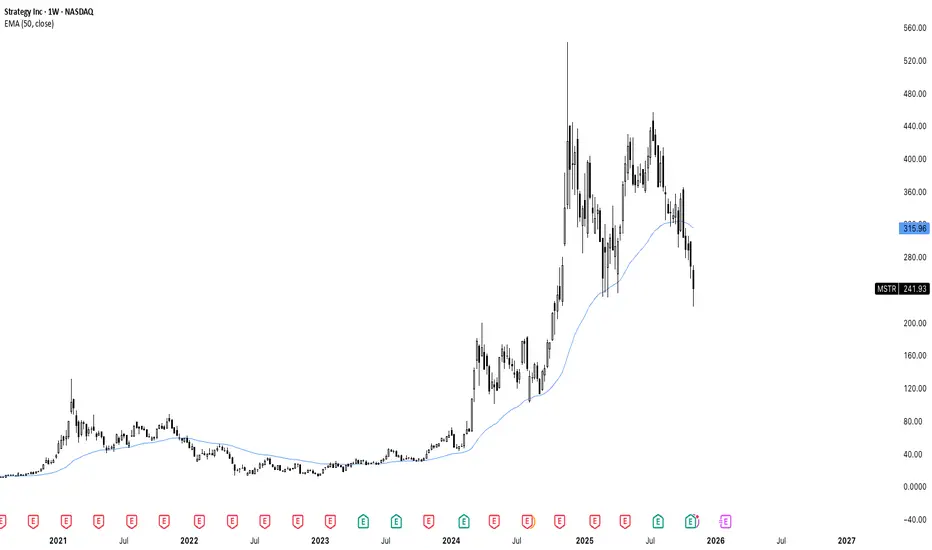
Microstrategy is who Satoshi warned us about. MSTR has broken below the 50 day moving average and is now at 52 weeks low. All while they hold the most bitcoin they ever have, now at 641,000 BTC. Some would even say they are trying to corner the market, using debt - while they claim they will never sell, but also they are not even earning any yield on their holdings. They will owe over $600 million in dividend payments next year. You simply can not create value out of thin air. NASDAQ:MSTR Shortby KennedyResearch117
MSTR HIGH PROBABILITY BIG BULL MOVE SOON!!!🚨 MSTR HIGH PROBABILITY BUY SETUP 🚨 * Here We Can See Clearly The Next Potential Moves For MSTR Coming Hours/Days. * Keep Your Eyes Close On Your Trading Positions. * Happy PIP Hunting Traders. FXKILLA.Longby FX-PIPHUNTER232342
Challenges and Risks in Global Investing1. Introduction to Global Investing Global investing refers to the practice of allocating capital across international markets, including stocks, bonds, mutual funds, and other financial instruments from different countries. While it offers opportunities to capture growth from emerging economies and diversification benefits, it also exposes investors to risks that stem from global interdependence. These risks may arise due to variations in political systems, market maturity, taxation, and macroeconomic conditions. Therefore, a well-informed global investor must carefully assess the potential threats and rewards before investing abroad. 2. Currency Risk One of the most significant challenges in global investing is currency risk or exchange rate risk. When investors hold assets denominated in foreign currencies, fluctuations in exchange rates can affect investment returns. For example, if an Indian investor invests in U.S. stocks and the Indian rupee strengthens against the U.S. dollar, the investor’s returns in rupee terms will decrease even if the stock’s price rises in dollar terms. Similarly, if the rupee weakens, the investor may benefit from favorable exchange rate movements. Currency volatility is influenced by inflation, interest rate differentials, trade balances, and geopolitical factors. Investors can mitigate this risk through hedging strategies, such as currency futures or options, but these come with additional costs and complexities. 3. Political and Geopolitical Risks Political instability is another major challenge in global investing. Changes in government, social unrest, corruption, or political uncertainty can severely affect the performance of investments in certain countries. For example, political tensions between countries can lead to trade restrictions, sanctions, or expropriation of assets, directly impacting multinational companies. The Russia-Ukraine conflict in recent years, for instance, has led to economic sanctions that affected investors with exposure to those regions. Similarly, sudden policy changes such as nationalization of industries, tax reforms, or foreign investment restrictions can negatively impact returns. Hence, political risk assessment is crucial when investing in developing or politically unstable nations. 4. Economic and Market Risks Different economies move through cycles of expansion and contraction at varying times. This creates economic risk, which can impact the performance of international investments. Emerging markets often offer high growth potential but may also experience sharp downturns due to weak economic structures, inflationary pressures, or currency devaluations. Developed markets, on the other hand, may provide stability but lower growth prospects. Moreover, global market risks—such as recessions, interest rate hikes, or financial crises—can have widespread effects. The 2008 Global Financial Crisis demonstrated how interconnected financial markets are, as a collapse in the U.S. housing market triggered a worldwide recession. 5. Regulatory and Legal Risks Each country operates under its own regulatory framework, which governs business practices, financial reporting, and investor protections. Differences in accounting standards, disclosure requirements, and corporate governance practices can pose serious challenges for global investors. For example, while the U.S. follows GAAP (Generally Accepted Accounting Principles), many other countries use IFRS (International Financial Reporting Standards). These variations can make it difficult to compare companies across borders. Legal systems in some countries may also lack transparency or enforceability. In extreme cases, investors may face fraud, corruption, or lack of legal recourse when disputes arise. Therefore, understanding the local legal and regulatory landscape is essential before making any international investment. 6. Cultural and Communication Barriers Cultural differences play a subtle but significant role in global investing. Business practices, negotiation styles, corporate culture, and consumer behavior vary across regions. Misunderstanding these cultural nuances can lead to poor investment decisions. For instance, a company operating successfully in the U.S. might not achieve the same results in Japan or India due to differences in consumer preferences, labor laws, or management styles. Similarly, language barriers can lead to misinterpretation of financial information or communication errors with local partners and institutions. Investors need to account for these soft factors when analyzing global markets to ensure that cultural misalignment does not undermine business potential. 7. Liquidity Risk Liquidity risk arises when investors are unable to buy or sell an asset quickly without affecting its price. In many foreign markets—especially in developing nations—financial instruments are less liquid than in major global exchanges. For example, while shares on the New York Stock Exchange (NYSE) can be traded almost instantly, stocks listed on smaller exchanges in emerging economies may take days or weeks to execute. This can pose problems during times of market stress when investors need to exit positions quickly. Investors must, therefore, assess the liquidity levels of foreign markets before investing and avoid overexposure to illiquid assets. 8. Information and Transparency Challenges Access to reliable and timely information is a cornerstone of sound investment decisions. However, in many countries, financial transparency and disclosure standards are not as rigorous as in developed markets. Incomplete or inaccurate data can lead to mispricing of assets and poor investment choices. Furthermore, language differences, lack of research coverage, and limited access to company executives can make it difficult for foreign investors to fully understand the market environment. Global investors often rely on local analysts, financial news, or international advisory firms to bridge this information gap. 9. Taxation and Repatriation Issues Each country has its own tax laws, including capital gains tax, dividend tax, and withholding tax. Navigating these differences can be complicated, especially when double taxation treaties are not in place. Additionally, repatriating profits from foreign investments can be difficult due to restrictions on currency transfers or unfavorable exchange rate conditions. Investors must consult international tax experts and understand cross-border tax implications to avoid unexpected liabilities. 10. Technological and Cybersecurity Risks As global investing increasingly relies on digital platforms, cybersecurity threats have become a significant concern. Online trading platforms, digital banking systems, and financial data networks are all vulnerable to hacking and data breaches. Moreover, technological disparities between countries may also impact efficiency and transparency. In less developed markets, outdated trading infrastructure or lack of digital safeguards can increase operational risks. Investors must prioritize cybersecurity and ensure their brokers or financial institutions follow robust digital protection standards. 11. Environmental, Social, and Governance (ESG) Risks The growing importance of ESG factors in global investing introduces another dimension of risk. Companies that fail to comply with environmental regulations, labor rights, or ethical practices may face boycotts, fines, or reputational damage. Investors must evaluate not only financial performance but also the sustainability practices of international firms. Ignoring ESG considerations can result in long-term losses as global markets increasingly reward responsible and transparent businesses. 12. Global Systemic Risks Certain risks, such as pandemics, climate change, and global recessions, affect the entire world simultaneously. The COVID-19 pandemic, for instance, caused massive disruptions across industries and countries, showing that no market is entirely insulated from global shocks. Such systemic risks highlight the importance of maintaining flexibility, diversification, and proper risk management strategies in global portfolios. 13. Strategies to Mitigate Global Investment Risks While global investing carries challenges, investors can manage these risks through prudent strategies: Diversification: Spreading investments across regions, sectors, and asset classes reduces exposure to any single market. Hedging: Using derivatives like options or futures to protect against currency or commodity price fluctuations. Research and Due Diligence: Conducting in-depth analysis of political, economic, and financial environments before investing. Professional Guidance: Consulting international fund managers or advisors with local expertise. Regular Monitoring: Continuously tracking geopolitical and economic developments that may impact returns. 14. Conclusion Global investing offers immense opportunities for wealth creation and diversification, but it comes with complex challenges and risks. Factors such as currency volatility, political instability, regulatory differences, and global crises can significantly impact investment outcomes. Successful global investors must adopt a disciplined approach that combines research, diversification, and risk management. By understanding and navigating these challenges wisely, investors can unlock the full potential of global markets while safeguarding their capital against unforeseen global shocks.Educationby GlobalWolfStreet1
MicroStrategy - Mean ReversionAfter a choppy but still successful call on MSTR in Feb, we are back with another one. Heavily oversold and ready to shoot alongside $BTC.Longby profitanium6
435This channel is not providing individualized trading or investment advice, nor is it a banking service, brokerage service, trading service, investment service or money management serviceLong01:09by dpopovici5
MSTR pull back a buying opportunityMSTR checking key supports. Respects the trend started 2 years ago, revisiting a historical RSI low, only seen back in June 2022.Longby DystopianInvest5
MSTR TRADES UP 1X FOR EVERY BTC UP, BUT 3-4X DOWN WITH BTCMSTR is dead. the "Leverage"is 3-4x down for btc movement, but only 1x up for btc movement the degradation of how far below each btc ath is also getting worse, it has doubled since the last btc ath.Shortby AgingRocker222
$MSTR Bullish Shark Harmonic completedNASDAQ:MSTR : C wave of this ABC correction has gone beyond A, meeting the requirements of an ABC flat correction. Bullish Shark Harmonic also looks complete. by HeadsUp2021446
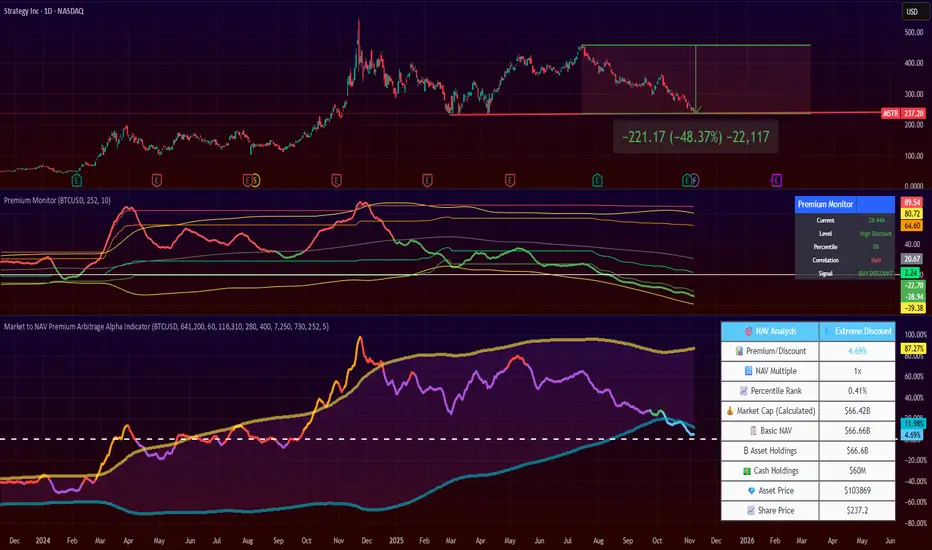
Strategy's Premium is Gone. Time to Load? 4 months ago, I posted that NASDAQ:MSTR premium was unsustainable and the stock price would drop. Since then, the price dropped by 50%!! Now, Strategy's is close to zero, and I flip my views on it. If you like this kind of trade, it might be a good time to start DCA'ing it. Note that Strategy continues to be a highly volatile stock, more volatile than Bitcoin itself. Finally, the stock is now at a technical resistance level. You can keep an eye on the premium/discount of this stock by looking at my 2 indicators: Market to NAV Premium Arbitrage Alpha Indicator , and Asset Premium/Discount Monitor Longby HenriqueCentieiro3314
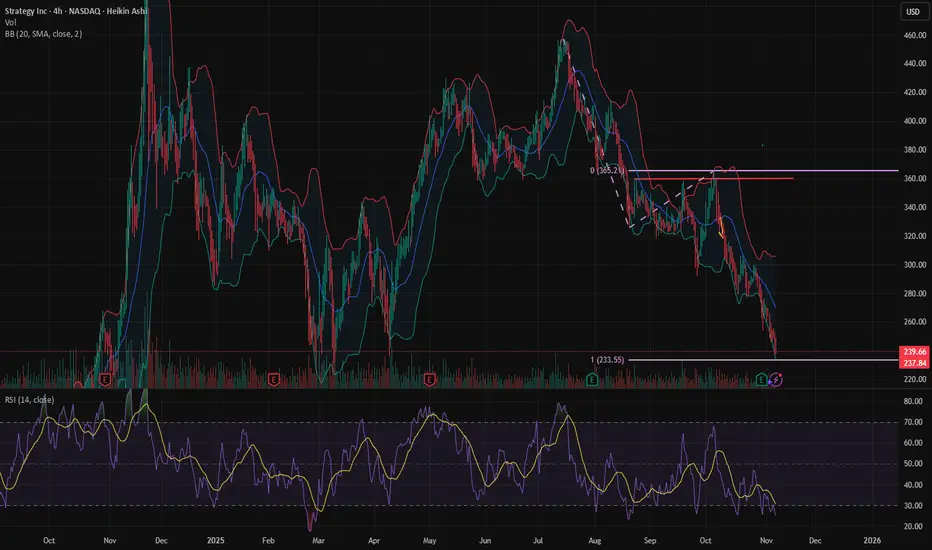
$MSTR: AB = CD target almost reachedNASDAQ:MSTR : the AB = CD targets $233 and today's low is $236.86. Very close. If NASDAQ:MSTR can bounce here, or fake breakdown to 233 or lower than bounce back, it would be good for Bitcoin. I don't own NASDAQ:MSTR shares and don't plan to trade this name. I'm looking at NASDAQ:MSTR as another data point to gauge bitcoin. by HeadsUp20215
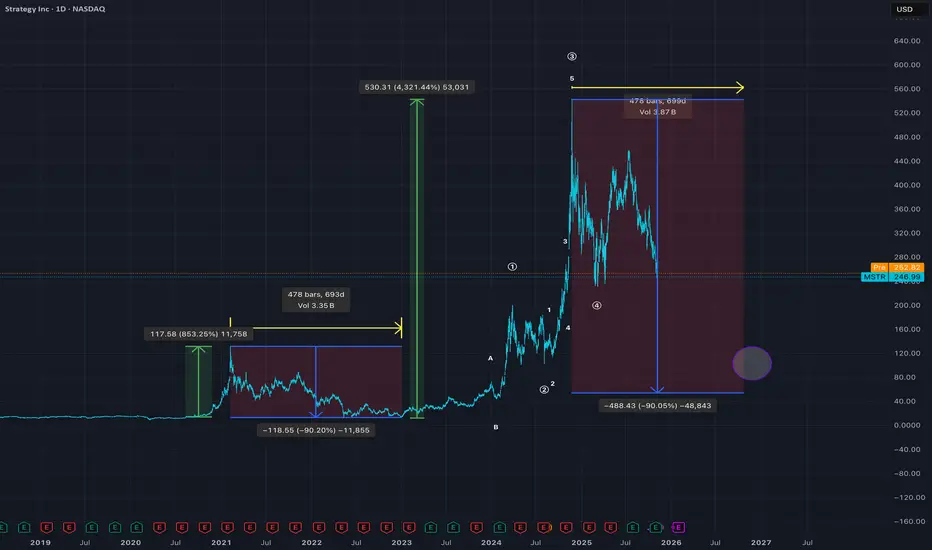
History Seems to Be Repeating on MSTR Lately, I’ve been noticing something interesting on MicroStrategy (MSTR) — the price action appears to be forming a structure very similar to what we saw earlier in the chart. ⸻ 🟨 Repeating Consolidation Zones Looking back, the first highlighted zone (around early 2024) shows how price moved sideways for a while after a strong rally. That consolidation eventually resolved in a sharp move upward once momentum returned. Now, if we look at the current structure (mid-to-late 2024 into 2025), the setup looks quite familiar. After another strong upward phase, price has again been consolidating in a broad range roughly between $250 and $450. ⸻ 🧩 Observing the Fractal Behavior This kind of repeated structure—where a period of consolidation follows a strong expansion—often suggests that market participants are adjusting to previous volatility and finding equilibrium before the next major phase. While past movements don’t predict future outcomes, it’s interesting to note how similar the rhythm of this current range is compared to the previous one. It almost feels like the market is “echoing” its earlier behavior. ⸻ 🔍 Key Points I’m Watching • The lower area of this range (around $230–$250) has acted as an important zone of interest before. • The upper boundary near $425–$450 has repeatedly capped upward movement. • How price behaves between these levels may give insight into the broader structure of the trend. ⸻ 🕰️ Final Thoughts This analysis isn’t a prediction or a recommendation — just an observation of how patterns sometimes reappear in the market. Whether or not this current range resolves in a similar way to the last one remains to be seen, but the repetition in structure and timing is fascinating from a technical perspective. Markets often rhyme, and MSTR might just be showing another verse of a familiar song. 🎵 by IDONTKNOW26
MSTR further downside but looking exhaustedNASDAQ:MSTR Price continues range bound in a complex wave 4 correction, notoriously hard to analyse. The trend is down but looks exhausted. Wave Y can complete any time in this flat correction pattern but is approaching the previous swing low and the 0.236 Fibonnacci retracement. Daily RSI has printed bullish divergence but price continues lower. IF pice breaks down further the next target is $185 where price may find a bottom. Recovering the daily 200EMA is the first goal.by Maddox_Metrics4
MicroStrategyBitcoin. Still lots of downside left on the table for Saylor's MicroStrategy. More time required before any type of lower risk entry point morphs into existence.by Badcharts1112
Will Microstrategy $MSTR follow the 2021 cycle? Top was around the most greedy time in the market per Election '24. As bitcoin put in new all time highs MSTR continued lower highs, just like in '21. Last line of support around $230, it should continue putting in lower highs as the cycle comes to an end. Shortby BigDaddyChet3
MSTR - How to profit from a $140 short target🔱 The MS ponzi is taking its toll. 🔱 I’m not laughing, because it’s genuinely unfortunate for everyone who believed in this scam. But today, I don’t want to rant about that. I want to show how one could profit from a potential drop of more than $100. As an Andrews Pitchfork trader, I know there’s roughly an 80% chance that price will reach the centerline. From there, price either reverses in the opposite direction or breaks through the centerline to continue its journey. That’s exactly what happened with MSTR. You can see how the price first reached the centerline, held there a few times, and then broke it. Since then, it’s been following the rulebook by moving further to the downside. Now, there’s another rule worth remembering: price often tests or retests the line it just broke. In our case, that line is the centerline. This means we could be lucky enough to get a pullback to the centerline, and that would be a good level to consider shorting. The target is usually the opposite line of the centerline, which in our case is the L-MLH (Lower Median Line Parallel). 👉 If you want to learn the full framework and its rules, check the links for free material. I hope this helps many of you, and I wish you all good profits.Shortby HowToChart151514
$MSTR still bullish at supportstrategy has lately been underperforming compared with simular assets. It's stuck in this arc and the diagonal line. When it finds support and breaks the arc you will teleport to the next arc. This gets invalidated when breaking to the downside!Longby CapitalCompass333446
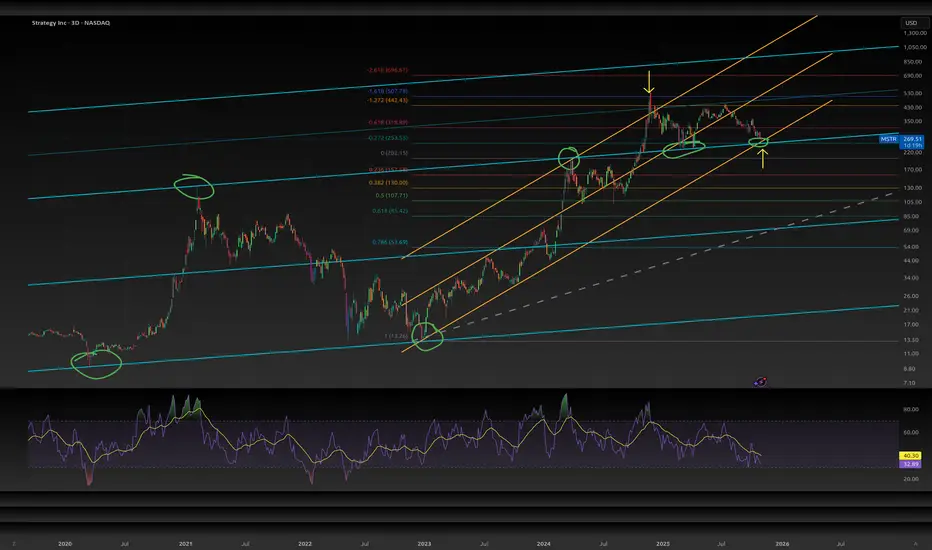
MSTR is on a point of significant confluenceMSTR is on a point of three major confluences. To lose this level would mean we are going much lower. However, I expect at least a significant bounce from here. we have the blue channel that previously acted as resistance and recently turned into support. we have the current orange channel we have the -.272 fib level, after hitting the -1.618 Nov 2024 RSI also looks like a bottoming pattern, but that needs to play out some more to be confident. I would not be surprised if we retest the underside of the -.618 around $315 in short order. If we lose this level, it could get really nasty to the downside. Longby novamaticUpdated 1113
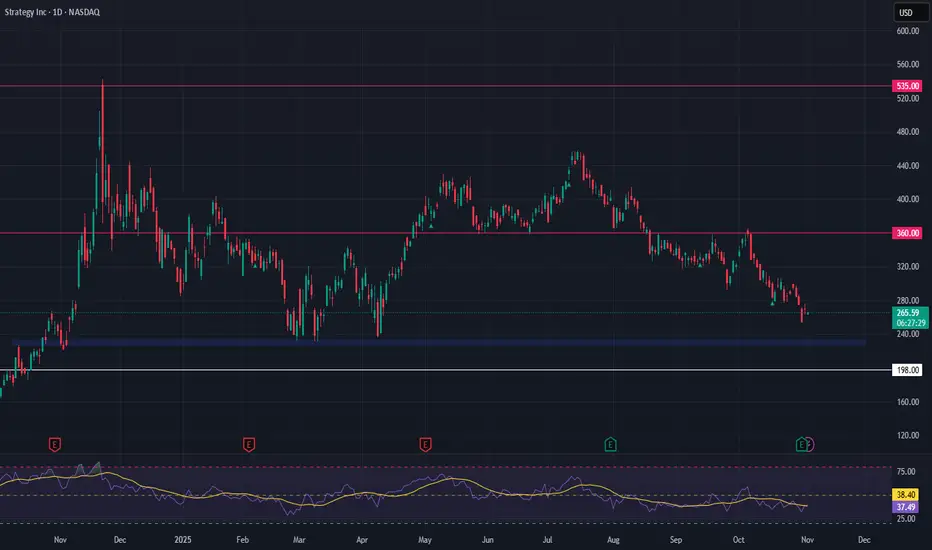
Strategy Inc (MSTR) – High-Beta Bitcoin Proxy at Key SupportStrategy Inc NASDAQ:MSTR has delivered another strong quarterly report, underscoring its continued commitment to aggressive Bitcoin accumulation. With over 158,000 BTC on the books, MSTR has firmly positioned itself as a leveraged proxy for Bitcoin, offering equity traders indirect crypto exposure. This bold balance sheet strategy has also pushed MSTR into alignment with S&P 500 inclusion criteria — a potential catalyst if index inclusion materializes. Technically, the stock is now retesting a key support zone between $228 and $233. This level has historically held well and may offer a high-conviction entry for those anticipating a BTC rebound. Should Bitcoin aim for new highs, MSTR could respond with outsized upside, though traders must account for the volatility and downside risks that come with crypto-correlated equities. 🎯 Trade Setup: Entry Zone: $228 – $233 Take Profit Targets: $360 and $535 Stop Loss: $198 This setup offers a high-risk, high-reward opportunity. As always, manage position size carefully and watch BTC price action for confirmation.Longby Richtv_official8