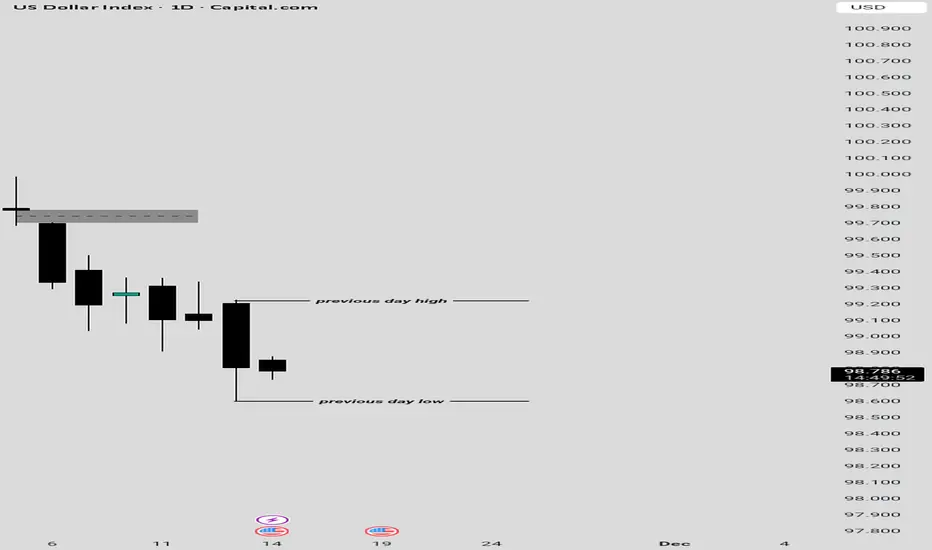
DXY Will Fall! Sell!
Hello,Traders!
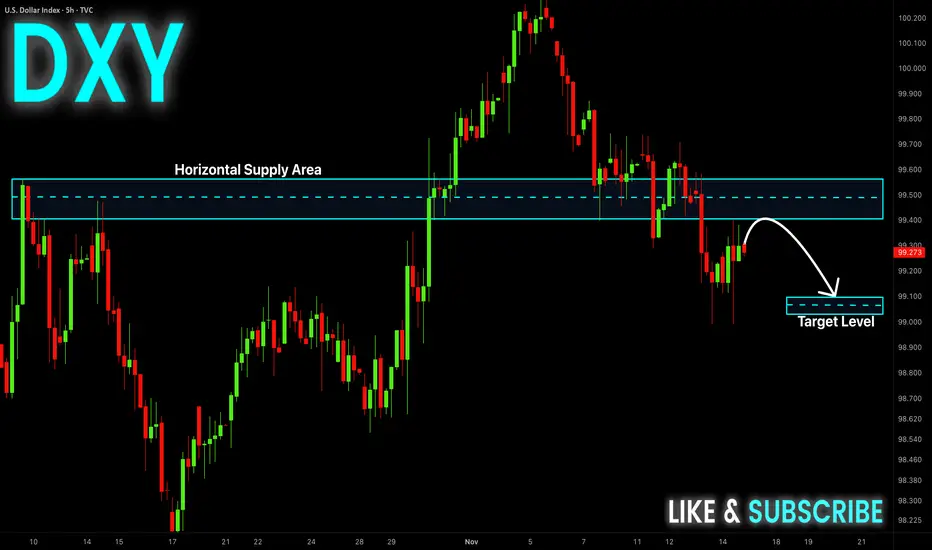
DXY price taps into a clean supply block, creating a shift in order flow as liquidity above the highs gets swept. A corrective push toward the next demand pocket is likely. Time Frame 5H.
Sell!
Comment and subscribe to help us grow!
Check out other forecasts below too!
Disclosure: I am part of Trade Nation's Influencer program and receive a monthly fee for using their TradingView charts in my analysis.
Trade ideas
DXY — Sunday War MapThe U.S. government has reopened after a 43-day shutdown, but the gap in economic data remains.
Several key datasets were not collected during the closure, and the missing information cannot be reconstructed.
As a result, the Dollar is now trading on partial visibility rather than complete fundamentals.
Macro Overview
The most recent complete inflation report is September CPI at 3.0%, with core inflation also at 3.0%.
Earlier in the month, the U.S. Dollar Index (DXY) briefly moved above 100.
It then retreated toward 99 after consumer sentiment fell to a three-year low.
Last week’s muted behavior reflects uncertainty, not a structural shift.
When information is missing, liquidity becomes cautious and price action compresses.
Key Events This Week (Nov 17–21)
FOMC Minutes — Wednesday, Nov. 20
This release provides the first reliable view into Federal Reserve discussions since the shutdown.
Markets will look for whether policymakers supported multiple rate cuts or expressed hesitation.
Consumer Sentiment — Friday, Nov. 22
Last month saw a more than 30% year-over-year decline.
Another weak reading will influence Dollar positioning.
Delayed Data Returns
Housing, industrial production, and jobless claims will re-appear gradually this week.
These incomplete releases still matter ahead of the December 9–10 Federal Reserve meeting.
The Dollar is currently driven more by data absence than by clear economic direction.
MSM — Market Structure Mapping
DXY remains inside a major daily bullish range:
Range Low: 97.672
Range High: 99.985
Price sits near the 50% geometric midpoint.
Last week closed at 98.776, maintaining structural balance and preserving the broader bullish framework.
VFA — Volume Flow Analytics
Price continues to hold on the 98.725 bullish volume node, a level typically used for quiet accumulation.
This suggests ongoing absorption of buy-side orders at discount levels ahead of potential volatility expansion.
OFD — Order Flow Dynamics
Liquidity remains concentrated around two notable participation zones:
Aggressive buyers: 98.243
Aggressive sellers: 99.225
These zones are often retested early in the week to assess participation or clear weak inventory before direction establishes.
PEM — Precision Execution Modeling
Mid-range conditions are typically used to clear stops on both sides before intent forms.
Execution criteria for the week:
Respect higher-timeframe direction
Wait for confirmation
Avoid mid-range noise
Act only when structure, flow, and behavior align
High-quality setups generally appear after liquidity sweeps, not before.
Psychological Frame
The major risk this week is acting on incomplete data.
The shutdown left a statistical gap that has not yet been resolved.
Professionals avoid committing capital until visibility improves.
The appropriate approach for the week is simple: observe first, act later.
— CORE5DAN
Institutional Logic. Modern Technology. Real Freedom.
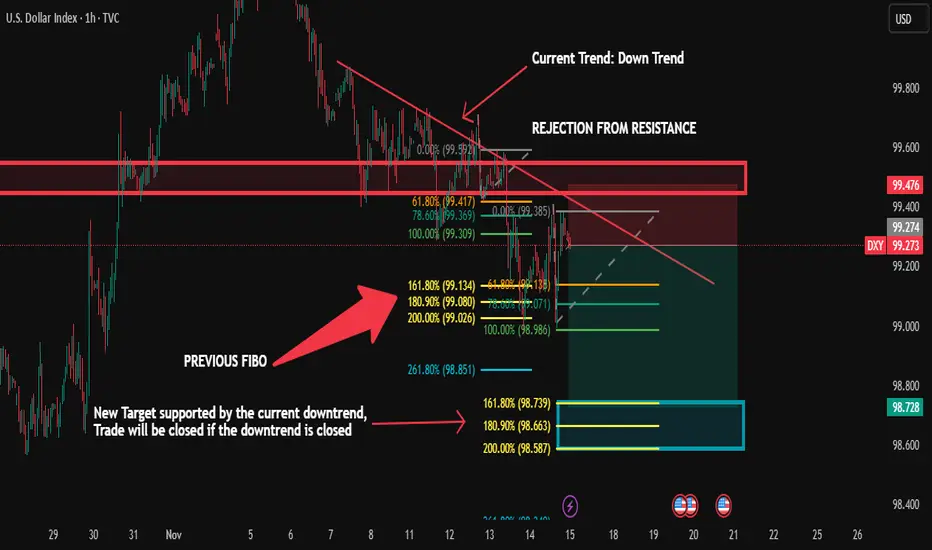
DXY is on the next target after reaching previous fibo targetDXY respected a resistance line and went downward then rose up and gave us a clear rejection for an uptrend, On the previous analysis we did by using Fibonacci we can clearly see that it reached it's target.
Now we have the same system as before, a perfect Fibonacci with a target to reach as long as we remain in a downtrend.
Key Forex Economic Events (17-21 November 2025)The global economic calendar for the upcoming week (commencing Monday, November 17, 2025) features a series of pivotal data releases and central bank events that are likely to influence currency pairs, bond yields, and risk sentiment across major markets. With the US Federal Reserve's policy trajectory under scrutiny amid persistent concerns about inflation, the highlight is Wednesday's 9:00 a.m. USD FOMC Meeting Minutes, which could provide critical insights into future rate decisions. This is complemented by preliminary GDP figures from Japan and Canada on Monday, UK CPI on Wednesday, and a flurry of flash PMI readings on Friday spanning the EUR, GBP, and USD. Traders in South Africa (ZA), operating in the SAST timezone, should note the alignment of these events with local trading hours to manage volatility effectively.
The week kicks off on Monday with Asia-Pacific focus: at 1:50am, Japan's Preliminary GDP q/q offers an early gauge of growth momentum in the world's third-largest economy, potentially impacting JPY crosses. This is followed at 3:30pm by Canada's CPI y/y, a key inflation metric that could sway Bank of Canada expectations and strengthen or weaken the CAD against its US counterpart.
Midweek intensity builds on Wednesday, where the 9:00am release of Great Britain’s CPI y/y will test the Bank of England's resolve on monetary tightening amid elevated cost-of-living pressures. The centerpiece, however, is the 9:00am USD FOMC Meeting Minutes—a verbatim recap of the Federal Open Market Committee's latest deliberations. Market participants will parse these for dovish or hawkish signals on balance sheet runoff, terminal rate projections, and labor market resilience, with any surprises capable of triggering sharp USD moves.
Thursday appears lighter, marked as tentative for a 3:30pm USD NFP (Non-Farm Payrolls) preview or related indicator, though no firm details are confirmed—advising caution for position sizing.
The week culminates on Friday with a PMI barrage starting at 10:00 a.m. EUR Flash Services PMI, followed by the 11:30 a.m. GBP Flash Services PMI, 4:45 p.m. USD Flash Services PMI, and 11:00 a.m. USD Flash Manufacturing PMI (noting potential overlap in timing for the USD releases). These high-frequency surveys will provide forward-looking snapshots of the Eurozone, the UK, and the US private sector's health, often serving as leading indicators for GDP and employment trends. Strong readings could bolster hawkish repricing, while weakness might fuel recession fears.
In summary, this week's calendar is dominated by inflation reads, growth proxies, and Fed commentary, presenting a high-impact environment for forex, equities, and fixed income. The FOMC Minutes stand out as a potential catalyst for volatility, with flash PMIs offering a capstone on Friday. For South African users (@alndobo), monitoring these in SAST—particularly the overlapping 9:00 am slots—will be essential for risk management. Positioning ahead of these events with appropriate stops and leveraging multi-asset correlations could yield opportunities, but vigilance against data surprises remains paramount in an uncertain macro backdrop.
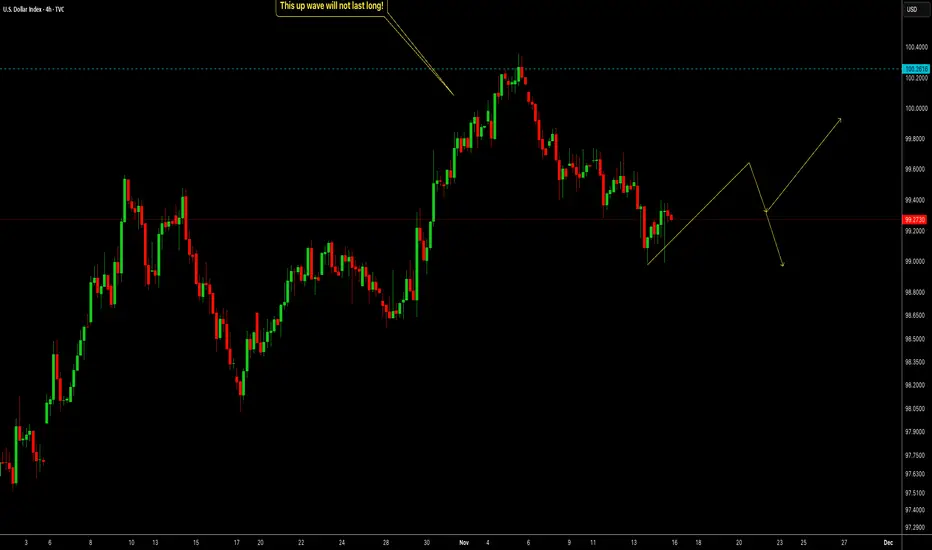
DXY - Short-Term Bounce, But the Bigger Drop Isn’t Done YetThe Dollar Index is forming a small corrective up-move on the 4H chart. This current rise still looks weak and is unlikely to last long. As long as price stays below the major zones above, the broader structure suggests one more push lower before any meaningful bullish reversal.
Short-term volatility is expected, but the higher-timeframe pressure remains to the downside. We’ll be watching for a final drop to complete the structure before the next big move.
Disclosure: We are part of Trade Nation's Influencer program and receive a monthly fee for using their TradingView charts in our analysis.
Bretton Woods 2.0?Examining the long-term trend of TVC:DXY since the 1980s, we might be facing a staggering 40% reduction in valuation, potentially landing us around 60. If the US were to devalue the dollar this drastically, could it effectively erase the national debt? 🤔 Is Trump bold enough to consider such a move?
We know the FED is going to cut eventually, the question is when and by how much? Initial claims came in higher than estimated, with cracks beginning to show in the labor market, how much longer can JPow hold out?
DXY Selling Idea before huge buys After years trying to understand the Forex Market, this is my next trading idea using Wyckoff Schematic Drawings. Only learnt about this this year. So lets break it down to understand this theory in Monthly Time Frame on DXY Dollar Index Chart.
Spring Theory is Three SC Sell Climax being done before the buy setup, Meaning?
After first SC then an ST Secondary Test of the low..Two SC must be reated before the buys. Posted chart just as a guide and analysis of Wyckoff Theory.
First SC @$78.00 Second SC @$71.13 Third SC should be around $64.00/$65.00 area.
Then to buy up taking out BS Buy Climax areas @$121.00 and $114.00 area to creat new HH Higher highs around $126.00 and $136.00 area. For now Sells are in play which is good oppounity on long term to buy Forex pairs like EURUSD and GBPUSD.
DXY 4H🔹 Overall Outlook and Potential Price Movements
In the charts above, we have outlined the overall outlook and possible price movement paths.
As shown, each analysis highlights a key support or resistance zone near the current market price. The market’s reaction to these zones — whether a breakout or rejection — will likely determine the next direction of the price toward the specified levels.
⚠️ Important Note:
The purpose of these trading perspectives is to identify key upcoming price levels and assess potential market reactions. The provided analyses are not trading signals in any way.
✅ Recommendation for Use:
To make effective use of these analyses, it is advised to manually draw the marked zones on your chart. Then, on the 15-minute time frame, monitor the candlestick behavior and look for valid entry triggers before making any trading decisions.
DXY Weekly Outlook: Key Imbalance Zones and Scenarios for the Last week, the DXY price reached the weekly FVG, tested its lower boundaries, and delivered the expected reaction. Now the chart shows new variables that allow us to forecast potential movement for the upcoming week.
Let’s examine the daily timeframe. The price has formed a bearish FVG. There are no other potential resistance zones on the daily chart, and the overall movement has been tight and directional, which is logical after hitting a strong higher-timeframe level. At the moment, the only structural reference on the daily chart is this newly formed FVG, and we should expect the price to operate within its boundaries.
One possible development is that the price respects the reaction from the weekly FVG and continues downward toward the next weekly support level. Below, there is also an unfilled gap that may attract price and serve as a local point B.
Another possible development is that the price breaks through the bearish daily FVG, forms a higher close, and continues moving toward the global point B we marked last week. This would signal that the strong overall trend remains intact and that buyers still dominate on the higher timeframes.
For now, the key focus is on how the price behaves inside the daily FVG. Whether this imbalance zone holds or gets broken will determine the further structure. We monitor reactions on the boundaries and wait for confirming volume to validate the next direction.
DXY Is Very Bullish! Buy!
Here is our detailed technical review for DXY.
Time Frame: 1D
Current Trend: Bullish
Sentiment: Oversold (based on 7-period RSI)
Forecast: Bullish
The market is on a crucial zone of demand 99.274.
The oversold market condition in a combination with key structure gives us a relatively strong bullish signal with goal 101.270 level.
P.S
Overbought describes a period of time where there has been a significant and consistent upward move in price over a period of time without much pullback.
Like and subscribe and comment my ideas if you enjoy them!
DXY Near Key Liquidity Pools — Which One Gets Taken First?NY Session Update
The Dollar opens New York trading holding firm in mid-range, rotating around the 0.50 region near 98.828.
The session begins with a steady structure, and flow remains shaped primarily by the broader macro tone rather than intraday volatility.
The Dollar spent the week under steady pressure as investors reassessed U.S. growth momentum. Several datasets were delayed, and the backlog created uncertainty around how strong the underlying economy actually is. The tone from the Federal Reserve shifted subtly toward patience — less focus on tightening, more on maintaining optionality.
At the same time, global risk appetite improved. Equities held firm, and capital rotated into other major currencies, reducing the Dollar’s safe-haven advantage. That combination — softer growth signals, stabilizing risk, and non-committal policy language — kept the Dollar pinned in mid-range structure.
Looking ahead, the next meaningful movement will likely come from surprise prints rather than scheduled events. Employment data, inflation momentum, and backlog clears remain the pressure points. Until those catalysts hit, the Dollar stays in observation mode: stable, compressed, and sensitive to macro tone rather than intraday noise.
NEXT WEEK’S U.S. DOLLAR DRIVERS
Inflation releases – Headline and core CPI/PPI data will test momentum in pricing pressure.
Employment & labour data – Wage momentum, participation and unemployment trends remain under the microscope.
Policy tone from the Federal Reserve – Speeches and any shifts in guidance around timing will carry enhanced weight.
Global risk-sentiment flow – Equity performance and risk-asset appetite at the NY open will continue to influence USD positioning.
Data backlog clarity – Delayed prints and residual effects from previous disruptions may create surprises in either direction, affecting Dollar flow.
CORE5 Pillar Overview
MSM — Market Structure Mapping:
Price remains inside weekly balance, with activity clustered around 98.776 — consistent with mid-range conditions.
VFA — Volume Flow Analytics:
The 4H anchored volume node at 98.725 continues to mark the area of most participation.
OFD — Order Flow Dynamics:
Recent activity shows hesitation to move deeper into the lower inefficiency zones.
PEM — Precision Execution Modeling:
Liquidity context remains defined by areas near 98.30 and 99.30, with the broader range limits at 97.672 and 99.985.
This provides the wider map for understanding structural rotation.
CORE5 Rule of the Day
Mid-range moves feed ego, not equity.
—
— CORE5DAN
Institutional Logic. Modern Technology. Real Freedom.
Bullish bounce off?US Dollar Index (DXY) is reacting off the pivot and could bounce to the 1st resistance.
Pivot: 99.08
1st Support: 98.08
1st Resistance: 99.80
Disclaimer:
The opinions given above constitute general market commentary and do not constitute the opinion or advice of IC Markets or any form of personal or investment advice.
Any opinions, news, research, analyses, prices, other information, or links to third-party sites contained on this website are provided on an "as-is" basis, are intended to be informative only, and are not advice, a recommendation, research, a record of our trading prices, an offer of, or solicitation for, a transaction in any financial instrument and thus should not be treated as such. The information provided does not involve any specific investment objectives, financial situation, or needs of any specific person who may receive it. Please be aware that past performance is not a reliable indicator of future performance and/or results. Past performance or forward-looking scenarios based upon the reasonable beliefs of the third-party provider are not a guarantee of future performance. Actual results may differ materially from those anticipated in forward-looking or past performance statements. IC Markets makes no representation or warranty and assumes no liability as to the accuracy or completeness of the information provided, nor any loss arising from any investment based on a recommendation, forecast, or any information supplied by any third party.
USD Rejected at Resistance- Key Test Ahead for DXYThe US Dollar reversed sharply off pivotal resistance into the November open with DXY poised to mark a second consecutive weekly loss. The focus is now on whether the pullback marks the start of a larger correction or a brief pause within the broader uptrend.
The Dollar has now fallen more than 1.2% off the monthly high with the decline now breaking below the September uptrend. A simple channel extending off the monthly high is guiding this decline with initial support now eyed at 99.68/78- a region defined by the August high-day close, the May low and the 38.2% retracement. Look for a larger reaction there IF reached with a break / close below needed to suggest a more significant high is in place and a larger trend reversal is underway. Subsequent support rests at 98.03 and the 2018 high / 61.8% retracement at 97.71/80.
Weekly open resistance is eyed at 99.62 and is backed closely by the November open at 99.75. A break / close above this threshold would threaten resumption of the September uptrend with key resistance steady at 100.15/35- a region defined by the 2024 low, the 200-day moving average and the 2024 low close. Strength beyond this pivot zone is needed to fuel the next major leg of the US Dollar advance. The next major technical consideration is eyed at the 1.618% extension of the September advance at 101.32.
Bottom line: DXY reversed from key resistance into the monthly open with a break below then September upslope threatening a deeper setback- be on the lookout for a possible exhaustion low in the days ahead. From a trading standpoint, losses would need to be limited to 98.68 IF this is a simple correction with a break above 100.35 needed to mark uptrend resumption.
-MB
EURUSD SHORT DXY is at Asia session low and EURUSD is at a session high. I have entered the first trade and have a second trade marked up as a back up in case the price returns to the daily high from yesterday before reversing. I consider this a risky trade as EU is showing bullish market structure on the 4hr chart so this 1.16 psychological level may well be about to be broken. I have reduced my risk on this scenario due to this reason.
DXY Is Entering a Decision Zone — The Next Move Starts Here.DXY | Neutral Bias | 4H Frame
CORE5 View: Price has filled its inefficiencies and now meets the weekly balance head-on. This is the decision point for the next impulse.
Fundamental Context
Tomorrow is the real driver: PPI + jobless claims, with CPI right behind it.
These three data points set the short-term path for the dollar’s yield expectations.
Markets are holding steady into the releases — no rush, no conviction.
This is a waiting zone until numbers show direction.
Market Structure Context
Price has pushed into the discount side of the 4H range, tapping the same zone that has triggered rotations before.
All single prints beneath have now been filled, removing imbalances.
Now the structure is pressing the weekly balance at 98.766, a level that normally slows momentum and forces the market to show its hand.
This is where structure decides between rotation or continuation.
MSM — Market Structure Mapping
The 4H structure carries a bearish tone, but it is pushing straight into weekly balance, which often neutralizes momentum.
Nothing is broken, but nothing is confirmed.
This is where professionals wait for liquidity to choose dominance.
DGM — Dynamic Geometry Modeling
The downward leg into discount matches the prior leg in size and rhythm.
Symmetry is complete.
Geometrically, this is a natural location where rotation can start — but only if liquidity agrees.
VFA — Volume Flow Analytics
Anchored volume sits at 98.725, only a few points below current price.
This is a reliable decision level:
• Rotation often begins here when volume defends.
• If price accepts below this node, bearish continuation opens quickly.
It’s a participation pivot — the market chooses, not us.
OFD — Order Flow Dynamics
Order flow still favors the bearish side.
No meaningful attempt higher, no failed push, no shift in intent.
Buyers are quiet; sellers are steady.
Patience here protects capital.
PEM — Precision Execution Modeling
We’re sitting mid-range into end-of-day liquidity with clear pools both above and below.
In these conditions, price often drifts, cleans both sides, and waits for tomorrow’s data.
For cross-market positioning, holding off until USD bias confirms is the professional move.
🧠 CORE5 Rule of the Day
“Context leads. Direction follows. Structure only works when you let it speak first.”
GOLD HEADING TO 4270? NOVEMBER 11 2025This is my view on the GOLD this week
After 3 failed rally by gold and the fake breakout of 4110 today; we could see gold rejoining the broken resistance at 4220 and rally up to 4270, a key level where we may see a second selloff of the commodity
Key level / buy entry 4128 / 4116
Target: 4240 / 4270
Shutdown Ended, What Is Next for the US Dollar?US shutdown ended after 43 days and set a new record. During the shutdown, a lot of economic data could not be released, and the lack of government spending caused a limited liquidity shortage. Now that the shutdown has ended, what is next for the US dollar?
US economy is expected to be hit by the shutdown in the fourth quarter. The impact is estimated to be around 1.5 percent on an already weakening economy. Over the last 25 years, annualized quarterly GDP growth has averaged 2.3 percent. Since 2021, US GDP rose above this average on a yearly basis. GDP was 2.8 percent in 2024, and this year it is expected to fall to 1.9 percent, below the long-term average, and it could drop further because of the shutdown. Growth in 2026 is also expected to be weak, with a forecast of only 1.8 percent.
While GDP is weakening, inflation forecasts still point to a near 3 percent pace, which is somewhat high in our view. This will keep the FED busy. Inflation implies a weaker currency unless supported by high rates. The FED has a dual mandate and cannot overlook the weakening GDP and softening labor market, so despite elevated inflation risks, rate cuts will continue. This will put ongoing pressure on the dollar, at least first half of 2026.
Dollar performance cannot be assessed without considering the euro, since 57.6 percent of the dollar index is tied to it. The eurozone is also expected to stay below its 25-year average growth rate of 1.32 percent. A 1.10 percent GDP rate with inflation below 2 percent is acceptable for the ECB. While the FED will be cutting rates, the ECB will likely hold, as Lagarde said in the latest press conference: “We are in a magnificent place.”
For the short term, the dollar is about to break its trend channel to the downside. Economic data from the US is expected to come in very weak. With expectations of weak data and easing liquidity problems, short-term downward pressure could push the index to 98.55 first. Below that initial support, the selloff could deepen. However, the long-term trend from 2011 is still holding(white trend).