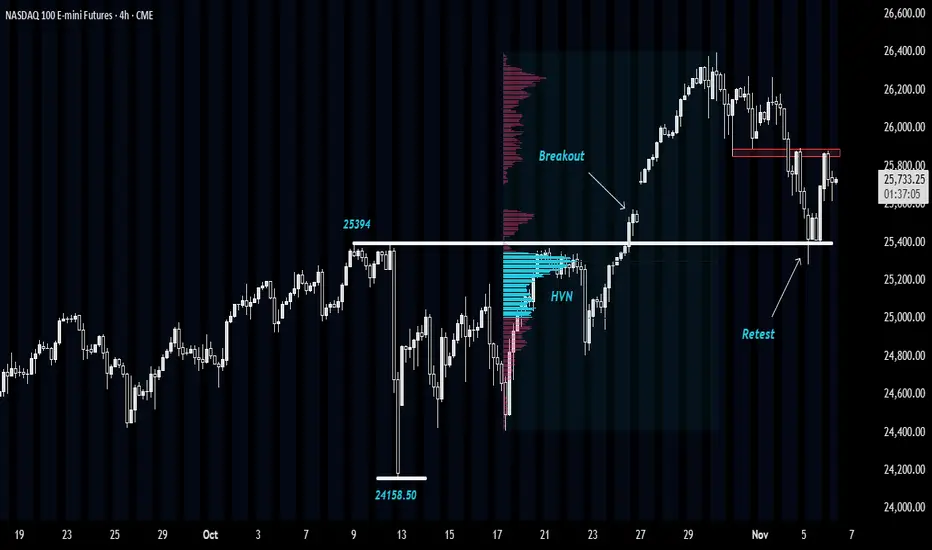
NASDAQ: Retesting Breakout ZoneThis idea is based upon successful Breakout Retest scenario near a High-Volume Node (HVN).
Let's first get to the basics:
A successful Breakout Retest -
A breakout retest scenario occurs when the price breaks through a key level of support or resistance and then returns to test that same level before continuing in the breakout direction.
For example, if the price breaks above a resistance zone, traders wait to see if the price comes back down to that zone. If it holds as new support and shows rejection candles or strong buying, that’s called a successful retest.
At a successful retest, several things typically happen:
➡The old resistance acts as new support (or vice versa in case of breakdown).
➡Traders who missed the initial breakout enter the trade, adding momentum.
➡Weak hands or short-term traders exit, cleaning up the order flow.
➡The price often accelerates in the direction of the breakout with stronger conviction and volume.
In simple terms, a successful retest confirms that the breakout was genuine and not a false move.
High Volume Node -
HVN is a price level or zone on a volume profile where a large amount of trading activity has occurred. It represents an area where buyers and sellers actively agreed on price, leading to high transaction volume.
These zones usually act as balance areas- price tends to pause, consolidate, or even reverse near them because many traders have open positions there. When price revisits an HVN, it often encounters strong support or resistance, as market participants react to protect or exit their earlier trades.
In short, an HVN marks a fair value area on the chart where market consensus was strongest.
NASDAQ Analysis -
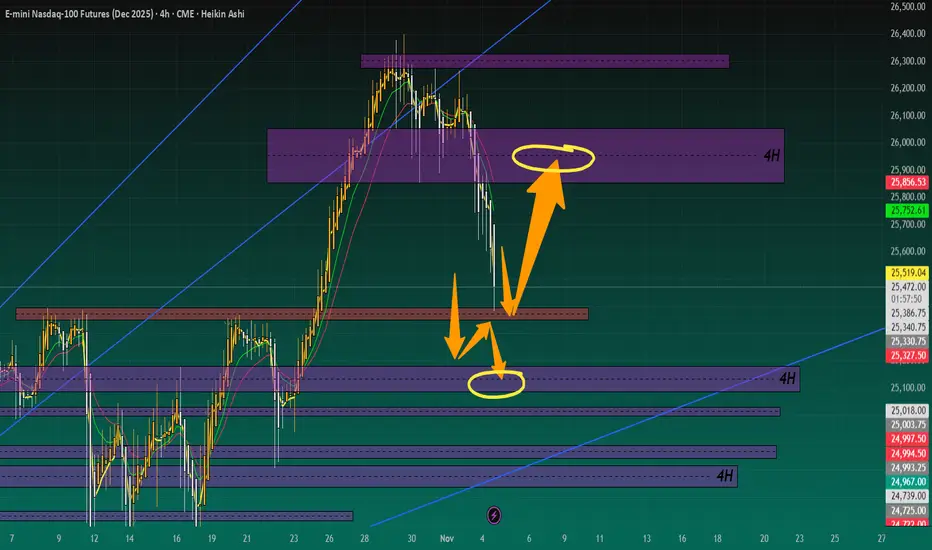
In the Nasdaq E-mini chart, we can observe a sharp decline from 25,394 to 24,158, but without any meaningful follow-through on the downside.
Subsequently, the price reacted once again from this same zone on 21st and 22nd October, before eventually breaking above 25,394 with strong momentum to form new highs.
At present, the market has pulled back to the 25,394 level, which previously acted as resistance. This area is now holding as support, suggesting a successful retest and presenting a potential buying opportunity.
Moreover, this retest is aligning with a HVN around 25,300, further reinforcing the support zone.
In the short term, the price is facing resistance near 25,900. A conservative long entry could be considered after a sustained move above 25,900, while an aggressive low-risk entry could be initiated around 25,500, closer to support.
📣Disclaimer:
Everything shared here is meant for education and general awareness only. It’s not financial advice, nor a recommendation to buy, sell, or hold any asset. Do your own research, manage your risk, and make sure you understand what you’re getting into.
Trade ideas
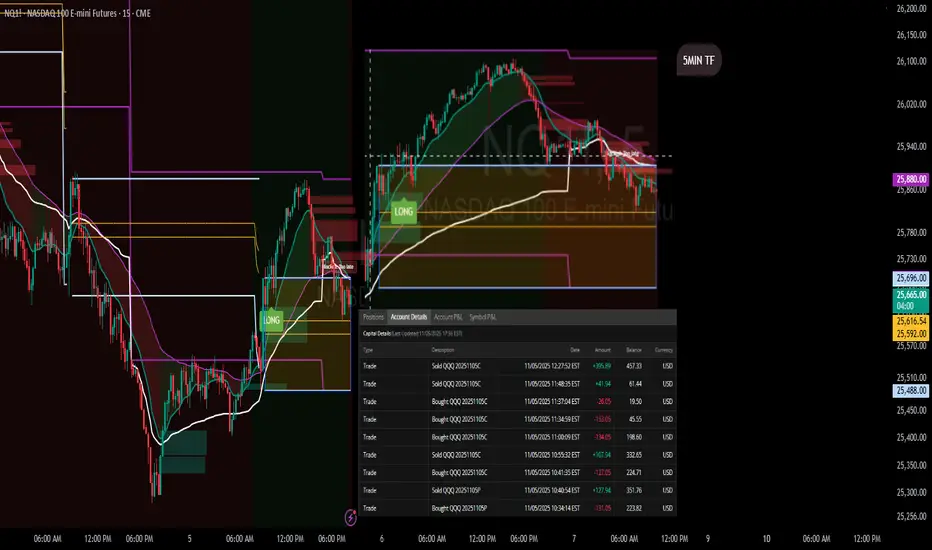
ORB Pro Signal Recap – Nov 5, 2025 | “Respect the Levels”Ticker: QQQ / NQ1! (5-min + 15-min TF)
Strategy: ORB Pro + Trendline Breakdown + Previous Day High Rejection
Focus: Signal confirmation & reaction zones
🧭 Market Context
The morning started strong, with buyers pushing off the open toward the previous day’s high (PDH) and ORB extension zone.
As price tapped the upper band, the ORB Pro system generated a clean long confirmation, aligned with the higher timeframe momentum.
But the rally quickly stalled at the PDH — a textbook reaction zone where the structure shifted.
From there, trendline breakdowns on both 5-min and 15-min charts confirmed exhaustion, and the system correctly prevented new long entries once momentum failed.
💹 Trade Breakdown
Initial Long: Taken on ORB Pro signal confirmation near the intraday retest (strong follow-through into PDH).
Profit-Take Zone: Price rejected sharply at the PDH and VWAP cluster — partials locked.
No Chasing: After the rejection, ORB Pro flagged “Blocked / Too Late,” keeping risk managed while trend flattened.
Result: Finished the day green with multiple small wins across calls — +$89.68 net on the $623C and +$15.89 on $626C.
📊 Performance Summary
Symbol Side Contracts Net Result
QQQ $623C Long 2 +$89.68
QQQ $626C Long 1 +$15.89
QQQ $622P Short hedge 1 –$3.11
Total P/L + $102.46 (Realized)
📈 Chart Recap
Price pushed through the early range with momentum but stopped exactly at the previous day’s ORB high and Fib confluence.
That rejection aligned perfectly with the HTF resistance zone on both 5-min and 15-min TFs.
The chart shows two green “LONG” entries and a clean signal fade once volume dropped —
a prime example of respecting structure over bias.
💡 Key Takeaways
PDH = Reaction Zone: Don’t ignore prior highs — they mark algorithmic defense zones.
Trust the Filters: ORB Pro prevented chasing the failed continuation after PDH rejection.
Structure First: The trendline breakdown confirmed what price was already telling us.
🧘♂️ Reflection
“The system signaled the move early, and I followed structure. PDH rejection confirmed the top, and discipline locked the profit. The goal wasn’t to predict — it was to react with control.”
Educational video. Hit the 'LIKE' button if this helped you.This is my thought process on how to trade. If you would like me to post more recorded videos like this.. or even when I am in a trade , please feel free to 'COMMENT' below this video. This is my logic on the market and this is why my name is NASDAQNYK. You dont need 20 indicators on your charts, you dont need anything but your eyes and 3 confluences to determine your typical entry and exit. Trading is only hard when you make it hard.
REMOVING NASDAQ FROM MY TRADING PLANTransition Note – Focusing Exclusively on EUR/USD
After several months of structured testing and data collection, I’ve decided to permanently remove the NASDAQ (US100) from my analytical framework and trading routine.
While the index offers remarkable volatility and potential, my recent journal review made something clear: the NASDAQ does not align with my strategy’s statistical edge.
The asset’s internal structure — heavily driven by algorithmic order flow and micro-volatility — tends to invalidate setups based on value zones, Wyckoff redistribution, and delta imbalances, which are the core of my system.
In contrast, EUR/USD consistently responds to institutional behavior:
clear dealing ranges and discount/premium rotations,
stronger respect for volume-based structures,
and predictable liquidity flow across sessions.
The data is objective:
• Win rate on NASDAQ – 38%
• Payoff ratio – 1.1:1
• Net result – negative
• Win rate on EUR/USD – 52%
• Payoff ratio – 2.16:1
• Net result – strongly positive
Therefore, all future macro and technical publications will focus exclusively on EUR/USD, with no further NASDAQ breakdowns or updates.
My aim is to refine precision, deepen macro integration (liquidity, yields, policy cycles), and operate where the statistical edge truly exists.
Consistency begins with focus — and mine is now 100% on the euro.
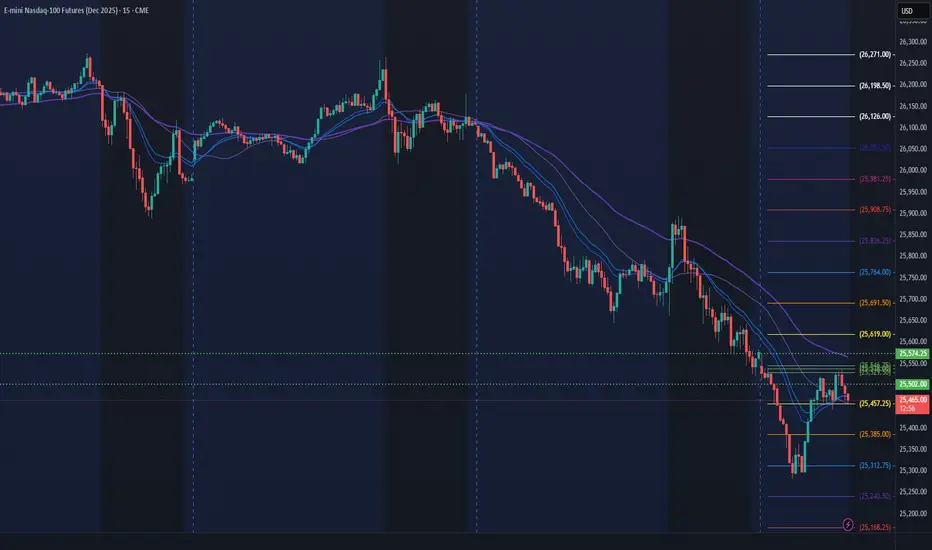
NQ Power Range Report with FIB Ext - 11/4/2025 SessionCME_MINI:NQZ2025
- PR High: 25574.25
- PR Low: 25501.75
- NZ Spread: 161.75
Key scheduled economic events:
09:15 | ADP Nonfarm Employment Change
10:00 | ISM Non-Manufacturing PMI
- ISM Non-Manufacturing Prices
10:45 | S&P Global Services PMI
Session Open Stats (As of 12:45 AM)
- Session Open ATR: 401.88
- Volume: 92K
- Open Int: 290K
- Trend Grade: Long
- From BA ATH: -3.5% (Rounded)
Key Levels (Rounded - Think of these as ranges)
- Long: 26636
- Mid: 25410
- Short: 24039
Keep in mind this is not speculation or a prediction. Only a report of the Power Range with Fib extensions for target hunting. Do your DD! You determine your risk tolerance. You are fully capable of making your own decisions.
BA: Back Adjusted
BuZ/BeZ: Bull Zone / Bear Zone
NZ: Neutral Zone
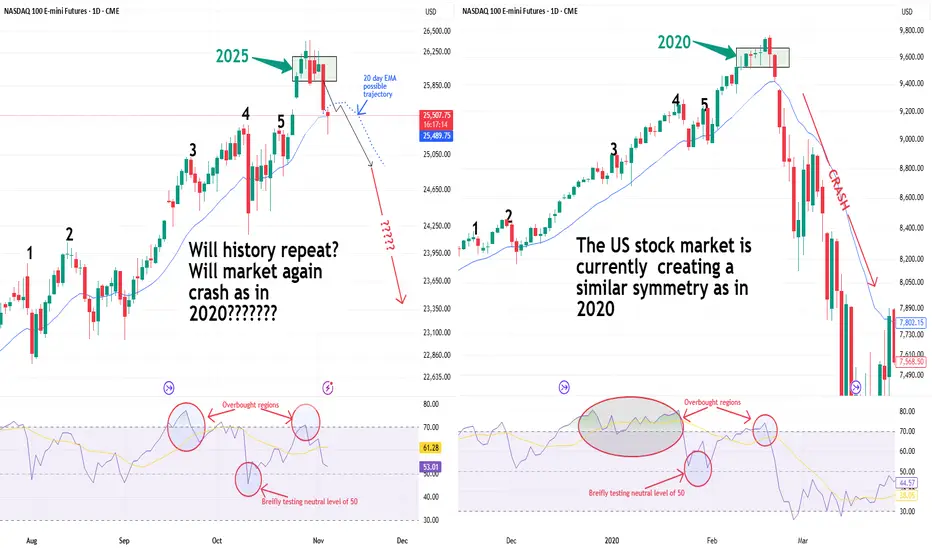
Will US Stock Market Crash Repeating 2020's TrajectoryThe NASDAQ 100 is creating a similar price action symmetry and RSI behavior to the pattern seen just before the 2020 crash.
* In 2020, this setup led to a sharp correction.
* In 2025, the symmetry looks almost identical.
Is it déjà vu — or just another pause before the next leg up?
Nasdaq Selloff Extends in Asia — But How Bad Is It, Really?Asian markets saw a second wave of selling today, with Nasdaq futures falling around 1% during Asian trade. After fielding several emails from journalists asking “why,” I can’t help but think this move may be more about technical repositioning after an extended run higher.
In this video, I walk through the monthly, weekly, and daily Nasdaq charts to share where I think we could go from here.
Matt Simpson, Market Analyst at City Index.
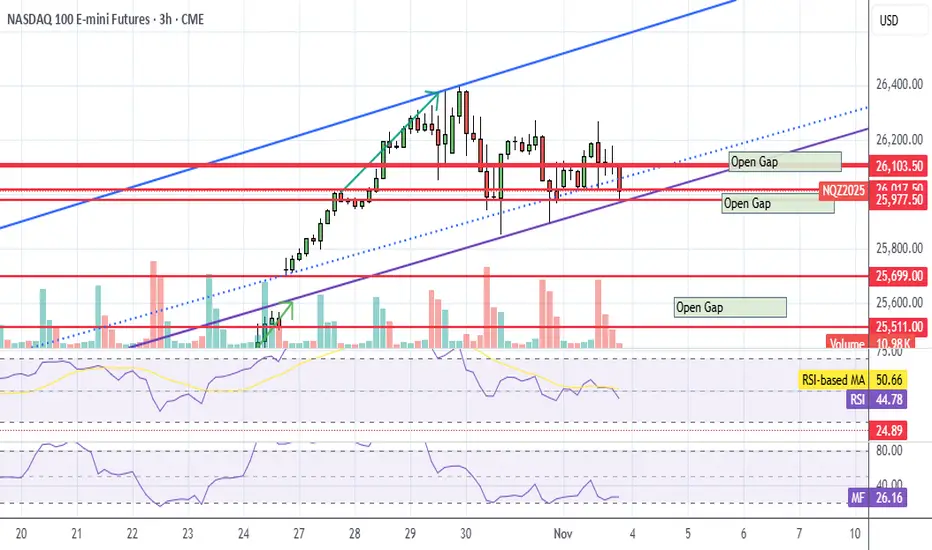
NQ UpdateI told everyone to stay bearish until the NQ gap fills. We're almost there, just a small gap left.
The big question is, does the TACO gap need to fill? 2 previous TACO gaps were left unfilled in the spring so I'm not sure. There is also a small gap above from yesterday afternoon.
If NQ breaks below the lower channel line then we know it's headed for TACO. (Today is Taco Tuesday at my local bar as well, lol)
The Empty Feeling After A WinA trader messaged me recently after closing a big win.
He said, “I should’ve felt great but I just felt… flat.”
That sudden emptiness after the high it’s more common than you think.
Follow along. I hope this helps.
BUT FIRST
NOTE – This is a post on mindset and emotion. It’s not a trade idea or system designed to make you money.
My intention is to help you preserve your capital, focus, and composure — so you can trade your own system with calm and confidence.
HERE’S WHAT HAPPENS
You execute beautifully.
Plan followed. Risk managed.
Trade hits target. Account up.
You should feel satisfied.
But instead… there’s a drop.
The charts look dull.
The mind goes searching.
“Maybe one more setup.”
“Just check the next pair.”
That’s not greed.
That’s chemistry.
When you’re in a trade, your brain is flooded with dopamine the chemical of pursuit, anticipation and drive.
When you exit, that hit disappears almost instantly.
To the nervous system, that chemical drop feels like loss .
And loss, even after a win, triggers the instinct to get it back.
WHAT’S REALLY GOING ON UNDERNEATH
You’re not chasing profit.
You’re chasing stimulation, the feeling of being alive in the action.
The mind interprets that feeling as boredom or missed opportunity.
But really, it’s your biology craving more.
The subconscious has learned to equate stillness with emptiness.
So it pushes for movement to escape the come-down.
That’s why so many traders give back profits after doing everything right.
They’re not making bad decisions.
They’re trying to fix a feeling.
HOW TO CATCH IT BEFORE IT CATCHES YOU
1️⃣ Notice your come-down cue.
After closing a trade, does your body feel restless?
Do you scroll, check charts, or reopen the platform out of habit?
That’s the withdrawal in motion.
2️⃣ Name it, don’t fight it.
Say it internally: “This is dopamine dropping.”
It takes the mystery out of the urge.
3️⃣ Breathe through the drop.
A long exhale through the mouth… six seconds out tells the body it’s safe.
Let your eyes rest on something still.
4️⃣ Reframe the pause.
That quiet space after a win isn’t emptiness.
It’s integration.
It’s the moment your nervous system resets for the next run.
Trading mastery isn’t just execution.
It’s emotional regulation before, during and after execution.
I put a lot of time and thought into every post that goes out here so I appreciate your support.
Thank you
NASDAQ (NQ1!) – Bearish Divergence Potential PullbackOn the 1-hour chart, a clear bearish divergence has formed at recent highs, aligning with loss of bullish momentum and price rejection near the upper trend channel. The short-term structure suggests sellers may gain control, with potential retracement zones around the 0.5–0.618 FIB levels and an unfilled GAP below.
If price confirms continuation after a minor relief bounce, we could see a corrective wave unfold before the broader uptrend resumes.
Bias: Short-term Bearish – looking for retracement opportunities toward key support levels before potential trend continuation.
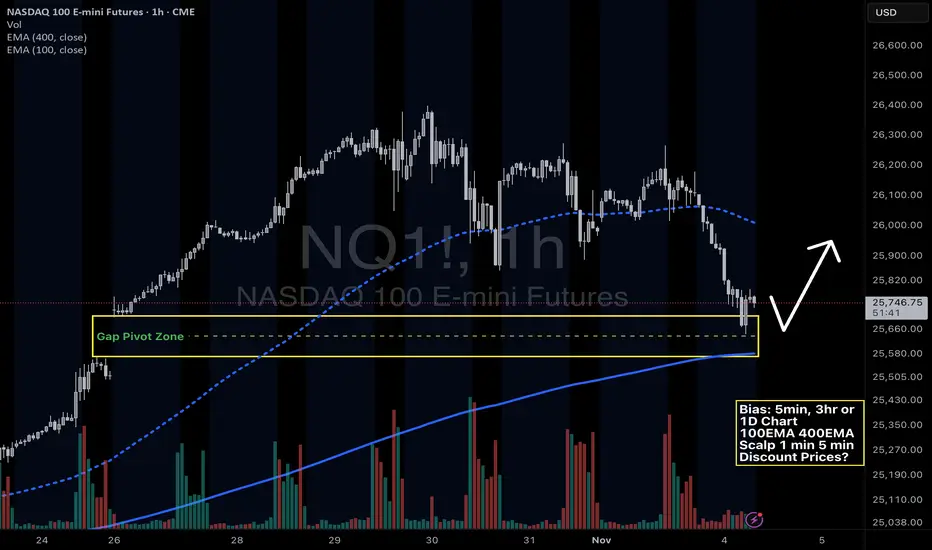
Nasdaq NQ - tapping into previous Gap Pivot ZoneNQ -Nasdaq Futures- pulled all the way back to the previous Gap up zone from October 26, 2025. Also, confluence with the 1 hour 400 EMA. Does this signal a bounce opportunity? Or does this signal that there will be a major news event that will occur? Is the market predictive of real life?
Will History Repeat Itself? NASDAQ 2025 vs 2020The NASDAQ 100 is currently showing a striking structural symmetry to the 2020 pre-crash formation.
Both phases formed a 5-wave impulsive rally, followed by tight consolidation near highs — a typical distribution top pattern.
The 20-day EMA is starting to flatten, signaling a possible loss of momentum.
If symmetry continues, the index could mirror a short- to mid-term correction, similar to early 2020’s breakdown.
While macro conditions differ today, market behavior often repeats in fractal patterns — a reminder that price structure often precedes headlines.
📊 Keep watch for a confirmed EMA rollover and breakdown below support near 25,500 — that could validate the bearish symmetry.
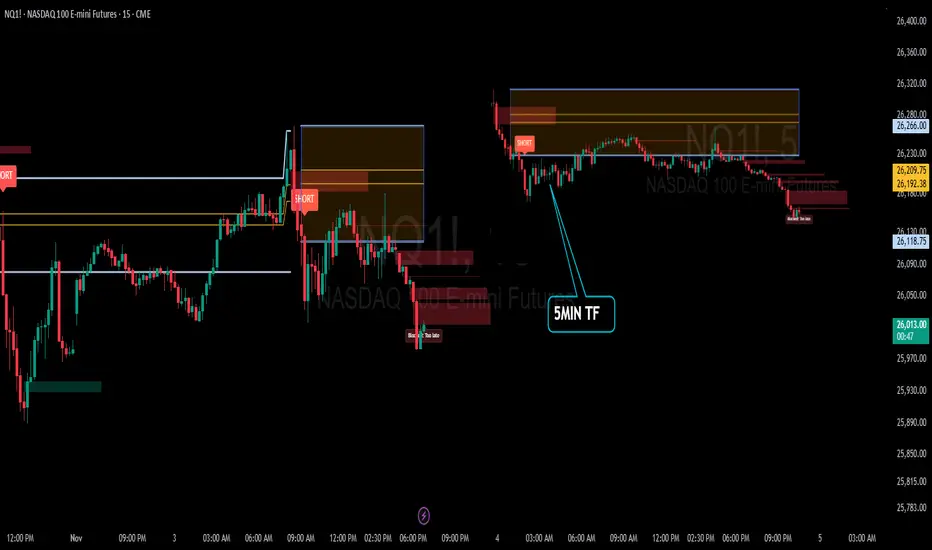
Recap: ORB Pro in Action | “Discipline > Direction”Date: November 3rd 2025
Ticker: QQQ / NQ1! (5-min TF)
Strategy: ORB Pro + Golden Pocket Retest + Volume Filter
Focus: Trend confirmation & controlled execution
🧭 Market Context
The morning opened sideways inside the ORB range — no clean conviction early on.
Around mid-morning, sellers gained control as lower highs formed beneath the EMA band and the Golden Pocket retest (0.5/0.618) failed with volume confirmation.
That break produced the clean short setup of the day, perfectly aligned with the higher-timeframe (HTF) downtrend.
🧠 Trade Review
Early Entries: Entered pre-confirmation and took initial heat.
Mid-Morning Setup: All filters aligned — EMA, volume, HTF direction. This was the textbook short that delivered follow-through.
Late Session Attempts: Momentum faded after lunch, with signals correctly blocked as “Too Late.”
Result: Several small wins offset by early losses, closing the day + $7.34 realized P/L after fees.
📊 Performance Snapshot
Metric Value
Win Rate ≈ 42 %
Best Trade + $287.94
Largest Loss – $189.05
Net Result + $7.34 (Realized)
Setup Accuracy High — execution mixed
📈 Chart Breakdown
The 5-minute chart highlighted a short trigger around 26 260 – 26 280, with smooth continuation into ORB extensions.
The ORB Pro filter marked “Blocked / Too Late” after the move — confirming that the system logic protected capital from late chases.
💡 Key Takeaways
Patience > Prediction — early entries rarely pay off.
Protect Green — partial profit lock once 1 R:R is reached.
System Strength — ORB Pro continues to validate structure when filters align.
🧘♂️ Reflection
“The system nailed the move — I jumped early. Still finished green, proving that execution discipline is the real edge. Tomorrow’s goal: one clean setup, one confident hold, and protect the profit.”
🧩 Next Steps
✅ Wait for full confirmation before entry
✅ Hold until 1:2 R:R min
✅ Avoid re-entries once HTF zone is tapped