Ode to Joy Jr.Buy the Dips worked well.
He always waits for a bounce in a BTD area (accumulation/distribution area). He buys 1 MNQ in 5-point intervals. Every target is 21 points. His first entry was 610 and his bottom entry was 490.
He has entered NQ Breakouts. First entry at 620 and every 20 points thereafter. 19-point target per entry.
If you prefer The MNQ Ladder of success you may buy 1 or more contracts every 5 points. 19-point target per entry. If you prefer 1 or more contracts every 10 points.
Ode to Joy Jr. because I think the original may have been taken down by the moderators.
Trade ideas
Monitoring AI Valuation - Precision on Upcoming CorrectionThese are the three largest market-cap listed companies on the Nasdaq.
If we are concerned about an AI bubble, I’m going to show you how I perform a quick glance at some top companies and their index to determine the likelihood of an upcoming short-, mid-, or long-term correction.
In 2017, Microsoft’s P/E reached its highest at 45 — and it continued to rise after that.
In 2023, Nvidia’s P/E reached its highest at 147 — and it continued to rise after that.
In 2024, Apple’s P/E reached its highest at 40 — and it continued to rise after that.
Micro E-mini Nasdaq-100 Index
Ticker: MNQ
Minimum fluctuation:
0.25 index points = $0.50
Disclaimer:
• What presented here is not a recommendation, please consult your licensed broker.
• Our mission is to create lateral thinking skills for every investor and trader, knowing when to take a calculated risk with market uncertainty and a bolder risk when opportunity arises.
CME Real-time Market Data help identify trading set-ups in real-time and express my market views. If you have futures in your trading portfolio, you can check out on CME Group data plans available that suit your trading needs www.tradingview.com
BULLISHNQ
BIAS: BULLISH
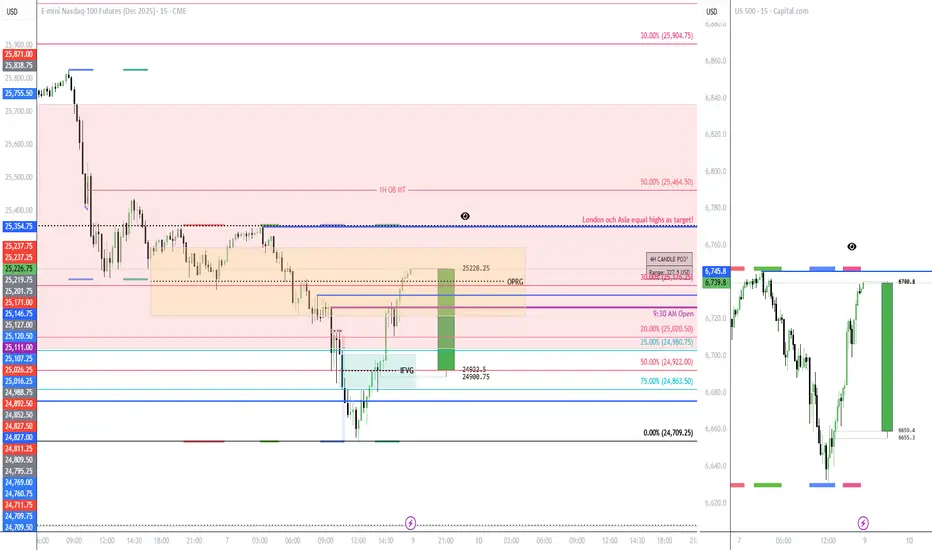
DAILY: Price is currently above the daily -OB MT. Yesterday, price retraced to the 4H + inversion fair value gap and respected this discount array and took off.
PDH & Asian High (equal highs): Has been raided ahead London opening plus the Old High on Thursday Nov. 06, 2025. Then it retraced lower filled the 1H +FVG between 11:00pm and 1:00am
PRE-MARKET: NQ and ES made a LL whereas YM failed to make a LL. There's a cracking correlation here (SMT).
BUYSIDE TARGET: LONDON HIGH @25,830.25 and DAILY -FVG Low end @ 25,881.00
NQ Daily Outlook | November 11th, 2025As expected NQ pushed higher during Asia session. 1hr has been trending nicely above the 50ema in black. I expect a bullish continuation London and NY. Lets see how price looks during London. Price can also pullback during London and continue during NY session so expect that too.
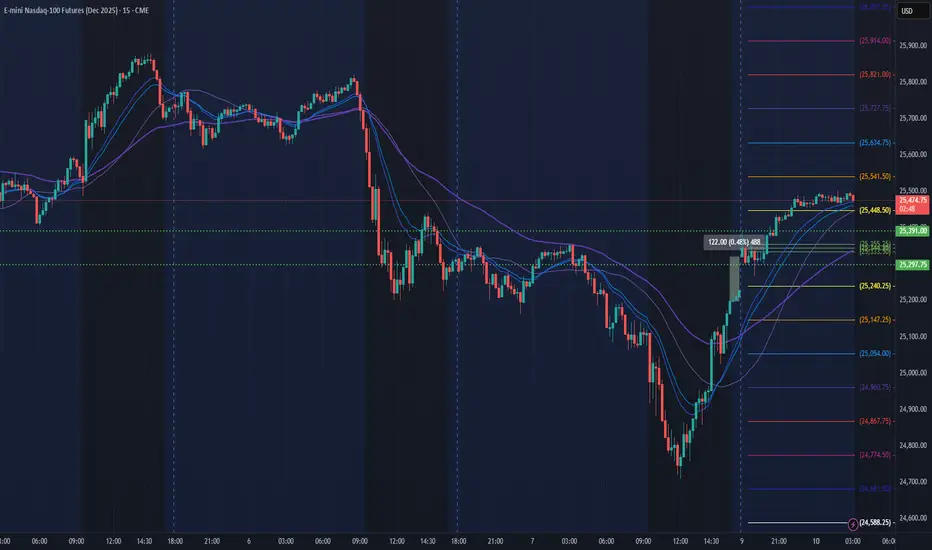
NQ Power Range Report with FIB Ext - 11/12/2025 SessionCME_MINI:NQZ2025
- PR High: 25673.50
- PR Low: 25629.50
- NZ Spread: 98.5
Key scheduled economic events:
13:00 | 10-Year Note Auction
Session Open Stats (As of 12:25 AM)
- Session Open ATR: 424.02
- Volume: 33K
- Open Int: 293K
- Trend Grade: Long
- From BA ATH: -2.6% (Rounded)
Key Levels (Rounded - Think of these as ranges)
- Long: 26636
- Mid: 25410
- Short: 24039
Keep in mind this is not speculation or a prediction. Only a report of the Power Range with Fib extensions for target hunting. Do your DD! You determine your risk tolerance. You are fully capable of making your own decisions.
BA: Back Adjusted
BuZ/BeZ: Bull Zone / Bear Zone
NZ: Neutral Zone
OPEC and Global Market Stability1. The Role and Objectives of OPEC
OPEC’s primary objective is to achieve stable oil prices in international markets while ensuring a fair return on investment for producing nations and a steady supply for consuming countries. To maintain balance, OPEC regulates oil production among its member nations, aligning supply with demand.
Market stability is central to OPEC’s philosophy. Volatility in oil prices—whether due to oversupply, underproduction, or external shocks—can harm both producers and consumers. For producers, low prices reduce revenue and strain national budgets; for consumers, excessively high prices trigger inflation and economic slowdowns. Thus, OPEC’s interventions are designed to prevent extreme price swings and promote predictability in global markets.
2. Mechanisms for Market Stability
OPEC uses a combination of strategies to achieve stability in the oil market:
a. Production Quotas:
The most significant tool is the allocation of production targets among member states. During times of excess supply, OPEC cuts output to prevent price declines; when demand rises or prices surge too high, it increases production. This mechanism acts as a balancing lever in the market.
b. Monitoring and Market Analysis:
OPEC maintains a highly sophisticated system of data collection and analysis. Through the OPEC Secretariat in Vienna, the organization constantly monitors global economic trends, oil inventories, demand projections, and supply disruptions. This allows OPEC to make informed decisions that align with global economic realities.
c. Cooperation with Non-OPEC Producers:
In recent years, OPEC has expanded its influence by forming alliances with non-member oil-producing countries, such as Russia, Mexico, and Kazakhstan. This collaboration, known as OPEC+, was formalized in 2016. The OPEC+ framework enhances OPEC’s control over the global oil supply, making it easier to stabilize prices in times of volatility.
3. OPEC’s Historical Impact on Market Stability
Since its inception, OPEC’s policies have shaped the evolution of global oil markets.
a. The 1970s Oil Crises:
During the early 1970s, OPEC gained significant power by using oil as a political and economic tool. The 1973 oil embargo, in response to Western support for Israel during the Yom Kippur War, caused prices to quadruple. Although disruptive, it demonstrated OPEC’s ability to influence global energy markets and highlighted the importance of energy security for consuming nations.
b. The 1980s Oil Glut:
In the early 1980s, technological advancements and overproduction led to a sharp fall in prices. OPEC responded by reducing output quotas, attempting to balance the market. However, disagreements among members limited effectiveness, underscoring the challenge of enforcing collective discipline.
c. The 2000s Oil Boom:
Rapid industrialization in China and India fueled a massive surge in global demand, leading to record-high oil prices. OPEC managed this period by gradually increasing production while maintaining relative market stability.
d. The 2020 COVID-19 Shock:
Perhaps the most dramatic test of OPEC’s stabilizing role occurred during the COVID-19 pandemic. In April 2020, global oil demand collapsed as travel and industrial activity halted. Prices even turned negative for a brief period. OPEC+, led by Saudi Arabia and Russia, implemented historic production cuts of nearly 10 million barrels per day to restore equilibrium. Within months, markets began recovering, showcasing OPEC’s ability to stabilize a crisis-driven market.
4. Challenges to OPEC’s Market Stability Mission
Despite its influence, OPEC faces multiple challenges in maintaining stability in today’s rapidly changing energy environment.
a. Internal Disagreements:
OPEC’s strength depends on collective compliance. Differences in economic needs, production capacities, and political agendas among member states often cause disputes. For instance, nations like Saudi Arabia prefer conservative production strategies, while others like Iran or Nigeria may push for higher output to meet domestic financial obligations.
b. Competition from Non-OPEC Producers:
The rise of shale oil production, particularly in the United States, has reduced OPEC’s market dominance. Shale oil’s flexibility—its ability to ramp up production quickly when prices rise—has weakened OPEC’s control over global supply dynamics.
c. Energy Transition and Climate Policies:
As the world shifts toward renewable energy and decarbonization, the long-term demand for oil may decline. This transition poses strategic challenges for OPEC, as it must adapt to a market where oil is no longer the primary source of energy. Balancing environmental commitments with economic survival remains a delicate task.
d. Geopolitical Tensions:
Many OPEC members are located in politically volatile regions. Conflicts in the Middle East, sanctions on countries like Iran and Venezuela, and regional rivalries can disrupt production and weaken the organization’s cohesion.
5. OPEC’s Modern Strategies for Stability
In response to evolving challenges, OPEC has refined its approach to market stability.
a. The OPEC+ Alliance:
The OPEC+ coalition has been a major innovation in global oil diplomacy. By bringing non-member producers into coordinated production agreements, OPEC has extended its reach beyond traditional boundaries. This broader coalition enhances the group’s capacity to respond to market shocks and maintain price stability.
b. Flexible Policy Frameworks:
OPEC now adopts a more flexible and data-driven approach. Instead of rigid annual quotas, it meets regularly to adjust policies based on real-time data. This agility allows quicker responses to demand changes, such as post-pandemic recovery or geopolitical disruptions.
c. Investment in Energy Technology:
Some OPEC members are diversifying their economies by investing in renewable energy, hydrogen, and carbon capture technologies. For example, Saudi Arabia’s Vision 2030 plan aims to reduce dependence on oil revenues and strengthen economic resilience. This diversification supports long-term market stability by mitigating risks from oil dependency.
6. OPEC’s Economic and Geopolitical Influence
OPEC’s role extends beyond oil markets—it significantly impacts global macroeconomic stability and international relations.
When OPEC successfully stabilizes prices, both producers and consumers benefit. Predictable oil prices allow governments to plan budgets, encourage investment, and maintain economic growth. Conversely, instability often leads to inflation, currency fluctuations, and trade imbalances.
Geopolitically, OPEC serves as a platform for dialogue between member nations, fostering cooperation in an otherwise fragmented global environment. Its coordination with non-OPEC producers has also strengthened diplomatic ties across continents.
7. The Future of OPEC and Market Stability
Looking ahead, OPEC’s relevance will depend on how effectively it adapts to a transforming global energy landscape. The push for carbon neutrality, electric vehicles, and renewable alternatives poses both threats and opportunities. While demand for oil may plateau in the coming decades, OPEC can continue to play a stabilizing role by ensuring orderly transitions in the energy market.
Future stability will likely involve balancing oil production with global sustainability goals, supporting cleaner technologies, and maintaining dialogue with both producers and consumers.
8. Conclusion
OPEC has been, and continues to be, a cornerstone of global market stability. Through production management, international cooperation, and adaptive policymaking, it has guided the oil market through crises, booms, and transitions. While challenges such as energy diversification, internal discord, and environmental policies loom large, OPEC’s experience and coordination capacity position it as a key player in shaping the future of global energy stability.
In essence, OPEC’s success in stabilizing markets lies not only in controlling oil output but in balancing the complex intersection of economics, politics, and sustainability in a world increasingly conscious of both energy security and environmental responsibility.
Elliott Wave Analysis of Nasdaq (NQ) Forecasts New All Time HighThe bullish cycle in the Nasdaq (NQ) that commenced from the April 2025 low remains underway, unfolding as an impulsive Elliott Wave structure. Within this broader advance, wave (3) of the eight-month rally concluded at 26,399. The subsequent corrective phase, wave (4), developed as a double three structure. This is an Elliott Wave pattern characterized by a combination of corrective sequences.
From the peak of wave (3), wave ((a)) declined to 25,853, followed by a rebound in wave ((b)) that reached 26,274. The final leg of the correction, wave ((c)), extended lower to 25,282, thereby completing wave W of a higher degree. A subsequent rally in wave X peaked at 25,880 before the index turned lower once more in wave Y, which has taken the form of a zigzag.
Within wave Y, wave ((a)) declined to 25,162, followed by a corrective bounce in wave ((b)) to 25,354.75. The final leg, wave ((c)), dropped to 24,707.1, marking the completion of wave Y of (4). From this low, the index has resumed its upward trajectory in wave (5). Advancing from wave (4), wave ((i)) topped at 25,768.75, and the pullback in wave ((ii)) found support at 25,478.50. Provided the pivot at 24,707.1 remains intact, the near-term outlook favors further upside continuation in wave (5)
NQ Daily Outlook | November 11th, 2025NQ has been trading above the 50ema since the open of the weekly candle. I want to see price push higher Asia session. We had a choppy Asia session and NY morning session on yesterdays daily candle so I'm expecting a push higher on this new Daily open.
Bias: Bullish expecting Asia to push higher, lets see...
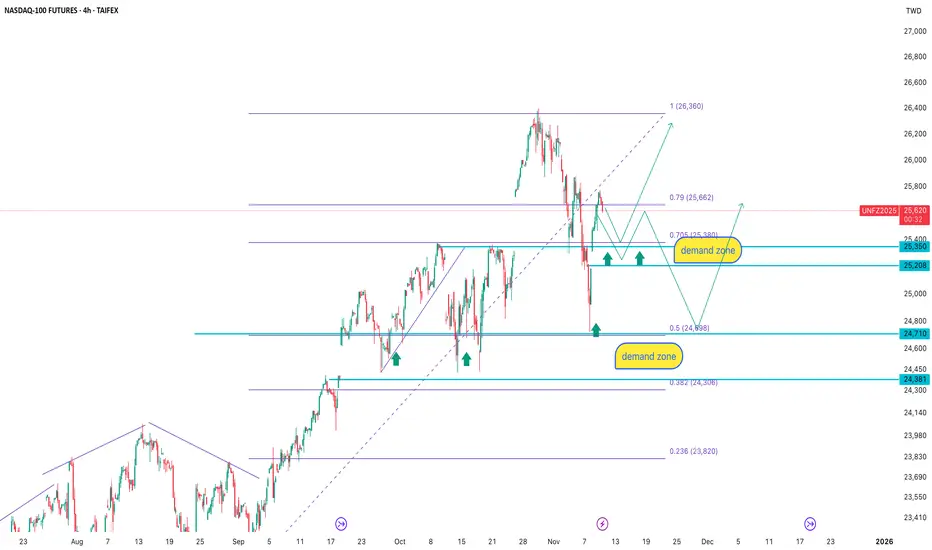
NASDAQ-100 4H: demand is not gone, only waiting for the priceAfter the recent upward impulse, the price retraced into the key demand zone at 25 350–25 208, an area that has repeatedly triggered buying reactions in the past. T
he latest correction pushed the price into the 0.79–0.705 Fibonacci range, which frequently acts as a retest zone before continuation.
Below that lies an even stronger demand zone at 24 710–24 381, aligning with the 0.5 Fibonacci level and previous volume accumulation.
The trading logic here is simple: don’t chase the move, let the price come to demand and wait for confirmation.
As long as the market structure holds, the primary scenario remains bullish from demand zones with a target toward 26 360 and potentially higher.
Fundamentally, NASDAQ remains supported by expectations of softer Fed policy, strong tech capital inflows, and continued investment in AI, cloud, and data-center infrastructure. Smart money accumulates on corrections, not on peaks.
When price falls into demand, it’s not fear — it’s opportunity.
Trades with B – Daily Recap (Nov 10 2025)Ticker: QQQ / NQ1!
Strategy: ORB Pro with Filters + 5 min / 15 min Multi-Timeframe Confluence
Result: Green day ✅ (+$97.78 total gain)
🧭 Market Context
The market opened inside an early consolidation range with mixed momentum. The 5-minute chart gave the first confirmation through a clean ORB signal rejection, while the 15-minute held the higher-timeframe structure and kept the EMA slope intact.
The plan today was simple — trade the first valid signal from ORB Pro, confirm with the higher timeframe trend, and respect stops.
🎯 Trade Execution Recap
9:37 AM: First Call entry (ORB signal + fib retest) — caught the initial push before stall. + $172.94
9:44 AM: Locked profits on strength into EMA resistance.
11:14 AM: Put entry after ORB Pro signaled a short on the 5 min matching 15 min trend.
11:40 AM: Exit for + $194.94 after momentum follow-through.
Cumulative Options P/L:
QQQ $618 Put (11/10/25) → + $67.89
QQQ $621 Call (11/10/25) → + $29.89
Net: + $97.78
💡 What Went Right
Followed the ORB signal with confirmation from the higher-timeframe trend filter.
Perfect execution on the Put trade — clean entry and timely exit.
Didn’t overstay the welcome once the move completed.
⚠️ What to Improve
Stay patient for stronger confluence before taking early entries.
Avoid re-entries once price returns to mid-range (less edge after initial break).
🧘♂️ Reflection
“The 5 min showed me the trigger, the 15 min confirmed the story. ORB Pro did its job — I just had to listen.”
Long trade
15min TF overview
Pair / Contract: MNQ1! (Micro E-mini Nasdaq-100 Index Futures)
Date: Mon 3 Nov 2025
Session: Tokyo Session → Pre-Asia to London Transition
Direction: Buy-side Trade
Timeframe: 15 minutes
🔹 Trade Details
Entry: 25 466.75
Take Profit (TP): 25 709.50 (+0.95 %)
Stop Loss (SL): 25 409.25 (–0.23 %)
Risk / Reward (RR): 3.14 R
🔹 Market Context
After a broad distribution → markdown sequence, price reached a high-volume imbalance zone near 24 900–25 000 — a previous accumulation base.
🧾The session opened with a liquidity sweep beneath prior low (24,875) → confirmed displacement above intraday structure.
🧾Multiple FVG patches stacked through 25 200–25 400 served as a refined entry trigger and confluence for continuation.
🧾Volume expansion into the retrace + KAMA flattening then uptick confirmed a shift in short-term bias to bullish.
🧾Target aligns with upper gap fill/supply zone ≈ 25 700 (level of previous imbalance).
🔹 Model Type
Accumulation → FVG Continuation Model
Displacement leg established structural BOS above 25,300.
Entry taken on retrace into discount FVG and breaker block confluence zone (25 460–25 420).
Price objective: recovery into the premium zone (gap-fill @ 25 700).
🔹 Execution Notes
Entry triggered after observing a clean MSB on the 5-minute chart, with confirmation of a candle close above KAMA. Stop set below FVG origin (25,409) to maintain a tight risk. Partial profits secured at 25,600 region before NY open volatility. Risk controlled with FVG-based entry for ~3 R return potential within the session window.
5min TF overview
🔹 Trade Narrative
This MNQ setup represents a reversal transition from a bearish liquidity flush into a controlled markup. The combination of volume absorption at the low, multiple FVG alignments, and a clear BOS confirm smart-money accumulation. With strong confluence from session timing and gap magnet at 25,700, this position targets a measured buyside retracement within a broader range-bound context.
NQ = NAS100Elite Strategy
NASDAQ (MNQ/NQ) – Multi-Timeframe Analysis
Price tapped into the 45-minute imbalance inside a 4H premium zone. The overall structure remains bearish, and the reaction confirms sellers defending this level.
Expecting continuation toward 25,300 and possibly 25,000 as the next liquidity zones.
Key confluence: 4H bearish structure + 45m FVG + liquidity grab on 5m.
📊 Educational analysis — not financial advice.
-------
Higher-Timeframe Context (4H Chart)
🔹 Overview
The 4H chart shows a clear bearish structure: lower highs and lower lows.
Price dropped aggressively from the 26,300–26,400 supply zone (blue).
The market then found strong demand at 24,800–25,000 (blue + gray confluence zone).
Current price is reacting to a 45-minute fair value gap (FVG) marked in red, sitting inside a bearish 4H imbalance.
🔹 Implications
The FVG at 25,550–25,600 represents a premium retracement level in a bearish leg.
This area is optimal for short-position entries as price taps into unmitigated imbalance.
Expectation: rejection → continuation toward 25,300 or lower, targeting the demand zone (24,900–25,000).
_______
Lower-Timeframe Confirmation (5-Minute Chart)
🔹 What’s happening now
Price just filled the 45-minute gap and reached the same supply zone.
Microstructure shows a slowdown + rejection wick from the red zone.
Potential entry trigger for short bias around 25,555–25,590.
Targets:
1st TP: 25,400 (internal liquidity)
2nd TP: 25,300 (structural low)
Stop-loss above 25,595 (above FVG).
🔹 Confluence
4H + 5M both align: bearish reaction at premium zone.
The liquidity buildup under 25,400 acts as the next target area.
NQ Power Range Report with FIB Ext - 11/10/2025 SessionCME_MINI:NQZ2025
- PR High: 25391.50
- PR Low: 25297.50
- NZ Spread: 210.0
No key scheduled economic events
Session Open Stats (As of 2:25 AM)
- Session Open ATR: 439.66
- Volume: 53K
- Open Int: 297K
- Trend Grade: Long
- From BA ATH: -3.4% (Rounded)
Key Levels (Rounded - Think of these as ranges)
- Long: 26636
- Mid: 25410
- Short: 24039
Keep in mind this is not speculation or a prediction. Only a report of the Power Range with Fib extensions for target hunting. Do your DD! You determine your risk tolerance. You are fully capable of making your own decisions.
BA: Back Adjusted
BuZ/BeZ: Bull Zone / Bear Zone
NZ: Neutral Zone
NQ / NASDAQ 100 Futures – Bullish & Bearish ScenariosNQ is currently sitting between a rising higher-timeframe trendline and a short-term descending trendline from the local top. Market is basically coiling — waiting for a direction.
Bullish Case
If buyers continue to defend the 24,850–24,950 swing low area and NQ can push back above the 25,580–25,640 zone, that would show the down-move was just a pullback into trendline support.
Break and hold above 25,640 opens the door to 25,900–26,000
Strength above 26,000 targets the previous supply zone near 26,200–26,350
Bullish structure stays valid as long as 24,850 holds.
Bearish Case
If price rejects at the descending trendline again and fails to reclaim 25,580–25,640, sellers are still in control short-term.
A breakdown below 24,850 followed by a weak retest would confirm the trendline failure.
First downside levels: 24,600, then 24,350
Losing 24,350 starts a deeper correction toward 24,000
Bears only gain real control below 24,850.
Bottom Line
The market is compressing. The real move comes on the break + retest of either:
25,640 to the upside → continuation long
24,850 to the downside → momentum shifts lower
No need to guess direction inside the wedge — react when one side wins.