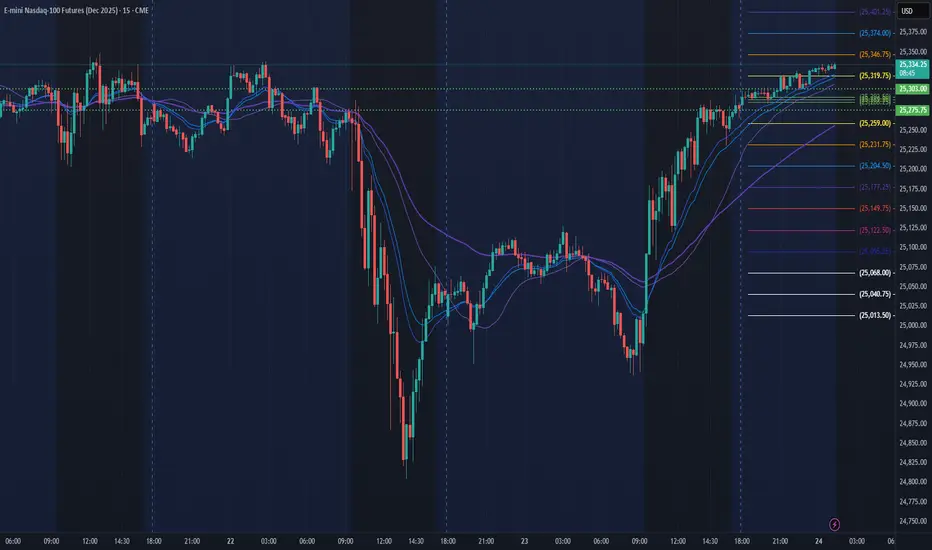
Target areas - NQ price for Market open.10/27/25 - These are the target areas - NQ price for Market open depending if price moves up or down. Will look for trades into these areas.by SoSo-Trader0
NQ = week 44T.A explained - BS & FS levels are expected support when dashed lines, tested when dotted and resistance when solid lines. The inverse is true for the Inv. BS Inv. FS levels, they are resistance as dashed lines, tested as dotted and support as solid lines. Monthly timeframe is color pink weekly grey daily is red 4hr is orange 1hr is yellow 15min is blue 5min is green if they are shown. strength favors the higher timeframe. 2x dotted levels are origin levels where trends have or will originate. When trends break, price will target the origin of the trend. its math, when the trend breaks, the vertex breaks too so the higher timeframe level/trend that breaks, the more volatility there could be as strength in the orders flow in to fuel the move.by StudyGuideTA3
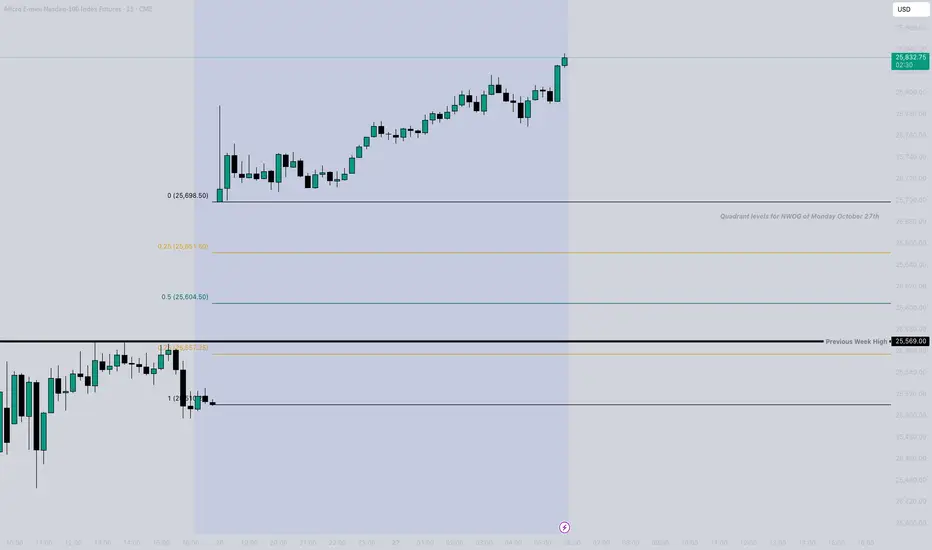
Monday October 27th New Week Opening Gap! Price created a huge gap this week that I will be shifting my attention to going into this weeks trading. I want to keep an eye for how price will likely use this NWOG with lots of medium and high impact news coming into this week as well. No news today so I won't be expecting anything extreme for a casual Monday trade but more focusing on what clues price can leave us that will give us a clear direction for the remainder of the week. Longby c-algotrades116
PRICE FLOW MNQZ2025This week, the price flow, for this week we are going to look for a rebalance and we will have sales. First, we expect the price to reach the level of $25,788, then we will look for sales down to 25,290. Be attentive to the economic calendar, which can cause significant distortions in the price path performance. by jmatehus900
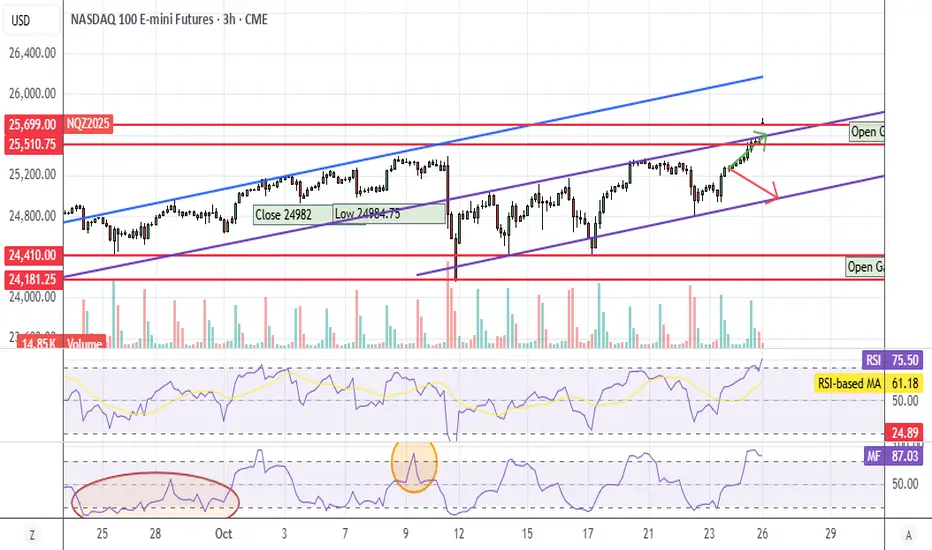
NQ UpdateGap up on trade news, actually regained the previous channel which is why it exceeded my target. I projected a melt up this week, that's all I can say. MFI and RSI overbought but doesn't matter in a melt up. I think the market will go down and fill the gap but not until next week.by hungry_hippo3
NASDAQ 100 (NQ1!): Bullish! Buy The Dips!Welcome back to the Weekly Forex Forecast for the week of Oct. 27 - 31st. In this video, we will analyze the following FX market: NASDAQ (NQ1!) NAS100 The NASDAQ closed last week at ATHs. I expect more of the same next week. Look for valid dip buying opportunities, my friends. If the market disrespects the +OB, then buys become invalidated. Enjoy! May profits be upon you. Leave any questions or comments in the comment section. I appreciate any feedback from my viewers! Like and/or subscribe if you want more accurate analysis. Thank you so much! Disclaimer: I do not provide personal investment advice and I am not a qualified licensed investment advisor. All information found here, including any ideas, opinions, views, predictions, forecasts, commentaries, suggestions, expressed or implied herein, are for informational, entertainment or educational purposes only and should not be construed as personal investment advice. While the information provided is believed to be accurate, it may include errors or inaccuracies. I will not and cannot be held liable for any actions you take as a result of anything you read here. Conduct your own due diligence, or consult a licensed financial advisor or broker before making any and all investment decisions. Any investments, trades, speculations, or decisions made on the basis of any information found on this channel, expressed or implied herein, are committed at your own risk, financial or otherwise.Long07:01by RT_Money5
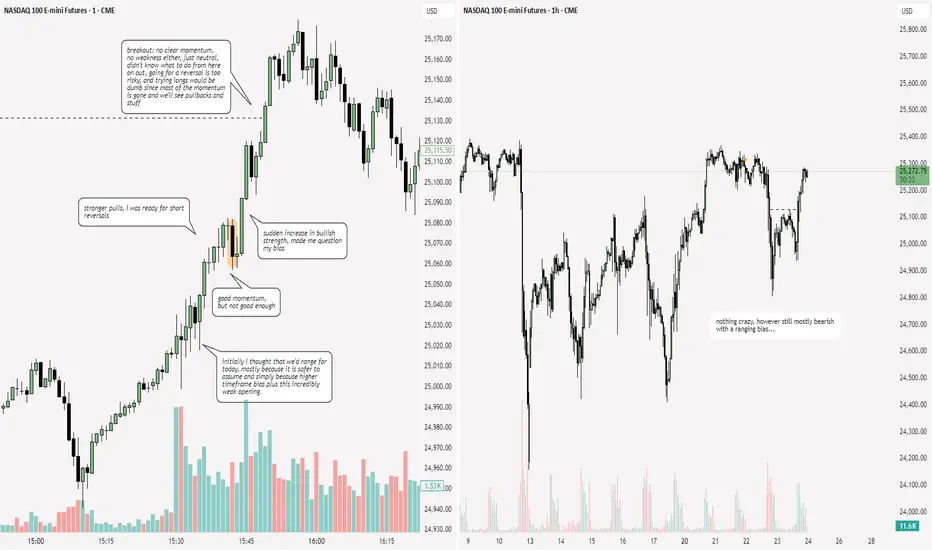
NQ: 275th trading session - recapNothing happened yet again, just another session just for the books here. I will trade tomorrow hopefully, I've been sickby GRBmlr1
NQ OUTLOOK FOR UP COMINGWe broke an all-time high last week, and we are currently above the 50/200 EMA. A fair value gap is present on the one-hour/4-hour time frame that is close to the previous resistance or break of structure, and TP2 is in play. If it breaks and closes above the last week high, look for the fair value gap to touch for an buy entry. If the market close above the previous 4-hour candle from last week, look for it to take out the current month high, technically it works OK, but if the president says or does something, throw the technicians out the window, stop your loss, and don't be greedy.02:16by Stewnomics4
HEY NAZ, WHATS NEWS GONNA MAKE YOU DO?! NAZ Bias-Bearish(personally) HOWEVER----- Let price show us the way. I believe that price will be looking for key levels to bounce around on before making its true climb or decline. The reason I am bearish this week is the belief that negative news is coming and a lack of pullbacks on daily/HTF charts. So sauce.... Im looking for price to come down and hit a fibs retracement at this FVG for a GOOD BUY bounce! Around 25,428-25,394! First, setup; after that, the IPP (important price point) to look at will be how price interacts with 25,509-25,491. If it doesn't break above on a higher time frame, I believe we push LL to hit BIG FVG 25,214!! which i really want to buy from there but if it breaks above we can see a strong retest of SOB and HH's! Either way, WE GET PAID! Sitting on my hands until the price shows me where we're riding! GDluckThisWeek and happy hunting!Shortby TaYbTrading5
NQ Week 43Updated levels for week 43 BS & FS levels are expected support when dashed lines, tested when dotted and resistance when solid lines. The inverse is true for the Inv. BS Inv. FS levels, they are resistance as dashed lines, tested as dotted and support as solid lines. Monthly timeframe is color pink weekly grey daily is red 4hr is orange 1hr is yellow 15min is blue 5min is green if they are shown. strength favors the higher timeframe. 2x dotted levels are origin levels where trends have or will originate. When trends break, price will target the origin of the trend. its math, when the trend breaks, the vertex breaks too so the higher timeframe level/trend that breaks, the more volatility there could be as strength in the orders flow in to fuel the move.by StudyGuideTAUpdated 10
Can NQ1! Push Through $25K+ Resistance Zone?🎯 The Great NQ Heist: Layered Entry Strategy for E-Mini NASDAQ-100 Futures 📊 Market Overview **Asset:** NQ1! (E-Mini NASDAQ-100 Futures) **Strategy Type:** Swing/Day Trade - Wealth Accumulation Map **Bias:** 🐂 **BULLISH** 🎭 The "Gentleman Thief" Layering Strategy 💰 Entry Philosophy: Layer Like a Pro This setup uses a **sophisticated layering approach** - think of it as strategically placing multiple limit orders to capture the best average entry. You're not going all-in at one price; you're building your position like a chess master. 📍 Suggested Layer Entry Zones: - 🎯 Layer 1: **24,800** - 🎯 Layer 2: **24,900** - 🎯 Layer 3: **25,000** - 🎯 Layer 4: **25,100** Note: You can scale in at ANY price level using this layering method. Add more layers based on your position size and risk tolerance. The beauty of this strategy is flexibility - enter where the market gives you opportunity! 🎪 🛡️ Risk Management Stop Loss Zone: **24,700** ⚠️ **Important:** This is MY stop loss level based on technical structure. However, trading is a personal journey - YOU decide your own risk parameters. Protect your capital first, profits second. Your SL should align with YOUR risk tolerance and account size. 🎯 Profit Target Target Zone: **25,600** 🚀 This level represents a confluence of: - 💪 Strong resistance zone - 📈 Overbought conditions - Potential bull trap area **Smart Exit Strategy:** As we approach this zone, consider scaling out of positions. Don't get greedy - take profits when the market offers them! ⚠️ **Reminder:** This is MY target projection. You're the captain of your own ship - take profits when YOU feel comfortable. Trail stops, scale out, or hold for moon - your money, your rules! 🌙 🔗 Related Pairs to Watch Keep your eyes on these correlated instruments - SEED_ALEXDRAYM_SHORTINTEREST2:NQ =F** - NASDAQ-100 Futures (spot reference) - NASDAQ:QQQ - Invesco QQQ Trust (ETF equivalent) - NASDAQ:AAPL , NASDAQ:MSFT , NASDAQ:NVDA , NASDAQ:GOOGL ** - Top NASDAQ-100 components - NASDAQ:NDX - NASDAQ-100 Index (cash) - CME_MINI:ES1! - E-Mini S&P 500 Futures (broader market correlation) 📌 Why these matter:** The NASDAQ-100 is tech-heavy, so major tech stocks drive NQ movement. Watch QQQ for retail sentiment and ES for overall risk appetite. When big tech moves, NQ follows! 💻 🎓 Strategy Breakdown This "layering" or "scaling-in" approach offers several advantages: - ✅ **Better average entry** - Dollar-cost averaging into position - ✅ **Reduced timing risk** - Not dependent on perfect entry - ✅ **Psychological comfort** - Builds confidence as position develops - ✅ **Flexibility** - Adapt to market conditions in real-time 📢 Final Thoughts The market rewards patience and discipline. This layered entry strategy is about working WITH the market, not against it. Whether you're a swing trader holding for days or a day trader scalping ticks, the principle remains: **Control your risk, let profits run.** 🏃♂️💨 ✨ **If you find value in my analysis, a 👍 and 🚀 boost is much appreciated — it helps me share more setups with the community!** **⚠️ DISCLAIMER:** This analysis represents a "gentleman thief" style layered trading strategy intended for educational and entertainment purposes only. This is NOT financial advice. Trading futures involves substantial risk of loss and is not suitable for all investors. Past performance is not indicative of future results. Always trade with risk capital you can afford to lose. Make your own trading decisions based on your personal risk tolerance, account size, and market analysis. 🎭📊 #NQ1 #NASDAQ100 #NASDAQFutures #EminiNQ #FuturesTrading #DayTrading #SwingTrading #TechnicalAnalysis #LayeringStrategy #ScalingIn #TradingSetup #FuturesMarket #TechFutures #NDX #QQQ #RiskManagement #TradingStrategy #MarketAnalysis #BullishSetupLongby The-ThiefUpdated 1
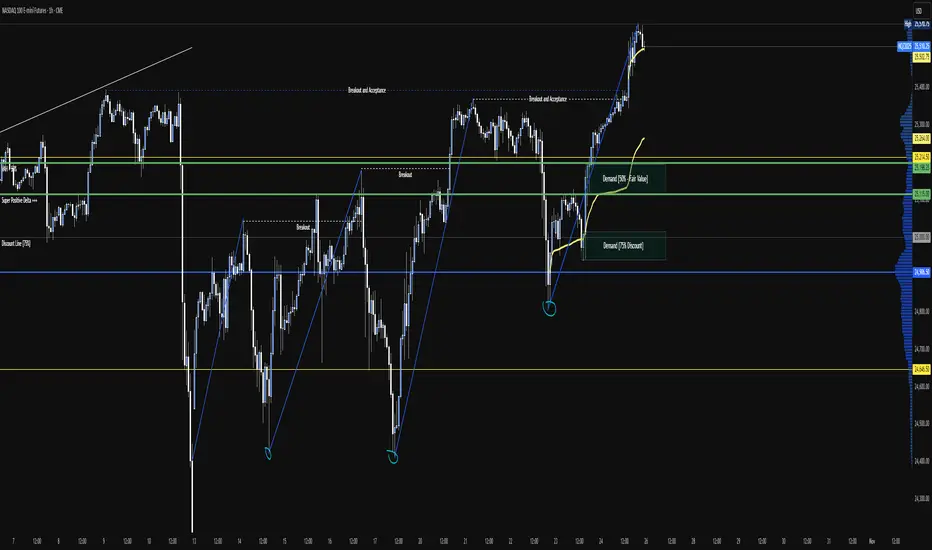
NQ - LONG SETUP AND STUDY ABOUT FAIL BEARISH CONTINUATIONContext: CPI was already priced higher, anchoring expectations toward a risk-on sentiment. Two VWAPs are now in play: VWAP 1 – Origin of the Swing: drawn from the structural reversal low (failed bearish continuation). VWAP 2 – Macro Event Anchor: anchored at the CPI release on Oct 24, 2025, serving as an institutional reference point until the next major macro event (Big Tech earnings next week). Market Structure: After three consecutive bearish structural failures and three long breakouts with acceptance, the bias had already shifted before the violation of 23,395. The final breakout and acceptance realigned all timeframes to a long structural bias. Operational Framework: Macro Value Area (VAH): acts as resistance-turned-demand zone. Discount Zone: preferred re-entry area. Trigger: Reaccumulation or failed new low pattern inside value. VWAP 1 + VWAP 2 confluence: defines fair value equilibrium and directional conviction. Revision Note: When sellers fail to extend a bearish range in index markets, all short setups must be reviewed. The structural bias in equity indices remains long by default — short efficiency must be proven, not assumed.Longby philipemav0
NQ Range (10-20-25, Week 4)NAZ is traveling within the Churn Zone, looking for a Breakout. Favoring a lower move prior to an upside Breakout. Scalping Shorts to KL's until "all hell breaks loose". Lower CZ currently is providing U Turns with the BTD/FOMO's redirecting the NAZ. The O/N, Dead Zone Lifting while the Open Drive continues to sell off. We have seen double Pump/Dumps after any O/N drop or Open Drive sell off. Will update as we go. Shortby MAZingUpdated 373717
NQZ2025 Return to Wick 50% then liquidity purgeOn the 4h chart, I see price close above the 50% of a 4h Order Block and above a 1h gap. I think the market has a high probability of treating the gap as an inversion, that, with the confluence of DXY purging shorts and the weekly wick 50%. Therefore, the next likely target is the liquidity resting above.Longby JustAltexUpdated 228
Target areas - NQ price for Market open.10/24/25 - These are the target areas - NQ price for Market open depending if price moves up or down. Will look for trades into these areas.by SoSo-Trader1
Charts for Friday! Good Luck, Trade in between the lines!Price on the 1H has already closed about midpoint of the 4H zone. In this case we have a break out up to the previous trendline to either retest or reject... We also can have price comeback and retest the level it just broke and either go up or down from there... Be aware of the pullbacks! I will post a updated chart for the week on Saturday night.Longby NasdaqNyk6
NQ & ES Premarket Comment Friday 24-10-2025Good morning everyone. Today we are operating within a Premium Zone. After witnessing price extend beyond the indices’ all-time highs (ATHs), our focus now shifts exclusively to short opportunities, should they arise. We’re trading within an extended upper range where only short setups make sense following the market’s open. It’s TGIF Strategy mode today — the goal is to target lower clusters/liquidity zones and aim for a weekly close below the highs. Our key objectives are the internal liquidity pools, fair value gaps (FVGs), and most importantly, the mean line (equilibrium point). Stay disciplined and patient. When price aligns with your personal model’s rules and confirms your bias — execute the short. If confirmation doesn’t come, do nothing. Let the market deliver its lessons. See you later in the final commentary of the week. PFShortby FTAKAS1
Bullish continuation for NASDAQ? 📊 CME_MINI:NQZ2025 Analysis – Oct 18, 2025 🧠 Market Context: Price recovered back into Premium of range (the upper part of the current weekly range) after the drop to 24,158. Creating an inside week that managed to provide a Bullish close. Inside Week consolidated in an 1H frame. Price currently upper band (Premium) of 1H consolidation. Trapped Sellers at discount of 1H range which happens to be previous week Opening Gap High area. Lack of US scheduled Red Folder news until Friday morning. 8:30am 📕 Core CPI m/m 📕 Weekly wick 50% at 25196 📕 CPI y/y 9:45am 📕 Flash Manufacturing PMI 📕 Flash Services PMI Price referencing areas between 25,050–25,210. Premium of a weekly range. 🔼 There are several thing to note here: 🎯 Daily wick 50% at 25121.75 🎯 Weekly wick 50% at 25196 🎯 A Daily REQ Close and Open ( Origin of Weekly Short) at 25354.00 🎯 And REQ (Relative Equal) Highs and ATHs (All Time Highs) at 25394.00 Price can continue to explore Premium of weekly range using these as targets but keep in mind the potential for weakness and reversal formations along these levels. High timeframe bias as well as structure still Bullish, keeping in mind that Price is currently within a Bearish Range (Friday October 10, 2025) Mondays PA and range might clarify wether Bias will remain Bullish, or if there will be any more signs of weakness and reversal formations. 🔻 There are several thing to note on the short side here: 🙁 Trapped Sellers ( Passive Liquidity) at discount of 1H Range and accumulation or Lower Band. 📉 Week Opening Gap (Reference partially) at discount of bigger range 📉 Weekly Low at 24410.00 📉 Previous Weekly Low at 24158.50 🧩 Context: Still questioning whether Fridays drop could be labeled as Price displacement and considered signal, or Rebalance. The difference will be noticed Mon-Tues. Still uncertain on 💲 Dollar TVC:DXY Pending Bullish continuation confirmation or reversal back into chop. Longby JP_TruUpdated 449
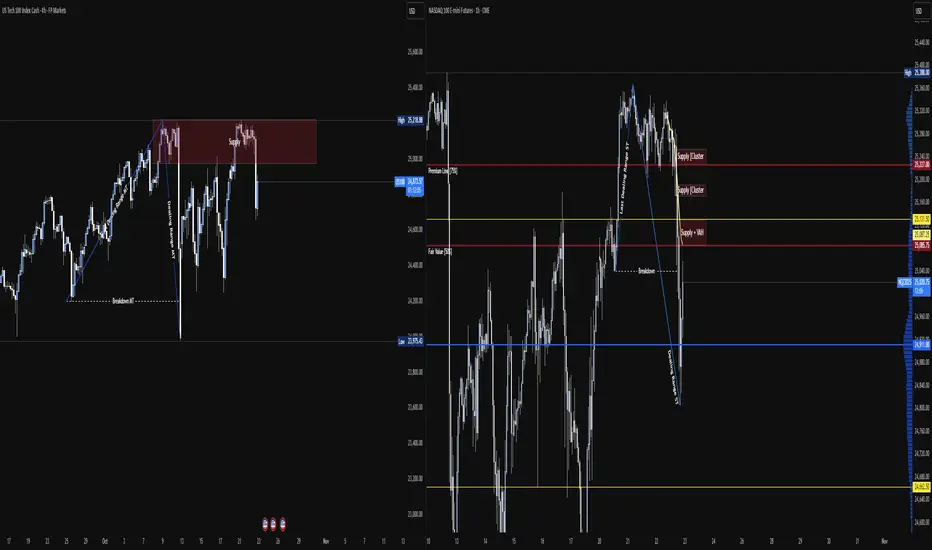
NASDAQ 100 - US100 // Short Setup Macro Overview After the daily structure break, the market retraced into the origin supply zone, confirming the redistribution phase. Today, price re-entered the macro Value Area and is now approaching the VAH, where institutional activity may lead to a new redistribution cycle toward the lower value edge (VAL). The medium-term bias remains bearish — the short-term structure has realigned with it. Context Summary – Daily: confirmed bearish structure after origin breakdown. – Re-entry into macro VA after short-term extension. – VAH at 25,130–25,227 aligns with supply + negative delta clusters. – Fibonacci 0.75 level (25,228.50) marks the center of premium liquidity. – Bias remains short below VAH. Execution Plan Bias: Short Entry Zone: 25,087.50 → 25,228.50 (Supply + VAH + 0.75 Fib) Stop Loss: 25,370 TP1: 24,800.00 TP2: 24,650.50 (VAL) Trigger: Redistribution on negative delta cluster near VAH. Shortby philipemavUpdated 6
Bond Market Overview in Global TradingIntroduction The global bond market is one of the largest and most influential components of the financial system, often considered the backbone of global capital markets. Bonds—also known as fixed-income securities—represent loans made by investors to borrowers, typically governments, municipalities, or corporations. In return, the borrower agrees to make periodic interest payments (coupons) and repay the principal at maturity. With a total value exceeding $130 trillion globally, the bond market surpasses the global equity market in size. It serves as a vital mechanism for governments to finance deficits, corporations to raise capital, and investors to achieve stable income streams. In global trading, bonds play a key role in portfolio diversification, interest rate management, and economic stability. 1. The Structure of the Global Bond Market The bond market can be broadly divided into sovereign bonds, corporate bonds, and municipal or supranational bonds. These segments cater to different types of issuers and investors: 1.1 Sovereign Bonds Sovereign bonds are issued by national governments to fund public spending, infrastructure projects, and fiscal deficits. Examples include U.S. Treasuries, UK Gilts, German Bunds, and Japanese Government Bonds (JGBs). They are considered the safest instruments in their respective countries, especially when denominated in a nation’s own currency. The U.S. Treasury market is the largest and most liquid, serving as a global benchmark for interest rates and risk-free returns. 1.2 Corporate Bonds Corporations issue bonds to finance operations, mergers, or expansion without diluting ownership through equity issuance. Corporate bonds typically carry higher yields than government bonds due to increased credit risk. They are classified as: Investment Grade Bonds: Issued by companies with strong credit ratings (e.g., Apple, Microsoft, Nestlé). High-Yield or Junk Bonds: Issued by companies with lower credit ratings, offering higher returns to compensate for default risk. 1.3 Municipal and Supranational Bonds Municipal bonds (or “munis”) are issued by states or local governments, primarily in the U.S., to finance public infrastructure like schools, hospitals, or transportation systems. Supranational organizations—such as the World Bank, IMF, or Asian Development Bank—also issue bonds to support global development initiatives. These bonds are typically low-risk due to strong institutional backing. 2. How the Bond Market Works 2.1 Primary Market The primary market involves the initial issuance of bonds. Governments issue bonds via auctions, while corporations issue through underwriters in public or private placements. The primary market provides direct funding to issuers. 2.2 Secondary Market Once issued, bonds trade in the secondary market, where investors buy and sell existing bonds. Prices fluctuate due to changes in interest rates, inflation, credit ratings, and market sentiment. Major secondary markets include the U.S. Treasury market, the London bond market, and electronic platforms like Tradeweb and MarketAxess. Liquidity in these markets ensures that investors can easily adjust portfolios and manage risks. 3. Key Features and Metrics Understanding the global bond market requires familiarity with core concepts: 3.1 Coupon Rate The coupon rate is the fixed or floating interest rate paid by the bond issuer to the bondholder. For instance, a 5% coupon bond with a $1,000 face value pays $50 annually. 3.2 Yield Bond yield reflects the effective return an investor earns. It varies inversely with bond prices—when interest rates rise, bond prices fall, and yields increase. Common types include: Current Yield Yield to Maturity (YTM) Yield Spread (difference between yields of two bonds) 3.3 Duration and Convexity Duration measures a bond’s sensitivity to interest rate changes. Longer-duration bonds experience greater price volatility. Convexity refines this measure, accounting for nonlinear changes in prices relative to yields. 3.4 Credit Rating Credit rating agencies—such as Moody’s, S&P Global, and Fitch—assess the creditworthiness of issuers. Ratings range from AAA (highest quality) to D (default), guiding investors on risk levels. 4. Participants in the Global Bond Market The bond market brings together a diverse set of participants: Governments: Issuing debt to fund national spending or manage monetary policy. Corporations: Raising long-term capital for expansion. Institutional Investors: Pension funds, insurance companies, and sovereign wealth funds seeking stable returns. Central Banks: Managing monetary policy by buying or selling bonds (quantitative easing or tightening). Retail Investors: Accessing bonds through ETFs or mutual funds. In global trading, institutional investors dominate due to the market’s scale and complexity, though retail participation has grown with digital bond platforms. 5. Global Bond Market Instruments The diversity of instruments reflects varying risk appetites and investment horizons: 5.1 Fixed-Rate Bonds These bonds pay a constant coupon over their lifetime. They offer predictability, making them popular among conservative investors. 5.2 Floating-Rate Notes (FRNs) Coupon payments adjust based on a benchmark rate (e.g., LIBOR, SOFR). FRNs protect investors from rising interest rates. 5.3 Zero-Coupon Bonds Issued at a discount, these bonds pay no periodic interest but return the face value at maturity. They appeal to long-term investors seeking capital appreciation. 5.4 Inflation-Linked Bonds Examples include U.S. TIPS and UK Index-Linked Gilts, which adjust coupon and principal payments for inflation, preserving real returns. 5.5 Convertible Bonds Hybrid securities allowing investors to convert bonds into equity under certain conditions. These offer growth potential alongside fixed-income stability. 5.6 Green and Sustainable Bonds These fund environmentally friendly or socially responsible projects. The green bond market has surged past $2 trillion, reflecting global ESG investment trends. 6. Importance of Bonds in Global Trading Bonds serve several crucial functions in international finance: 6.1 Capital Formation They enable governments and corporations to raise large amounts of capital efficiently. 6.2 Benchmark for Interest Rates Sovereign bonds—especially U.S. Treasuries—serve as global benchmarks for interest rates, influencing mortgage rates, corporate debt costs, and derivatives pricing. 6.3 Portfolio Diversification Bonds typically have low correlation with equities, reducing overall portfolio volatility. 6.4 Safe Haven Investment During economic uncertainty, investors flock to high-grade government bonds, particularly U.S. Treasuries, as a refuge from market turbulence. 6.5 Monetary Policy Tool Central banks use bond markets to influence liquidity and interest rates. For example, through open market operations or quantitative easing (QE). 7. Factors Influencing Bond Prices and Yields Bond performance depends on macroeconomic and market dynamics: 7.1 Interest Rates The most critical factor—bond prices move inversely to interest rates. When central banks raise rates to combat inflation, existing bond prices fall. 7.2 Inflation Higher inflation erodes the purchasing power of fixed returns, reducing bond attractiveness unless yields rise accordingly. 7.3 Credit Risk Downgrades in an issuer’s credit rating or default concerns can cause sharp price declines, especially in corporate or emerging market bonds. 7.4 Currency Movements Global investors face exchange rate risk when investing in foreign bonds. A weaker local currency can erode returns. 7.5 Economic and Political Stability Geopolitical tensions, wars, or policy uncertainty often drive investors toward stable, developed-market bonds. 8. Major Global Bond Markets 8.1 United States The U.S. bond market, led by Treasury securities, is the most liquid and widely traded globally. Corporate bond trading is also highly active, supported by transparent regulations and deep investor demand. 8.2 Europe The Eurozone bond market includes government bonds from Germany, France, and Italy, as well as Eurobonds—international bonds denominated in euros but issued outside the Eurozone. 8.3 Asia-Pacific Japan, China, and India have growing bond markets. Japan’s low-yield JGBs influence global interest rate dynamics, while China’s bond market—now the world’s second largest—has opened to foreign investors via programs like Bond Connect. 8.4 Emerging Markets Countries like Brazil, Mexico, Indonesia, and South Africa issue sovereign and corporate bonds that offer higher yields but carry elevated currency and credit risks. 9. Technological and Regulatory Developments 9.1 Digital Bond Trading Technological platforms have transformed bond trading from traditional over-the-counter (OTC) methods to electronic trading networks. Platforms such as Bloomberg, MarketAxess, and Tradeweb enhance transparency, liquidity, and efficiency. 9.2 Blockchain and Tokenization Blockchain technology allows tokenized bonds—digital representations of bond ownership on secure ledgers. These innovations promise faster settlement, lower costs, and greater accessibility. 9.3 ESG and Sustainable Finance Regulations Regulatory bodies in the EU and other regions are promoting green disclosure frameworks, ensuring transparency in ESG-linked bonds. 9.4 Monetary and Fiscal Coordination Global bond markets increasingly reflect coordinated central bank actions, as seen during COVID-19 stimulus efforts and post-pandemic tightening cycles. 10. Challenges and Risks Despite its stability, the bond market faces key challenges: Rising Interest Rates: As central banks tighten monetary policy, bond prices decline, causing capital losses. Sovereign Debt Crises: Excessive government borrowing (e.g., Greece 2010, Argentina 2018) can trigger market shocks. Liquidity Risk: In less developed or high-yield markets, bonds may be hard to sell quickly. Currency Volatility: Cross-border investors face exchange rate fluctuations that impact returns. Climate Risk: Environmental disasters and transition risks can affect bond valuations, especially for sectors with high carbon exposure. 11. The Future of the Global Bond Market The future trajectory of the global bond market will be shaped by technological innovation, sustainable finance, and monetary policy evolution. Digital Bonds and tokenized securities are expected to revolutionize issuance and settlement. Green and social bonds will continue expanding, aligning finance with climate goals. Artificial intelligence and data analytics will enhance credit risk assessment and trading strategies. Interest rate cycles post-2025 will redefine global yield curves as inflation stabilizes. Furthermore, greater participation from retail investors and emerging economies will democratize bond investing, creating a more balanced and inclusive market. Conclusion The global bond market is an intricate, dynamic, and essential part of the international financial system. It serves as a source of funding for governments and corporations, a tool for investors to earn stable income, and a mechanism for central banks to execute monetary policy. In an era of technological transformation and shifting geopolitical landscapes, the bond market’s role remains indispensable in balancing risk, facilitating investment, and promoting economic growth worldwide. As sustainability, innovation, and global integration advance, bonds will continue to anchor financial stability and serve as a foundation for responsible global trading.Educationby GlobalWolfStreet6
NQ Power Range Report with FIB Ext - 10/24/2025 SessionCME_MINI:NQZ2025 - PR High: 25303.00 - PR Low: 25276.00 - NZ Spread: 60.5 Key scheduled economic events: 08:30 | CPI (Core|MoM|YoY) 09:45 | S&P Global Manufacturing PMI - S&P Global Services PMI 10:00 | New Home Sales AMP Futures temporarily setting US Equity Indices Margins to 25% for expected volatility spike for U.S. Economic News Releases Session Open Stats (As of 12:55 AM) - Session Open ATR: 385.77 - Volume: 20K - Open Int: 284K - Trend Grade: Long - From BA ATH: -0.2% (Rounded) Key Levels (Rounded - Think of these as ranges) - Long: 26020 - Mid: 23571 - Short: 21939 Keep in mind this is not speculation or a prediction. Only a report of the Power Range with Fib extensions for target hunting. Do your DD! You determine your risk tolerance. You are fully capable of making your own decisions. BA: Back Adjusted BuZ/BeZ: Bull Zone / Bear Zone NZ: Neutral Zone Longby mv3trader50
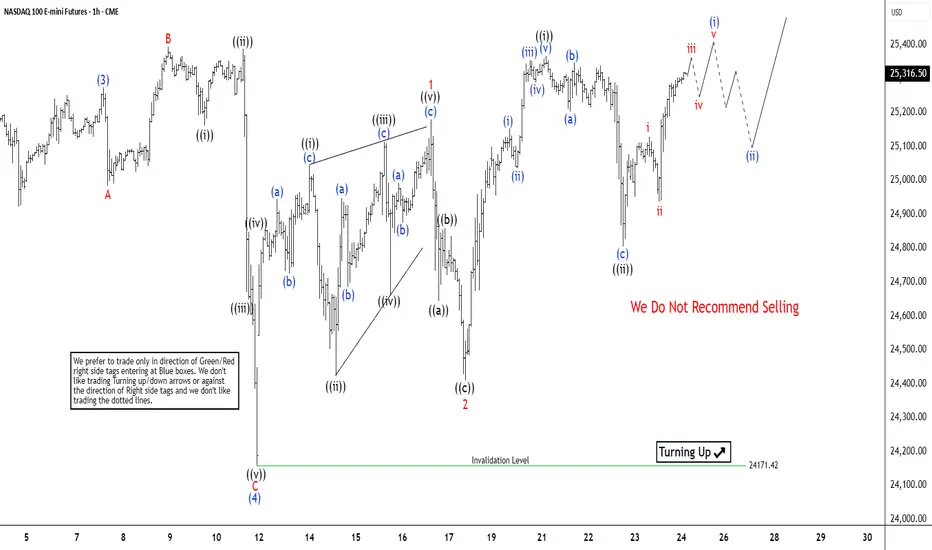
Nasdaq Futures (NQ) Targeting Wave (5) Upside Nasdaq Futures (NQ) advances steadily toward completing the cycle that originated at the April 7, 2025 low. The index targets a fresh all-time high. This rally develops as a textbook impulsive structure. Wave (3) culminated at 25,275. Wave (4) then corrected lower and finished at 24,166.26. The 1-hour chart captures this progression clearly. The internal structure of wave (4) took the form of an expanded flat. Wave A ended at 24,984.75. The Index then rallied in Wave B to 25,394. Wave C completed the pattern with a decline to 24,166.26. Wave (5) now drives the index higher. From the wave (4) low, wave 1 rose to 25,179.5 and formed a leading diagonal. Wave 2 pulled back to 24,410. The advance then nested with wave ((i)) peaking at 25,368 and wave ((ii)) finding support at 24,804.75. This nesting confirms the underlying bullish trend. Provided prices hold above 24,166.26, any near-term dip should attract buyers at the 3, 7, or 11 swing levels, aligning with structural support zones. Upside momentum remains intact. The minimum target extends from the October 21, 2025 high. An inverse Fibonacci retracement of 123.6% to 161.8% yields a range of 25,490 to 25,701, consistent with classic wave extensions.by Elliottwave-Forecast9
NQ: 274th trading session - recapNun much again, mostly also for the books but atleast today price action wasn't as ugly as it normally is...by GRBmlr0