#ETH/USDT forms bullish patterns#ETH
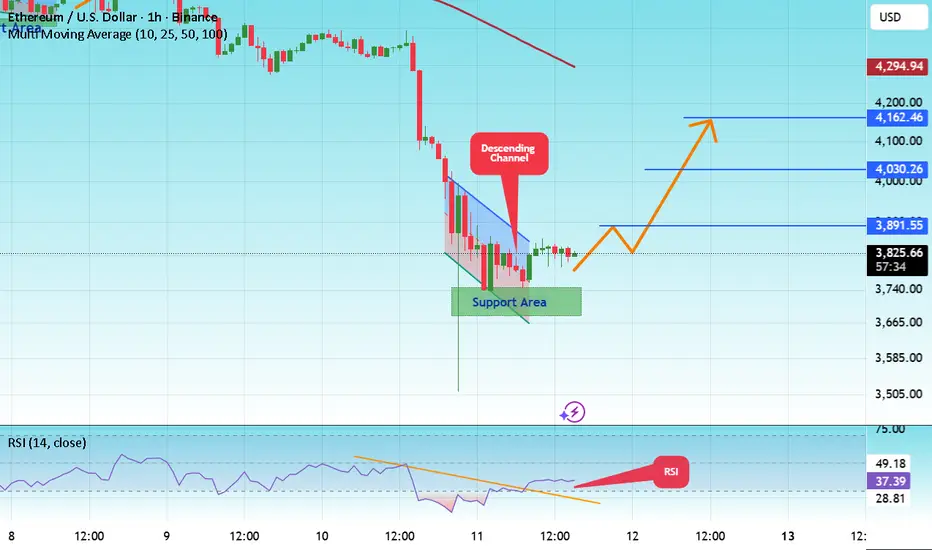
The price is moving in a descending channel on the 1-hour frame and is expected to break and continue upward.
We have a trend to stabilize above the 100 moving average once again.
We have a downtrend on the RSI indicator that supports the upward move with a breakout.
We have a major support area in green that pushed the price higher at 3700.
Entry price: 3817.
First target: 3890.
Second target: 4030.
Third target: 4162.
To manage risk, don't forget stop loss and capital management.
When you reach the first target, save some profits and then change your stop order to an entry order.
For inquiries, please comment.
Thank you.
Trade ideas
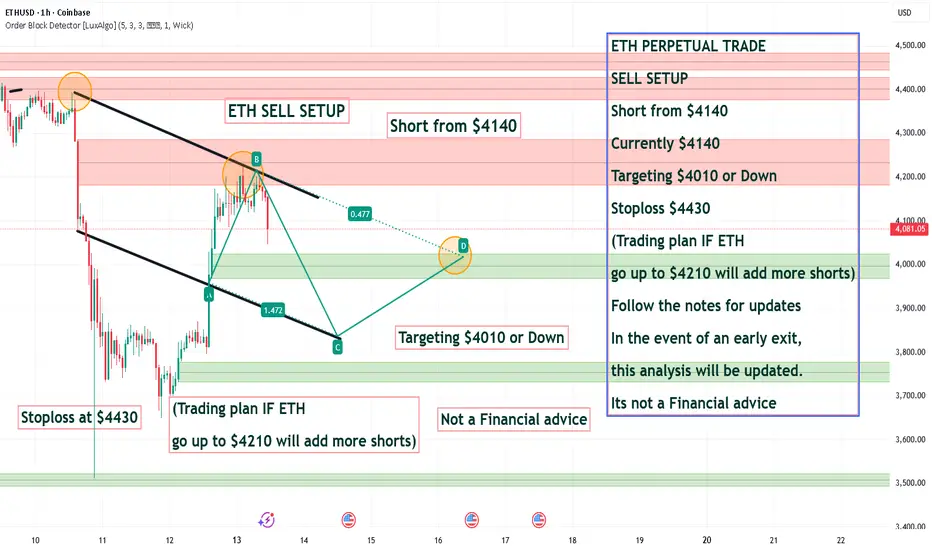
ETH: high-level consolidationAfter last week's sharp decline, the price began to rebound over the weekend and broke above 4,000. Today, it entered a high-level consolidation phase. This indicates that bullish forces have strengthened recently and are trying to push the price higher. Overall, today's trend shows that the bulls have started to counterattack, but the overall situation is still uncertain. Given the market's uncertainty, it is essential to set strict stop-losses and control positions when trading to guard against risks from sharp price fluctuations.
Buy 4020 - 4030
TP 4040 - 4050 - 4060
SL 4010
Daily-updated accurate signals are at your disposal. If you run into any problems while trading, these signals serve as a reliable reference—don’t hesitate to use them! I truly hope they bring you significant assistance
Start of Altseason and Ethereum's RiseHello friends 👋
I've posted my Ethereum analysis for you ✍️. Given the oversold zone on the RSI 📉 and Ethereum's past history 📜, I predict we will see a significant surge in the next two months 🚀—around 130% 💹, reaching a price of $8,000 USDT for Ethereum 💎.
Furthermore, the altcoin season is also expected to happen during this period 🌕.
I hope you'll also share your own thoughts about the market in the comments section 💬.
📢 Important Note: This is solely an analysis/prediction, and the responsibility for any trading or investment decisions is entirely your own! ⚠️
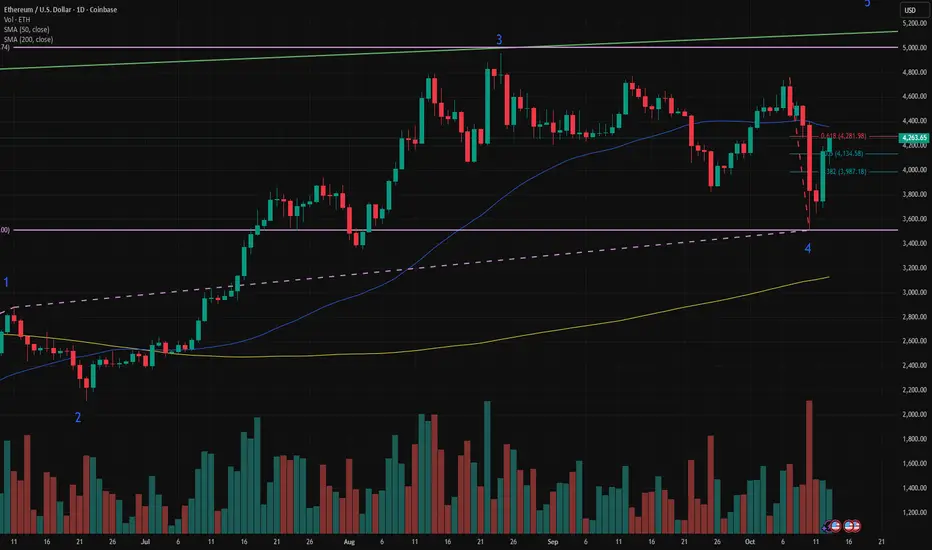
ETH is still following my plans pretty preceiselyWhat a mess Friday turned out to be with a recording breaking liquidation event with the numbers still growing - bigger than FTX!
SUNK COST FALLACY: THE DAMAGE IS DONE, DO NOT PANIC IN AND OUT OF POSITIONS.
So many alt-coins proved there is nothing but thin air holding them up - no real demand whatsoever! I'll take a look at some charts today. Now these wicks can be classed as 'anomalies' in technical analysis but in this case i think we've revealed some of the strong tokens now with real backing.
It is expected that with such large wicks we at least test the centre of the wick on one more terrifying shake-out that isn't actually as bad as the one we just has but feels it because traders and investors are been kicked while their down in a state of panic.
-------------
CRYPTOCAP:ETH was looking toppy for a while especially with the 'poke above all time high' Elliot wave 1 rule and i shared my thoughts on downside targets. It is has my secondary target o the drop of the daily 200EMA and bounce hard with bullish divergence in RSI. This is also a shallow retracement of the .382 Fibonacci showing macro strength.
I expect another pullback to test the High Volume Node as support before a strong wave 3 to commence
Safe trading
Energy Market Analysis and the Rising Geopolitical Tensions1. Overview of the Global Energy Market
The global energy market is a vast network of interconnected systems that encompass fossil fuels (oil, coal, and natural gas), renewable sources (solar, wind, hydro, and bioenergy), and emerging technologies such as hydrogen and nuclear fusion. As of 2025, fossil fuels still account for approximately 80% of global energy consumption, although renewable energy’s share is growing rapidly due to environmental pressures and technological progress.
Key Players in the Energy Market
OPEC and OPEC+: The Organization of the Petroleum Exporting Countries (OPEC), led by Saudi Arabia, along with partners like Russia (OPEC+), plays a central role in regulating global oil supply and influencing prices.
The United States: A global leader in shale oil and gas production, the U.S. has transformed from an energy importer to a major exporter, significantly altering global trade flows.
China and India: As the world’s largest energy consumers, these nations’ growing demand drives global market trends, particularly in coal and renewable energy investments.
Russia: A dominant exporter of natural gas to Europe and oil to Asia, Russia’s geopolitical strategies have direct consequences on global energy stability.
Current Market Trends
Increased diversification toward renewable energy and energy storage systems.
Shift in trade patterns as Europe reduces dependence on Russian energy.
Price volatility driven by conflicts, sanctions, and supply chain disruptions.
Strategic stockpiling and national energy security initiatives.
2. The Role of Geopolitics in Energy Markets
Energy and geopolitics are deeply intertwined. Control over energy resources has long been a source of both cooperation and conflict among nations. Geopolitical events often cause significant fluctuations in energy supply and prices. For example:
The 1973 Oil Crisis, when Arab nations embargoed oil exports to the West, caused severe economic shocks.
The Gulf War (1990–91) disrupted oil flows and reshaped Middle Eastern energy politics.
The Russia–Ukraine war (2022–present) has triggered global energy shortages and a reorientation of European energy policy.
Why Geopolitics Matters
Energy as a Strategic Weapon: Countries with abundant energy reserves use them as geopolitical tools to influence others.
Supply Chain Disruptions: Political instability or sanctions can halt production or transportation.
Investment Uncertainty: Geopolitical risks discourage long-term investments in exploration and infrastructure.
Shifts in Alliances: Nations often realign politically to secure stable energy supplies.
3. Geopolitical Flashpoints Affecting the Energy Market
a. The Russia–Ukraine Conflict
The ongoing Russia–Ukraine war has had one of the most profound impacts on the global energy system in decades. Before the conflict, Russia supplied nearly 40% of Europe’s natural gas. Sanctions and the subsequent cutoffs have forced Europe to diversify rapidly toward liquefied natural gas (LNG) from the U.S., Qatar, and Norway.
This geopolitical shift has led to:
Record-high energy prices in Europe (2022–2023).
Acceleration of renewable energy projects to reduce dependence on imports.
Growth in LNG infrastructure, especially in Germany, the Netherlands, and Poland.
Increased Russian energy exports to China and India, creating new trade alliances.
b. Middle East Tensions
The Middle East remains the heart of global oil production, with countries like Saudi Arabia, Iran, Iraq, and the UAE controlling vast reserves. However, the region’s persistent instability—stemming from political rivalries, sectarian divides, and external interventions—creates continuous uncertainty.
Recent flare-ups, such as Iran–Israel tensions and Red Sea shipping disruptions, have threatened supply routes through vital chokepoints like the Strait of Hormuz and Suez Canal, through which nearly 20% of global oil shipments pass.
c. The South China Sea Dispute
The South China Sea is a key maritime route that handles nearly 30% of global trade, including large volumes of energy cargo. Competing territorial claims between China, Vietnam, the Philippines, and others create risks for oil and gas exploration and maritime transport. China’s increasing militarization of the area has strategic implications for global energy logistics, especially for nations dependent on oil imports from the Middle East.
d. U.S.–China Strategic Competition
The rivalry between the U.S. and China extends beyond trade—it encompasses technology, semiconductors, and energy resources. Both nations are competing for leadership in clean energy technologies such as solar panels, batteries, and electric vehicles. Additionally, the race to control rare earth minerals—vital for renewable technologies—has become a geopolitical battleground.
4. Energy Security and Supply Chain Vulnerabilities
Energy security refers to the uninterrupted availability of energy sources at an affordable price. Geopolitical tensions undermine this stability in multiple ways:
Disrupted Supply Chains: Wars or sanctions can halt production and transport of energy commodities.
Infrastructure Attacks: Pipelines and refineries are often prime targets during conflicts.
Price Volatility: Market panic and speculation amplify price swings, harming consumers and industries.
Dependence Risks: Heavy reliance on a single supplier or route increases vulnerability.
In response, many countries are pursuing energy diversification strategies, developing domestic reserves, investing in renewables, and building strategic petroleum reserves (SPR) to cushion against shocks.
5. The Green Energy Transition Amid Geopolitical Uncertainty
The global shift toward renewable energy is reshaping the geopolitical map. Solar, wind, hydro, and green hydrogen are reducing dependence on fossil fuels, yet they introduce new challenges—especially around the sourcing of critical minerals like lithium, cobalt, and nickel.
Opportunities in the Green Transition
Energy Independence: Nations can reduce reliance on imports by producing renewable energy domestically.
Job Creation: Expansion of renewable infrastructure creates employment and stimulates innovation.
Climate Commitments: The transition supports global sustainability goals under the Paris Agreement.
Challenges
Mineral Dependency: Many clean technologies rely on minerals concentrated in politically unstable regions (e.g., Congo for cobalt).
High Initial Investment: Developing renewable capacity requires significant capital.
Technological Gaps: Developing nations may struggle to keep pace with advancements in green technology.
6. Market Impacts: Price Fluctuations and Investment Trends
Geopolitical instability exerts a direct impact on energy prices:
Oil Prices: Fluctuate sharply with supply disruptions. For instance, Brent crude spiked above $120 per barrel in 2022 due to the Ukraine crisis.
Natural Gas Prices: Europe’s gas prices increased fivefold amid the cutoff from Russia.
Coal Demand: Surged temporarily as nations sought alternatives to gas.
Renewable Energy Investments: Hit record highs as governments sought energy security through self-sufficiency.
Investors are increasingly incorporating geopolitical risk assessments into portfolio decisions. Energy companies are diversifying geographically and shifting capital toward renewables and resilient infrastructure.
7. Regional Analysis
a. Europe
Europe has taken bold steps toward energy independence. The EU’s REPowerEU plan aims to cut Russian gas imports by 90% and expand renewable capacity. However, the short-term transition has been costly, leading to inflation and industrial challenges.
b. North America
The U.S. continues to leverage its shale revolution and emerging hydrogen sector to strengthen energy security. Canada’s vast oil sands also play a role in regional stability.
c. Asia-Pacific
Asia remains the largest energy-consuming region. China leads in solar and battery manufacturing, while India is aggressively expanding its renewable portfolio. However, both nations remain dependent on coal and imported oil.
d. Middle East and Africa
The Middle East continues to dominate fossil fuel exports, but some nations—like the UAE and Saudi Arabia—are investing in renewable diversification through initiatives like NEOM and Masdar. African countries such as Nigeria and Mozambique are emerging gas exporters, though political instability hinders growth.
8. The Future of Energy Geopolitics
The energy landscape is moving toward multipolarity—no single region will dominate global energy supply. Key trends shaping the future include:
Energy Transition Diplomacy: Nations will compete to lead in clean technology exports.
Technological Dominance: Control over green technology patents and supply chains will become a geopolitical tool.
Strategic Partnerships: New alliances will form around renewable energy corridors, critical minerals, and hydrogen infrastructure.
Decentralization of Power: Smaller nations rich in minerals or renewable potential will gain strategic significance.
9. Policy Recommendations
To mitigate risks and foster stability, global policymakers should:
Diversify Energy Sources: Reduce dependence on single suppliers or regions.
Invest in Infrastructure Security: Protect pipelines, grids, and data networks from attacks.
Strengthen Multilateral Cooperation: Use institutions like the IEA, WTO, and G20 to mediate energy disputes.
Accelerate Renewable Adoption: Support financing and innovation in clean energy technologies.
Promote Strategic Reserves: Maintain emergency stockpiles for oil, gas, and critical minerals.
Conclusion
The global energy market stands at a crossroads where geopolitics and sustainability intersect. Rising geopolitical tensions—whether from wars, trade rivalries, or territorial disputes—continue to disrupt supply chains and influence market dynamics. Yet, this period of uncertainty also presents an opportunity: to accelerate the transition toward a more secure, diversified, and sustainable energy future.
Energy will always remain a cornerstone of national power, but its sources, structures, and strategies are evolving. Nations that adapt—by embracing renewable energy, strengthening supply resilience, and engaging in cooperative diplomacy—will not only withstand geopolitical shocks but also lead the next chapter of the global energy revolution.
Bullish Retest of Reclaimed SupportHello TradingView Community,
This post outlines a potential long trade setup for the Ethereum / U.S. Dollar (ETHUSD) pair, based on the 15-minute timeframe.
Technical Analysis:
The chart shows a key horizontal price level at approximately $4,141.59. This level has been a significant pivot point, acting as both support and, more recently, resistance.
After a sharp move down, the price has shown considerable strength by breaking back above this level, which is a bullish signal indicating that buyers may be regaining control. The trading idea is based on a classic "break and retest" pattern. The price is currently consolidating on top of this former resistance zone. The expectation is that this level will now act as new support, providing a solid base for a potential move higher.
Trade Setup:
The long position tool on the chart visualizes a potential trade plan for this bullish scenario:
Entry: Approximately $4,141.59 (at the retest of the new support).
Stop Loss: $4,054.84 (placed below the key support structure to invalidate the idea if the level fails to hold).
Take Profit: $4,392.28 (targeting a new potential higher high).
This setup provides a structured plan with a favorable risk-to-reward ratio for a potential continuation of the bullish momentum.
Disclaimer: This analysis is for educational and discussion purposes only and should not be considered financial advice. Trading cryptocurrencies involves significant risk. Please conduct your own due diligence and manage your risk appropriately.
ETH's Critical $4100 Retest: What's Next for Ethereum?
After dropping down to key support level of 3500, price has delivered a strong bounce today, currently retesting the critical $4100 'Deciding Area'. This recovery is now challenging the 'Dynamic Resistance Trend channel' formed during the recent decline.
Going forward, the key levels to watch are the immediate resistance from the $4100 zone and the trend channel. Should ETH overcome these, the next major resistance lies between $4200 to $4300. On the downside, if the current rebound loses momentum, previous support levels like the 3850−3950 zone and the $3700 1st Key Support will become crucial areas to hold.
Disclaimer:
The information provided in this chart is for educational and informational purposes only and should not be considered as investment advice. Trading and investing involve substantial risk and are not suitable for every investor. You should carefully consider your financial situation and consult with a financial advisor before making any investment decisions. The creator of this chart does not guarantee any specific outcome or profit and is not responsible for any losses incurred as a result of using this information. Past performance is not indicative of future results. Use this information at your own risk. This chart has been created for my own improvement in Trading and Investment Analysis. Please do your own analysis before any investments.
ETH:Plummeting sharplySince October, Ethereum has exhibited an extreme price trend of "rallying and then pulling back – plummeting sharply", reflecting violent swings in market sentiment between "optimism over technological prospects" and "macro-driven risk aversion".
The psychological levels of 3,400 and 4,000 serve as crucial short-term support. If the price breaks below 3,400, a flood of stop-loss orders may be triggered. Resistance is concentrated around 4,500 , and an effective breakout will require confirmation from increased trading volume.
In the short term, affected by lingering panic and insufficient trading volume, Ethereum is likely to consolidate within the 3,400–4,500 range. Close attention should be paid to the validity of the 3,400 support level.
ETH: Oscillated around the 3850Affected by the aftershocks of the global financial market turbulence in the previous two days, ETH rebounded slightly today and oscillated around the 3,850 level after a correction. This indicates that bullish sentiment in the market has not completely faded, but high leverage risks still persist.
Today's ETH trend also shows a tug-of-war between "long-term technical positives" and "short-term market volatility". Investors need to balance expectations for upgrades and macro risks, remain vigilant against the risk of a sell-off triggered by high-leverage trading, and at the same time pay attention to marginal changes in the Layer 2 ecosystem and upgrade adaptation progress.
Buy 3830 - 3840
TP 3850 - 3860 - 3870
SL 3825
Daily-updated accurate signals are at your disposal. If you run into any problems while trading, these signals serve as a reliable reference—don’t hesitate to use them! I truly hope they bring you significant assistance
Eth/Usd - Breakout Loading, Watch Level CloselyEthereum is currently trading within an ascending triangle pattern, characterized by a horizontal resistance zone and rising trendline support. This pattern typically signals bullish continuation, though traders should watch closely for confirmation before entering a position.
Key Levels
• Resistance Zone (R): Around $3,850–$3,870, marked by repeated price rejection.
• Support Zone (S): Around $3,700–$3,720, providing strong buying interest.
• Current Price: Approximately $3,839.
Technical Outlook
• Trendline Support: ETH is respecting a clear upward-sloping trendline, showing buyers are steadily pushing higher lows.
• Horizontal Resistance: Price continues to test the $3,850 resistance area. A strong breakout and close above this level would confirm bullish momentum.
• Moving Averages: The shorter-term (blue) EMA is positioned above the longer-term (black) EMA, suggesting near-term bullish bias as long as support holds.
Scenarios
• Bullish Scenario:
If Ethereum breaks and holds above the $3,850 resistance, it could trigger a move toward the next resistance target near $4,000–$4,050. This would confirm a breakout from the ascending triangle pattern.
• Bearish Scenario:
A breakdown below the ascending trendline could lead to a retest of the $3,700 support zone or even lower toward $3,650, signaling short-term weakness.
Summary
Ethereum is consolidating just below a key resistance level within an ascending triangle. A breakout above $3,850 may open the door to further upside momentum, while a breakdown below trendline support could invalidate the bullish setup. Traders should watch for a decisive move with volume confirmation to gauge the next direction.
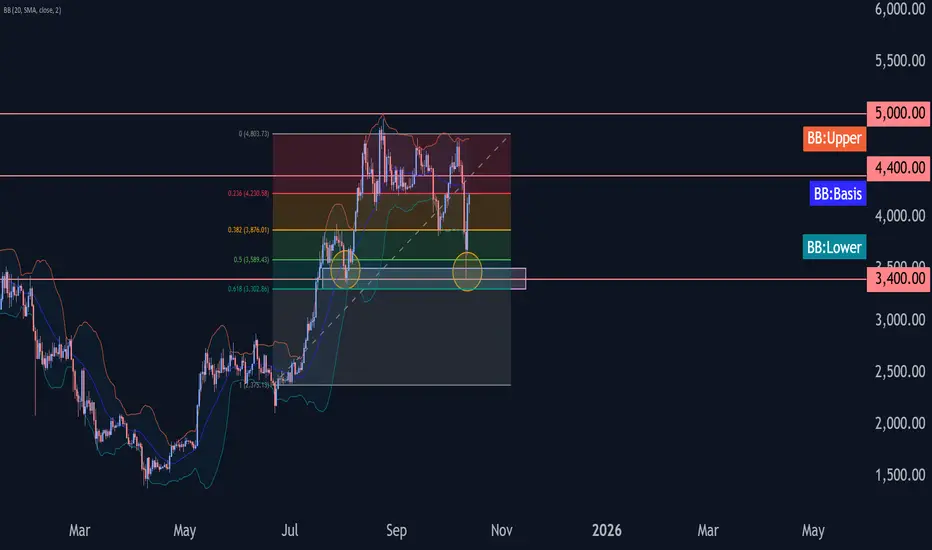
ETH— What the 3500 Support Means and How I’m Trading ItExactly on Friday, just before the big drop, I bought ETH at 4300.
Fortunately, I had a stop loss at 4150, which — of course — got triggered.
But instead of frustration or searching for someone to blame, I took it like a trader should — accepted it, moved forward, and focused on what’s next. Because in trading, maturity starts where ego ends.
Technical Picture
Looking at the chart, after breaking the 4300 support line, ETH accelerated to the downside and found buyers around 3500.
This level is not random — it’s defined by:
1. A major horizontal support
2. The ascending trendline from previous lows
3. And the psychological round number of 3500
Naturally, we saw an initial rebound from that area.
Trading Plan
If the market retests the 3500 zone, I’ll be looking for buying opportunities, targeting a potential retest of 4300.
However — and this is crucial — my trade will be low-volume and protected by a tight stop.
Why? Because while I believe this could be a turning point, so does everyone else.
And when every retail trader sees the same thing, I trade carefully — because as we’ve all learned now, there’s no such thing as free money.
Final Thought
Discipline is not about winning every trade — it’s about staying rational when emotions scream louder than logic.
$ETH I’m waiting for the 3D candle to close. CRYPTOCAP:ETH I’m waiting for the 3D candle to close.
If it closes above 3.8k, I expect the next candle to be green, indicating a small bounce across the board.
The key level to watch is 3,330k, which marks the 2025 yearly open.
Overall, the chart looks good, and ETH is currently testing the weekly demand zone.
#Ethereum
ETHUSD – Wave 4 Correction Near Completion? Preparing for the FiEthereum (ETHUSD, Log Mode) appears to be completing a Wave 4 corrective structure (W–X–Y) within the broader impulsive cycle from the March lows.
Wave 4 found strong support near the 0.5 retracement level around $3,500, aligning with the lower parallel channel of the wave 3 advance.
A potential Wave 5 rally could begin once confirmation of reversal is seen, with upside targets projected at:
$4,867 (3.618 extension of Wave 1)
$7,800–$7,900 (1.272 extension of the macro structure)
If ETH breaks below $3,500, it could invalidate this immediate bullish count and suggest a deeper correction.
Key Levels:
Support: $3,530 / $3,350
Resistance: $4,867 / $7,800
Invalidation: Below $3,500
Watching for signs of a Wave 4 bottom to confirm the start of Wave 5, potentially leading Ethereum into new all-time-high territory in the coming months.
ETH TO 3,054$ WITHIN THE NEXT 7 DAYS!Hi, all
as the title says.......
once BTC hits sub 103k levels, we then should achieve the next target of 2,410-2,198$ within the next 1.5 months MAXIMUM, but I expect it to happen much sooner.
PLEASE SEE LINKED IDEAS FOR CONTEXT and how we have been able to predict the market correctly time and time again and see what others are blinded to.
ETH/USD Navigates Critical Support Amid Bearish PressureETH/USD Navigates Critical Support Amid Bearish Pressure
The ETH/USD price is currently trading around 3826, hovering above the 3700 current support level. Current resistance is at 3850 to 3950 for today. A dynamic resistance trend channel suggests continued bearish pressure overhead. A potential short-term bounce towards the 4000 and 4100 levels is possible. However, if the 3700 current support fails to hold, the price could drop significantly towards 3500.
Disclaimer:
The information provided in this chart is for educational and informational purposes only and should not be considered as investment advice. Trading and investing involve substantial risk and are not suitable for every investor. You should carefully consider your financial situation and consult with a financial advisor before making any investment decisions. The creator of this chart does not guarantee any specific outcome or profit and is not responsible for any losses incurred as a result of using this information. Past performance is not indicative of future results. Use this information at your own risk. This chart has been created for my own improvement in Trading and Investment Analysis. Please do your own analysis before any investments.
Ethereum at a Turning PointShort-Term Outlook (1–2 Weeks)
Ethereum has been moving inside a descending channel, with recent price action testing the lower boundary. The 50-day moving average (SMA50) around $4,380 acts as strong resistance.
Currently, ETH is trading below that level and close to the lower trendline — a zone of high sensitivity.
If price rebounds and closes above $3,900, a short-term recovery toward $4,250–$4,500 is likely.
However, a daily close below $3,700 would confirm a breakdown, opening the path toward $3,400–$3,200.
Short-Term Setup:
Entry Zone: Above $3,900 after confirmation
Targets: $4,250 → $4,500
Stop Loss: Daily close below $3,700
Long-Term Outlook (1–3 Months)
ETH remains within a medium-term descending channel, showing no confirmed breakout yet.
If it can reclaim and sustain above $4,500, the bearish pattern would be invalidated, and a rally toward $4,800–$5,000 could follow.
But a confirmed breakdown below $3,700 would strengthen the bearish case, potentially leading price down to $3,200–$2,900.
Long-Term Setup:
Bullish Case: Close above $4,500 → Targets: $4,800 → $5,000
Stop Loss: Below $3,900
Bearish Case: Close below $3,700 → Targets: $3,200 → $2,900
Stop Loss: Reclaim above $3,900
Summary:
Ethereum is standing right at a decision zone. The $3,700 level acts as the key pivot — holding it could trigger a rebound toward $4,500, while losing it might mark the start of a deeper correction in the months ahead.