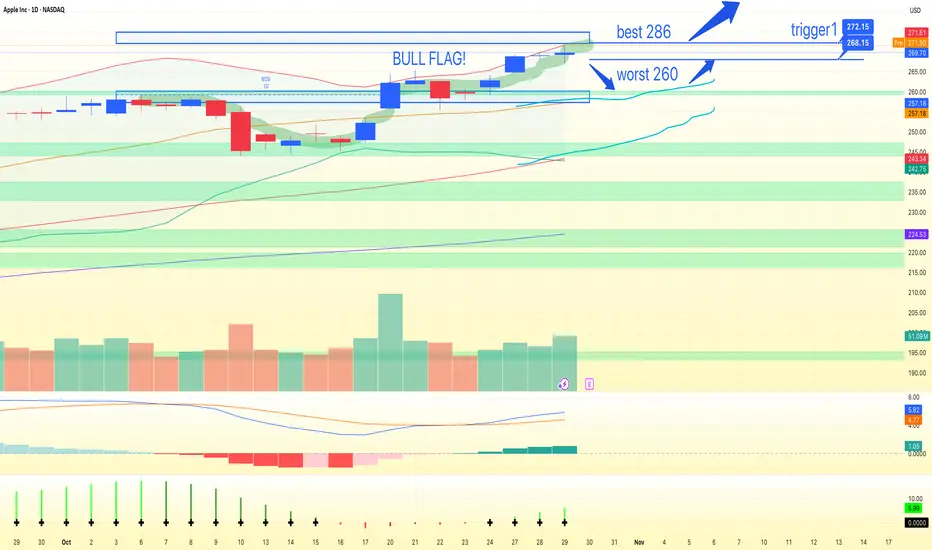
AAPL Bullish Breakout: Retest Buy Toward 282–286Apple (AAPL) is trending firmly higher on the 1D chart, with multiple break-of-structure pushes and price riding the upper Bollinger Band. The recent surge cleared resistance and printed a new high at 271.60, while the 20/60/120 MAs remain positively stacked and rising. Short-term momentum favors continuation, but a brief pause wouldn’t surprise given the extension.
My primary path is a buy-the-retest setup: a dip into the former ceiling turned demand at 260.00–264.00 holds, followed by a constructive bounce. If that plays out, I’m looking for a grind toward 278–280 first, then an extension into 282–286 as higher highs resume. Alternatively, strength through resistance is a momentum trigger— a daily close above 271.60 (aggressive >272.00) would validate a break-and-hold and open the same targets.
Invalidation is clean: a decisive daily close below 260.00 breaks the structure and risks a deeper pullback. Until then, the bias stays bullish; consider partial sizing on initial entries and add on confirmation to respect expanding volatility. Stops can sit just below 260.00 (around 258.00) for retest entries, or tucked under the breakout level if trading the close-above trigger.
This is a study, not financial advice. Manage risk and invalidations
Trade ideas
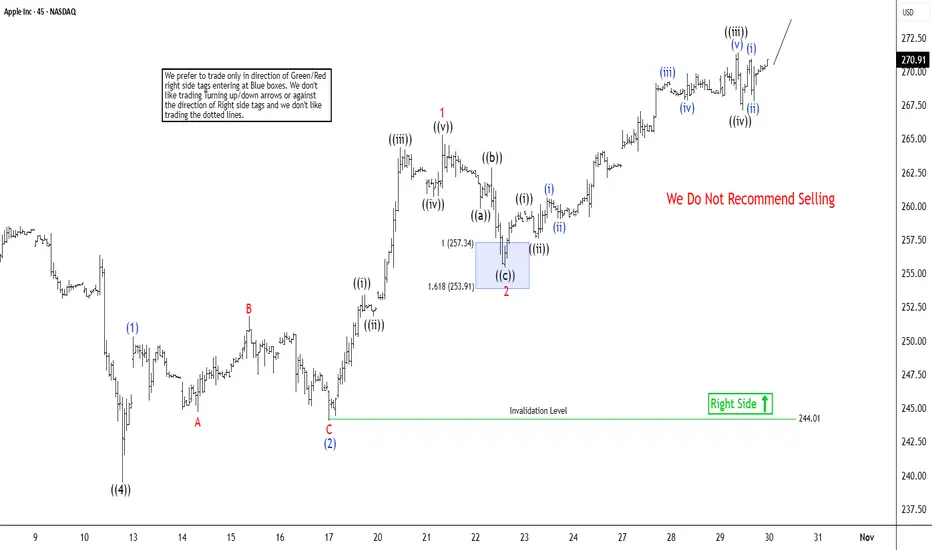
AAPL in Wave ((5)) to New All-Time High as Nested PatternApple (AAPL) has surged to a new all-time high, extending an impulse wave that began from the April 2025 low. Wave ((4)) of this larger impulse concluded at $239.49, as clearly illustrated on the 45-minute chart. Now, wave ((5)) advances higher in the form of a nested impulse structure. Rising from the wave ((4)) base, wave (1) completed at $250.65 before wave (2) pulled back to $244.01. From there, the stock nested upward again, with wave 1 ending at $265.29 and wave 2 correcting to $255.43. Apple then extended further in wave 3, which itself unfolds as an impulse of lesser degree.
Within wave 3, wave ((i)) topped at $259.67, followed by a dip in wave ((ii)) to $257.55. Wave ((iii)) pushed higher to $271.41, and wave ((iv)) retraced to $267.11. Wave ((v)) of 3 should finish soon, leading to a pullback in wave 4 before the uptrend resumes with renewed strength.In the near term, the bullish outlook remains intact as long as the pivot low at $244.01 holds. Any dips are likely to find support in 3, 7, or 11 swing sequences, setting the stage for continued upside. This Elliott Wave progression underscores persistent momentum, with nested impulses reinforcing the primary trend and positioning Apple for additional gains ahead.
A few important steps for creating robust and winning StrategiesAs the title says, I want to share knowledge & important insights into the best practices for creating robust, trustworthy and profitable trading Strategies here on TradingView.
These bits of information that my team I have gathered throughout the years and have managed to learn through mostly trial and error. Costly errors too .
Many of these points more professional traders know, however, there are some that are quite innovative for all levels of experience in my opinion. Please, feel free to correct me or add more in the comments.
There are a few strategic and tactical changes to our process that made a noticeable difference in the quality of Strategies and Indicators immediately.
Firstly and most importantly, we have all heard about it, but it is having the most data available. A good algorithm, when being built NEEDS to have as many market situations in its training data as possible. Choppy markets, uptrends, downtrends, fakeouts, manipulations - all of these are necessary for the strategy to learn the possible market conditions as much as possible and be prepared for trading on unknown data.
Many may have heard the phrase "History doesn't repeat itself but rhymes well" - you need to have the whole dictionary of price movements to be able to spot when it rhymes and act accordingly.
The TradingView Ultimate plan offers the most data in terms of historical candles and is best suited for creating robust strategies.
___
Secondly, of course, robustness tests. Your algorithm can perform amazingly on training data, but start losing immediately in real time, even if you have trained it on decades of data.
These include Monte-carlo simulations to see best and worst scenarios during the training period. Tests also include the fundamentally important out-of-sample checks . For those who aren’t familiar - this means that you should separate data into training sets and testing sets. You should train your algorithm on some data, then perform a test on unknown to the optimization process data. It's common practice to separate data as 20% training / 20% unknown / 20% training etc. to build a data set that will show how your algorithm performs on unknown to it market movements. Out of sample tests are crucial and you can never trust a strategy that has not been through them.
Walk-forward simulations are similar - you train your algorithm on X amount of data and simulate real-time price feeds and monitor how it performs. You can use the Replay function of TradingView to do walk-forward tests!
When you are doing robustness tests, we have found that a stable strategy performs around 90% similarly in terms of win rate and Sortino ratio compared to training data. The higher the correlation between training performance and out of sample performance, the more risk you can allocate to this algorithm.
___
Now lets move onto some more niche details. Markets don’t behave the same when they are trending downward and when they are trending upwards. We have found that separating parameters for optimization into two - for long and for short - independent of each other, has greatly improved performance and also stability.
Logically it is obvious when you look at market movements. In our case, with cryptocurrencies, there is a clear difference between the duration and intensity of “dumps” and “pumps”. This is normal, since the psychology of traders is different during bearish and bullish periods. Yes, introducing double the amount of parameters into an algorithm, once for long, once for short, can carry the risk of overfitting since the better the optimizer (manual or not), the better the values will be adjusted to fit training data. But if you apply the robustness tests mentioned above, you will find that performance is greatly increased by simply splitting trade logic between long and short. Same goes for indicators.
Some indicators are great for uptrends but not for downtrends. Why have conditions for short positions that include indicators that are great for longs but suck at shorting, when you can use ones that perform better in the given context?
___
Moving on - while overfitting is the main worry when making an algorithm, underoptimization as a result of fear of overfitting is a big threat too . You need to find the right balance by using robustness tests. In the beginning, we had limited access to software to test our strategies out of sample and we found out that we were underoptimizing because we were scared of overfitting, while in reality we were just holding back the performance out of fear. Whats worse is we attributed the losses in live trading to what we thought was overfitting, while in reality we were handicapping the algorithm out of fear.
___
Finally, and this relates to trading in general too, we put in place very strict rules and guidelines on what indicators to use in combination with others and what their parameter range is. We went right to theory and capped the values for each indicator to be within the predefined limits.
A simple example is MACD . Your optimizer might make a condition that includes MACD with a fast length of 200, slow length of 160 and signal length of 100. This may look amazing on backtesting and may work for a bit on live testing, but these values are FUNDAMENTALLY wrong (Investopedia, MACD). You must know what each indicator does and how it calculates its values. Having a fast length bigger than the slow one is completely backwards, but the results may show otherwise.
When you optimize any strategy, manually or with the help of a software, be mindful of the theory. Mathematical formulas don’t care about the indicator’s logic, only about the best combination of numbers to reach the goal you are optimizing for - be it % Return, Profit Factor or other.
Parabolic SAR is another one - you can optimize values like 0.267; 0.001; 0.7899 or the sort and have great performance on backtesting. This, however, is completely wrong when you look into the indicator and it’s default values (Investopedia, Parabolic SAR).
To prevent overfitting and ensure a stable profitability over time, make sure that all parameters are within their theoretical limits and constraints, ideally very close to their default values.
Thank you for reading this long essay and I hope that at least some of our experience will help you in the future. We have suffered greatly due to things like not following trading theory and leaving it all up to pure mathematical optimization, which is ignorant of the principles of the indicators. The separation between Long / Short logic was also an amazing instant improvement.
View the linked idea where we explain the psychology of risk management and suggest a few great ways to calculate and manage your risk when trading - just as important as the strategy itself!
What do you think? Do you use any of these methods; Or better ones?
Let us know in the comments.
Can AAPL Earnings Fuel Its Rally?Apple (AAPL) extended gains to a record high, briefly pushing its market capitalization past the USD 4 trillion mark as strong iPhone 17 demand and a broad tech rally buoyed sentiment. Early data from Counterpoint Research showed iPhone 17 sales outpacing the previous generation by 14% in the first 10 days across the US and China, underscoring resilient consumer demand despite higher price points. However, signs of moderating lead times and delayed AI feature rollouts may temper momentum ahead of Thursday’s earnings, where investors will focus on iPhone sustainability and progress in Apple’s AI strategy.
From a technical perspective, AAPL is approaching the resistance at 127.2% Fibonacci Extension at 275. A break above this level may prompt a further rise toward the 161.8% Fibonacci Extension at 290. Conversely, a retracement may prompt a retest of the support at 245.
By Li Xing Gan, Financial Markets Strategist Consultant to Exness
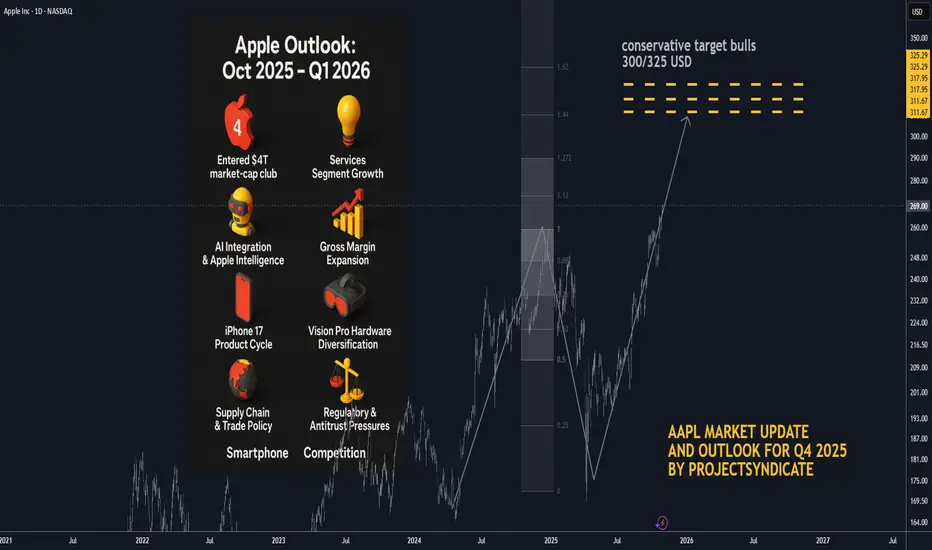
AAPL: Q1 2026 Target and Updated Outlook BULLS🍏 Apple Outlook: Oct 2025 – Q1 2026
🧠 Status and Tape Read. Apple (AAPL) has entered the $4 T market-cap club on Oct 28–29 2025, propelled by strong iPhone 17 sell-through and Services momentum. Shares pushed toward the $270 area intraday before easing, marking a powerful reversal from mid-year consolidation. Near-term, positioning is elevated into Thursday’s print; options imply ~±4% move on earnings.
📈 Path into Q1’26. Our base case shifts from a prolonged correction to a higher-low / buy-the-dip regime: dips toward the mid-$240s–$250s should attract sponsorship unless Services rolls over or China iPhone demand fades. A constructive tape through Q1’26 hinges on (1) Apple Intelligence engagement metrics, (2) iPhone 17 replacement/Android switcher rates, and (3) regulatory overhang.
📰 What’s New and recent headlines
🏆 Apple hits $4 T market value for the first time, joining Nvidia and Microsoft. Drivers: iPhone 17 traction and Services strength; stock up sharply since spring.
🗓️ Earnings set for Thu, Oct 30 (after-close); Street looking for growth in revenue/EPS; Services eyed >$100 B annual run-rate.
🔼 Loop Capital upgraded AAPL to Buy with $315 PT ahead of the move, citing iPhone cycle acceleration.
🧾 “Who Bought 8 Million Shares?”
🧺 JPMorgan Large Cap Growth Fund (SEEGX) increased its Apple position by ~8.15 million shares to ~32.9 million shares, per latest fund tracking.
⚙️ Catalysts Shaping Apple’s Stock Price in 2025–26
🤖 AI Integration & Apple Intelligence — Strength: 9/10
Rollout of on-device Apple Intelligence and upgraded Siri remains the core narrative into 2026. Look for user engagement datapoints and third-party app integrations at/after earnings. A positive read-through would validate the iPhone super-cycle argument.
💡 Services Segment Growth — Strength: 8.5/10
Consensus expects Services to push past a $100 B annual clip; durability watched versus regulatory pressure (DMA in EU, global app store scrutiny). A sustained >13% YoY growth print keeps multiple support intact.
📊 Gross Margin Expansion & Cost Efficiencies — Strength: 8/10
Management has guided 46–47% GM for FQ4 (tariff headwind embedded). Mix shift to Services + component deflation support FY26 margin resilience.
📱 iPhone 17 Product Cycle — Strength: 8/10 (↑ from 7.5)
Early sell-through outpacing prior gen in the U.S. and China within first days; the iPhone 17 (incl. “Air”) is the incremental driver restoring unit momentum.
🥽 Vision Pro & Hardware Diversification — Strength: 7/10
Next-gen devices + Apple Intelligence tie-ins create optionality; still niche near-term but adds ecosystem gravity.
💵 Capital Returns — Strength: 7/10
$110 B buyback authorization remains a floor; watch cadence vs. stock at ATHs and post-print cash deployment commentary.
🌏 Supply Chain & Trade Policy — Strength: 6.5/10
China exposure/tariffs remain a swing factor; Apple has been absorbing some costs rather than pushing through prices on key models.
⚖️ Regulatory & Antitrust Pressures — Strength: 6/10
DMA compliance and global app store cases could trim Services take-rate; monitor any remedial changes called out on the call.
📈 Macro & Rates — Strength: 5/10
“Higher for longer” limits multiple expansion; any disinflation/soft-landing upside would expand P/E support.
🥊 Smartphone Competition — Strength: 5/10
Android OEM velocity still high in EM; Apple’s cycle needs sustained switcher share to outrun.
💼 Earnings Set-Up: FQ4 reporting Thu Oct 30 2025
📅 Consensus into print:
• Revenue: ~$101–104 B (TipRanks ref: $102.2 B)
• EPS: ~$1.74–$1.82 (TipRanks ref: $1.78)
• Gross Margin guide: 46–47% (company indication)
• Services: watch for >$100 B annualized pace confirmation
• Implied move: options pricing ~±4%
🎧 Watch items on the call: Apple Intelligence activation/MAUs, iPhone 17 channel inventory, China mix, Services take-rate headwinds (EU), GM puts/takes (tariffs), cap-return cadence.
🎯 Street Positioning & Targets
🔼 Loop Capital: Buy, PT $315 (Oct 20/21 2025).
📊 General take: Many houses remain Overweight; focus turning to 2026 EPS power and AI monetization path.
🧭 Tactical View 0–3 Months
📈 Into/after print: Choppy but constructive. Chasing at ATHs is risky; prefer buy-on-weakness zones near $248–255 with stop discipline. A bullish guide/Services beat could sustain a breakout; a light AI engagement update or China wobble likely gets faded back into the mid-$250s.
⚠️ Risk-case: Regulatory headline or guide below mid-single-digit growth could quickly compress P/E and retest the $240s.
🚀 Bull-case: Clean beat/raise + AI usage KPIs → re-rate toward $290–300 into holiday.
🏁 Quick Milestone Recap
🥇 $4 Trillion Market Cap achieved on Oct 28–29 2025, making Apple the third public company (after Nvidia, Microsoft) to reach the level; iPhone 17 momentum and Services strength cited across coverage.
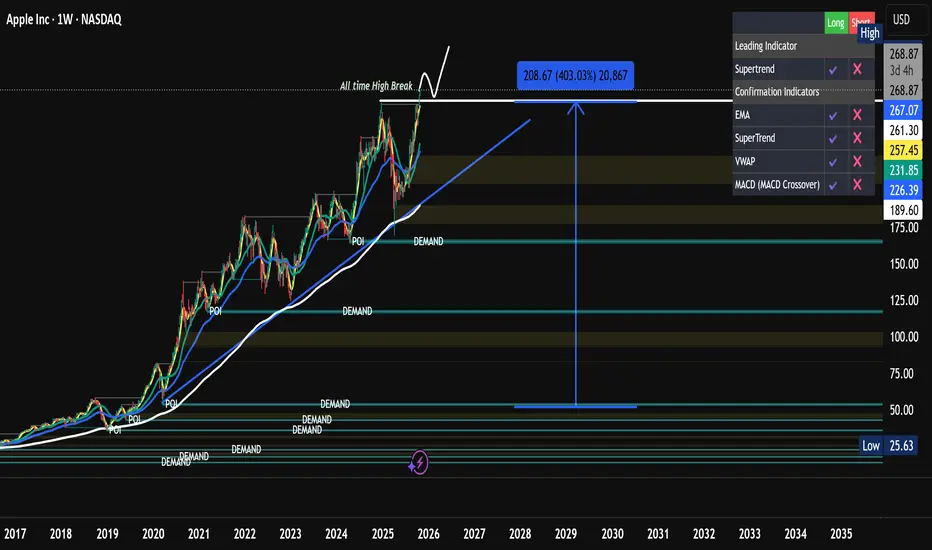
Apple Inc (AAPL) – All-Time High Break and Demand Structure Apple continues to display one of the strongest technical structures among large-cap equities. The price action has respected multi-year demand zones and continues to advance in a controlled parabolic channel, signaling strong institutional order flow and long-term accumulation behavior.
1. Multi-Year Demand Structure
Each pullback into a demand zone since 2019 has produced a strong bullish reaction, confirming active institutional defense at key points of interest (POIs). The structure showcases consistent higher highs and higher lows, a textbook uptrend aligned with long-term exponential moving averages and anchored VWAP support.
The most recent reaction off the weekly demand near $130 - $135 marks another strong reaccumulation phase. This region acted as a liquidity pocket where large orders were likely absorbed before initiating the next expansion wave.
2. All-Time High Break and Price Discovery
Price has now decisively broken above the all-time high, entering a fresh price discovery phase.
Such breakouts often attract momentum buyers and algorithmic inflows, but historically, Apple tends to consolidate briefly above new highs before continuing its trend.
The current projection suggests a measured move toward $208 - $210, which represents approximately +40% from the breakout level. This target is derived from the vertical measured range of the prior accumulation base and Fibonacci extension alignment.
3. Indicator Confluence
Key indicators are showing strong trend confirmation:
EMA Cluster: All major EMAs are stacked bullishly and acting as dynamic support.
VWAP: Anchored VWAP from the previous high sits below price, confirming that institutional cost basis remains positive.
SuperTrend: Flipped bullish on the weekly timeframe, signaling trend continuation.
MACD: Crossed bullish above the zero line, aligning with the macro bullish momentum shift.
Together, these indicators confirm that price structure is healthy, with momentum and liquidity aligned for continuation rather than exhaustion.
4. Smart Money and Institutional View
Apple’s current behavior fits the smart money model of accumulation → manipulation → expansion. The manipulation phase occurred during the deep retracement in 2022–2023, where retail sentiment turned bearish while institutions accumulated within the demand blocks.
The ongoing breakout represents the expansion phase where smart money distributes into higher liquidity as price advances.
5. Long-Term Outlook
If Apple continues to respect the ascending demand trendline and sustains above the all-time high zone, the next major liquidity cluster lies near $208 – $210.
Beyond that, a long-term projection suggests that a full cycle expansion could carry price toward the $260 – $270 region over the next few years, especially if macro conditions remain favorable for large-cap tech.
Key Levels
Current Price: 147.27
Support / Demand Zones: 135.00 – 140.00 and 120.00 – 125.00
Short-term Target: 208 – 210
Long-term Projection: 260 – 270
Invalidation: Sustained close below 130.00
Summary
Apple has officially entered a new phase of price discovery following its all-time high breakout. The multi-year demand structure, strong institutional flow, and technical indicator confluence all point to sustained bullish momentum.
The first major target zone remains $208 - $210, while the long-term projection sits near $260+, supported by macro bullish sentiment in the Nasdaq and strong fundamental resilience.
A brief retest of the breakout zone could occur, but dips into the 135–140 area would likely be absorbed aggressively by institutional buyers, maintaining the long-term uptrend.
The Phantom TradeThe Phantom Trade .... In the spirit of Halloween ...
NOTE – This is a post on mindset and emotion. It is not a trade idea or strategy designed to make you money. My intention is to help you preserve your capital, focus, and composure — so you can trade your own system with calm and confidence.
You missed it.
The setup you’d been watching for days, maybe weeks finally played out.
Clean. Precise. Exactly as planned.
But you weren’t in it.
Maybe you hesitated.
Maybe the trigger didn’t line up perfectly.
Or maybe you just weren’t at your desk.
Either way, it’s done.
But your mind doesn’t let it go.
You replay it.
Frame by frame.
You check where you would have entered, where you would have exited.
You tell yourself it’s “reviewing.”
But it’s not.
It’s rumination.
A mental loop that feels productive but keeps you stuck in what can’t be changed.
You’re not trading the market anymore… you’re trading your memory of it.
And every replay reinforces the belief that you should’ve done better.
The body joins in too.
Tight chest. Restless legs.
An urge to make it back .
That’s the real danger.
Because the next trade isn’t about opportunity, it’s about redemption.
And redemption trades rarely end well.
The skill isn’t in ignoring the regret.
It’s in recognising it for what it is: the echo of unmet expectation.
Ask yourself: what am I actually trying to fix here?
The missed trade… or the feeling of not being enough?
The point here is:
Reflection helps you grow.
Rumination keeps you stuck.
Learn to tell the difference.
That’s where real mastery begins.
AAPL Weekly Outlook (Oct 28–31)AAPL Weekly Outlook (Oct 28–31): “Apple’s Momentum Reboot — Eyes on $275 Breakout Zone!” 📱
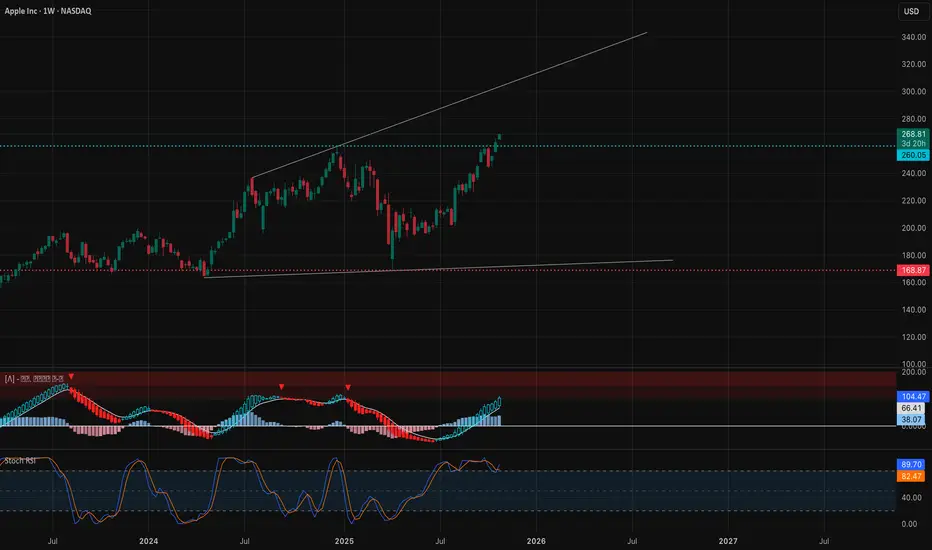
1. Weekly (1W) Structure – Macro Breakout Confirmation
Apple has officially shifted from recovery to expansion phase. The weekly chart shows a confirmed Change of Character (CHoCH) into Break of Structure (BOS) above $260, reclaiming a bullish trajectory. Price is pushing toward the upper channel trendline near $275–$280, showing clean continuation momentum with no immediate resistance until that level.
* Bias: Bullish continuation
* Support: $224 → $260
* Resistance: $275 → $280
* MACD: Strong bullish expansion; histogram widening upward.
* Stochastic RSI: Overbought but still trending — strength, not exhaustion yet.
💡 Weekly Thought:
Momentum is accelerating across the board, confirming institutional participation. Unless $260 breaks down, Apple remains a buy-on-dip candidate heading into November earnings.
2. Daily (1D) – Trend Acceleration
Daily structure is showing clean BOS sequences along an ascending parallel channel. After retesting the midline near $244–$250, Apple bounced strongly and reclaimed the $260 handle. This confirms buyers defending the demand base, now pushing price to challenge $268–$270 short-term resistance.
* Bias: Bullish continuation
* Support: $244 → $259
* Resistance: $270 → $275
* Indicators:
* MACD turning positive again after pullback reset.
* Stochastic RSI curled upward from midzone — signals renewed strength.
💭 Daily Suggestion:
Look for intraday retests around $262–$264 as a potential long entry. A clean daily close above $270 opens path to $275 and eventually $280 if macro remains supportive.
3. 1-Hour (1H) – Intraday Playbook
Intraday structure aligns perfectly with higher timeframes — multiple BOS and short consolidation ranges above $260 confirm sustained bullish control. Momentum is strong, but short-term traders should be cautious of profit-taking near $270–$272 zone before the next leg higher.
* Scalp Bias: Bullish above $262
* Support: $260 → $255
* Resistance: $270 → $275
* Setup Idea:
* Call scalp: Above $266 with target $272–$275.
* Put scalp: Only below $260 breakdown, targeting $255.
📈 1H Thought:
If AAPL consolidates tightly between $266–$269 early in the week, it may coil for a breakout toward $275 later this week.
4. GEX & Options Sentiment – Institutional Positioning
Gamma Exposure (GEX) data shows heavy call concentration aligning perfectly with price structure, reinforcing bullish continuation bias.
* Highest positive GEX / resistance: $269 → $275 → $280
* Support (put-dominated zones): $257 → $252
* Call ratio: 9.1% (moderate bullish exposure)
* IVR: 19.9 (low IV environment)
* IVx avg: 32.6 (slightly cooling)
Institutions are pinning price near $265–$270 with positive gamma bias. The $275–$280 zone acts as the next magnet if upward momentum persists.
5. Suggested Option Plays
* Bullish Setup (Preferred):
* Buy-to-open 270C–275C (1DTE/2DTE) if price reclaims $268 with strength.
* Target: $275–$280
* Stop: Below $260
* Reason: Gamma buildup supports continuation, clean technical breakout setup.
* Bearish Hedge (Cautious):
* Buy 255P (1DTE/2DTE) only if price breaks $260 with confirmed volume.
* Target: $252
* Stop: Above $266
Apple’s structure is aligned bullishly across all timeframes — a clear continuation from the mid-October breakout with strong call-side gamma buildup. The next move hinges on whether $270 flips to support; if so, the stock is primed for a potential $275–$280 test.
🎯 Primary Bias: Bullish toward $275–$280
⚠️ Watch For: Breakdown under $260 = short-term exhaustion signal.
This analysis is for educational purposes only and does not constitute financial advice. Always do your own research and manage your risk before trading.
Apple company will grow value next monthWhy I think AAPL stock would grow to cross $300 because
1.) Chart looks good.
2.) News is all good.
3.) China problems solved today. thank to Trump*.
seems like a no-brainer!
✅ Chart looks strong — Technical do show bullish momentum, especially if it’s breaking resistance near $240–$250.
✅ Positive news — Apple investing $600B in U.S. manufacturing and AI could boost long-term growth.
✅ China issue easing — Reduced geopolitical risk means better supply chain and investor confidence.
Counterarguments (for good discussion):
❌ Valuation already high — Some analysts think AAPL’s price-to-earnings ratio is stretched, limiting upside.
❌ iPhone sales slowing — Global phone demand could weaken even if supply chains improve.
❌ AI competition — Microsoft, Google, and others might outpace Apple in AI innovation.
So, crossing $300 is possible — but depends on whether earnings and innovation keep pace with the hype.
-Beau Robinson
$AAPL📱 NASDAQ:AAPL Earnings This Week! 🍎
Apple’s earnings are right around the corner, and I’ve been noticing strong demand for the new iPhones even older models are still holding solid in the market.
After the latest iOS update, my older phone started slowing down a bit, which pushed me to upgrade (I use my phone daily for trading and keeping up with news). That experience alone made me realize how Apple continues to drive upgrades and repeat buyers.
With the holiday season coming up, I expect Apple products especially iPhones and accessories to stay in high demand. Accessories themselves are a massive market that shouldn’t be overlooked.
I’m also watching for retail traders to step in this week. Sellers seem willing to raise prices, so it’ll be interesting to see who takes profits and who rides it higher.
Let’s see if NASDAQ:AAPL delivers a strong report and keeps that momentum going. 🚀📊
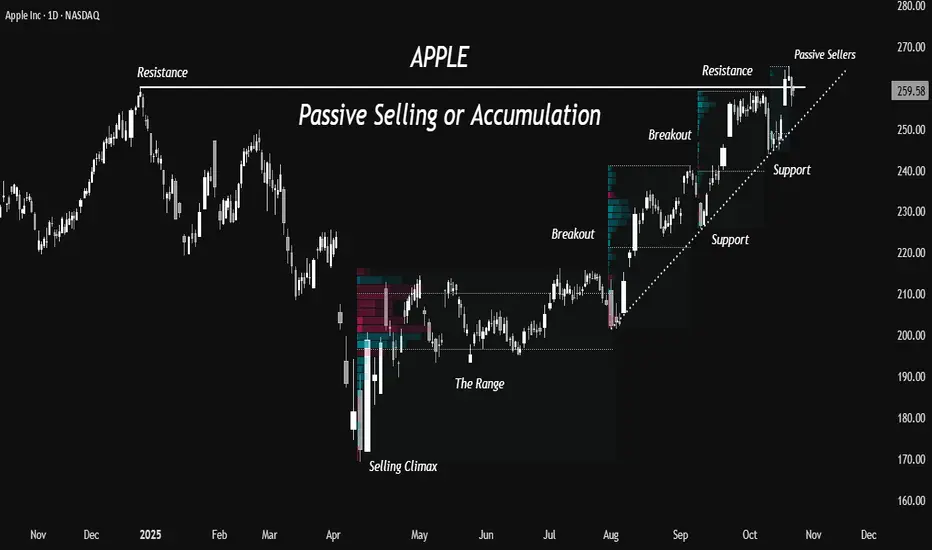
Apple- Passive Selling or More Accumulation?A Bottom and Accumulation
The stock formed a top near 260 in December 2024 and a bottom near 169 in April 2025.
After a sharp bounce of 25% from the lows in just 4 days, the stock consolidated for about 76 sessions in a range from 193 to 214- roughly a 10% range. This created a well-defined base structure, suggesting a period of accumulation.
Breakouts with Volume
The range broke out with strong volume expansion in the beginning of August, confirming a shift in market structure from accumulation to markup. Since then, the stock has maintained a steady uptrend, experiencing only brief pullbacks of about 5 to 6 percent- typical of a healthy trending phase.
Passive Selling at Highs
Currently the stock is trading near its previous highs of 260. It broke out of this resistance and then pulled back below this level. Passive selling is seen around 260 level which means sellers are stepping up, trying to absorb buyers. and the next few sessions will reveal whether this zone turns into a distribution area or simply a retest before continuation.
Trendline Buyers
Pullback buyers are watching the up trendline support which has held the previous shakeouts at two occasions (in Sep and Oct). As long as the stock sustains above this trendline, trend-following participants are likely to continue adding on dips, providing structural support to the uptrend.
Two Scenarios
A sustained move above 260, supported by strong volumes, would reaffirm bullish control and open the door for further upside momentum. Conversely, a break below the trendline could trigger long liquidation from those who bought above 260, leading to broader profit booking and a possible retracement toward 240 or even 225.
What do you think about the stock?
Will it fail the current breakout or sustain?
Do comment below 💬
#For educational purpose only, not a buy/sell recommendation.
APPLE: Price Action & Swing Analysis
The recent price action on the APPLE pair was keeping me on the fence, however, my bias is slowly but surely changing into the bearish one and I think we will see the price go down.
Disclosure: I am part of Trade Nation's Influencer program and receive a monthly fee for using their TradingView charts in my analysis.
❤️ Please, support our work with like & comment! ❤️
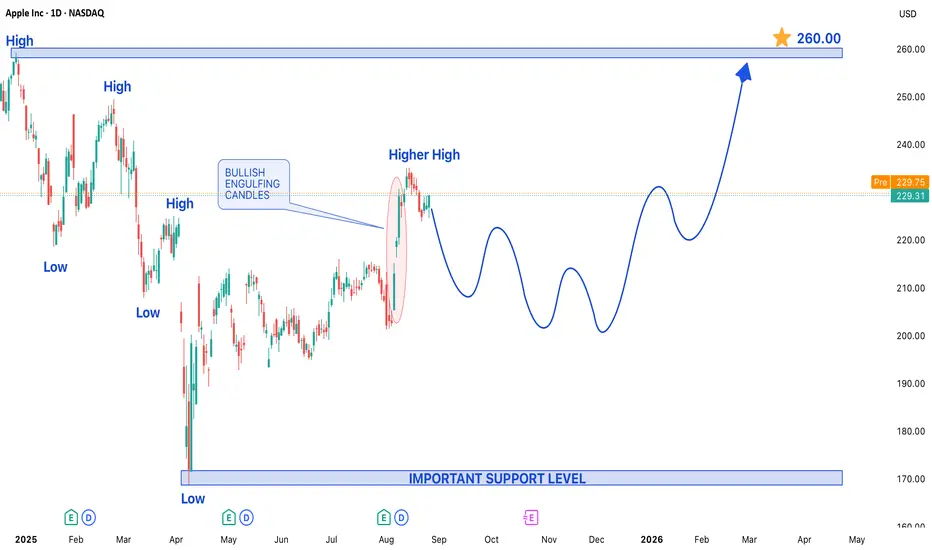
APPLE INC SHIFTED TO BULLISH TREND STRUCTURE IN DAILY CHARTTechnical Analysis: Apple Inc. (AAPL) Shifts to Bullish Daily Trend
A significant technical development is underway for Apple Inc. (AAPL), as its daily chart has conclusively shifted into a bullish trend structure. This critical change in market posture indicates that buyer momentum has successfully overwhelmed previous selling pressure, setting the stage for a potential sustained upward move. The emergence of this new trend is characterized by a clear pattern of price action that signals growing confidence among buyers.
The primary evidence for this bullish shift is the formation of a higher high. This occurs when the price surpasses a previous significant peak, breaking the sequence of lower highs that defines a bearish or corrective phase. This achievement demonstrates that buyers are not only active but are also willing to bid up the price to new interim levels, establishing a new upward trajectory. This price-based evidence is powerfully confirmed by a key candlestick pattern: the **Bullish Engulfing candle. This pattern materializes when a large bullish candle completely "engulfs" the real body of the preceding bearish candle. It represents a decisive victory for the bulls within a single trading session, marking a clear shift in sentiment from selling to aggressive buying and providing strong confirmation of the underlying strength.
Given the confluence of this new bullish trend structure, the higher high formation, and the potent Bullish Engulfing candlestick pattern, the expectation is for AAPL's price to remain bullish in the upcoming trading sessions. The path of least resistance appears to be firmly to the upside, with momentum favoring the buyers.
Key Levels to Watch:
Upside Target: Based on this technical structure, the price is projected to aim for a target level of $260.00 on the higher side. This objective will likely serve as a key profit-taking zone and a significant psychological resistance level that the market will test.
Downside Support: While the outlook is bullish, it is prudent to identify key risk management levels. On any pullback, the support level of $170.00 is expected to act as a crucial floor. This level should hold to keep the newly established bullish structure intact. A decisive break below this support could invalidate the current bullish thesis and signal a return to a neutral or bearish consolidation phase.
In summary, the technical evidence for AAPL has turned convincingly positive. Traders and investors may look for opportunities on the long side, targeting the $260.00 level, while using any moves toward $170.00 as a potential value area, always with appropriate risk management strategies in place.
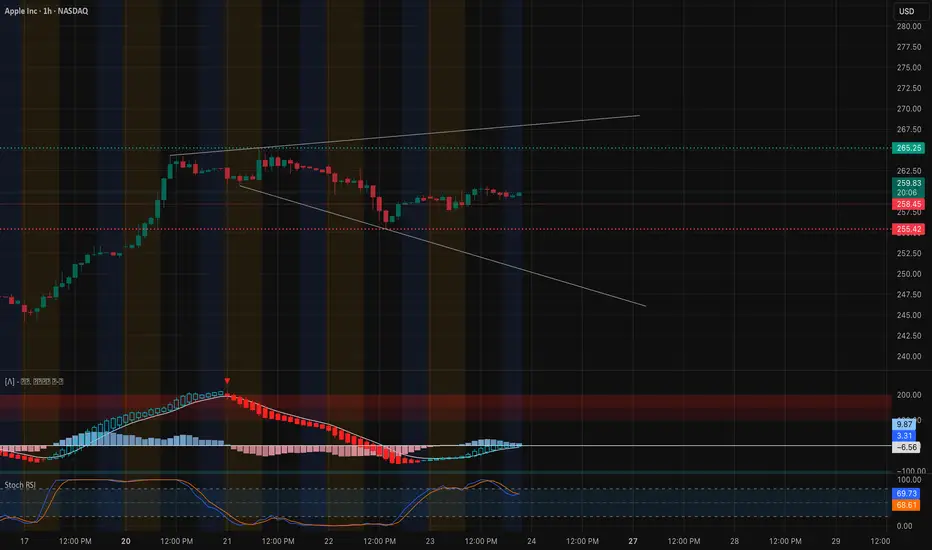
AAPL Testing Mid-Range Balance: (Oct. 24 Outlook)Can Bulls Reclaim $262 or Will It Slip Back to $252? 🍏
1. Market Structure (1H & 15M)
Apple’s recent price action shows a fragile equilibrium forming between supply and demand after a clean recovery from the $252 zone. On the 1-hour chart, we’ve got a CHoCH confirming short-term buyers stepping back in around $255, but price remains capped below a key mid-range resistance zone at $260–$262, where several prior breakdown candles originated.
The BOS from earlier in the week was followed by a retracement that created a local higher low structure, hinting at possible accumulation between $255–$258. However, the failure so far to push decisively through $262.50 shows hesitation — likely due to overhead liquidity and the GEX call wall there.
On the 15-minute chart,
Apple is consolidating inside a rising channel with small BOS/CHoCH rotations that reflect indecision. The latest CHoCH suggests short-term exhaustion, but as long as price respects $257–$258, bulls still have a chance to retake control into Friday.
2. Supply and Demand / Order Blocks
* Demand Zone (Support): $252.5–$255.5, aligning with a previous BOS level and high-volume accumulation area.
* Near-Term Demand: $257–$258 (15M fair value gap + local retest zone).
* Supply Zone (Resistance): $262–$265 — key order block cluster where sellers previously initiated the drop; breakout beyond this range could ignite a trend continuation toward $268+.
The chart shows clear liquidity resting above $262 and below $252 — suggesting that whichever side gets swept first will likely define Friday’s directional bias.
3. Indicator Confluence
* 9 EMA / 21 EMA: On the 15M, both EMAs are converging with a mild upward slope, indicating an early transition from consolidation to possible upside momentum. The 1H EMAs are flattening — a neutral but stabilizing signal.
* MACD: The 1-hour MACD is curling upward with histogram bars flipping positive, suggesting bulls are slowly regaining control. On the 15-minute, MACD shows mild bearish divergence but flattening momentum — setting up for a potential premarket expansion.
* RSI: 1-hour RSI is sitting near 68, close to bullish control but not yet overbought. 15M RSI oscillates between 52–60, ideal for a momentum reset phase.
* Volume: Volume picked up during the $252 bounce but has cooled — typical of compression before a possible breakout.
4. GEX (Gamma Exposure) & Options Sentiment
Friday’s GEX chart paints a tight battleground between the $252.5 HVL support and the $262–$265 gamma wall. The highest positive gamma lies right at $259–$260, meaning dealers may attempt to pin price near that zone through hedging.
Below that, the PUT support around $250 aligns perfectly with structural demand and previous BOS support — this is the line bulls must defend. Above, $265 represents the dominant call wall, making it the near-term ceiling unless a gamma squeeze takes hold.
The current IVR (20) and IVX avg (29.8) show low volatility, and call sentiment remains modest (7.1%), implying traders are cautious but not overly bearish. If momentum accelerates past $262, gamma positioning could flip and lead to a controlled squeeze toward $267–$270.
5. Trade Scenarios for Friday, Oct. 24
Bullish Setup 🟩
* Entry Zone: $258–$259 retest or breakout above $262.2
* Targets: $264 → $267 → $270
* Stop-Loss: Below $256.8
* Confirmation: Hold above 9 EMA on 15M + MACD histogram rising + RSI > 60
Bearish Setup 🟥
* Entry Zone: $261–$262.5 rejection or CHoCH under $257
* Targets: $255 → $252 → $248
* Stop-Loss: Above $263.5
* Confirmation: MACD crossdown + RSI divergence + BOS to downside
6. Closing Outlook for Oct. 24 (Friday)
Friday looks to be a compression breakout setup for Apple — momentum is tightening between $257 and $262. If bulls reclaim $262 with conviction, watch for a potential gamma-driven squeeze toward $267+. Conversely, a rejection there with fading volume could pull Apple back toward its $252–$255 accumulation base.
My personal view: AAPL remains neutral-to-bullish as long as $257 holds. Buyers have shown up at every dip this week, and Friday’s session might reveal whether that base was genuine accumulation or just short-term relief. Keep your eyes on $262 — that’s the key trigger level.
📊 Final Thought:
“AAPL is balancing between $257 and $262 — the calm before the breakout. If bulls crack $262, the gamma unwind could send it flying toward $270. If not, expect a cool-off back to the $255 zone.”
This analysis is for educational purposes only and not financial advice. Always do your own research and manage your risk before trading.
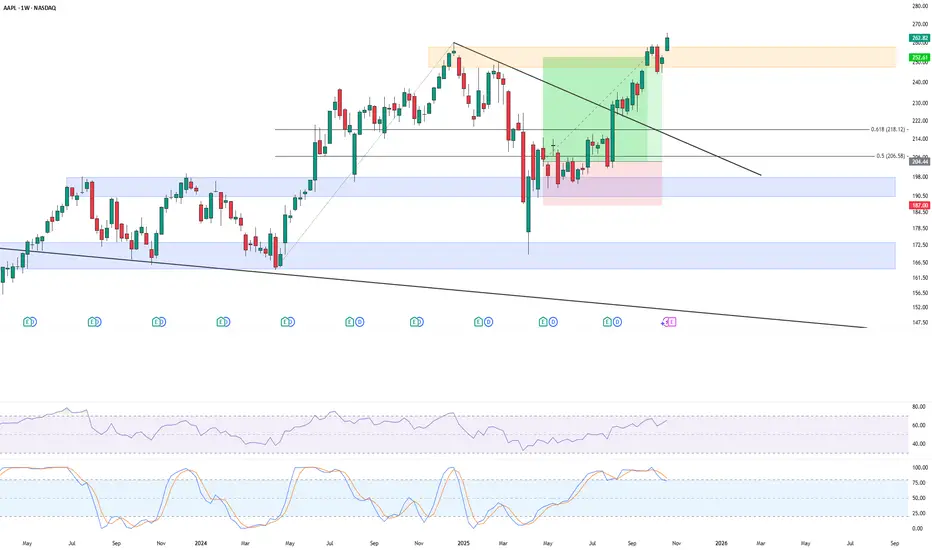
Apple: New All-Time High as Low Is Adjusted Apple has recently seen a period of heightened volatility, marked by sharp gains and notable pullbacks. In response to the latest price action, we’ve made a slight adjustment to our wave count and revised the low for magenta wave (4). We’re now allowing for magenta wave (5) to break above the $260.10 resistance level, which would complete green wave . Our alternative scenario, which carries a 34% probability, still calls for a new corrective low in blue wave alt.(IV). In this case, Apple would have just finished beige wave alt.b slightly above $260.10 and would next decline in wave alt.c, falling below support at $212.94. Even so, the alternative corrective low would remain above the $168 level.
Apple: New All-Time High!Apple has recently seen a period of heightened volatility, marked by sharp gains and notable pullbacks. We’re allowing for magenta wave (5) to break above the $260.10 resistance level, which would complete green wave . However, our alternative scenario, which carries a 34% probability, calls for a new corrective low in blue wave alt.(IV) . In this case, Apple would have just finished beige wave alt.b slightly above $260.10 and would next decline in wave alt.c , falling below support at $212.94. Even so, the alternative corrective low would remain above the $168 level.
Apple Smashes Expectations with iPhone 17Apple Smashes Expectations with iPhone 17: Sales Up 14% in Just 10 Days
By Ion Jauregui – Analyst at ActivTrades
Apple (NASDAQ: AAPL) has made another bold move with the launch of its iPhone 17. According to Counterpoint, the latest model sold 14% more than the iPhone 16 in its first 10 days in key markets such as China and the United States. Growth is even more remarkable in China, where the base model almost doubled its sales compared to the iPhone 16. Overall, sales across both markets surged 31%, consolidating Apple as the undisputed leader in the sector.
The secret behind this success seems simple but effective: a better chip, enhanced display, upgraded front camera, and larger storage capacity, all while maintaining the same price as last year. Apple’s “more for the same” strategy has, at least so far, proven highly profitable.
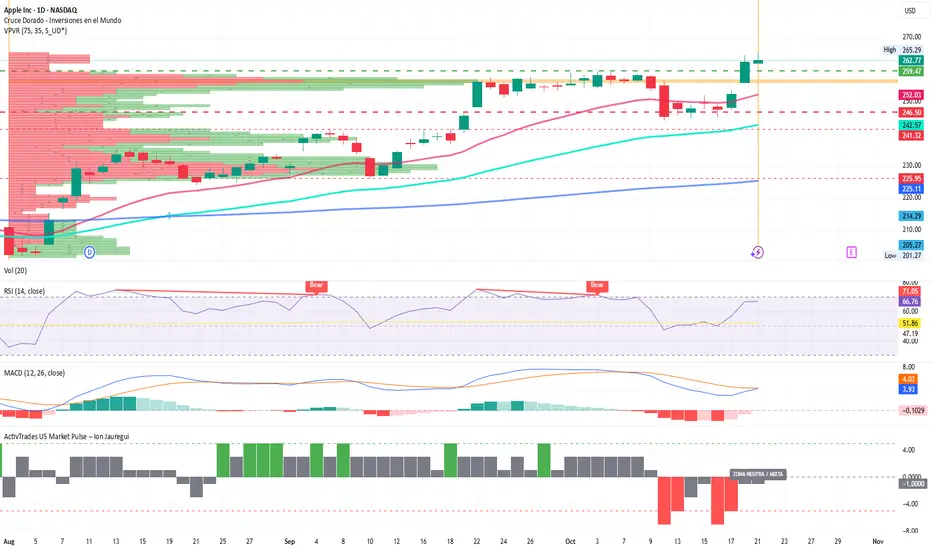
AAPL Technical Analysis
From a technical perspective, Apple shares show a solid bullish momentum following the iPhone 17 announcement:
The price has broken key resistance at $259.47, consolidating above the 50-day moving average for two consecutive sessions.
Relative Strength Index (RSI) indicators are in slightly overbought territory but show no immediate correction signals.
MACD indicates the early stages of a bullish crossover.
Trading volume has increased significantly in recent days, confirming strong institutional interest.
In this context, current support is around $246.50, with the next support above $241.28 near the 100-day moving average, while the previous key support is at $225.95, coinciding with the 200-day moving average. The ActivTrades US Market Pulse indicates a neutral risk balance, suggesting that these moves are largely driven by speculation around Apple.
For Apple, these figures represent more than just a commercial victory. The company needed a sales boost to justify its position in an increasingly competitive market, and early indicators show it is succeeding.
The iPhone 17 not only strengthens investor confidence in Apple but also sets a new benchmark for the tech industry at a time when innovation and demand for premium devices are higher than ever.
*******************************************************************************************
La información facilitada no constituye un análisis de inversiones. El material no se ha elaborado de conformidad con los requisitos legales destinados a promover la independencia de los informes de inversiones y, como tal, debe considerarse una comunicación comercial.
Toda la información ha sido preparada por ActivTrades ("AT"). La información no contiene un registro de los precios de AT, o una oferta o solicitud de una transacción en cualquier instrumento financiero. Ninguna representación o garantía se da en cuanto a la exactitud o integridad de esta información.
Cualquier material proporcionado no tiene en cuenta el objetivo específico de inversión y la situación financiera de cualquier persona que pueda recibirlo. La rentabilidad pasada y las estimaciones o pronósticos no son sinónimo ni un indicador fiable de la rentabilidad futura. AT presta un servicio exclusivamente de ejecución. En consecuencia, toda persona que actúe sobre la base de la información facilitada lo hace por su cuenta y riesgo. Los tipos de interés pueden cambiar. El riesgo político es impredecible. Las acciones de los bancos centrales pueden variar. Las herramientas de las plataformas no garantizan el éxito.
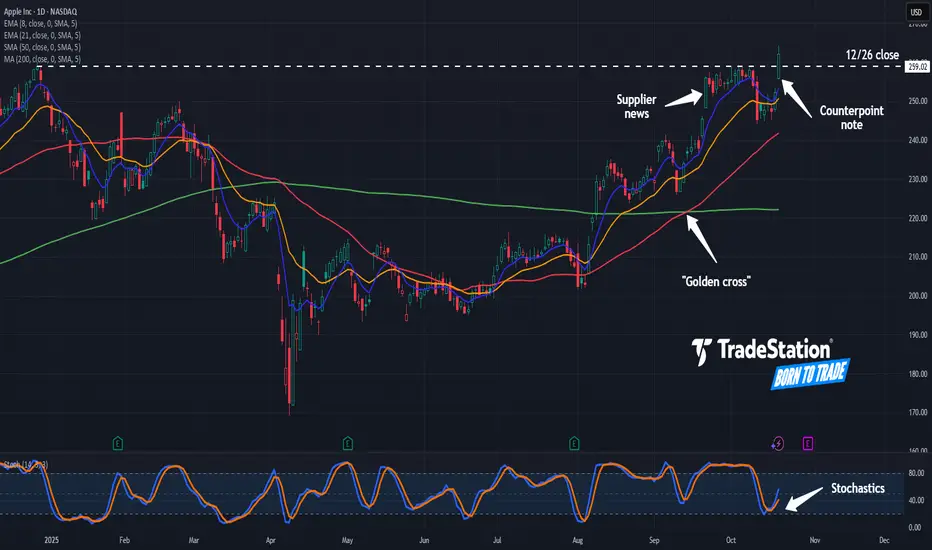
Potential Breakout in Apple Apple has been trapped as the broader Nasdaq rallies, but that might have changed yesterday.
The first pattern on today’s chart is the December 26 closing price of $259.02. AAPL paused near that level in early October but closed above it yesterday. That may be viewed as a potentially bullish breakout.
Second, the tech giant surged on September 22 after The Information reported suppliers were told to increase component production. That was the first clue of strong demand for the iPhone 17. Another report from Counterpoint Research on Monday noted strong early sales of the new handset.
Third, the 50-day simple moving average (SMA) had a bullish “golden cross” above the 200-day SMA last month. That may suggest its longer-term trend is getting more bullish.
Fourth, the 8-day exponential moving average (EMA) is above the 21-day EMA. That may reflect a bullish short-term trend.
Next, stochastics recently turned up from an oversold condition.
Finally, AAPL is a highly active underlier in the options market. (Its average daily volume of 790,000 contracts ranks fifth in the S&P 500, according to TradeStation data.) That could help traders take positions with calls and puts.
TradeStation has, for decades, advanced the trading industry, providing access to stocks, options and futures. If you're born to trade, we could be for you. See our Overview for more.
Past performance, whether actual or indicated by historical tests of strategies, is no guarantee of future performance or success. There is a possibility that you may sustain a loss equal to or greater than your entire investment regardless of which asset class you trade (equities, options or futures); therefore, you should not invest or risk money that you cannot afford to lose. Online trading is not suitable for all investors. View the document titled Characteristics and Risks of Standardized Options at www.TradeStation.com . Before trading any asset class, customers must read the relevant risk disclosure statements on www.TradeStation.com . System access and trade placement and execution may be delayed or fail due to market volatility and volume, quote delays, system and software errors, Internet traffic, outages and other factors.
Securities and futures trading is offered to self-directed customers by TradeStation Securities, Inc., a broker-dealer registered with the Securities and Exchange Commission and a futures commission merchant licensed with the Commodity Futures Trading Commission). TradeStation Securities is a member of the Financial Industry Regulatory Authority, the National Futures Association, and a number of exchanges.
Options trading is not suitable for all investors. Your TradeStation Securities’ account application to trade options will be considered and approved or disapproved based on all relevant factors, including your trading experience. See www.TradeStation.com . Visit www.TradeStation.com for full details on the costs and fees associated with options.
Margin trading involves risks, and it is important that you fully understand those risks before trading on margin. The Margin Disclosure Statement outlines many of those risks, including that you can lose more funds than you deposit in your margin account; your brokerage firm can force the sale of securities in your account; your brokerage firm can sell your securities without contacting you; and you are not entitled to an extension of time on a margin call. Review the Margin Disclosure Statement at www.TradeStation.com .
TradeStation Securities, Inc. and TradeStation Technologies, Inc. are each wholly owned subsidiaries of TradeStation Group, Inc., both operating, and providing products and services, under the TradeStation brand and trademark. When applying for, or purchasing, accounts, subscriptions, products and services, it is important that you know which company you will be dealing with. Visit www.TradeStation.com for further important information explaining what this means.
Apple Inc. (AAPL) Expands With AI-Powered DevicesApple Inc. (AAPL) is a global technology leader known for its iconic products — iPhone, Mac, iPad, and Apple Watch — as well as its fast-growing services segment, including Apple Music, iCloud, and Apple TV+. The company’s ecosystem continues to drive customer loyalty and recurring revenue. Apple’s growth is fueled by innovation in hardware and AI, expansion in digital services, and strong brand power that keeps it at the center of global consumer technology.
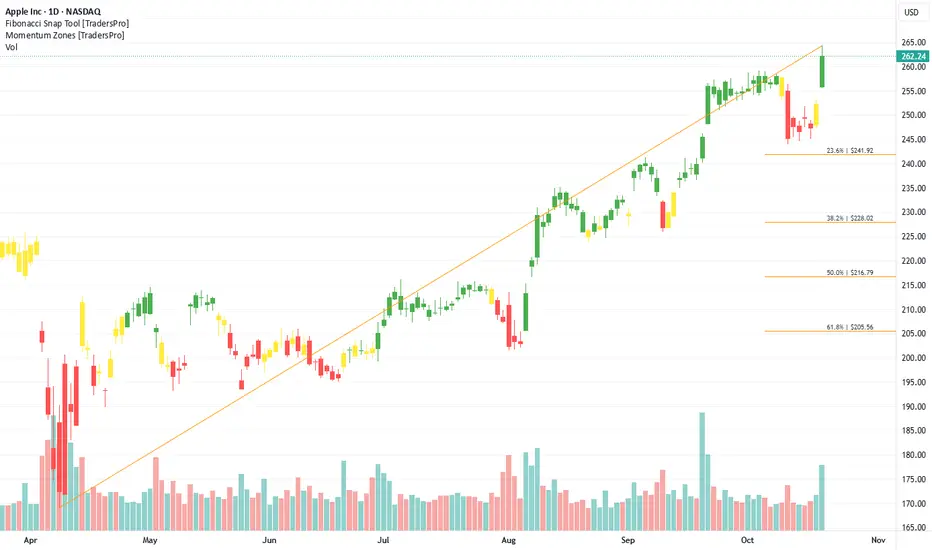
On the chart, a confirmation bar with rising volume highlights bullish momentum. The price has entered the momentum zone after climbing above the .236 Fibonacci level. A trailing stop can be placed just below this Fibonacci line using the Fibonacci snap tool, helping traders protect profits while leaving room for continued upside potential.
Apple (AAPL) Shares Hit an All-Time HighApple (AAPL) Shares Hit an All-Time High
On 26 September, we noted that Apple (AAPL) shares were nearing a record peak. Less than a month later, that forecast has materialised: according to the chart, AAPL surged more than 4% yesterday, surpassing its December 2024 high. This marks:
→ a new all-time record;
→ a return to second place by market capitalisation (Apple has overtaken Microsoft, while Nvidia remains in first position).
Why Are Apple Shares Rising?
→ Strong sales figures. Counterpoint Research reported that sales of the new iPhone 17 series in the US and China during the first ten days were 14% higher than those of the iPhone 16 last year. Analysts note that the base model offers significant improvements at the same price, encouraging consumers to upgrade.
→ Analyst forecasts. Loop Capital not only raised its rating to Buy (with a target price of $315) but also declared the start of a “long-awaited upgrade cycle”. In their view, this is not a short-term surge but the beginning of sustained growth in shipments expected to continue until 2027.
Optimism is also fuelled by anticipation of Apple’s upcoming earnings report and the festive shopping season, which could further accelerate iPhone 17 sales.
Technical Analysis of Apple (AAPL) Shares
Price movements in 2025 have formed a broad upward channel (shown in blue). Within this structure:
→ the channel’s median line acted as support in mid-October;
→ yesterday’s rally lifted the price into the upper quarter of the channel.
From a demand perspective:
→ Trading opened with a bullish gap (see arrow), and the price jumped rapidly in the first minutes — evidence of strong buying interest.
→ The psychological level of $250 is losing its role as resistance and may become future support.
→ The price remains within a steep rising channel (marked in orange).
From a supply perspective:
→ The RSI indicator shows overbought conditions;
→ Some investors may take profits at the new record high.
Taking these factors into account, once the current bullish momentum cools, AAPL could see a short-term pullback — potentially towards the area of the bullish gap or one of the orange trendlines (solid or dotted).
This article represents the opinion of the Companies operating under the FXOpen brand only. It is not to be construed as an offer, solicitation, or recommendation with respect to products and services provided by the Companies operating under the FXOpen brand, nor is it to be considered financial advice.
Long trade
📘 Trade Journal Entry
Pair: AAPL (Apple Inc)
Direction: Buyside Trade
Date: Fri 10th Oct 2025
Time: 11:30 AM
Session: London Session AM
Timeframe: 15 minutes
🔹 Trade Details
Entry: $258.49
Profit Level: $269.22 (+4.27%)
Stop Level: $243.69 (–1.96%)
Risk-Reward Ratio (RR): 2.16
🔹 Technical Context
The demand zone on the 15-minute timeframe (near $252–$255) held strongly following an earlier breaker block and order block reaction.
Price retraced to the 0.618–0.786 Fibonacci zone before resuming upward momentum.
Kaufman Adaptive Moving Average (KAMA) is trending upward, confirming directional bias alignment.
RSI recovered from mid-range, showing bullish divergence and improved momentum.
The 1.618 Fib extension aligns closely with the target zone (~$261–$262), confluencing with prior structural resistance.
🔹 Narrative
After a period of range compression within the 255–258 zone, Apple broke from its re-accumulation structure following a liquidity sweep below the 15-minute demand zone.
Institutional accumulation was evident, as reflected by high-volume candle expansion and a clear reclaim of structure at 257.
🔹 Market Sentiment Context
Broader NASDAQ composite strength aligns with post-earnings optimism and risk-on appetite.
USD weakness and moderating Treasury yields have improved tech-sector conditions.
The upcoming Q4 earnings cycle and expectations of a potential Fed rate cut sustain short-term bullish sentiment across mega-cap equities.