Sol continues to hold up strongCRYPTOCAP:SOL is holding up well with only a shallow retracement to the 0.382 for wave (4)- the weekly 200EMA.
Price is above the weekly 200EMA, which is bullish, but lost the pivot, which is bearish, giving the overall pattern ambiguity. Wave C is underway, but looks near completion at wave 4’s expected Fib targets.
🎯 Terminal target for the business cycle could see prices as high as $660 based on weekly pivots
📈 Weekly RSI is bearish with room to fall, but doesn’t often reach oversold.
👉 Analysis is invalidated if we close back below $50, as wave 4 can not go below the 0.5 Fib.
Safe trading
Trade ideas
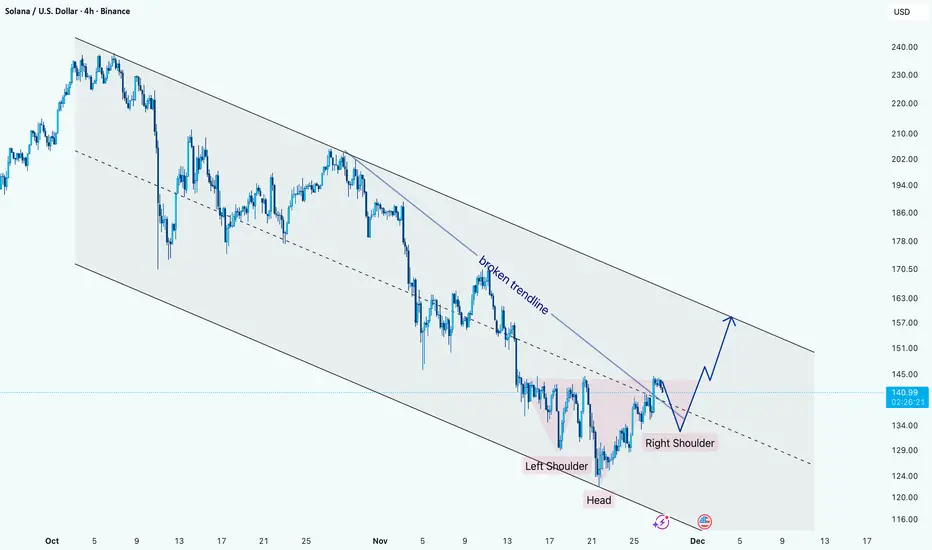
SOL Reversal Structure Forming Inside Downtrend ChannelHi!
Solana is trading inside a well-defined descending channel, but momentum is shifting. Price has broken the inner descending trendline and is now forming a clear inverse Head & Shoulders at the bottom of the structure.
The neckline zone has been tested multiple times, showing growing buyer strength. As long as price holds above the right-shoulder support, the structure favors a bullish continuation.
A breakout above the neckline opens the way toward the upper boundary of the main descending channel, with the next key reaction zone near $155–160. Failure to hold the right shoulder would delay the reversal and pull the price back toward mid-channel support.
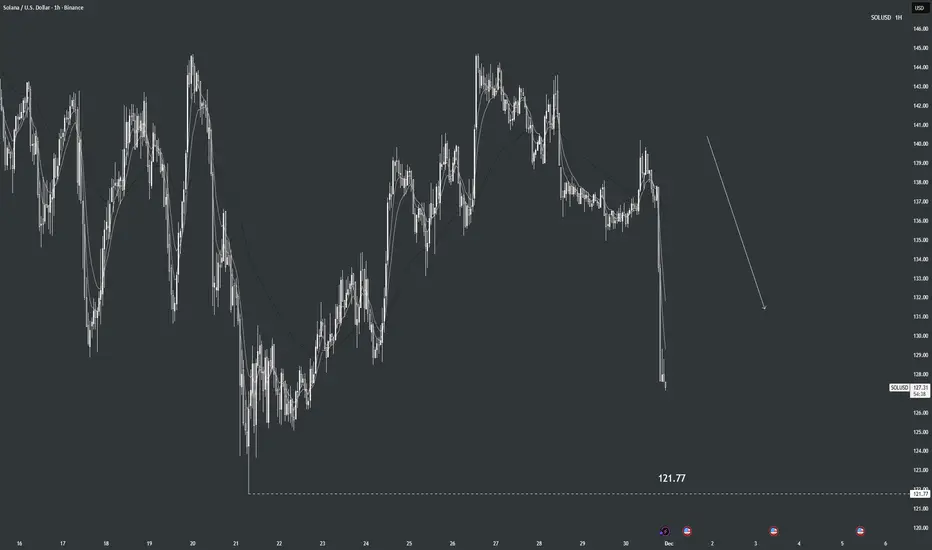
SOL Daily Outlook | November 30, 2025Timeframe
1 Hour (1H)
EMAs Used
5 EMA
10 EMA
50 EMA
Market Structure
SOL has shifted into a bearish impulse–correction sequence on the 1H chart. Price broke structure to the downside and followed with a sharp impulse lower. The recent correction has failed to reclaim previous highs, and the 5, 10, and 50 EMAs are now aligned bearishly, supporting continued downside movement.
What I Want to See
I want to see SOL continue this bearish sequence, using any smaller corrections as fuel for the next impulse down.
Bias
Bearish.
BTC ETH SOL MSTR The Bounce Seems To Be OverRemember that Socrates analysis has daily closings at 6pm Eastern Time and Weekly closing on Friday at 6pm. It appears that November 28th was an important HIGH, Socrates is pointing to a likely resumption of the downtrend for the next 3 weeks, which price action should begin to confirm in the next 2 days or so however, price action will do what it will do, meaning that if by Wednesday price action continues to push strongly higher then we should immediately turn BULLISH but, I'm betting that the price will resume its downward trajectory starting around December 2nd.
Now for much better news for crypto: BTC, ETH and SOL have generated a new channel lines from the HIGH on November 28th which implies a more sideways trajectory to an eventual important LOW in mid-December. I suspect that for BTC the bottom support of the long-term up-trend channel around +$70k will probably hold by mid-December which should give us a very strong rally into February.
As for MSTR, this coming week is a WEEKLY PANIC CYCLE which implies that this coming week should open higher than last week and close the week BELOW the prior week, in other words, a move back down to around 167 by end of this coming week.
SOLUSDT Holds Support – Eyes on 148–150 ZoneLooking at the H4 chart, SOL has just broken above the green FVG cluster at 136–140 and is now holding above it, turning this area into new support. Multiple H4 candles closing above 140 indicate selling pressure below has weakened, and buyers are accepting higher prices.
The lower Ichimoku cloud is starting to curve up, signaling that the previous downward momentum has lost strength, and a corrective upswing is forming. Above, the large FVG cluster around 148–150 remains untested, likely acting as a “price magnet” for the current move.
My only forecast for SOLUSDT: I expect SOL to continue rising. In the short term, price may pull back slightly to 140–138 to retest the green FVG and attract more buying. As long as SOL holds above 136, these dips are just pullbacks within the uptrend.
From the current base, SOL could gradually climb toward 148–150 USDT, where strong FVG and resistance are located, making it an area to watch in the coming sessions.
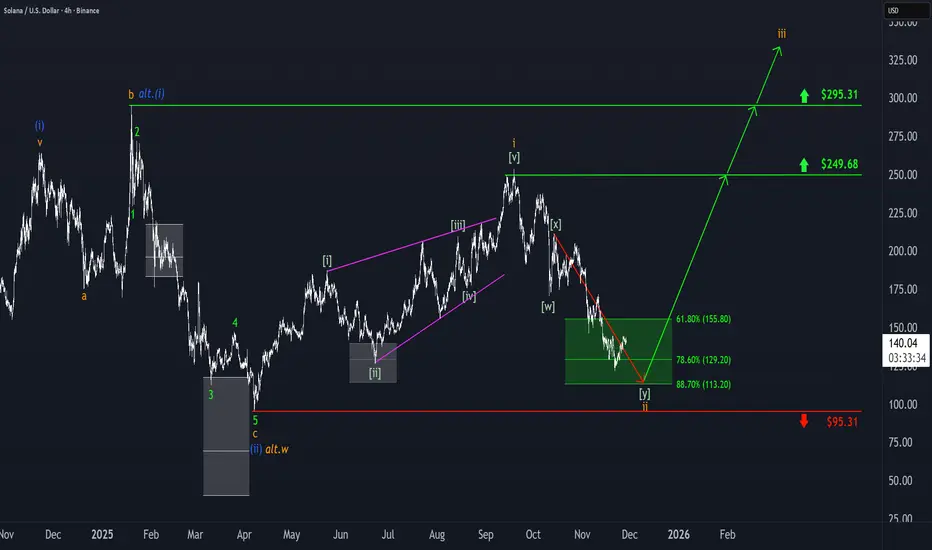
Solana: Is the Bottom In, or More Downside Ahead?SOL has already climbed more than 15% from last Friday’s low at its peak, potentially signaling the completion of wave ii in orange. For now, however, we’re still keeping open the possibility that this move could dip to a new low—within our green Target Zone ($155.80–$113.20). In any case, once this interim correction wraps up, wave iii in orange should kick off an impulsive rally, only losing steam above resistance at $295.31.
Solana: Is the Bottom In, or More Downside Ahead? SOL has already climbed more than 15% from last Friday’s low at its peak, potentially signaling the completion of wave ii in orange. For now, however, we’re still keeping open the possibility that this move could dip to a new low—within our green Target Zone ($155.80–$113.20). In any case, once this interim correction wraps up, wave iii in orange should kick off an impulsive rally, only losing steam above resistance at $295.31.
Monthly Crypto Analysis: Solana (SOLUSD) – Issue 107 The analyst expects Solana’s price to decline by the specified end time, based on quantitative analysis.
The take-profit level only highlights the potential price range during this period — it’s optional and not a prediction that the market will necessarily reach it.
You don’t need to go all-in or use leverage to trade wisely.
Allocating just a portion of your funds helps keep overall risk low and ensures a more sustainable approach.
Our strategy is built on institutional portfolio management principles, not the high-risk, all-in trading styles often promoted on social media.
Results are evaluated over the entire analysis period, regardless of whether the take-profit level is reached.
The validity of this analysis is based on a specific time range (until 23 Dec 2025), and after this period, the analysis will be reviewed and updated (once every 28 days).
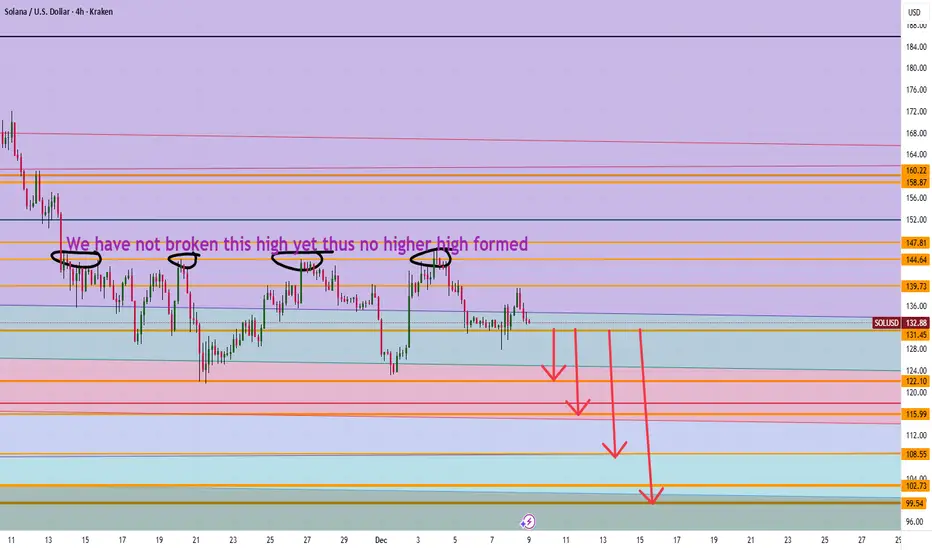
SOL Bleeds Below 130 – Sellers Take Full ControlSolana broke down again, slicing through 130 support after repeated rejections from the 180–220 OB cluster. Structure is fully bearish with no bullish MSB to confirm a reversal.
RSI dropped to 36 and MACD just crossed back bearish. This chart screams continuation unless bulls pull off a fast reclaim of 140.
Momentum is fading hard. Expect lower prices if trend stays intact.
Bias: Bearish
Pair: SOL/USDT
Timeframe: 12H
This is not financial advice, only data analysis. Please consult a qualified financial professional for personalized guidance.
solana is ready to pump?currently I see solana ascending and getting ready to decide where we are heading, the way the market looks I dont want to get in a trade and get sandwiched in.
were either going to be
* bouncing off the small yellow trend line and go up to $145 and break towards the upside ^
* bounce off the small yellow trend line hit $145 to reject that level and head down to $135 again and finally bounce back up and retest to break $145 ^
* break small trend line and go lower towards $120 again and lower.
SOL - The Next Collapse May Be InevitableCRYPTOCAP:SOL COINBASE:SOLUSD BINANCE:SOLUSDT BINANCE:SOLBTC
Fundamental Analysis:
Solana pumped strongly in 2020–2021 because it offered high speed, low fees and a new ecosystem that attracted developers and traders. The same thing happened again in 2024–2025, but this time the main driver was the huge wave of easy-to-create tokens and memecoins . Anyone could launch a coin in a few minutes and many of these tokens were dumped on the market with no real purpose. Now that most of these new coins are losing popularity and people are realizing that many were simply scams, activity on the Solana blockchain is starting to slow down. Even with the recent Solana ETFs, large investors will likely wait for a major price drop before buying, not during a hype phase that has already ended.
Technical Analysis:
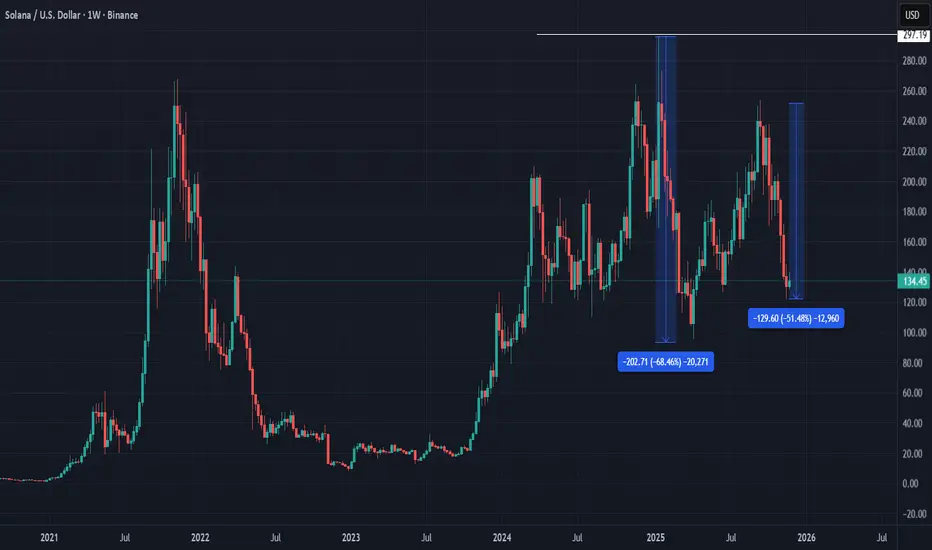
The price almost hit $300, then made a very strong correction of around 68%. After that, the market struggled to bring the price back to $250, and it quickly fell again to around $135. This tells me that the zone between 200–300 was used by whales as a distribution zone. They sold heavily while the market was excited, and the weak recovery shows that buying pressure is not strong anymore.
My Expectation:
Because the fundamentals are weakening and momentum is fading, I believe the next range of distribution will move lower, likely around . If activity keeps dropping and no new narrative appears, holders may rush to exit and the price could fall sharply.
This is not a signal to short — it is only my personal point of view on how Solana currently looks to me.
$SOL Solana is currently in a clear accumulation phase following a strong reaction from the major demand zone.
The horizontal accumulation in this zone indicates both a re-intensification of liquidity and the market gathering energy for the next directional breakout.
As long as the region holds, the structure is positive, and this accumulation will be the key to the next expansion phase.
SOL Rejected from 150 – Failing to Reclaim StructureAfter flipping MSB at 170, Solana failed to maintain bullish structure and rolled over. The 130–140 zone has held as a floor, but RSI is flatlining below 50 and MACD is fading again.
Price remains trapped under stacked OB zones between 180 and 240. No bullish follow-through yet — lower high scenario still valid.
A break under 130 would confirm further downside.
Bias: Bearish
Pair: SOL/USDT
Timeframe: 12H
Global Currency StabilityUnderstanding Its Dynamics, Drivers, and Implications
Currency stability is a cornerstone of global economic health. When currencies maintain predictable value relative to one another, international trade, investment, and economic planning become more efficient and less risky. Conversely, volatile or unstable currencies can disrupt markets, reduce investor confidence, and strain national economies. Global currency stability refers to the overall steadiness of major currencies across countries and regions, which plays a vital role in maintaining economic growth, promoting trade, and fostering international financial confidence.
1. The Concept of Currency Stability
Currency stability is often defined by the minimal fluctuations in a currency’s exchange rate over time. A stable currency has predictable purchasing power both domestically and internationally. This stability allows businesses and governments to make long-term financial decisions with greater confidence. Central to the concept is exchange rate stability, which indicates the relative value of one currency compared to others. Stability reduces uncertainty in international transactions, investment flows, and cross-border trade contracts.
Currencies can be stable in nominal terms, meaning their exchange rate relative to another currency does not fluctuate excessively, or in real terms, which takes into account domestic inflation rates. Both forms of stability are crucial, as a nominally stable currency experiencing high domestic inflation may still lose purchasing power and create economic uncertainty.
2. Factors Influencing Global Currency Stability
Currency stability is determined by a combination of domestic and international economic factors. Some of the primary drivers include:
a. Monetary Policy: Central banks play a key role in maintaining currency stability through interest rate adjustments, open market operations, and foreign exchange interventions. A credible and transparent monetary policy can stabilize a currency by controlling inflation, supporting investor confidence, and ensuring liquidity in financial markets. For instance, the Federal Reserve in the United States or the European Central Bank employs policy tools to manage the value of their currencies, indirectly impacting global stability.
b. Fiscal Policy and Government Debt: Governments influence currency stability through their spending and borrowing patterns. Excessive public debt or budget deficits can weaken confidence in a currency, leading to depreciation and volatility. Conversely, responsible fiscal management enhances credibility, attracting foreign investment and supporting stable currency conditions.
c. Trade Balances: Countries with consistent trade surpluses often experience currency appreciation, while persistent trade deficits may lead to depreciation. A balanced trade scenario contributes to predictable currency values and reduces the risk of sudden shifts caused by external imbalances.
d. Capital Flows: Cross-border investment flows, including foreign direct investment and portfolio investment, directly affect currency demand and supply. Sudden inflows can strengthen a currency, while abrupt outflows can trigger instability. Countries with robust capital markets and regulatory frameworks can better manage these fluctuations, contributing to global stability.
e. Political Stability and Governance: Political uncertainty, policy changes, or geopolitical risks can undermine confidence in a currency. Stable governments with transparent institutions are more likely to maintain consistent economic policies, supporting predictable currency values.
f. Global Economic Conditions: Events such as global recessions, commodity price shocks, and financial crises influence currency stability. For example, a decline in oil prices may weaken oil-exporting countries’ currencies, impacting broader trade and investment networks.
3. The Role of Major Currencies in Global Stability
Certain currencies, often referred to as reserve currencies, play a disproportionate role in global stability. The US Dollar (USD), Euro (EUR), Japanese Yen (JPY), and recently, the Chinese Yuan (CNY), are central to international trade, finance, and reserves. These currencies are widely used for cross-border transactions, denominating global commodities, and holding central bank reserves.
The stability of these major currencies directly affects global markets. A stable US Dollar, for instance, reduces transaction risk for international traders and investors. Conversely, volatility in these currencies can trigger ripple effects, affecting emerging markets, global trade pricing, and international debt servicing.
4. Mechanisms for Maintaining Currency Stability
Countries and international institutions employ multiple strategies to maintain currency stability:
a. Fixed and Managed Exchange Rate Systems: Some nations peg their currencies to a stable foreign currency, like the USD or EUR. Pegging provides predictability, reduces speculative volatility, and can anchor inflation expectations. Managed exchange rates allow limited flexibility while preventing extreme fluctuations.
b. Foreign Exchange Reserves: Central banks maintain reserves of foreign currencies to intervene in currency markets when excessive volatility occurs. By buying or selling their own currency or foreign currency, central banks can stabilize exchange rates temporarily or support longer-term credibility.
c. International Coordination: Organizations such as the International Monetary Fund (IMF) provide frameworks for stabilizing currencies through lending, policy advice, and financial monitoring. During crises, coordinated actions by multiple countries can prevent global contagion and stabilize volatile currency markets.
d. Monetary Policy Transparency and Credibility: Consistent communication and clear policy objectives reduce market uncertainty. Investors and traders can anticipate central bank actions, decreasing speculative attacks that could destabilize currencies.
5. Implications of Currency Instability
Unstable currencies have broad economic consequences:
Inflation and Purchasing Power Erosion: Rapid depreciation can increase import prices, fueling domestic inflation and reducing living standards.
Investment Hesitancy: Investors prefer predictable returns. Currency volatility can deter both domestic and foreign investment, slowing economic growth.
Trade Disruption: Unpredictable exchange rates complicate pricing, contract negotiation, and profit planning for exporters and importers.
Debt Servicing Risks: Countries with foreign-denominated debt face higher repayment costs if their currency weakens, potentially triggering defaults or fiscal crises.
6. The Interconnected Nature of Global Currency Stability
In today’s globalized economy, currency stability is not just a national concern but an international one. Global trade, financial markets, and capital flows are deeply interconnected. Instability in a major currency, such as the USD or Euro, can transmit shocks across multiple countries, especially emerging markets with weaker financial systems. Conversely, stable currency regimes promote confidence, facilitate trade, and support sustainable growth worldwide.
7. Challenges to Global Currency Stability
Despite mechanisms to maintain stability, several challenges persist:
Geopolitical Tensions: Conflicts, sanctions, and political instability can disrupt currency markets.
Speculative Attacks: Currency traders sometimes engage in large-scale speculation, causing sudden and severe exchange rate movements.
Emerging Market Vulnerabilities: Less developed financial systems may struggle to manage sudden capital flow reversals or external shocks.
Global Economic Shocks: Events like pandemics, financial crises, or commodity price collapses can trigger synchronized instability across multiple currencies.
8. Conclusion
Global currency stability is a fundamental pillar of international economic health. It ensures predictability in trade, investment, and financial planning, reducing systemic risk and fostering economic growth. Achieving stability requires coordinated monetary and fiscal policies, strong institutional frameworks, and proactive management of trade and capital flows. While challenges such as geopolitical uncertainty and market speculation persist, transparent and credible governance, combined with global cooperation, can support resilient currency systems. Stable currencies not only benefit individual nations but also underpin the smooth functioning of the global economy, enabling sustainable development and prosperity worldwide.
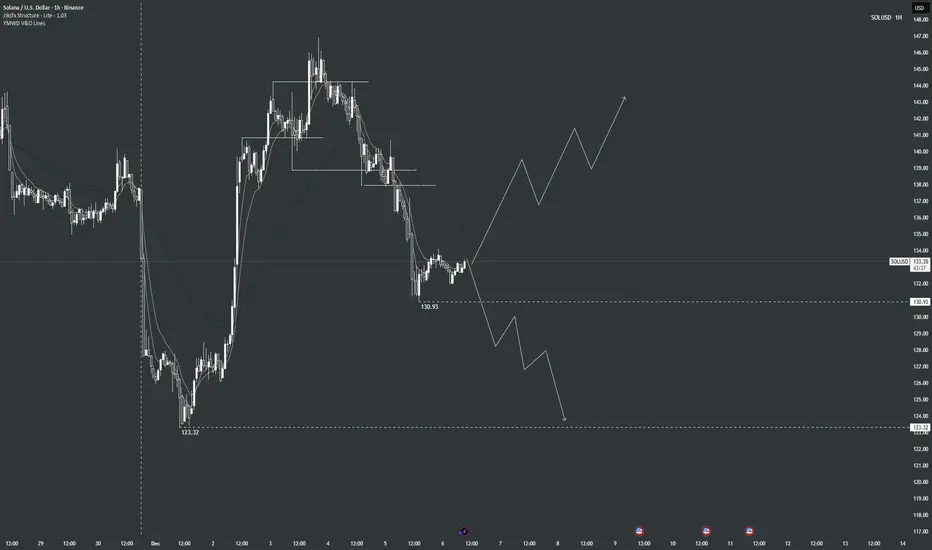
SOL Daily Outlook | December 6, 2025SOL Daily Outlook | December 6, 2025
1H Market Structure Overview
Solana is currently testing key support at $130.93 after pulling back from the previous highs near $146–$147. On the 1H timeframe, price is showing signs of bearish momentum with lower highs forming after the peak. Structure is at a critical point: a break below $130.93 would confirm further downside, while holding this level could allow for a reversal back toward previous highs.
Bias
Bearish on 1H — currently favoring the downside while watching the $130.93 support closely. Bias can change if price shows a strong bounce from this level and starts forming higher lows.
What We Want to See Next
Bullish scenario: Price holds above $130.93 and reverses higher, targeting $137–$143, with a potential retest of the $146–$148 area.
Bearish scenario: Price breaks below $130.93, confirming 1H bearish momentum, with the next key support at $123.32. If sellers remain in control, further downside could develop beyond this level.