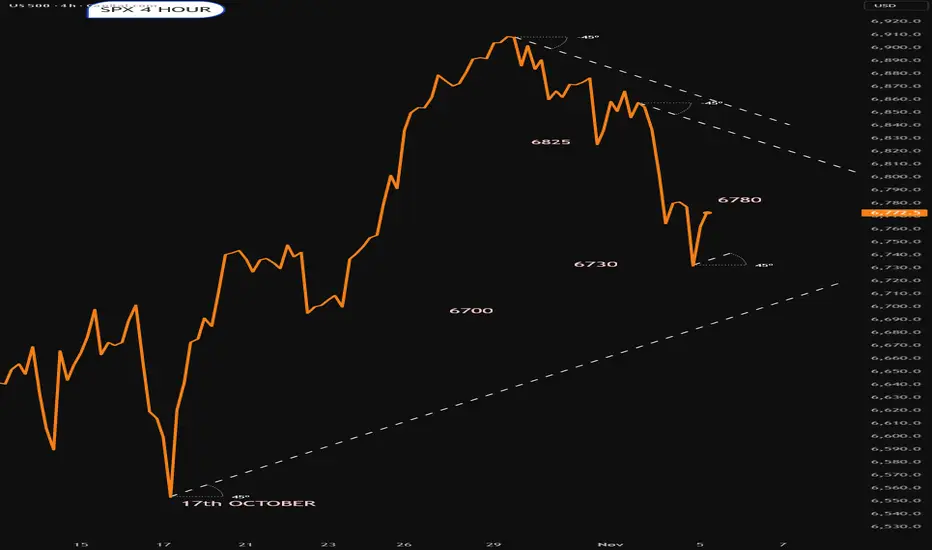
S&P 500 Is moving downthe overall sentiment of the latest news are not very good , a lot of traders are expecting a crash due to market overvaluation take this as an advice Shortby thetradinglord281
I'm just marking support and resistance day 3 learning trading Just started, don't wait to really get my first 100 dollars. Just excited to really learn and start trading.by ns0570171110
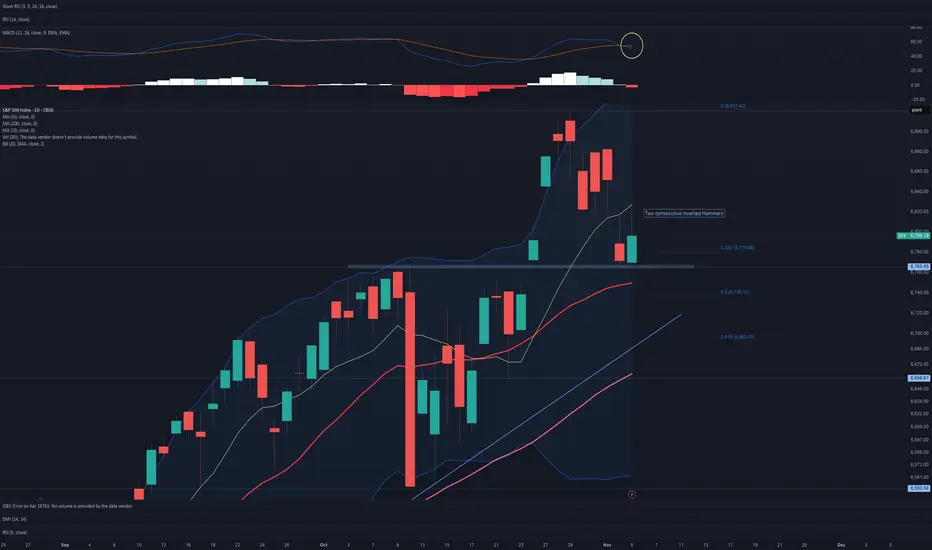
$SPX: MACD has triggered a sell signal. SP:SPX : While today's bounce started off promising, it ultimately fell short. It was unable to break above and reclaim the 10-day moving average, and today, the MACD generated a sell signal. However, before drawing any definitive conclusions, it’s essential to keep things in perspective. So far, this downward movement could be seen as a simple pullback. The S&P 500 has reached the 0.382 retracement level, and it's crucial to note that the 20-day simple moving average would need to be breached to increase the likelihood of a further decline.by OLIV20200
Markets Looking SOFT at highs - Correction Underway (Key Levels)October 10th candle is a very important low for all US Markets -S&P -Nasdaq -Dow -Russell The rally from that Oct 10 candle low (Friday) was met with aggressive support but was only showing rallies in Mag 7 and AI related plays Earnings for the most part are coming in meeting or exceeding expectations, but price action is certainly looking soft with the market making lower highs and lower lows for now We have plenty of technical support, but given the longest US Government Shutdown in history with dot.com like valuations (there is bubble and non-bubble evidence), sentiment and elevated volatility are taking their toll and dragging the markets lower I've closed a lot of open positions and de-risked the portfolio pretty severely this week with the intention of finding ways to participate in a cautiously bullish environment. As I mention in the video, markets tend to V bottom, but round out the tops so the longer we stall at these highs and the more "rounded" look we have near these highs, the more fragile and support can be if we eventually see a break lower - TBD Day to day, we continue to do good work carving out short-term winners and properly position for what is next - good or bad Thanks for watching. See you in the live markets -Chris24:05by ChrisPulver6
Possible WXYIf this is an expanding ending diagonal we may see WXY correction in wave (4).Shortby Supergalactic1
Update at 4pmAlthough the trade did not go my way today, I still expect a further move down. I'm incorrect if they get over the high from today. Gold also looks ready to test it's lows. Oil still consolidating above it's 18ma. BTC looks like a pullback is also coming, a further low is expected still. Short06:11by rsitrades118
SPX moneyPrice make a foundation low then pullback creating short term uptrend eventually coming to an end. Following price fell and make a new external low. Waited for price to come back to the last time buyers were in control and in discount to take us to the external low. Same play... continuation. by Noitw000
V Pattern In SPX/USDHey fellow traders and followers! Look what I found on the 8hr SPX chart. Looks like a developing V pattern so far. What could that mean ? Means up to me. Here are the numbers; We need to break and hold above the Break Line of 6873.1 area to solidify a long position to Target 1) 6939.7 Target 2) 6966.7 I can't stress enough the importance of the Break Line area being a solid support in order for the trade to have a 8 out of 10 chance to make you money. This move if reached fetches a nice profit $$$ Just look at the points you can gain where I posted it on the chart. Ok, let's see how things play out... See you at the starting gate $$$Longby Trade-Farmer1
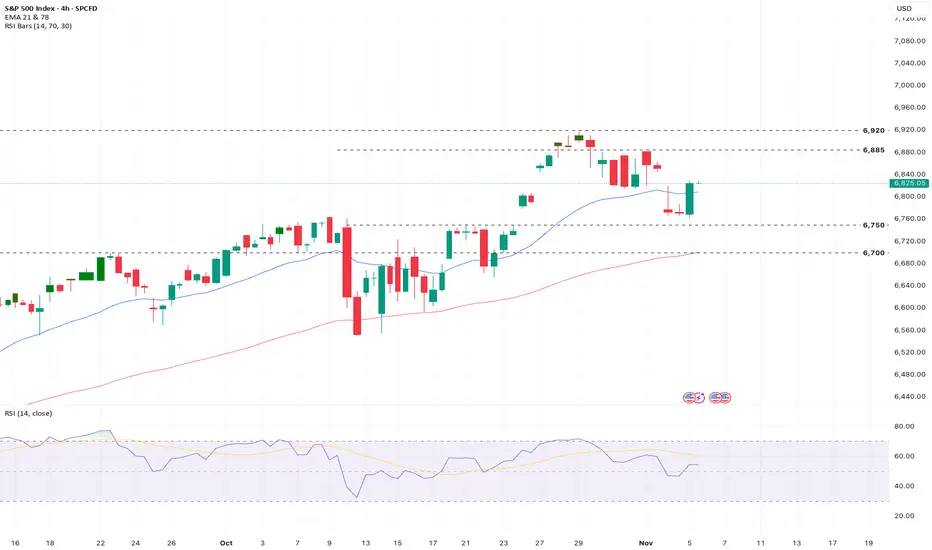
US500 maintains inherently bullish structureFundamental Analysis US500 maintains an inherently bullish structure, trading above both EMAs. Q3 earnings were strong, with 83% of companies beating expectations and delivering 13.8% blended EPS growth, largely thanks to megacap tech/AI. However, the forward P/E ratio is high at 23.1x (above the 5-year average of 19.9x), signaling elevated valuations. The recent profit taking in high growth names like AMD and Nvidia due to margin concerns and macro headwinds (high rates/inflation) exposes this valuation sensitivity. Technical Analysis The index is currently pulling back from all time highs near 6,900, consolidating in a short term support zone of 6,750. Momentum is neutralizing with RSI approx 51.6, indicating a pause rather than a reversal. Key technical battleground: Resistance at 6,885 and 6,920 versus support at 6,750 and the EMA at 6,700. Consolidation is the most probable short term path. Sentiment Analysis Sentiment is cautious to slightly negative. The sharp correction in AI leaders (AMD, NVDA) has fueled "AI bubble" fears, overriding fundamentally strong earnings reports. There is a clear, broad sector rotation occurring as investors de-risk and take year end profits from high growth tech toward defensive/value plays. The market is currently driven by nervousness about sustaining premium valuations against persistent macro uncertainty. Outlook The near term outlook is moderately cautious. While the long term bullish trend remains supported by healthy corporate earnings, the market faces an inflection point driven by overvaluation concerns in the tech sector. Further short term volatility is expected as the market digests earnings nuances (like margin guidance) and awaits clearer signals on US monetary policy and inflation. A decisive break of the 6,750 support or 6,885 resistance will likely define the next directional move. Analysis is by Terence Hove, Senior Financial Markets Strategist at ExnessLongby WiseLeoTrading1
SP500 Consolidated Bullish range because rebounded stronglyThe SP 500 is currently consolidating within a bullish range after price action recently tested key support levels and rebounded strongly. This suggests that buyers are defending the lower boundary of the range, maintaining the broader bullish momentum. On Wednesday, U.S. equities gained, led by a rebound in technology-related shares. Additionally, U.S. private payrolls data came in stronger than expected, signalling continued labour market resilience and supporting investor sentiment. Meanwhile, the U.S. dollar extended its gains from last week, reflecting confidence in the U.S. economy. If bullish momentum continues and the current support holds, we could see further upside potential, with the SP 500 possibly targeting the 6,900–6,980 range in the near term. You may find more details in the chart. Trade wisely best of Luck buddies. Ps; Support with like and comments for better analysis Thanks for Supporting.Longby MrMartin_11339
SPX Breaks Down: Tech Momentum Cools as Risk-Off Sentiment BuildThe S&P 500 just broke below its short-term descending channel — confirming selling pressure is building. High-valuation tech and AI names like NASDAQ:NVDA , NASDAQ:MSFT , NASDAQ:GOOGL , NASDAQ:MU , and NASDAQ:PLTR are leading the pullback as investors rotate out of crowded trades. Macro headwinds — Fed uncertainty, stretched valuations, and global weakness — are weighing on sentiment. Near-term bias stays bearish unless SP:SPX can reclaim 6,850.07:09by Alchemy Markets1
S&P 500 at Critical Support – Last Line of Defense?Since the S&P 500 index( SP:SPX ) is one of the key indicators in the financial markets, and it’s been highly correlated with parallel markets recently, it's always a good idea to keep an eye on its analysis. Now, for example, Bitcoin ( BINANCE:BTCUSDT ) started to decline as the S&P 500 index dropped, and right now the S&P 500 index is at a pretty critical Support zone($6,774_$6,689) and Support lines. It's essentially moving right around its last line of hope. From an Elliott Wave theory perspective, in this current zone, the S&P 500 index could be completing the Triple Three Correction(WXYXZ)=main wave 4. Looking ahead, we might expect the S&P 500 index to climb up toward its Resistance zone($6,894_$6,859). And given the current positioning, the risk-to-reward ratio looks quite favorable—as long as you keep a reasonable stop loss in place and practice good risk management. Note: if these Support lines break downward, we could see further declines in the S&P 500 index and in those correlated markets as well. So it's definitely something to monitor closely. Please respect each other's ideas and express them politely if you agree or disagree. S&P 500 Index Analyze (SPX500USD), 1-hour time frame. Be sure to follow the updated ideas. Do not forget to put a Stop loss for your positions (For every position you want to open). Please follow your strategy and updates; this is just my Idea, and I will gladly see your ideas in this post. Please do not forget the ✅' like '✅ button 🙏😊 & Share it with your friends; thanks, and Trade safe.Longby pejman_zwinUpdated 5531
Bull Run Stumbles: S&P 500 Heads Toward a Potential Correction After a rough day on Wall Street, the S&P 500 dropped about 1.2%, pulling U.S. markets lower. But there’s more behind this fall than just profit-taking. What’s Really Happening? Warning Signs from Wall Street Two top banking leaders raised caution. Morgan Stanley’s Ted Pick expects a 10–15% correction, calling it a “healthy normalization.” Goldman Sachs’ David Solomon warned that tech stocks are showing bubble-like behavior, with prices running much faster than earnings. AI Boom Driving Market Concentration The AI craze and tech optimism have made a few mega-cap companies dominate the market. In fact, just 10 big tech firms now make up nearly 40% of the S&P 500’s total value, making the market more fragile. Fed Confusion Adds to Uncertainty The Federal Reserve is sending mixed signals — some officials talk about possible rate cuts by December, while others say rates should stay high because the economy is still strong. Adding to the mess, a partial U.S. government shutdown has delayed key data, leaving investors and the Fed guessing about what’s really happening in the economy. What the Chart Reveals From a technical standpoint, the U.S. market’s rally has been nothing short of extraordinary. Since the April bottom near 4,835, the index has soared nearly 42%, touching a recent peak around 6,920 — and even gained about 12–13% before the latest (April 2025) pullback began. But now, the momentum seems to be fading. The chart is flashing early warning signals — RSI divergence suggests that while prices made new highs, the underlying strength (momentum) did not. That often hints at a potential trend reversal. If this weakness deepens, the index could correct swiftly by around 10%, targeting the 6,200–6,100 zone. And if the “healthy normalization” predicted by Morgan Stanley’s Ted Pick (a 15% drop) plays out, the index might slide further to around 5,700 — a level that would reset valuations to more reasonable territory after the sharp run-up. Valuation Check Let’s set aside all the opinions and headlines for a moment and focus on the key valuation metrics that truly help us understand the real picture of the U.S. market. The Price-to-Earnings (P/E) Ratio — The Market’s Mood Meter P/E Ratio = Current Market Price/Earnings Per Share (EPS) So, Current Market Price = P/E Ratio*EPS Currently, the S&P 500’s P/E ratio stands at 30.8x, with an EPS of $222.5. When you multiply the two — 30.8 × 222.5 = roughly $6,800 — it perfectly aligns with the index’s recent market level. Now, to find out what the fair value of the market should be, let’s use the 5-year median P/E ratio, which is around 25.4x. Fair Market Price = 25.4*222.5 = 6,650. This aligns perfectly with the technical chart levels, suggesting that a 15% correction would be a healthy pullback to help cool down the overheated U.S. market. The Buffett Indicator — Market Cap vs. GDP One of Warren Buffett’s favorite valuation tools compares the total U.S. stock market capitalization to the country’s GDP — essentially measuring how large the market has grown relative to the real economy. At present, this ratio stands at around 224%, far above the long-term fair value range of 100–120%. Even when compared to its 5-year median level of 192%, the market still appears significantly overvalued. To return to its median level, the ratio would need to drop by roughly: 100 = 16.6% That’s roughly a 15–16% correction, which again perfectly aligns with both the technical chart signals and Ted Pick’s projection of a healthy market normalization. The Bottom Line The U.S. market’s extraordinary rally has been built on a mix of AI optimism, liquidity hopes, and investor euphoria, but the fundamentals are starting to whisper caution. Both valuation metrics and technical signals point to the same conclusion — the market is stretched, and a 10–15% correction wouldn’t be a disaster; it would be a return to balance. History shows that every overheated bull run needs a pause — not to end the story, but to give it a stronger foundation. So if the coming months bring some red on the screen, smart investors will see it not as fear, but as the market taking a deep breath before its next big move.Shortby NaranjCapital114
Monthly CloseS&P500 Timeframe H6 - Since the open this week we have been hovering around the 6,000 mark which is currently acting as a psychological level. Is there more upside to come before the end of the monthly candle close or are we going to see another bounce lower from this zone like we did last week?by S7insUpdated 2
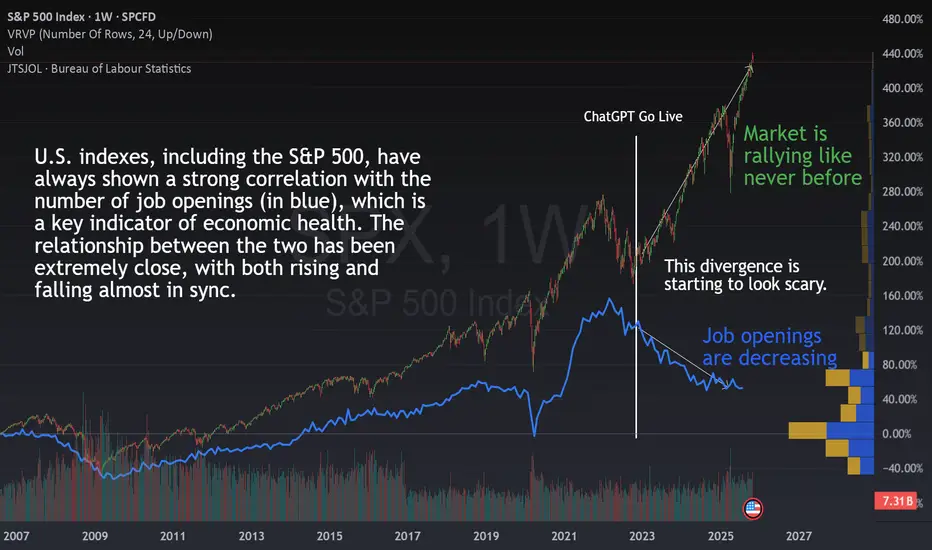
The Scariest Divergence In the MarketThe Scariest Divergence In the Market If you look at the chart, you’ll see the TVC:SPX (candles) and U.S. job openings (in blue) plotted together since 2001. Historically, these two metrics have been highly correlated , both rising and falling almost in sync as the economy expanded or contracted. But something changed dramatically in November 2022. That’s when ChatGPT went live, marking the start of the AI boom that has reshaped entire industries and mindsets. From that point on, we can see a massive divergence, the kind we’ve never seen before. While job openings have kept declining steadily, the market has rallied like never before. This is not logical from a historical point of view. 🤖 Is AI Replacing Workers? One possible explanation is that the market sees AI as a reason for optimism: “If companies can do more with less labor, that means higher margins and better efficiency.” So, fewer job openings might not scare investors anymore, it could even be seen as a sign of progress. But that raises two key questions: Is AI really replacing workers ? If so, what happens to the broader economy and ? 📊 What the Data Says So Far Surprisingly, unemployment in the U.S. has increased only slightly since AI went mainstream. It’s a slow, healthy rise not a surge. So i t doesn’t seem like AI is replacing workers at scale just yet. That’s good news in one sense, if unemployment remains low, consumer demand stays healthy, and the economy keeps running. However, it also means that companies’ fixed costs haven’t really improved, and their productivity gains from AI are still very moderate , far from the exponential growth that the market seems to be pricing in. 💡 My current View From my perspective, this chart makes one thing very clear. The benefits of AI , as of today, are still much smaller than what the market is assuming. Yes, AI will improve margins and efficiency over time. But if everyone implements it, competition will eventually push prices down again, and margins with them. The very same than internet with the online sales. The real challenge won’t be for companies that adopt AI, but for those that don’t adapt fast enough , or for those that overspend on AI tools that fail to deliver meaningful returns. ☄️Some AI Stocks Are Starting to Show Doubt Several major AI-related stocks are also showing concerning patterns . We don’t have confirmation yet , but it’s time to stay alert and be prepared in case the market starts breaking key support levels among the main players. And the main index, S&P 500 is still in the bull zone but are key levels to watch closely: 🤔 What Do You Think? Is AI truly transforming company performance as fast as investors believe? Or are we witnessing a global over-excitement where expectations are running far ahead of reality? by TopChartPatterns4421
SPX500 - Biggest Weekly Loss as AI Valuations Face ScrutinySPX500 – MARKET OUTLOOK | Biggest Weekly Loss as AI Valuations Face Scrutiny 🇺🇸 The S&P 500 posted its largest weekly loss in weeks as investors questioned high AI stock valuations and shifted toward safer assets. The index remains under bearish pressure while trading below 6,770, with momentum favoring further downside. 🔽 Below 6,770: Bearish continuation toward 6,705 → 6,670 → 6,610. 🔼 Above 6,782: Bullish correction toward 6,814 → 6,842. Pivot Zone: 6,755–6,765 Support: 6,705 · 6,670 · 6,610 Resistance: 6,798 · 6,814 · 6,842 SPX500 remains bearish while below 6,770, but a confirmed 1H close above 6,782 could trigger a short-term recovery toward 6,814–6,842.Shortby SroshMayi5
SPX500 longMarket Structure Overall trend on higher timeframes (H1–H4) remains bearish — you can see a strong impulse down, then a current range/consolidation phase. The lower low was formed near the 6 730s (bottom gray zone). Price is now consolidating just above that liquidity zone — showing accumulation before a possible short-term correction upward. 🔹 Key Zones Demand zone (orange + gray lower area) → This is where the previous bearish leg ended. → Several candle rejections show liquidity absorption from sellers. Internal Range Equal highs marked by green line — liquidity built up for potential sweep. Equal lows marked by orange line — base of current accumulation. Supply zone (gray upper area) Between 6 795 – 6 815. This zone was the origin of the last strong bearish displacement, so it’s your target zone for a possible pullback or continuation rejection.Longby TheEliteTrading0
SPX updated for November 5thTrying to bounce.Plenty of resistance Bulls will want to keep it above 6700 November 5th a big day over here in the UK.420 years ago Guy Fawkes tried to blow up our parliament.He and his gang were caugh ton 5th Novemeb3r 1605by Dentalfloss12360
US 500 - Has All the Good News Been Priced?Concerns about excessive stock market valuations, especially when talking about AI focused companies, isn’t something new. In fact, it has been an on-going theme over the last 6 months of the year leading to bouts of risk aversion. This was again the case late on Monday evening, and throughout the day yesterday when the earnings of Palantir Technologies were in the spotlight. The strange thing was that the earnings from this company, released after the close on Monday, beat analysts’ expectations, however a lack of clarity on future revenue needed to justify a market capitalisation of over $600 billion was what brought the latest concerns of an AI bubble back to the attention of traders, leading to a negative sentiment shift for the wider sector and the US 500 index in general. Now, this may or may not be the start of a wider correction and much will depend on future risk events, price action and technical trends (more on this below), however the question for traders this time around is whether the positive news flow for US indices in the short term has already been priced? After all the US 500 index only hit a new record of 6925 on October 30th, 5 days ago. November and December are historically strong performance months for the US 500, however currently traders are faced with several issues to navigate. Only a week ago the Federal Reserve cast some doubt over whether a rate cut in December would happen or not, with policymakers maintaining this stance in their comments at various events since then. This wasn’t expected and has led to some disappointment for traders which weighed on US 500 sentiment. Q3 earnings have generally beaten expectations but then valuations were already high to reflect this, leading to some potential fatigue. Trade tensions between the US-China have cooled, but concerns still remain about economic growth in both countries, especially in the US, where a US government shutdown has led to the delay of key data releases such as CPI, retail sales and the all-important Non-farm Payrolls update on the current health of the US labour market, a key factor influencing the decision making of the Fed on potential interest rate cuts. This means the release of today’s US ADP Private Payrolls data at 1315 GMT and the US ISM Services PMI survey at 1500 GMT could have a bigger influence over the direction of the US 500 moving across the week. Technical levels and trends may also become increasingly important. Technical Update: Back to Fibonacci Retracement Support After reaching a new all-time high of 6925 on October 30th, the US 500 index has corrected by 2.9%, easing short-term overextended upside conditions. This pullback may reflect a healthy pause within a broader uptrend, but the question now appears to be whether this marks the extent of corrective downside moves or is the beginning of a phase of further price weakness. As the chart below shows, latest declines in the US 500 index have now returned to a potential support zone at 6750/6760, marking the 38.2% Fibonacci retracement of the October 10th to 30th rally and the current level of the Bollinger mid-average. This possible support band may limit current declines, but closing behaviour around this area could be important in determining whether buyers can regain the upper hand or if deeper corrective risks can emerge. Traders could now be watching this 6750/6760 support closely, as closing break below might see increased downside pressure. Such moves could then mean focus shifts to 6711, even 6661, marking the deeper 50% and 61.8% Fibonacci retracement levels. That said, while the support is currently under pressure, the 6750/6760 range still holds on a closing basis and may help limit further selling pressure, even possibly see renewed attempts at price upside. However, traders may also now be monitoring 6825, equal to half the recent price decline, as a resistance level in the sessions ahead. If momentum is to shift back toward attempts to renew price strength, a closing break above 6825 may be required to suggest scope to retest the 6925 October 30th all-time high. The material provided here has not been prepared accordance with legal requirements designed to promote the independence of investment research and as such is considered to be a marketing communication. Whilst it is not subject to any prohibition on dealing ahead of the dissemination of investment research, we will not seek to take any advantage before providing it to our clients. Pepperstone doesn’t represent that the material provided here is accurate, current or complete, and therefore shouldn’t be relied upon as such. The information, whether from a third party or not, isn’t to be considered as a recommendation; or an offer to buy or sell; or the solicitation of an offer to buy or sell any security, financial product or instrument; or to participate in any particular trading strategy. It does not take into account readers’ financial situation or investment objectives. We advise any readers of this content to seek their own advice. Without the approval of Pepperstone, reproduction or redistribution of this information isn’t permitted. by Pepperstone5
S&P 500: Overheated Valuation vs. SeasonalityAs the S&P 500 posts a Shiller CAPE ratio of 40.24 in early November 2025 — nearly equivalent to the dot-com bubble peak in 2000 (~44) — a key question arises: can the U.S. market still advance during the last two months of the year? History suggests that November and December seasonality often favors bulls, yet economic reality and valuation levels may temper this optimism. Valuations on the Verge of Overheating Fundamental indicators speak for themselves. A Shiller P/E around 40 signals extreme overvaluation; the historical average is around 17. The Buffett Indicator, which compares total market capitalization to GDP, exceeds 200% — an all-time high, well above levels seen before the 2000 and 2007 crises. In other words, U.S. equity prices are today largely disconnected from the size of the real economy. Historical comparisons are striking: the market has only been this expensive on the eve of the tech crash twenty-five years ago. This makes any new bullish episode difficult to justify fundamentally. Yet history also shows that markets can remain overvalued for long periods, especially when liquidity is abundant and investors fear “missing out” on gains. Seasonality: A Favorable Tailwind at Year-End Statistically, November and December are the most favorable months for U.S. equities. According to Topdown Charts (1964–2024), November delivers an average return of +1%, positive in 69% of cases, while December rises +1.2% on average, gaining nearly 70% of the time. Market Paradox: Expensive Yet Bullish? This coexistence of extreme valuation and seasonal bullish momentum is not unprecedented. In 1999, for instance, the S&P 500 gained over 20% in the six months leading up to its historical peak, even though its CAPE exceeded 40. Investor psychology and flow dynamics often play a more significant role than fundamental reasoning in the short term. However, such an environment reduces the margin of safety: any macroeconomic shock or earnings disappointment could trigger a sharp correction. History shows that markets can ignore excesses … until the moment they cannot. Conclusion The S&P 500 approaches the end of 2025 in a paradoxical situation: supported by historically favorable seasonality but in fundamental weightlessness. November and December could indeed be positive due to bullish inertia, liquidity effects, and collective psychology. Yet at these valuation levels, every additional point of gain also brings the market closer to an inflection point. DISCLAIMER: This content is intended for individuals who are familiar with financial markets and instruments and is for information purposes only. The presented idea (including market commentary, market data and observations) is not a work product of any research department of Swissquote or its affiliates. This material is intended to highlight market action and does not constitute investment, legal or tax advice. If you are a retail investor or lack experience in trading complex financial products, it is advisable to seek professional advice from licensed advisor before making any financial decisions. This content is not intended to manipulate the market or encourage any specific financial behavior. Swissquote makes no representation or warranty as to the quality, completeness, accuracy, comprehensiveness or non-infringement of such content. The views expressed are those of the consultant and are provided for educational purposes only. Any information provided relating to a product or market should not be construed as recommending an investment strategy or transaction. Past performance is not a guarantee of future results. Swissquote and its employees and representatives shall in no event be held liable for any damages or losses arising directly or indirectly from decisions made on the basis of this content. The use of any third-party brands or trademarks is for information only and does not imply endorsement by Swissquote, or that the trademark owner has authorised Swissquote to promote its products or services. Swissquote is the marketing brand for the activities of Swissquote Bank Ltd (Switzerland) regulated by FINMA, Swissquote Capital Markets Limited regulated by CySEC (Cyprus), Swissquote Bank Europe SA (Luxembourg) regulated by the CSSF, Swissquote Ltd (UK) regulated by the FCA, Swissquote Financial Services (Malta) Ltd regulated by the Malta Financial Services Authority, Swissquote MEA Ltd. (UAE) regulated by the Dubai Financial Services Authority, Swissquote Pte Ltd (Singapore) regulated by the Monetary Authority of Singapore, Swissquote Asia Limited (Hong Kong) licensed by the Hong Kong Securities and Futures Commission (SFC) and Swissquote South Africa (Pty) Ltd supervised by the FSCA. Products and services of Swissquote are only intended for those permitted to receive them under local law. All investments carry a degree of risk. The risk of loss in trading or holding financial instruments can be substantial. The value of financial instruments, including but not limited to stocks, bonds, cryptocurrencies, and other assets, can fluctuate both upwards and downwards. There is a significant risk of financial loss when buying, selling, holding, staking, or investing in these instruments. SQBE makes no recommendations regarding any specific investment, transaction, or the use of any particular investment strategy. CFDs are complex instruments and come with a high risk of losing money rapidly due to leverage. The vast majority of retail client accounts suffer capital losses when trading in CFDs. You should consider whether you understand how CFDs work and whether you can afford to take the high risk of losing your money. Digital Assets are unregulated in most countries and consumer protection rules may not apply. As highly volatile speculative investments, Digital Assets are not suitable for investors without a high-risk tolerance. Make sure you understand each Digital Asset before you trade. Cryptocurrencies are not considered legal tender in some jurisdictions and are subject to regulatory uncertainties. The use of Internet-based systems can involve high risks, including, but not limited to, fraud, cyber-attacks, network and communication failures, as well as identity theft and phishing attacks related to crypto-assets. by Swissquote5
Key Pillars of Global Market SuccessKey Pillars of Global Market Success In the modern interconnected world, success in the global market depends on much more than simply exporting products or services across borders. It involves mastering an ecosystem of strategies, competencies, and adaptability that allows businesses to thrive amid fierce competition, diverse consumer preferences, evolving technology, and changing regulations. Understanding the key pillars of global market success is crucial for any organization that aims to expand internationally, build a sustainable brand, and maintain long-term growth. Below are the fundamental pillars that support success in the global marketplace. 1. Strong Market Research and Cultural Understanding Before entering any foreign market, businesses must conduct thorough market research to understand the local culture, consumer behavior, economic environment, and regulatory structure. This goes beyond studying demographics or income levels; it involves understanding cultural nuances, preferences, and purchasing habits. For instance, a marketing strategy that works in the United States may fail in Japan or India because of differences in communication style, color symbolism, and social norms. Companies like McDonald’s and Coca-Cola have succeeded globally because they localize their products — offering the McPaneer burger in India or tea-based beverages in China. Effective market research also helps identify: Consumer trends and unmet needs Competitor strategies Pricing expectations Distribution challenges Ultimately, cultural intelligence — the ability to adapt to local customs while maintaining a global identity — is one of the strongest foundations for global market success. 2. Product Innovation and Adaptability Innovation is the lifeblood of global competitiveness. Successful global companies are those that continuously innovate to meet diverse consumer demands and rapidly changing technologies. However, innovation must be combined with adaptability. A product that dominates one region may need to be redesigned for another. For example, automobile manufacturers often modify car designs for local road conditions, fuel quality, and climate. Similarly, software companies translate and localize their user interfaces for different languages and legal frameworks. The key is to build a balance between standardization and customization. Standardization offers economies of scale and a unified brand identity, while customization ensures relevance in local markets. Innovative adaptability also includes: Sustainable product design Integration of digital technologies Customer-centric product development Innovation and adaptability ensure that companies remain competitive, responsive, and resilient to global shifts in demand. 3. Effective Global Strategy and Vision Every successful international business is built upon a clear strategic vision. This vision outlines why the company is expanding globally, where it intends to grow, and how it plans to achieve that growth. A global strategy must align with the company’s core competencies while considering: Market entry modes (exporting, franchising, joint ventures, acquisitions) Localization vs. standardization decisions Long-term investment and operational models Supply chain and logistics networks For instance, companies like Apple and Toyota have achieved success because of their well-defined global strategies that focus on efficiency, innovation, and customer experience. Strategic clarity allows companies to avoid costly mistakes — such as entering markets without understanding local regulations or underestimating cultural resistance. It ensures that every move supports the company’s broader vision of global growth and brand leadership. 4. Strong Brand Identity and Reputation A strong brand transcends borders. Global market success depends heavily on how consumers perceive and trust a brand. Reputation, once built, becomes a key competitive advantage that drives loyalty and market expansion. Companies that consistently deliver quality, ethical practices, and transparency earn the trust of global customers. Apple, Nike, and Samsung are examples of brands that represent innovation, quality, and status — values that resonate worldwide. Brand success in the global market also depends on: Consistent brand messaging across cultures Localized marketing campaigns that reflect local values Corporate social responsibility (CSR) initiatives that enhance goodwill Emotional connection through storytelling and authenticity A powerful global brand acts as a bridge across cultures and markets, allowing companies to command premium prices and sustain long-term relationships. 5. Efficient Supply Chain and Operations Management Operational efficiency and a resilient supply chain are vital for global competitiveness. The ability to source materials globally, manufacture efficiently, and deliver products on time defines a company’s success in international markets. A robust supply chain ensures: Cost optimization through global sourcing Speed and flexibility in responding to market changes Risk mitigation against disruptions such as geopolitical tensions or pandemics Technological integration — such as blockchain for transparency or AI for demand forecasting — has revolutionized global supply chain management. Companies like Amazon and Unilever have mastered this pillar by building logistics networks that span continents, supported by data analytics and automation. These efficiencies not only improve profitability but also enhance customer satisfaction and competitiveness. 6. Financial Strength and Risk Management Global expansion requires significant financial resources. Success depends not only on investment capacity but also on the ability to manage risks such as currency fluctuations, inflation, political instability, and trade policy changes. Companies must establish: Hedging strategies for currency and interest rate volatility Diversified revenue streams to offset regional downturns Robust financial planning for taxation, compliance, and cost management Financial resilience allows businesses to withstand global shocks, like the COVID-19 pandemic or trade wars, while continuing operations and maintaining investor confidence. Additionally, access to global financing options — such as international bonds, venture capital, and foreign direct investments (FDIs) — strengthens a company’s ability to scale operations and explore new markets. 7. Talent Management and Cross-Cultural Leadership Human capital is one of the most valuable assets in global success. Managing a diverse, cross-cultural workforce requires leadership that understands different values, work ethics, and communication styles. Successful global firms emphasize: Cross-cultural training for employees Inclusive leadership that values diversity Decentralized decision-making for regional responsiveness Talent mobility programs to develop global leaders For example, multinational companies like Google and IBM encourage internal global mobility, allowing employees to experience different cultures and bring innovative ideas to their roles. Building global teams also enhances creativity, problem-solving, and adaptability — qualities essential for sustained success in international markets. 8. Technology Integration and Digital Transformation Digital transformation is no longer optional; it is the backbone of modern global business success. Companies that leverage technology for marketing, operations, analytics, and customer engagement gain a massive advantage. Key technological enablers include: Artificial Intelligence (AI) for predictive analytics and automation Big Data for consumer insight and personalized marketing Cloud computing for scalable operations E-commerce platforms for global reach Digitalization allows even small and medium enterprises (SMEs) to compete internationally without the need for large physical infrastructure. For instance, Shopify and Alibaba have enabled countless businesses to access global markets through online stores, while advanced logistics and digital payment systems simplify global trade transactions. Thus, technology acts as both a driver of innovation and an equalizer that lowers barriers to global market entry. 9. Legal and Ethical Compliance Operating globally requires strict adherence to international laws, trade agreements, and ethical standards. Failure to comply can lead to heavy penalties, brand damage, or even market bans. Key compliance areas include: Trade regulations and import/export duties Data protection and privacy laws (e.g., GDPR in Europe) Environmental sustainability standards Anti-corruption and fair competition laws Ethical conduct, corporate transparency, and sustainability practices are now essential for brand reputation and investor trust. Companies that integrate Environmental, Social, and Governance (ESG) principles attract more customers and long-term investors. A responsible global business does not merely chase profit; it contributes to global well-being and sustainable development. 10. Customer-Centric Approach and Relationship Building At the heart of global market success lies one universal truth — the customer is king. Businesses that place customers at the center of their strategy are more likely to succeed globally. This involves: Listening to customer feedback from diverse markets Offering localized support and services Using data analytics to personalize offerings Building long-term trust rather than focusing solely on short-term sales Companies like Amazon, Netflix, and Starbucks excel because they continuously adapt their customer experience using data-driven insights. A strong customer relationship not only drives loyalty but also builds powerful word-of-mouth reputation in new markets. 11. Sustainability and Social Responsibility Modern consumers, investors, and regulators increasingly expect businesses to operate sustainably. Environmental and social responsibility is no longer a marketing choice but a business imperative. Sustainability includes: Reducing carbon footprint and waste Ethical sourcing of raw materials Supporting community development Transparent ESG reporting Brands that align their operations with global sustainability goals (like the UN Sustainable Development Goals) not only attract conscious consumers but also secure long-term stability by reducing regulatory risks. Companies like Tesla, Patagonia, and Unilever have demonstrated how sustainability can be integrated into the business model while maintaining profitability. 12. Continuous Learning and Adaptation The global market is dynamic — what works today may not work tomorrow. Continuous learning, innovation, and adaptation are the final and most enduring pillars of success. Businesses must stay alert to: Technological disruptions (AI, automation, blockchain) Changing trade policies and tariffs Evolving consumer expectations Economic and geopolitical shifts Agile companies that embrace change, experiment, and learn from failures can sustain success in the ever-evolving global landscape. Conclusion Global market success is not built overnight. It requires a combination of strategic clarity, cultural understanding, innovation, and resilience. The twelve pillars discussed above — from research and adaptability to sustainability and learning — form an integrated framework that helps businesses expand internationally while maintaining a strong competitive edge. The global marketplace rewards those who can balance local relevance with global vision. Companies that invest in people, technology, ethics, and innovation not only achieve profitability but also become agents of positive global change. In essence, the true measure of global market success lies in creating lasting value — for customers, employees, communities, and the planet — while navigating an ever-changing world with agility and integrity.Educationby GlobalWolfStreet6
S&P 500 15M Live chart this is S&P 500 15M live chart with demand supply ict FVG strategy by alertboo113320