Trade ideas
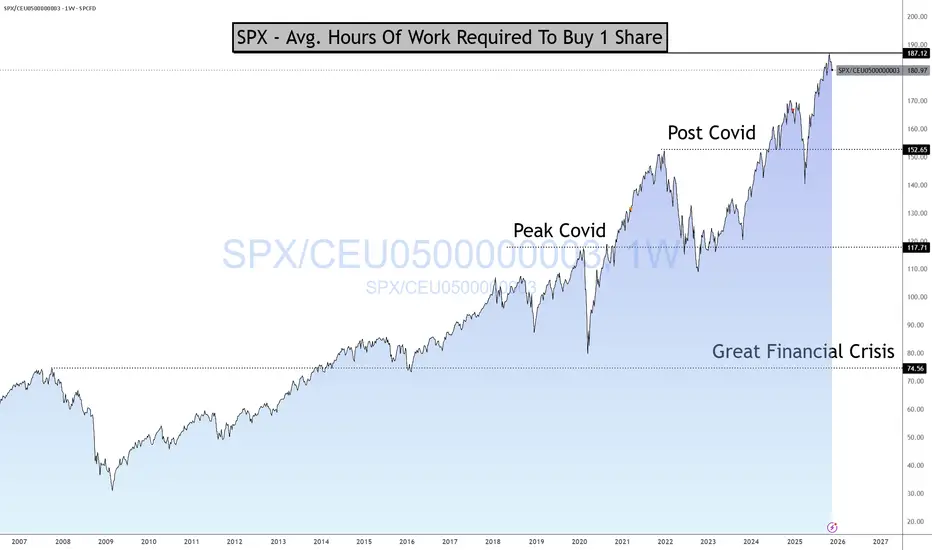
SPX - Hours Of Work To Buy 1 ShareHours of work needed to buy just one share of the S&P 500 just hit a new all-time high: 187 hours.
That’s:
150% more work than 2007
60% more than pre-COVID (2019)
10% more than “Liberation Day”
As I tell my kids:
Don’t look at the price tag.
Look at how many hours of your life — your blood, sweat, and effort — it takes to buy the thing.
Then decide if it’s actually worth it.
When the amount of work required keeps rising while what you get keeps shrinking, that’s not “innovation” or “AI magic.”
That’s over-speculation.
Buffett said it best:
Price is what you pay. VALUE is what you get.
Everyone screams about the price going up…
but nobody asks whether the VALUE justifies the hours of work required to own it.
That’s the truth — not the narratives.
THANK YOU for getting me to 5,000 followers! 🙏🔥
Let’s keep climbing.
If you enjoy the work:
👉 Boost
👉 Follow
👉 Drop a solid comment
Let’s push it to 6,000 and keep building a community grounded in truth, not hype.
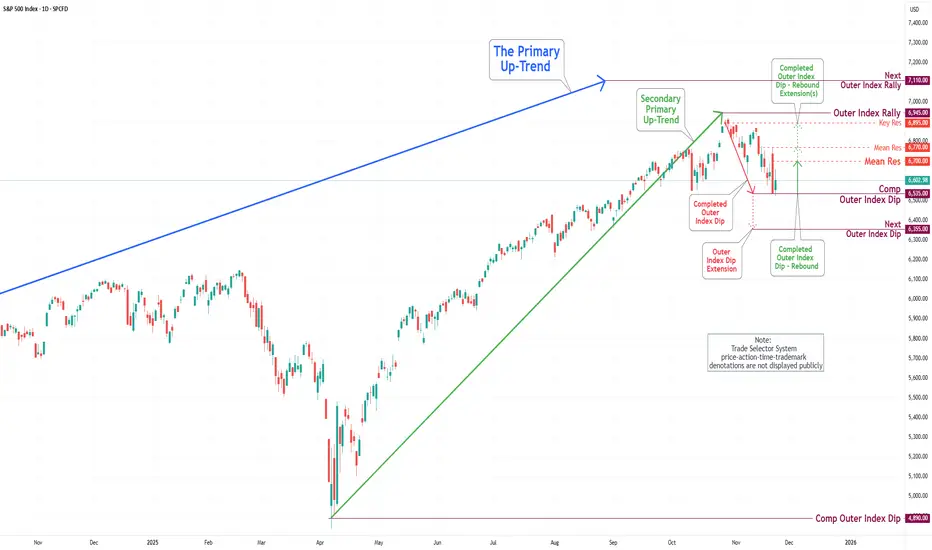
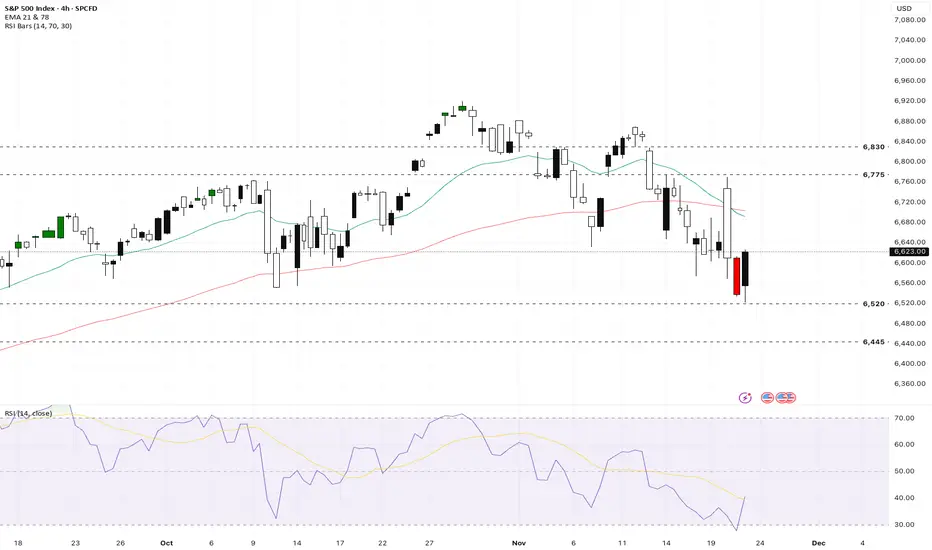
US500 remains under pressure as technology sector momentum coolsThe US500 moved lower after a volatile session marked by fading momentum in technology stocks and renewed macroeconomic uncertainty. Despite short-term weakness, the index remains up almost 10% year-on-year compared to this period in 2024.
Fundamental analysis
The US Federal Reserve policy is now in sharp focus, with remarks from policymakers supporting expectations for a possible interest rate cut in Dec, which is inspiring a slight rebound and giving traders hope for year-end support. Fed New York President Williams said the central bank has room to cut rates again soon as the labor market softens, which improved sentiment. Recent strong US earnings, including from key US 500 members, have offered some relief but have not reversed the current downward trend as AI-driven enthusiasm cools. Renewed fiscal uncertainties, increasing debt issuance, and mixed economic data have weighed on sentiment.
Technical analysis
The index charted a bearish engulfing candlestick below its EMA21, suggesting sellers still control price action in the short term. Key resistance is observed near 6775 and 6830, while immediate support is now at 6520 and a major support at 6445. The volatility index (VIX) jumped by nearly 12% to 26.42, signaling rising market stress and a defensive posture by portfolio managers. In a technical warning that sellers have seized control, charts show Thursday’s losses fully erased the previous session’s advance. The Bearish Engulfing pattern was unusually large and swift and echoed a similar setup in early Mar that preceded a 5% drop in the index. The US500 broke below both its EMA21 and EMA78, levels that many traders view as key lines of support.
Sentiment and outlook
A $5 tln slide in global equities has left investors questioning how much further the tech-led pullback can go. US stock futures swung between gains and losses in volatile trading amid a sustained retreat from the market’s riskier corners. However, seasonality is historically positive heading into Thanksgiving week, and many market participants expect a rebound into year-end, especially with the Fed likely leaning dovish and volatility peaking. Risk appetite remains subdued, but technical and macro catalysts point toward possible stabilization and recovery if central bank signals remain supportive.
Analysis is by Terence Hove, Senior Financial Markets Strategist at Exness
SPY in consolidationNothing to report as yet. Looks like a correction, nothing telling me it's a bottom. We could have some drop and pop type moves, so be careful. Gold looks like it will go higher so far. Oil probably goes lower to test it's lows. BTC hit 82k target but could easily fall to 73k. MJ stocks look interesting around here, so I'm wondering if there will be news to legalize soon.
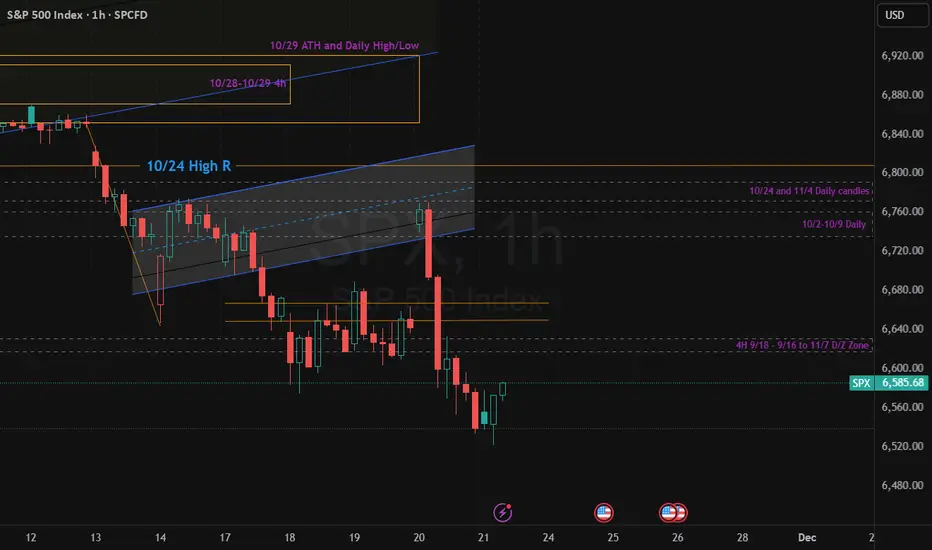
$SP:SPX $SPX 1H update Nov 21Check Bear-flag thesis from Nov 17 played out cleanly. We got the rising parallel channel after the late-Oct dump, then a decisive 1H breakdown + failure retest on Nov 20 — classic continuation, not a fakeout. Since then, structure is still bearish (lower highs/lows), and today’s candles are impulsive enough to treat bounces as corrective until proven otherwise.
Key levels: (For Macro Check daily and weekly charts as well.)
• Overhead 1H supply / retest area sits ~6600–6620 (from the Nov 20 breakdown). Price is NOT there yet — we’re ~654x. If we mean-revert into this zone and stall, it’s a high-quality short-reaction area.
• Near-term resistance ~6640–6670 (prior base). Bulls need a reclaim + hold here to even argue structure shift.
• Current lows ~6540s are extension territory — expect bounce attempts, but one green candle doesn’t equal reversal unless we break/hold a 1H lower high.
Bias: bearish under 6600–6620. Watching for either (a) corrective bounce into supply to sell, or (b) true structure reclaim above 6640–6670 to invalidate. #SPX #SP500 #BearFlag #SupplyDemand SP:SPX SP:SPX
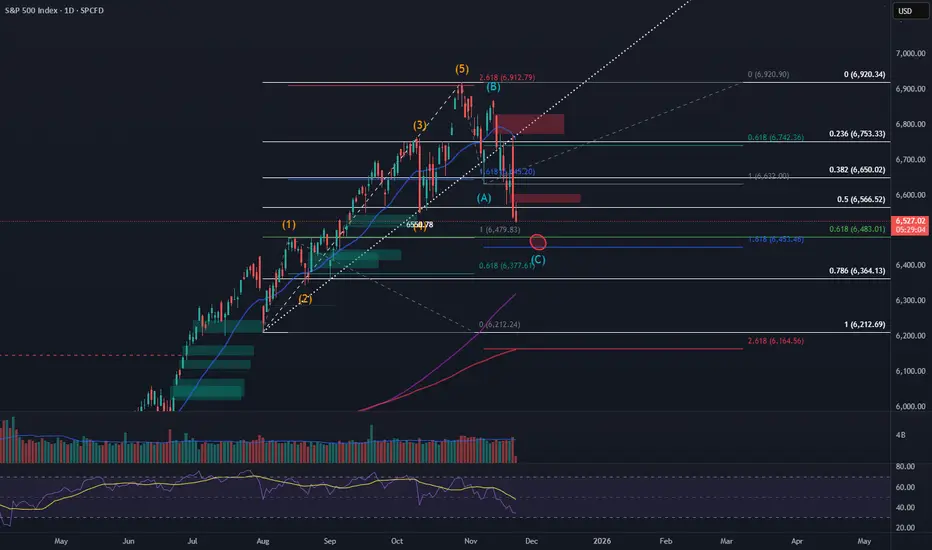
SPX Corrective Wave C Approaching Key Fibonacci ConfluenceThe S&P 500 appears to be completing an A–B–C corrective structure following the recent top. Price is currently breaking below wave (A) and moving toward a strong confluence zone at the 0.618–1.618 Fibonacci levels. This area aligns with prior demand, trendline support, and measured targets, making it a potential reversal zone for wave (C). Watching for bullish reaction or confirmation before considering upside continuation.
S&P 500 Wave Analysis – 21 November 2025
- S&P 500 index reversed from strong support level 6555.00
- Likely to rise to resistance level 6800.00
S&P 500 index recently reversed from support area between the strong support level 6555.00, lower daily Bollinger Band and the 50% Fibonacci correction of the upward impulse from August.
The upward reversal from the support level 6555.00 stopped the previous minor ABC correction 2 from the end of October.
Given the clear daily uptrend, S&P 500 index can be expected to rise to the next resistance level 6800.00 (former top of wave (3) from October).
S&P500 H4 | Bearish Reaction off Key ResistanceMomentum: Bearish
Price is currently below the ichimoku cloud.
Sell entry: 6,706.19
- Strong pullback resistance
- 61.8% Fib retracement
- 100% Fib projection
Stop Loss: 6,790.06
- Swing high resistance
Take Profit: 6,602.91
- Swing low support
High Risk Investment Warning
Stratos Markets Limited (tradu.com/uk ), Stratos Europe Ltd (tradu.com/eu ):
CFDs are complex instruments and come with a high risk of losing money rapidly due to leverage. 70% of retail investor accounts lose money when trading CFDs with this provider. You should consider whether you understand how CFDs work and whether you can afford to take the high risk of losing your money.
Stratos Global LLC (tradu.com/en ): Losses can exceed deposits.
Please be advised that the information presented on TradingView is provided to Tradu (‘Company’, ‘we’) by a third-party provider (‘TFA Global Pte Ltd’). Please be reminded that you are solely responsible for the trading decisions on your account. Any information and/or content is intended entirely for research, educational and informational purposes only and does not constitute investment or consultation advice or investment strategy. The information is not tailored to the investment needs of any specific person and therefore does not involve a consideration of any of the investment objectives, financial situation or needs of any viewer that may receive it. Past performance is not a reliable indicator of future results. Actual results may differ materially from those anticipated in forward-looking or past performance statements. We assume no liability as to the accuracy or completeness of any of the information and/or content provided herein and the Company cannot be held responsible for any omission, mistake nor for any loss or damage including without limitation to any loss of profit which may arise from reliance on any information supplied by TFA Global Pte Ltd.
SPX500 – Key Levels After 3.5% Drop | Bearish Below 6578SPX500 | OVERVIEW
U.S. index futures declined as Nasdaq and S&P500 faced renewed selling pressure, with tech names — including Nvidia — continuing to weaken after Thursday’s sharp drop.
Concerns over stretched valuations remain a key driver of the pullback.
SPX500 – Market Outlook | Bearish Below 6578
SPX500 and Nasdaq futures fell again as tech stocks remain under pressure following Thursday’s selloff. Market sentiment continues to weaken due to concerns over stretched valuations.
Below 6578: Bearish continuation toward 6510 → 6425
Above 6578 (1H close): Short-term correction toward 6610 → 6635
Pivot: 6578
Support: 6510 · 6425
Resistance: 6610 · 6635
SPX500 stays bearish as long as price remains below the pivot. A break above 6578 would only allow a short correction, not a trend reversal.
previous idea:
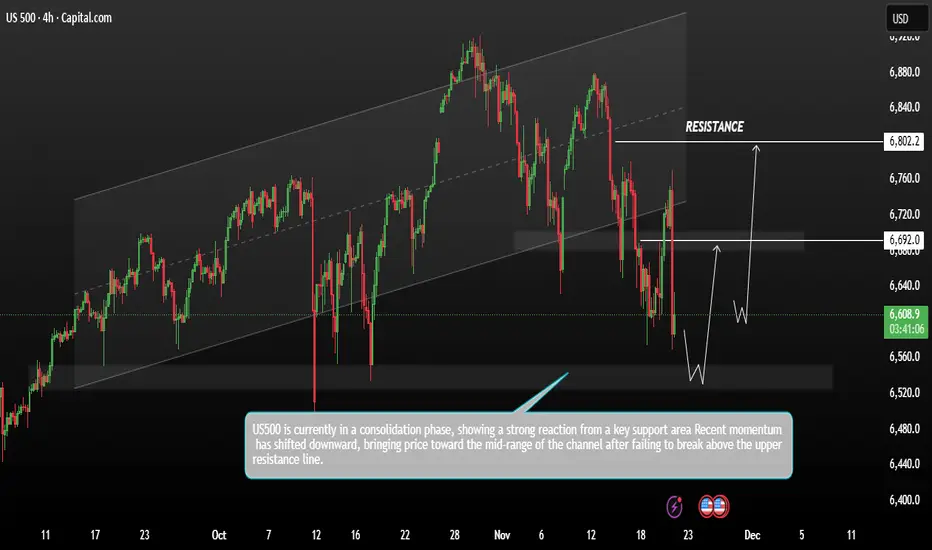
US500 Price Showing Bullish forming a reversal patternUS500 price action moving within a broad ascending channel, with multiple touches on both the upper and lower trend boundaries. Recent momentum has shifted downward, bringing price toward the mid-range of the channel after failing to break above the upper resistance line.
A key support zone sits around 6,550–6,500, highlighted by a shaded region where previous buyers stepped in. The projection on the chart suggests a potential dip into this support area, forming a reversal pattern before pushing higher.
If a bullish rebound occurs from this support, the next critical level is the mid-range supply zone around 6,690 / 6,720. A successful breakout above this zone could open the path toward the major resistance area near 6,802, which is clearly marked as the upper target.
You may find more details in the chart.
Trade wisely best of luck buddies,
Ps; Support with like and comments for better analysis Thanks for Supporting.
S&P500 crashes! Due relief rally or further pain?Nvidia delivered impressive earnings, but the stock reversed and closed nearly 3% lower, triggering heavy selling across tech and risk assets as odds for a December rate cut have collapsed to just 34%, with policy uncertainty amplified by the cancelled October NFP report. Despite a strong market and rising unemployment in September's NFP report, traders remained defensive and fuelled the declines.
Key drivers:
Nvidia beat earnings, but post-report selling intensified sector losses.
The Fed’s odds for a December rate cut have dropped to 34%, amplifying caution.
The abrupt cancellation of the October NFP means the market lacks fresh labour data, fuelling defensive positioning.
S&P 500, Nasdaq, and Bitcoin broke major supports, confirming risk-off conditions.
Right now, the S&P 500 has broken below channel support near 6,600 and failed to climb back in. If prices stay below this threshold, expect another sharp move lower targeting 6,500 and possibly 6,350. There’s potential for upside, given momentum divergence on the RSI 4-hour chart. If we see a short-term bounce and a return to the channel, a move toward 6,682 is possible, which sets up a tactical short opportunity.
Trade idea:
Entry: Midpoint of 23.6/38.2 Fibonacci (6,655–6,682 area)
Stop-loss: Above 61.8% Fib (6,775)
Take Profits: TP1 6,500 (recent low/support), TP2 6,440 (major support), TP3 trail stop to 6,170 (long-term support)
Risk-off drivers are in control. Earnings reversals, Fed uncertainty, and cancelled NFP data are fuelling this price action. Technically, it comes down to whether we see a return inside the channel for a relief bounce or a sharp continuation downward.
Watch your levels, remain nimble, and let fundamentals and technicals, not emotions, guide your trade.
Let me know your setups in the comments, and follow for more high-action technical and macro trade ideas.
This content is not directed to residents of the EU or UK. Any opinions, news, research, analyses, prices or other information contained on this website is provided as general market commentary and does not constitute investment advice. ThinkMarkets will not accept liability for any loss or damage including, without limitation, to any loss of profit which may arise directly or indirectly from use of or reliance on such information.
US500 retreated on a hawkish Fed shift and a tech-sector fall
September nonfarm payrolls rose by 119k (cons. 51k), but August was sharply revised down to -4k from 22k, while continuing jobless claims increased by 28k from the prior week. The unemployment rate climbed to 4.4% (prev. 4.3%, cons. 4.3%), the highest in four years, further weighing on sentiment.
Fed commentary added to the pressure. Cleveland Fed President Mester noted that, despite signs of labor-market cooling, inflation remains elevated. Chicago Fed President Goolsbee also cautioned that inflation has not yet reached the 2% target, signalling reluctance toward additional rate cuts.
Today’s PMI and consumer expectations data will be key indicators of current US economic conditions.
US500 broke below the lower boundary of the ascending channel, extending its sharp decline. The diverging bearish EMAs indicate a potential continuation of the downtrend.
If US500 breaks below 6500, the index could retreat toward the next support at 6430.
Conversely, if US500 closes above 6650, where EMA21 intersects, the index may advance toward the following resistance at 6700.
Hellena | SPX500 (4H): LONG to resistance area of 6775.Dear colleagues, according to the last forecast the price is at the support level, but as it turned out, the correction in wave “4” is a bit more complicated than I thought.
Wave “4” consists of three waves “ABC” and should be over soon. The upward movement is still in priority, but I will target the not so distant resistance area of 6775.
Once it is reached, we will think about how to reach higher levels.
Manage your capital correctly and competently! Only enter trades based on reliable patterns!
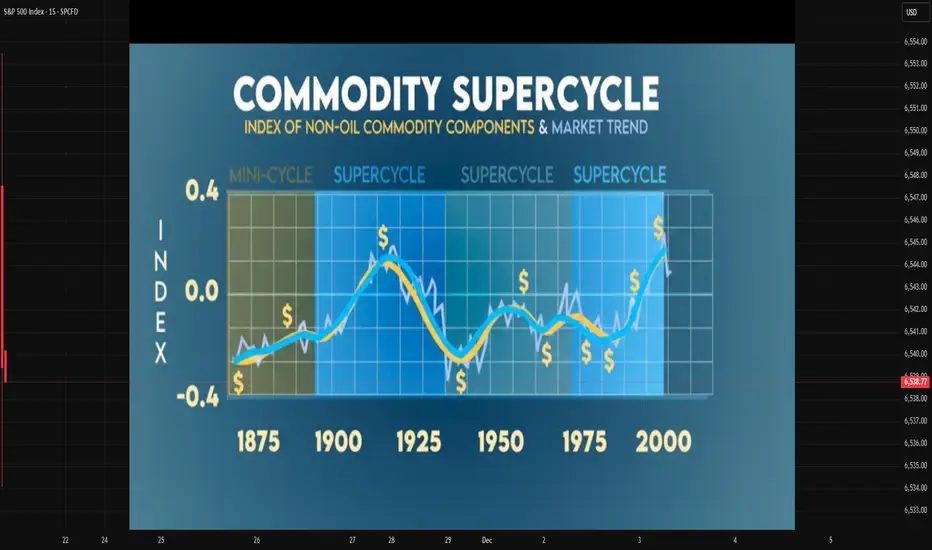
Commodity Supercycle Trends1. Understanding the Concept of Supercycles
Commodities traditionally move in cycles based on supply–demand fluctuations, but a supercycle is different in scale and duration. Price trends in supercycles tend to:
Last for 10–20 years
See sustained upward trajectories
Be driven by massive structural demand
Cause large-scale capital investments and supply expansions
Supercycles usually involve multiple commodities rising together, including crude oil, copper, aluminum, iron ore, wheat, corn, and rare earth metals.
2. Historical Commodity Supercycles
Economists identify four major commodity supercycles in the past 150 years:
a. Late 19th-Century Industrialization Supercycle (1890s–1910s)
This era coincided with the rapid industrial expansion in the US and Europe. Demand surged for coal, metals, and agricultural output to support railway construction, electricity expansion, and manufacturing.
b. Post-WWII Reconstruction Supercycle (1945–1970)
After World War II, Europe and Japan undertook large-scale rebuilding. This sharply increased the demand for energy, steel, and industrial metals. The global population was also rising rapidly, driving agricultural commodity consumption.
c. China-Led Supercycle (2000–2014)
Perhaps the most notable modern supercycle, driven by:
China’s industrialization and urbanization
Massive infrastructure investment
Globalization and trade expansion
Strong energy demand, especially crude oil
Metals like copper, iron ore, and aluminum saw exponential price growth during this period.
d. The “Green Transition” and Renewables Supercycle? (2020s–ongoing)
There is debate over whether the post-2020 environment constitutes a new supercycle. Still, strong demand for battery metals, rare earth elements, lithium, nickel, copper, and silver—essential for clean energy technologies—suggests a potential long-duration upward trend.
3. Drivers Behind Commodity Supercycles
Supercycles are created by mega-trends rather than short-term economic fluctuations. Key drivers include:
a. Industrialization and Urbanization
Emerging economies (e.g., China in the 2000s, India in the 2020s) undergo phases where construction, manufacturing, and infrastructure grow at a rapid pace. This increases demand for:
Steel and iron ore
Cement
Base metals
Energy fuels
b. Technological Shifts
New technologies can reconfigure commodity demand:
Electric vehicles → lithium, nickel, cobalt
Solar energy → silver, polysilicon
Semiconductor demand → rare earths
Technological revolutions often create entirely new commodity markets.
c. Population Growth and Changing Consumption Patterns
Growing populations increase demand for:
Food grains (wheat, rice, corn)
Protein (soybean, livestock feed)
Energy (oil, natural gas)
Urban lifestyles also increase per-capita metal and energy consumption.
d. Underinvestment in Supply
Supercycles often begin after years of:
Low commodity prices
Reduced mining investment
Capacity shrinkage
Supply chain disruptions
When demand picks up suddenly, supply cannot catch up, causing prices to surge.
e. Monetary and Fiscal Stimulus
Loose monetary policy or money supply expansion can raise:
Inflation
Liquidity in markets
Investment in commodity funds
This increases speculative and real demand for commodities.
4. The 2020s: Are We in a New Commodity Supercycle?
Analysts worldwide debate whether the 2020s reflect the start of a new supercycle. Several powerful forces suggest this possibility:
a. Energy Transition and Green Technologies
The transition to a low-carbon global economy hugely increases demand for:
Copper (electric grids, EVs)
Lithium (EV batteries)
Nickel, cobalt (battery chemistry)
Silver (solar panels)
Rare earths (wind turbines, electronics)
Estimates show the energy transition may require 3–10 times more metals compared to the current baseline.
b. Supply Constraints
This decade faces:
Mine depletion
Scarcity of high-grade ores
Stringent environmental rules
Slow permitting processes
Geopolitical resource nationalism (Africa, Latin America)
Supply shortages amplify price pressures.
c. Geopolitical Shifts
Conflicts and tensions between major powers affect commodity flows:
US–China rivalry impacts rare earths
Middle East tensions influence oil
Russia’s sanctions affect natural gas and metals
Realignment of supply chains supports longer-term price elevation.
d. Climate Change Disruptions
Extreme weather affects:
Agricultural output
Mining operations
Shipping routes
More frequent droughts, floods, and storms disrupt supply and raise volatility.
5. Major Commodities Likely to Dominate the Coming Supercycle
1. Copper
Considered the “new oil” of the green economy, copper demand is expected to surge due to:
EVs requiring 2–4 times more copper
Renewable energy grids
Electrification of industries
2. Lithium
A core input for batteries, with demand expected to grow 10–15x by 2035.
3. Nickel and Cobalt
Key metals for high-density battery chemistries.
4. Crude Oil
Despite renewable energy growth, oil demand remains strong due to:
Aviation
Petrochemicals
Industrial use
Slow transition in developing countries
5. Natural Gas and LNG
Seen as a “bridge fuel” in the transition away from coal.
6. Agricultural Commodities
Food prices are rising due to climate volatility and rising global population.
7. Precious Metals (Gold, Silver)
Investors hedge against inflation, currency depreciation, and geopolitical uncertainty.
6. Investment and Trading Implications
a. Long-Term Opportunities
A supercycle supports multi-year rallies in:
Mining stocks
Metal ETFs
Energy companies
Commodity indices
b. Volatility Will Remain High
While long-term trend is upward, short-term fluctuations will be sharp due to:
Interest rate swings
Policy changes
Currency volatility
c. The Role of Emerging Markets
India, Indonesia, Vietnam, and parts of Africa are entering new phases of:
Industrialization
Infrastructure spending
Urbanization
This will add structural demand to the global commodity landscape.
d. ESG and Sustainability Constraints
Environmental regulations limit new mining capacity, pushing prices higher.
7. Conclusion
Commodity supercycles represent long-term, structural shifts in global economic dynamics. They arise when powerful forces—industrialization, population growth, technology transitions, geopolitics, and supply constraints—drive sustained commodity demand. The world today is experiencing pressures that resemble previous supercycle conditions, especially with the rise of green energy, supply chain restructuring, and climate-driven disruptions. Whether or not this evolves into a full-fledged supercycle, commodities like copper, lithium, nickel, crude oil, natural gas, and agricultural products are likely to experience elevated demand and significant price appreciation in the years ahead. Understanding these trends helps investors and policymakers strategize effectively in a resource-constrained and rapidly evolving global economy.
$SPX: A worrying Intraday Turnaround!While everyone, even the taxi driver, was celebrating NVDA's positive earnings report, the SP:SPX suddenly reversed. After touching the 20-day simple moving average, it dropped sharply with no buyers stepping in. With a 3.5% swing between the intraday high and low, the SP:SPX closed slightly below the horizontal support level at 6,550 and the 100-day moving average.
It's unfortunate that the right shoulder is missing, as it would otherwise form a perfect head and shoulders pattern—though it might be more accurately described as the head of a one-armed head and shoulders. Jokes aside, the technical outlook for the SP:SPX has significantly deteriorated. The market's bullish sentiment has evaporated, making it more challenging to establish a bottom.
If the S&P 500 doesn’t recover and consolidate support around 6,550 by Friday—an extremely important level that also aligns with the 1:1 extension below—we could face an “Air Pocket” of approximately 175 points. Within this Air Pocket area, we have extensions at 1.382, 1.5, and 1.618. The 14-period RSI is approaching oversold conditions, but it's not quite there yet.
SPX500 ShortHello traders,
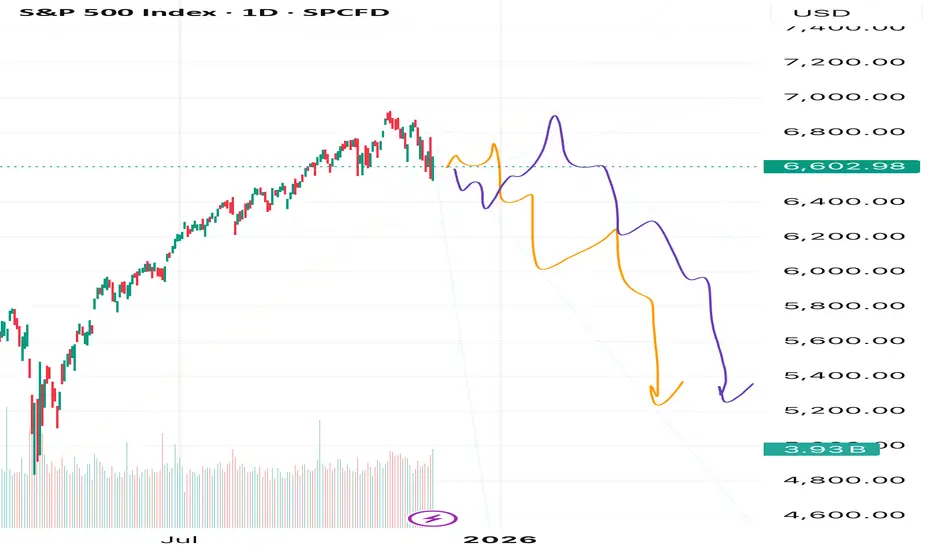
I am expecting the SPX500 to see a potential 20% correction. Current sentiment appears mixed while valuations remain elevated, which increases downside risk. This view also aligns with the technical setup:
On the weekly timeframe, price is respecting a well-defined channel.
On the daily timeframe, a double-top pattern has just formed, suggesting possible trend exhaustion.
Not financial advice, just sharing my market perspective.
SPX Big Drop Today - H4 DowntrendSPX opened up big today and quickly erased all the gains. It created a lower high (LH) on 61.8 and rejected there for a nice short. Price broke support on H4 signaling weakness, so we pull out fibs to measure where the next possible LH could be. First TP is on the -27% red line, which also lines up with previous daily support. Lets see how price reacts in that area. Feel free to drop opinions!
Ray Dalio’s bubble warning aged fast today Ray Dalio’s warning not to “sell just because there’s a bubble” didn’t land today as a delayed September jobs report showing 119,000 new jobs cut into hopes of a December Fed rate cut.
The S&P 500 swung from a 1.9% gain to a 1.1% loss, and the Nasdaq flipped from up 2.6% to down 1.5%. The S&P 500 chart now shows declining momentum with lower highs forming. That kind of engulfing behaviour can mark exhaustion phases in extended rallies.
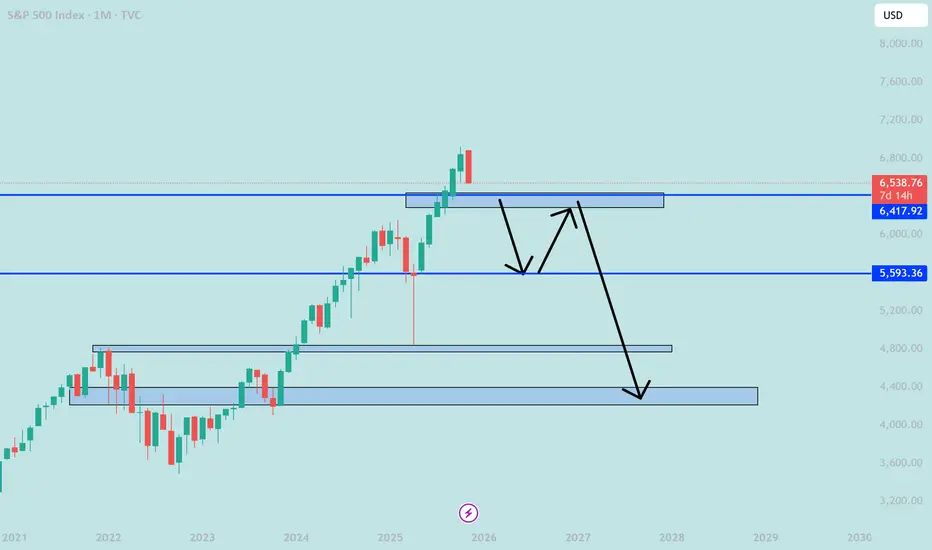
Bitcoin also unraveled, dropping nearly 5% and sinking back under 87,000 as liquidations accelerated. The current monthly candle could be confirming a potential shift in trend momentum after a multi-year climb.
SPX US🌎The first wave of the current impulse has ended, and we are now in the second.
The second wave's target has been met—the gap has been closed.
A breakout of 6870 will confirm that we are entering the third wave.
This marking fits well with the New Year's rally.
Also, the expectation of a Fed rate cut, as well as the end of the shutdown, will support the bullish momentum.
VIX may give the clueSPX popped from the NVDA earnings and may continue higher, but as long as we're below the 18 daily, the bias is down. The Vix is still above it's 18 ma and 20 support zone. Gold - choppy and in no man's land here. Oil - choppy. Nat Gas, maybe a nice short in this area. BTC could drop a little then rally higher.