
DocuSign (DOCU): Innovating Through Adversity as AI-Powered Contract Intelligence Takes Center Stage
DocuSign, Inc. (NASDAQ: DOCU) finds itself navigating one of the most challenging periods in its public market history, with the stock suffering a 52% decline over the past twelve months and recently touching a 52-week low of $51.63 on February 2. This sustained downward trajectory reflects a confluence of headwinds: post-pandemic growth normalization, intensifying competition in the e-signature space, and broader market rotation away from high-multiple SaaS names that previously commanded premium valuations.
Yet beneath this surface of investor skepticism, DocuSign is quietly executing a strategic transformation that seeks to reposition the company from its origins as a point solution for electronic signatures into a comprehensive Intelligent Agreement Management (IAM) platform. The January 13, 2026 release of significant AI-powered enhancements represents the most tangible manifestation of this pivot to date—and may offer a credible pathway toward re-accelerating growth and restoring investor confidence.
The Innovation Cycle: From E-Signature Utility to Contract Intelligence Layer
DocuSign's historical success was built on digitizing a single, discrete workflow: the act of signing documents. This created a massive, highly profitable business, but also imposed a ceiling on the company's total addressable market and exposed it to feature commoditization as competitors integrated basic e-signature functionality into broader productivity suites.
The IAM platform strategy represents a deliberate and ambitious expansion of this addressable opportunity. Rather than merely executing signatures, DocuSign aims to become the system of record and intelligence layer for the entire contract lifecycle—from creation and negotiation through execution, renewal, and analysis.
The January 2026 feature release provides concrete evidence of this strategic evolution:
AI-Powered E-Signature Enhancements:
Plain-Language Summarization: Complex legal and contractual language is automatically translated into clear, accessible summaries for signers. This addresses a pervasive friction point in the agreement process: signer hesitation or confusion caused by dense, jargon-heavy text.
Iris, the Contract-Specific AI Assistant: Named as a distinct product capability within the IAM ecosystem, Iris enables signers to ask contextual questions about documents and receive immediate, accurate answers. This shifts the e-signature experience from passive execution to interactive understanding.
Automated Signature Field Placement: Machine learning models now predict and automatically position signature fields, initials, dates, and other required inputs based on document structure and historical patterns. This reduces preparation time and eliminates a common source of user error.
Automated Agreement Creation Tools: Currently rolling out in the U.S. market, these tools extend AI assistance upstream into the contract drafting phase, enabling faster, more accurate document generation.
These capabilities are already live for customers in the United States, United Kingdom, and Australia, with broader international expansion anticipated throughout 2026.
Strategic Context: Addressing Persistent Workflow Inefficiencies
DocuSign's product evolution is grounded in a clear, quantifiable market reality. Enterprises today manage thousands—often hundreds of thousands—of active contracts, the vast majority of which exist as static, unstructured PDF documents. Critical information regarding renewal dates, pricing terms, service level commitments, and compliance obligations is locked within these files, inaccessible to automated analysis and invisible to the systems that govern procurement, legal, and finance operations.
This fragmentation creates substantial operational drag. Contract reviews require manual reading. Renewal opportunities are missed. Compliance risks go undetected. By positioning IAM as the intelligence layer that renders contract portfolios searchable, analyzable, and actionable, DocuSign is effectively pursuing a platform consolidation strategy—expanding its wallet share within existing customer accounts while raising switching costs and competitive moats.
Market Positioning: Differentiating Through Intelligence
The e-signature market has matured, with basic functionality widely available from competitors including Adobe Sign, Dropbox Sign (formerly HelloSign), and various vertical-specific offerings. Competing on signature features alone is a race to zero.
DocuSign's thesis, supported by the IAM roadmap, is that contract intelligence represents the next value frontier. Enterprises will pay premium subscription fees not merely to execute signatures faster, but to understand what their contracts actually say, automate obligation tracking, and extract commercial insights from their agreement portfolios. This is a fundamentally different—and substantially larger—addressable market than electronic signatures alone.
The Valuation Disconnect: Innovation Versus Sentiment
Despite this strategic evolution, DocuSign's equity valuation continues to reflect profound skepticism. The 52% decline over the past twelve months has compressed the company's multiple to levels unseen since its early post-IPO trading days. This dislocation between product momentum and stock price performance creates a classic analytical tension: is the market correctly anticipating structural challenges to DocuSign's growth model, or has sentiment become disconnected from underlying business fundamentals?
Supporting the bullish case is the observation that DocuSign's platform transition addresses a genuine, large-scale enterprise pain point. Contract fragmentation is not a niche problem; it is a pervasive operational inefficiency affecting virtually every large organization. If DocuSign successfully executes its transition from signature utility to contract intelligence platform, the revenue and margin profile that supported prior valuation premiums could plausibly re-emerge.
Supporting the bearish case is the recognition that platform transitions are inherently difficult, competition remains intense, and the company's recent history of execution missteps has eroded investor trust that must be re-earned through consistent, verifiable performance.
Technical Framework: Defined Risk and Reward Parameters
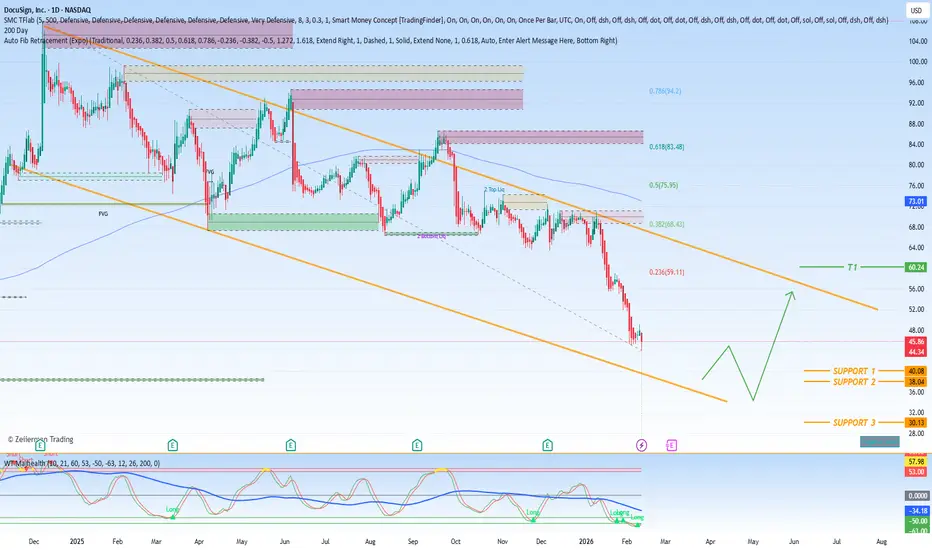
For investors and traders positioning in DocuSign following its extended decline, the technical landscape provides clearly defined levels for profit-taking and risk management:
Primary Take-Profit Target: $60.00
This level represents the logical near-term upside objective. A recovery to $60.00 would imply approximately 16% upside from current levels and would represent a re-test of prior breakdown resistance. Achievement of this target would likely require confirmation that DocuSign's AI-driven product enhancements are translating into measurable adoption metrics, renewal rate improvements, or new customer acquisition acceleration.
Critical Support Zones:
$40.00 – Primary downside support representing a key psychological and technical level. A hold above this zone would suggest that the post-earnings selling pressure is abating and that the stock is establishing a new, higher base from which to attempt recovery.
$38.00 – Secondary support representing a deeper retracement level. This zone aligns with prior historical consolidation ranges and would represent a approximately 26% decline from current levels. For long-term value investors, this area may represent an attractive entry point with favorable risk-reward characteristics.
$30.00 – Major long-term support representing a complete re-pricing of DocuSign's growth expectations and competitive positioning. A decline to this level would imply a fundamental reassessment of the company's addressable market, execution capability, and durable competitive advantages. While not the base case, the identification of this zone provides a disciplined risk management boundary.
Conclusion: A Turnaround Story in Search of Believers
DocuSign presents a classic turnaround narrative: a market-leading franchise that defined a category, enjoyed extraordinary pandemic-driven pull-forward growth, and now faces the dual challenge of normalizing demand and evolving its business model to address a larger, more defensible opportunity. The January 2026 AI feature release demonstrates that product innovation remains robust and that management understands the strategic imperative to expand beyond the e-signature comfort zone.
Yet product innovation alone does not guarantee investment returns. DocuSign must now demonstrate that these capabilities translate into sustained revenue re-acceleration, expanding enterprise relationships, and improved profitability. The company must also contend with a skeptical investor base that has been disappointed by previous guidance reductions and growth deceleration.
For patient investors willing to look through near-term sentiment headwinds, DocuSign's current valuation—reflected in its approach toward multi-year support zones—offers a compelling asymmetric opportunity. The defined technical framework provides disciplined entry, exit, and risk management parameters. The strategic pivot toward Intelligent Agreement Management addresses a genuine, large-scale enterprise need. And the company retains substantial brand equity, distribution reach, and installed base advantages.
Whether this combination proves sufficient to reverse the twelve-month downtrend and re-establish DocuSign as a core holding in growth-oriented portfolios will depend on execution consistency over the coming quarters. The $60.00 take-profit level represents the first meaningful test of the market's willingness to re-engage with this storied but challenged software franchise.
DocuSign, Inc. (NASDAQ: DOCU) finds itself navigating one of the most challenging periods in its public market history, with the stock suffering a 52% decline over the past twelve months and recently touching a 52-week low of $51.63 on February 2. This sustained downward trajectory reflects a confluence of headwinds: post-pandemic growth normalization, intensifying competition in the e-signature space, and broader market rotation away from high-multiple SaaS names that previously commanded premium valuations.
Yet beneath this surface of investor skepticism, DocuSign is quietly executing a strategic transformation that seeks to reposition the company from its origins as a point solution for electronic signatures into a comprehensive Intelligent Agreement Management (IAM) platform. The January 13, 2026 release of significant AI-powered enhancements represents the most tangible manifestation of this pivot to date—and may offer a credible pathway toward re-accelerating growth and restoring investor confidence.
The Innovation Cycle: From E-Signature Utility to Contract Intelligence Layer
DocuSign's historical success was built on digitizing a single, discrete workflow: the act of signing documents. This created a massive, highly profitable business, but also imposed a ceiling on the company's total addressable market and exposed it to feature commoditization as competitors integrated basic e-signature functionality into broader productivity suites.
The IAM platform strategy represents a deliberate and ambitious expansion of this addressable opportunity. Rather than merely executing signatures, DocuSign aims to become the system of record and intelligence layer for the entire contract lifecycle—from creation and negotiation through execution, renewal, and analysis.
The January 2026 feature release provides concrete evidence of this strategic evolution:
AI-Powered E-Signature Enhancements:
Plain-Language Summarization: Complex legal and contractual language is automatically translated into clear, accessible summaries for signers. This addresses a pervasive friction point in the agreement process: signer hesitation or confusion caused by dense, jargon-heavy text.
Iris, the Contract-Specific AI Assistant: Named as a distinct product capability within the IAM ecosystem, Iris enables signers to ask contextual questions about documents and receive immediate, accurate answers. This shifts the e-signature experience from passive execution to interactive understanding.
Automated Signature Field Placement: Machine learning models now predict and automatically position signature fields, initials, dates, and other required inputs based on document structure and historical patterns. This reduces preparation time and eliminates a common source of user error.
Automated Agreement Creation Tools: Currently rolling out in the U.S. market, these tools extend AI assistance upstream into the contract drafting phase, enabling faster, more accurate document generation.
These capabilities are already live for customers in the United States, United Kingdom, and Australia, with broader international expansion anticipated throughout 2026.
Strategic Context: Addressing Persistent Workflow Inefficiencies
DocuSign's product evolution is grounded in a clear, quantifiable market reality. Enterprises today manage thousands—often hundreds of thousands—of active contracts, the vast majority of which exist as static, unstructured PDF documents. Critical information regarding renewal dates, pricing terms, service level commitments, and compliance obligations is locked within these files, inaccessible to automated analysis and invisible to the systems that govern procurement, legal, and finance operations.
This fragmentation creates substantial operational drag. Contract reviews require manual reading. Renewal opportunities are missed. Compliance risks go undetected. By positioning IAM as the intelligence layer that renders contract portfolios searchable, analyzable, and actionable, DocuSign is effectively pursuing a platform consolidation strategy—expanding its wallet share within existing customer accounts while raising switching costs and competitive moats.
Market Positioning: Differentiating Through Intelligence
The e-signature market has matured, with basic functionality widely available from competitors including Adobe Sign, Dropbox Sign (formerly HelloSign), and various vertical-specific offerings. Competing on signature features alone is a race to zero.
DocuSign's thesis, supported by the IAM roadmap, is that contract intelligence represents the next value frontier. Enterprises will pay premium subscription fees not merely to execute signatures faster, but to understand what their contracts actually say, automate obligation tracking, and extract commercial insights from their agreement portfolios. This is a fundamentally different—and substantially larger—addressable market than electronic signatures alone.
The Valuation Disconnect: Innovation Versus Sentiment
Despite this strategic evolution, DocuSign's equity valuation continues to reflect profound skepticism. The 52% decline over the past twelve months has compressed the company's multiple to levels unseen since its early post-IPO trading days. This dislocation between product momentum and stock price performance creates a classic analytical tension: is the market correctly anticipating structural challenges to DocuSign's growth model, or has sentiment become disconnected from underlying business fundamentals?
Supporting the bullish case is the observation that DocuSign's platform transition addresses a genuine, large-scale enterprise pain point. Contract fragmentation is not a niche problem; it is a pervasive operational inefficiency affecting virtually every large organization. If DocuSign successfully executes its transition from signature utility to contract intelligence platform, the revenue and margin profile that supported prior valuation premiums could plausibly re-emerge.
Supporting the bearish case is the recognition that platform transitions are inherently difficult, competition remains intense, and the company's recent history of execution missteps has eroded investor trust that must be re-earned through consistent, verifiable performance.
Technical Framework: Defined Risk and Reward Parameters
For investors and traders positioning in DocuSign following its extended decline, the technical landscape provides clearly defined levels for profit-taking and risk management:
Primary Take-Profit Target: $60.00
This level represents the logical near-term upside objective. A recovery to $60.00 would imply approximately 16% upside from current levels and would represent a re-test of prior breakdown resistance. Achievement of this target would likely require confirmation that DocuSign's AI-driven product enhancements are translating into measurable adoption metrics, renewal rate improvements, or new customer acquisition acceleration.
Critical Support Zones:
$40.00 – Primary downside support representing a key psychological and technical level. A hold above this zone would suggest that the post-earnings selling pressure is abating and that the stock is establishing a new, higher base from which to attempt recovery.
$38.00 – Secondary support representing a deeper retracement level. This zone aligns with prior historical consolidation ranges and would represent a approximately 26% decline from current levels. For long-term value investors, this area may represent an attractive entry point with favorable risk-reward characteristics.
$30.00 – Major long-term support representing a complete re-pricing of DocuSign's growth expectations and competitive positioning. A decline to this level would imply a fundamental reassessment of the company's addressable market, execution capability, and durable competitive advantages. While not the base case, the identification of this zone provides a disciplined risk management boundary.
Conclusion: A Turnaround Story in Search of Believers
DocuSign presents a classic turnaround narrative: a market-leading franchise that defined a category, enjoyed extraordinary pandemic-driven pull-forward growth, and now faces the dual challenge of normalizing demand and evolving its business model to address a larger, more defensible opportunity. The January 2026 AI feature release demonstrates that product innovation remains robust and that management understands the strategic imperative to expand beyond the e-signature comfort zone.
Yet product innovation alone does not guarantee investment returns. DocuSign must now demonstrate that these capabilities translate into sustained revenue re-acceleration, expanding enterprise relationships, and improved profitability. The company must also contend with a skeptical investor base that has been disappointed by previous guidance reductions and growth deceleration.
For patient investors willing to look through near-term sentiment headwinds, DocuSign's current valuation—reflected in its approach toward multi-year support zones—offers a compelling asymmetric opportunity. The defined technical framework provides disciplined entry, exit, and risk management parameters. The strategic pivot toward Intelligent Agreement Management addresses a genuine, large-scale enterprise need. And the company retains substantial brand equity, distribution reach, and installed base advantages.
Whether this combination proves sufficient to reverse the twelve-month downtrend and re-establish DocuSign as a core holding in growth-oriented portfolios will depend on execution consistency over the coming quarters. The $60.00 take-profit level represents the first meaningful test of the market's willingness to re-engage with this storied but challenged software franchise.

Disclaimer
The information and publications are not meant to be, and do not constitute, financial, investment, trading, or other types of advice or recommendations supplied or endorsed by TradingView. Read more in the Terms of Use.
Disclaimer
The information and publications are not meant to be, and do not constitute, financial, investment, trading, or other types of advice or recommendations supplied or endorsed by TradingView. Read more in the Terms of Use.