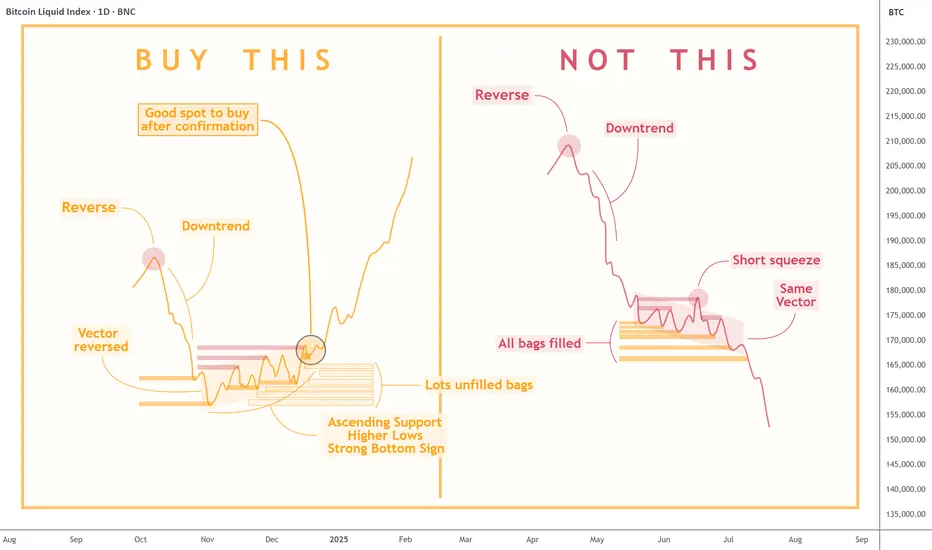
Quick Lesson: How to Identify Trend ReversalKnowing when to enter the market can mean the difference between making a profit and incurring a loss. The chart above clearly compares two similar-looking scenarios with very different outcomes: the one you should aim for and the one you should avoid.
- On the left , we see a textbook example of a bullish reversal. After a significant downtrend, the market prints higher lows and begins forming an ascending support. This signals that selling pressure is fading and buyers are stepping in. Notably, there are usually lots of unfilled bags — latecomers who show strong demand below the current price level but never get their orders filled, and who then just hit the 'market buy' button, which adds fuel to the fire of pump.
- In contrast, the right side shows a very similar pattern — a downtrend followed by consolidation, but with crucial differences. Here, all prior liquidity zones have already been filled, meaning there is less incentive for buyers to support the price. The “same vector” suggests price action hasn’t changed direction, and a common short squeeze traps late buyers before resuming the decline. This is a common bull trap , where a temporary price pump gives false hope before another leg down.
To sum up , a REAL REVERSAL builds on structure, accumulation, and higher lows—whereas a FALSE BOTTOM is often characterized by brief rallies, exhausted liquidity, and no change in vector trend. Experienced traders wait for confirmation and accumulation before entering a position, not just a temporary pause in a downtrend.
Lesson
NO TRADE? THAT IS THE TRADEToday, I took no trades and I’ll be honest, it was really tempting to break that discipline.
I stared at the chart longer than I needed to. My cursor hovered around the Buy and Sell buttons. My brain tried to convince me that “maybe” this candle meant something. Even though there was no valid sweep, no BOS, and no clean entry into an FVG , the desire to just “be in a trade” was strong.
But I reminded myself:
📌 No Setup = No Trade
📌 Your edge is your lifeline
📌 Discipline is what pays you, not activity
What I felt today is something every trader battles, setup hoping . It’s that mental trap where silence feels wrong, and boredom feels dangerous. But the truth is, boredom is part of being a consistently profitable trader. There are days where your best trade is the one you don’t take.
And I’m proud to say I did nothing.
No revenge trade.
No gambling.
No deviation from plan.
Instead, I observed. I journaled my emotions. I stayed in control. That’s the work behind the scenes: the mental reps that build longevity in this business .
So if you had a quiet session today too, and you resisted the urge to jump in without reason, celebrate that. You're training your mind to trust your system, not your feelings.
Sometimes, the most powerful trade you’ll ever take… is the one you never place.
Quick Lesson: Slow & Fast Flows (Study it & Benefit in Trading)It is always important to look not only at levels (supports/resistances), but how exactly price moves within them.
On the left side , we see a slow flow—a controlled and gradual decline. Sellers are patient, offloading positions over time into visible liquidity levels. Each dip is met with small bids, creating a staircase-like drop. This kind of move doesn’t trigger panic immediately, but it’s dangerous because it builds up pressure. Eventually, when buyers dry up, a larger breakdown happens.
On contrary, the right side shows a fast flow. Here, a large sell order slams into a thin order book, causing an immediate price spike down. There's little resistance, and multiple levels are skipped. This creates an inefficient move, often forming a sharp wick. These fast drops are typically caused by fear, liquidation, or aggressive exit orders. But what’s interesting is the recovery: because the move was so aggressive and liquidity was so thin, price can snap back up quickly. These are often V-shaped reversals with low resistance on the way back.
Try to look for such setups on the chart and learn how the price behaves . Studying such cases will help you identifying upcoming sell-offs/pumps and earn on them.
Adapting to Market Conditions: Mastering the Market’s Rhythm Markets are not static, they constantly evolve and successful traders are those who adapt their strategies accordingly. Understanding the shapes of trending and volatile markets is, I would say not only essential but also absolute necessary to staying profitable.
This adaptability ensures you’re always aligned with what the market is doing, rather than fighting against it.
1. Trending Markets: Go with the Flow 🌊📈
Trending markets are characterized by sustained movement in one direction, either upward or downward.
In these markets for example:
Example 1: Tesla (TSLA)🚀
When Tesla (TSLA) is in a strong uptrend, as indicated by higher highs and higher lows on the daily chart, breakout strategies work well. For instance, buying above a resistance level and riding the trend upwards aligns with market momentum.
Also, in November last year, Tesla's stock (TSLA) experienced a pullback to its 50-day moving average, which acted as a support level before the stock resumed its upward trend. This technical behavior is common in trending markets, where moving averages often serve as dynamic support or resistance levels.
Traders and investors monitor such pullbacks to key moving averages as potential entry points, anticipating that the trend will continue.
________________________________________
💎 Remember:
- Moving averages often act as dynamic support/resistance in trending markets. Pullbacks to these levels can provide excellent entry points.
________________________________________
Example 2: Forex (EURUSD):
📉 A trending EURUSD pair driven by central bank policy divergence is ideal for moving average crossovers or trend-following indicators like the MACD. Here the examples are numerous and often they do play out.
For example, if the pair is steadily declining, shorting on pullbacks to resistance levels gives a good risk-to-reward ratio.
2. Range-Bound Markets: Mastering Consolidation 🔄🏦
In range-bound markets, price moves between well-defined support and resistance levels without a clear trend. In this case, focus on buying near support and selling near resistance rather than chasing breakouts.
📉 How to Trade Range-Bound Markets:
To do that you’re going to have to study the market.
First, and the most essential to pinpoint accurately, is identify Support and Resistance Levels.
🚫What to avoid in this scenario is Chasing FALSE Breakouts.
•While it might be tempting to jump into a trade when the price appears to break out of the range, these moves often fail, causing the price to snap back into the range.
Patience is essential—seriously, take a deep breath! 🧘
When you resist the urge to chase a breakout, that’s the discipline I was talking about.
________________________________________
💎 Remember:
🛑 Pinpoint Support and Resistance: Accurately identify key levels where price tends to reverse.
🚫 Avoid False Breakouts: Resist the urge to jump into breakouts; many of these fail, leading to price snapping back into the range.
🌟 Pro Tip: Patience is a skill, not a trait. Sticking to your plan is what separates amateurs from professionals.
________________________________________
3. Volatile Markets: Swimming in More Dangerous Waters 🌊🦈
• In these kinds of markets, you never know if you’re catching a wave or becoming the snack!
Though, let’s be honest: it’s usually the latter! — with volatility this wild, most of us are just chum in the water while the sharks feast!🦈
• Volatility spikes are often triggered by economic events, earnings reports, or geopolitical news. These markets can create massive opportunities but also higher risks. Navigating these markets requires an understanding of the underlying factors driving the instability.
Here are a few examples:
Example 1: Stocks (Amazon - AMZN) 💸:
📊 Macroeconomic Events: Changes in consumer spending patterns, inflation data, or Federal Reserve interest rate decisions can impact Amazon's valuation, as they directly affect consumer behavior and borrowing costs.
🌍Geopolitical News: With its massive global reach, even a small disruption in supply chains, shipping costs, or international demand can cause BIG ripples for the company.
📈Earnings Reports: Amazon's quarterly reports, often lead to significant stock price movements, as the company's revenue growth, profitability, and guidance influence investor sentiment.
• What are the risks?
One of the biggest risks, and something that can’t be stressed enough, is emotional decision-making . When markets are volatile, it’s easy to let fear or excitement take over, leading to impulsive trades.
________________________________________
💎 Remember:
• Your emotions aren’t great traders—they’re more like that friend who screams “BUY!” or “SELL!” at the worst possible time. Don’t let the emotions drive your portfolio; they’ll crash it faster than a teenager with a new driver’s license. 🚗
⏰ Bad timing is another one.
– If you’re caught on the wrong side of a trade you can experience substantial losses. But again this is where risk management and setting clear limits on how much you’re willing to lose make the difference in the end.
⚠️ What are the opportunities?
Fast Trades: Short-term traders can capitalize on price swings by executing well-timed trades.
• These opportunities require more attention, a clear strategy, and the ability to act decisively, as even small price movements can lead to meaningful gains—or losses—in a short amount of time.
📉➡️📈 This is good mostly for long-term investors as price dips are viewed as golden opportunities for a stock with solid potential. It’s like a discount at a discount.
• Most of the time, the market eventually recovers, and the stock not only regains its value but often surpasses it.
This confidence comes from studying past trends and patters—you can view short-term dips as just the market’s way of throwing a tantrum, like your wife being mad at you for something you didn’t do... but still texting to ask if you want anything from the store.
📊 Navigating volatile stocks like Amazon requires a proper risk management strategy and an informed approach that can help mitigate the dangers and maximize the opportunities these unique markets present.
Example 2: Forex (USDJPY):
⚠️ During events like the NFP report, USDJPY can see BIG moves. Avoid trading during the initial instability and instead focus on breakout trades once the dust settles.
For example, if the pair breaks out of a symmetrical triangle post-announcement, it often indicates the direction of sustained movement.
💥 An instance of USD/JPY reacting to a major economic release occurred on December 19, 2024, following the Federal Reserve's interest rate decision.
• This led to a significant surge in USD/JPY, with the pair rising over 2% to reach 157.51, nearing a 4 month low for the yen.
A rollercoaster ride, and a dizzy one for the traders, that left traders hanging upside down, clutching their positions, and most likely also questioning their life choices.
🕒 But this is about TIMING once again. And usually, you can’t control it—like trying to catch a bus that always seems to show up either too early or right after you’ve given up and walked away.
________________________________________
💎 Remember:
⚡ Short-Term Trades: Volatility allows skilled traders to capitalize on quick price swings.
⏰ Bad Timing: Being on the wrong side of a volatile move can lead to significant losses.
________________________________________
4. Market Condition Transitions: Recognizing the Shift
⏳Adapting also means recognizing—are you paying attention?—when markets are shifting. Spotting these early —yes, we are back to TIMING!—helps you adjust your strategy before it’s too late.
• Now how to do that? Recognizing the shift, nothing more simple - These pompous words can be summed up to staying alert, using the right tools, and reacting with a clear plan—not impulse. It’s about reading the market’s signals and aligning your strategy accordingly. A good example was in Forex on AUDUSD.
5. Adapt Like a Chameleon 🦎➡️
• Markets are ever-changing, and rigid strategies can easily become a recipe for failure. Adaptability is the name of the game —a game that rewards the quick thinkers and punishes the stubborn. Like trying to win a staring contest with a cat: you’ll blink, and the market’s already moved.
________________________________________
💎 Remember:
• ✅ Stay alert to market signals.
• 🛠️ Use the right tools.
• 🎯 React with a clear, well-thought-out plan.
________________________________________
Wait, I’m not done yet!
This is the ultimate thing I’ve dreaded for years, the cornerstone of my growth. Or at least the thing that keeps reminding me how much I still have to learn:
📖💻 Backtesting and Journaling.
• It’s not glamorous to be real, it’s downright tedious—especially journaling since I’m not a very organized person myself. Honestly, for a long time, I thought it was just something only obsessive perfectionists did—but it turned out to be a great tool to check my assumptions, spot my mistakes, and, occasionally, confirm that I might actually know what I’m doing. Which felt great to have on ‘paper’.
📉🤯 It’s not just about keeping records; it’s about holding yourself accountable and spotting patterns you didn’t even know were there. Your brain works in mysterious ways—like convincing you that every loss was “just bad luck” until the journal smacks you with the truth.
Backtesting is another one of those unglamorous but essential tasks. It’s like doing your lessons before a big test—except the test is the market, and failing costs you real money. Auch.
📈 Backtesting is where you discover if your “brilliant strategy” is actually brilliant or just wishful thinking.
I recommend backtesting a strategy for an interval of at least six months to a year. This timeframe allows you to observe how the strategy performs across various market conditions. Testing for only a short period, like a month, is tempting but misleading. It’s like watching the first five minutes of a movie and thinking you know the ending—spoiler alert: you don’t.
________________________________________
🔁💪 By extending your backtesting period, you can gain confidence in your strategy’s ability to adapt, manage risk, and deliver consistent results.
Plus, a longer testing period helps spot and get past unusual moves in the market, like an unexpected lucky streak or a one-off market event that might otherwise give you a false sense of confidence.
• This way you can tweak and refine it before putting real money on the line. It’s the ultimate rehearsal before stepping onto the trading stage!
________________________________________
💎 Remember:
• ✍️ Accountability: Journaling helps you spot mistakes and refine your strategies.
• 🧩 Pattern Recognition: Discover trends in your own behavior and trading results that you didn’t notice before.
• 🔎 Pro Tip: Journaling isn’t just for perfectionists; it’s for anyone who wants to improve.
• 🕒 Test Over Time: Backtest your strategies over at least 6–12 months to evaluate their performance across different conditions.
• 🛠️ Refinement: Use backtesting to tweak and perfect your strategy before trading live.
• 🎬 Think of It Like Rehearsal: Testing prepares you for real markets, reducing costly errors.
________________________________________
Please boost this post, every like and comment drives me to bring you more ideas! I’d love to hear your perspective in the comments.
Best of luck , TrendDiva
How To Do Multi-TimeFrame Analysis With TradingViewHey,
In this video I provide the two key laws that helped me with trading;
1. An imbalance on the higher time-frames is a range on the lower time-frames.
2. A run on the higher time-frames is a trend on the lower time-frames.
From this point of view, I share with you how I analyze the charts from Monthly to Weekly to Daily chart, and how I like to time the next few days of price-action.
The chart I use in this tutorial is GBP/USD.
Kind regards,
Max Nieveld
$CHILLGUY How to Spot Euphoria LessonHere's a good lesson on spotting EUPHORIA.
I was over a friend's house who is a retail crypto trader on Thanksgiving.
He was telling that I had to buy $CHILLGUY because its the biggest meme ever.
I didn't even bother looking at the chart because of my past experience knowing how to gauge market sentiment,
but I replied, "you telling me this should be an instant sell signal for you".
From that day on, it was DOWN-ONLY 80% for the next 1.5 months 🤓
The 20 Trading Lessons from Top Traders I have read a lot of trading books since the time I started trading my own account and the one book that really helps me out and “I wish I’ve read this one first” – is Market Wizards Interview with Top Traders by Jack D. Schwager.
Here’s the list that struck me most that I’d like to share:
“Early trading failure is a sign that you are doing something wrong; it is not necessarily a good predictor of ultimate potential failure or success.” – Michael Marcus
“If you don’t stay with your winners, you are not going to be able to pay for the losers.” – Michael Marcus
“Liquidating positions is the way to achieve mental clarity when one is losing money and confused regarding market decisions.” – Michael Marcus
“Being a successful trader also takes courage: the courage to try, the courage to fail, the courage to succeed, and the courage to keep going when the going keeps tough.” – Michael Marcus
“Place your stops at a point that, if reached, will reasonably indicate that the trade is wrong, not at a point determined primarily by the maximum dollar amount you are willing to lose per contract. If the meaningful stop point implies an uncomfortably large loss per contract, trade a smaller number of contracts.” – Bruce Kovner
“The times when you least want to think about trading – the losing periods – are precisely the times when you need to focus most on trading.” – Richard Dennis
“Everybody gets what they want out of the market.” – Ed Seykota
“It is a happy circumstance that when nature gives us true burning desires, it also gives us the means to satisfy them.” – Ed Seykota
“Frankly, I don’t see markets; I see risks, rewards and money.” – Larry HIte
“ I have two basic rules about winning in trading as well as in life: 1. If you don’t bet, you can’t win. 2. If you lose all your chips, you can’t bet” – Larry Hite
“In my judgment, all traders are seekers of truth.” – Michael Steinhardt
“The more disciplined you can get, the better you are going to do in the market. The more you listen to tips and rumors, the more money you’re likely to lose.” – David Ryan
“When the market gets good news and goes down, it means the market is very weak; when it gets bad news and goes up, it means the market is healthy.” – Marty Schwartz
“Learn to take losses. The most important thing in making money is not letting your losses get out of hand. Also, don’t increase your position size until you have doubled or tripled your capital. Most people make the mistake of increasing their bets as soon as they start making money. That is a quick way to get wiped out.” – Marty Schwartz
“The best traders are the most humble.” – Mark Weinstein
“You have to learn how to lose; it is more important than learning how to win.” – Mark Weinstein
“Most traders who fail have large egos and can’t admit that they are wrong. Even those who are willing to admit that they are wrong early in their career can’t admit it later on. Also, some traders fail because they are too worried about losing.” – Brian Gelber
“You are never really confident in this business, because you can always be wiped out pretty quickly. The way I trade is: Live by the sword, die by the sword. There is always the potential that I could get caught with the big position in a fluke move with the market going the limit against me. On the other hand, there is no doubt in my mind that I could walk into any market in the world and make money.” – Tom Baldwin
“Clear thinking, ability to stay focused, and extreme discipline. Discipline is number one: Take a theory and stick with it. But you have to be open-minded enough to switch tracks if you feel that your theory has been proven wrong. You have to be able to say, my method worked for this type of market, but we are not in that type of market anymore.” – Tony Saliba
“ How do you judge success? I don’t know. All I know is that all the money in the world isn’t the answer.” Tony Saliba
There’s still a lot of golden information that I want to write in here – for ourselves and for everyday reading so as to keep us aligned with our trading goal, but I prefer to encourage you to read the book.
SIMPLE RULE BASED Structure FOR BEGINNERS☝️The main purpose of my resources is free, actionable education for anyone who wants to learn trading and improve mental and technical trading skills. Learn from hundreds of videos and the real story of a particular trader, with all the mistakes and pain on the way to consistency. I'm always glad to discuss and answer questions. 🙌
☝️ALL videos here are for sharing my experience purposes only, not financial advice, NOT A SIGNAL. YOUR TRADES ARE YOUR COMPLETE RESPONSIBILITY. Everything here should be treated as a simulated, educational environment.
🔜RULE FOLLOWING CHALLENGE, join to improve your trading 💪Did you know that most beginner traders can't follow their rules for 7 days in a row? Unfortunately, they start overtrading or changing the rules of the system, entering random trades, overrisk, etc.
I've been there many many times myself, but then slowly started focusing on this part and made my first 7, then 10 days of rules following, broke with another tilt, started again, reached 17, 30 days, and failed again.
Each time it became better and better, and now I'm on my way to 50 days of rule-following.
I developed a routine and system that allows me to keep doing it, day after day. It includes mental technics, as well as simple EAs for Metatrader to help with over-risking and overtrading issues.
If you want to step out of your comfort zone and improve your trading, join this 7-day rule-following challenge by leaving a comment below.
It will be hosted here on TradingView, probably using the Stream feature, but I'll let you know later when we will gather up.
Three GOLDEN rules of tradingThree golden rules of trading
1. Learn when to stay out of the markets. This comes from the principle that it’s almost always good to do the contrary of what beginners do. Think for yourself, beginners tend to always search for an entry and predict any kind of price action, even the choppiest one. The truth is, sometimes markets are in condition when it’s just doesn’t make sense to trade and we need to wait.
Some questions to ask ourselves: if I would enter 1000 trades like this, do I think it will be a consistent strategy?
Do I really see a clear price action development now, or do I want to enter very early to not miss the initial move, which by the way will develop basically out of nowhere? It’s an illusion that we need to predict everything. We need to see clarity, not predict the chop.
Realize, that what we often need to do in live markets is DO NOTHING.
2. Learn how to lose
Most traders who are still learning, and after a loser, tend to become emotional (fearful, frustrated, angry etc.) and start to act based on emotions, not an actual plan they had. This can be conscious when you understand you’re making a mistakes, but emotional brain took over and you still overtrade, tilt or over risk. Or it could be unconscious when you believe you’re doing the right things.
So how to do it? Be aware of your emotional triggers, have a mental journal and step by step learn to RESIST this desire to revenge and place another trade. It’s a long process, but with commitment, it’s possible to achieve.
3. Learn to actually follow the rules
It’s a hard one to master. Beginners and even experienced trades tend to deviate from the rules of their strategy without proper testing. You constantly need to keep in mind that placing random trades will give you random results and it’s not sustainable long-term.
The best way to do it is to start a rule-following challenge, when you tick day by day if you followed the rules.
Most people didn’t follow their trading rules even for 5 days in a row! Just think about it.
📖Ultimate guide to feeling a little bit better after a loser.1The video is long, feel free to use speed settings :)
Thanks for your interest in the last post about the Major mistakes traders do.
Now let's talk about coping emotionally with losers. This is Part 1.
📖We all know this feeling, it feels awful, hopeless like something very valuable has been taken from us, like it destroys our work and plans and it feels BAD.
Who am I to speak on this topic. 4 year of trading experience, lost maybe 25 funding challenges over the course of 3 years, got 2 times funded the previous year and lost these funded accounts. Had multiple losers, out of which many just stamped me emotionally.
Over time I developed coping skills to better prepare for these -1’s and though I’m far from being really good at it, I’m definitely a bit better than I was some time before.
And this is my ultimate guide to feeling a little bit better after a -1.
📖First of all, congrats - if you’re still here, it means you’re interested in the topic and by watching videos like these from me or other traders, and thinking, and trying to become better, you’ll do it eventually. Yes, with time you better find one source of education that really sticks to you, and for me, it’s the method.. but even other videos can build some foundation for your work in this direction.
📖As pointed out in the Mental Game of Trading, Our brain functions in 3 layers, so to say - automated habits, emotional brain, and rational. The thing is, emotions can really block rational thinking. It’s physical and happens in your brain. It literally changes our chemistry. Accept the fact we can't accept losers fully. It will always feel shite, but with time and a good strategy of preparation, it will get better. So this is a Stoic principle applied to trading, be prepared for the worst-case scenario, how? Expect it to happen, and know it’s inevitable and you’ll feel bad. Paradoxically, it allows you to feel a little bit better when it actually happens.
📖Notes and full diary, you want to know all about how you behave in the markets so that you recognize the build-up of emotions and can prepare better for the next inevitable loser, and in case you understand you need to stop because you’ll become too emotional - than you’ll be able to stop.
How diaries work is that you know all your triggers, and patterns, in a way that nothing is new to you about how you feel about the market and how you react to certain situations.
📖Appreciate yourself and your work! gratitude - videos, practice, mooji. appreciate the work you did, especially if the loss comes out from a high-quality setup. Many people turn too much attentions to their flaws while forgetting recognizing their powerful sides. What’s your super power - holding to TP, sticking to max trades per day, not overrisking, really going through the checklist.
📖Awareness doesn’t equal control. You can control things only to some extent, but when emotions really kick in, it’s too late. That’s why people very often say: I understand everything, but I can’t stop. Yes, my friend this is how emotional brain works - it leaves with no control over the actions. Awareness doesn’t equal control. If you feel bad, you need to STOP, because in that state losers will feel especially bad.
📖Trade less, a lot less. Good traders and my experience.
📖Record a trade as a -1 in a journal once you started it - Ment’s video.
💡MAJOR mistake that all beginners do. Try to do the opposite.💡The main purpose of my resources is free, actionable education for anyone who wants to learn trading. Consider following the attached links for improvement of your mental and technical trading skills - learn from hundreds of videos featuring the real story and growth of a particular trader, with all the mistakes and pain on the way to consistency. I'm always glad to discuss and answer questions.
Trading Hacks - Deep AnalysisSorry for sound quality, better quality on yt
☝️Dear traders, no one here has superpowers, and I'm just a human after all. Please take everything with a grain of salt. I'm sharing my view and one of the possible scenarios of price action, but mostly - my direct experience. When I enter I try to predict as little as possible and actually follow what the market is doing, joining the market and not arguing with it or forcing my will. Have good trading, keep a constant flow of self-awareness, and do your best. 🙌
📝 ALWAYS review your trades and improve your trading strategy.ALL your trades should get a good in-depth review. Unless, of course, you're just gambling, then the market isn't for you, and you're likely not even using TradingView -- because why would you need a chart? 🙂
If you make a red trade, review it, do better next time.
If you make a green trade, but you were like this the whole time: :sweating: ... chances are you were lucky. Review it, do better next time.
If you make a green trade and it doesn't "continue", so to speak, either you knew exactly what you were doing (nice!), or you were lucky. Review it, do better next time.
If you make a GREAT trade and it continues to RIP after (aka "left gains on the table"), NICE JOB.. Review it. Do it again. And again.
Keep reviewing all your trades till you have a bullet proof strategy.
There is no other way to advance as a trader.
If you don't review your trades, you will not improve.
Open your mind to learning from other traders. You may be better than them in some things, but they may be better than you in some things.
Kobe, Lebron, Ronaldo, Messi, Brady, and every athlete you can name has went to practice every day throughout his/ her career. Pros don't stop practicing. Neither should you.
In the referenced trade, I made a quick +10% in NASDAQ:QQQ calls. Although the intention was to scalp, I got lucky to not get burned. Here's how I normally review my trades:
Remember to NOT force trades. There's no point. I warned against forcing any trades yesterday in my quad/ triple witching post. Volatility is no joke. More volatility coming next week. Remember that.
Follow for more insight & share/ like this with others who can benefit. Welcome to join my community. Link below.
ARM: Be careful chasing hot IPOs.NASDAQ:ARM see a lot of FOMO here..
Remember:
Don't market buy. They will fill your order as high as possible.
Don't FOMO buy. Don't force a trade.
SoftBank is a dumper. They tried dumping ARM in 2020 for a +25% gain to $NVDA. Let that sink in.
Also, don't short it. You might get roasted.
SoftBank bought 25% stake at 64B valuation recently. That means that should serve as a decent floor. The other floor is 40B which NASDAQ:NVDA would scoop up I imagine.
Follow for more tips & like this post. Your support is appreciated.
📖STOIC TRADING📖Stoic trading.
I bet stoics didn't trade, but they knew a lot about life in general. I suggest to cultivate stoic mindset in regards to trading, and negative expectation and negative visualization in particular. You can talk about it with ChatGPT and explore yourself, but here let me explain a bit.
So, instead of doing exactly what everyone else does - that is to expect your next trade to deliver big time, or to dream about a big runner, or huge profits in a day or a week, or to trade back all your recent losses with one overrisked entry - try to do something that's completely different. And by the way, that's a great overall approach to trading: find what doesn't work, and do the opposite (that's one of the main principles discussed widely by great Tom Dante).
To do this, when you come to the market, visualize and expect nothing🙀. Literally tell yourself this:
1️⃣..I showed up to the charts just to observe and analyze them (by the way, did you know that speculation, from latin "specio", means observation, with no judgement)
2️⃣..I expect my setup to NOT show up today, and so today I'm not expecting any trades to have
In case you'll find your setup, continue to keep the following negative mindset:
3️⃣..I followed my rules and entered a good setup, and I will follow my management rules, but right now I expect this trade to just end up as a loser
If you were able to protect at breakeven later, expect it to hit your breakeven and not your take profit.
For beginners, this all can sound stupid, even somewhat like a paradox🙄, but that's only because they don't understand how trading works. And trading really works in a way, that having LESS trades brings you MORE profit. Even if you're trading 1 sec. chart, and I'm not joking here.
This mindset practice I described above allows you to protect your emotional capital and also enter setups with a better quality. I will talk more about this and also why so called "overtrading" is actually pure gambling, and how it destroys people's accounts in the next post. Have a good day everyone, and keep the grind, even if there's no one to appreciate or believe in you!
P.S. I appreciate you and believe you will eventually do it and become consistent and profitable trader. 🙌
Education: The 90-90-90 rule - Why do traders fail?" Many are called, but few are chosen ". Ever heard this proverb?
This is certainly true for trading, in fact, there is even a rule in trading about this, the 90-90-90 rule. So what does this rule say?
" 90% of traders lose 90% of their money in 90 days "
😱😱😱
That's right, statistics show that 90% of people who start trading lose the majority of their money in less than 3 months. But why is that so? In this post I will try to lay out the reasons for failure, if you are a new or struggling trader, I'm sure you'll find this useful. Let's get into it ...
🤯 EXPECTATIONS
Many start trading because they've seen or read about success stories, people becoming rich overnight, they might even have a friend who has been successful in trading and they think (to say it in Jeremy Clarckson's famous words) " How hard can it be? . With this approach, failure is imminent...
📐 NOT HAVING A PLAN
" If you fail to plan, you are planning to fail - Benjamin Franklin. Trading without a plan results almost certainly in failure. Your trading plan should include the definition of your setup, entry, stop loss, profit taking, trade management, risk management and money management.
🔄 NOT TESTING YOUR PLAN
OK, you have determined how you will trade, what defines your entries and exits, how much of your capital you will risk and how you will manage your trades. But do you know what is the expectancy of that plan? Do you know how much trades you will win on average, and how many you will lose? How much money can you expect to make?
Backtesting your plan, executing it flawlessly time after time on historical data will give you that information and the confidence to execute your plan time and time again without hesitation.
😱 EMOTIONS - THIS IS THE BIG ONE!
If did not take the time to create a trading plan and backtest it, you don't really know what you are doing and emotions will have the best of you.
Fear, greed, hope, excitement, anxiousness, boredom and frustration will drive your hard earned capital away from you.
Results of these emotions are : trading too much, letting your losers run and cutting winners short, revenge trading, overleveraging etc...
I could write an entire post about each of the emotions and how they can affect you while trading, but it would make this post too lengthy. Just know that emotions are your biggest enemy when trading, for best results you should be in a stoic state when trading.
🕺 EGO
" The market can remain irrational longer than you can remain solvent. ". If you want to prove the market that you are right, you are doomed to fail. The market is always right, no matter what happens, so you better learn to accept that your analysis or prediction of what would happen was wrong and cut your losses. Fast!
📚 LACK OF EDUCATION
It takes many years to learn a skill or a profession, trading is no different. If you think about making lots of money without putting the time in to learn and test, you pretty much guarantee yourself to fail.
You wouldn't want a lawyer without education to defend you in court, or a self-proclaimed surgeon who learned on YouTube to operate on you, would you?
💰 STARTING CAPITAL TOO LOW
If you're starting with a low capital, you will tend to try and make it grow fast, resulting in taking too many trades, too high of a risk, too high leverage. If you start with a low capital, you'll have to be OK with the fact that it will grow slowly and that it will take (a lot of) time to build up a sizeable account.
🚦 BUYING OR FOLLOWING SIGNALS
" There is no such thing as easy money. " You might think that you don't have the time to learn about trading, making and backtesting a trading plan. So why not follow signals?
Ask yourself what you know about this service? How profitable is it (and don't just go from the claims they make)? Do you know anything about the reason for a signal, why was it triggered?
Have you talked to other users who used the service, what do they think about it? Why is this person/company selling signals if they are so successful as they claim? Philanthropy ? 🤔
📉 INDICATORS OVERLOAD
Indicators can help you make decisions for trading, but too many indicators can and will lead to opposite signals or " analysis paralysis .
Most indicators are derived from price, so it makes sense to learn how to read price action and discover the story behind the candles.
🆕 THE NEXT SHINY OBJECT SYNDROME
You took the time to develop a trading plan and even tested it, but you run into a drawdown... Rather than counting on your experience and the expectancy that you know is there, you look for a new shiny method of trading, until the same thing happens again with this new method ... Rinse & repeat, never giving the chance for your original method, which you know was working when you tested it, to prove its worth ...
Alright, I think I have provided the main reasons why new or inexperienced traders fail. Knowing why they (or you) fail is one thing, doing something about it is not a small feat. But with enough dedication, persistance and the right mindset, you can prove these statistics wrong!
Feel like reasons are missing, let me know in the comments below.
" Trading is a ruthless business that does not take any hostages, better come prepared. - Nico Muselle
So what is your story?
Are you a successful trader now but recognize these reasons for failure?
Are you a new trader? Was this helpful?
What did/will you do to overcome this?
What did/do you struggle most with?
Help the TradingView community by commenting below.
"Trading is a ruthless business that does not take any hostages, so you better come prepared." - Nico Muselle
Liked this post ? "Smash that like button!" 👍 - follow for more educational posts and alerts 🔔 when a new one is published.
Thank you for your visit! 🙏
Trading with Candlesticks Harmony - Above 80% Win RateIn this video I discuss how to use simple wave-analysis and how to use candlesticks harmony in 5 or 15 minutes time-frames to trade with success. This sterategy even works on 1 minute time-frames for some forms of countable harmonies...
---
Gerald Mann was born Mr. Peiman Ghasemi on February 16, 1988. He got deported from Turkey to Iran where he is exit banned now. Alongside trading, he is also wishing to gain the freedom to leave the country. On the other side the silence of the related governmental departments of the U.S. is obvious. There is no answer.
What is FOMO and how we can minimise itI like to try keep explanations nice, simple and short.. everyone one should know the definition of FOMO is (fear of missing out) this is a simple and common emotion that affects us in all different areas of our life but when you bring it to the charts and your trading it can lead to a roller coaster of emotions and mistakes...
I found a few things that help me when learning and still controlling it is... Been cautious with who you follow and monitor how your desertions are influenced from others, (hot tips, signals etc) you always want to have a clear view of how you yourself analyse the markets with a strict plan.. you may be a quick intra-day trader but someone you follow gives a signal that might be a trade to hold for weeks... a mix up in trading styles can cost you a loss even though the person you follow makes the right call.
This kind of backs off the last suggestion I made but its simple Create a plan, Know which time frame your trading in (short term long term) and trade only if its right by YOUR trading plan.
Overconfidence can lead to trying to stay to active on the charts, chasing every possible trade setup and can really mess with your head. Chasing a loss after losing money is another common mistake.. sometimes i take a day or 2 away from the market if I have had a nice winning trade as well as possibly taking a loss. Sometimes its best to take a breather access what you may have done right or wrong and come back with a clear head ready to make smart decisions
One of my personal favourite strategy's to limit this situation is, If you want to enter the market but price may not be at the area you think it may support or resist from, take 50% of the usual amount you risk for example you usually risk 1% which may be $100 make it 0.5% which is $50 and then if price goes the way you expect your still entered in a position but then if price goes the opposite way and hits the level you expect then you can enter the other 0.5% of risk to get into another trade a maybe a better entry point...
DONT rush into trades on the Monday!! Remember there is a whole week for many opportunity's to arise and sometimes the best opportunity's don't come until the end of the week, I used to over trade on the Monday and end up trying to catch up the rest of the week... So I for a while didn't even look at the charts on the Monday to resist the temptation.
Different strategy's will work for different people so find something that works for you and stick to it!! Let me know if you can share any ideas that helped you, it may be able to help someone else!!
✍️WEEKLY QUOTE: You don't need to know in order to make money✍️...Having an awareness or an understanding of some principle, insight, or concept doesn't necessarily equate to acceptance and belief. When something has been truly accepted, it isn't in conflict with any other component of our mental environment. When we believe in something, we operate out of that belief as a natural function of who we are, without struggle or extra effort. To whatever degree there is a conflict with any other component of our mental environment, to the same degree there is a lack of acceptance. It isn't difficult, therefore, to understand why so few people make it as traders. They simply don't do the mental work necessary to reconcile the many conflicts that exist between what they've already learned and believe, and how that learning contradicts and acts as a source of resistance to implementing the various principles of successful trading.
The answer is quite simple: The typical trader doesn't predefine his risk, cut his losses, or systematically take profits because the typical trader doesn't believe it's necessary. The only reason why he would believe it isn't necessary is that he believes he already knows what's going to happen next, based on what he perceives is happening in any given "now moment." If he already knows, then there's really no reason to adhere to these principles. Believing, assuming, or thinking that "he knows" will be the cause of virtually every trading error he has the potential to make (with the exception of those errors that are the result of not believing that he deserves the money).
If he believes that anything is possible, then there's nothing for his mind to avoid. Because anything includes everything, this belief will act as an expansive force on his perception of the market that will allow him to perceive information that might otherwise have been invisible to him.
It's the ability to believe in the unpredictability of the game at the micro level and simultaneously believe in the predictability of the game at the macro level that makes the casino and the professional gambler effective and successful at what they do
Their belief in the uniqueness of each hand prevents them from engaging in the pointless endeavor of trying to predict the outcome of each individual hand. They have learned and completely accepted the fact that they don't know what's going to happen next. More important, they don't need to know in order to make money consistently. Because they don't have to know what's going to happen next, they don't place any special significance, emotional or otherwise, on each individual hand, spin of the wheel, or roll of the dice. In other words, they're not encumbered by unrealistic expectations about what is going to happen, nor are their egos involved in a way that makes them have to be right. As a result, it's easier to stay focused on keeping the odds in their favor and executing flawlessly, which in turn makes them less susceptible to making costly mistakes.
From Trading in the Zone by M. Douglas
✍️WEEKLY QUOTE: Remember the errors✍️..I advocate that you focus on eliminating your biggest errors, rather than trying to acquire new knowledge..
..It may feel like you are taking a step back, but this is a very useful heuristic for learning, because you are always acutely aware of what your biggest leaks are, and it is a much more efficient way to progress. When you constantly chop off your C-trade errors, eventually your A-trade becomes your B-trade, and you develop an entirely new, better A-trade..
When you are simply working on preventing your biggest leaks, all you have to do is make an effort to remember not to do them. If you are falling out of the Zone, it is much easier to steady the ship when you have simple reminders of what not to do, then trying to apply 10 pages of notes on complex trading concepts.
This was from How to Get in the Zone More Often – Minimize Active Learning by Jared Tendler