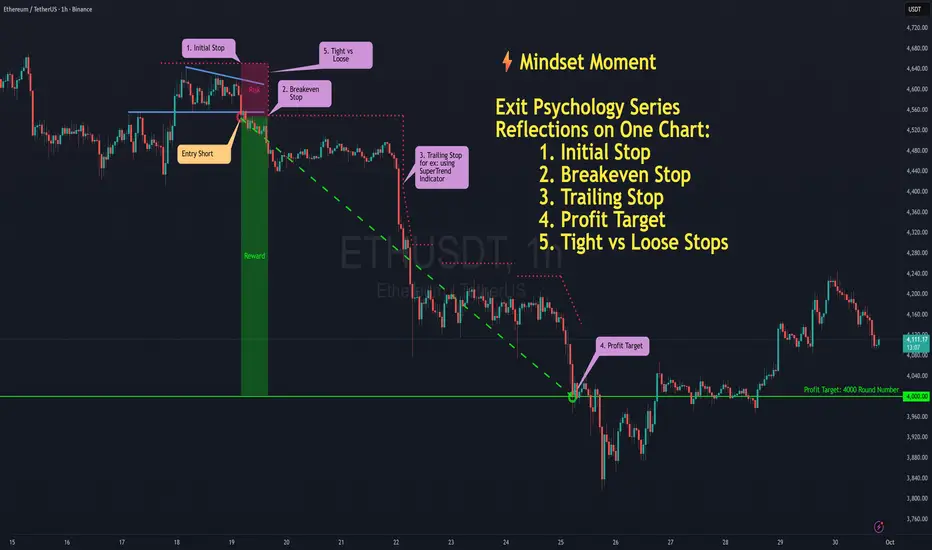
Exit Psychology – Reflections On The SeriesNOTE – This is a post on Mindset and emotion. It is NOT a Trade idea or strategy designed to make you money. If anything, I’m taking the time here to post as an effort to help you preserve your capital, energy and will so that you are able to execute your own trading system as best you can from a place of calm, patience and confidence.
Over the last few posts we’ve walked through the psychology behind many exits. Here on this chart, you can see how they all might have played out on a single trade.
One trade, four different exits. Whichever you choose to implement isn’t just a technical decision - it’s a psychological mirror.
Taking each in turn:
The initial stop: the line where you admit, “The trade idea didn’t work”
The break-even stop: the comfort of “I can’t lose now.”
The trailing stop: the wrestle between protecting gains and letting them run.
The profit target: the choice between certainty and potential.
Put them all on the same chart and you’ll notice something: none of them are just about price. Each is a reflection of the trader making the call.
What we’ve uncovered in this series:
The initial stop tests whether you can accept being wrong on a trade idea without making it personal.
The break-even stop shows how much discomfort you’re willing to tolerate before reaching for relief.
The trailing stop mirrors your balance between fear of giving back and trust in your process.
The profit target surfaces your relationship with certainty versus possibility.
And tight vs. loose? That isn’t just a preference. It begins with trader type: your personality, values and beliefs set a natural baseline. It’s shaped further by how well your strategy fits that style. And in the moment, emotion (fear or hope) nudges you tighter or looser than planned.
The bigger reflection:
Exits reveal more than entries. They show how you handle:
Loss and regret.
Control and uncertainty.
Trust and identity.
Comfort and growth.
But reflection alone isn’t enough. To turn insight into progress, you need practical ways to anchor behaviour:
Pre-commit in writing: Note where you’ll exit before you enter, it closes the door to mid-trade negotiation.
Separate outcomes from emotions: Journal not just where you exited, but how you felt in the moment. Patterns emerge quickly.
Differentiate protecting vs. controlling: Ask yourself, “Am I moving this stop to protect the plan, or because I’m uncomfortable right now?”
Train the nervous system: Notice the physical urge to act and how it shows up in the body (ex: shallow breath, tense shoulders). Pause before execution and breathe. Slow down the ‘urge’ and re-train self trust.
These small practices are how you build the consistency to stay aligned with both your system and your psychology.
Closing thought:
The market doesn’t care where you exit. But your mindset does - and so does your account.
Clarity in those decisions is where growth begins and where your odds of staying in the game increase.
In the end, your edge isn’t only your system. It’s your state of mind - before, during and after engaging with the market.
I hope you’ve enjoyed this series. If so would love to hear in the comments.
Here’s a recap of the entire Psychology of Exits series in case you’d like to check out the details of each:
Exit Psychology 1/5 : The Initial Stop
Exit Psychology 2/5 : The Break-Even Stop - Comfort or Illusion?
Exit Psychology 3/5: The Trailing Stop – Patience vs Protection
Exit Psychology 4/5 : The Profit Target – Certainty vs. Potential
Exit Psychology 5/5: Tight vs. Loose
And finally here is the link to the original article by TradingView that inspired this series as promised:
p.s. Apols if anything is odd in this post, I have had to repost it.
Stops
Exit Psychology 5/5: Tight vs. LooseNOTE – This is a post on Mindset and emotion. It is NOT a Trade idea or strategy designed to make you money. If anything, I’m taking the time here to post as an effort to help you preserve your capital, energy and will so that you are able to execute your own trading system as best you can from a place of calm, patience and confidence.
This 5-part series on the Psychology of Exits is inspired by TradingView’s recent post “The Stop-Loss Dilemma.” Link to the original post at the end of this article.
Here’s a scenario:
Two traders, same setup. One uses a tight stop. One sets it loose.
The first gets stopped out quickly - several scratches in a row. Frustration builds: “The market keeps hunting me.”
The second holds through the noise, but watches a small loss balloon. Self-talk creeps in: “If I’d cut it sooner, I’d be fine.”
Same market. Different styles. Each trader convinced the other way might be better.
How behaviour shows up with tight vs. loose stops:
Tight stops: Often chosen by traders who value precision and control. The mindset is “I’d rather be wrong small and often than wrong big.” The cost? A series of small cuts that can erode confidence.
Loose stops: Favoured by traders who value patience and the bigger picture. The mindset is “give the trade room to breathe.” The cost? Larger drawdowns and the risk of turning manageable losses into emotional ones.
Neither is inherently better. The choice often begins with trader type - your personality, values and beliefs shape a natural preference for precision (tight) or patience (loose). The trap isn’t in the preference itself it’s when short-term emotions hijack that baseline.
The psychology underneath:
Your baseline style comes from deeper beliefs and tendencies:
Tight stop traders often believe:
“If I’m precise, I can avoid being wrong.”
“Smaller losses hurt less.”
“Control comes from minimising risk quickly.”
Loose stop traders often believe:
“The market needs space to prove me right.”
“One big win will pay for the rest.”
“Patience will protect me from being shaken out.”
But when stress or excitement kicks in, those baseline tendencies can distort:
Tight traders over-tighten - cutting winners short out of fear.
Loose traders loosen further - holding too long out of hope.
The key is to know the difference between what reflects your style and what reflects an emotional trigger.
Why context matters:
Timeframe: Scalpers naturally need tighter stops; swing traders can afford looser ones.
Volatility: Calm markets tolerate precision; wild ones punish it.
Strategy: Breakout systems often need wider buffers; mean reversion thrives on tight control.
Your stop isn’t just about the chart. It’s about who you are, the system you run and the market you’re in.
Practical tips … the How:
Notice your natural bias: Do you lean toward safety through control (tight) or safety through space (loose)? Awareness matters more than labels.
Align your stop style with both your timeframe and your temperament. A system that grinds against your personality will drain your energy.
Review your data: Do tight stops cut you out too soon? Do loose stops bleed too much? Your history holds the clues.
Separate outcome from process: A stop-out isn’t failure - it’s feedback. Tight or loose, consistency beats reaction.
Reframe:
It’s not about tight versus loose. It’s about congruence, between your strategy, the market context and your personality. When those three line up, stops become less about fear and more about discipline.
Closing thought:
Every stop: initial, break-even, trailing, or profit target is really a mirror. It reflects not only your strategy, but also your relationship with uncertainty, control and trust in yourself.
The market doesn’t care how you exit. But your mindset does… as does your account.
Every adjustment, every shift of a stop, every decision to hold or cut, carries both a financial cost and an emotional cost. Learning to see those decisions clearly, is where growth begins and where your odds of staying in the game increase.
A link to Exit Psychology 4/5 : The Profit Target – Certainty vs. Potential
A link to the original article as promised:
This is Part 5 of the Psychology of Exits series.
👉 Thanks for following along ... and for those who have stayed the course with me, there's a bonus wrap up that I'll be writing up today and releasing tomorrow. Stay tuned.
p.s. Apologies if the chart on this post is a little odd. I had to repost this.
Exit Psychology 2/5 : The Break-Even Stop - Comfort or Illusion?NOTE – This is a post on Mindset and emotion. It is NOT a Trade idea or strategy designed to make you money. If anything, I’m taking the time here to post as an effort to help you preserve your capital, energy and will so that you are able to execute your own trading system as best you can from a place of calm, patience and confidence.
This 5-part series on the Psychology of Exits is inspired by TradingView’s recent post “The Stop-Loss Dilemma.” Link to the original post at the end of this article.
Here’s another scenario:
Your trade starts working in your favour. You feel relief. Within minutes, you move the stop to break-even. “Now I can’t lose.”
But the market breathes back, tags your new level by a whisker and then runs in your original direction. You’re flat, frustrated and watching from the sidelines.
How behaviour shows up with break-even stops:
For many traders, the urge to move to break-even comes quickly. It’s a way of taking risk off the table but often at the cost of cutting trades short. Typical behaviours include:
Locking in break-even as soon as price moves a little in your favour.
Using break-even as a substitute for taking partial profits.
Feeling “safe” after the adjustment and disengaging from trade management.
Why traders choose this approach:
There are rational reasons for going break-even:
Protecting capital in volatile conditions.
Reducing stress when multiple trades are open.
Creating a sense of progress after a string of losses.
These can all make sense in context. But the challenge is that moving too soon to break-even can turn a promising trade into repeated small scratches leaving you exhausted, under-confident and questioning your method. And … you’re still taking full losses for those trades that go immediately against you.
The psychology underneath:
At break-even, traders aren’t usually optimising expectancy; they're seeking emotional relief. The pull comes from:
Fear of loss: Wanting to avoid the pain of turning a winner back into a loser.
Need for certainty : A break-even stop feels like control in an uncertain environment.
Regret avoidance : Scratches hurt less than watching profit evaporate into loss.
Anchoring bias : Once price moves your way, the mind treats that unrealised gain as already yours. Giving it back feels like losing more than it is.
Identity narrative : Moving to break-even can reinforce the self-image of being disciplined or “safe” even if it’s cutting potential edge.
Control vs. trust : The break-even adjustment is often less about the market and more about soothing the discomfort of waiting. It’s easier to do something than to trust the original plan.
Short-term comfort over long-term edge : The relief of “no risk” overrides the patience needed to let the trade develop.
Physiology : Heart rate settles, shoulders relax, the nervous system rewards the move with immediate calm, even if expectancy drops.
Practical tips … the How:
If you use break-even stops, the work is about applying them intentionally rather than reflexively. A few ways to manage the psychological side:
Define in advance: When will you move to break-even? After it moves a pre-defined amount in your favour ( X ATRs)? After a structure shift? Make it rule-based.
Consider scaling out partial size instead of rushing to break-even. Bank some, let the rest breathe.
Journal whether break-even stops are improving or reducing expectancy across 50–100 trades.
Train your nervous system: stay with mild discomfort instead of rushing to neutralise it. For instance: notice the physical tension that arises (tight chest, shallow breath, clenched jaw) when your trade pulls back. Instead of reacting on the chart, take one slow, deliberate breath and simply observe that feeling before deciding.
Reframe:
A break-even stop isn’t wrong. It can be useful in the right context. But when used as a reflex, it’s more about managing feelings than managing risk.
Closing thought:
Break-even can feel like safety. But safety and growth don’t always align. The real edge comes from knowing when you’re protecting wisely and when you’re just buying short-term comfort at the expense of long-term results.
A link to Exit Psychology 1/5 : The Initial Stop
A link to the original article as promised:
This is Part 2 of the Psychology of Exits series .
👉 Follow and stay tuned for Part 3: The Trailing Stop - Patience vs. Protection out next week .
How to Use Stop Losses in TradingViewThis video covers stop loss orders, explaining what they are, why traders use them, and how to set them up in TradingView.
Disclaimer:
There is a substantial risk of loss in futures trading. Past performance is not indicative of future results. Please trade only with risk capital. We are not responsible for any third-party links, comments, or content shared on TradingView. Any opinions, links, or messages posted by users on TradingView do not represent our views or recommendations. Please exercise your own judgment and due diligence when engaging with any external content or user commentary.
The placement of contingent orders by you or broker, or trading advisor, such as a "stop-loss" or "stop-limit" order, will not necessarily limit your losses to the intended amounts, since market conditions may make it impossible to execute such orders.
My Biggest New Trader Mistakes & Lessons LearnedI thought I'd share my experience with other New Traders (I'm still 'new', 2yrs in). I made all the classic mistakes and plenty more, my learning is only just beginning.
Hopefully this educational post helps others new to trading.
Use a Stop Loss
So many times I didn't use a Stop Loss. One of the main reasons was I kept getting Stopped Out and then the price reversed, it made me paranoid. Also when the day changes at the start of the Asia session, or over the weekend with the gaps on market open, I thought I was better not having one.
I've Learned: If you don't use a Stop Loss it's psychologically hard to get out of a losing trade and you can easily blow your account. I think it's OK to move the stops temporarily before the Asian open, but ideally the trade would only be left open if a) it's well in profit and b) the move looks likely to continue.
Don't move your SL & TP
I kept moving both of these stops, I either couldn't face the actual loss when a trade went bad (it seemed less real on paper and there was always 'the chance' it would come back in my favour) or I got greedy when the trade went in my favour and then before I knew it, it reversed and my profit was gone.
I've Learned: Moving Stops and Targets risks profitable trades; it's psychologically damaging as it suggests lack of planning and strategy, this is gambling. On the other hand, having a plan and seeing it playout, however big or small is hugely satisfying and is the best confidence builder.
Get In and Out
I kept looking for the really big moves, and I had a few, but only a few. I believe the longer you're in a trade, the riskier it is due to the many factors that can affect price - Institutions, Fundamentals, Global Events, there are so many things that can turn a good strategy bad, and I lost money.
I've Learned: There are so many trading pairs, so many options, there'll always be another trade. Staying in a trade for too long is leaving money on the table, when it could be in your account, getting out too early is annoying, but having profit on the trade is much more important.
Leaving trades over a weekend
I've left both winning and losing trades over a weekend, and many times previously winning trades went against me, and losing ones got worse. Price can be unpredictable due to fundamental changes over a weekend.
I've Learned: On a Friday, unless 80% happy that your trade will continue in the right direction over the weekend, close it and review again after market open (you may lose a few but you will have banked profits or minimised losses in many cases).
Keep Fundamentals in mind
I follow some traders who don't seem to care about Fundamentals, but in that time I've seen many of their signals go bad because of big news. I think, that they think, that if the news is in their favour they reach target quicker. If it's not, they reach target slower, as the market has already decided future price regardless. I've seen fundamentals shape both shorter and longer term trends, they can easily cause reversals and commonly they cause spikes in the opposite direction from what you'd expect, before then moving as you'd expect, but this can be too late.
I've Learned: Each pair / trade is different, however I've learned to take a pragmatic approach, often getting out of a trade before the news and waiting for the market to calm down before considering re-entering. This can mean missing out, but too many times I was on the wrong side of the news, I'm more profitable stepping back first.
Have positive involvement in the TradingView community
From time to time I see comments on Trader's ideas that are less than positive, as though the commentator can predict the future? As a community of retail traders we are up against the institutions and the big money movers who love to take retail traders' money, this means as retail traders we're all on the same team. The total value of all of our accounts is like comparing the size of an atom to a planet!
I've Learned: If you don't like someone's idea, move past it, or discuss professionally. Be open-minded to ideas and celebrate success, 'like' ideas that you like and give positive comments where you agree, we're all in this together, and everyone is trying their best.
Do your own research
I signed up to loads of Telegrams and followed signals blindly, and it cost me a lot. It's too easy for people giving signals to only report on the successful ones. The community around trading, particularly TradingView is awesome but it can be confusing, for every chart, for every pair there is so much subjectivity. Previous price action does not dictate future price movement, if it did everyone would win.
I've Learned: Don't put your destiny in the hands of others, read and learn as much as possible but create your own plan and strategy, it's much more rewarding, both psychologically and for me, financially.
Take a Break
I was watching the charts of my trades almost constantly, whether up or down I was watching them, but not doing anything. If losing (without a SL) I'd be watching hoping it would come back, if winning I'd often manually close too early, or leave it too long (FOMO) and it was too much and made no positive impact on my trading success, it just caused stress.
I've Learned: To create my plan with all of these lessons in mind, and action it if the conditions are right. If I'm working on my personal trading development now, I'm looking for future trading opportunities, I'm setting alerts for future price action, I'm writing and publishing my ideas, and most importantly I'm taking a break to enjoy weekends, holidays and normal stuff!
Writing and publishing this education article is really cathartic for me, it's helping me to keep embedding the lessons I have learned. The best lessons are the hardest ones, the expensive ones!
I've just started publishing my ideas on here and I appreciate all the support I can get to becoming a better trader, hopefully one day I can be good enough to do this full-time.
It'd be great to know if you've experienced these and other lessons as a new trader.
Are there any more that you can share with me, and the rest of the TradingView community?
The Problem with Breakeven TradesThe issue with breakeven trading is that when enough people are joining the market at the same place, be it a demand area or an order block.
Many traders like to secure their positions immediately.
This, however, creates liquidity.
Whenever a large group of people move stop losses to the same area, expect that area to be a target for the banks.
In this example, we can see buy orders being activated at an order block, a sudden push to make buyers secure their position, followed by a stop hunt of risk-free trades before continuing to the upside.
Do you ever get caught in situations like this?
Learning Parallel Channel TrapsSometimes we can get so caught up in the fear of missing out on the breakout that we forget it could be a trap.
It is always crucial to listen to your intuition when you see these easy setups because more often than not they are more complex than they seem.
In this example, a breakout occurred and buyers put stops below the last structure, a few days later this structure got raided for liquidity.
Once the liquidity was gathered we began to see the true move to the upside.
Do you see this often in the markets?
ATR Indicator - How to Avoid Getting Stopped out of TradesIn this post we can see how the stops were taken out beyond. the 26600 price level.
For any setup that a noobie trader may place, the SL would be taken out at this level;
However using the ATR indicator we can avoid getting stopped out and keep our trade.
I recommend you watch some videos on this indicator to get a better understanding but the main jist of it is ->
Take a sweep low/high of a range and add/minus the ATR value (on the sweep candle) to get more legroom for price to move (but it will miss your stop)
I hope you find this useful.
USDCAD - Be Careful of Overlapping Levels of Structure Experience is a major part of becoming a consistently profitable trader. Now experience isn't just gained by the amount of time that you spend in the markets, it has to be earned by doing the little things such as reviewing your trades on a daily basis & asking yourself what did I do good, what did I do bad & what could I have done better?
Something that I began to notice in my trading years back was that I wasn't being the smartest with my stop loss in certain situations and this was mainly due to having too much of a recency bias and not focusing enough on the past in comparison to the present.
Situations like the one on the chart would routinely take me out because although my stops were below the most recent level fo structure (making me feel safe), they were not below those sneaky past levels of structure causing me to be easy pickens for smart money hunting.
I now take this into account on every trading scenario I look at and although it has reduced the amount of trades that I take, it has increased my efficiency in the opportunities that I do take.
Akil
How Stop Hunts workQuick thoughts on recent price action.
Shows possible thought process of whales / market makers.
So for my Stop Loss settings, I ask myself:
-Where are everybody else's stops? (too much of a target)
-If I put my stop above/below, what happens to my Risk v Reward formula?
-If I can not my stop above/below, am I just asking to LOSE that stop?