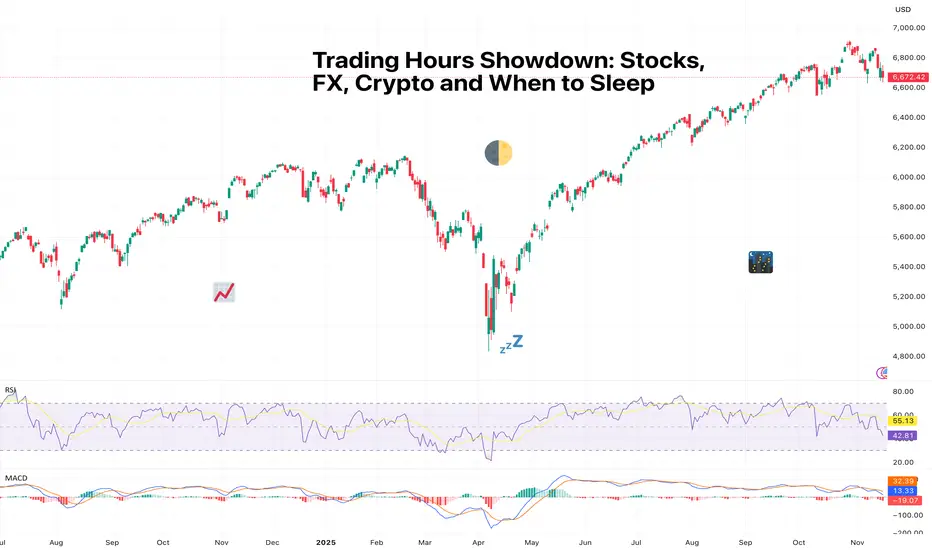
Trading Hours Showdown: Stocks, FX, Crypto and When to SleepSome markets close, some don’t, and some don’t care that you need rest.
If financial markets were people, they’d each have wildly different sleeping habits. Stocks tuck themselves in usually at 4 p.m. (that is, where they originate from), FX stays up all night but insists it’s “fine,” and crypto is that friend who messages you at 3 a.m. with a life-changing idea (and a 12% move for fun).
Understanding when each market is awake, liquid, and volatile is one of the most underrated skills a trader can have. It’s not just about timing entries; it’s about managing risk while you’re away from your devices.
Let’s break down the global sleep schedule and why your portfolio should care.
🌅 Stocks: The 9-to-5ers of the Financial World
US stocks like routine. They open at 9:30 a.m. ET, close at 4 p.m., and observe weekends and holidays like well-behaved citizens.
There’s also pre-market and after-hours trading, but liquidity dries up real fast and moves tend to be exaggerated.
Why it matters:
Limited hours = overnight gap risk
Most volume typically happens in the first and last 30 minutes
Big news after hours can cause violent opens the next day
Stops can’t protect you when price jumps over your level
Every trader eventually experiences the heartbreak of a perfect setup ruined by an overnight earnings surprise. Consider it a rite of passage.
🌍 Forex: The Market with No Bedtime
FX ( forex or foreign exchange) trades 24 hours a day, five days a week, rotating through global sessions:
Asia (Tokyo)
Europe (London)
US (New York)
That’s a 120-hour work week with no break. Think of it like a global relay race where someone is always awake and analyzing inflation differentials.
Why traders love it:
Continuous liquidity = fewer gaps
Beautiful macro-driven trends
Volatility waves follow session overlaps (London–NY especially)
But…
FX weekends could be silent killers. You’re unprotected from Friday close to Sunday open. That’s plenty of time for geopolitical headlines, surprise events, central bank drama, or a country deciding to unpeg its currency.
🔥 Crypto: The Market That Never Sleeps or Blinks
The cryptocurrency market trades 24/7/365. No days off, no weekends, no holidays, no rest. Just pure, unfiltered price action around the clock.
This sounds great until you realize you can never fully unplug. Bitcoin BITSTAMP:BTCUSD does not respect your circadian rhythm.
Why it’s unique:
No “overnight gaps” because it never closes
But liquidity gaps may appear during low-volume hours
Late-night moves can be extreme due to thin order books
Leverage unwinds can trigger liquidation cascades at 3 a.m.
Global retail participation exaggerates emotional spikes
Crypto doesn’t gap like stocks, but it drifts, snaps, and rips through levels and can make your stomach churn.
🧭 Liquidity: The Real Story Behind the Sleep Schedule
Across markets, the one concept that ties them all together is liquidity. That is, how deep the order book is and how efficiently your trades can execute.
Stocks
Thick liquidity during US hours
Thin, jumpy after-hours
Prone to large news-driven gaps
Forex
Deep liquidity almost 24 hours a day
Most volume during London–NY overlap
Macro news instantly reflected in price
Crypto
Liquidity pockets vary wildly
Exchanges differ in depth
Weekends and Asia-over-US crossovers can trigger whipsaws
😴 The Question of Sleep (And How Traders Manage It)
Traders eventually learn a few things about trading various asset classes.
If you:
Hate surprises → Avoid overnight stock positions
Love macro trends → FX is your playground
Enjoy volatility → Crypto keeps things interesting
Value sleep → Choose an asset class that aligns with your time zone and day trade it
Choosing a market to trade isn’t just about your strategy, but also about your lifestyle.
Volatility doesn’t just depend on the asset. It depends on when you’re watching.
Off to you : How do you deal with trading different assets in different time zones? Are you a niche player or a broader market maven? Share your comments below!
Assetclass
What Are Asset Classes? Definition and MeaningWhat Are Asset Classes? Definition and Meaning
In the realm of finance and investing, you may have come across the term "asset class". This article is designed to help you understand its definition, its meaning, and its significance in your investment journey.
Asset Class Definition
In a nutshell, an asset class refers to a grouping of investments that exhibit similar characteristics and are subject to the same laws and regulations. The classification is based on attributes such as risk, return, and the market dynamics that drive them.
The asset class meaning implies that the investments within each class are believed to behave similarly and should, therefore, have the same place in a trader's portfolio. They offer a structured way to diversify a portfolio, thereby helping to minimise risk while maximising return.
How Many Asset Classes Are There?
The next logical question would be, how many assets can we trade? Traditionally, there were three main asset classes - equities (stocks), fixed Income (bonds), and cash or cash equivalents. But, the modern financial markets have expanded this list and now include many others, such as real estate, commodities, foreign exchange (forex or FX), and cryptocurrencies*.
What are the different asset classes? And what is an example of an asset class? Now that we've established a fundamental understanding of what an asset class is let's take a look at the asset classes list and further discuss a few examples to learn more.
Equities
The equity asset class refers to stocks and shares of publicly traded companies. When you invest in equities, you're essentially buying a small piece of ownership in a company. The return on these investments typically comes in the form of capital gains (i.e., selling the stock at a higher price than what you paid for it) or dividends paid out by the company.
However, you can also trade stocks. This won’t bring you dividends but will allow you to trade on a price increase and decline. CFD trading is one of the options. Trading stocks involves researching and analysing numerous factors, including the company's financial health, industry trends, and broader economic indicators, as well as technical indicators and chart patterns. If you want to trade stock CFDs, you can open an FXOpen account.
Fixed Income
This asset class includes investments like government bonds, corporate bonds, and other debt instruments that pay a fixed amount over a specific period. The primary source of return is the interest paid on the borrowed funds.
One of the primary characteristics of fixed-income investments is the regular income they provide. This makes them particularly attractive to those seeking a consistent income stream. Additionally, the risk associated with fixed income is typically lower than that of equities.
Investors in fixed income pay attention to factors such as interest rates, credit quality of the issuer, and the bond's maturity date. Changes in interest rates can affect bond prices, and investors should consider their risk tolerance and investment objectives when selecting bonds.
Cash and Cash Equivalents
Cash and cash equivalents are financial assets that are highly liquid and can be readily converted into cash. These assets are considered to be very safe and easily accessible, making them an essential part of a company's or an individual's financial portfolio.
Cash includes physical currency (coins and banknotes) as well as deposits in bank accounts that are available for immediate withdrawal. Cash equivalents, on the other hand, are short-term investments that are highly liquid and have a typical maturity period of three months or less from the date of purchase. These investments are close to maturity and carry a minimal risk of changes in value due to their short-term nature.
Commodities
This class includes raw materials and resources that can be traded in various markets. They include items like gold, oil, agricultural products, and metals. Commodities are usually used as a hedge against inflation, as their prices can rise when the general price level increases. Additionally, commodities can provide a diversification benefit because their prices are driven by different factors than equities and fixed income.
Commodities are typically traded on futures exchanges. Nevertheless, market participants have the opportunity to tap into the commodity sphere via Exchange Traded Funds (ETFs), diversified mutual funds, and Contracts for Difference (CFD). Commodity trading requires an understanding of the specific market factors that impact each asset. Additionally, commodity prices can be volatile, so risk management strategies are crucial when trading these assets.
Real Estate
Investing in physical properties, whether residential, commercial, or industrial, comes under this asset class. Returns are derived from rental income or selling the property for a profit.
Investing in real estate involves various considerations that differ significantly from those of other asset classes, including high entry costs, management responsibilities, market risk and diversification. Real estate can be directly owned, or investors can gain exposure to this asset class through real estate investment trusts (REITs) or real estate-focused funds.
Cryptocurrencies*
This is a relatively new addition to the asset class family. These digital or virtual assets use cryptography for security, with Bitcoin and Ethereum being well-known examples.
Cryptocurrencies* are decentralised, meaning they are not controlled by any central bank or government. They can be transferred directly between parties via the Internet without the need for a middleman.
You can trade cryptocurrencies* on crypto exchanges or via different financial instruments, including CFDs. When trading a cryptocurrency CFD*, you don’t need to own the underlying asset. You trade on price movements, predicting future price direction based on comprehensive analyses. Trading cryptocurrencies* involves a high level of risk due to their extreme volatility. Therefore, it’s vital to know how margin trading works and understand how to reduce risk exposure with various risk management strategies.
If you want to trade shares, commodities, or cryptocurrencies*, you can try the TickTrader platform.
Investment Asset Classes and Portfolio Diversification
These are the most popular examples of the types of asset classes. The complexity and diversity of these categories signify the importance of understanding the different asset classes before making investment decisions.
Knowing the different instruments and their characteristics is essential for any investor. The key to building a successful portfolio is not just about selecting individual investments but more about allocating funds among these trading categories.
Diversification across financial asset classes reduces risk because different assets react differently to the same economic event. For instance, when inflation rises, it might be harmful to bonds but could be good for commodities like gold. So, a diversified portfolio is expected to balance out the losses in one class with gains in another, stabilising the overall returns.
Final Thoughts
In the world of investing, various asset classes offer distinct opportunities and risks. Equities offer growth potential, fixed income provides stability, commodities offer diversification, cash and cash equivalents provide low-risk opportunities, and cryptocurrencies* introduce new possibilities. When talking about trading, commodities also provide diversification and hedging opportunities; while stocks allow traders to benefit from significant price fluctuations, the high-volatility nature of cryptocurrencies* makes short-term trading exciting. If you are interested, you can trade shares, commodities, and cryptocurrencies* on the FXOpen platform.
*At FXOpen UK and FXOpen AU, Cryptocurrency CFDs are only available for trading by those clients categorised as Professional clients under FCA Rules and Professional clients under ASIC Rules, respectively. They are not available for trading by Retail clients.
This article represents the opinion of the Companies operating under the FXOpen brand only. It is not to be construed as an offer, solicitation, or recommendation with respect to products and services provided by the Companies operating under the FXOpen brand, nor is it to be considered financial advice.
What are stocks and how do they work?Stocks are exchange traded securities that give rights of ownership to their holder. Normally, they are bought and sold publicly on the stock market exchange; however, private transactions of stocks are also possible. Commonly, the purpose of issuing stock by a company is to raise capital needed for its operations. This process of raising funds allows for fast expansion of capital and company's businesses.
Illustration 1.01
Picture above shows the weekly chart of Apple stock which is the biggest of all stocks in terms of market capitalization.
Stocks are also called equities and their units are called shares. Owner of a stock is then called shareholder and emitent of the stock is called the issuer. Shares entitle a shareholder to the corresponding ownership of the company's assets and profit. However, a shareholder does not own the company itself; additionally, a shareholder does not take any legal liability for a company's actions. This is because a company is viewed as its own legal entity. Shareholders can be either major or minor. Major shareholders hold over 50% of outstanding shares in a company while minor shareholders hold less than 50% of outstanding shares in a company.
Stocks and shares
There is only a slight difference between the terms “stocks'' and “shares”. The term “stocks” is more general and can refer to a single company or broad group of companies. The term “shares'' usually refers to one particular company. However, nowadays, these two terms are used interchangeably.
Separation of ownership and control
Separation of ownership and control is associated with publicly traded companies. It refers to claims on management's decision making and claims on corporation's assets and profit. In publicly traded companies shareholders have limited rights to control a company; shareholders possess only legal claims to the company's profit and assets.
Voting rights
Voting rights represent a shareholder's ability to vote on policy matters within a company. These matters may include issuing new shares, appointing members to board of directors, approving acquisitions and mergers, etc.
Common stock and preferred stock
There are two categories of stocks: common stocks and preferred stocks. Common stocks entitle a shareholder to vote at shareholders' meetings and to receive dividends paid by a company. Common stocks have usually better yield over the long-term, however, at the cost of higher risk in case of liquidation of a company. Preferred stocks differ from common stocks in that they usually come with limited or no voting rights at all. In addition to that, preferred stocks have higher claims on dividends and distribution of assets by a company. This means that in case of liquidation of a company, preferred shareholders have priority over common shareholders. In such an event, common shareholders get paid only after creditors, bondholders, and preferred shareholders were paid.
Illustration 1.02
Illustration above shows the daily chart of Philip Morris Inc. stock. It also shows quarterly dividend intervals above the timeline (blue D in circle). Dividends paid to investors were equal to 1.20 USD per share.
Dividends
Dividend represents the distribution of corporate profits to eligible shareholders. Many stock titles tend to pay dividends to their investors on a monthly, quarterly, semi-annually or annually basis. These dividends can be either in the form of cash or stock. Typically, common shareholders are eligible for dividend payments when they hold the stock before the ex-dividend date. Some companies choose not to pay dividends and instead they reinvest corporate profit back into the company.
Stocks categorization
1. Growth stocks - Growth stocks have higher earnings and grow at a faster pace than the market average. They are normally bought with the purpose of capital appreciation. Growth stocks rarely pay dividends.
2. ncome stocks - These types of stocks pay dividends to their investors on a regular basis. Income stocks are commonly bought with the purpose to generate consistent income.
3. Value stocks - Value stocks are stocks that have a low price-to-earnings ratio.
4. Blue-chip stocks - Blue-chip stocks are the large companies that are well known and have a stable history of growth.
5. Penny stocks - These stocks are small public companies whose shares normally trade below price of 1 USD/per share.
Illustration 1.03
Picture above shows the monthly chart of Tesla Inc. stock. It is an example of the growth stock which appreciated more than 20 000% since 1st June 2010.
DISCLAIMER: This content serves solely educational purposes.