Selection and Focus
Hello, traders.
By "Following," you'll always receive the latest information quickly.
Have a great day.
-------------------------------------
We are always at a crossroads.
We choose which instruments and coins (tokens) to trade and take responsibility for that choice.
You can see in the chart above that the price has fallen back to near the HA-Low indicator on the 1W chart.
And, the 1D chart shows a stepwise downward trend.
In other words, the price fell below the HA-High indicator, exhibiting a normal decline, and then encountered the HA-Low indicator, forming a stepwise downtrend.
A normal downtrend is formed from a high and then declines, while a stepwise downtrend is formed from a low and then renewed.
While both types of downtrends ultimately represent the same decline, the difference is that in a stepwise downtrend, you can choose the criteria for entering a trade.
Therefore, we can look for charts where a stepwise downtrend transitions to an uptrend and trade based on whether support and resistance are present.
Looking at this example chart, the price fell below the HA-High indicator on August 14th and then exhibited a normal downtrend.
Then, on October 10th, it fell below the HA-Low indicator, forming a stepwise downtrend.
Looking at the larger 1W chart, we can see that the price has been in a normal downtrend since February 3rd, falling below the HA-High indicator.
Then, after October 6th, it touched the HA-Low indicator, indicating that it had reached a low.
It appears to be currently testing support near the HA-Low indicator level of 0.00544.
Therefore, whether support is found near the HA-Low indicator level of 0.00544-0.00611 on the 1W and 1D charts indicates a different meaning from the stepwise decline seen so far.
However, the point at which the downtrend turns into an uptrend and the uptrend is likely to begin is when the price rises above 0.01090 and holds, giving us time to decide on a trade.
Therefore, we can buy when the price rises after finding support in the 0.00544-0.01090 range.
The buy zone, or support zone, is too wide, making it difficult to trade.
In this case, we buy when the price rises after finding support in the key zone, such as the 0.00544-0.00611 range or near 0.01090.
Most traders are afraid to buy at the lowest price, so they will buy when the price rises to around 0.01090.
This phenomenon is called a breakout trade.
In other words, the psychological pressure to buy arises when the price breaks above 0.01090.
Therefore, you should buy when the price rises after finding support in the DOM(-60) ~ HA-Low range, and sell some of the gains, gradually buying during a stepwise downtrend.
By leaving behind coins (tokens) that represent profits, you can reduce the burden of buying at the bottom.
However, if you're not familiar with day trading, you may continue to use your investment funds to buy.
However, don't be afraid of this.
This is because the start of a stepwise downtrend means that the likelihood of a bullish turn has increased.
What you should be afraid of is the HA-High ~ DOM(60) range, i.e., when you buy during the high and then the downtrend begins.
This is because you don't know how far the decline will go.
Only when you encounter the DOM(-60) or HA-Low indicators will you know the end of the decline is near.
Therefore, you need to understand the current position of your chosen asset or coin (token) and consider how to set your trading timing and how to proceed with the trade.
------------------------------------------------------------------
From this perspective, looking at the BTC chart reveals the significance of its current position.
In other words, if the price declines from the current position, it marks the beginning of a stepwise downtrend. If it rises, it indicates the possibility of an upward trend until it encounters the HA-High or DOM(60) indicator.
The M-Signal indicator on the 1M chart passes through this crucial crossroads, making it even more crucial.
The same holds true for the ETH chart.
Therefore, rather than focusing on whether the price will rise or fall, you should check for support near the established low point, i.e., the DOM(-60) to HA-Low range, and respond accordingly by making split purchases.
In other words, trading that leaves behind the coins (tokens) that represent profits from day trading is a useful strategy.
If you're not familiar with day trading, you should purchase at the lowest possible price between DOM(-60) and HA-Low.
Since these purchases should be made every time a cascading downtrend occurs, it's best to purchase in small amounts.
If you find a profitable purchase price within the DOM(-60) to HA-Low range on a certain day, you can sell the amount of each purchase price, leaving the coins (tokens) that represent profits.
It sounds simple, but actually executing a trade is not easy.
Therefore, this trading method (leaving coins corresponding to profits) should be practiced during a cascading downtrend to become familiar with it.
Therefore, until you become accustomed to it, trade with small amounts of capital.
-
Thank you for reading to the end.
I wish you successful trading.
--------------------------------------------------
Breadth Indicators
Next Volatility Period: Around December 28th
Hello, traders!
Follow us to get the latest information quickly.
Have a great day.
-------------------------------------
#ETHUSDT
With the formation of a new trend line, the next volatility period is expected to occur around December 28th - January 1st.
At this time, the key will be whether the price can find support near the lows of 2828.57-2887.66 and rise above the M-Signal indicator on the 1M chart.
However, the most important support and resistance area is the 2419.83-2706.15 range, so it's crucial to maintain the price above this level.
To turn into an uptrend and establish a bullish trend, it must rise above the 3321.30-3438.16 level.
Therefore, you should develop or adjust your medium- to long-term trading strategy based on the movements of the upcoming volatility period.
If it falls below the 2419.83-2706.15 level, a bear market is likely to begin, so you should consider a response plan.
If it finds support and rises, consider this the final uptrend and focus on finding a time to take profits.
This is because, as mentioned in the explanation of the BTC big picture, 2026 is expected to be a major bear market.
-
Thank you for reading to the end.
I wish you successful trading.
--------------------------------------------------
Next Volatility Period: Around December 28th
Hello, traders!
Follow us to get the latest information quickly.
Have a great day.
-------------------------------------
#BTCUSDT
This volatility period will end on December 24th, and the next one will be around January 10th, 2026.
However, it's important to observe the movement after the newly formed trend line passes around December 28th.
The rising trend line (1) is drawn on the 1W chart. The key is whether it can rise along this trend line and break out of the short-term downtrend line.
The low point is 84739.74-87944.84, so a bullish trend is likely to occur if the price finds support near this level and rises above the M-Signal indicator on the 1M chart.
To break above this key point or level and continue the uptrend, the StochRSI, TC, and OBV indicators must show upward trends.
If possible,
1. The StochRSI indicator should not have entered the overbought zone.
2. The TC indicator should remain above zero.
3. The OBV indicator should remain above the High Line.
Therefore, we need to determine if the above conditions can be met while finding support near the low point (84739.74-87944.84).
The most important support and resistance level is 69000-73499.86.
Therefore, volatility may occur as the price approaches this level.
If support is found at this level, I believe it's definitely a good time to buy.
I believe the price level we won't see again is below 42K.
-
Thank you for reading to the end.
I wish you successful trading.
--------------------------------------------------
- This is an explanation of the big picture.
(3-year bull market, 1-year bear market pattern)
I will explain in more detail when the bear market begins.
------------------------------------------------------
Examples of How to Determine When to Trade
Hello, fellow traders!
Follow us to get the latest information quickly.
Have a great day!
-------------------------------------
How can you profit from trading with charts that show the above movements?
To trade, you need a basic trading strategy.
This basic trading strategy varies from person to person, so it's important to create a basic trading strategy that suits you.
The basic trading strategy I'm suggesting is to buy in the DOM(-60) ~ HA-Low range and sell in the HA-High ~ DOM(60) range.
However, if the HA-High ~ DOM(60) range rises, a step-up trend is likely, while if the DOM(-60) ~ HA-Low range falls, a step-down trend is likely.
Therefore, you should trade using a segmented trading method.
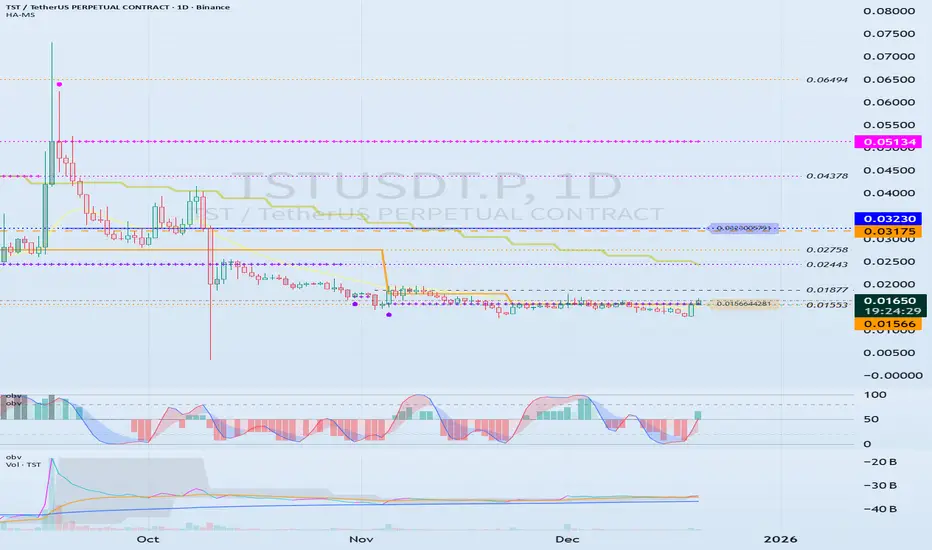
Looking at the chart, you can see that a step-down trend is occurring, and the HA-High indicator has been created for the first time.
Therefore, if the current HA-Low indicator level of 0.01566 is supported and the price rises, the wave will end around 0.03230.
If you zoom in on the chart, you can see that the M-Signal indicator on the 1D chart has risen above the HA-Low indicator and has broken above it.
Therefore, we can see that short-term trading is possible.
The following evidence supports this:
1. The TC indicator has risen above the 0 level.
2. The StochRSI indicator is showing an upward trend.
3. The OBV indicator is showing signs of rising above the High Line.
Therefore, we can initiate a trade around the HA-Low indicator level of 0.01566, depending on whether there is support.
However, since the price is in a stepwise downtrend, if it falls below 0.01566, we should cut our losses or sell in installments to secure funds for future purchases.
A full-scale uptrend is likely to begin when the M-Signal indicator on the 1W chart rises above it.
-
Unlike the TST chart, the CHZ chart has the M-Signal indicator from the 1M chart.
Therefore, to sustain a long-term uptrend, the price must rise above the M-Signal indicator on the 1M chart.
Currently, the price is in a stepwise downtrend, but it has risen above the M-Signal indicator on the 1W chart.
Therefore, if the price remains above the M-Signal indicator on the 1W chart, an uptrend is expected.
As mentioned earlier, the basic trading strategy considers the HA-High ~ DOM (60) range as a sell zone.
Therefore, we should respond based on the presence of support around the 0.04363-0.04631 range.
If the HA-High ~ DOM (60) range supports the price and rises, a stepwise uptrend is likely.
At this point, the key is whether the price can sustain itself by breaking above the M-Siganl indicator on the 1M chart.
-
To continue the uptrend by breaking above a key point or range, the following conditions must be met:
1. The TC indicator must be trending upward. If possible, it should remain above the zero level.
2. The StochRSI indicator must be trending upward. If possible, it should not enter the overbought zone.
3. The OBV indicator must be trending upward. If possible, it should remain above the High Line.
Based on the above conditions, the current price movement appears highly likely to continue upward.
However, if the price breaks above the next important level, the 0.04363-0.04631 range, we must reassess whether the above conditions are met.
------------------------------------------------------------
To trade, we strive to gather as much information as possible.
This information includes issues beyond the chart itself.
However, if you identify issues outside of the chart before the chart analysis is complete, you may end up analyzing the chart subjectively. Therefore, it's best to explore other issues after the chart analysis is complete.
The most important thing when looking at a chart is the flow of funds.
However, it can be difficult for individual investors to understand this flow.
Analyzing trading volume can also be difficult, so to simplify this process, we created the TC indicator, which utilizes the OBV and PVT indicators.
Furthermore, the DOM indicator, which comprehensively evaluates the DMI, OBV, and MONENTUM indicators, also includes trading volume and displays support and resistance points.
Additionally, you can activate the StochRSI 20, 50, and 80 indicators, as well as the OBV High and Low indicators.
You can utilize these indicators to further refine your trading strategy.
However, you should first check the movement and alignment of the M-Signal indicator on the 1M, 1W, and 1D charts.
Next, you should check the location of the DOM(-60) ~ HA-Low or HA-High ~ DOM(-60) range and determine whether there is support near those areas.
Using other people's indicators or chart analysis requires significant time and observation.
Otherwise, you are more likely to misinterpret the data and fail to trade.
To utilize my charts, it's recommended to activate the indicators as follows:
1. Activate only the M-Signal and HA-Low/HA-High indicators on the 1M, 1W, and 1D charts to check and observe the basic chart movements.
You can trade with these indicators alone.
However, if volatility occurs, the high and low points are not clearly defined, which can delay response times.
2. To prevent this, activate the DOM(60) and DOM(-60) indicators. The DOM(60) indicator represents a high, while the DOM(-60) indicator represents a low.
Therefore, you can buy around the DOM(-60) ~ HA-Low range depending on whether there's support, and sell around the HA-High ~ DOM(60) range depending on whether there's support.
3. If you're comfortable interpreting steps 1 and 2, you can use the movements of the auxiliary indicators TC, StochRSI, and OBV.
Steps 1 and 2 can be thought of as indicating support and resistance points. When determining support near these points, refer to the movements of the auxiliary indicators TC, StochRSI, and OBV to help you determine whether there's support.
Becoming proficient at interpreting steps 1 through 3 will greatly aid you in identifying trading opportunities.
-
Thank you for reading to the end.
I wish you successful trading.
--------------------------------------------------
Next Volatility Period: Around December 23rd
Hello? Hello, traders.
If you "Follow" us, you'll always get the latest information quickly.
Have a great day.
-------------------------------------
(XRPUSDT 1D Chart)
I believe the expected uptrend will continue when the price rises above 2.4810-2.6013.
Therefore, the final buy zone is the 2.4810-2.6013 zone.
If the price falls below the 1.5-19669 zone, a long-term downtrend should be considered.
Therefore, if support is found around the 1.5-19669 zone, it would be a good time to buy from a long-term perspective.
As it's difficult to determine the support level on a 1D chart alone, the StochRSI 80 and 20 indicators on the 1M chart are marked.
Therefore, the 1.8209-1.9575 range should be considered the support level for a continued uptrend.
If the price rises above the OBV High indicator and holds, further upside is likely.
However, it must break above the M-Signal indicator on the 1W chart.
-
Thank you for reading.
We wish you successful trading.
--------------------------------------------------
Next Volatility Period: Around January 1, 2026
Hello, traders!
Follow us to get the latest information quickly.
Have a great day!
-------------------------------------
(ETHUSDT 1D Chart)
This volatility period is expected to last until December 17th.
To initiate an uptrend, the price must rise above the M-Signal indicator on the 1M chart and remain stable.
In this sense, the key is whether the price can find support near 2887.66 and rise above 3025.27 to maintain its upward momentum.
However, a full-scale uptrend is expected to begin only if the price rises above the HA-High ~ DOM (60) range on the 1M chart (3321.30-3438.16).
-
From a trading perspective, trading below the M-Signal indicator on the 1M chart is difficult, so if possible, it's best to find a trading opportunity around 3025.27 based on the presence of support.
In the medium to long term, you can buy in installments whenever support is found near the DOM (-60) ~ HA-Low range.
Therefore, the timing for buying in installments is until support is found near 2770.12-2887.66.
However, if the price declines from the DOM(-60) to HA-Low range, a step-down trend is likely, so you should consider a countermeasure.
In other words, if you bought when the price was supported near the DOM(-60) to HA-Low range, you can sell a portion of your holdings when the price rises and then begins to decline, leaving the coins (tokens) corresponding to the profit. This can be done in installments.
-
To sustain the uptrend from a long-term perspective, the price must be maintained above 2419.83-2706.15.
If this fails and the price declines, a long-term downtrend is likely, so you should consider a countermeasure.
There are two types of declines:
1. Normal Decline
This occurs when the price rises from the DOM(-60) to HA-Low range, forms the HA-High to DOM(60) range, and then declines.
This decline is likely to continue until it reaches the DOM(-60) or HA-Low indicators, making it difficult to gauge the actual extent of the decline.
Therefore, during a normal decline, it's difficult to determine the timing of a partial purchase, so caution is advised when making a purchase.
However, other indicators and support and resistance levels can be used to estimate the timing.
2. Staircase Decline
This refers to a further decline from the DOM(-60) to HA-Low range.
Therefore, if the decline continues, the DOM(-60) or HA-Low indicators will eventually be encountered again, allowing for the timing of a partial purchase.
However, because it's impossible to predict the frequency of this decline, split trading is necessary.
When making a split trade, it's important to increase the number of coins (tokens) corresponding to the profit by engaging in short-term trading (day trading) at each split purchase price.
At the same time, you should recover a portion of your principal to secure funds for future split purchases.
-
Among the declines mentioned above, the moment we should be interested in is when the second step decline occurs.
In other words, it's worth considering trading when the DOM(-60) or HA-Low indicators are met.
-
Thank you for reading to the end.
I wish you successful trading.
--------------------------------------------------
The key is whether it can turn bullish
Hello, fellow traders.
Follow us to get the latest information quickly.
Have a great day.
-------------------------------------
(PM 12M chart)
The 111.25-123.55 range is expected to be a strong support area.
If the price falls below Fibonacci 1 (157.55), it is expected to form a downward wave towards 134.15.
If it finds support near Fibonacci 1 (157.55) and rises, it is expected to rise towards Fibonacci 1.618 (206.50).
-
(1M Chart)
The key question is whether it can find support near 153.32 and rise above 182.13.
The 153.32-182.13 range, which is the HA-High ~ DOM (60) range, is considered a sell zone.
Therefore, if you are in profit, you should focus on finding the right time to sell in installments.
To initiate a new purchase, you should confirm whether support is found in the 153.32-182.13 range.
Therefore, here's what we need to check:
To continue the uptrend by breaking above a key point or range, the StochRSI, TC, and OBV indicators must show upward trends.
If possible,
1. The StochRSI indicator should not have entered an overbought zone.
2. The TC indicator should remain above zero.
3. The OBV indicator should remain above the High Line.
If the above conditions are met and the price breaks above the 153.32-182.13 range, it is highly likely to continue rising.
If not, it will only pretend to rise and then fall again.
-
(1W Chart)
The M-Signal indicator on the 1W and 1M charts is crossing the Fibonacci range of 0.886 (148.52) to 1 (157.55).
Therefore, the key question is whether support can be found around 153.32 and an upward movement can occur.
-
(1D Chart)
The basic trading strategy is to buy in the DOM(-60) to HA-Low range and sell in the HA-High to DOM(60) range.
However, if the price rises in the HA-High to DOM(60) range, a stepwise uptrend is likely. If the price falls in the DOM(-60) to HA-Low range, a stepwise downtrend is likely.
Therefore, a split trading approach is necessary.
The price formed a low in the 144.60-148.53 range, which is the DOM(-60) ~ HA-Low range, and then rose.
Therefore, based on a basic trading strategy, it is highly likely to touch the 182.13-184.10 range.
The key to this is whether the price can break above the 163.59-170.29 range and turn upward.
-
Thank you for reading to the end.
I wish you successful trading.
--------------------------------------------------
Next Volatility Period: Around December 23rd
Hello, fellow traders!
Follow us to get the latest updates quickly.
Have a great day!
-------------------------------------
#BTCUSDT
To initiate a bullish trend, the price must rise above and sustain the OBV Low indicator level.
Considering the basic trading strategy of buying around DOM(-60) ~ HA-Low and selling around HA-High ~ DOM(60), the current price position represents a buying opportunity.
However, if the price falls between DOM(-60) and HA-Low, a stepwise downward trend is likely, so you should consider a response plan.
If the price falls below the DOM(-60) indicator, you should check for support around the 69000-73499.86 level.
This is because the 69000-73499.86 level represents an important support and resistance zone for sustaining an uptrend from a long-term perspective.
If the price declines from the 69,000-73,499.86 range, it is expected to form an uptrend around 42,000, a level never seen again.
-
If the price rises above the OBV Low indicator level and continues its upward trend, we should check for an upward breakout near the area circled on the chart.
If the price fails to break out, we should consider a response plan, as this could signal a full-blown bear market.
If the price continues to rise, the target levels are: - Right Fibonacci ratio 2.618 (133,889.92)
- Right Fibonacci ratio 3 (151,018.77) ~ 3.14 (157,296.36)
It is expected to re-establish the trend by rising near the above range.
The coin market is likely to experience a major bear market around the week of January 26, 2026.
-
Thank you for reading.
I wish you successful trading.
--------------------------------------------------
- Here's an explanation of the big picture.
(3-year bull market, 1-year bear market pattern)
I will explain more in detail when the bear market begins.
------------------------------------------------------
Hyperliquid Eyes HYPE Token Recovery with Massive Burn ProposalThe Hyper Foundation has submitted a proposal to burn all HYPE tokens in the Assistance Fund. If Hyperliquid validators agreed to burn, it would reduce both the circulating and total supply. This will trigger a recovery in HYPE price.
On December 17, the Hyper Foundation announced the Assistance Fund HYPE token supply burn proposal. The foundation requires validator voting on the proposal to proceed with the burn mechanism. It likely comes to solidify confidence in Hyperliquid and HYPE price, which has dropped more than 50% in a few months.
The Assistance Fund plays a crucial role in the Hyperliquid ecosystem by automatically converting trading fees into HYPE tokens as part of the L1 execution. These tokens are stored in a special system address (0xfefefefefefefefefefefefefefefefefefefefe), which, like the zero address, has never had a private key or control over the funds in the address. As a result, these tokens are irretrievable unless a hard fork is executed.
If passed, the current 37 million HYPE and all future tokens in the address will be burned from the total supply. The current tokens represent almost 13% of the circulating supply.
Validator Voting Timeline and Governance Process
The validator voting will decide whether the tokens held in the Assistance Fund address should be burned or not. A “Yes” vote would mean validators agree to treat these tokens as permanently removed from circulation.
The Hyper Foundation also mentioned that the vote will cement a consensus to never authorize any protocol upgrade that could access the locked tokens.
Validators are required to express their vote in the governance forum by December 21 at 04:00 UTC. Users can then stake to validators who align with their perspective until December 24 at 04:00 UTC. The final outcome will depend on a stake-weighted consensus measured at the close of voting on December 24.
Some validators, such as the Kinetiq x Hyperion, have even voted in favor of the proposal to burn all tokens in the Assistance Fund address.
HYPE Token Price Gains Community Reactions
The Hyperliquid community expects the burn to trigger a recovery in HYPE price by reducing its supply, boosting overall confidence in Hyperliquid. As the voting deadline approaches, the community is watching closely, anticipating a positive shift in token dynamics.
As CoinGape reported earlier, the launch of the first spot Hyperliquid ETF in the U.S. is also near, as Bitwise amended S-1 for its Hyperliquid ETF. It revealed a management fee of 0.67% and BHYP as the ticker symbol.
HYPE price jumped 2% after the Assistance Fund HYPE token supply burn proposal, currently trading at $26.66. The 24-hour low and high are $26.21 and $28.02, respectively. However, trading volume has dropped by 5% over the last 24 hours.
CoinGlass data showed massive buying in the derivatives market. At the time of writing, the total HYPE futures open interest jumped 3% to $1.52 billion in the last 24 hours. The 4-hour HYPE futures open interest has climbed almost 4%, with a more than 5% jump on both CME and Binance.
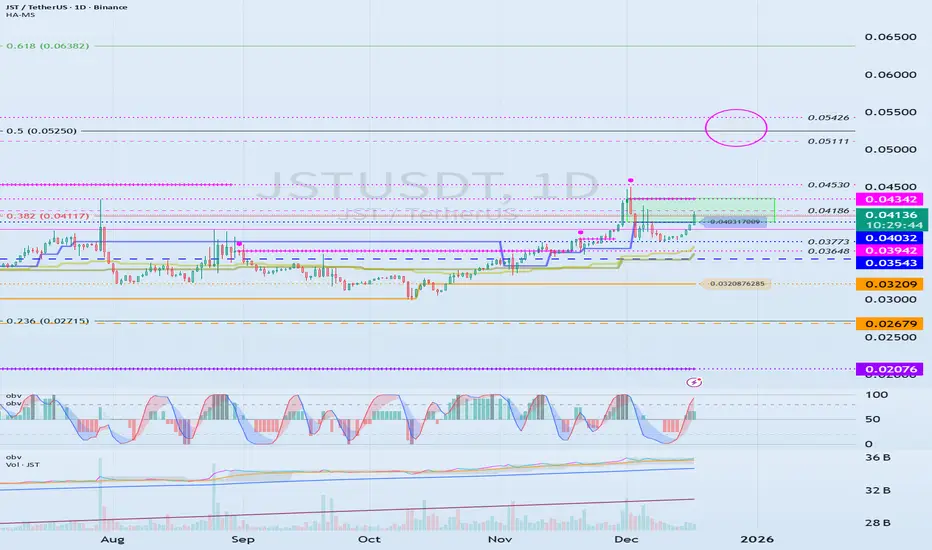
The key is whether the price can break above the 0.04032-0.04342
Hello, traders!
Follow us to get the latest information quickly.
Have a great day.
-------------------------------------
(JSTUSDT 1M chart)
If the price holds above 0.03942, a full-scale uptrend is expected to begin.
-
(1W chart)
If the price rises with support near 0.03942, an upward breakout near 0.05111 is likely to initiate an uptrend.
If the price fails to rise and falls,
1st: 0.03543
2nd: 0.02679
We should check for support near the 1st and 2nd levels above.
-
(1D chart)
The HA-High ~ DOM(60) range is formed between 0.04032 and 0.04342.
Therefore, a breakout above 0.04032 and 0.04342 is necessary for a stepwise uptrend to occur.
The first resistance level of the step-up trend is expected to be around 0.05111-0.05426.
Since the M-Signal indicator on the 1M chart is passing around 0.03543, if it falls below 0.03543, it's advisable to halt trading and assess the situation.
To break above a key point or range and continue the uptrend, the StochRSI, TC, and OBV indicators must show upward trends.
If possible,
- The StochRSI indicator should not enter the overbought zone.
- The TC indicator should remain above zero.
- The OBV indicator should remain above the High Line.
Currently, the StochRSI indicator has entered the overbought zone, which could limit the upside.
To overcome this and continue the uptrend, trading volume must increase explosively.
If not, you should look for a sideways movement and see if it tests support.
-
Thank you for reading.
I wish you successful trading.
--------------------------------------------------
Check for support near 159.51-161.01
Hello, fellow traders!
Follow me to get the latest information quickly.
Have a great day.
-------------------------------------
(LRCX 1D Chart)
If LRCX finds support near the 159.51-161.01 level and rises, it is expected to rise to around the Fibonacci level of 2.618 (197.94).
Since the current price level is within the previous high range, it should maintain the price above the 159.51-161.01 level if possible.
If not, a normal downtrend is likely.
At this point,
1st: M-Signal on the 1W chart (around 134.21)
2nd: M-Signal on the 1M chart (around 113.0)
There is a possibility of a decline to the 1st and 2nd levels above, so we need to consider a response plan.
A normal downtrend should be considered a profit-taking period.
This means it's likely difficult to determine the right time to buy again.
However, we can use various methods to mark support and resistance points and determine the right time to trade by checking for support.
Even so, it's difficult to easily buy during a normal downtrend.
It's best to consider the right time to buy when support is found around the DOM (-60) to HA-Low range and then determine the right time to trade.
Currently, the HA-Low indicator is at 65.49, so if it falls below 159.51 and continues to decline, the HA-Low indicator is likely to form.
If the HA-Low indicator forms, a new wave will form, so it's important to check for support at that time.
-
Thank you for reading.
We wish you successful trading.
--------------------------------------------------
The key is whether it can find support near 456.84 and rise
Hello, traders. Nice to meet you.
If you "Follow" me, you'll always get the latest information quickly.
Have a great day.
-------------------------------------
(VRTX 1M Chart)
The key is whether it can rise above 456.84-495.89.
If the price succeeds in rising,
1st: Right Fibonacci level 1.618 (552.93)
2nd: Right Fibonacci level 1.902 (619.03) ~ 2 (641.84)
3rd: Right Fibonacci level 2.618 (785.67)
We need to check for support near the above levels.
If the price fails to rise,
1st: 316.40
2nd: 236.34
There is a possibility of a decline near the first and second levels above.
At this time, it's important to check for the formation of the DOM (-60) or HA-Low indicator.
If the price falls below the M-Signal indicator on the 1M chart and remains there, there's a possibility of a downtrend, so we need to consider a response plan.
However, if the price declines to around 236.34-316.40, it could be a buying opportunity depending on the level of support, so you should also consider a response plan.
-
(1D chart)
The boxed areas represent important support and resistance zones.
Among them, the 456.84-495.89, 483.06-491.57, and 426.27-440.81 zones represent resistance zones.
For an upward breakout of these resistance zones and a sustained uptrend, the following conditions must be met:
1. The StochRSI indicator must be trending upward. Ideally, it should not have entered the overbought zone.
2. The TC indicator must be trending upward. Ideally, it should remain above zero. 3. The OBV indicator should show an upward trend. If possible, it should remain above the High Line.
With the above conditions met, we need to see if it can rise above and sustain the final resistance level of 495.89.
To achieve this, we expect to see up and down swings.
If it falls below the lowest resistance level of 426.27-440.81, it is highly likely to fall to the support level of 373.65-385.83.
At this point, a drop below 426.27 could lead to a step-down trend, so we need to consider how to respond.
However, if support is found, it's time to buy, so we need to consider how to proceed with partial purchases.
The reason for this concern is that if the price rises from the 373.65-385.83 range, it will touch the 426.27-440.81 range, then fall and touch the 373.65-385.83 range again.
In other words, if the price rises after receiving support from a support area, then forms a resistance area, then falls and touches the support area again, the likelihood of further declines is higher.
Therefore, you should consider how to execute a partial purchase when a stepwise downtrend is observed.
-
In any case, if the price rises after receiving support from around 456.84, the resistance area will be around 483.06-495.89.
If it breaks above, the stepwise uptrend is likely to continue.
-
Thank you for reading to the end.
I wish you successful trading.
--------------------------------------------------
The key is whether it can rise above 0.2851
Hello, fellow traders!
Follow us to get the latest information quickly.
Have a great day.
-------------------------------------
(TRXUSDT 1M Chart)
From a long-term perspective, the price needs to remain above 0.18-0.2011 to continue the uptrend.
If it encounters resistance at 0.2851 and declines, we should check for support near the M-Signal indicator on the 1M chart.
If further declines occur, support around 0.18-0.2011 will be crucial.
-
(1W chart)
Looking at the 1W chart, we should examine whether it finds support near 0.2548-0.2851 and can rise.
If it finds support near 0.2548-0.2851 and rises, the key question is whether it can break above the 0.3379-0.3614 range.
-
(1D chart)
Therefore,
1st: 0.2548-0.2851
2nd: 0.18-0.2011
When support is found near the 1st and 2nd levels above, it indicates a period of partial buying.
It is falling below the HA-Low indicator, showing a stepwise downward trend.
Therefore, you should consider either waiting for the stepwise downward trend to stop or increasing the number of coins (tokens) that can be profited through day trading.
-
Thank you for reading to the end.
I wish you successful trading.
--------------------------------------------------
Start of a full-blown uptrend: 2.0-2.1446
Hello, traders!
Follow us to get the latest information quickly.
Have a great day!
-------------------------------------
(SUIUSDT 1M chart)
To continue the uptrend, the price must rise above the M-Signal indicator on the 1M chart and hold.
Accordingly, the key question is whether the price can rise above the 2.0-2.1446 range and maintain its upward momentum.
If the upward movement fails, we should observe whether the M-Signal indicator on the 1M chart moves sideways until it declines near the Fibonacci level of 0.236 (1.3434).
-
(1W chart)
The key question is whether the price can find support and rise near the newly forming DOM (-60) ~ HA-Low range (1.4969-1.8396).
Based on the basic trading strategy, the target range is around the 4.2272-4.7328 range.
However, caution is advised when trading, as the price is currently forming below the M-Signal indicator on the 1M chart.
Therefore, I think it's best to start trading after confirming whether the price rises to around 2.0-2.1446 and maintains its strength.
-
(1D Chart)
When analyzing charts, it's best to observe the movements of the 1D chart as a basic trading strategy.
This is because most indicators are derived from the 1D chart.
In this sense, the key is whether the price can find support and rise around the 1.3451-1.5174 range, which is the DOM(-60) ~ HA-Low range on the 1D chart.
As mentioned earlier, to sustain the uptrend from a long-term perspective, the price must remain above the M-Signal indicator on the 1M chart. Therefore, the current price level is not suitable for trading.
A decline in the DOM(-60) ~ HA-Low range could lead to a step-down trend.
This means that the price is renewing its low, but it can also be considered a time for a split buy.
Therefore, you should consider how to execute a split buy before starting a trade.
If the price rises from the DOM(-60) to HA-Low range, the HA-High to DOM(60) range will form.
Therefore, if you bought near the DOM(-60) to HA-Low range, you should sell near the HA-High to DOM(60) range.
However, if the price rises from the HA-High to DOM(60) range, it's likely to form a step-up trend, so it's recommended to sell in steps.
As mentioned earlier, a step-up trend, like a step-down trend, means that the price is renewing its high.
Therefore, since a sharp decline is possible at any time, it's advisable to sell in steps at the appropriate time to secure profits.
-
In summary, if you encounter the DOM(-60) or HA-Low indicators, you should focus on finding the right time to buy and consider how to execute the split purchase.
Furthermore, if you encounter the DOM(60) or HA-High indicators, you should focus on finding the right time to sell and consider how to execute the split purchase.
This is the basic trading strategy.
If not, and you buy when the HA-High ~ DOM(60) range supports and rises, or sell when the DOM(-60) ~ HA-Low range resists and falls, it's best to maintain your stop loss.
-
Thank you for reading to the end.
I wish you successful trading.
--------------------------------------------------
See if it can rally after holding support at 0.2558-0.2672
Hello, fellow traders!
Follow us to get the latest updates quickly.
Have a great day!
-------------------------------------
(BATUSDT 1M Chart)
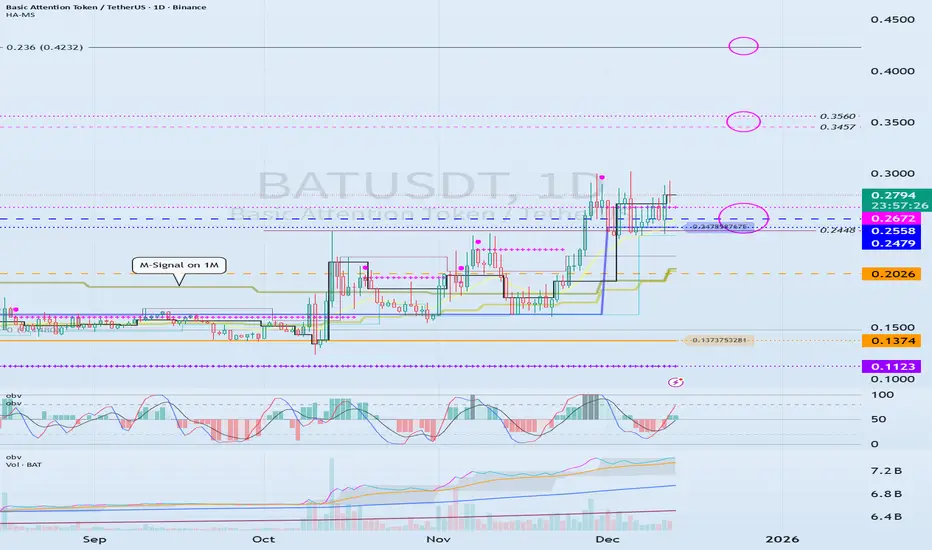
After a significant decline, the price is forming a close above the M-Signal indicator on the 1M chart.
Accordingly, if the price remains above the M-Signal indicator on the 1M chart, the long-term uptrend is expected to continue.
Since the StochRSI 80 indicator is forming at 0.2448, we should examine whether it finds support near this level and can rise.
A full-scale uptrend is likely to begin when it rises above the Fibonacci level of 0.236 (0.4232).
If a full-scale uptrend begins, the target point is around 0.8357.
-
(1D chart)
Therefore, the key question is whether it can find support near the 0.2479-0.2672 range and rise above 0.3457-0.3560.
If it declines, we should examine whether support is found near the M-Signal indicator on the 1M chart.
Therefore, support around 0.2026 is crucial.
-
Thank you for reading to the end.
I wish you successful trading.
--------------------------------------------------
Strong Support and Resistance Area: 533.90-793.86
Hello, fellow traders!
Follow us to get the latest information quickly.
Have a great day!
-------------------------------------
(BNBUSDT 1D Chart)
The 533.90-793.86 area is a strong support and resistance area. A decline below this area is highly likely to trigger a long-term downtrend.
Therefore, if support is found around the 533.90-793.86 range, it would be a buying opportunity.
Since the HA-Low indicator formed at 871.15, if support is found around the 833.78-871.15 range, this would also be a buying opportunity.
Resistance levels are:
1st: 1028.57-1088.90
2nd: 1220.98-1302.65
The first and second levels above are resistance levels.
-
If the price holds above 793.86, it is expected to rise to around the circled range shown on the chart above.
BNB should be traded differently from BTC or ETH.
In other words, while you can continue to invest in BTC and ETH to purchase them, you should hold altcoins like BNB, XRP, and SOL by increasing the number of coins that represent profits.
Therefore, if the price rises after purchasing, you should sell the original purchase amount, leaving only the number of coins that represent profits.
This is because in a bear market, the price drops more sharply than expected.
BTC and ETH also show significant declines during bear markets, similar to altcoins. However, they tend to rebound faster than altcoins, allowing for continued investment and purchase.
However, to stabilize your psychological state, it's important to take some profits while you're in profit.
-
Thank you for reading to the end.
I wish you successful trading.
--------------------------------------------------
Check if the price remains above 2887.66
Hello, fellow traders.
If you "Follow" me, you'll always receive the latest information quickly.
Have a great day.
-------------------------------------
(ETHUSDT 1D Chart)
The HA-Low indicator on the 1D chart is showing signs of forming at 2887.66.
Since the HA-Low indicator previously formed at 3472.96 and is showing signs of forming again, determining whether support at 2887.66 is crucial.
Furthermore, since the indicator is located near the M-Signal indicator on the 1M chart, we need to see if the price can maintain its upward momentum above the M-Signal indicator on the 1M chart.
In this sense, a rise above the previous HA-Low indicator level of 3472.96 is expected to trigger an uptrend.
Therefore, to ensure that the uptrend continues after breaking above a key point or range, we need to monitor whether the StochRSI, TC, and OBV indicators remain in an upward trend.
Since the OBV indicator has fallen below the EMA 3, it must rise above and remain above the EMA 3 level.
We need to confirm whether the price can rise above the M-Signal indicator on the 1M chart after passing through this volatility period around November 27th (November 26th-28th).
-
Thank you for reading.
We wish you successful trading.
--------------------------------------------------
Silver at Extremes: RSI Signals Haven’t Missed in 20 YearsTVC:SILVER has delivered a massive breakout — up +109.9% YTD — but the weekly RSI is now pushing into one of the most extreme zones seen in two decades. Historically, every major spike into the 80–85 RSI band has preceded cooling periods, consolidations, or full reversals.
The chart makes the pattern clear:
• Each parabolic advance since 2004 ended with RSI extremes similar to today.
• Price is testing the same overextension zone seen at the 2011 blow-off top and the 2020 surge.
• Weekly RSI rarely stays above 80 for long — momentum tends to reset before the next leg can form.
This doesn’t guarantee a top.
But when a commodity doubles in a single year and hits long-term RSI ceilings simultaneously, risk/reward becomes asymmetric.
Silver’s trend remains powerful — the question now is how sustainable the slope is.
December 8 - December 12 2025: Disappointment ImminentThe market has not changed too much since last week, where my assessment that the market was in a neutral state turned out to be mostly accurate. I’m continuing to refine my analysis so I have changed some things heading into this week which should help provide even clearer signals. With the rate decision in focus, it will be important to consider the implications that a cut (which I am biased towards) vs unchanged rates will have on these indicators, as it will likely make the difference between the market continuing its bullish trend to end the year or if equities will continue to feel pressure from high interest rates and a slowing economy.
1. Macro
Here we are seeing low demand for treasuries TVC:US10 and the dollar TVC:DXY while bond and equity put hedging has been unwinding. I think the current state of the market provides a clear signal of why the Fed needs to cut interest rates this month - dumping bonds while growth stagnates will make real yields surge and could cause the market to retreat from US assets altogether, which would be a worst-case scenario. I think the Fed has no choice but to keep cutting rates in order to keep yields down. Since the breakeven rate FRED:T5YIE was rising at the end of last week, a drop in the nominal yield TVC:US05Y now would send the real yield to lower lows.
2. FX
Since the dollar can service as a funding or carry currency, I am comparing US rates to “carry” countries and the dollar index to other carry currencies in order to determine whether investors in this yield-seeking regime would be interested in dollars. Here you can see that compared to yields in Great Britain, Canada, New Zealand, and Australia (not shown), US yields are underperforming, and as a result, the dollar is weakening against the respective currency indices TVC:AXY , TVC:CXY , TVC:ZXY
This is my new indicator that normalizes carry country yields (GB, CA, SE, NZ, AU) vs safe haven yields (JP, CH, EU, & US), shown on the dashed line, and respective currency pairs on the dotted line in order to detect the risk regime. Here we are seeing that carry yields are elevated and the market is still chasing after them compared to rushing to funding currencies for yield or safety.
Here is a comparison of funding countries. My expectation for this week is that
1. The market will still be seeking yield (risk-on)
2. If US yields & USD fall, it will lift carry trades vs USD (such as FX_IDC:CADUSD & OANDA:AUDUSD )
3. Risk-on regime continues, which will boost US equities
Of course, the opposite will play out if the Fed keeps rates high, however they need to keep foreign investors buying US debt in order to sustain our unsustainable debt for a little while longer. Leaving rates unchanged will spook investors about the trajectory of monetary policy and lead to higher yields. This is why I am quite confident we will see a rate cut and am explaining this scenario in more detail.
3. Risk
Credit fear continues to ease, while risk-on tech bets AMEX:XLK recover against safety in consumer staples AMEX:XLP
4. Equity Comparison
Tech is still battered compared to other sectors. A sign of tension will emerge if tech continues to underperform the market while the Fed is signaling continued monetary easing. This would point to a true change in sentiment in which the market may be bearish on Tech. If this were to happen, a major market correction could be on the horizon.
5. Bias
I’ve changed a few things on this layout and moved the CVD indicators to my QQQ chart since they react better to regular market hours order flow. Here I have a Z-score indicator of CME_MINI:ES1! - CBOE:VX1! which shows that the equity regime for September so far is bullish. ADL is flattening out but is not giving a useful signal yet. I also changed the linear Historical Volatility indicator to a Z-score oscillator which shows HV is declining and moving back to its floor, which can also be seen on VIX. Since we are guaranteed to see a major volatility spike after the rate announcement, I think VIX may be choppy until then.
What’s worth noting is that with HV (non-directional) at its floor (sensitive to any Vol spikes) and VIX back to its floor ahead of the rate announcement, this signals to me that equities may have more sensitivity to a downside movement.
+-+-+-+-+-+-+-+-+-+-+-+-+-+-+-+-+-+-+-+-+-+-+-+-+-+-+-+-+-+-+-+-+-+-+-+-+
When viewed together, I think all of this sends an interesting message that points to divergence between Macro/FX and US equities. With the Fed cutting rates into slower growth and Tech underperforming, low HV/VIX makes equities vulnerable to a reduction in risk exposure. I think this is what we will see if rates are cut under the current regime.
1. Yields will fall, but TVC:DXY may hold steady if there is equity pressure in the US.
2. Risk-on yield-seeking trades in FX will continue. Dollar may hold up against other funding currencies but will fall against higher-yielding currencies
3. Tech will underperform
4. VIX catching a bid will correspond with US indices falling
5. Since global environment will still be risk-on, volatility will be limited to the US and may be less intense
As always, the reason I post my analysis is to provide a reference point as the week unfolds, and to backtest my strategies for improvement. For now, my bias is low volatility until FOMC (likely sideways or upside drift) followed by downside later in the week.
Check if it can rise above 422.80
Hello? Hello, traders.
If you "Follow" us, you'll always get the latest information quickly.
Have a great day.
-------------------------------------
(ZECUSDT 1D Chart)
After a sharp rise, the price is showing a sharp decline.
The key to a bullish turn is whether the price can rise above 422.80 and hold.
If the uptrend fails, we need to check for support around 216.60.
If it falls below 216.60, it's likely to take time to rise again.
Although the price is showing a short-term downtrend, falling below the M-Signal indicator on the 1D chart, it should be considered an ongoing uptrend because the M-Signal indicator on the 1D chart > M-Signal on the 1W chart > M-Signal on the 1M chart is arranged in this order.
Therefore, if the M-Signal indicator on the 1W chart declines, consider whether it can find support near the M-Signal indicator on the 1M chart and consider a response plan.
Therefore, the movement when the price falls to around 216.60 is crucial.
There is a possibility that the price will rise above the OBV High indicator, sustaining the price and indicating further upward movement.
However, since the OBV Low indicator is still above the OBV High indicator, a sideways movement seems likely.
-
Thank you for reading to the end.
We wish you successful trading.
--------------------------------------------------
The key is whether it can break above 588.5-616.2
Hello, traders!
Follow us to get the latest information quickly.
Have a great day.
-------------------------------------
(BCHUSDT 1D chart)
The 1D chart is rising towards the HA-High ~ DOM (60) range, raising expectations for a bullish trend.
Accordingly, the key question is whether the 588.5-616.2 range can be supported and the price can rise.
If it rises, we should examine whether it can break above the 678.7-719.5 range, which is the range formed by the DOM (60) indicator on the 1M chart and the previous high.
To continue the uptrend by breaking above key points or ranges, the StochRSI, TC, and OBV indicators must show upward trends.
If possible,
- The StochRSI indicator should not have entered an overbought zone.
- The TC indicator should remain above zero.
- The OBV indicator should remain above the High Line.
Therefore, we should examine the movements of the StochRSI, TC, and OBV indicators when the price rises above the DOM (60) indicator.
If the StochRSI falls below 80, it's considered a stop loss, as further declines are likely.
-
Thank you for reading.
We wish you successful trading.
--------------------------------------------------
SPX : Potential Zweig Breadth ThrustThe Breadth Thrust Indicator is a technical indicator that looks at how many stocks advance vs. decline over 10 days.
When it snaps from around 0.40 to above about 0.615 in 10 trading days or less, that’s called a Zweig Breadth Thrust and has historically lined up with strong bull runs more often than not.
Historically it doesn’t happen often, but when it does, forward returns over the next several months have usually been positive, which is why traders get excited when the line on your chart surges like this.
Historically, once a full thrust has triggered, the index has often been higher 6–12 months later in the majority of cases.
Hindenburg Omen Is Flashing AgainThe Hindenburg Omen has triggered, and it’s lining up with what the market breadth data has been whispering for months. If you look at the bottom pane, you’ll see the percentage of stocks above their major moving averages has been sliding for about six months.
So even though the index has kept pushing to new highs, fewer stocks are moving with it. A small group of mega-caps is doing all the heavy lifting, while the broader market slowly weakens underneath.
Historically, that’s exactly the kind of environment where the Hindenburg Omen becomes relevant. It doesn’t promise a crash, but it flags when internal conditions have deteriorated enough to allow one. Several past signals have occurred before meaningful corrections.
Why This Matters Now
The next couple of weeks are important. CPI, PPI and labour data between now and 10 December will shape expectations heading into the FOMC meeting. If the Fed changes tone on monetary policy, liquidity, or the path of rates, it will feed directly into sector rotation and capital flows.
That’s why I’m not committing to any major trades right now. The signals are mixed, breadth is weakening, leadership is narrow and policy risk is rising. Capital preservation comes first until we get a clear direction from the data and the Fed.
Sometimes the smartest move is patience. Let the data confirm the story. The market isn’t going anywhere.


