Is Europe's Industrial Crown Jewel Being Quietly Dismantled?Volkswagen Group, once the symbol of German engineering dominance and post-war European recovery, is experiencing what can only be described as a structural dismantling rather than a cyclical downturn. The company faces a perfect storm of challenges: geopolitical vulnerability exposed by the Nexperia semiconductor crisis, where China demonstrated escalation of dominance over critical supply chains, catastrophic labor cost disadvantages ($3,307 per vehicle in Germany versus $597 in China), and a complete failure of its CARIAD software division that consumed €12 billion with little to show for it. The result is unprecedented: 35,000 German job cuts by 2030, the first factory closures in 87 years, and Golf production moving to Mexico.
The technological surrender is perhaps most revealing. VW is investing $5.8 billion in American startup Rivian and $700 million in Chinese EV maker XPeng—not as strategic partnerships, but as desperate attempts to acquire the software and platform capabilities it failed to develop internally. The company that once provided technology to Chinese joint ventures now buys entire vehicle platforms from a Chinese startup founded in 2014. Meanwhile, its profit engine has collapsed: Porsche's operating profit plummeted 99% to just €40 million in Q3 2024, while VW's China market share eroded from 17% to under 13%, with only 4% share in the critical EV segment.
This isn't just corporate restructuring—it's a fundamental transfer of power. VW's "In China, For China" strategy, which moves 3,000 engineers to Hefei and creates a separate technological ecosystem under Chinese jurisdiction, effectively places the company's intellectual property and future development under the control of a systemic rival. The patent analysis confirms the shift: while BYD has built a moat of 51,000 patents focused on battery and EV technology, much of VW's portfolio protects legacy internal combustion engines—stranded assets in an electric future. What we're witnessing is not Germany adapting to competition, but Europe losing control of its most important manufacturing sector, with the engineering and innovation increasingly done by Chinese hands, on Chinese soil, under Chinese rules.
China!
China50 rallies continue to attract sellers.CHN50 - 24h expiry
The overnight rally has been sold into and there is scope for further bearish pressure going into this morning.
We are trading at oversold extremes.
Levels close to the 61.8% pullback level of 15226 found sellers.
15239 has been pivotal.
Bespoke resistance is located at 15250.
We look to Sell at 15215 (stop at 15335)
Our profit targets will be 14855 and 14755
Resistance: 15050 / 15212 / 15253
Support: 14978 / 14850 / 14767
Risk Disclaimer
The trade ideas beyond this page are for informational purposes only and do not constitute investment advice or a solicitation to trade. This information is provided by Signal Centre, a third-party unaffiliated with OANDA, and is intended for general circulation only. OANDA does not guarantee the accuracy of this information and assumes no responsibilities for the information provided by the third party. The information does not take into account the specific investment objectives, financial situation, or particular needs of any particular person. You should take into account your specific investment objectives, financial situation, and particular needs before making a commitment to trade, including seeking, under a separate engagement, as you deem fit.
You accept that you assume all risks in independently viewing the contents and selecting a chosen strategy.
Where the research is distributed in Singapore to a person who is not an Accredited Investor, Expert Investor or an Institutional Investor, Oanda Asia Pacific Pte Ltd (“OAP“) accepts legal responsibility for the contents of the report to such persons only to the extent required by law. Singapore customers should contact OAP at 6579 8289 for matters arising from, or in connection with, the information/research distributed.
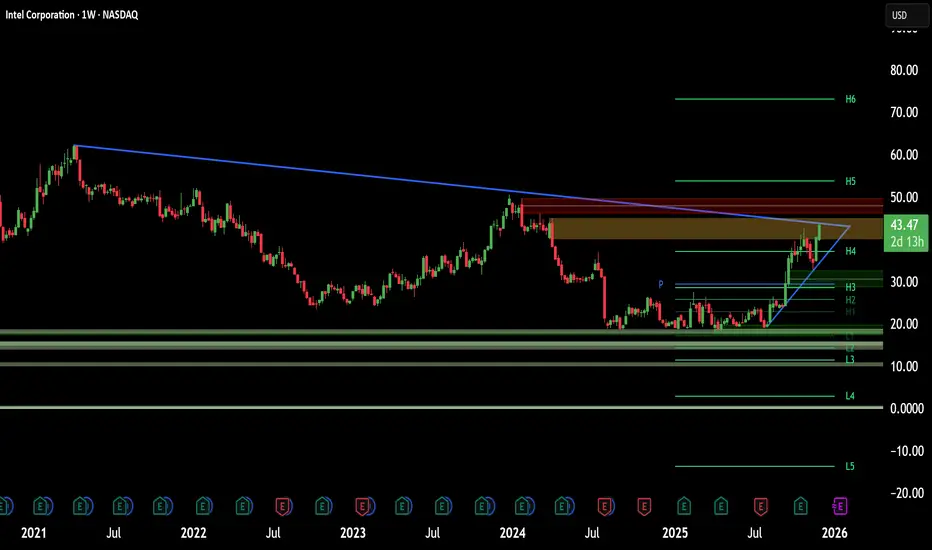
Is Intel’s Apple Deal the Ultimate Pivot?Intel (NASDAQ: INTC) stock soared over 116% this year. Reports suggest Apple may use Intel’s foundry by 2027. We analyze the drivers behind this potential resurrection.
Geopolitics & Geostrategy: The Stability Premium
In a volatile world, Intel offers a "stability premium." TSMC’s concentration in Taiwan risks Western supply chains. The US government now holds a ~10% stake in Intel. This actively incentivizes domestic production to secure the grid. Apple chooses Intel to hedge against geopolitical friction. This move aligns with US strategic interests, treating Intel as a sovereign asset.
Management & Leadership: The Tan Effect
CEO Lip-Bu Tan drives a massive cultural shift. He replaced Pat Gelsinger’s engineering vision with operational discipline. Tan prioritizes customer listening, an area where Intel historically struggled. This pivot is paying off. Securing Apple proves Intel is shedding its "arrogant" legacy. It is becoming a true service-oriented foundry.
Technology & Innovation: The 18A-P Advantage
The deal relies on Intel’s **18A-P process technology**. Apple aims to use this for entry-level M-series chips. This validates Intel's aggressive manufacturing roadmap. Additionally, the Trump administration invested $150 million in xLight. This startup develops next-gen lithography lasers to aid chipmaking. It reinforces the ecosystem surrounding Intel’s manufacturing capabilities.
Business Models: The Foundry Pivot
Intel is transforming from a product company to a hybrid foundry. Analysts estimate the Apple deal could generate ~$1 billion annually. However, the "Apple Seal of Approval" is worth far more. It signals to giants like Qualcomm that Intel is ready. It also creates leverage against TSMC’s pricing power.
Final Verdict: The Apple rumors convert Intel into a legitimate turnaround play. US geopolitical interests align with the new leadership. Validated technology suggests Intel’s worst days are likely over.
Is Boeing's Defense Bet America's New Arsenal?Boeing's recent stock appreciation stems from a fundamental strategic pivot toward defense contracts, driven by intensifying global security tensions. The company has secured major wins, including the F-47 Next Generation Air Dominance (NGAD) fighter contract worth over $20 billion and a $4.7 billion deal to supply AH-64E Apache helicopters to Poland, Egypt, and Kuwait. These contracts position Boeing as central to U.S. military modernization efforts aimed at countering China's rapid expansion of stealth fighters like the J-20, which now rivals American fifth-generation aircraft production rates.
The F-47 program represents Boeing's redemption after losing the Joint Strike Fighter competition two decades ago. Through its Phantom Works division, Boeing developed and flight-tested full-scale prototypes in secret, validating designs through digital engineering methods that dramatically accelerated development timelines. The aircraft features advanced broadband stealth technology and will serve as a command node controlling autonomous drones in combat, fundamentally changing air warfare doctrine. Meanwhile, the modernized Apache helicopter has found renewed relevance in NATO's Eastern flank defense strategy and counter-drone operations, securing production lines through 2032.
However, risks remain in execution. The KC-46 tanker program continues facing technical challenges with its Remote Vision System, now delayed until 2027. The F-47's advanced variable-cycle engines are two years behind schedule due to supply chain constraints. Industrial espionage, including cases where secrets were sold to China, threatens technological advantages. Despite these challenges, Boeing's defense portfolio provides counter-cyclical revenue streams that hedge against commercial aviation volatility, creating long-term financial stability as global rearmament enters what analysts describe as a sustained "super-cycle" driven by great power competition.
The Strategic Rise of the RenminbiAgainst a backdrop of economic headwinds, the Chinese renminbi is defying market logic. We analyze the geopolitical, strategic, and industrial drivers powering the currency’s 2025 ascent.
A Currency Defying Headwinds
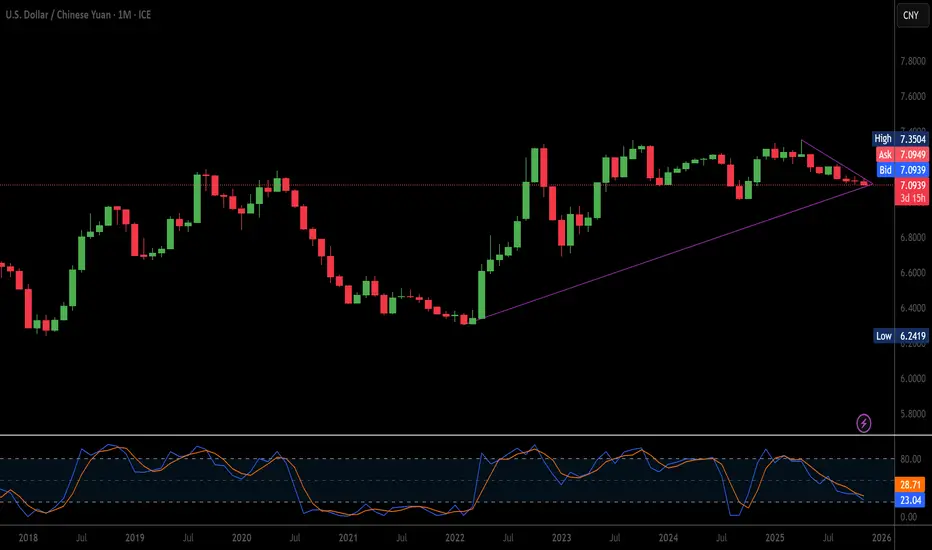
In 2025, the **USD/CNY** exchange rate has shifted significantly, with the renminbi posting a nearly 3% annual gain against the dollar. This performance stands in stark contrast to the 5% depreciation seen during the 2018 trade tensions. What makes this valuation remarkable is the severe disconnect from traditional macroeconomic fundamentals. China currently faces weak domestic consumption, record-low interest rates, and a massive $281 billion capital account deficit.
Typically, such indicators would trigger a sell-off. Yet, the currency has appreciated. This divergence points to a singular, powerful causal force: tight, strategic state management by the People’s Bank of China (PBoC). Beijing is prioritizing stability over market freedom to project economic resilience.
Geostrategy: The 15th Five-Year Plan
The controlled rise of the renminbi is not accidental; it is a calculated geostrategic move. The **15th Five-Year Plan**, released in October 2025, signals a major pivot in Beijing's approach to global finance. The document omits previous cautious language like "prudently promote," replacing it with assertive directives for currency internationalization.
Market analysts interpret this as a clear signal: currency strength is now a central policy goal. By engineering a stable rise, China aims to mirror its strategy during the 1998 Asian Financial Crisis. The goal is to establish the renminbi as a regional anchor and a reliable store of value, countering the dominance of the US dollar.
Management & Leadership: The PBoC’s Aggressive Defense
Central bank leadership has deployed a sophisticated "reference rate strategy" to guide the market. Since November 2024, the PBoC has consistently set the daily midpoint rate significantly higher than market forecasts. The average spread between the PBoC’s fix and market expectations has reached 327 basis points—an historically high gap.
This is a masterclass in market signaling. By aggressively managing expectations, leadership creates a one-sided bet that deters speculative short-selling. This proactive management forces market participants to align with state objectives rather than economic fundamentals.
Business Models: State Banks as Market Makers
China’s unique financial business model allows for direct intervention through state-owned banks. These institutions have acted as proxies for the central bank, executing discreet USD sales and CNY purchases to cap volatility. This "engineered calm" has reduced the three-month volatility of the pair to near decade-lows.
The stability has altered corporate behavior. Exporters, previously hoarding dollars, are now unwinding holdings of over $1 trillion stored in domestic banks. This creates a self-reinforcing loop: state intervention stabilizes the price, and corporate flows then validate that price, generating real demand for the renminbi.
Innovation & Industry Trends: The High-Tech Backstop
While financial engineering plays a role, the renminbi’s strength is also underpinned by China’s evolving industrial base. The decline in low-margin manufacturing is being offset by a surge in high-tech exports. Trade competitiveness remains robust despite currency appreciation.
This resilience is rooted in the country's pivot to high-value sectors like electric vehicles, green energy, and advanced machinery. Patent analysis of Chinese firms reveals a massive accumulation of IP in these domains. This technological leverage allows Chinese exporters to absorb exchange rate costs better than their low-tech predecessors, sustaining the trade surplus.
Cyber Finance & Global Adoption
The strategy is yielding tangible results in global markets. Daily trading volume in the CNY–USD pair has surged 60% to $781 billion. The renminbi now accounts for over 8% of global FX turnover.
This growth is driven by institutional investors and central banks diversifying their reserves. China is leveraging this trend by integrating the renminbi into cross-border digital payment systems. This "Cyber Finance" approach bypasses traditional SWIFT rails, further insulating the currency from geopolitical sanctions and US dollar liquidity crunches.
Conclusion: A Political Asset
The 2025 rise of the renminbi is a political project as much as an economic one. It challenges the standard "Impossible Trinity" of economics by maintaining a stable exchange rate and independent monetary policy through strict capital controls. For global investors, the message is clear: the PBoC will prioritize currency strength as a tool of soft power, regardless of domestic economic pain.
VIPS | This Chinese Retailer Will Rise High | LONGVipshop Holdings Ltd. is a holding company, which engages in the provision of online product sales and distributions services. It operates through the following segments: Vip.com, Shan Shan Outlets, and Others. The Others segment includes internet finance, offline shop, and city outlets. The company was founded by Ya Shen and Xiao Bo Hong on August 22, 2008 and is headquartered in Guangzhou, China.
Chinese stocks could hedge US tech crash Chinese stocks broke their loose correlation to US equities in 2021.
US tech stocks may or may not be in a bubble, but if they are Chinese stocks could be attractive.
The 2008 crash in the US was viewed as a major relative leap for China, because their citizens are generally savers (setting aside the reasons for those savings lol). They were able to weather the storm then and guess what, they're all padded with cash again because of the domestic deflationary storm right now.
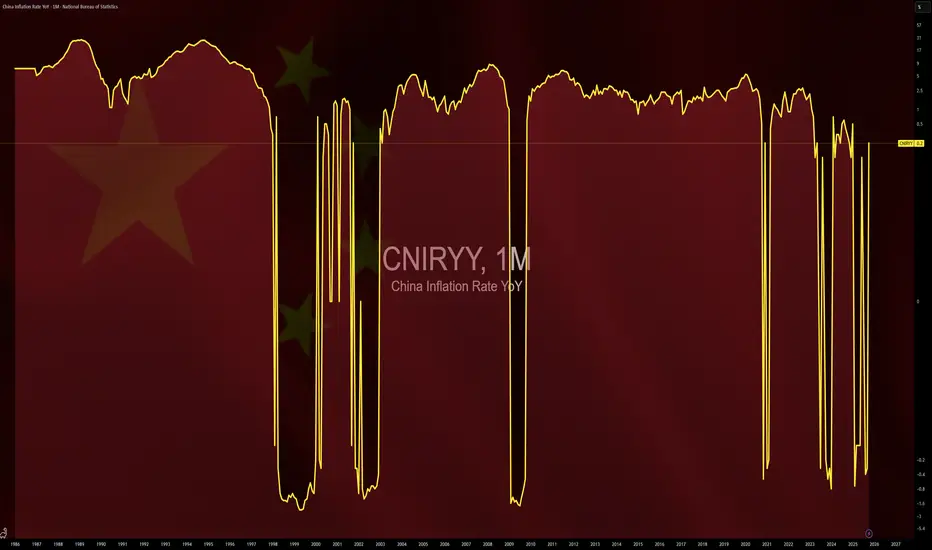
$CNIRYY -China CPI (October/2025)ECONOMICS:CNIRYY +0.2%
October/2025
source: National Bureau of Statistics of China
-China’s consumer prices rose 0.2% yoy in October 2025,
defying expectations for no change and rebounding from a 0.3% decline in the prior month.
It was the first increase in consumer inflation since June and the fastest pace since January.
Non-food inflation accelerated (0.9% vs 0.7% in September), lifted by the expansion of consumer trade-in programs and increased holiday spending during the Golden Week, both of which helped boost domestic demand.
Prices continued to grow for housing (0.1% vs 0.1%), clothing (1.7% vs 1.7%), healthcare (1.4% vs 1.1%), and education (0.9% vs 0.8%).
Meantime, transport costs fell at a slower pace (-1.5% vs -2.0%). On the food side, prices logged the smallest decline in three months (-2.9% vs -4.4%).
Core inflation, which excludes food and energy, rose 1.2% yoy, the highest in 20 months, after September's 1.0% growth. On a monthly basis, consumer prices also increased 0.2%, following a 0.1% gain in September, reaching the highest level in three months. source: National Bureau of Statistics of China
PDD | Temu On The Rise | LONGPDD Holdings, Inc. is a multinational commerce group that owns and operates a portfolio of businesses. The company aims to bring more businesses and people into the digital economy so that local communities and small businesses can benefit from increased productivity and new opportunities. It has built a network of sourcing, logistics, and fulfillment capabilities, that support its underlying businesses. PDD Holdings was founded by Hua Lin Cai and Zheng Huang in 2015 and is headquartered in Dublin, Ireland.
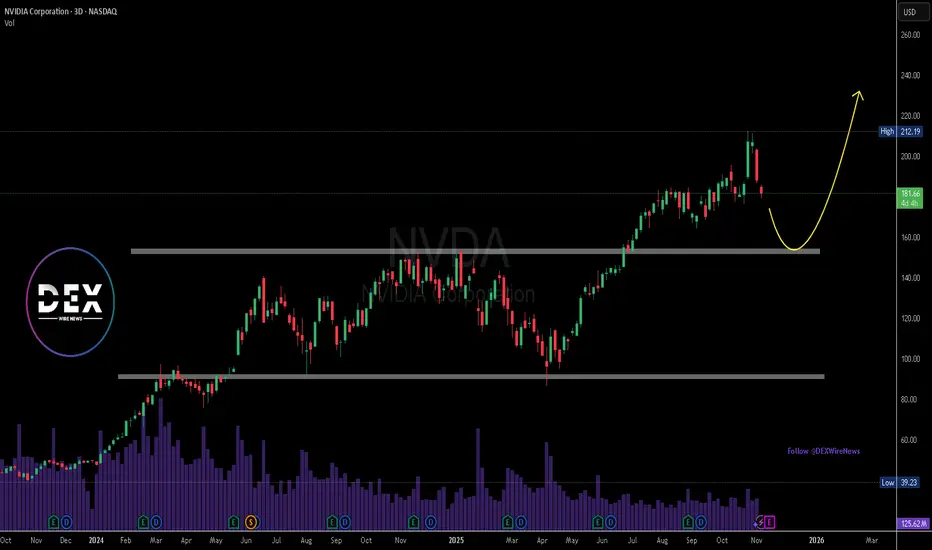
Nvidia Corp.($NVDA) Drops as U.S. Blocks AI Chip Sales to China Nvidia Corp. (Nasdaq: NASDAQ:NVDA ) shares dropped 4.18% to $180.22 on Friday after reports that Washington will block the company’s sales of scaled-down AI chips to China. The decision marks another escalation in U.S. restrictions on advanced semiconductor exports.
According to The Information, the White House informed several federal agencies that Nvidia will not be allowed to sell its new B30A AI chip to Chinese firms. Nvidia had already provided samples to some customers in China before the ban was confirmed.
The B30A was designed to meet U.S. export thresholds while retaining enough computing power for AI training when used in large clusters. However, U.S. officials reportedly concluded that the chip still poses national security risks.
Compounding Nvidia’s challenges, Beijing has issued new guidelines restricting foreign chips in state-backed data centers. Reuters reported that China will require all new projects using government funding to rely solely on domestically developed processors. Data centers less than 30% complete must remove foreign chips, while advanced projects will face case-by-case reviews.
Technical View
The NVDA chart shows a recent rejection from the $212 level, with price sliding toward $180. A further decline toward $160 support is possible before a rebound, as indicated by the yellow curve. Long-term structure remains bullish, but near-term weakness persists under regulatory pressure
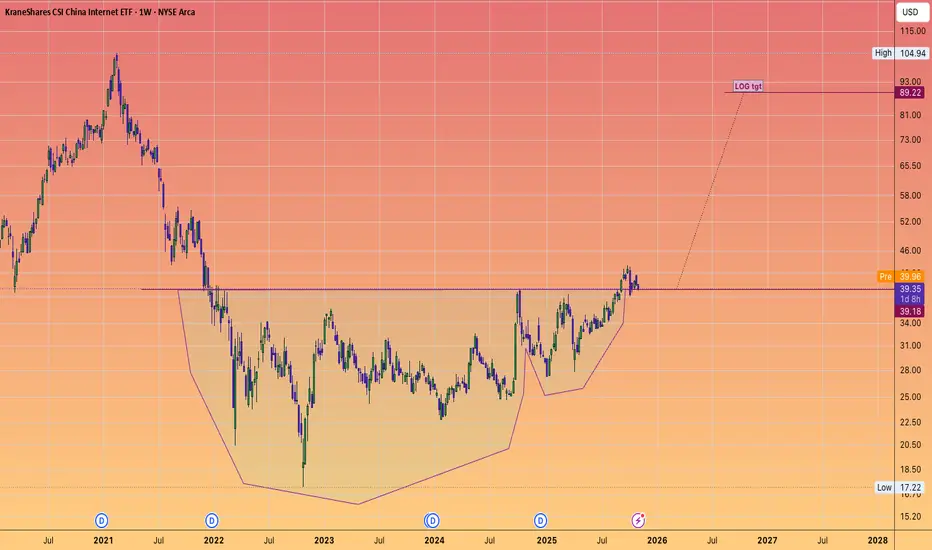
CHINA INTERNET ETF $KWEB to $90Components:
1 ALIBABA GROUP HOLDING LTD 11.02%
2 TENCENT HOLDINGS LTD 10.94%
3 PDD HOLDINGS INC 8.31% #PDD
4 BAIDU INC-CLASS A 5.07%
5 JD.COM INC-CLASS A 4.97%
6 MEITUAN-CLASS B 4.95%
7 JD HEALTH 4.60%
8 KUAISHOU TECHNOLOGY
9 TENCENT MUSI-ADR 4.24% #TME
10 KANZHUN LTD - ADR 4.03% #BZ
Clean Cup and Handle
China stocks can continue their recovery
China50 to find enough buyers at current support?CHN50 - 24h expiry
The overnight dip has been bought into and there is scope for further bullish pressure going into this morning.
15160 has been pivotal.
Previous resistance at 15200 now becomes support.
Daily signals are mildly bullish.
Our outlook is bullish.
We look to Buy at 15185 (stop at 14995)
Our profit targets will be 15755 and 15855
Resistance: 15382 / 15570 / 15774
Support: 15235 / 15080 / 14827
Risk Disclaimer
The trade ideas beyond this page are for informational purposes only and do not constitute investment advice or a solicitation to trade. This information is provided by Signal Centre, a third-party unaffiliated with OANDA, and is intended for general circulation only. OANDA does not guarantee the accuracy of this information and assumes no responsibilities for the information provided by the third party. The information does not take into account the specific investment objectives, financial situation, or particular needs of any particular person. You should take into account your specific investment objectives, financial situation, and particular needs before making a commitment to trade, including seeking, under a separate engagement, as you deem fit.
You accept that you assume all risks in independently viewing the contents and selecting a chosen strategy.
Where the research is distributed in Singapore to a person who is not an Accredited Investor, Expert Investor or an Institutional Investor, Oanda Asia Pacific Pte Ltd (“OAP“) accepts legal responsibility for the contents of the report to such persons only to the extent required by law. Singapore customers should contact OAP at 6579 8289 for matters arising from, or in connection with, the information/research distributed.
NIO | China will Lead the EV BattleNIO, Inc. is a holding company which engages in the design, manufacture, and sale of electric vehicles. Its products include the EP9 supercar and ES8 7-seater SUV. It provides users with home charging, power express valet services, and other power solutions including access to public charging, access to power mobile charging trucks, and battery swapping. It also offers other value-added services such as service package, battery payment arrangement, and vehicle financing and license plate registration. The company was founded by Bin Li and Li Hong Qin on November 28, 2014 and is headquartered in Jiading, China.
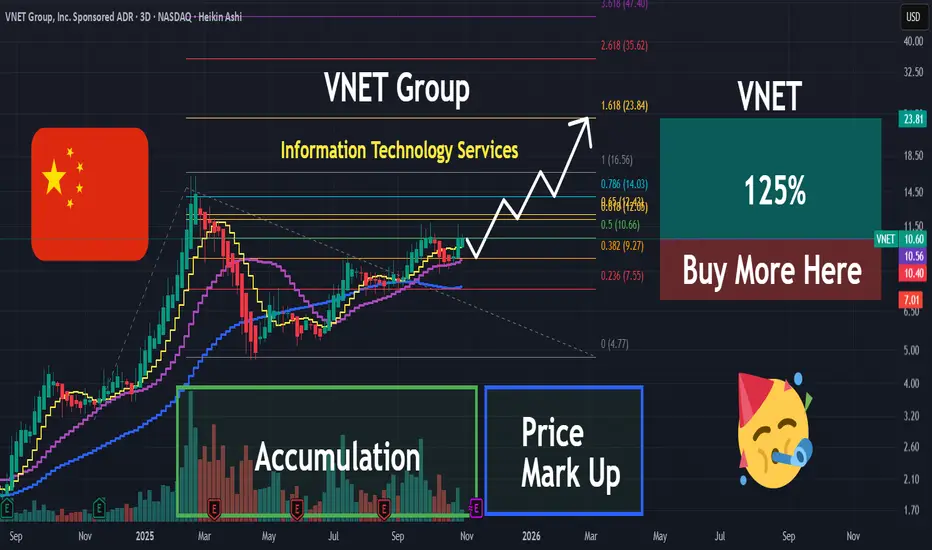
VNET | IT Services in China on the Rise | LONGVNET Group, Inc. operates as a carrier- and cloud-neutral internet data center services provider in China. It provides hosting and related services, including IDC services, cloud services, and business VPN services, to improve the reliability, security, and speed of its customers' internet infrastructure. The firm serves numerous industries, ranging from internet companies to government entities, blue-chip enterprises to small- and mid-sized enterprises. VNET Group was founded by Sheng Chen and Jun Zhang in 1999 and is headquartered in Beijing, China.
Bitcoin Daily Analysis – October 30, 2025🚀 Welcome to another Bitcoin analysis!
Yesterday, the interest rate was cut by one step, just as everyone expected — and that’s definitely a positive signal for Bitcoin. 💪💰
But why did we see a drop? 📉
The world is still anxious about the U.S.–China tariff situation, and those concerns intensified after Powell’s comments, suggesting the December rate cut isn’t guaranteed.
Right now, the market is in a fear phase 😨 — meaning both good and bad news can move prices sharply.
Stay calm and patient, and don’t let the candles scare you. 🕯️🧘♂️
Overall, conditions still favor a bullish continuation, and unless major negative news comes from the U.S. or China, we could soon start the final leg of this uptrend. 📈🔥
The $106,000–$102,000 zone is showing strong demand, making it a potential entry area — but always manage your risk and capital wisely. ⚖️
Remember: every decision in this part of the market should follow your predefined scenario — never trade emotionally or react impulsively. 🧠💼
Disclaimer:
This content is for informational purposes only and does not constitute financial or investment advice. © DIBAPRISM
Larry D.Kohn
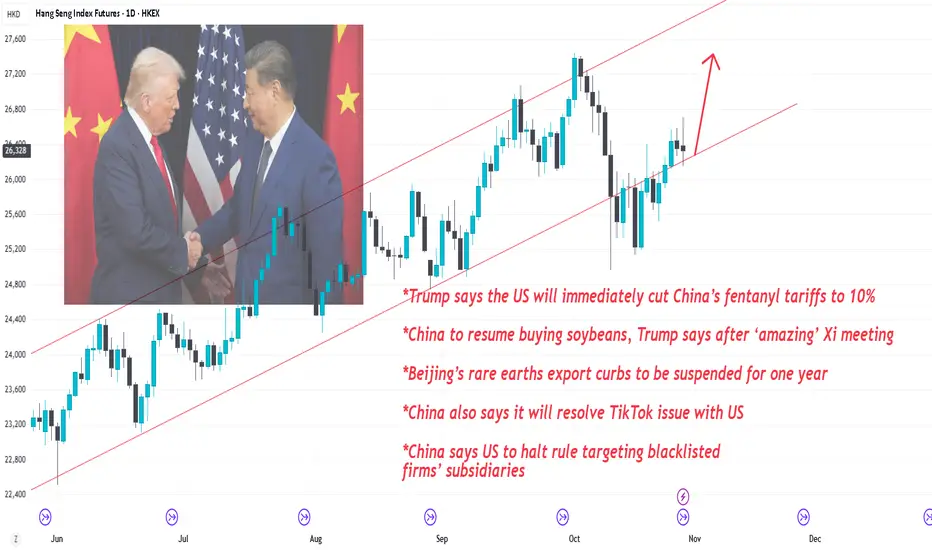
China Rally Loading? – Markets React to Trump–Xi Trade TruceAfter months of pressure, Chinese equities finally got what they needed: a visible political thaw. The Trump–Xi meeting in Busan marked the first broad trade reset in over two years — with both sides agreeing to suspend or reduce tariffs, reopen commodity flows, and relax export controls on rare earths and semiconductors.
The headline changes are not symbolic. China will halt rare-earth export curbs for one year, the U.S. cuts fentanyl-related tariffs to 10%, and both countries resume agricultural and energy trade — including soybean and oil deals. Beijing also promised to work with Washington on resolving the TikTok issue, while the U.S. temporarily suspends its “50% rule” that targeted Chinese subsidiaries of blacklisted firms.
This combination sends a clear signal: geopolitical pressure is easing, at least for now. The Hang Seng Index has already broken back above the mid-channel trend line, and momentum is building toward the upper resistance zone around 27 000. If the truce holds and follow-through buying continues, a retest of 28 000–29 000 by year-end looks possible.
From a valuation standpoint, Chinese equities remain among the most discounted major markets globally. Industrial, tech-hardware and materials companies trade at forward P/E ratios between 7–10, compared with 20+ for U.S. peers. If rare-earth exports resume and TikTok’s uncertainty is lifted, capital inflows into mainland-linked ETFs could accelerate.
The opportunity lies in the asymmetry: sentiment is still fragile, yet fundamentals are improving. A stable policy backdrop plus renewed U.S. demand for energy and agri-products could set up Chinese indices for an extended relief rally — potentially the strongest since early 2023.
Key levels to watch:
• Hang Seng Index support – 26 000
• Resistance zone – 27 500–28 000
• Break above 28 000 → trend confirmation and rotation toward Chinese cyclicals
Trade logic:
Short-term traders can target a breakout continuation within the rising channel, while longer-term investors may look at selective exposure to resource, industrial and tech-infrastructure names poised to benefit from normalized U.S.–China flows.
If this détente lasts longer than a “subscription diplomacy” cycle, China might be setting up not for a dead-cat bounce — but for the next real rotation story.
Gold facing pressure ahead of US - China meetingChina's purchase of its first US soybean cargo this year, ahead of a meeting with the US, signals expectations for a constructive dialogue and a positive outcome on the sidelines of the APEC summit.
Optimism over a potential trade breakthrough may continue to pressure gold prices.
However, the ongoing data blackout leaves the Fed cautious, heightening volatility in the near term.
XAUUSD failed to breach the EMA, but the higher swing low signaled diminishing bearish momentum. If XAUUSD holds above 3900, the price may retest the resistance at 4020.
Conversely, if XAUUSD closes above 4020, the price may retest the next resistance at 4150 and reverse the trend.
By Van Ha Trinh - Financial Market Strategist at Exness.
China Stocks — The Calm Before a New U.S.–China Trade Reset?The upcoming Trump–Xi meeting could mark a major turning point for Asian markets. While headlines focus on tariffs and semiconductors, the real leverage point lies in rare-earth metals — materials where China still dominates global supply and processing. Any sign of easing U.S. restrictions or a framework for new technology cooperation could quickly reprice Chinese industrial and resource names that have been heavily discounted since 2022.
The Hang Seng Index has quietly rebounded from its spring lows and is now testing the lower line of its rising channel. A sustained break above this zone could trigger a technical rotation back into Chinese equities — especially those tied to critical materials, power technology, and domestic AI infrastructure.
After years of capital flight and valuation compression, many Chinese mid-caps trade at fractions of Western peers despite solid earnings recovery. If the political narrative shifts from confrontation to cautious cooperation, the asymmetric upside could be significant. The market still doubts it — which is exactly what gives the move potential energy.
In short: rare-earth leverage + trade détente + ultra-low valuations = potential spark for a new China rally. Watch for follow-through after the Trump–Xi meeting and confirmation on the Hang Seng channel breakout. Comment Below if you have any Chineese stocks that you like, here are mine :)
NYSE:BABA NASDAQ:BIDU NASDAQ:JD NASDAQ:XNET NASDAQ:PDD
SPX500: Trump's trip to East Asia shakes marketsHello Traders,
This is the Daily Chart!!
We had great bullish year! A bullish channel is crystal clear! we are about to be considered as overbought buyers! But since it's stocks and the channel is broken, we are till bullish!!
And this is the chart of recent 3M,
1- the break is powerful.
2- we need a correction, technically.
3- we are about the mid-term channel.
4- top of the long-term channel could also be firsthand support, they call it SL hunt, I don't.
How China Is Quietly Taking Over Europe’s Industrial FutureThe Lack of Rare Earth Elements Pushes Europe into Major Concessions to China.
Europe’s growing shortage of rare earth elements is forcing it to make unprecedented concessions to China — so deep that analysts now warn the continent could see the collapse of entire industrial sectors within the next five to six years.
Automotive, shipbuilding, aviation, and railway manufacturing are all at risk. To stay afloat, European manufacturers — especially in Germany — are reportedly transferring valuable production know-how and proprietary technologies to Chinese partners in a desperate attempt to survive just a few more months or years.
China, meanwhile, is using this knowledge to strengthen its own technological base. The scenario is alarmingly familiar: just as China mastered and surpassed the West in electric vehicles, it is now poised to outpace Europe across nearly every remaining industrial field.
Investing in major German corporations is rapidly becoming meaningless. These companies will either shut down or be bought out entirely. The battle for industrial dominance has already been decided — China has won against Europe. What remains is the larger confrontation with the United States, a conflict that will likely unfold on Europe’s back, among the ruins of its once world-leading industries.
Gold facing pressure but still open for further surgeFollowing a recent rally, the gold price met significant profit-taking pressure. Prices reached a record high of 4381, signaling an easing of US-China trade tensions.
China confirmed trade talks with the US will occur tomorrow in Malaysia alongside the ASEAN summit. However, both sides are escalating tensions pre-talks to gain bargaining power, potentially complicating a final agreement.
Meanwhile, the prolonged US government shutdown, combined with a weakened Labor Market and a lack of data, has obscured the Labor Market's current situation. This uncertainty fueled market concern and drove investors toward safe-haven assets.
Concurrently, expectations place the US CPI at 3.1% YoY, accelerating from 2.9%. This increase raises stagflation concerns in the US economy, further supporting the gold price.
Technically, XAUUSD hovers slightly above the EMA78. Both EMAs are consolidating, signaling continued flattening momentum.
However, the long-term trend remains to the upside, suggesting investors may buy the dips amid the remaining uncertainty.
China50 to continue in the upward move?CHN50 - 24h expiry
Daily signals are bullish.
20 1day EMA is at 15033.
Intraday dips continue to attract buyers and there is no clear indication that this sequence for trading is coming to an end.
Dips continue to attract buyers.
We look for a temporary move lower.
Risk/Reward would be poor to call a buy from current levels.
We look to Buy at 15055 (stop at 14898)
Our profit targets will be 15505 and 15585
Resistance: 15339 / 15400 / 15500
Support: 15150 / 15000 / 14827
Risk Disclaimer
The trade ideas beyond this page are for informational purposes only and do not constitute investment advice or a solicitation to trade. This information is provided by Signal Centre, a third-party unaffiliated with OANDA, and is intended for general circulation only. OANDA does not guarantee the accuracy of this information and assumes no responsibilities for the information provided by the third party. The information does not take into account the specific investment objectives, financial situation, or particular needs of any particular person. You should take into account your specific investment objectives, financial situation, and particular needs before making a commitment to trade, including seeking, under a separate engagement, as you deem fit.
You accept that you assume all risks in independently viewing the contents and selecting a chosen strategy.
Where the research is distributed in Singapore to a person who is not an Accredited Investor, Expert Investor or an Institutional Investor, Oanda Asia Pacific Pte Ltd (“OAP“) accepts legal responsibility for the contents of the report to such persons only to the extent required by law. Singapore customers should contact OAP at 6579 8289 for matters arising from, or in connection with, the information/research distributed.